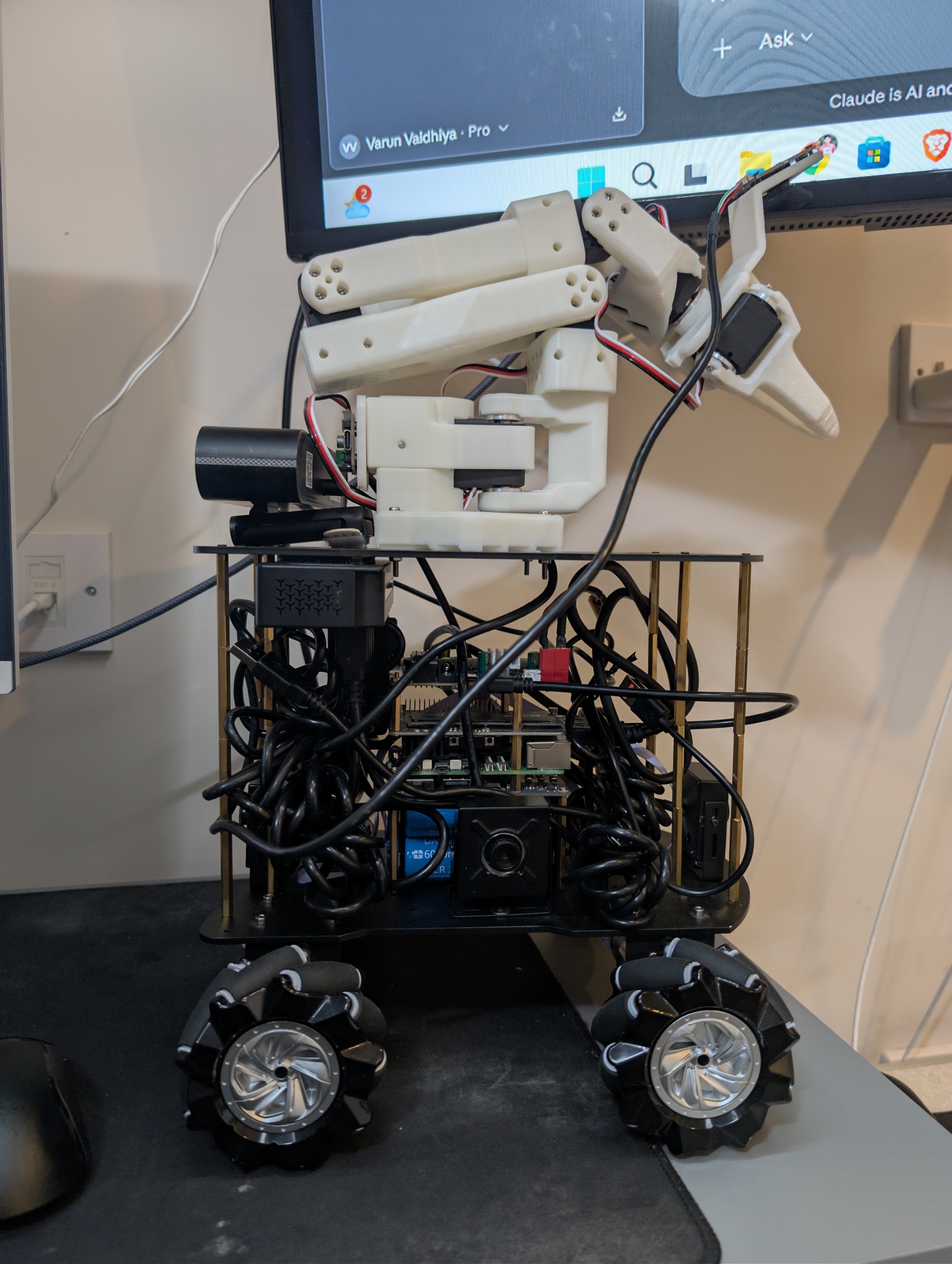
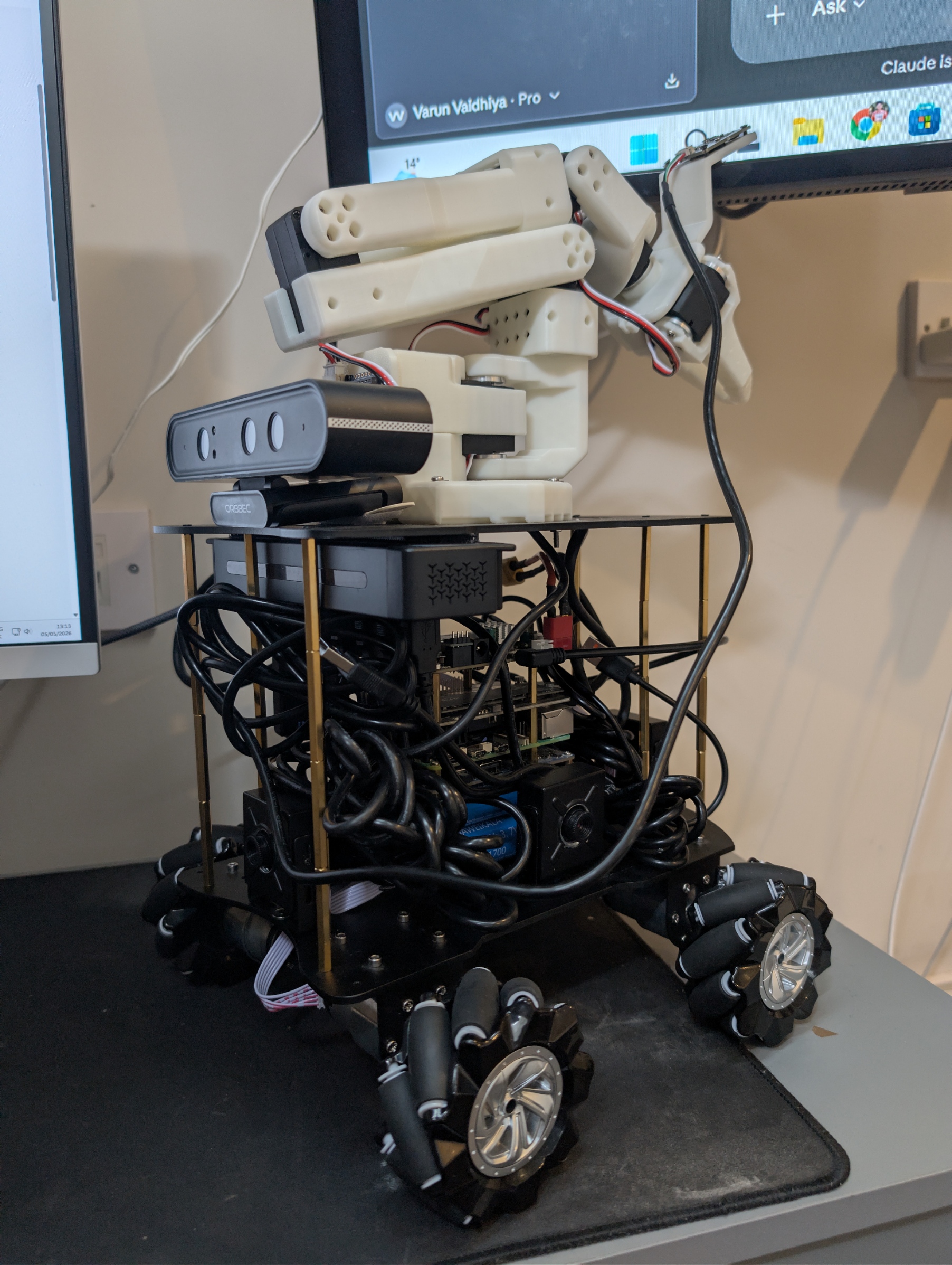
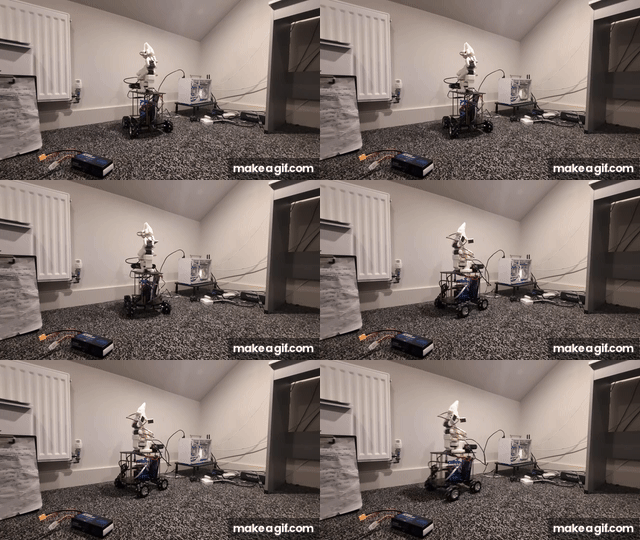
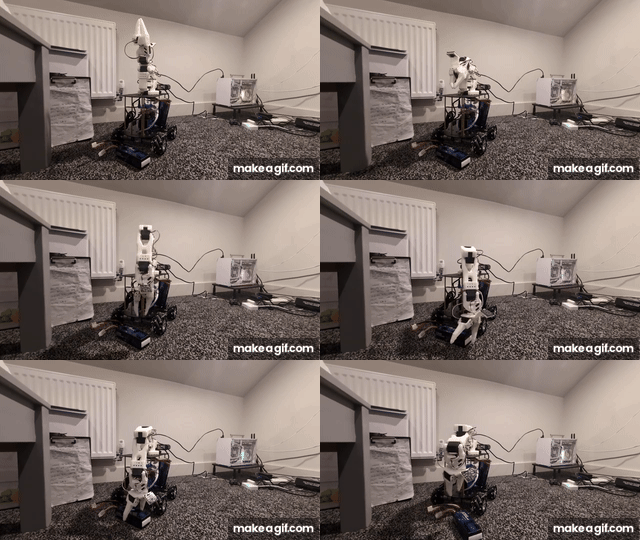
OmniBot is the open reference robot from OHHO ROBOTICS LTD: an open-source (Apache-2.0) ROS 2 Jazzy mobile manipulator (mecanum base + SO-101 arm) that you can run in simulation on a laptop in three commands, then build at home.
⭐ If OmniBot is useful or interesting to you, please star the repo: it helps other robotics people find it.
## Why OmniBot
- **Teleop from anywhere**: Xbox gamepad, Android app, Meta Quest VR (the proprietary OhhO-VR app), or the browser via rosbridge.
A model alone isn't a robot. An LLM needs an agent harness (tools, memory, guardrails) before it can do real work; a VLA or RL policy needs the same around it before it can move real motors. OmniBot is that harness, end to end, in one repo:
- **Simulation**: Gazebo Harmonic worlds, Nav2/SLAM, a CPU-only Docker sim, and Gazebo + RViz in the browser. Test a policy before it touches hardware.
- **Data**: `teleop_recorder_node` writes LeRobot datasets and is started from `omnibot_lerobot` `teleop_record.launch.py` (not the default bring-up). Default `action_source` is `leader` (Xbox gamepad and leader arm). Quest and Android teleop on `/cmd_vel/teleop` and `/arm/joint_commands/teleop` need `action_source:=vr` and the `/ohho/record/start` and `/ohho/record/stop` services. Android record buttons publish rosbag topics `/rosbag_recorder/start` and `/rosbag_recorder/stop`. Documented browser sim teleop publishes `/cmd_vel` ([docs/reference.md](docs/reference.md)); the recorder's teleop action source is `/cmd_vel/teleop`.
- **Policy runtime**: OpenVLA, SmolVLA, and RL policies drive the mecanum base and SO-101 arm over ROS 2, through one command mux per actuator.
- **Safety guards**: e-stop torque latch, joint limits and per-cycle delta clamps, stale-inference rejection, refusal on missing or black camera frames, and a source-staleness watchdog on base velocity. See [docs/safety.md](docs/safety.md).
- **Deployment**: `pip install ohho-os==1.1.2` (the last Apache-2.0 release of OhhO OS; see [Boundary with OhhO OS](#boundary-with-ohho-os)), Prometheus + Grafana observability (fleet v0: one robot today), and an opt-in OTA update agent that needs the `omnibot_ota` ROS package, which this workspace does not build.
- **Honest and tested**: README commands run in CI. CPU Python line coverage is reported in the [CI `cpu` job](.github/workflows/ci.yml) (see [docs/test-coverage.md](docs/test-coverage.md)). Anything that needs a robot or GPU is labelled as such in [docs/reference.md](docs/reference.md).
## Quickstart (no robot, no GPU)
[`ohho-os` 1.1.2](https://pypi.org/project/ohho-os/1.1.2/) is the last release of OhhO OS published under Apache-2.0. Later OhhO OS versions are proprietary and licensed separately by OHHO ROBOTICS LTD; the quickstart pins 1.1.2 so it only uses that Apache-2.0 release. The docs-test job in [`.github/workflows/ci.yml`](.github/workflows/ci.yml) runs these three commands in a fresh virtualenv via [`scripts/docs_test_readme.py`](scripts/docs_test_readme.py).
```bash
pip install ohho-os==1.1.2
ohho doctor
ohho sim --robot omnibot --seconds 2
```
## Simulation Demo in Docker (OHH-33)
OmniBot provides a self-contained, CPU-only simulation demo published to GHCR (`ghcr.io/ohho-robotics/omnibot-sim:latest`). You can run Gazebo Harmonic, Nav2 autonomous navigation, and Foxglove Studio browser visualisation without installing ROS 2 Jazzy or Gazebo on your host machine.
### Run with Docker Compose
From the repository root:
```bash
docker compose up sim
```
This brings up:
- **`sim`**: Headless Gazebo Harmonic in the apartment environment, `nav2_map_server` with the checked-in map, AMCL localization, Nav2 path planning, and autonomous navigation to the `kitchen` waypoint (`sim_navigation.launch.py autonavigate:=true`).
- **`foxglove`**: `foxglove_bridge` WebSocket service listening on `ws://localhost:8765`.
### Visualise in Foxglove Studio
1. Open [Foxglove Studio](https://app.foxglove.dev) in your browser (or use the desktop app).
2. Select **Open connection** and connect to `ws://localhost:8765`.
3. Import the checked-in layout: [`omnibot-digital-twin/configs/foxglove/omnibot_layout.json`](omnibot-digital-twin/configs/foxglove/omnibot_layout.json).
4. Watch the robot autonomously plan and drive to its destination in real time.
### Browser desktop: Gazebo GUI and RViz at http://localhost:6080
The `desktop` service runs the sim with its windows (Gazebo Harmonic client and RViz) on a virtual desktop streamed to the browser with noVNC. The host needs only Docker.
```bash
docker compose up -d desktop # then open http://localhost:6080
docker compose stop desktop
```
Launchers that wait for the page and open the browser: `./docker/omnibot-desktop.sh` (Linux, macOS), `.\docker\omnibot-desktop.ps1` or `docker\omnibot-desktop.cmd` (Windows). The page is bound to 127.0.0.1; set `OMNIBOT_PORT` for another port, `OMNIBOT_WORLD=apartment` for the apartment, `OMNIBOT_VNC_PASSWORD` for a password. Details: [`docker/README.md`](docker/README.md).
### VS Code DevContainer
Open this repository in VS Code with the Dev Containers extension installed and select **Reopen in Container** ([`.devcontainer/devcontainer.json`](.devcontainer/devcontainer.json)).
> [!NOTE]
> Acceptance check on a fresh Ubuntu machine with Docker within 10 minutes: TODO (left for Varun to verify on clean host hardware).
### GPU VR profile (RTX 5060 Ti, WSL2)
The CPU compose file above stays on llvmpipe. On a host with the NVIDIA Container Toolkit and a Blackwell driver (CUDA 12.8+ user-mode, such as an RTX 5060 Ti in WSL2), this starts the Quest camera profile. Gazebo stays headless and renders through Ogre2 EGL on the GPU. rosbridge (9090) and web_video_server (8080) are published on 127.0.0.1 only.
```bash
docker compose -f docker-compose.gpu.yml up sim-vr
```
That service runs `ros2 launch omnibot_bringup sim_vr.launch.py` with `world:=apartment`, `vr:=true`, and `gui:=false`. It uses the same image as the CPU demo; the GPU compose file turns software rendering off. Do not combine this file with `docker-compose.yml` (that starts a second simulator). CI does not push `ghcr.io/ohho-robotics/omnibot-sim:vr-`.
On that PC, `nvidia-smi` inside the container and the Gazebo real-time factor in the sim log are still to be recorded.
## Build the ROS 2 workspace
Ubuntu 24.04 with ROS 2 Jazzy already installed. The symlinks in [`src/`](src/) are the colcon workspace. The `ros` CI job runs this block on `ros:jazzy-ros-base-noble`.
```bash
sudo apt-get update
sudo apt-get install -y python3-colcon-common-extensions python3-rosdep python3-pytest python3-pip
sudo rosdep init || true
rosdep update
source /opt/ros/jazzy/setup.bash
rosdep install --from-paths src --ignore-src -y --rosdistro jazzy \
--dependency-types=build \
--dependency-types=buildtool \
--dependency-types=build_export \
--dependency-types=buildtool_export \
--dependency-types=exec \
--dependency-types=test
colcon build --symlink-install --base-paths src
source install/setup.bash
colcon test --base-paths src --event-handlers console_direct+ --return-code-on-test-failure
colcon test-result --verbose
```
Then start the Gazebo sim with `ros2 launch omnibot_bringup sim.launch.py world:=flat`. That launch also drives the SO-101 arm, including the gripper, through `arm_sim_driver` using the joint limits and safety rules in [`omnibot_arm/config/arm_params.yaml`](omnibot-ros2/omnibot_arm/config/arm_params.yaml). The Quest camera profile is `ros2 launch omnibot_bringup sim_vr.launch.py` (apartment world, headless, rosbridge and MJPEG). The teleop gate is `ros2 launch omnibot_bringup sim_teleop.launch.py`. Topic contract: [docs/vr.md](docs/vr.md). See [docs/reference.md](docs/reference.md) for worlds, bridged topics and browser teleop.
On the physical robot (docs-test skips this):
```bash
ros2 launch omnibot_bringup robot_with_joy.launch.py
ros2 launch omnibot_bringup robot_vr.launch.py
ros2 launch omnibot_bringup perception.launch.py
ros2 launch omnibot_arm arm.launch.py
ros2 launch omnibot_lerobot teleop_record.launch.py
```
The Pi and the GPU workstation use one RMW, `rmw_cyclonedds_cpp`, and a Cyclone DDS profile with static peers. Domain id, peer addresses, firewall ports, WSL2, and the checks (`ros2 doctor --report`, `ros2 node list`, `ros2 topic hz`) are in [docs/network.md](docs/network.md).
Three nodes stay off unless you opt in. Their packages are not in this repository. If the package is missing, launch logs one warning that names it and does not start the node.
| Node | Package | How to enable | What it needs |
|---|---|---|---|
| `object_perception_node` | `omnibot_perception` | `ai_perception:=true` on [`perception.launch.py`](omnibot-ros2/omnibot_bringup/launch/perception.launch.py) and [`master/omnibot_pi.launch.py`](omnibot-ros2/omnibot_bringup/launch/master/omnibot_pi.launch.py) (default `false`) | The `omnibot_perception` package installed separately. It estimates object distance and pose from the depth camera. |
| `metrics_bridge` (`ros2_prometheus_bridge`) | `omnibot_metrics` | `use_metrics:=true` on [`robot.launch.py`](omnibot-ros2/omnibot_bringup/launch/robot.launch.py) (default `false`). `metrics_port` defaults to `8888`. | The `omnibot_metrics` package installed separately. The Prometheus job `omnibot_ros2_bridge` scrapes that port only while this node is running. |
| `ota_agent` (`ota_agent_node`) | `omnibot_ota` | `use_ota:=true` on [`robot.launch.py`](omnibot-ros2/omnibot_bringup/launch/robot.launch.py) and [`hybrid_robot.launch.py`](omnibot-ros2/omnibot_hybrid/launch/hybrid_robot.launch.py) (default `false`), plus `ota_manifest_url` | The `omnibot_ota` package installed separately, and a manifest URL. |
`astra_camera` is not an apt package either. `perception.launch.py` and `omnibot_pi.launch.py` still default `depth_camera` to true, and skip that driver with one warning when the package is not installed. The Pi master launch documents `ai_perception:=false` as the default way to leave object perception off.
## MoveIt 2 for the SO-101 (OHH-395)
[`omnibot_moveit_config`](omnibot-ros2/omnibot_moveit_config/) plans the SO-101 arm and gripper through the ros2_control controllers. The mecanum base is a fixed virtual joint (`world` to `base_footprint`), so plans stay on the arm. The arm has 5 DOF. `kinematics.yaml` sets `position_only_ik` for the `arm` group, which is the Cartesian goal mode. Pilz `LIN` takes a pose and leaves the orientation tolerance loose; the tool position is the constraint that is solved. The gripper group loads KDL as well, with `position_only_ik` false, because Pilz will not plan a group that has no IK solver.
```bash
ros2 launch omnibot_moveit_config demo.launch.py
```
Mock hardware (`use_mock:=true`), `move_group`, and RViz. `rviz:=false` is the headless path used in CI. `gz:=true` uses Gazebo Harmonic and `gz_ros2_control` (`gui:=true` opens a window).
On the robot, start the bringup manager first, then MoveIt. `move_group.launch.py` uses the hardware URDF and the controller manager from `robot.launch.py`.
```bash
ros2 launch omnibot_bringup robot.launch.py
ros2 launch omnibot_moveit_config move_group.launch.py
```
The default pipeline is `ompl` and the default planner is `RRTConnect`. The Pilz pipeline is `pilz_industrial_motion_planner` with planners `PTP`, `LIN`, and `CIRC`. The RViz MotionPlanning panel lists those names. The arm controller action is `/arm_joint_trajectory_controller/follow_joint_trajectory`. The gripper controller action is `/gripper_controller/gripper_cmd` (`ParallelGripperCommand`).
```bash
python -m pytest omnibot-ros2/omnibot_moveit_config/test/test_moveit_config_files.py
```
That pytest parses the SRDF and the YAML with PyYAML. The plan-and-execute test runs in the colcon `ros` job.
## Nav2 + slam_toolbox in Gazebo (OHH-30)
Simulation only. The apartment world from `sim.launch.py` is mapped with `slam_toolbox`, the saved map is checked in, and Nav2 (DWB) drives the holonomic base to the named waypoints `kitchen`, `desk`, and `door`. Nothing here was run on the real robot.
| Piece | Where |
|---|---|
| Mapping launch (`slam_toolbox`, headless Gazebo, scripted sweep) | [`sim_mapping.launch.py`](omnibot-ros2/omnibot_navigation/launch/sim_mapping.launch.py), [`sim_map_sweep.py`](omnibot-ros2/omnibot_navigation/scripts/sim_map_sweep.py) |
| Saved map and how to regenerate it | [`maps/`](omnibot-ros2/omnibot_navigation/maps/) (`apartment.yaml`, `apartment.pgm`, `apartment.posegraph`, `apartment.data`), [`maps/README.md`](omnibot-ros2/omnibot_navigation/maps/README.md), [`generate_sim_map.sh`](omnibot-ros2/omnibot_navigation/scripts/generate_sim_map.sh) |
| Named waypoints, map frame | [`config/waypoints.yaml`](omnibot-ros2/omnibot_navigation/config/waypoints.yaml), read by [`go_to_waypoint.py`](omnibot-ros2/omnibot_navigation/scripts/go_to_waypoint.py), [`waypoint_navigator.py`](omnibot-ros2/omnibot_navigation/scripts/waypoint_navigator.py), and the scenario test |
| Nav2 on the saved map | [`sim_navigation.launch.py`](omnibot-ros2/omnibot_navigation/launch/sim_navigation.launch.py), [`config/nav2_params.yaml`](omnibot-ros2/omnibot_navigation/config/nav2_params.yaml) |
| Integration test (kitchen within 60 s from the start pose; desk and door the same way) | [`test_nav_sim_scenarios.py`](omnibot-ros2/omnibot_navigation/test/test_nav_sim_scenarios.py), [`run_nav_scenarios.sh`](omnibot-ros2/omnibot_navigation/scripts/run_nav_scenarios.sh) |
| CI: 3 scenarios, nightly and `workflow_dispatch` | [`.github/workflows/nav-sim.yml`](.github/workflows/nav-sim.yml) |
The launch files and the scenario runner need ROS 2 Jazzy and Gazebo Harmonic, so docs-test skips them.
```bash
source /opt/ros/jazzy/setup.bash
source install/setup.bash
# Map the apartment with slam_toolbox (drives a fixed sweep, saves into maps/)
omnibot-ros2/omnibot_navigation/scripts/generate_sim_map.sh
# Nav2 on the saved map, then send the robot to a named waypoint
ros2 launch omnibot_navigation sim_navigation.launch.py
ros2 run omnibot_navigation go_to_waypoint.py kitchen
# The CI scenarios: a fresh sim per run, non-zero exit if any run fails
omnibot-ros2/omnibot_navigation/scripts/run_nav_scenarios.sh kitchen desk door
```
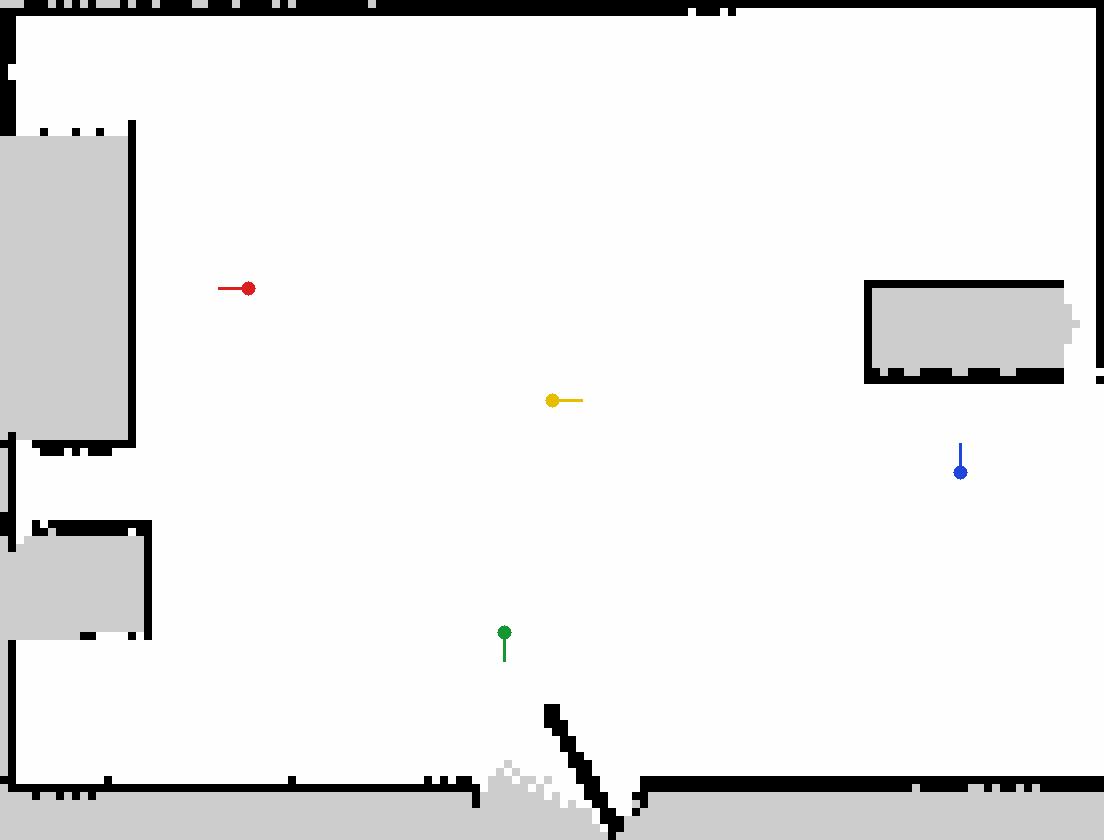
The saved map with the start pose (yellow), `kitchen` (red), `desk` (blue), and `door` (green), drawn by [`render_map_overlay.py`](omnibot-ros2/omnibot_navigation/scripts/render_map_overlay.py). Grey is unknown space (inside the furniture and outside the walls).
### Time to goal
Each run starts a fresh headless Gazebo sim with the robot at the spawn pose (0, 0, yaw 0). Time is Gazebo simulation time from goal acceptance to Nav2 `SUCCEEDED`, with a 60 s limit. A run passes only if Nav2 succeeds in time **and** the final ground-truth pose (`/odom`, exact in the planar sim) is within 0.30 m and 0.50 rad of the waypoint. Nav2's own goal checker is tighter: 0.15 m and 0.20 rad.
| Scenario | Goal (map frame) | Runs | Passed | Time to goal, min / median / max (s) |
|---|---|---|---|---|
| `kitchen` | x -1.90, y 0.70, yaw 180 deg | 5 | 5 | 15.7 / 17.0 / 17.5 |
| `desk` | x 2.55, y -0.45, yaw 90 deg | 5 | 5 | 18.8 / 20.0 / 21.6 |
| `door` | x -0.30, y -1.45, yaw -90 deg | 5 | 5 | 8.2 / 12.8 / 13.4 |
Where these numbers come from: the 15 runs in [`nav_sim_runs_local.jsonl`](omnibot-ros2/omnibot_navigation/docs/nav_sim_runs_local.jsonl) and [`nav_sim_runs_local_log.txt`](omnibot-ros2/omnibot_navigation/docs/nav_sim_runs_local_log.txt), made with `run_nav_scenarios.sh --repeat 5 kitchen desk door` in a `ros:jazzy-ros-base-noble` Docker container (Mesa software rendering, 16 CPUs, real-time factor 1.0 in every run). They are local runs, not a GitHub Actions run. The [`nav-sim`](.github/workflows/nav-sim.yml) workflow produces the same table for each CI run in its job summary and artifacts; its nightly schedule runs each scenario 5 times in a row. Times on a CI runner may differ.
### Nav2 tuning for the mecanum base
Changes to [`nav2_params.yaml`](omnibot-ros2/omnibot_navigation/config/nav2_params.yaml), each of which the file now comments:
- DWB stays. The base is holonomic and DWB samples `vx`, `vy`, and `vtheta` (`vy_samples: 10`, `min_vel_y` -0.20, `max_vel_y` 0.20). `min_y_velocity_threshold` was 0.5, above `max_vel_y`, so the controller zeroed every lateral command. It is now 0.001. [`test_nav_assets.py`](omnibot-ros2/omnibot_navigation/test/test_nav_assets.py) fails if it goes back above `max_vel_y`.
- MPPI was not needed: 15 of 15 runs reached their goal in under 23 s with DWB once the lateral threshold above was fixed, so MPPI was not tried.
- Footprint is the 0.30 x 0.28 m rectangle around the 0.265 x 0.250 m chassis instead of a 0.22 m circle.
- Velocity caps stay at 0.20 m/s and 1.0 rad/s, the Yahboom driver clamp, so sim and robot limits match.
- Fixes needed to start on Jazzy at all: `nav2_amcl::OmniMotionModel` (the old class name does not exist), `nav2_navfn_planner::NavfnPlanner` (old `/` name not found), no `plugin_lib_names` list (it re-registers built-in BT nodes and crashes `bt_navigator`), a `behavior_server` section, and `slam_toolbox` launched as a lifecycle node (it stayed `unconfigured` before) with `map_file_name: ""` (the old `omnibot_map` made it fail to load a pose graph at start).
Not covered: `drive:=mecanum` (wheel-physics) with Nav2 was tried once and the `map` frame never appeared before Nav2's startup timeout, so `sim_navigation.launch.py` uses the planar holonomic drive only. The 3-D RTAB-Map stack, real-robot SLAM/Nav2, and bags are untouched.
GPU policy stacks (OmniVLA engine / OpenVLA / SmolVLA, Isaac Lab RL) need a desktop NVIDIA GPU, not the Raspberry Pi. The OmniVLA engine Python package is `vla_engine` ([README](omnibot-ai-engines/vla_engine/README.md)); CI runs its FastAPI tests with CPU torch.
```bash
pip install -e "omnibot-ai-engines/vla_engine[serve,gpu]"
pip install -r omnibot-ai-engines/rl_engine/requirements.txt
```
## Replay a run (MCAP + Foxglove)
OmniBot records demo and telemetry runs into [MCAP](https://mcap.dev/) files via `rosbag2` with zstd compression, providing an honest 'Twin v0' replay and scrub capability without requiring proprietary simulators.
### Record a run
To record a run to MCAP:
```bash
ros2 launch omnibot_bringup record.launch.py
```
Options:
- `bag_path:=my_run`: Output directory / bag name (defaults to timestamped `rosbag2_YYYY_MM_DD-HH_mm_ss`).
- `use_sim_time:=true`: Timestamp using simulation `/clock`.
- `topics:="/tf /odom /scan ..."`: Override default topics.
Default recorded topics:
- `/tf`, `/tf_static`: Transform tree
- `/odom`: Robot odometry and twist
- `/scan`: 2D LaserScan
- `/camera/*`: Front, wrist, BEV, and depth camera streams
- `/agent/trace`, `/agent/loop_trace`: Agent loop decisions, tool calls, and verifier traces
- `/imu`, `/imu/data`: Linear acceleration and angular velocity
- `/rosout`: ROS logs
### Replay in Foxglove Studio
1. Open [Foxglove Studio](https://foxglove.dev/) (desktop app or [web app](https://app.foxglove.dev)).
2. Choose **Open local file** and select the `.mcap` file.
3. Import the checked-in layout: [`foxglove/omnibot_layout.json`](foxglove/omnibot_layout.json) (**Layout** → **Import from file...**).
4. Scrub the timeline to inspect the 3D scene (`/tf`, `/odom`, `/scan`), camera feeds, odometry/IMU plots, mission status, and agent execution trace.
Sample 30 s run MCAP: attached to GitHub releases (under 50 MB, replays directly in Foxglove Studio).
## Hardware (bill of materials)
These are the parts referenced in this repo's code and docs. Prices are not yet documented. Help fill them in via [#19](https://github.com/ohho-robotics/OmniBot/issues/19).
| Part | Qty | Where it is referenced | Approx. price |
|---|---|---|---|
| Mecanum chassis with 4 wheels (80 mm diameter, 0.215 m × 0.165 m wheel spacing) | 1 | [`mecanum-kinematics/config/mecanum_params.yaml`](mecanum-kinematics/config/mecanum_params.yaml) | TBD |
| Yahboom motor driver board (motors, wheel encoders, onboard IMU; USB serial 115200) | 1 | [`yahboom-python-driver/`](yahboom-python-driver/), [sensor guide](omnibot-ros2/omnibot_navigation/docs/SENSOR_INTEGRATION.md) | TBD |
| Raspberry Pi 5 (onboard compute) | 1 | [`omnibot_pi.launch.py`](omnibot-ros2/omnibot_bringup/launch/master/omnibot_pi.launch.py) | TBD |
| SO-101 arm (Feetech STS3215 servos) | 1 | [`omnibot-ros2/omnibot_arm/config/arm_params.yaml`](omnibot-ros2/omnibot_arm/config/arm_params.yaml), [meshes](omnibot-ros2/omnibot_description/meshes/so101/) | TBD |
| Orbbec Astra Pro RGB-D camera | 1 | [sensor guide](omnibot-ros2/omnibot_navigation/docs/SENSOR_INTEGRATION.md) | TBD |
| Wrist camera | 1 | [`perception.launch.py`](omnibot-ros2/omnibot_bringup/launch/perception.launch.py) | TBD |
| Xbox controller (teleop) | 1 | [`robot_with_joy.launch.py`](omnibot-ros2/omnibot_bringup/launch/robot_with_joy.launch.py) | TBD |
| Meta Quest 3 / 3S (optional VR teleop) | 0–1 | OhhO-VR (proprietary, not open source) | TBD |
| Desktop PC with NVIDIA GPU (optional, VLA/RL) | 0–1 | [`omnibot-ai-ros2/omnibot_vla/README.md`](omnibot-ai-ros2/omnibot_vla/README.md) | TBD |
| Battery, wiring, mounts | — | Not documented yet | TBD |
## Architecture
Full system diagram, launch graph, launch-derived topics table, and [known limitations](docs/architecture.md#known-limitations): **[docs/architecture.md](docs/architecture.md)**.
```mermaid
flowchart LR
subgraph Inputs
T["Xbox / keyboard teleop
/cmd_vel/teleop"]
A[Android app & OhhO-VR
via rosbridge]
N[Nav2 / SLAM]
V[VLA policy_node]
R[RL policy]
end
CM["/control_mode
teleop · nav2 · vla · rl_nav"]
ES["/emergency_stop"]
T --> BM[cmd_vel_mux]
A --> BM
N --> BM
V --> BM
R --> BM
V --> AM[arm_cmd_mux]
A --> AM
CM --> BM
CM --> AM
ES --> BM
ES --> AM
BM --> YB[Yahboom base driver
mecanum wheels, encoders, IMU]
AM --> AD[arm_driver_node
SO-101, limits + e-stop latch]
YB --> O["/odom, /imu/data"]
CAM[Astra Pro + wrist camera] --> LR[LeRobot recorder
datasets → training]
AD --> LR
```
Details: control-mode gating in [docs/reference.md](docs/reference.md#bring-up-control-mode), arm and policy safety in [docs/safety.md](docs/safety.md), the model adapter interface in [docs/model-adapter.md](docs/model-adapter.md), and Pi/workstation DDS in [docs/network.md](docs/network.md). October pick-and-place fill-in: [docs/october-task.md](docs/october-task.md).
## Observability (1 robot)
Prometheus, alert rules, Grafana dashboards, and Loki compose stack live in [`infra/observability/`](infra/observability/). Configs are validated headlessly; live robot verification and dated dashboard capture are a TODO for Varun on hardware. See [`infra/observability/README.md`](infra/observability/README.md).
## Roadmap
- [ ] Nav2 + slam_toolbox in Gazebo with named waypoints (in review: [#18](https://github.com/ohho-robotics/OmniBot/pull/18))
- [ ] Hardware build guide and priced BOM ([#19](https://github.com/ohho-robotics/OmniBot/issues/19))
- [ ] MuJoCo backend for `mujoco.launch.py` ([#24](https://github.com/ohho-robotics/OmniBot/issues/24)); Isaac backend after that
- [ ] SO-100 arm support ([#26](https://github.com/ohho-robotics/OmniBot/issues/26))
- [ ] WebRTC video for the Quest client (MJPEG today)
- [ ] First tagged release, v0.1.0
## VR profile tag (not yet tagged)
The Quest client lives in OhhO-VR (proprietary, not open source), not in a second Unity tree on this commit. The Gazebo VR launch (`sim_vr.launch.py`), the real-robot VR launch (`robot_vr.launch.py`), and the GPU sim compose file are on other branches. They are not in `origin/main` (`d296c9be6cc898e11e8f671c2457292b30cec905`). The intended git tag is `vr-profile-v1.0.0`. It is not yet tagged. The intended sim image name `ghcr.io/ohho-robotics/omnibot-sim:vr-1.0.0` is a placeholder and is not published. Notes and the human commands: [CHANGELOG.md](CHANGELOG.md), [docs/releases/vr-profile-tag-commands.md](docs/releases/vr-profile-tag-commands.md).
## Contributing & community
OmniBot is the open project of OHHO ROBOTICS LTD and welcomes contributions. New here? Pick a [**good first issue**](https://github.com/ohho-robotics/ohho-omnibot/issues?q=is%3Aissue+is%3Aopen+label%3A%22good+first+issue%22) or a [**help wanted**](https://github.com/ohho-robotics/ohho-omnibot/issues?q=is%3Aissue+is%3Aopen+label%3A%22help+wanted%22) issue. Questions, build photos and ideas go in [**Discussions**](https://github.com/ohho-robotics/ohho-omnibot/discussions). Read [CONTRIBUTING.md](CONTRIBUTING.md) first: every commit from an outside contributor needs a DCO sign-off (`git commit -s`). The code of conduct lives in the [org `.github` repo](https://github.com/ohho-robotics/.github).
## Boundary with OhhO OS
OmniBot stays open source under Apache-2.0. OhhO OS, the engine behind the OHHO ROBOTICS LTD commercial products, is proprietary and closed source. To keep the two cleanly separate:
- **No closed code here.** Nothing in this repository may copy, vendor, bundle, or embed source, binaries, or models from closed OhhO OS (including ohho-os after the `last-apache-2.0` tag, OhhO Planning, OhhO Fleet, and OhhO Verified).
- **Public interfaces only.** OmniBot talks to OhhO OS only through public interfaces: the documented ROS 2 topics, services, and actions listed in [docs/reference.md](docs/reference.md) and [docs/architecture.md](docs/architecture.md), and the published `ohho` CLI and API of `ohho-os` 1.1.2 (Apache-2.0).
- **No new hard dependency.** OmniBot must keep working without a licence for closed OhhO OS. Any closed OhhO OS integration stays optional and lives outside this repository.
- Code in this repository is Apache-2.0, including code moved here before the boundary was written down. Pull requests that break these rules are not merged.
Demos and updates: [YouTube](https://www.youtube.com/@varun.vaidhiya/videos) · [X @varunvaidhiya](https://x.com/varunvaidhiya).
## Layout
| Directory | What it is |
|---|---|
| [`src/`](src/) | Colcon workspace (symlinks) |
| [`omnibot-ros2/`](omnibot-ros2/) | Driver, arm, description, bringup, Nav2, and MoveIt |
| [`omnibot-ai-ros2/`](omnibot-ai-ros2/) | VLA, LeRobot, RL, and orchestration nodes |
| [`omnibot-ai-engines/`](omnibot-ai-engines/) | Learning and agent engines, plus the GPU training trees |
| [`mecanum-kinematics/`](mecanum-kinematics/) | Wheel inverse and forward kinematics |
| [`yahboom-python-driver/`](yahboom-python-driver/) | Yahboom serial protocol |
| [`ros2-bev-stitcher/`](ros2-bev-stitcher/) | Bird's-eye homography |
| [`omnibot-digital-twin/`](omnibot-digital-twin/) | Gazebo world and compose files |
| [`infra/observability/`](infra/observability/) | Prometheus, Grafana dashboards, alert rules, and Loki stack |
| [`omnibot-android/`](omnibot-android/) | Kotlin controller |
| [`omnibot-vr/`](omnibot-vr/) | Retired pointer to the Quest app (the proprietary OhhO-VR app) |
## License
[Apache-2.0](LICENSE) for OhhO code in this repository. The Quest app (OhhO-VR) and OhhO OS after `ohho-os` 1.1.2 are proprietary software of OHHO ROBOTICS LTD and are not part of this repository. See [NOTICE](NOTICE) and [Boundary with OhhO OS](#boundary-with-ohho-os).
⭐ **Star the repo** to follow progress.