
LookSee
Self-hosted video analytics with a visual workflow editor.



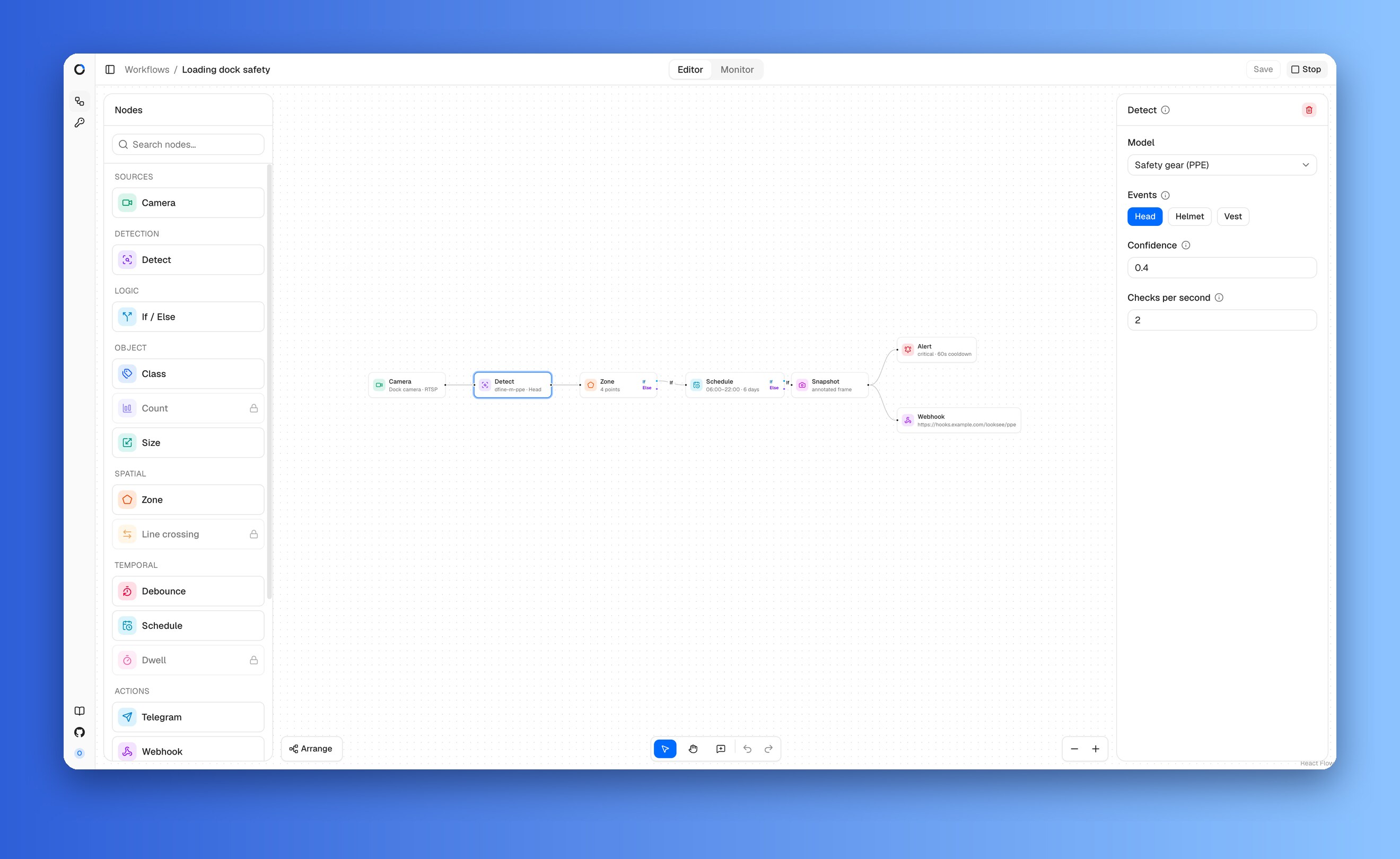
LookSee watches live streams, browser webcams, and video files, runs ONNX object detection on them, and turns what it sees into events. You describe what matters as a workflow graph: a camera, a model, filters such as a zone or a schedule, and actions such as an alert, a snapshot, or a Telegram message. Everything runs on your own hardware.
## What it does
- **Any camera.** RTSP, RTMP, SRT, and WHEP streams, browser webcams published over WebRTC, and video files looped as live streams.
- **Your models.** Drop a model bundle into `models/`; detection runs on ONNX Runtime with CPU, CUDA, or CoreML providers and ByteTrack tracking.
- **Visual workflows.** Chain detection with class, zone, size, schedule, debounce, and if/else filters, then fan out to actions.
- **Actions that reach people.** Alerts with history, annotated snapshots, webhooks, Telegram, Discord, email, and MQTT. Slack, line crossing, dwell time, and counting are part of the Enterprise edition.
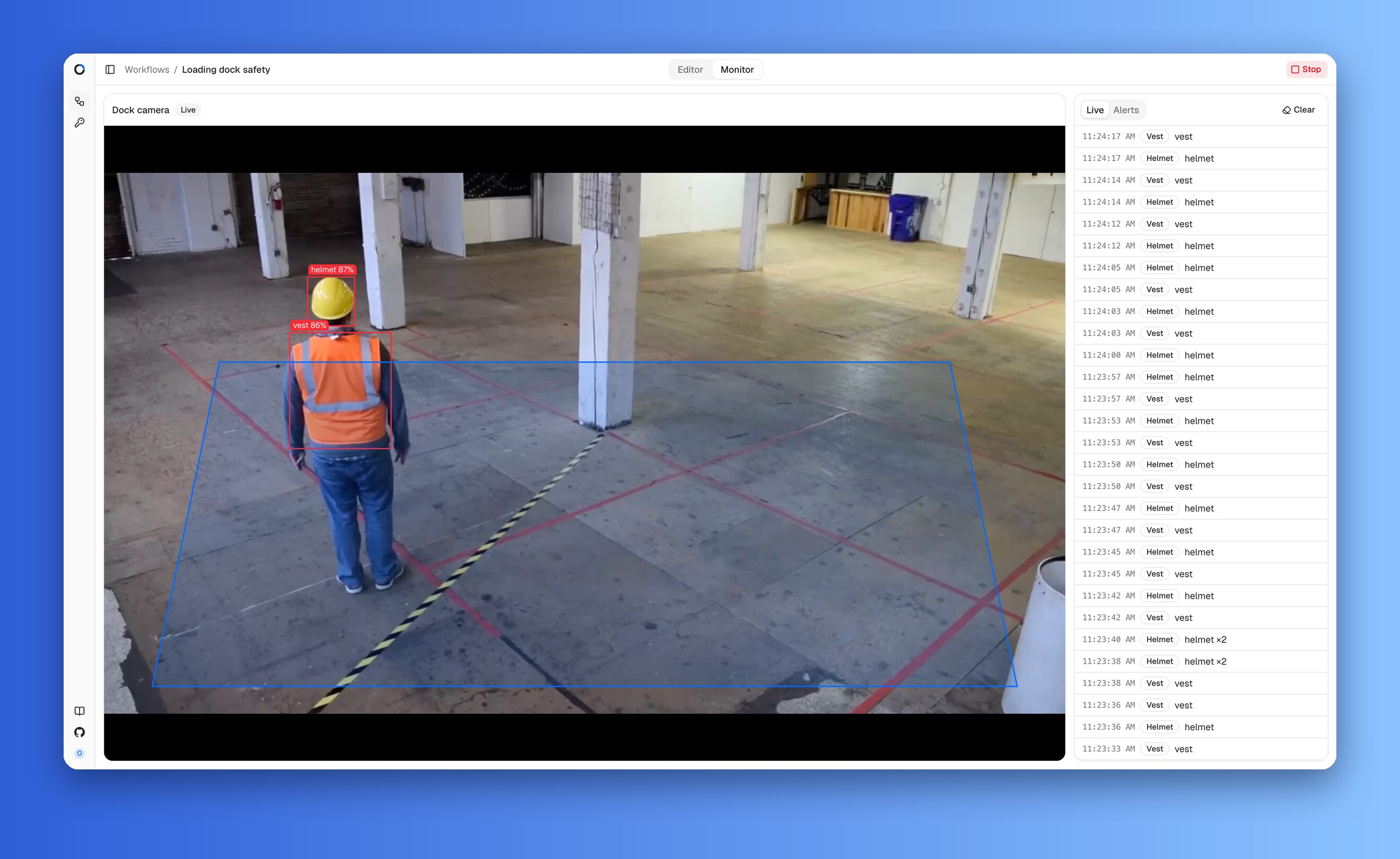
- **Live monitor.** Low-latency WebRTC playback with detection overlays, an event feed, and alert history next to every camera.
- **Self-hosted.** One `docker compose up`, PostgreSQL and Valkey for state, MediaMTX for streams, RustFS for video storage, no cloud dependency.
## How it works
```mermaid
flowchart LR
cameras[Cameras and files] -->|ingest| mediamtx[MediaMTX]
mediamtx -->|RTSP| inference[Inference
ONNX Runtime · ByteTrack]
inference -->|detections| valkey[(Valkey)]
valkey --> api[API
workflows · events · actions]
api --> actions[Alerts · Snapshots · Webhooks
Telegram · Discord · Email · MQTT]
api <-->|HTTP · WebSocket| studio[Studio]
mediamtx -->|WebRTC| studio
api --- postgres[(PostgreSQL)]
```
The **API** owns workflows, cameras, credentials, and alerts, derives events from detections, and walks the workflow graph for every event. The **inference service** decodes streams, runs the model, tracks objects, and publishes strict detection messages. **Studio** is the browser interface: the graph editor and the live monitor. **MediaMTX** normalizes every source into one RTSP path per camera and serves WebRTC playback to the browser.
## Quick start
You need Docker with Compose 2.24 or later.
```bash
git clone https://github.com/okoflow/looksee.git
cd looksee
cp .env.example .env
```
Set private `POSTGRES_PASSWORD`, `MTX_MEDIA_PASSWORD`, and `STORAGE_PASSWORD` values in `.env`, then start the stack:
```bash
docker compose up -d --build
```
Open [http://127.0.0.1:3000](http://127.0.0.1:3000) and create the owner account. RustFS stores uploaded videos in a persistent Docker volume; the video bucket is created automatically. For a server on your network, set `WEBRTC_HOST_IP` to its address.
> [!WARNING]
> Until the owner account exists, anyone who can reach the web interface can
> claim the instance. Run LookSee on a trusted network, and read
> [SECURITY.md](SECURITY.md) before exposing it further.
LookSee ships without detection models. A model is a directory under `models/` with a `manifest.json` and a `model.onnx` exported from D-FINE; the API picks it up on the next request. The [documentation](https://github.com/okoflow/looksee-docs) explains the bundle format and how to export a model.
## Documentation
Guides and reference live in [looksee-docs](https://github.com/okoflow/looksee-docs), available in English, Russian, Hebrew, and Korean.
Start with *Getting started*, then *Concepts* for the workflow model and *Nodes* for every node and its fields.
## Repository
| Path | What lives there |
| --- | --- |
| [`apps/api`](apps/api) | FastAPI control plane: workflows, cameras, events, actions, alerts |
| [`apps/inference`](apps/inference) | ONNX detection service: decoding, models, tracking |
| [`apps/studio`](apps/studio) | Next.js interface: workflow editor and live monitor |
| [`packages/shared`](packages/shared) | Pydantic wire contracts between the API and inference |
| [`ee/api`](ee/api) | Enterprise node types and integrations |
| `models` | Model bundles, discovered at runtime |
| `docker`, `compose.yaml` | MediaMTX configuration and the deployment stack |
[CONTRIBUTING.md](CONTRIBUTING.md) covers the development setup, the checks that run in CI, and the commit and pull request conventions. Each package README describes its internal layout.
## Editions
The Community edition is everything outside `ee/`, licensed under Apache-2.0. The Enterprise edition adds line crossing, dwell time, and count threshold filters and the Slack action; it is unlocked with `LICENSE_KEY` and licensed under the [LookSee Enterprise license](ee/LICENSE). The same images ship both.
## Security
Report vulnerabilities privately through [GitHub security advisories](https://github.com/okoflow/looksee/security/advisories/new). [SECURITY.md](SECURITY.md) lists the supported versions, the process, and the hardening steps for a deployment.
## License
Copyright The LookSee Authors, listed in [AUTHORS](AUTHORS).
Apache-2.0, except the `ee/` directory, which is under the [LookSee Enterprise license](ee/LICENSE). Third-party components keep their own licenses. See [LICENSE](LICENSE).