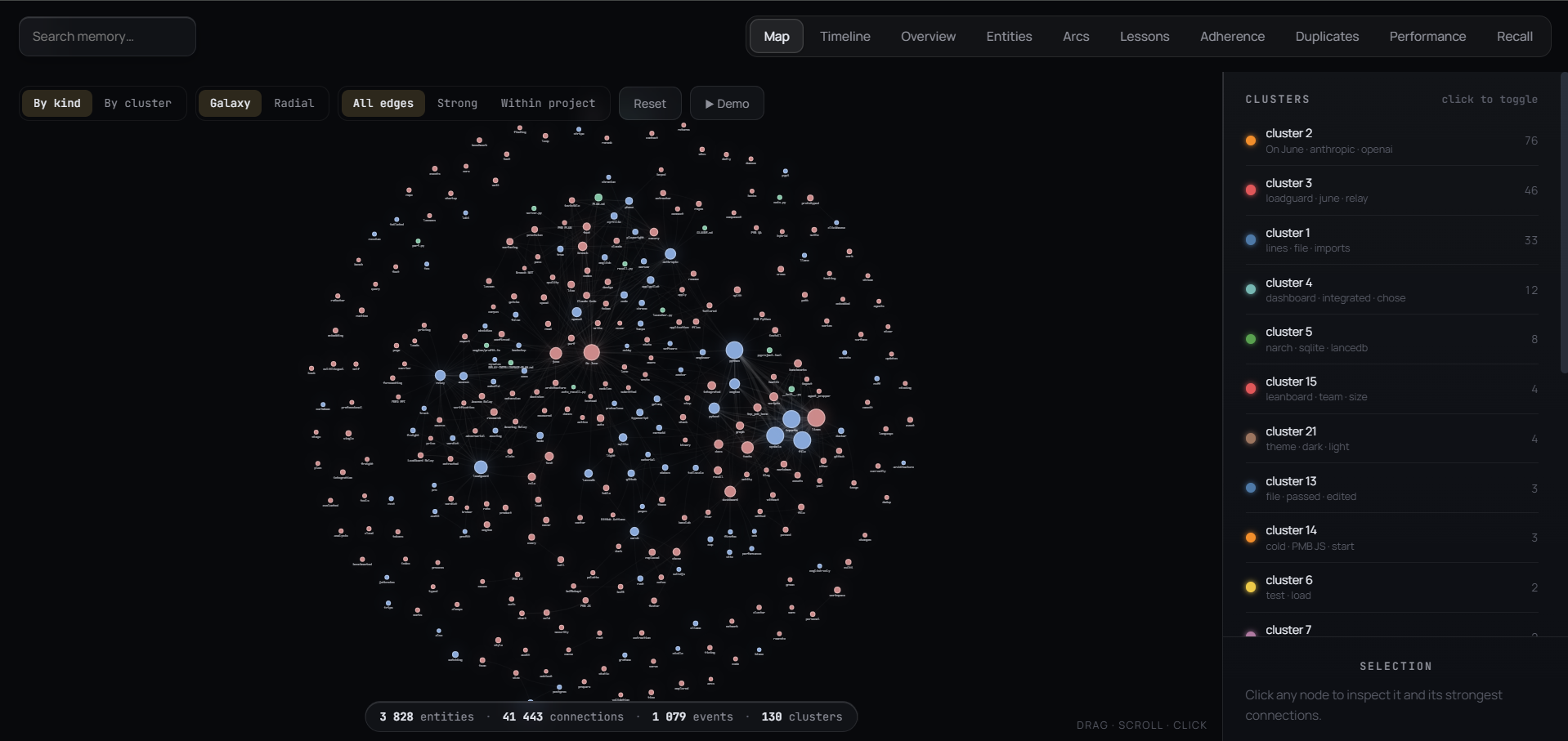
PMB logo # PMB ### Local-first memory for your AI coding agent. ### SQLite is the source of truth. No cloud, no API keys, no re-explaining. [![Website](https://img.shields.io/badge/website-pmbai.dev-8B7FF0.svg)](https://pmbai.dev) [![PyPI](https://img.shields.io/pypi/v/pmb-ai.svg?label=pypi)](https://pypi.org/project/pmb-ai/) [![CI](https://github.com/oleksiijko/pmb/actions/workflows/ci.yml/badge.svg)](https://github.com/oleksiijko/pmb/actions/workflows/ci.yml) [![Docs](https://img.shields.io/badge/docs-online-475569.svg)](https://docs.pmbai.dev) [![Python](https://img.shields.io/pypi/pyversions/pmb-ai.svg)](https://pypi.org/project/pmb-ai/) [![License](https://img.shields.io/badge/license-Apache_2.0-blue.svg)](LICENSE) [![MCP](https://img.shields.io/badge/MCP-native-purple.svg)](https://modelcontextprotocol.io) [![GitHub MCP Registry](https://img.shields.io/badge/GitHub_MCP_Registry-listed-8B7FF0?logo=modelcontextprotocol&logoColor=white)](https://github.com/mcp/oleksiijko/pmb-ai) PMB dashboard - your project's memory as a live entity graph *Local-first memory, visualized. 3,800+ entities and 41,000+ connections, captured automatically as you work.* [**Website**](https://pmbai.dev) · [**Docs**](https://docs.pmbai.dev) · [Quickstart](#quickstart) · [Demo](#demo) · [Why PMB](#why-pmb) · [How it works](#how-it-works) · [FAQ](#faq) **Your AI agent forgets everything between sessions.** So you re-explain the same decisions, lessons and constraints over and over. PMB remembers them in one local workspace and feeds them back through MCP - no cloud, no API keys, no LLM call on the read path. And it tells you **when memory is actually helping**, instead of claiming "+X%". ⭐ **Star the repo if PMB saves you a re-explanation.**

--- PMB gives Claude Code, Cursor, Codex and the other MCP-aware agents a real memory: decisions you made last week, lessons you taught them, personal facts, project structure, PDFs. They survive every restart, every model upgrade, every agent switch - because they live in a **local workspace you own**, with SQLite as the durable source of truth and rebuildable search indexes beside it. No API keys. No subscription. No LLM call on the read path. Just local files. ## Quickstart ```bash pip install pmb-ai # 1. install pmb setup # 2. detect your agent + wire the MCP entry pmb warmup # 3. preload the model (first recall is instant) # 4. restart your agent, then just talk to it - memory is automatic pmb stats # 5. see what's stored pmb recall "auth decision" # 6. search memory from the terminal pmb doctor # 7. confirm everything is wired ``` That's it - your agent now remembers. No account, no keys, nothing leaves your machine. > **Command name:** the CLI is **`pmb`**. Via `pip` you also get the alias > **`pmb-ai`**; via `npm` (`npx pmb-ai setup`) the command is `pmb-ai` and it > installs the Python package first, then runs setup. Same tool - use whichever > your install gave you. > **Links:** [pmbai.dev](https://pmbai.dev) (site) · > [docs.pmbai.dev](https://docs.pmbai.dev) (docs) · > [Getting started](docs/guide/getting-started.md) · > [Deleting memories](docs/guide/deleting-memories.md). --- ## Demo *What it feels like - same prompt, with and without memory:*
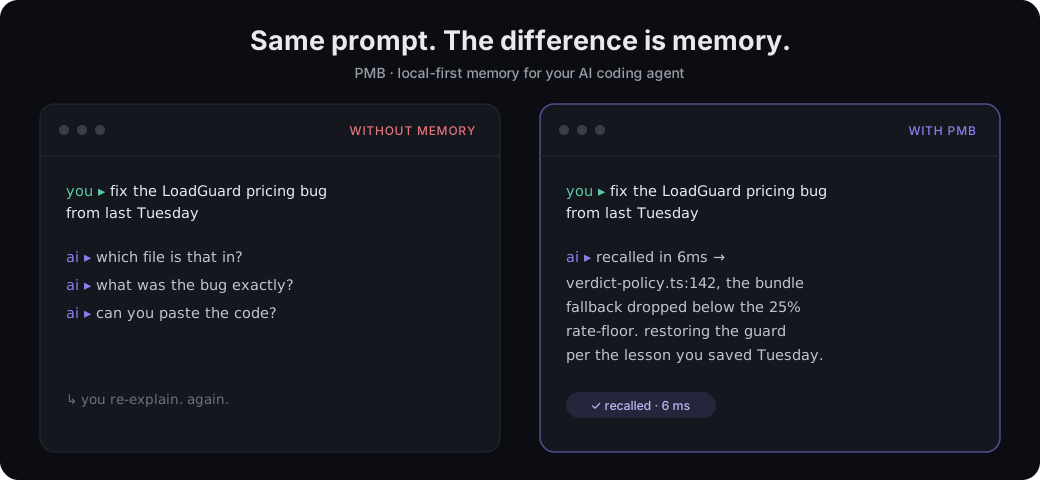
Watch the 2-minute PMB setup ▶ Click to play the 2-minute setup Same prompt, with and without memory: without PMB the agent asks which file and what the bug was; with PMB it recalls verdict-policy.ts:142 in 6 ms.
``` You: fix that LoadGuard pricing bug we hit last Tuesday Agent: prepare(message="fix LoadGuard pricing bug") ↓ (6 ms) → project_context: 12 events about LoadGuard, 4 lessons (incl. "never lower NEGOTIATE/SKIP under 25%"), 3 decisions, 2 open goals → active_arcs: "LoadGuard verdict-policy refactor (started Tue)" → lessons: 1 directly matches "pricing" → recent_activity: 8 commits this week Looking at src/engine/verdict-policy.ts (you opened it Tuesday 14:32, last changed Wednesday). The pricing bug is on line 142 where the bundle fallback tightened below the rate-floor. Per the lesson you saved, we never drop the threshold under 25% - restoring the guard there. ``` The agent didn't ask. It didn't guess. It read its memory in **6 ms** and showed up already informed. --- ## Why PMB - **Local-first, zero-config.** SQLite holds the durable memory; rebuildable search indexes stay local. No account, API keys, telemetry, or cloud to trust. - **It actually gets used.** On Claude Code / Codex, hooks inject the right memory *before* the model thinks - you never have to remember to call a tool. - **Multilingual, no setup.** The embedder covers 50+ languages; a Russian query finds an English fact. No per-language config. - **MCP-native.** One `pmb connect` wires Claude Code, Cursor, Codex, Windsurf, Zed, VS Code, and more. - **Fast read path.** Recall in ~35 ms warm; writes return in under a millisecond - no LLM call to remember. - **Honest impact.** The dashboard shows which lessons actually changed outcomes, instead of claiming "+X%". - **Your data, in the open.** `pmb export` dumps everything to Markdown/JSON. Apache 2.0. --- ## See your memory `pmb dashboard` opens a local, liquid-glass web UI on `http://127.0.0.1:8765` over everything PMB captured - written automatically, just by working. It binds to `127.0.0.1` only, so nothing leaves your machine.
PMB dashboard - Map (entity graph) *Map - every entity and connection in your project, as a live graph.* PMB dashboard - Timeline (journal) *Timeline - your memory as a journal, newest first.*
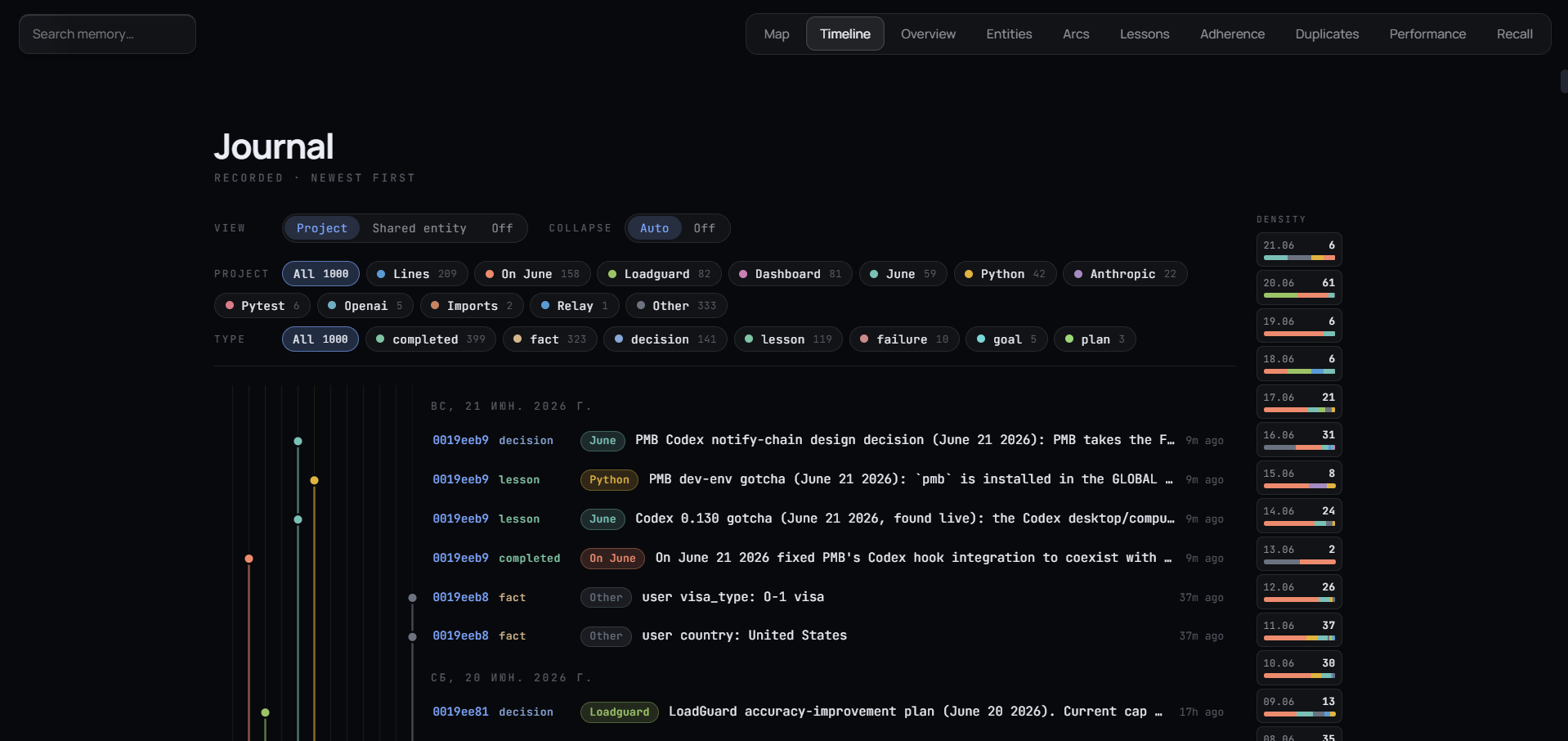
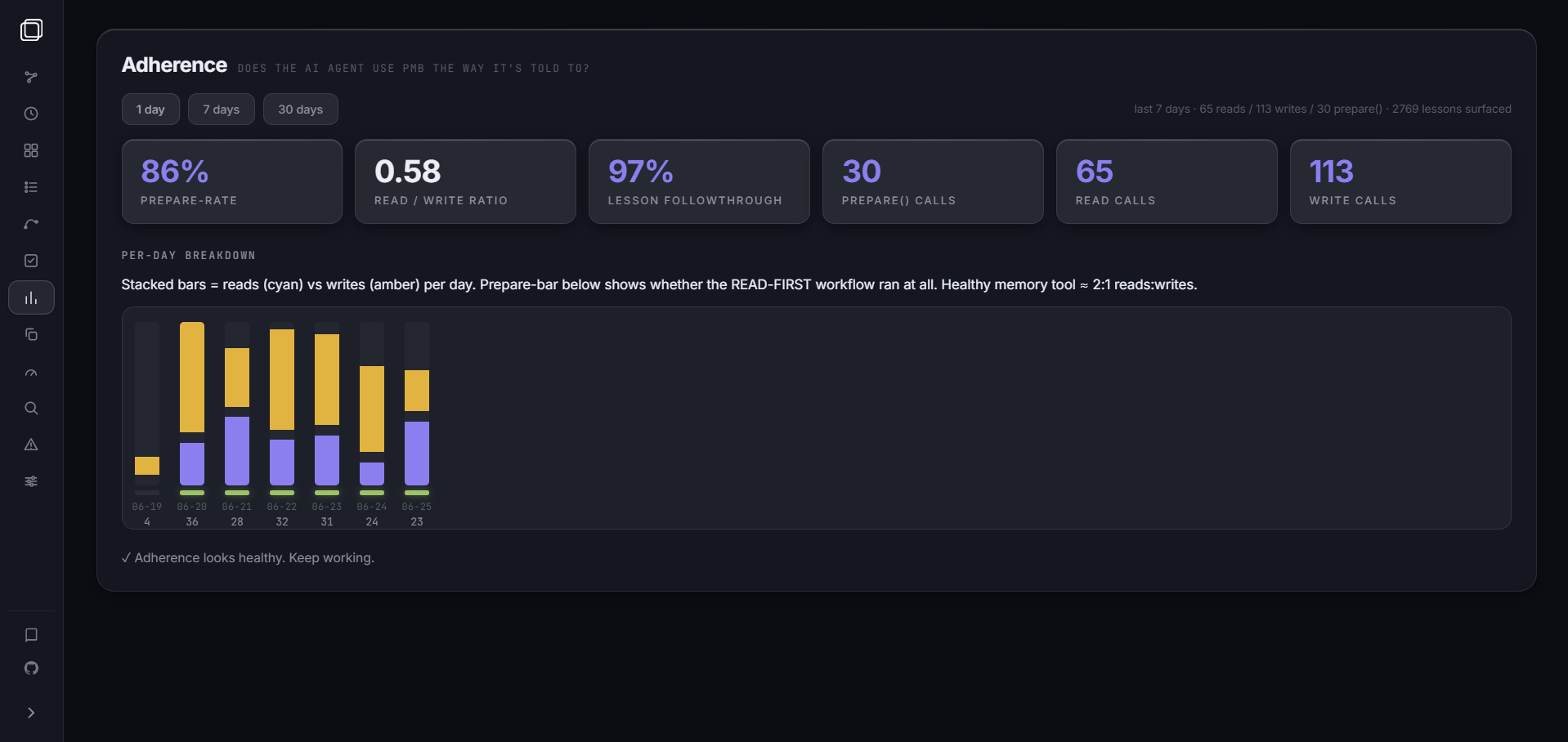
Nine tabs: **Map** (entity graph, live), **Timeline** (git-graph by project), **Overview**, **Entities**, **Arcs** (narrative threads), **Lessons** (per-rule follow-rate, dead-lesson detection), **Duplicates** (inline merge), **Performance** (per-tool latency), **Recall** (debug ranker). --- ## What you can store ```bash # Personal facts that change (time-travel: old values archived, never lost) record_keyed_fact("user", "city", "Warsaw") # Project structure - symbols, imports, .gitignore-aware pmb index project . # Why each file exists + the intent behind every commit (Haiku-summarised, local) pmb track modules # one-line purpose per indexed file pmb track changes # new commits: what changed and WHY # PDFs (research papers, manuals, contracts) pmb index pdf paper.pdf pmb index pdf ~/docs --recurse # Whatever your agent logs as it works: decisions, lessons, completed tasks, goals ``` PMB is content-agnostic. If it's text the agent will care about later, PMB remembers and retrieves it. ## What the agent gets back A single MCP call - `prepare(message)` - returns the right things at the right level of detail, in 4-16 ms: | Field | What it is | |---|---| | `project_context` | Full project overview if the message mentions a project: key facts, lessons (RULES to follow), decisions, open goals, related entities, the project's narrative arc | | `lessons` | Procedural rules matching the query, each with a `surface_id` so the agent can confirm it followed the rule later | | `recent_activity` | Last 24 h of decisions / edits / completions for session continuity | | `open_goals` | In-progress goals so the agent knows what you're pursuing | | `active_arcs` | Narrative arcs the project is currently living in | For everything else there's `recall(query)` (hybrid search, 35 ms warm) and 27 other tools in [docs/reference/COMMANDS.md](docs/reference/COMMANDS.md). --- ## How it works ```mermaid flowchart LR A[Your agent] -->|MCP stdio| B[PMB MCP server] B --> C[Engine] C -->|read 35 ms| R[Hybrid recall
BM25 + vector + graph + rerank] C -->|write under 1 ms| W[Async embed queue
SQLite first, vectors later] R --> D[(SQLite)] R --> E[(LanceDB)] W --> D W --> E style A fill:#dbeafe,color:#1e3a8a style B fill:#ede9fe,color:#5b21b6 style C fill:#dcfce7,color:#14532d ``` - **Storage** - every durable event lives in SQLite, the source of truth. Rebuildable vector indexes live in LanceDB beside it. The whole workspace stays on your disk and can be copied or exported anytime. - **Recall** - BM25 (lexical) + dense vector (semantic) + entity graph + optional cross-encoder rerank, fused via Reciprocal-Rank-Fusion. - **Writes** - async. The MCP tool returns in under a millisecond; the embed + LanceDB insert happen on a background thread. - **Dedup** - four layers: exact text match -> cosine >= 0.92 auto-merge -> cosine 0.80-0.92 borderline (LLM verify later) -> manual review in the dashboard. Old values are archived, never deleted; full history via `keyed_fact_as_of(t)`. - **Multilingual - no language packs.** The default embedder (`paraphrase-multilingual-MiniLM-L12-v2`) covers 50+ languages, so *где я живу* finds a keyed-fact stored as *user.city = Warsaw*. Intent detection rides English semantic anchors that transfer cross-lingually, and the cold lexical path self-compiles from your own traffic. Recall stays strong across ~11 languages (top-3 ~= 0.9 on a 101-query eval; top-1 = 1.00 for en/fr/pt/ru). See [docs/contributing/adding-a-language.md](docs/contributing/adding-a-language.md). --- ## Install The [Quickstart](#quickstart) above is all most people need. Other ways: ```bash # From source git clone https://github.com/oleksiijko/pmb.git && cd pmb python -m venv .venv && source .venv/bin/activate pip install -e . pmb warmup # prime the ~450 MB embedder once ``` Wire one or more agents (all stdio - the server runs as a child of your agent; no network, no port, no token): ```bash pmb connect claude-code # also: codex · cursor · windsurf · gemini · vscode · zed · opencode · continue ``` Point several agents at one memory: ```bash pmb connect claude-code --workspace personal pmb connect cursor --workspace personal # both read/write the same workspace ``` > Sharing one memory across machines or a team? That's an optional HTTP mode > with bearer-token auth - see [docs/guide/TEAM.md](docs/guide/TEAM.md). Not needed for local use. > **Running the tests?** Use the venv's Python: `.venv/bin/python -m pytest` > (or `.venv\Scripts\python.exe -m pytest` on Windows). Bare `pytest` outside > the venv just reports missing `numpy`/`fastmcp`/`typer`. --- ## CLI cheat sheet ```bash # Memory pmb stats show counts and storage info pmb recall "query" search with full debug pmb dashboard web UI on port 8765 (graph, settings, errors) # Ingest pmb index pdf paper.pdf extract + chunk + embed pmb index pdf ~/docs --recurse entire directory pmb index project . scan codebase pmb track changes summarise commit intent (why) pmb track modules one-line purpose per module pmb import chatgpt ~/Downloads/export.json bring existing history # Continuity & efficiency (opt-in) pmb resume save write .pmb/resume.md (commit it) pmb resume install refresh resume.md at every turn end pmb health lessons-impact which lessons actually help outcomes pmb memory ledger Memory Delta handles this session # Maintenance pmb regraph rebuild entity graph pmb consolidate run sleep pass (optional) pmb compact archive old events pmb dedupe resolve borderline duplicates # Hooks (force-feed PMB at the protocol level - no model cooperation) pmb hooks install claude-code wire all lifecycle hooks pmb hooks list show what's installed pmb hooks capabilities ambient mechanism each agent supports pmb hooks uninstall claude-code remove them pmb auto-context "fix bug in PMB" preview per-turn injection pmb session-restore -m 180 preview post-compaction restore pmb lesson-followcheck --dry-run preview follow-through scoring # Ambient memory (the write side - memory journals the agent's work) pmb autowrite --dry-run preview ambient auto-write for this turn pmb ambient-watch . ambient auto-write for MCP-only hosts (git observer) pmb forget-auto drop memory the ambient layer wrote itself # Config pmb config list default tier (25 keys you care about) pmb config list --pro every key, including 80 advanced knobs pmb config set recall.ppr_enabled true toggle a feature pmb connect --rules-only refresh CLAUDE.md only ``` Step-by-step per agent: [docs/guide/usage.md](docs/guide/usage.md). Full reference: [docs/reference/COMMANDS.md](docs/reference/COMMANDS.md). --- ## Hooks - memory that doesn't wait to be asked The hard part of agent memory isn't storing - it's getting the agent to *use* what's stored. Soft instructions in a rules file get skipped. So PMB wires hooks at the protocol level (`pmb hooks install claude-code`), each removing a dependency on the model remembering to act: - **UserPromptSubmit -> auto-recall.** Every message is classified (regex, multilingual, sub-ms) and the matching memory - lessons, past decisions, recall hits, project overview - is injected *before* the model thinks. Trivial messages inject nothing. - **PostToolUse -> ambient observe.** Every tool the agent runs is appended to a lightweight action journal (a single SQLite INSERT, no model). Reads and `ls` are filtered out; edits, tests and commits are kept. - **SessionStart -> session-restore.** After a context compaction the agent rebuilds "where you left off" from what the session recorded, instead of re-asking you. - **Stop -> follow-through + ambient auto-write.** (a) It checks which surfaced lessons actually showed up in what the agent did and marks them followed, *deterministically*. (b) If the agent did NOT call a `record_*` tool, it synthesizes one activity entry from the observed actions - so real work is captured even when the agent stays silent. Preview any without an agent: `pmb auto-context "..."`, `pmb session-restore -m 180`, `pmb lesson-followcheck --dry-run`, `pmb autowrite --dry-run`. ## Ambient memory - the write side Auto-recall fixed the *read* side; ambient memory does the same for the *write* side - the memory journals the agent's work even when it forgets `record_batch`: - **Coordinated.** If the agent already called a `record_*` tool this turn, ambient stays silent; it only fills the gap. - **Outcome-scored, not churn.** A turn is journaled only if results clear a quality bar (tests passed, a failure fixed, a deploy ran), not by file count alone. - **Honest + reversible.** Every ambient entry is tagged `source=autowrite`, shown as auto in the dashboard, and removable with `pmb forget-auto`. **On by default**; disable with `pmb config set autowrite.enabled false`. - **Works on every host.** Claude Code (hooks), Codex (`pmb codex-notify`), MCP-only hosts like Cursor/Zed/VS Code (git observer, `pmb ambient-watch .`). Check yours with `pmb hooks capabilities`. Synthesis is template-based by default (instant, no model). Opt into a local/API/CLI model summary with `pmb config set autowrite.synthesizer llm:ollama` or `llm:openai` (it has a timeout and falls back to the template). ## Self-improvement loop Every surfaced lesson carries a `surface_id`. Follow-through is recorded both ways: the agent confirms via `mark_lesson_followed(surface_id, True)`, and the **Stop hook** infers it from recorded activity. The **Lessons tab** then shows, per rule: how often it was shown, how often it was followed, `★ USEFUL` (followed >= 2x), `? UNVERIFIED` (surfaced but unconfirmed), and `💀 DEAD` only when a rule is repeatedly **ignored** (>= 2). You see which rules help and prune the ones that don't. --- ## Settings - 25 you care about, 80 you don't PMB has 105 tunables. The 25 that affect day-to-day quality are **default-tier** (`pmb config list`). The rest are internal weights and experimental flags, hidden behind `--pro` so the surface stays scannable. Every pro key still reads with `pmb config get` and writes with `pmb config set` - hidden from `list`, not gated. | Key | Default | What it does | |---|---|---| | `recall.top_k` | 5 | How many results recall returns | | `recall.bm25_weight` | 0.7 | BM25 vs vector mix (1.0 = pure BM25) | | `recall.ppr_enabled` | **true** | Multi-hop graph diffusion, gated by intent | | `recall.keyed_fact_boost` | 0.35 | How hard personal-attr facts win on personal queries | | `recall.rerank` | false | Always-on cross-encoder (regresses LoCoMo, keep off) | | `embedding.model` | `paraphrase-multilingual-MiniLM-L12-v2` | The vector model | | `graph.extractor` | `regex` | `regex` / `spacy` / `llm:claude` / `llm:openai` / `llm:ollama` / `llm:codex` | | `mcp.record_batch_async` | true | Fire-and-forget writes (sub-ms return) | | `agent.apply_lessons` | true | Agent surfaces lessons before acting | | `dedup.enable` | true | All four dedup layers | | `decay.factor_per_day` | 0.985 | Importance half-life | | `chat.model` | `haiku` | Default model for `pmb-chat` | --- ## Numbers | | | |---|---| | Recall p50 / p95 warm | **35 ms / 110 ms** | | `prepare(message)` warm | **4-16 ms** | | `record_batch_async` | **< 1 ms** | | MCP cold boot | **3.7 s** | | LoCoMo recall@10 (n=10) | **94.5 %** | | Multilingual mega-stress top-10 (900 q) | **99.2 %** | ```bash # Reproduce locally python scripts/benchmarks/benchmark_locomo.py --n-conversations 10 python scripts/benchmarks/mega_stress_test.py ``` --- ## Privacy - 100 % offline by default. No network calls from the engine, zero telemetry - there is no PMB server to call home to. - Workspace = a directory under `~/.pmb//`. Copy it to Dropbox, push it to git, share it on a USB drive. Your call. - Secrets are auto-redacted at write time (OpenAI / Anthropic / AWS / Stripe / GitHub keys; configurable). - Apache 2.0 licensed. Forks welcome. --- ## FAQ **Does PMB call an LLM?** On read: never. On write: never by default. Optional: `pmb consolidate` can run a local Ollama, Claude CLI, Anthropic, or OpenAI pass to write short reflections - opt-in. **What about cost?** $0. There is no PMB service. **Does the agent need to know about PMB?** After `pmb connect`, the rules are appended to `CLAUDE.md` / `AGENTS.md` automatically. The default profile exposes 10 core MCP tools (including the `prepare()` read-first pattern); wider profiles exist for ingestion and admin. **Will it slow my agent down?** Tools return in single-digit milliseconds for everything except `recall` (35-110 ms warm), which is below human perception. **Can two agents share one memory?** Yes - point them at the same workspace. SQLite WAL + a 10 s busy-timeout handle concurrent writes. **Wipe a fact?** `pmb forget ` archives it (excluded from recall, restorable). Hard-delete: `pmb delete --hard`. **Windows?** Yes - tested on Windows 11, macOS 14, Ubuntu 22.04. Cyrillic paths and console encoding are handled. **PDFs / code / Markdown?** `pmb index pdf paper.pdf`, `pmb index project .`, `pmb import markdown ~/notes/`, `pmb import chatgpt path.json`. **Cold start is slow.** First recall loads the embedding model (~3 s). Run `pmb warmup` once, or let the prewarm thread handle it in the background. **Roadmap?** See [docs/ROADMAP.md](docs/ROADMAP.md): litestream backup, optional cloud-sync (BYO bucket), tree-sitter project indexing, image OCR. --- ## Contributing Issues and PRs welcome. There's one full-time maintainer; please open a discussion before a large change so we can align on direction. ```bash git clone https://github.com/oleksiijko/pmb.git && cd pmb python -m venv .venv && source .venv/bin/activate pip install -e ".[dev]" pytest # full suite, ~4 minutes pytest -k recall # fast subset, ~12 s ``` ### Dev commands ```bash bash scripts/test.sh # whole suite (CI-equivalent) bash scripts/test.sh tests/recall # a subset (any pytest args pass through) bash scripts/codeql_local.sh # run CI's CodeQL security-extended locally bash scripts/install-dev-hooks.sh # pre-commit hook: ruff + CodeQL before each commit ``` `scripts/codeql_local.sh` auto-installs the CodeQL bundle on first run and runs the exact suite CI uses, so security findings are caught locally instead of on a push. The pre-commit hook bypasses with `git commit --no-verify` (or skip just the scan with `SKIP_CODEQL=1`). License: **Apache 2.0**.


