The decision layer for AI agents.
Ollaya runs open decision models on your own hardware, the way Ollama runs LLMs. Typed questions in, calibrated answers out, in milliseconds: routing, guardrails, triage and tool approval without an LLM call.
Website · Models · Bench · Docs · Releases · Hugging Face
Created and maintained by Mert Cobanov (@mertcobanov).
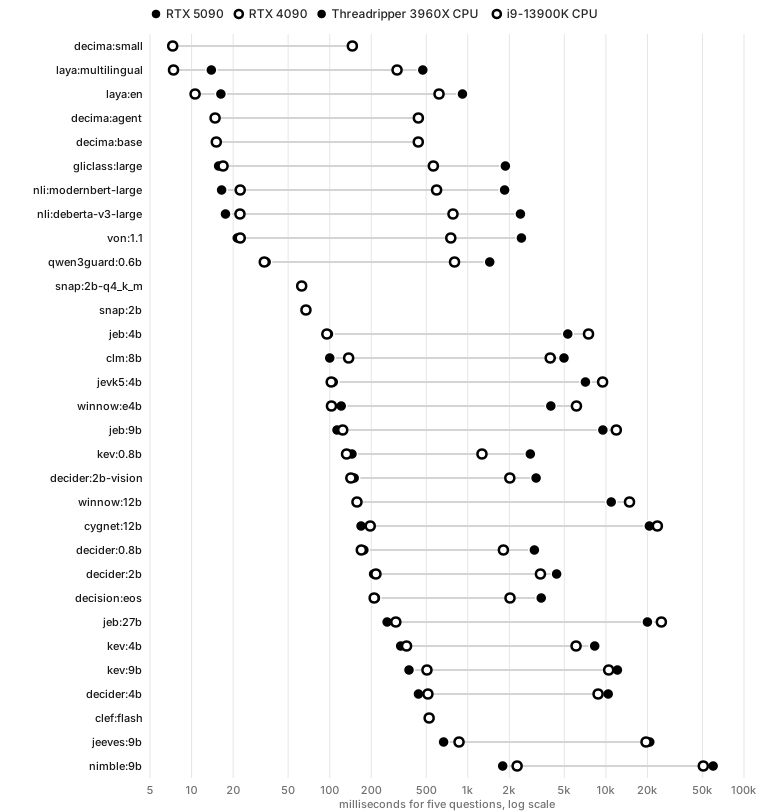
A decision model reads a *state* (a message, an email, a ticket, any JSON) plus typed questions (`choice`, `score`, `noul`) and returns calibrated probabilities in a single forward pass, in milliseconds. It never generates text. Ollaya pulls these models by name and serves them from a local daemon behind a self-hosted, Jev-compatible API (TypeSafe's `/v1/systemone` wire format), so the TypeSafe SDK and existing Jev clients work unchanged once they point at Ollaya and name an open model. ```sh curl -fsSL https://ollaya.dev/install.sh | sh ollaya run winnow:e4b --preset triage "Third time this year you've double-charged me. Refund it today or I'm cancelling and moving to a competitor." ``` ``` intent refund ███████████████░ 0.91 is_urgent yes ███████████████░ 0.92 frustration 2.89 / 3 very angry or using stron… ██████████████░░ 0.86 refund_requested yes ████████████████ 0.99 churn_risk yes ████████████████ 0.99 ``` Or ask your own questions: `ollaya run kev --ask "Is a refund requested?" --ask "Which team?" --choice billing --choice sales < ticket.txt`. `winnow:e4b` is the recommended model: 0.724 accuracy on typed decisions (TypeSafe reports 0.738 for its Jev) and 113 ms for five questions on an RTX 5090. It is a 4B-class language model, so without an NVIDIA GPU start with `laya`: `laya:multilingual` answers five questions in 516 ms on a CPU. All models and their numbers: [ollaya.dev/search](https://ollaya.dev/search). ## A self-hosted, Jev-compatible API **What is a Jev-compatible API?** An HTTP API that takes the same requests as TypeSafe's hosted Jev (a `state` plus typed `questions` at `POST /v1/systemone`) and returns the same `answers`, so TypeSafe's SDK and any client written for Jev work against it unchanged. Ollaya's `/v1/systemone`, `/v1/decisions` and `/v1/models` are wire-identical to TypeSafe's (as `typesafe-sdk` 0.7.1 defines them), served from your own machine with open models. **Migrating from Jev.** Point the SDK at Ollaya and pick an open model: ```sh export TYPESAFE_BASE_URL=http://localhost:11435 export TYPESAFE_API_KEY=local # any non-empty value export TYPESAFE_DEFAULT_MODEL=winnow:e4b # instead of "jev-latest" ``` Details, including proxies and warm-up: [TypeSafe compatibility](https://ollaya.dev/docs/typesafe-compatibility). | | Ollaya | TypeSafe Jev | Ollama | |---|---|---|---| | Runs on | Your machine or server | TypeSafe's cloud | Your machine or server | | Jev API | `/v1/systemone`, `/v1/decisions`, `/v1/models` | The original | `/v1/systemone` | | Models | Open decision models from Perplexity, Cloudflare, PostHog, Bespoke Labs and others | Jev (closed) | Its own GGUF builds of nine decision models (0.40, October 2026) | | Probabilities | Each author's calibration | TypeSafe's | Raw softmax | | Your data leaves the machine | No | Yes | No | | License | Apache-2.0 | Proprietary, hosted | MIT | The [FAQ](https://ollaya.dev/docs/faq) compares Ollaya and Ollama in more detail, measured on the same GPU. ## Features - **One binary.** `ollaya serve` runs the daemon; `ollaya run`, `pull`, `list`, `ps`, `show`, `rm`, `cp`, `stop` and `create` work the way they do in Ollama. If the daemon isn't running, the CLI starts it. - **TypeSafe-compatible.** `POST /v1/systemone`, `/v1/decisions` and `GET /v1/models` are wire-identical to TypeSafe. The official SDK works unchanged when you set `TYPESAFE_BASE_URL=http://localhost:11435`. - **Native API.** `/api/decide` adds routing information and timings. `/api/pull` streams NDJSON progress, and there are `/api/tags`, `/api/show`, `/api/ps` and more. See [docs/api.md](docs/api.md). - **Weights come from their authors.** Ollaya publishes only small ONNX graphs, about 3 MB each. These graphs read the original weight files (usually `model.safetensors`) from the author's Hugging Face repository, pinned to a commit and verified by sha256. Models whose authors publish GGUF files (`winnow`, `jevk5`, `jeb`) run that file itself on llama.cpp. Ollaya never re-hosts weights. - **For agents.** `ollaya mcp` serves the models to Claude Code, Claude Desktop, Cursor and other MCP clients (`claude mcp add ollaya -- ollaya mcp`, or [one click in Cursor](https://cursor.com/install-mcp?name=ollaya&config=eyJjb21tYW5kIjoib2xsYXlhIiwiYXJncyI6WyJtY3AiXX0%3D)), and the [`ollaya-decisions` skill](skills/ollaya-decisions/SKILL.md) teaches agents when and how to use them (`npx skills add ollaya-dev/ollaya --skill ollaya-decisions`). - **Routers.** `laya` detects the script and language of each request, then answers with `laya:en` or `laya:multilingual`. - **Modelfiles.** You can bake a question set into your own model: ``` FROM laya QUESTIONS ./triage.json PARAMETER precision fp32 ``` Then run `ollaya create triage -f Modelfile` and `ollaya run triage "…"`. - **Fast and exact.** - **Hardware:** ONNX Runtime on CPU, and CUDA on NVIDIA GPUs. GGUF models run on llama.cpp: CPU, ROCm/HIP on AMD GPUs, Vulkan on Windows (any vendor's GPU; an integrated one when you name it), CUDA on NVIDIA GPUs, and Metal on Apple silicon. - **Precision:** ONNX uses fp16 on GPU and fp32 on CPU when available; GGUF keeps its model quantization on either device. - **Accuracy:** fp32 exports give the same decision as the PyTorch reference on 100% of 2,383 questions per checkpoint. ## Models | Model | What it is | |---|---| | `winnow:e4b` | **Recommended.** EldanRing's Winnow-E4B, a Gemma 4 fine-tune run from the author's Q8_0 GGUF on llama.cpp | | `credence:e4b`, `credence:e4b-calibrated` | Txoka's MiCA refinements of Winnow-E4B, Q8_0: accuracy-focused and public-calibration variants; see the measured tradeoffs in the family documentation | | `laya` | Router: picks `laya:en` or `laya:multilingual` by language | | `laya:en` | English decision model (ModernBERT-large, 421M) | | `laya:multilingual` | 100+ languages (mmBERT-base, 322M) | | `laya:typed-decisions` | Fine-tuned on the typed-decisions workflows | | `decider`, `decider:4b`, `decider:0.8b` | Mapika's Qwen3.5 decoders, 2B (the default), 4B and 0.8B | | `decider:2b-vision` | Mapika's Qwen3.5-2B vision-language decider: questions about an image (`--image`, `images` on `/api/decide`) as well as the state | | `kev`, `kev:0.8b`, `kev:9b` | Jared Palmer's Kev: a LoRA and a pointer head on Qwen3.5 (4B by default, 0.8B, 9B), calibrated | | `decision` | Decision 1.0 Eos by the vLLM Semantic Router contributors: a fine-tuned Qwen3.5-0.8B with an endpoint head, 16k-token rows | | `qwen3guard` | Qwen3Guard-Gen-0.6B safety guard with built-in questions: safe, controversial or unsafe, and the category | | `nli`, `nli:modernbert-large` | Moritz Laurer's zero-shot NLI classifiers (DeBERTa-v3-large, ModernBERT-large) | | `gliclass` | Knowledgator's instruction-following zero-shot classifier (DeBERTa-v3-large) | | `gliclass-v4`, `gliclass-v4:9b` | Knowledgator's GLiClass v4 (decoder-KV on Qwen3.5-2B and -9B): the labels follow the instructions and the state in one decoder row, a two-layer scorer with up to three reasoning steps reads them, and the model's own calibrator rescales every label; text only | | `von` | Victor Hugo Panisa's Von 1.1 (ModernBERT-large): every option scored at its own marker, 8k-token context. Archived upstream on 2026-10-19; `d1-omni` is its successor | | `winnow` | EldanRing's Winnow-12B, the larger sibling of `winnow:e4b` | | `clm` | Contrastive-LM's CLM-v0.1-8B: the Qwen3-8B encoder and two projection heads score options by similarity, with questions and options cached. Built for agent, game and tool-calling states | | `jevk5` | alibiserikbay's JevK5 v0.3, a Qwen3.5-4B fine-tune run from the author's Q8_0 GGUF on llama.cpp, up to 16 options | | `nimble`, `nimble:9b-v3` | Bespoke Labs' Nimble v2: a LoRA on Qwen3.5-9B that reads the whole request as a JSON schema and scores option codes, with the author's temperature, up to 255 options. `nimble:9b-v3` is v3 (non-commercial license) as the author's Decision Index engine serves it | | `strands-decider`, `strands-decider:e2b`, `strands-decider:e4b` | Strands Agents' Strands Decider: a LoRA and a pointer head on Qwen3.5-2B base (the default) or on Gemma 4 E2B / E4B, every option scored at the end of its own line, calibrated per question type; up to 255 options | | `pplx-decider` | Perplexity's pplx-decider-flash v1.2: Qwen3.5-4B distilled from its 27B decision models, every question in one sequence and read at its own marker, calibrated; up to 255 options | | `d3`, `d3:edge`, `d3:lite`, `d3:nano`, `d3:flash` | Decision 3.0 by the vLLM Semantic Router contributors: Qwen3.5 fine-tunes (0.6B to 9B, 4B by default) with a 255-code readout, every question its own forward pass. Images and videos are not served | | `jeb`, `jeb:4b`, `jeb:27b` | Jason Brashear's Jebadiah (AINode): LoRAs merged into Qwen3.5 (9B by default, 4B) and Qwen3.8-27B, run from the authors' GGUF on llama.cpp with their per-type temperatures | | `jeeves` | PostHog's Jeeves-9B without its reasoning chain: Qwen3.5-9B (LoRA merged) and a pointer head | | `clef` | Cloudflare's Clef-Flash: Qwen3.5-9B, fully post-trained, with a joint schema head that scores every question's options in one forward pass, with no fitted temperature | | `cygnet` | blockbrain-ai's Cygnet: frozen Gemma 4 12B IT (Q8_0 GGUF) with a letter-readout prompt and temperature 3.4 | | `snap` | logitlab's snap1-2b: MiniCPM5-2B fine-tuned on the prompt of emnlmn's snap engine, run from the author's Q8_0 GGUF on llama.cpp with snap's own prompt, up to 26 options | | `d1`, `d1:3b-vision` | Liquid AI's d1-3B, on LFM2.5-VL-3B: typed text and image decisions from the author's Q8_0 GGUF and projector, with max-pooled answer forms and temperature 1.0 | | `d1-omni` | Liquid AI's d1-omni-600M, text questions: an LFM2.5 encoder with a decision head that scores every option at its own marker, calibrated per question type and option count; 16k-token context. Its image and audio paths are not served | | `decima`, `decima:agent`, `decima:small` | A. M. Madani's Decima: multilingual encoders with a late-interaction scorer that reads every option against the state. `decima:base` is mmBERT-base (321M); `decima:agent` (2.2) is fine-tuned for coding-agent decisions and knowledge-graph judgments; `decima:small` (122M) is the smallest | | `largha` | Phocinae's Largha: Laya's decision network on mmBERT-small (144M), fine-tuned on the typed-decisions workflows; runs on the CPU, CUDA and the Apple GPU | | `arbiter` | Codekins' Arbiter v3.3 (Zyot Lab): a LoRA and a fixed 24-slot head on Gemma 3 4B IT, one forward pass per question. It answers noul, choices of up to 16 options and scores of exactly 6 levels | Browse them at [ollaya.dev/search](https://ollaya.dev/search); every tag's accuracy, speed and memory is on [Ollaya Bench](https://bench.ollaya.dev). Decoder tags ending in `-fp16` (`kev:4b-fp16`) compute in fp16 on NVIDIA GPUs: faster, with at least 99.5 % of their decisions the same as the base tag's. Laya's `-fp32` and `-fp16` tags pin the precision. The derived files of every model are also published at [huggingface.co/ollaya-dev](https://huggingface.co/ollaya-dev). Ollama 0.40 also serves decision models, nine of them, through the same TypeSafe wire format ([measured side by side](docs/measurements/2026-10-ollama-0.40.md)). [The FAQ](https://ollaya.dev/docs/faq#ollama-runs-decision-models-now-how-is-ollaya-different) compares the two projects. ## Results Every model in the library is measured on our own machines and published, with the raw data, on [Ollaya Bench](https://bench.ollaya.dev): one released runtime, each author's own weights, the same 5,880 questions for every model (Bespoke Labs' 13 public subsets and typed-decisions), and speed and memory on a GPU and a CPU. Edition 2026.10 ran Ollaya 0.13.0 on an RTX 5090 desktop, and 0.14.0, 0.15.0, 0.17.0, 0.18.0 and 0.19.0 added what they changed: - **Score.** Chance-corrected accuracy over 14 tasks, with 95 % intervals: `pplx-decider:flash` 73.7, `jeb:27b` 69.1 (scored without the 5 tasks it was trained on), `d3:mini` 68.0, `d3:flash` 67.8 and `jeb:9b` 66.0 (scored without the 5 tasks it was trained on). The fastest of these, `jeb:9b`, answers five questions in 111 ms on the RTX 5090. - **Calibration.** The lowest calibration errors on the public benchmark are 0.016 (`pplx-decider:flash`), 0.018 (`jeeves:9b`) and 0.020 (`jeb:9b`). - **Speed and memory.** Five-question requests through the HTTP API take 14 ms to 1.0 s on the RTX 5090 and 314 ms to 62.0 s on its Threadripper 3960X. Every model's VRAM and RAM are on its page. - **Parity.** Before a model ships, its runtime is checked question by question against the authors' code (or llama.cpp's own server, for GGUF models) on each device it runs on. Earlier runs, the comparison with Ollama on the same GPU (on the same Nimble weights the calibration error is 0.022 on Ollaya and 0.115 on Ollama) and the Windows, CUDA and Vulkan measurements are at [ollaya.dev/results](https://ollaya.dev/results).