Geti™ - A framework to rapidly build and deploy computer vision AI models
[![Container build](https://github.com/open-edge-platform/geti/actions/workflows/build.yaml/badge.svg)](https://github.com/open-edge-platform/geti/actions/workflows/build.yaml) [![Codecov](https://codecov.io/gh/open-edge-platform/geti/branch/develop/graph/badge.svg?token=9HVFNMPFGD)](https://codecov.io/gh/open-edge-platform/geti) [![OpenSSF Scorecard](https://api.securityscorecards.dev/projects/github.com/open-edge-platform/geti/badge)](https://securityscorecards.dev/viewer/?uri=github.com/open-edge-platform/geti) [![License](https://img.shields.io/badge/License-Apache%202.0-blue.svg)](https://opensource.org/licenses/Apache-2.0) [![PyPI version](https://img.shields.io/pypi/v/getitune?logo=pypi&logoColor=white)](https://pypi.org/project/getitune/) [![PyPI downloads](https://static.pepy.tech/badge/getitune)](https://clickpy.clickhouse.com/dashboard/getitune) **Application**: [Install](application/docs/install.md) • [Upgrade](application/docs/upgrade.md) • [Docs](https://docs.geti.intel.com/) • [License](#license)
**Library** (`getitune`): [Install](https://docs.geti.intel.com/docs/user-guide/library/get-started/installation) • [Docs](https://docs.geti.intel.com/docs/user-guide/library/get-started/intro)
**_Geti™_** is an open-source, end-to-end platform for building and continuously improving your own computer vision models. It covers annotation, fine-tuning, optimization, deployment, and inference — with 1,600+ model variants for detection, classification, and segmentation, optimized by OpenVINO™ for Intel® CPUs, GPUs, and NPUs.

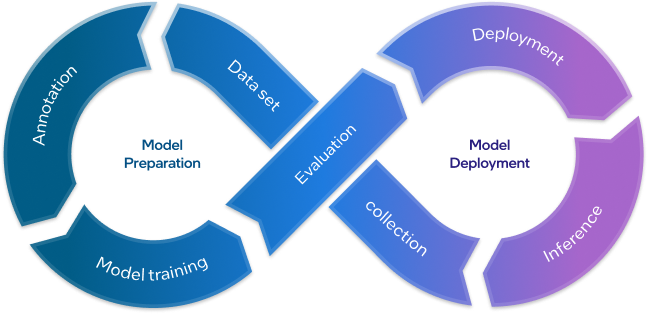
Geti™ - Learning Cycle

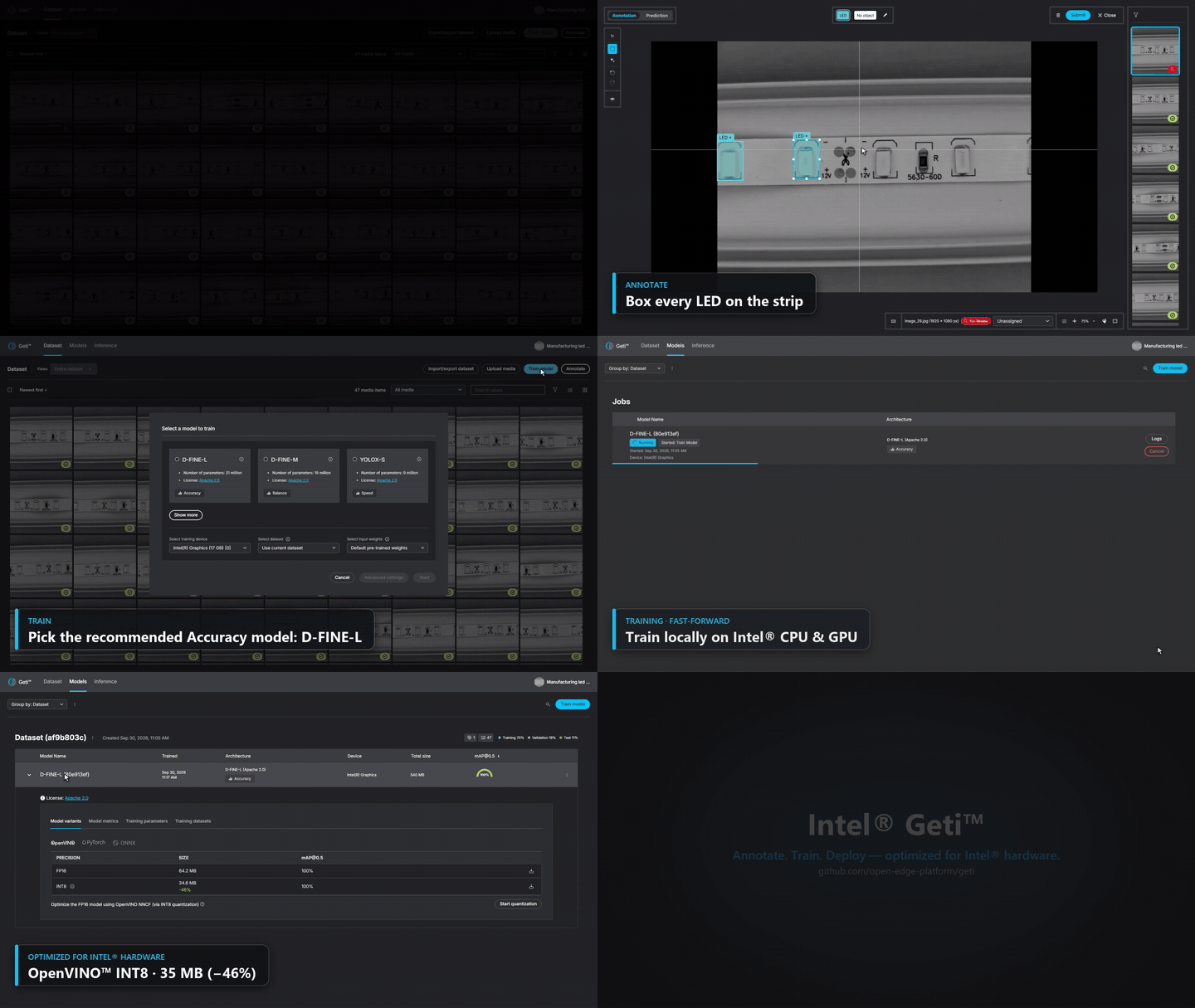
The Geti™ application is powered by **_getitune_**, its engine for model training and optimization, which is also available standalone as a Python library. Choose the application for a no-code experience, or the `getitune` Python API for code-first workflows — both paths lead to production-ready models. Both are developed in this repository, under [`application/`](application/) and [`libraries/getitune/`](libraries/getitune/). ## Full lifecycle with an intuitive SME interface The Geti™ application runs as a native Windows app or a pre-built Docker image for Linux. - Install as a [**Windows application (MSIX)**](application/docs/install.md#windows-app) - Run as a [**Docker container**](application/docs/install.md#run-with-docker) - Install and launch via a [**script**](application/docs/install.md#install-script) - Build and run [**from source**](application/docs/install.md#run-from-source-for-development) (for development) For complete, step-by-step instructions - including prerequisites, GPU/accelerator support, container and source builds, the install script, and troubleshooting - see the [Installation guide](application/docs/install.md). To update an existing Geti™ installation to a newer version, follow the [Upgrade guide](application/docs/upgrade.md).

Build and optimize a model in the Geti™ application

> [!TIP] > The [documentation](https://docs.geti.intel.com/) is a valuable resource to learn more about Geti™ and its capabilities. > New users are encouraged to read the step-by-step tutorial ["Train your first model"](https://docs.geti.intel.com/docs/user-guide/quick-start/training-your-first-model). ## Full lifecycle with a simple Python API Geti's training engine is also available on PyPI as `getitune`, an open-source Python library for training, optimizing, and deploying models.

Train and optimize a model with the getitune Python API

Install getitune and run the demo code ```bash uv pip install "getitune[xpu]" --extra-index-url https://download.pytorch.org/whl/xpu # for Intel® XPU acceleration uv pip install "getitune[cuda]" --extra-index-url https://download.pytorch.org/whl/cu128 # for NVIDIA® CUDA acceleration uv pip install getitune # CPU-only by default ``` > [!IMPORTANT] > **Ultralytics YOLO models** are NOT included in the package by default. To install these models, which are distributed > under the [AGPL-3.0 license](./THIRD-PARTY-NOTICES.md#ultralytics), you must specify the `ultralytics` extra as > explained in the [getitune documentation](https://docs.geti.intel.com/docs/user-guide/library/get-started/installation). **Pick a model, then train, export, and quantize it:** ```python from getitune.engine import create_engine from getitune.utils import list_models # Explore available models to pick the one you need all_models = list_models() # All model names detection_models = list_models(task="DETECTION") # Filter by task recipes = list_models(return_recipes=True) # Full recipe YAML paths # Choose a model and point it at your dataset engine = create_engine( model="edgecrafter_m", data="./led_counting", work_dir="./my_workspace", # checkpoints, exports, and logs device="auto", # "auto", "cpu", "gpu", or "xpu" ) # Train the model on your own Intel CPU or GPU engine.train() # Export the trained model to OpenVINO format (.xml + .bin) exported_model_path = engine.export() # Load the exported model into the OpenVINO engine openvino_engine = create_engine(model=exported_model_path, data=engine.datamodule) # Quantize the model to INT8, optimized for Intel hardware optimized_model_path = openvino_engine.optimize() # Run inference with the optimized INT8 model predictions = openvino_engine.predict(checkpoint=optimized_model_path) ``` See the [getitune documentation](https://docs.geti.intel.com/docs/user-guide/library/get-started/quick-start) for the full list of recipes, advanced configuration, dataset support, backend-specific options, and deployment/optimization examples.
## Key Features
🏆 State-of-the-art model catalog Train and fine-tune modern architectures such as RF-DETR, DINOv3 DETR, YOLO26, YOLOX, D-FINE, and Mask R-CNN. Would you like to see a specific model added? Let us know by opening a [GitHub issue](https://github.com/open-edge-platform/geti/issues)!
Computer Vision Task Model Architecture Paper
Object Detection
Locate and classify objects with bounding boxes. Common use cases: counting items, defect localization, surveillance.
D-FINE M / L / X DEIM + D-FINE
DINOv3 DETR S / M / L DINOv3 + DEIMv2 + DETR
ECDet S / M / L / X EdgeCrafter
MobileNet V2 ATSS MobileNetV2 + ATSS
MobileNet V2 SSD MobileNetV2 + SSD
RF-DETR N / S / M / L RF-DETR
RT-DETR R50 RT-DETR
RT-DETRv2 R18 / R34 / R50 / R101 RT-DETRv2
YOLO11 N / S / M / L / X Ultralytics YOLO11
YOLO12 N / S / M / L / X YOLOv12
YOLO26 N / S / M / L / X YOLO26
YOLOX Tiny / S / L / X YOLOX
Instance Segmentation
Detect objects and produce pixel-precise masks per instance. Common use cases: medical imaging, robotics, area estimation.
EoMT Large 640 EoMT
EoMT-DINOv3 Large 640 DINOv3 + EoMT
Mask2Former Swin-T / S / B / L Mask2Former
Mask-RCNN EfficientNet B2 EfficientNet + Mask R-CNN
Mask-RCNN ResNet50 ResNet + Mask R-CNN
Mask-RCNN Swin-T Swin Transformer + Mask R-CNN
RF-DETR N / S / M / L / XL / 2XL RF-DETR
RTMDet Tiny RTMDet
YOLO11 N / S / M / L / X Ultralytics YOLO11
YOLO26 N / S / M / L / X YOLO26
Classification (multi-class, multi-label)
Assign one or more labels to an entire image. Common use cases: defect classification, product categorization, content tagging.
ConvNeXt T / S / B / L ConvNeXt
ConvNeXt V2 A / B / L ConvNeXt V2
DINOv3 ViT S / B / L DINOv3
DINOv2 Small DINOv2
EfficientNet B0 / B3 EfficientNet
EfficientNet V2 Small EfficientNetV2
MobileNet V3 Large MobileNetV3
ViT Tiny ViT
YOLO26 N / S / M / L / X YOLO26
Other models from timm (1600+ backbones) timm
🔄 Interactive end-to-end model training Geti™ enables users to start building deep-learning computer vision models with as few as 10-20 images and take them to production in one environment - annotate, train, optimize, run inference, and improve accuracy in a rapid train-predict-annotate loop.
⚡ Hardware-accelerated inference & model optimization Every model is automatically exported with [OpenVINO™](https://www.intel.com/content/www/us/en/developer/tools/openvino-toolkit/overview.html) for deployment across the full Intel® XPU portfolio (Arc™ GPUs, Core™ Ultra processors); NVIDIA® CUDA and CPU-only execution are also supported. Fine-tune and run inference directly on edge and client hardware - including Intel® Panther Lake and Arc™ Battlemage (B-series) GPUs - with no Kubernetes cluster or data-center GPU required. Built-in accuracy-aware INT8 quantization further reduces model size and latency on resource-constrained edge devices with minimal impact on accuracy.
🚀 Integrated deployment & inference Build custom pipelines (source → model → sink) to deploy models inside Geti and monitor real-time predictions on video streams. Sources include USB/IP cameras and video files; optional sinks include folder, MQTT, and webhook. Complete pipelines can be exported as OpenVINO™-optimized bundles for edge deployment.
🎨 Multiple computer vision tasks Geti™ supports [multiple computer vision tasks](https://docs.geti.intel.com/docs/user-guide/learn-geti/computer-vision-tasks/ai-fundamentals-tasks) that are commonly employed across various use cases - image classification, object detection and instance segmentation from the no-code web interface, with even more tasks available through the `getitune` library.
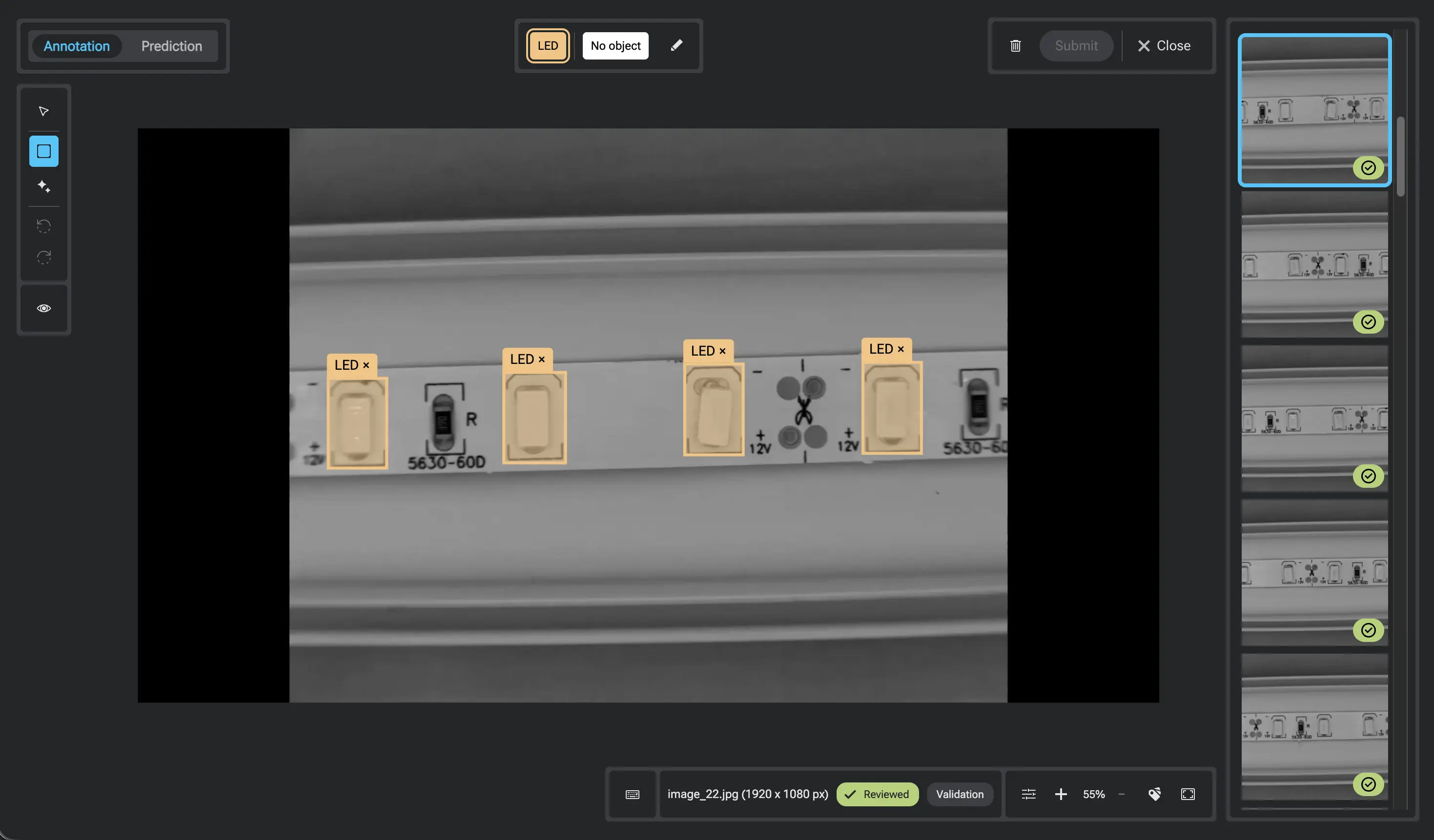
🧠 Smart annotations Smart annotations in Geti™ enable users to easily create bounding boxes and polygons. These smart annotation features coupled with the AI-assisted annotations and state-of-the-art AI models such as the Segment Anything Model keep human experts in the loop while massively reducing the total annotation efforts needed by a human.

Smart Annotations

📦 Model & dataset management Track how datasets and models evolve, link models to a specific dataset revision, view exact training hyperparameters, and fine-tune from any previous version. Import and export in COCO, Pascal VOC, YOLO, and a Geti-optimized native format, with label filtering to selectively include or exclude labels on import/export.
## Ecosystem Explore other open-source AI projects by Intel®: - [Anomalib](https://github.com/open-edge-platform/anomalib) - An anomaly detection suite comprising state-of-the-art algorithms and features such as experiment management, hyper-parameter optimization and edge inference. - [Instant Learn](https://github.com/open-edge-platform/instant-learn) - A framework for developing, benchmarking, and deploying zero-shot visual prompting algorithms on the edge. - [Datumaro](https://github.com/open-edge-platform/datumaro) - Dataset Management Framework, a Python library and a CLI tool to build, analyze and manage Computer Vision datasets. - [OpenVINO™](https://github.com/openvinotoolkit/openvino) - Software toolkit for optimizing and deploying deep learning models. - [OpenVINO™ Model Server](https://github.com/openvinotoolkit/model_server) - A scalable inference server for models optimized with OpenVINO™. - [Model API](https://github.com/open-edge-platform/model_api) - A set of wrapper classes for particular tasks and model architectures, simplifying data preprocessing and postprocessing as well as routine procedures. - [Physical AI Studio](https://github.com/open-edge-platform/physical-ai-studio) - An end-to-end framework for teaching robots to perform tasks through imitation learning from human demonstrations. ## Who uses Geti™? Geti™ is used by research institutes, industrial partners, universities and AI enthusiasts. Applications range from robotics to medical analysis or industrial quality control. There are some interesting members of the Geti™ community: - [Intel Foundry](https://medium.com/open-edge-platform/solving-silicon-foundry-woes-with-ai-vision-geti-and-a-robotic-dog-a8382b5d9267) - [Royal Brompton and Harefield hospitals](https://www.rbht.nhs.uk/artificial-intelligence-theme-new-trust-led-research) - [WSC Sports](https://www.linkedin.com/posts/wsc-sports-technologies_revolutionizing-sports-broadcasting-with-activity-7161419649878773761-cUM3/) - [Dell NativeEdge](https://infohub.delltechnologies.com/en-us/p/transforming-edge-ai-with-continuous-learning-meet-intel-geti-and-openvino-on-dell-nativeedge/) - [Bravent](https://www.linkedin.com/posts/bravent_intelgeti-openvino-manufacturing-activity-7214544905086390272-H19g/) - [ASRock Industrial](https://www.asrockind.com/en-gb/article/176) - [PeopleSense.AI](https://community.intel.com/t5/Blogs/Tech-Innovation/Artificial-Intelligence-AI/Intel-Liftoff-Days-2024-Highlights-from-the-Third-Edition/post/1661265) - [Capgemini](https://www.capgemini.com/insights/expert-perspectives/capgemini-and-intel-corporation-redefining-the-future-of-robotics-and-physical-ai/) ## Contribute To report a bug or submit a feature request, please open a [GitHub issue](https://github.com/open-edge-platform/geti/issues). If you have an open question, ask in [GitHub Discussions](https://github.com/open-edge-platform/geti/discussions). For developers who would like to contribute with a pull request, see the [Contributing guide](CONTRIBUTING.md) for details.

Thank you 👏 to all our contributors!

Contributors ## License Geti™ source code is licensed under the [Apache License Version 2.0](LICENSE). Docker images contain Geti™ components licensed under Apache 2.0 and may also contain third-party components governed by different license terms, listed separately in [this file](THIRD-PARTY-NOTICES.md). The Windows MSIX App is licensed under the [Intel Simplified Software License](https://software.intel.com/sites/landingpage/pintool/intel-simplified-software-license.txt). Regarding models trained with Geti™, their license depends on the model type and is indicated within the application; most are licensed under Apache 2.0, while some fall under more restrictive licenses (e.g. [Ultralytics AGPL3.0 models](./THIRD-PARTY-NOTICES.md#ultralytics)). It is the end user's responsibility to ensure that the specific use of Geti™ and the models complies with the respective licenses.