OpenMeter logo # OpenMeter **Meter usage. Enforce access. Bill customers. Keep the stack yours.** OpenMeter is open-source monetization infrastructure built for AI, API, and usage-based products. It turns high-volume events into real-time usage, powers access enforcement, and handles usage-based billing from pricing and subscriptions through credits and invoices. API-first and composable, it can own the path from raw usage to invoice—or only the parts your stack is missing—and work with the payment and tax providers you already use. [Quickstart](#quickstart) · [Documentation](https://openmeter.io/docs) · [API reference](https://openmeter.io/docs/api/open-source) · [Community](https://github.com/openmeterio/openmeter/discussions) [![GitHub Release](https://img.shields.io/github/v/release/openmeterio/openmeter?style=flat-square)](https://github.com/openmeterio/openmeter/releases/latest) [![CI Status](https://img.shields.io/github/actions/workflow/status/openmeterio/openmeter/ci.yaml?style=flat-square)](https://github.com/openmeterio/openmeter/actions/workflows/ci.yaml) [![License](https://img.shields.io/github/license/openmeterio/openmeter?style=flat-square)](LICENSE)


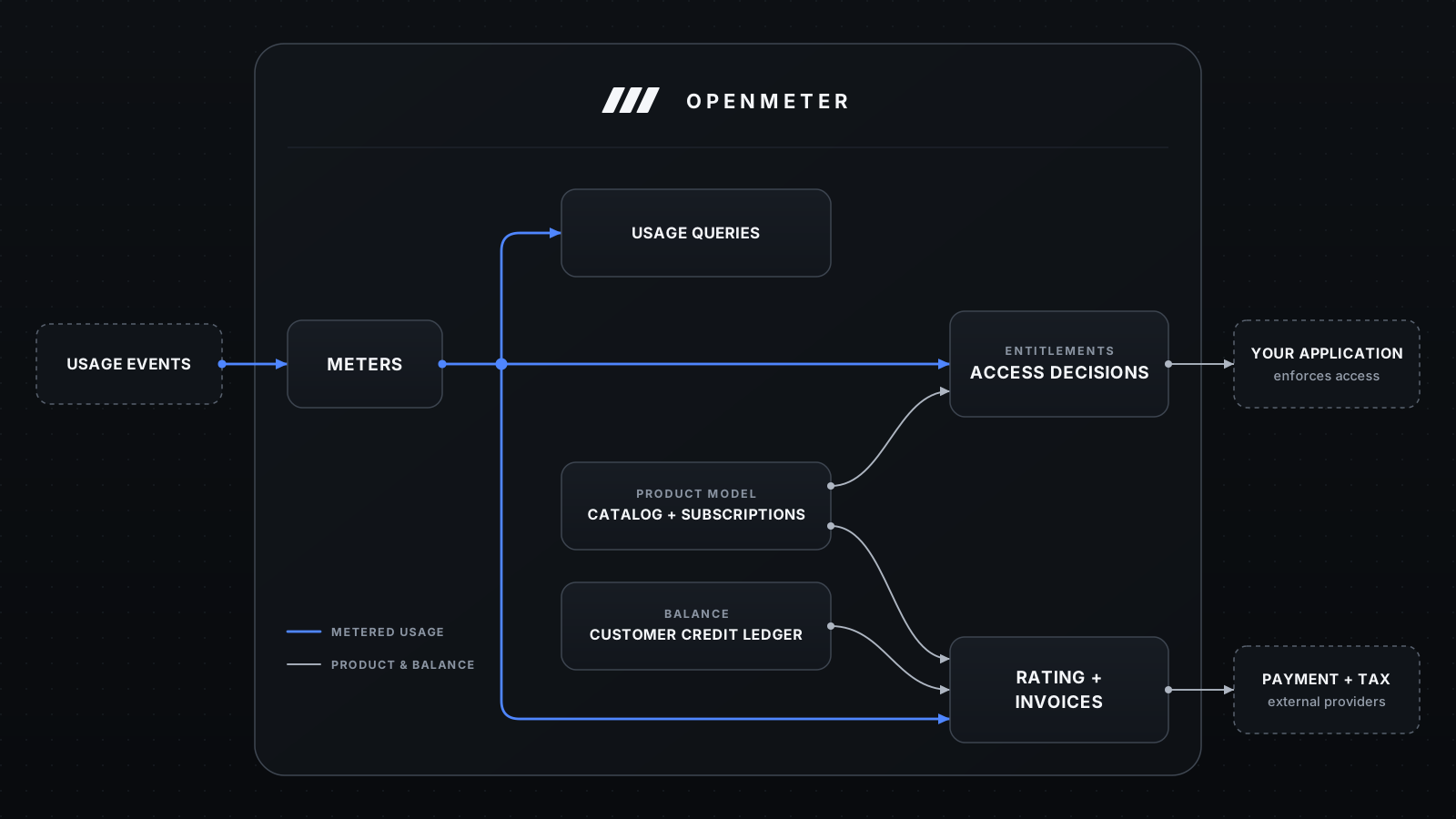
## How it fits together ![Usage events flow through OpenMeter's meters into queries, access decisions, and billing](assets/how-openmeter-works.svg) ## Is OpenMeter a fit? | Question | Answer | | --- | --- | | **What is it best for?** | Products with usage-based or hybrid pricing, prepaid credits, or usage limits that need one source of truth for consumption. | | **What is it not?** | A bundled operator UI, payment processor, tax engine, or general-purpose accounting system. If you only need fixed recurring subscriptions, a direct payment-provider integration is usually simpler. | | **How mature is it?** | Releases are beta and can include breaking changes. The [OpenMeter metering engine](https://openmeter.io/) has run in production for years and processed billions of usage events. Review [releases](https://github.com/openmeterio/openmeter/releases) and [migration guides](docs/migration-guides) when upgrading. | ## What OpenMeter provides | Capability | What it covers | | --- | --- | | **[Meter usage](https://openmeter.io/docs/metering/overview)** | Ingest CloudEvents, attribute usage to customers, aggregate it in real time, and query it by time window or dimension. | | **[Model products and pricing](https://openmeter.io/docs/product-catalog/overview)** | Define versioned plans, features, add-ons, and flat, recurring, per-unit, tiered, package, or dynamic prices; then assign customer subscriptions. | | **[Control access](https://openmeter.io/docs/billing/entitlements/overview)** | Calculate feature access and usage-limit balances for your application to enforce, with one-time or recurring entitlement grants. | | **[Bill usage](https://openmeter.io/docs/billing/overview)** | Rate flat and usage-based charges, manage customer credit balances and subscription changes, and run the invoice lifecycle. | | **[Integrate](https://openmeter.io/docs/api/open-source)** | Use the OSS REST API and JavaScript, Python, or Go SDKs, send webhooks, and connect external invoicing providers. | ## Quickstart The local evaluation stack requires [Git](https://git-scm.com/) and [Docker with Compose](https://docs.docker.com/compose/). Use `curl`, Node.js 22+, or Python 3.9+ for the examples below. ```sh git clone https://github.com/openmeterio/openmeter.git cd openmeter/quickstart docker compose up -d --wait ``` The stack includes an `api_requests_total` meter. Choose a client below; each example sends one `request` event and queries its metered value.
Bash (curl) ```sh curl -sS -o /dev/null -w '%{http_code}\n' \ -X POST http://localhost:48888/api/v1/events \ -H 'Content-Type: application/cloudevents+json' \ --data-raw '{ "specversion": "1.0", "type": "request", "id": "readme-curl-1", "source": "readme", "subject": "readme-curl", "data": { "method": "GET", "route": "/hello" } }' response= for attempt in 1 2 3 4 5 6 7 8 9 10; do response=$(curl -fsS 'http://localhost:48888/api/v1/meters/api_requests_total/query?subject=readme-curl') printf '%s' "$response" | grep -q '"value":1' && break sleep 1 done printf '%s\n' "$response" ```
TypeScript SDK Install the [OpenMeter TypeScript SDK](https://www.npmjs.com/package/@openmeter/sdk): ```sh npm install @openmeter/sdk tsx ``` Save as `quickstart.ts`, then run `npx tsx quickstart.ts`: ```ts import { OpenMeter } from '@openmeter/sdk' const openmeter = new OpenMeter({ baseUrl: 'http://localhost:48888' }) const queryUsage = () => openmeter.meters.query('api_requests_total', { subject: ['readme-typescript'], }) async function main() { await openmeter.events.ingest({ type: 'request', id: 'readme-typescript-1', source: 'readme', subject: 'readme-typescript', data: { method: 'GET', route: '/hello' }, }) let usage = await queryUsage() for (let attempt = 1; usage.data[0]?.value !== 1 && attempt < 10; attempt++) { await new Promise((resolve) => setTimeout(resolve, 1000)) usage = await queryUsage() } if (usage.data[0]?.value !== 1) { throw new Error('usage was not processed in time') } console.log(usage.data[0].value) } main().catch((error) => { console.error(error) process.exitCode = 1 }) ```
Python SDK The Python SDK is in preview, so install it with pre-releases enabled: ```sh python -m pip install --pre openmeter ``` Save as `quickstart.py`, then run `python quickstart.py`: ```python import time from openmeter import Client from openmeter.models import Event with Client(endpoint="http://localhost:48888") as openmeter: openmeter.events.ingest_event( Event( id="readme-python-1", source="readme", specversion="1.0", type="request", subject="readme-python", data={"method": "GET", "route": "/hello"}, ) ) for _ in range(10): usage = openmeter.meters.query_json( "api_requests_total", subject=["readme-python"], ) if usage.data and usage.data[0].value == 1: break time.sleep(1) else: raise RuntimeError("usage was not processed in time") print(usage.data[0].value) ```
Event processing is asynchronous. A successful example ends with a metered value of `1`. > [!NOTE] > This Compose setup is a local evaluation stack. It runs the OpenMeter API and > workers together with Kafka, ClickHouse, PostgreSQL, Redis, and Svix using > `latest` OpenMeter images; it is not a production topology. Continue with the [full OSS quickstart](quickstart/README.md), try a [metering example](https://openmeter.io/docs/metering/guides/common-examples), add [entitlements and usage limits](https://openmeter.io/docs/billing/entitlements/quickstart), or model [plans and subscriptions](https://openmeter.io/docs/product-catalog/overview). When you are done, remove the containers and their local data volumes: ```sh docker compose down -v ``` ## Running OpenMeter The core runtime is OpenMeter's API and worker processes plus Kafka, ClickHouse, and PostgreSQL. Redis is optional for distributed deduplication and query progress; Svix is used when webhook delivery is enabled. The [architecture guide](https://openmeter.io/docs/open-source/architecture) explains the complete runtime and data flow. The official [Helm chart for Kubernetes](https://openmeter.io/docs/open-source/kubernetes) is intended for development deployments, not production. ## Project and community | Need | Go to | | --- | --- | | Ask a question or discuss an approach | [GitHub Discussions](https://github.com/openmeterio/openmeter/discussions) | | Report a reproducible bug or request a feature | [GitHub Issues](https://github.com/openmeterio/openmeter/issues) | | Track changes | [Releases](https://github.com/openmeterio/openmeter/releases) and [migration guides](docs/migration-guides) | | Report a vulnerability | [Security policy](SECURITY.md) | | Build or contribute | [Contributing guide](CONTRIBUTING.md) and [Code of Conduct](CODE_OF_CONDUCT.md) | ## License OpenMeter is licensed under the [Apache License 2.0](LICENSE).