# Requirements Analyzer
[简体中文](README.zh-CN.md) · [How it works](HOW_IT_WORKS.md) · [Known limitations](KNOWN_LIMITATIONS.md)
Quality-and-risk analysis of **requirement documents**. It audits sources, finds gaps and conflicts, and writes one register with executable P0 / P1 verification.
What the register looks like:
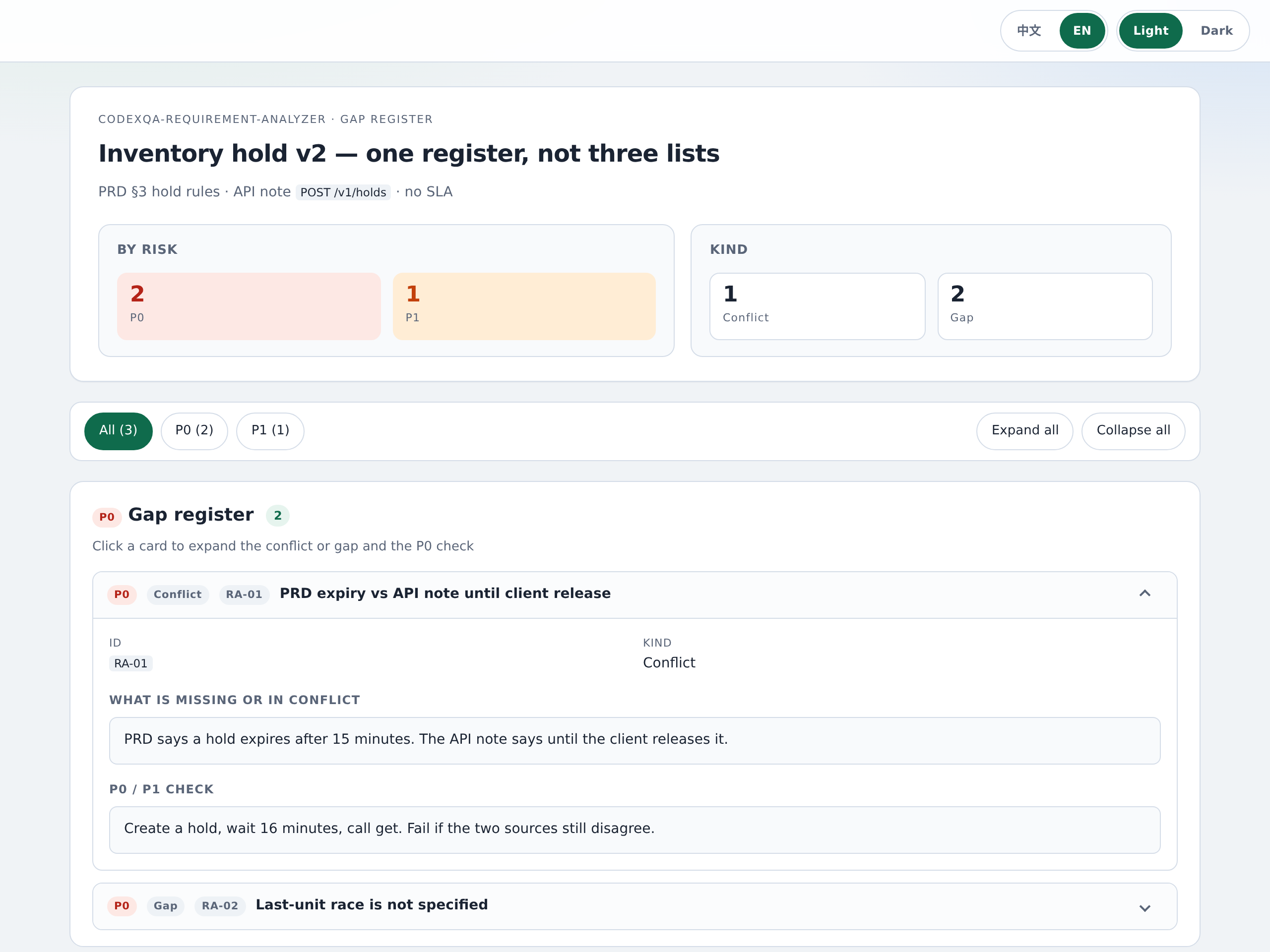
It is **not** [`codexqa-testcase-generator`](https://github.com/openqa-cn/codexqa/blob/main/skills/codexqa-testcase-generator/README.md). That skill writes test plans and manual cases from local requirements (files, paste, or HTTPS docs). This skill reviews whether the requirements themselves are complete, consistent, and testable.
## What you give it
**Documents, not a git clone.**
| Job | Bring |
|---|---|
| Analyze one PRD | The requirement text (file, paste, or URL the agent can fetch) |
| Multi-source pack | PRD plus stories / API notes / scope / plan. Optional role reports with `source_role` |
| Incomplete pack | Whatever you have. The run still ships a first draft and marks gaps |
No application `code/`. No clone URL. Do not ask this skill to invent endpoints, SLAs, or whether the feature is worth building.
## What it does
1. Intake and a short-input gate.
2. Structure inventory, source audit, smells, NFR and success-metrics grids.
3. One gap / conflict register (`RA-xx`) with risk and testability.
4. P0 / P1 items get verification fields (preconditions, stimulus, expected, evidence).
Default output is Markdown. Excel / CSV / JSON / Word only when you ask (`output-formats.md`). Helper scripts live in `scripts/` (`npx --yes tsx scripts/run_analysis.ts --input `).
There is no recorded host-agent score. See [KNOWN_LIMITATIONS.md](KNOWN_LIMITATIONS.md).
```
codexqa-requirement-analyzer/
├── SKILL.md # agent entry
├── prompts/ # analysis quality bar (agent)
├── references/ # grids loaded on demand
├── examples/ # generic inventory-hold samples
├── evals/ # skill-up cases; not a published accuracy score
├── scripts/ # parse / convert helpers
├── HOW_IT_WORKS.md
└── KNOWN_LIMITATIONS.md
```
## Install
```bash
npx skills add openqa-cn/codexqa --skill codexqa-requirement-analyzer
```
Start a **new** agent session.
## What you can say to the Agent
```text
Analyze these requirement documents with codexqa-requirement-analyzer.
Produce one gap/conflict register. P0 items must include verification fields.
Do not invent endpoints or SLAs that are not in the source.
```
A two-source conflict (from `quick-start.md`):
```text
Source A (PRD): submit is allowed when stock is insufficient; reserve later.
Source B (API): insufficient stock returns 400 and must not create an order.
Run codexqa-requirement-analyzer. Mark the conflict; do not pick a winner.
```
## License
Apache-2.0, same as this repository.