# Subgraph Registry
 Agent-friendly semantic classification of all subgraphs on [The Graph Network](https://thegraph.com).
Pre-computed index of **15,330 subgraphs** with domain classification, protocol type detection, schema fingerprinting, canonical entity mapping, and composite reliability scoring.
> **What's new in 0.8.0** — three agent-discovery upgrades:
> - **[Semantic search](#semantic-search)** via 384-dim embeddings (`semantic_search_subgraphs`)
> - **[Schema evolution tracking](#schema-evolution)** with stability days surfaced on every result (`get_schema_changes`)
> - **[OpenAPI 3.1 spec](#openapi)** auto-generated for MCP tools + REST routes, served at `/.well-known/openapi.json`
## The Problem
Agents querying The Graph need to discover and select the right subgraph before they can query data. Today this requires 3-4 tool calls (search, check volumes, fetch schema, infer structure) before any real work happens. This registry flips that: agents start with structured knowledge, not a blank slate.
## What It Does
1. **Crawls** all active subgraphs from the Graph Network meta-subgraph
2. **Fetches** the GraphQL schema for every deployment
3. **Extracts contract addresses** from each manifest's `dataSources` and `templates` — agents can answer "which subgraph indexes contract 0x… on chain X?"
4. **Generates a per-subgraph starter GraphQL query** from the parsed schema (real top entity, real fields, sensible orderBy) — no more generic boilerplate that doesn't compile against most subgraphs
5. **Classifies** each subgraph by domain, protocol type, canonical entities, and schema family
6. **Scores** reliability using on-chain signals (query fees, volume, curation, stake)
7. **Returns x402 + legacy query URLs** — agents can pay $0.01 USDC on Base per query (no API key) or use a Studio key
8. **Publishes** as SQLite database + REST API + MCP server + **per-subgraph JSON-LD at `/.well-known/subgraph/{id}.jsonld`** for ecosystem crawlers
9. **Generates** visual dashboards and bot-readable category files (auto-updated with each sync)
---
## Querying with x402 (no API key)
Every result includes `query_url_x402` alongside the legacy `query_url`. The Graph's public x402 gateway (live since 2026-05-08) accepts **$0.01 USDC on Base** per query with zero signup.
```js
// An x402-native agent — discovery to data in two calls
const { recommendations } = await mcp.call("recommend_subgraph", {
goal: "find DEX trades on Arbitrum",
});
const top = recommendations[0];
// POST your GraphQL query. The first call returns HTTP 402 with a
// base64 `payment-required` header; the x402 client signs the
// EIP-3009 USDC transfer on Base and retries automatically.
const data = await x402Fetch(top.query_url_x402, {
method: "POST",
body: JSON.stringify({ query: "{ swaps(first: 5) { id amountUSD } }" }),
});
```
Pricing manifest returned per subgraph:
```json
{
"amount_usd": 0.01,
"asset": "USDC",
"asset_contract": "0x833589fCD6eDb6E08f4c7C32D4f71b54bdA02913",
"chain": "base",
"network": "eip155:8453",
"pay_to": "0x79DC34E41B2b591078d3dE222C43EcaaBD52FcCB",
"scheme": "exact",
"asset_transfer_method": "eip3009"
}
```
Client libraries: [`@graphprotocol/client-x402`](https://www.npmjs.com/package/@graphprotocol/client-x402), `x402-fetch`, or any generic x402 wrapper.
---
## Registry at a Glance
Agent-friendly semantic classification of all subgraphs on [The Graph Network](https://thegraph.com).
Pre-computed index of **15,330 subgraphs** with domain classification, protocol type detection, schema fingerprinting, canonical entity mapping, and composite reliability scoring.
> **What's new in 0.8.0** — three agent-discovery upgrades:
> - **[Semantic search](#semantic-search)** via 384-dim embeddings (`semantic_search_subgraphs`)
> - **[Schema evolution tracking](#schema-evolution)** with stability days surfaced on every result (`get_schema_changes`)
> - **[OpenAPI 3.1 spec](#openapi)** auto-generated for MCP tools + REST routes, served at `/.well-known/openapi.json`
## The Problem
Agents querying The Graph need to discover and select the right subgraph before they can query data. Today this requires 3-4 tool calls (search, check volumes, fetch schema, infer structure) before any real work happens. This registry flips that: agents start with structured knowledge, not a blank slate.
## What It Does
1. **Crawls** all active subgraphs from the Graph Network meta-subgraph
2. **Fetches** the GraphQL schema for every deployment
3. **Extracts contract addresses** from each manifest's `dataSources` and `templates` — agents can answer "which subgraph indexes contract 0x… on chain X?"
4. **Generates a per-subgraph starter GraphQL query** from the parsed schema (real top entity, real fields, sensible orderBy) — no more generic boilerplate that doesn't compile against most subgraphs
5. **Classifies** each subgraph by domain, protocol type, canonical entities, and schema family
6. **Scores** reliability using on-chain signals (query fees, volume, curation, stake)
7. **Returns x402 + legacy query URLs** — agents can pay $0.01 USDC on Base per query (no API key) or use a Studio key
8. **Publishes** as SQLite database + REST API + MCP server + **per-subgraph JSON-LD at `/.well-known/subgraph/{id}.jsonld`** for ecosystem crawlers
9. **Generates** visual dashboards and bot-readable category files (auto-updated with each sync)
---
## Querying with x402 (no API key)
Every result includes `query_url_x402` alongside the legacy `query_url`. The Graph's public x402 gateway (live since 2026-05-08) accepts **$0.01 USDC on Base** per query with zero signup.
```js
// An x402-native agent — discovery to data in two calls
const { recommendations } = await mcp.call("recommend_subgraph", {
goal: "find DEX trades on Arbitrum",
});
const top = recommendations[0];
// POST your GraphQL query. The first call returns HTTP 402 with a
// base64 `payment-required` header; the x402 client signs the
// EIP-3009 USDC transfer on Base and retries automatically.
const data = await x402Fetch(top.query_url_x402, {
method: "POST",
body: JSON.stringify({ query: "{ swaps(first: 5) { id amountUSD } }" }),
});
```
Pricing manifest returned per subgraph:
```json
{
"amount_usd": 0.01,
"asset": "USDC",
"asset_contract": "0x833589fCD6eDb6E08f4c7C32D4f71b54bdA02913",
"chain": "base",
"network": "eip155:8453",
"pay_to": "0x79DC34E41B2b591078d3dE222C43EcaaBD52FcCB",
"scheme": "exact",
"asset_transfer_method": "eip3009"
}
```
Client libraries: [`@graphprotocol/client-x402`](https://www.npmjs.com/package/@graphprotocol/client-x402), `x402-fetch`, or any generic x402 wrapper.
---
## Registry at a Glance
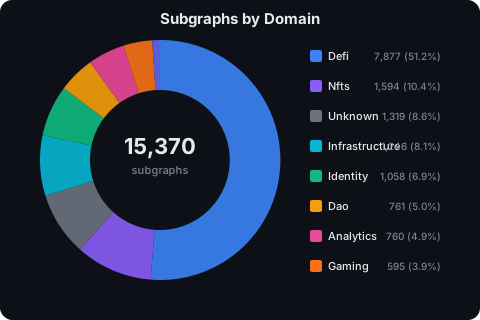
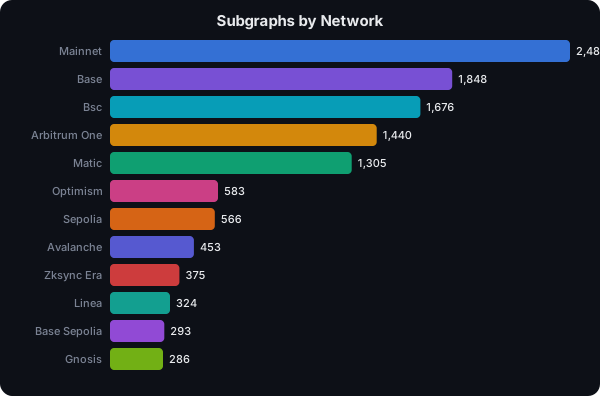
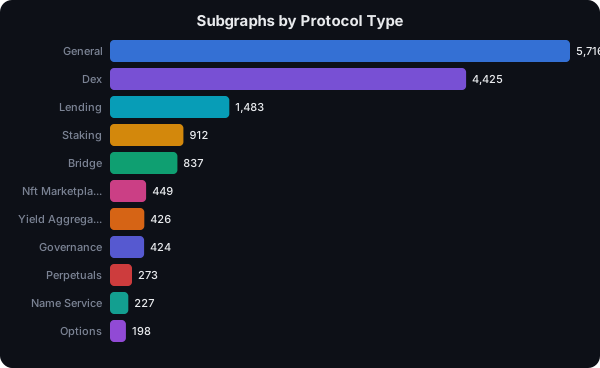
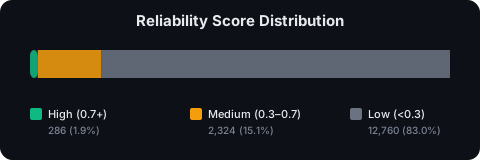
> Charts auto-generated from `registry.db` on each sync. See [`python/generate_docs.py`](python/generate_docs.py).
---
## Browse by Category
### Domains
Explore subgraphs by use case — each file lists the top 25 subgraphs ranked by reliability score.
| Domain | Count | File |
|--------|-------|------|
| [DeFi](docs/domains/defi.md) | 7,844 | Swaps, pools, lending, vaults, yield |
| [NFTs](docs/domains/nfts.md) | 1,565 | Collections, marketplaces, sales |
| Unclassified | 1,333 | Not confidently classified |
| [Infrastructure](docs/domains/infrastructure.md) | 1,251 | Indexers, oracles, registries |
| [Identity](docs/domains/identity.md) | 1,061 | ENS, name services, resolvers |
| [Analytics](docs/domains/analytics.md) | 766 | Snapshots, metrics, historical data |
| [DAO](docs/domains/dao.md) | 758 | Governance, proposals, voting |
| [Gaming](docs/domains/gaming.md) | 585 | Players, quests, items, worlds |
| [Social](docs/domains/social.md) | 167 | Profiles, posts, follows |
Full index: [`docs/DOMAINS.md`](docs/DOMAINS.md)
### Networks
Explore subgraphs by blockchain — each file lists the top 25 subgraphs on that chain.
| Network | Count | File |
|---------|-------|------|
| [Ethereum](docs/networks/mainnet.md) | 2,484 | Largest ecosystem |
| [Base](docs/networks/base.md) | 1,841 | Fast-growing L2 |
| [BSC](docs/networks/bsc.md) | 1,670 | BNB Chain |
| [Arbitrum](docs/networks/arbitrum-one.md) | 1,437 | Leading L2 |
| [Polygon](docs/networks/matic.md) | 1,304 | Polygon PoS |
| [Optimism](docs/networks/optimism.md) | 580 | OP Stack L2 |
| [Avalanche](docs/networks/avalanche.md) | 453 | C-Chain |
Full index: [`docs/NETWORKS.md`](docs/NETWORKS.md)
### Protocol Types
| Type | Count | Description |
|------|-------|-------------|
| DEX | 4,411 | Uniswap, Sushi, Curve, Balancer, PancakeSwap |
| Lending | 1,469 | Aave, Compound, Morpho, Spark, Silo |
| Staking | 898 | Lido, Rocket Pool, EigenLayer, Graph Network |
| Bridge | 836 | Hop, Stargate, Across, Wormhole, LayerZero |
| NFT Marketplace | 450 | OpenSea, Blur, Rarible, Foundation |
| Yield Aggregator | 425 | Yearn, Beefy, Harvest, Convex |
| Governance | 425 | Snapshot, Tally, Compound Governor |
| Perpetuals | 273 | GMX, Gains, dYdX, Hyperliquid |
| Name Service | 227 | ENS, Space ID, Unstoppable Domains |
| Options | 192 | Premia, Dopex, Lyra, Hegic |
---
## Reliability Score
Each subgraph gets a composite reliability score (0-1) based on four on-chain signals:
| Signal | Weight | What it measures |
|--------|--------|------------------|
| **Query Fees** | 30% | GRT fees earned from actual usage |
| **Query Volume** | 30% | 30-day query count |
| **Curation Signal** | 20% | GRT tokens curated by the community |
| **Indexer Allocation** | 20% | GRT allocated to this subgraph by indexers |
All values are log-scaled and capped at 1.0. A 0.5 penalty is applied if the subgraph has been denied/deprecated.
**Score tiers:** High (0.7+) = strong signal, real usage | Medium (0.3-0.7) = functional, some activity | Low (<0.3) = minimal signal or test deployment
### The score measures traction, so it measures age
All four inputs are cumulative — fees and curation accrue, volume needs 30 days
to exist at all. A subgraph deployed last month therefore scores near zero no
matter how good it is. Measured on the current corpus (served, non-denied):
| Age | Count | Avg reliability |
|-----|-------|-----------------|
| < 30 days | 64 | 0.107 |
| 30–90 days | 227 | 0.143 |
| 90–365 days | 1,100 | 0.225 |
| > 1 year | 4,034 | 0.313 |
The newest subgraph anywhere in the registry's top 25 is **280 days old** — yet
59 of those 64 sub-30-day subgraphs are already serving real query volume.
Rather than reweight the score and trade a measurable signal for a guess,
`search_subgraphs` returns young matches in a **separate `emerging` list**
alongside an `emerging_caveat` explaining that a low score at that age is
expected rather than damning. Every result also carries `age_days` and
`maturity` (`new` < 30d, `emerging` < 90d, `established`). This matters most
for new chains and new protocols, where no mature deployment *can* exist —
searching "perpetual futures" surfaces years-old Ethereum and BSC deployments
in the main list and the 40-day-old Monad perps subgraph under `emerging`.
`semantic_search_subgraphs` ranks by cosine similarity rather than reliability,
so it is already age-neutral — it carries the `maturity` labels but no
`emerging` list, because a three-week-old subgraph can top it on merit.
### Ranking
Three tools rank, and each ranks differently on purpose:
- **`search_subgraphs`** — orders by how many of your query terms matched, then
by reliability. OR-ing the terms and ordering on reliability alone meant a
popular subgraph matching one incidental word beat a precise match on all
three, so being *more* specific returned worse answers. Version tokens
(`v2`, `v3`, `v4`) are kept rather than dropped as too short.
- **`semantic_search_subgraphs`** — orders by `semantic_score × (0.5 + 0.5 ×
reliability)`. Pure cosine put testnets first, since their text is nearly
identical to mainnet's. The 0.5 floor keeps new subgraphs competitive.
- **`recommend_subgraph`** — infers domain and protocol type from the goal, but
as a *ranking bonus*, never a filter. As a filter, one bad keyword collapsed
the candidate pool to nothing.
A term matching a subgraph's **name** counts for more than one matching its
description — `%ens%` also matches "tok**ens**", so equal weighting handed a
search for `ens` to four Uniswap subgraphs.
Chain names are aliased, so `ethereum`, `arbitrum`, `polygon` and `bnb` resolve
to the corpus values `mainnet`, `arbitrum-one`, `matic` and `bsc`.
### Testnets
723 of the 5,425 served subgraphs are on testnets, and their text is nearly
identical to their mainnet twins', so they compete for the top slot. They are
**excluded by default** and every result carries `testnet: true|false`. Pass
`include_testnets: true` to see them — and an explicit request for a testnet
network (`network: "sepolia"`) always wins over the default, so that still
returns exactly what you asked for.
## Using the registry from payql
[`payql`](https://www.npmjs.com/package/payql) can use this registry as its
free discovery source instead of paying for a network-subgraph query. Run the
registry's HTTP transport and point payql at it:
```bash
npx subgraph-registry-mcp --http-only # serves :3848
PAYQL_REGISTRY_URL=http://127.0.0.1:3848/graphql npx -y payql
```
`POST /graphql` answers in the Graph network subgraph's `subgraphMetadataSearch`
shape, which is what payql already parses — so this needs no change on payql's
side, and discovery becomes free and locally-ranked.
### Denied deployments
Curation-denied deployments (`deniedAt > 0` — denied indexing rewards, usually
spam, duplicates or deprecations) are **excluded by default** from
`search_subgraphs`, `semantic_search_subgraphs` and `recommend_subgraph`. Pass
`include_denied: true` to the two search tools to see them; every result then
carries `denied: true|false` so the choice stays visible.
---
## MCP Server
The registry is available as an MCP server with **dual transport** — stdio for local clients and SSE/HTTP for remote agents.
Same abilities as [graphops/subgraph-mcp](https://github.com/graphops/subgraph-mcp) (hosted SSE `https://subgraphs.mcp.thegraph.com/sse`), **better discovery**. Schema, execute, contract-lookup and 30-day counts use the **official tool names** so an agent can swap connectors. Search stays on our names (`search_subgraphs`, `recommend_subgraph`, `semantic_search_subgraphs`) because they already beat official `search_subgraphs_by_keyword` (reliability, real `query_volume_30d`, network).
Official workflow says ALWAYS call `get_deployment_30day_query_counts` before selecting. **Skip that extra round-trip here** — every search/recommend hit already carries `query_volume_30d`. The counts tool still exists under the official name and reads those same registry figures. Official counts have been observed returning 0 for ENS, Lido and Uniswap; we do not copy those zeros.
> The shipped server is the Node implementation in [`src/index.js`](src/index.js); that's what `npx subgraph-registry-mcp` runs and what's published to npm. A Python equivalent in [`python/mcp_server.py`](python/mcp_server.py) is kept for local development against the same SQLite database — bug fixes and new tools should land in the Node version first.
**Discovery tools (never execute GraphQL, never introspect live schemas):**
- **search_subgraphs** — filter by domain, network, protocol type, entity, or keyword. Ranked by matched terms, reliability and real `query_volume_30d`.
- **recommend_subgraph** — natural language goal to best subgraphs (includes `schema_stable_days`)
- **semantic_search_subgraphs** — vector-similarity search over precomputed embeddings (sentence-transformers/all-MiniLM-L6-v2, 384-dim). Use for fuzzy/paraphrased goals where literal keyword match would miss.
- **get_subgraph_detail** — full classification for a specific subgraph (includes `schema_changed_at` and crawled `contract_addresses`)
- **list_registry_stats** — registry overview (domains, networks, counts)
- **get_schema_changes** — chronological schema-fingerprint history for a subgraph (one row per detected change). Helps agents prefer mature subgraphs whose data contract has been stable.
**Opt-in query / schema (caller must invoke; search never auto-queries). Official names for connector swap-in:**
- **execute_query_by_subgraph_id** / **execute_query_by_deployment_id** / **execute_query_by_ipfs_hash** — POST GraphQL to The Graph gateway. Same routing as official (`subgraphs/id` vs `deployments/id`). Requires `THE_GRAPH_STUDIO_API_KEY` (or `GATEWAY_API_KEY`). Without a key, returns `{error: credentials_required, query_url, query_url_x402, hint}` immediately — no hang, no x402 auto-pay. Convenience superset: **execute_query** accepts `id` OR `deployment_id` OR `ipfs_hash`.
- **get_schema_by_subgraph_id** / **get_schema_by_deployment_id** / **get_schema_by_ipfs_hash** — local `registry_schema` (entities, example_query, fingerprint) with no network when the subgraph is in the corpus; live `__schema` introspection only when a Studio key is set. Convenience superset: **get_schema**.
- **get_top_subgraph_deployments(contract_address, chain)** — official name. Official `chain` is graph-node ids (`mainnet`, not `ethereum`); we accept both. Top 3 from crawled manifests, ranked by reliability then real 30-day volume (not official query-fees / 0-count oracle). Substreams-powered subgraphs often have no dataSources addresses — that gap is reported, not faked.
- **get_deployment_30day_query_counts** — official name, `ipfs_hashes` in. Real registry `query_volume_30d`. Unknown hashes return `not_in_registry` rather than a fake 0. Usually unnecessary: the same number is already on every search hit.
Set `THE_GRAPH_STUDIO_API_KEY` in the MCP host env to enable execute/live-schema. No private key is bundled. The keyed gateway often returns HTTP 200 with a GraphQL error body when auth is missing — `execute_query` surfaces `http_status` and `errors` honestly.
### Install
```bash
# Claude Code
claude mcp add subgraph-registry -- npx subgraph-registry-mcp
# Claude Desktop
{
"mcpServers": {
"subgraph-registry": {
"command": "npx",
"args": ["subgraph-registry-mcp"],
"env": {
"THE_GRAPH_STUDIO_API_KEY": "your-studio-key"
}
}
}
}
# Remote agents (SSE)
npx subgraph-registry-mcp --http-only
# Then connect to http://localhost:3848/sse
```
The server auto-downloads the pre-built registry (8MB SQLite) from GitHub on first run.
---
## Well-Known JSON-LD Manifest
Stable, machine-readable per-subgraph manifest that other crawlers and agent frameworks can index without going through MCP. Served by the Node MCP HTTP transport:
```
GET /.well-known/subgraph/{id}.jsonld Full per-subgraph manifest (JSON-LD)
GET /subgraphs/{id}.jsonld Alias (same payload)
GET /.well-known/subgraph-index.jsonld Discovery list — top 100 by reliability with @id links
```
Each manifest includes classification, parsed entities, contract addresses (from the indexed `dataSources`), endpoints (x402 + API-key), a per-subgraph starter query generated from the actual schema, pricing, and metadata. The `@context` + `@type` make the shape auto-discoverable.
```bash
# Start the HTTP transport
npx subgraph-registry-mcp --http-only
# Fetch the manifest for Uniswap V3 Mainnet
curl http://localhost:3848/.well-known/subgraph/5zvR82QoaXYFyDEKLZ9t6v9adgnptxYpKpSbxtgVENFV.jsonld
```
---
## Semantic Search
Every subgraph has a precomputed 384-dim embedding from `sentence-transformers/all-MiniLM-L6-v2`, built from its display name, description, canonical entities, top schema entity names, and protocol metadata. At MCP-tool-call time the Node server embeds the query string with the same model (via [@xenova/transformers](https://github.com/xenova/transformers.js), quantized ONNX bundled in the npm package — no first-call download) and ranks rows by cosine similarity.
```js
const { subgraphs } = await mcp.call("semantic_search_subgraphs", {
query: "lending positions near liquidation on a Layer 2",
limit: 5,
});
// subgraphs[i].semantic_score is cosine similarity in [0, 1]; >0.5 ~= strong match.
```
Use it when:
- The goal is paraphrased or use-case-shaped (`search_subgraphs` is keyword-only).
- You're exploring "what data exists for X?" rather than fetching a specific protocol's subgraph.
Same model is shared between Python crawl-time (`fastembed`) and JS runtime (`@xenova/transformers`) — vectors are bitwise-comparable so cosine math gives consistent rankings across runtimes.
Embeddings add ~22 MB to `registry.db` (14k × 384 × 4 bytes); model bundle adds ~23 MB to the npm package.
---
## Schema Evolution
Each crawl computes a `schema_fingerprint` (MD5 of sorted `entity:field_count` pairs) per subgraph. Whenever the fingerprint changes from the previous sync, an immutable row is written to `schema_history`. The table is append-only and survives full DB rebuilds.
```js
const history = await mcp.call("get_schema_changes", {
subgraph_id: "5zvR82QoaXYFyDEKLZ9t6v9adgnptxYpKpSbxtgVENFV",
});
// {
// total_changes: 3,
// stable_days: 47.2,
// changed_within_24h: false,
// changed_within_7d: false,
// changes: [
// { fingerprint: "abc123...", prev_fingerprint: "def456...", detected_at: 1717... },
// ...
// ]
// }
```
`recommend_subgraph` and `get_subgraph_detail` results now also include `schema_changed_at` (unix seconds of last detected change) and `schema_stable_days` so agents can prefer subgraphs whose data contract has been stable longer — useful when a query needs to keep working across the agent's planning horizon.
---
## OpenAPI
The full API surface (MCP tools + REST routes) is published as OpenAPI 3.1:
- `openapi.yaml` — checked into the repo, single source of truth
- `data/openapi.json` — bundled with the npm tarball
- `GET /.well-known/openapi.json` — served by the HTTP transport for live discovery
The spec is regenerated on every release from the declarative `TOOLS[]` + `REST_ROUTES[]` exports in [`src/index.js`](src/index.js) via [`scripts/gen-openapi.js`](scripts/gen-openapi.js). CI fails any PR that touches `src/index.js` without regenerating the spec.
---
## REST API
```
GET /summary Registry overview and stats
GET /domains Domain breakdown
GET /networks Network breakdown
GET /families Schema family groups (fork/clone detection)
GET /subgraphs Filter subgraphs
GET /subgraphs/{id} Full detail for one subgraph (now includes contract_addresses and example_query)
GET /search?q=uniswap Free-text search
GET /recommend?goal=...&chain= Agent-optimized recommendation
```
```bash
# Start API server
cd python && python server.py
# Example: find DEX subgraphs on Arbitrum
curl "http://localhost:3847/recommend?goal=query+DEX+trades+on+Arbitrum&chain=arbitrum-one"
# Example: filter by entity type
curl "http://localhost:3847/subgraphs?entity=liquidity_pool&network=base&min_reliability=0.5"
```
---
## Bot-Readable Category Files
The `docs/` directory contains structured `.md` files with YAML frontmatter designed for AI agents and bots to consume:
```
docs/
├── DOMAINS.md # Index of all domains with counts
├── NETWORKS.md # Index of all networks with counts
├── charts/ # Auto-generated SVG visualizations
│ ├── domains.svg
│ ├── networks.svg
│ ├── protocol-types.svg
│ └── reliability.svg
├── domains/ # One file per domain
│ ├── defi.md # Top 25 DeFi subgraphs by reliability
│ ├── nfts.md
│ ├── dao.md
│ └── ...
└── networks/ # One file per network
├── mainnet.md # Top 25 Ethereum subgraphs by reliability
├── base.md
├── arbitrum-one.md
└── ...
```
Each category file includes:
- YAML frontmatter (domain/network, count, percentage, last updated)
- Top 25 subgraphs ranked by reliability score
- MCP tool and REST API query examples
---
## Architecture
```
Graph Network Subgraph (meta-subgraph, 140M queries/month)
|
v
crawler.py ---- async httpx, ID-based cursor pagination
|
v
classifier.py - rule-based domain/protocol classification + schema fingerprinting
|
v
registry.py --- builds SQLite + indices
|
├── server.py ------ FastAPI REST API (:3847)
├── generate_docs.py SVG charts + category .md files
└── scheduler.py --- weekly incremental sync
MCP Server (src/index.js, published to npm)
├── stdio ←── Claude Desktop / Claude Code
└── SSE ←── OpenClaw / remote agents (:3848)
python/mcp_server.py — local-dev MCP server hitting the same SQLite DB
```
## Quick Start (Local Build)
```bash
cd python
python3 -m venv .venv && source .venv/bin/activate
pip install -r requirements.txt
echo "GATEWAY_API_KEY=your-key-here" > .env
# Full crawl + classify (~11 min)
python registry.py
# Generate charts and category files
python generate_docs.py
# Start API server
python server.py
```
## How It Stays Current
A GitHub Actions workflow runs every 3 days:
1. Incremental crawl (`updatedAt_gte: lastSyncTimestamp`)
2. Reclassify new/changed subgraphs
3. Regenerate SVG charts and category .md files
4. Commit and push updates
## License
MIT