# @yodolabs/plateau-creative-mcp
**An MCP server that turns Project PLATEAU's 3D city data into scene-editing and glTF export tools for creative LLM agents.**
[](https://www.npmjs.com/package/@yodolabs/plateau-creative-mcp)
[](LICENSE)
[](https://www.mlit.go.jp/plateau/)
[](package.json)
**English** · [日本語](README.ja.md)
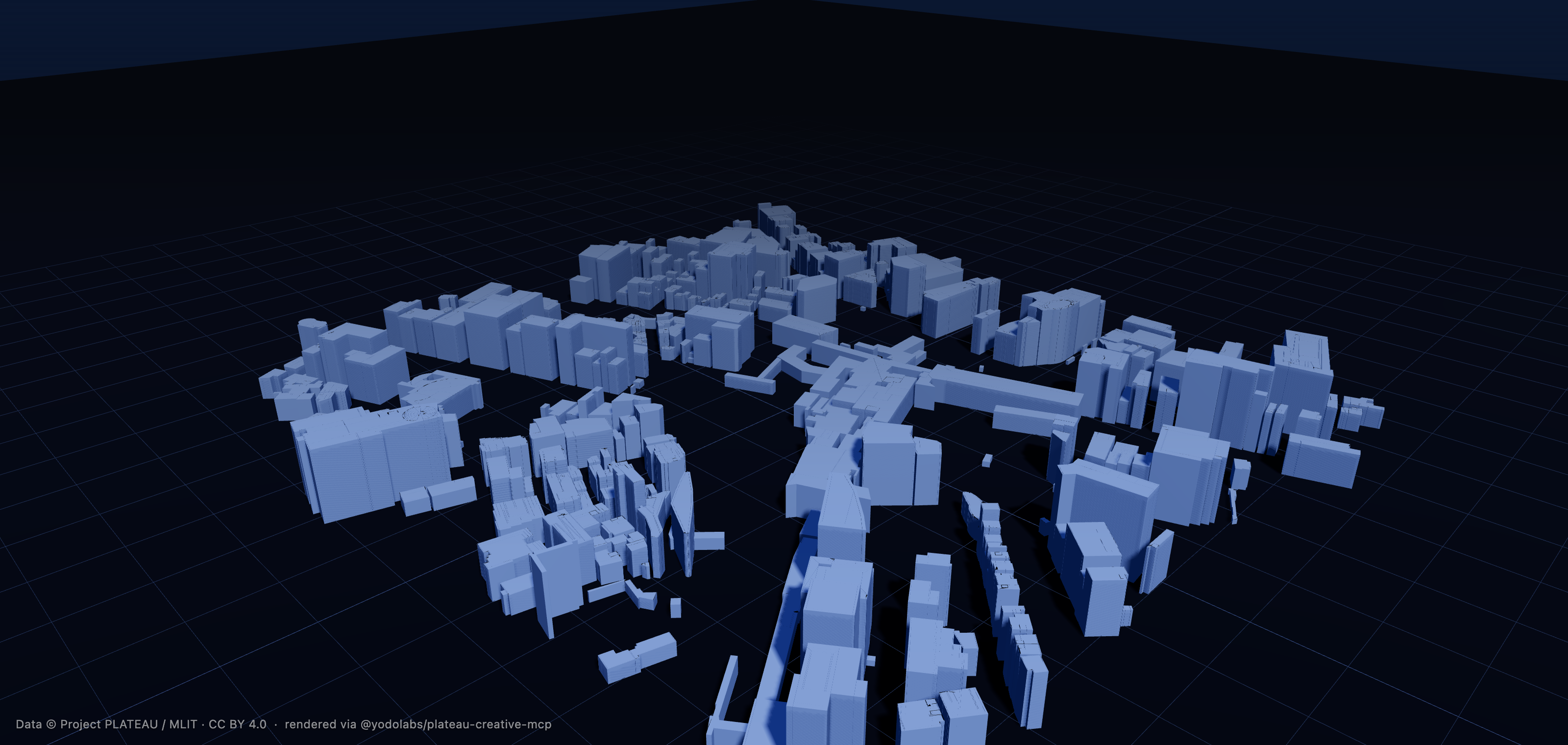
A real Shibuya block — loaded from PLATEAU, edited, and exported as one .glb by the export_glb tool, here rendered with three.js. Same geometry your LLM hands off to Blender / Unity / Unreal. Data © Project PLATEAU / MLIT (CC BY 4.0).
> This server exposes tools. Orchestration is your LLM's job — point Claude / Cursor / any MCP client at this server alongside Blender MCP / Unity MCP / Unreal MCP and let it compose the workflow.
PLATEAU has an official MCP server for **data access** (catalog, specs, CityGML, attributes). This one fills the missing **creation, scene-editing, and DCC export** layer: load a Tokyo neighbourhood, delete every skyscraper, scale a block to 3× height, and emit a `.glb` ready for Blender / Unity / Unreal — all driven by tool calls.
```mermaid
flowchart LR
CLIENT["Claude / Cursor/` outputs, point straight at them:
```bash
export PLATEAU_ARTIFACT_DIR=/path/to/plateau-bridge
export PLATEAU_OUTPUT_DIR=./out
npx @yodolabs/plateau-creative-mcp # stdio MCP server
```
```jsonc
{
"mcpServers": {
"plateau-creative": {
"command": "npx",
"args": ["-y", "@yodolabs/plateau-creative-mcp"],
"env": {
"PLATEAU_ARTIFACT_DIR": "/path/to/plateau-bridge",
"PLATEAU_OUTPUT_DIR": "/Users/you/plateau-out"
}
}
}
}
```
Smoke run without an MCP client:
```bash
npx tsx scripts/smoke-load-area.ts
```
## Example workflows
### 1. Cyberpunk Shibuya flythrough (cross-MCP)
```
load_area(city="shibuya", bbox=[139.6975,35.6555,139.7045,35.6605], lod=2)
-> compose_scene(time="19:30", weather="rain")
-> export_glb() # to ./out/_v3.glb
=> BlenderMCP: import_glb + cyberpunk shader + render
```
```mermaid
flowchart LR
LLM(("LLM")) --> A["plateau-creative-mcp/buildings.parquet`. Defaults to a cache dir (where `download_area` writes); set it to point at an existing `plateau-bridge` checkout. |
| `PLATEAU_ARTIFACT_INDEX_URL` | plateau-bridge `distribution/index.json` | Cache index (JSON) listing each city's bundle URL + sha256. Defaults to the public mirror; override to use your own. |
| `PLATEAU_ARTIFACT_DOWNLOAD_TIMEOUT_MS` | `300000` | Per-download timeout in milliseconds (5s–30min). |
| `PLATEAU_AUTO_DOWNLOAD` | `false` | `true` makes `load_area` auto-fetch a missing city from the index before loading. |
| `PLATEAU_OUTPUT_DIR` | `./out` | Where `.glb` / `LICENSE.txt` / manifests are written. |
| `PLATEAU_DATA_MODE` | `artifact` | `artifact` (TS + duckdb) or `subprocess` (Python helper). |
| `PLATEAU_PYTHON_BIN` | `python3` | Python interpreter for `subprocess` mode (must have `duckdb` installed). |
| `PLATEAU_SUBPROCESS_SCRIPT` | bundled `python/plateau_query.py` | Override path to the JSON-stdio helper. |
| `PLATEAU_SCENE_DIR` | `./.scene-store` | Disk dir when scene persistence is enabled. |
| `PLATEAU_PERSIST_SCENES` | `false` | `true` to serialize scenes to disk between calls. |
| `PLATEAU_MAX_SCENES` | `64` | LRU cap on in-memory scenes. |
| `PLATEAU_SCENE_TTL_MS` | `3600000` | Scene TTL in milliseconds. |
| `OSM_OVERPASS_URL` | unset | Set to enable `link_buildings_to_pois` (e.g. `https://overpass-api.de/api/interpreter`). |
| `OSM_OVERPASS_TIMEOUT_MS` | `25000` | Overpass request timeout. |
| `PLATEAU_UPSTREAM_ENABLED` | `false` | `true` registers 13 official `plateau_*` tools proxied to the hosted PLATEAU MCP. |
| `OFFICIAL_PLATEAU_MCP_URL` | hosted default | Override the official PLATEAU MCP endpoint (rare). |
See [`.env.example`](.env.example) for a copy-paste template.
### Footprint geometry vs box fallback
Polygon extrusion via the DuckDB `spatial` extension is on by default; on first run the extension is auto-installed. If install/load fails (offline CI, restricted environment), the exporter cleanly falls back to centroid-anchored 12 m × 12 m boxes per building. `available_attributes` in `load_area`'s response includes `footprint_polygon` when the high-fidelity path is active.
### Mesh merging + sidecar index
`single_glb` exports merge every building into one `BufferGeometry` — one draw call, dramatically smaller GLB JSON overhead. To preserve per-building identity for downstream editing tools, each export writes a sidecar `.buildings.json` next to the GLB:
```json
{
"scene_id": "scene_01...",
"version": 4,
"merged": true,
"total_triangles": 73482,
"ranges": {
"": [{"triangle_start": 0, "triangle_count": 18}]
}
}
```
### scene_manifest mode
When the export exceeds the single-GLB limits (1 km² / 5000 buildings) you can request `mode: "scene_manifest"`. The manifest links the corresponding 3D Tiles `tileset.json` and enumerates the leaf tile content URIs whose bounding regions intersect the scene bbox — downstream consumers can lazy-load just the tiles they need:
```json
{
"scene_id": "scene_01...",
"mode": "scene_manifest",
"bbox": [139.69, 35.65, 139.72, 35.67],
"tileset": "/abs/path/out_shibuya/3dtiles/tileset.json",
"tileset_available": true,
"tiles": [
{
"url": "/abs/path/out_shibuya/3dtiles/15/29096/4943_bldg_Building.glb",
"relative_uri": "15/29096/4943_bldg_Building.glb",
"bbox": [139.6984, 35.6577, 139.7060, 35.6644],
"min_height_m": 39.3,
"max_height_m": 332.3
}
],
"edits": { "deleted_building_uids": [], "extrusions": [] },
"attribution": { "license": "CC BY 4.0" }
}
```
3D Tiles are produced by a local build and are not part of the on-demand download bundles. For downloaded cities, `scene_manifest` returns a tile-less manifest (edits + bbox + attribution) with a `tileset_note`.
### POI linking
`link_buildings_to_pois` requires `OSM_OVERPASS_URL`. With it set, the tool POSTs an Overpass QL query for `amenity` / `shop` / `office` / `tourism` / `leisure` nodes inside the scene bbox, then matches each named POI to the nearest building centroid within `max_distance_m`. ODbL attribution is automatically merged into the returned envelope.
## Out of scope (intentionally)
- `export_3dgs` — Gaussian-splat round-trip is future work.
- `export_usd` — a separate Isaac Sim project.
- `simulate_earthquake` / `simulate_flood` — a separate risk-analysis effort.
- Generic OSM querying — OSM-MCP territory.
- Cross-MCP auto-orchestration — your LLM does that.
## Attribution & license
- **Software:** MIT (this repo).
- **Data:** PLATEAU is **CC BY 4.0** (© Project PLATEAU / MLIT). OSM POIs are **ODbL 1.0**.
- Every tool response carries `attribution_metadata`. `export_glb` injects it into `asset.extras.attribution` and writes a `LICENSE.txt` next to the GLB. **Keep that file alongside the GLB and credit PLATEAU in any derived video / screenshot.**
### GLB compression
Set `options.compress: true` on `export_glb` to apply the gltf-transform pipeline (dedup → weld → prune → quantize). Real-world numbers from a 0.4 km² Shibuya patch (507 buildings, 138k triangles): **9.94 MB → 6.05 MB (~40% reduction)**, no perceptible loss. Output uses the standard `KHR_mesh_quantization` extension — Blender, Unity, Unreal, and three.js all decode it natively.
### Talking to upstream MCP servers
`JsonRpcMcpClient` is a minimal MCP-over-HTTP client (`tools/list` + `tools/call`) exposed as a building block for upstream integrations.
`OfficialPlateauMcpClient` is a typed wrapper around the [official PLATEAU MCP server](https://github.com/Project-PLATEAU/plateau-streaming-tutorial/blob/main/mcp/plateau-mcp.md) (hosted at `https://api.plateauview.mlit.go.jp/mcp`). It covers all 13 upstream tools:
- **Spec**: `specOutline`, `specRead`
- **Catalog**: `getMetadata`, `searchAreas`, `getArea`, `searchDatasets`, `getDataset`, `listDatasetTypes`
- **CityGML**: `citygmlGetAttributes`, `citygmlGetFeatures`, `citygmlGetGeoidHeight`, `getCityGmlFiles`
- **Helper**: `explainSpatialId`
```ts
import { OfficialPlateauMcpClient } from "@yodolabs/plateau-creative-mcp";
const upstream = new OfficialPlateauMcpClient();
const meta = await upstream.getMetadata();
const datasets = await upstream.searchDatasets({ area_codes: ["13113"], year: 2023 });
```
Response shapes use `[k: string]: unknown` index signatures because the upstream spec is still evolving — validate at the call site if you need strict types.
## Examples
Reproducible workflow recipes live in [`examples/`](examples/) — Claude Desktop prompts ([`examples/claude-prompts.md`](examples/claude-prompts.md)), Cursor `.cursorrules` ([`examples/cursor-rules.md`](examples/cursor-rules.md)), a Blender Python snippet showing the merged-GLB + sidecar handoff ([`examples/blender-mcp-handoff.py`](examples/blender-mcp-handoff.py)), and the full cyberpunk-Shibuya walkthrough ([`examples/cyberpunk-shibuya.md`](examples/cyberpunk-shibuya.md)).
## Contributing
Issues and PRs are welcome — see [CONTRIBUTING.md](CONTRIBUTING.md). Run `npm run lint && npm run typecheck && npm test` before opening a PR.
## What's included
10 own MCP tools + 13 proxied tools from the official PLATEAU MCP (combined 23-tool catalog when `PLATEAU_UPSTREAM_ENABLED=true`), on-demand artifact download (`download_area` + optional `load_area` auto-fetch) so no data clone is needed, polygon footprint extrusion (DuckDB `spatial`) with box fallback, mesh merging + sidecar identity index, GLB compression (~40% shrink), `scene_manifest` mode with 3D Tiles tile enrichment, Overpass POI linking, three data-access modes (TS+duckdb artifact / Python subprocess / upstream MCP-over-HTTP), and an allowlist-gated cross-MCP bridge to BlenderMCP-compatible servers.
---
Built by **[Yodo Labs](https://yodolabs.jp)** — PixelX Inc. / ピクセルエックス株式会社
Built on top of [`plateau-bridge`](https://github.com/pixelx-jp/plateau-bridge) · Data © [Project PLATEAU](https://www.mlit.go.jp/plateau/) / MLIT (CC BY 4.0)
Questions: [pan@yodolabs.jp](mailto:pan@yodolabs.jp)