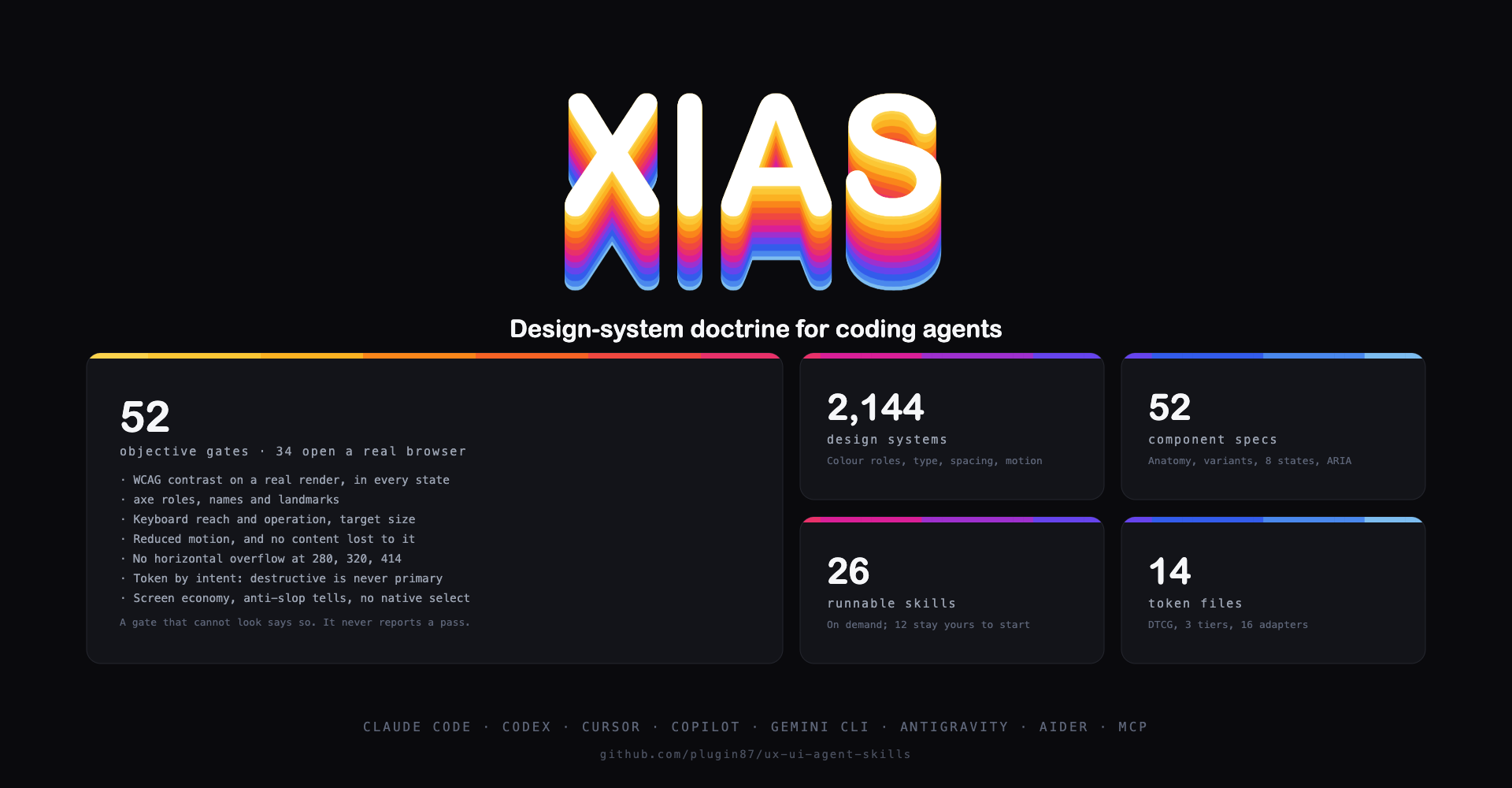

# UX/UI Agent Skills *aka **XIAS*** ### Design-system doctrine for coding agents, and **52 gates** that check what they build instead of taking their word for it. Instructions, design tokens, 26 runnable skills and 2,144 design systems (2,087 of them measured from the live site) that make a coding agent design to a senior standard, in **any framework** and against **any design system**. Then the gates measure what it built.
XIAS: design-system doctrine for coding agents. 52 objective gates, 34 of which open a real browser: WCAG contrast in every state, axe roles and landmarks, keyboard, target size, reduced motion, no horizontal overflow at 280, token by intent, screen economy. 2,144 design systems, 52 component specs, 26 runnable skills, 14 DTCG token files, 16 framework adapters. Claude Code, Codex, Cursor, Copilot, Gemini CLI, Antigravity, Aider, MCP.

plugin87/ux-ui-agent-skills | Trendshift

[![Version](https://img.shields.io/badge/version-3.1.0-6366f1?style=for-the-badge)](https://github.com/plugin87/ux-ui-agent-skills/releases) [![License: MIT](https://img.shields.io/badge/license-MIT-22c55e?style=for-the-badge)](#license) [![WCAG 2.2 AA→AAA](https://img.shields.io/badge/WCAG-2.2_AA→AAA-a855f7?style=for-the-badge)](#-accessibility-standards)

[![npm](https://img.shields.io/npm/v/ux-ui-agent-skills?style=flat-square&logo=npm&logoColor=white&color=cb3837)](https://www.npmjs.com/package/ux-ui-agent-skills) [![npm downloads](https://img.shields.io/npm/dt/ux-ui-agent-skills?style=flat-square&logo=npm&logoColor=white&color=cb3837)](https://www.npmjs.com/package/ux-ui-agent-skills) ![Tokens](https://img.shields.io/badge/Design_Tokens-DTCG-fbbf24?style=flat-square) ![Skills](https://img.shields.io/badge/runnable_skills-26-14b8a6?style=flat-square) ![Gates](https://img.shields.io/badge/objective_gates-52-16a34a?style=flat-square) [![Live demo](https://img.shields.io/badge/live_demo-open-0ea5e9?style=flat-square)](https://plugin87.github.io/ux-ui-agent-skills/) ![Design Systems](https://img.shields.io/badge/design_systems-2144-f97316?style=flat-square) ![Frameworks](https://img.shields.io/badge/frameworks-any-8b5cf6?style=flat-square) ![Adapters](https://img.shields.io/badge/framework_adapters-16-22d3ee?style=flat-square) ![React 19](https://img.shields.io/badge/React-19-60a5fa?style=flat-square&logo=react) ![Next.js 15](https://img.shields.io/badge/Next.js-15-000000?style=flat-square&logo=nextdotjs) ![SwiftUI 6](https://img.shields.io/badge/SwiftUI-6-f472b6?style=flat-square&logo=swift) ![Tailwind v4](https://img.shields.io/badge/Tailwind-v4-38bdf8?style=flat-square&logo=tailwindcss)



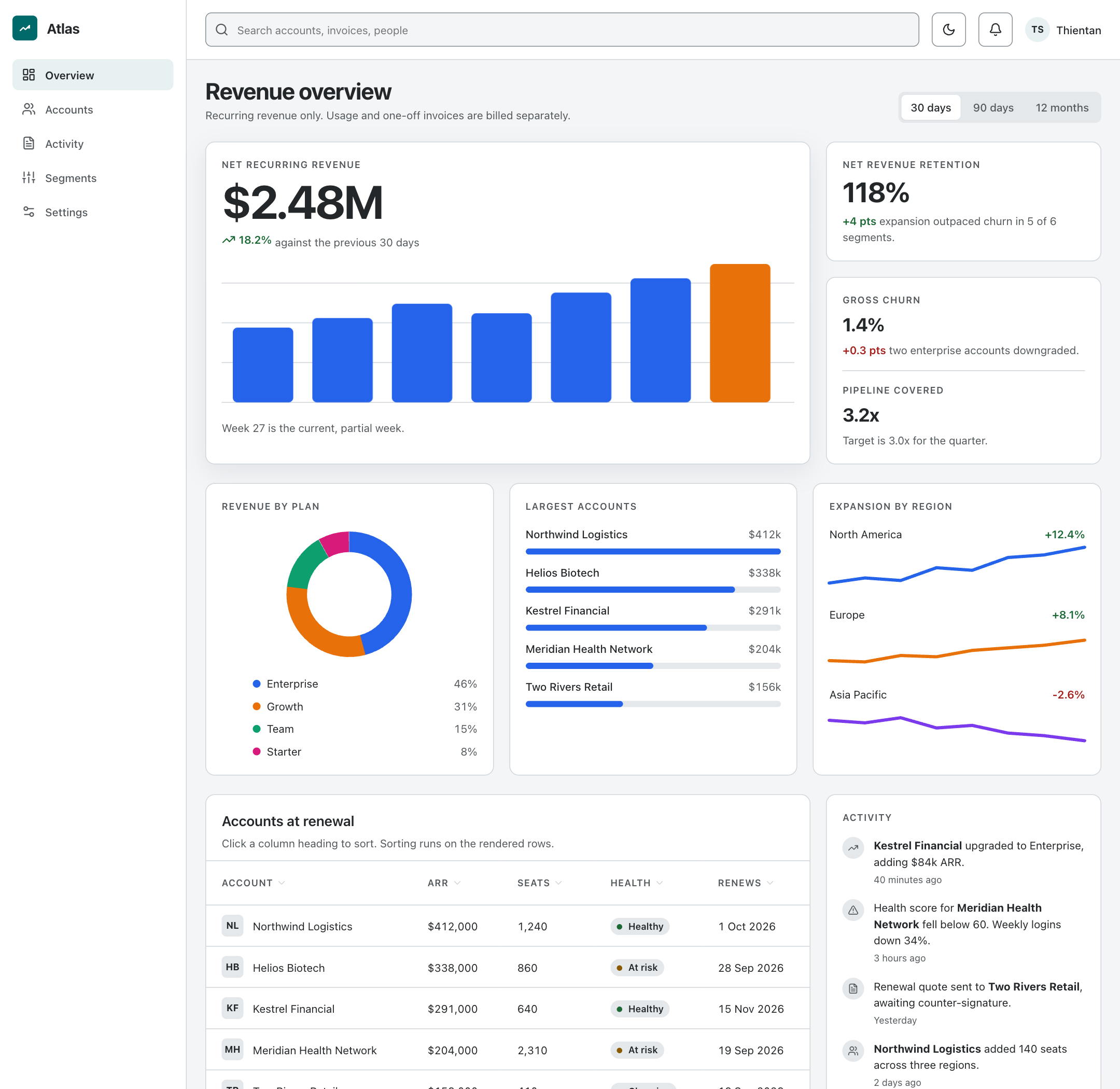
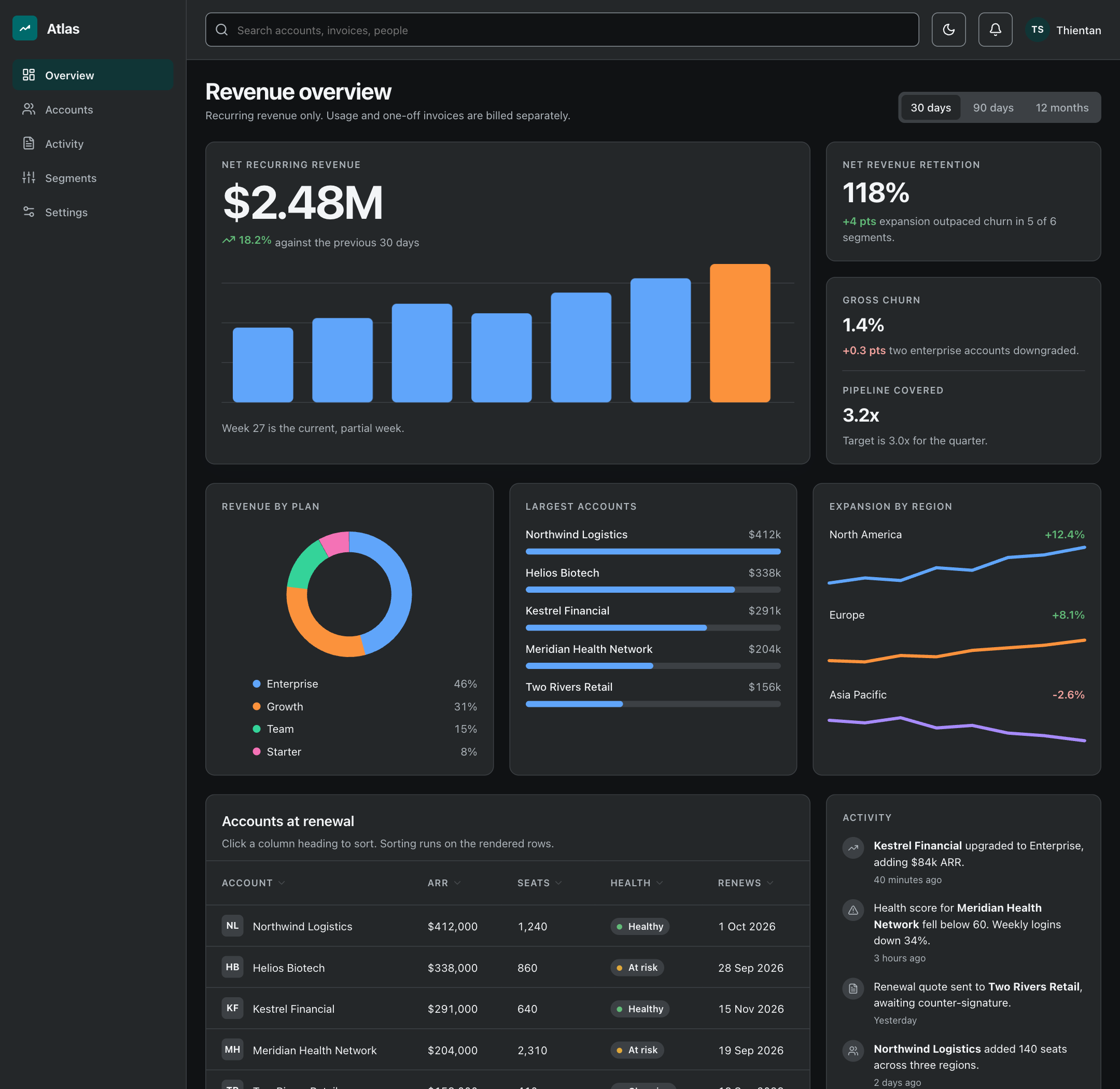
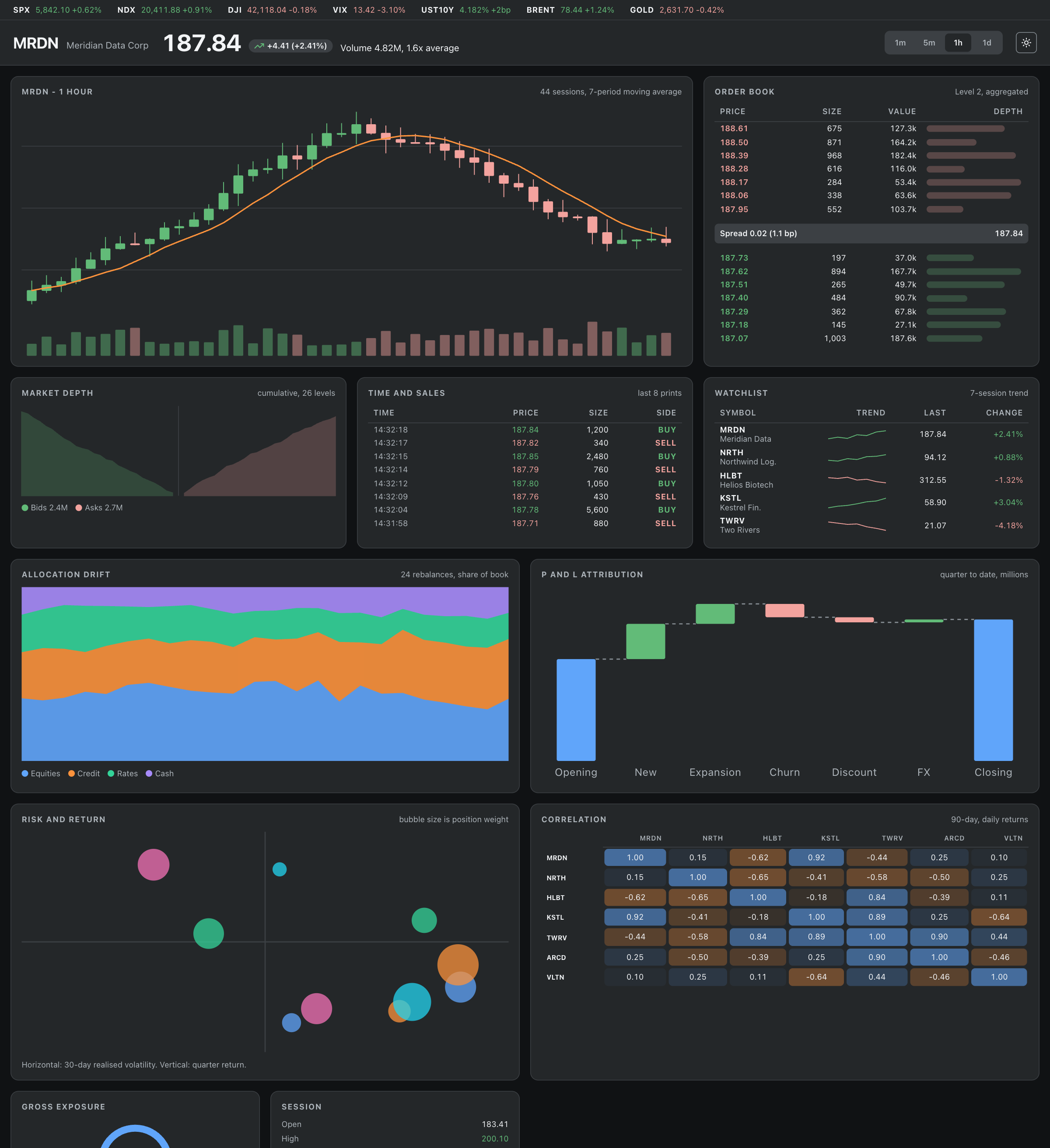
**Current release [`v3.1.0`](https://github.com/plugin87/ux-ui-agent-skills/releases)** · [Changelog](CHANGELOG.md) · No build tools, dependencies, or runtime: a pure instruction and knowledge layer for AI agents. --- ## The output, rendered Not a mockup. These are screenshots of the files in `examples/`, taken by `node scripts/screenshot_docs.mjs` from the same HTML the 52 gates measure, so what you see below is what the gate run passed, in both themes. **Click through them yourself: [plugin87.github.io/ux-ui-agent-skills](https://plugin87.github.io/ux-ui-agent-skills/).** There are 56 live pages (twenty whole-product screens, five websites from a product launch to a Thai public service page, every component harness, both reference screens and an iPhone Duo simulator), with a theme toggle. No install, no clone. Atlas revenue console in light theme: sidebar navigation, a hero net-recurring-revenue figure at 2.48 million with a weekly bar chart, retention and churn cards, a donut of revenue by plan, an account ranking, regional sparklines, a sortable renewals table and an activity feed The same Atlas console in dark theme, rendered from the same token theme with no per-page palette Meridian Terminal: a trading desk screen with a market ticker, candlestick chart with volume and moving average, order book with depth bars, cumulative depth curve, time and sales tape, watchlist sparklines, stacked area allocation, waterfall attribution, bubble chart and a correlation matrix **Meridian Terminal** is the density test: **ten chart types on one screen**: candlestick, volume, moving average, depth, order book, tape, sparklines, stacked area, waterfall, bubble and a correlation matrix. Every one of them is inline SVG drawn from the same tokens, with no chart library. [Open it live.](https://plugin87.github.io/ux-ui-agent-skills/terminal/) Build one yourself with **`/data-dashboard`**. **Atlas** is one HTML file in `examples/showcase/`, built only from the kit's tokens and rules: the hero figure leads at 3x the body size, the three breakdowns are deliberately three different shapes rather than three identical cards, the range tabs move the numbers, and the table headers really sort. [Open it live.](https://plugin87.github.io/ux-ui-agent-skills/showcase/)
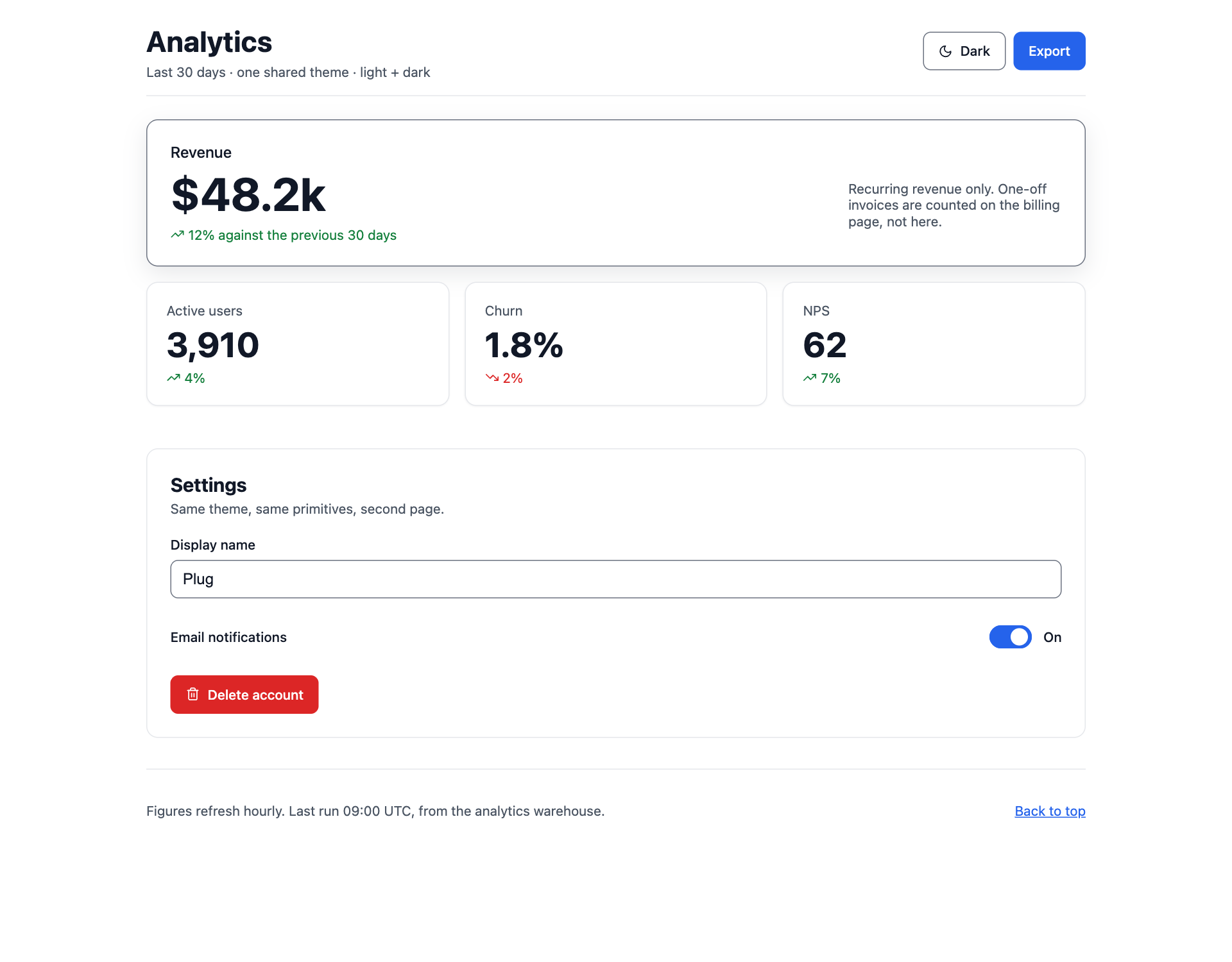
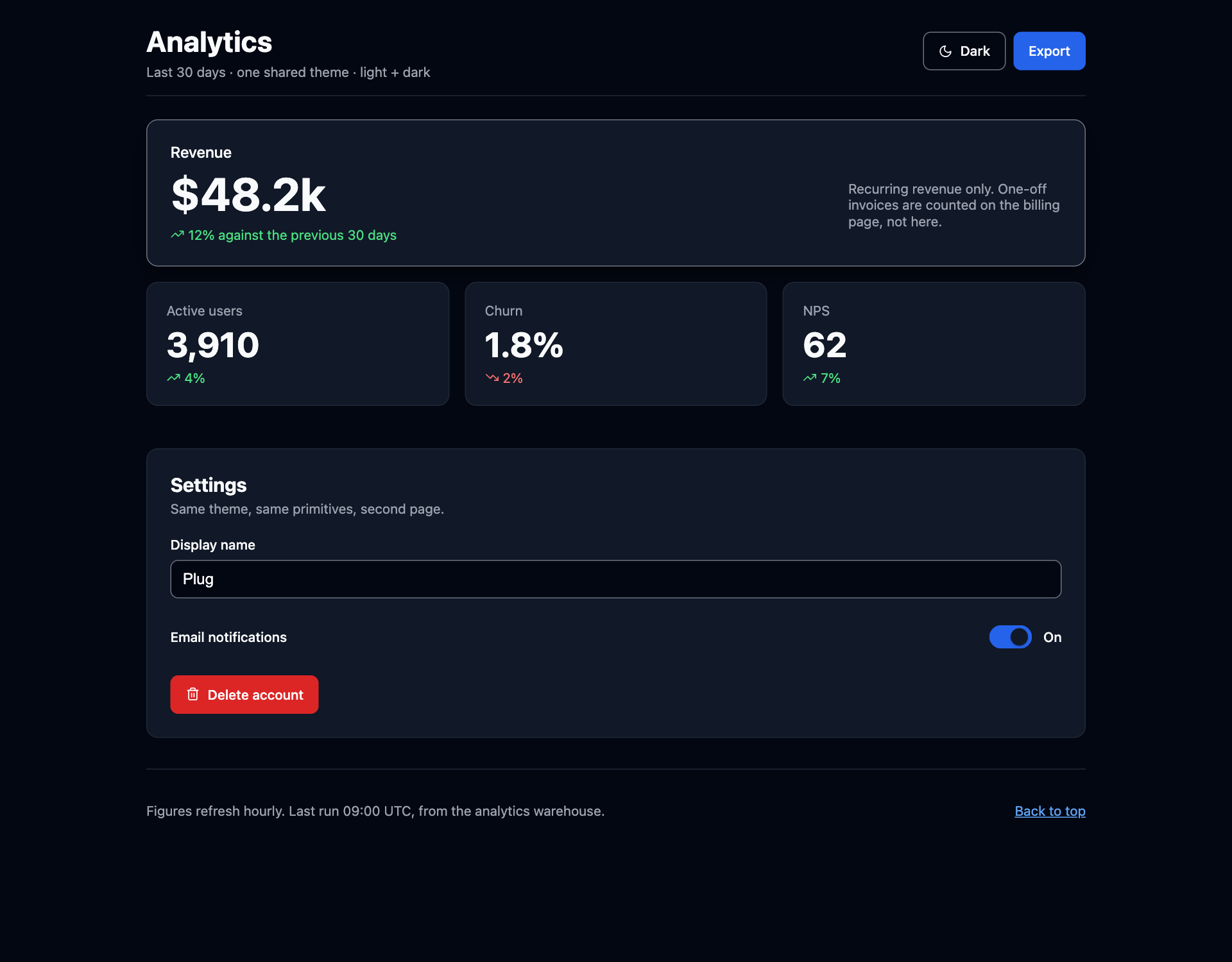
Reference app in light theme: an Analytics screen led by one hero revenue metric, three smaller stats beneath it, a settings form, and a red Delete account action The same Analytics screen in dark theme, rendered from the same token theme with no per-page palette
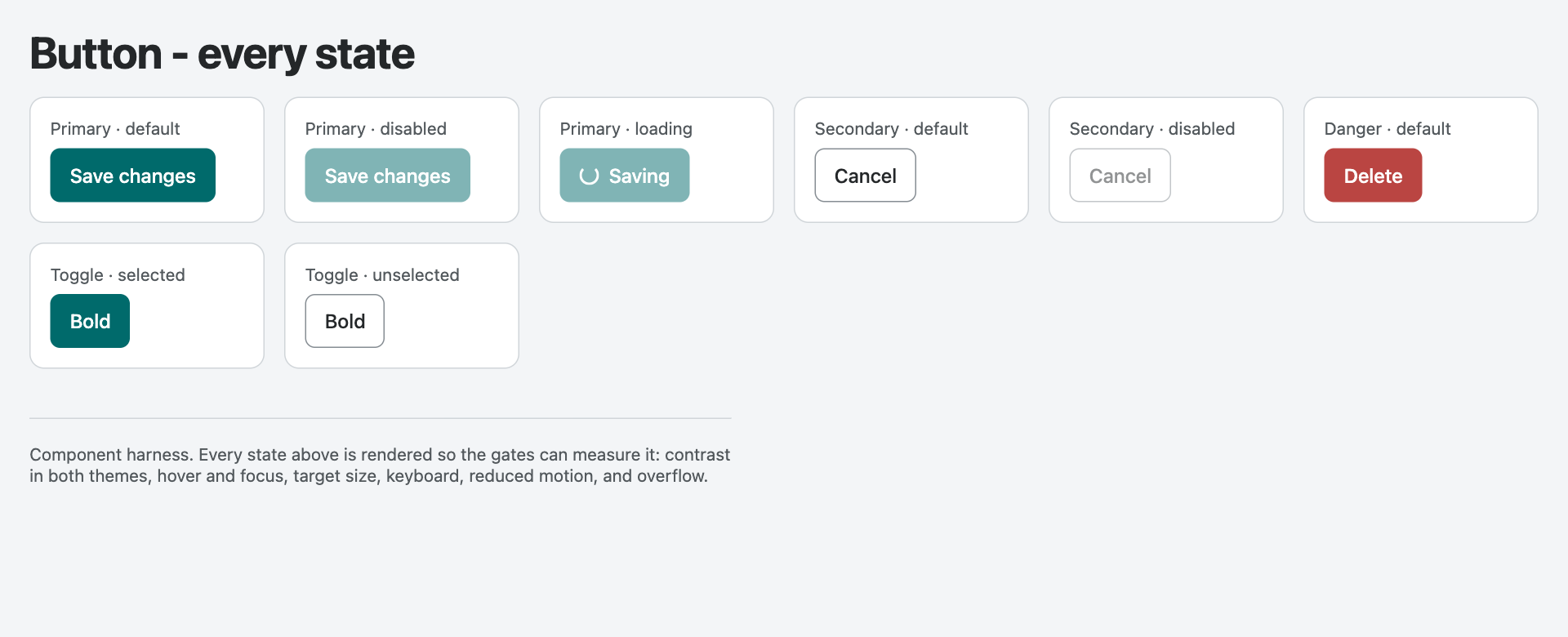
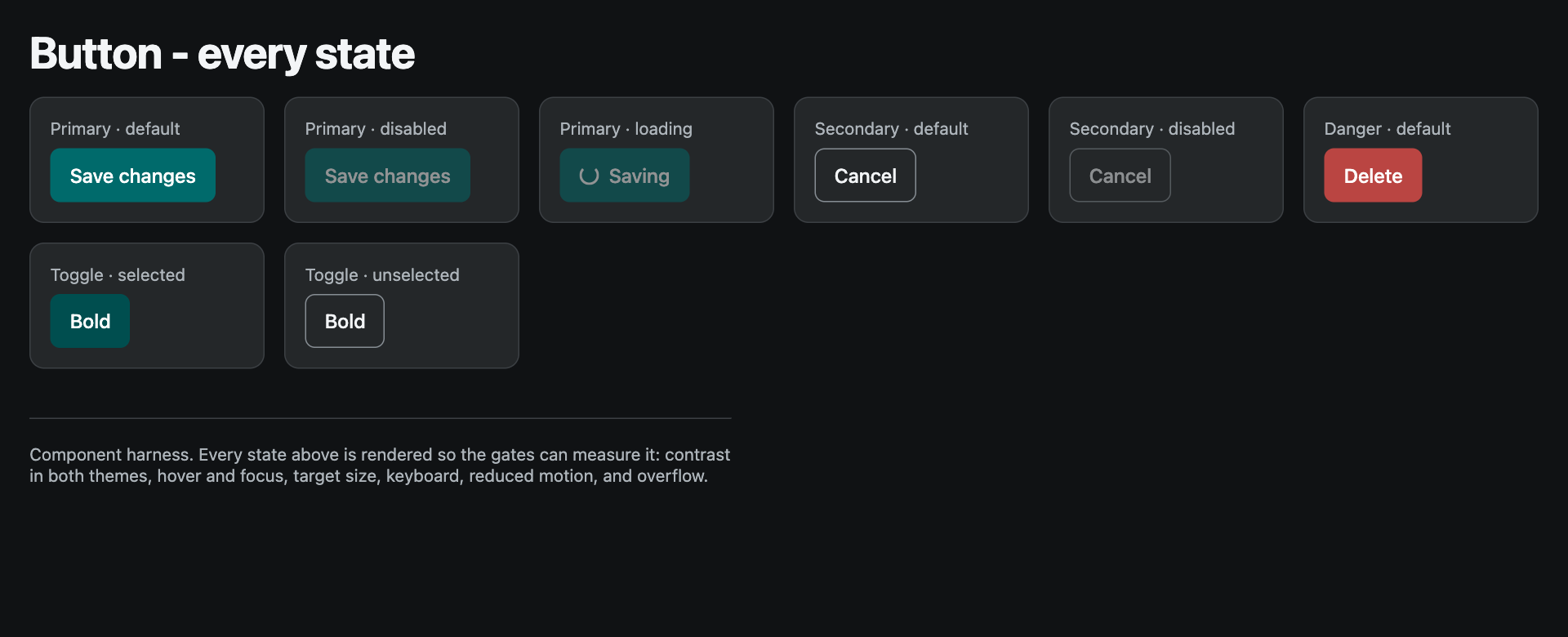
Button harness in light theme showing primary, disabled, loading, secondary, danger and toggle states side by side The same button states in dark theme, with the destructive action still wearing the danger variant
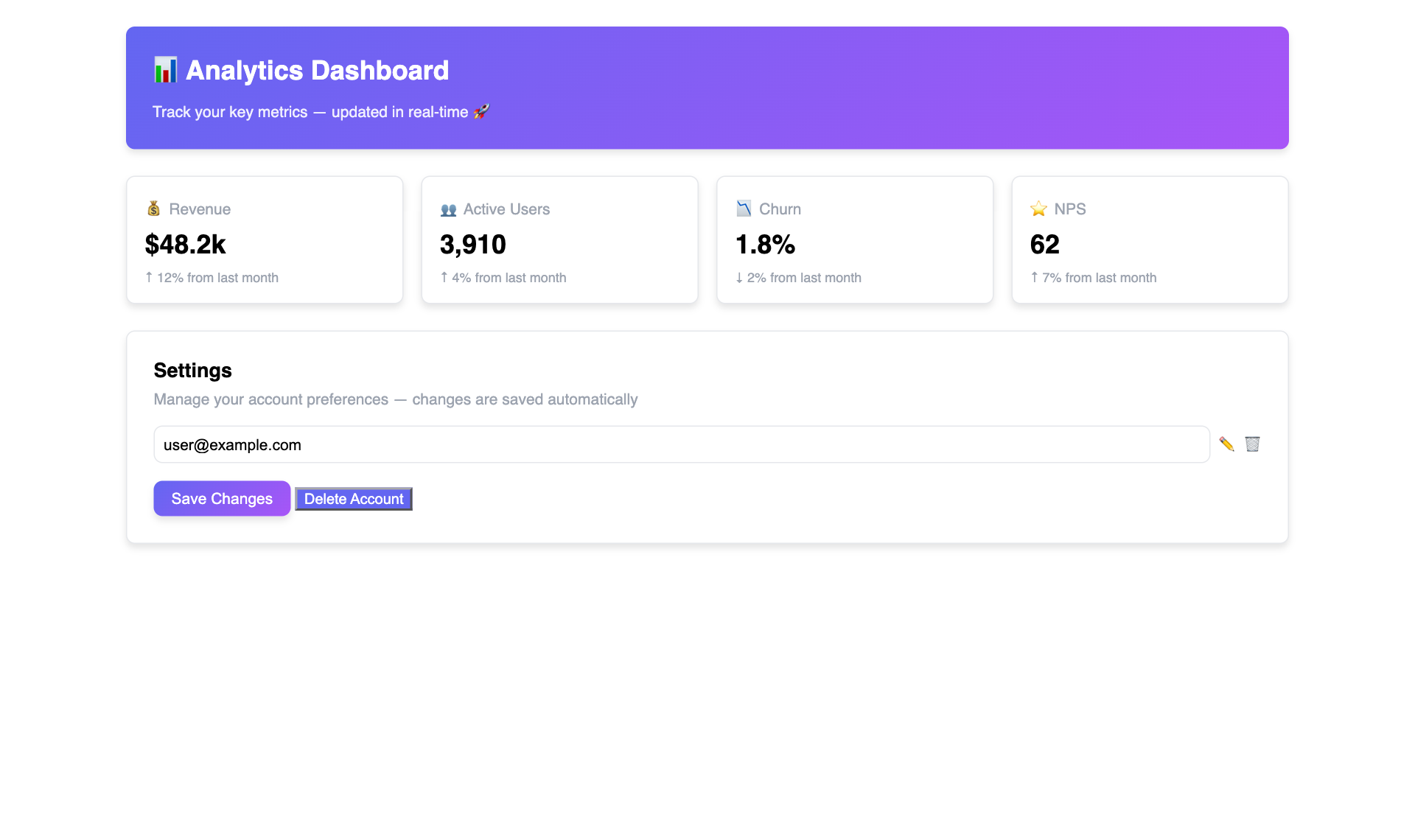
One theme, two modes, no per-page palette. The destructive action wears the danger variant in both. Loading keeps full strength and swaps in a spinner instead of borrowing the disabled dimming. Every one of those is a rule in `CLAUDE.md` that a gate or a critic enforces. --- ## What the gates actually catch Left: the same dashboard written the way a model writes it when nothing stops it: the indigo-to-purple gradient, four equal cards with no focal point, emoji as icons, one radius and one shadow everywhere, grey-on-white body text, and a blue Delete Account. Right: the reference app in this repo.
A generated-looking analytics dashboard: purple gradient header with emoji, four identical stat cards, grey low-contrast labels, tiny icon buttons, and a blue Delete Account button
Statistical defaults
The same dashboard built to the kit's rules: one hero revenue metric leading, three smaller stats, a settings panel, and a red Delete account action
Built to the rules
The difference is not a matter of opinion, and that is the point. The page on the left is `tests/fixtures/bad/slop-screen.html`; here is what the gates say about it: | Gate | Verdict on the left-hand page | |---|---| | REAL-render WCAG | `x

"Analytics Dashboard" 1.00:1 (need 3)`: white text on a gradient has no measurable background | | State-aware WCAG | `x default "Save Changes" 1.00:1 (need 4.5) [rgb(255,255,255) on rgb(255,255,255)]`: 6 states below AA | | Target size (2.5.8) | `x button.icon-btn is 15.3x16 (min 24x24)` | | Responsive | `x @280px overflow +820px (widest: div.card)` | | axe-core | `SERIOUS target-size` | | Slop tells | HIGH: hardcoded indigo-purple gradient, single radius, one flat shadow, `#000` on `#fff` | | Taste audit | HIGH: biggest heading 24px vs 14px body = 1.7x, not a display scale | | Token by intent | `x "Delete Account" is destructive but filled with rgb(99, 102, 241) (hue 239deg, not a danger colour)` | | No emoji | `x slop-screen.html:55: emoji/pictograph`: a chart glyph in the `

` | | No hardcoded values | `FAIL: 63 hardcoded value(s)` | Ten gates reject it, none of them on a matter of taste. The right-hand page passes all 52. The last row is there because building this comparison broke a gate open. `lint_intent` originally read that blue Delete Account as fine: it resolved "primary" and "danger" from the page's own CSS variables, and a page with no tokens resolved neither, so it skipped the page and reported zero intent-bearing controls. An untokenised page is precisely where intent gets picked by convenience, so the gate no longer looks away: a destructive label filled with a saturated colour outside the danger hue range is wrong-intent with or without a theme. Re-checked against every example in both themes afterwards: no false positives. `tests/meta/browser-gates.test.mjs` pins every claim in this table, so it cannot rot. --- ## It was run blind, and it came back as rework Two subagents were handed a brief and a project scaffolded by `ux-ui-skills new`, which installs the kit and ships **no example screens**, and nothing else. No hints, no warning that anything would be scored, no access to the conversation that built the kit. They met `CLAUDE.md` and `.claude/rules/` the way a new user's agent does. **Both scored 14/14** on an independent run of `evals/run.mjs`, scored here rather than self-reported. The rules transfer across a cold start. **And the two runs cost the kit seven defects that four in-session runs never hit**, because a familiar run keeps reaching for a finished demo theme instead of the template a real user gets: a secondary button at **1.13:1** dark-on-dark because the component tier never followed the dark map; a reduced-motion policy in an external stylesheet read as "no policy" (Chromium treats a `file://` linked sheet as cross-origin, so the gate was blind exactly where every real project lives); a missing scrim token; a theme that emitted colours and no spacing; an intent gate that did not know "cancel subscription" is destructive. Then the outputs went to `/critique`, which renders the work and argues for rejection. Verdict on two pages that pass all fourteen gates: **rework**, eight findings, five Major, and not one of them measurable: an empty state that reads as a page that failed to load, a theme toggle that communicates nothing about its own state, a toast claiming "Draft project created" over a list that never changed, and a loading state wearing the disabled dimming so it reads as "you cannot do this". **The blind outputs were never edited.** They are in `evals/out/` as the record of what a cold-start agent produced; patching them would be editing the experiment. The findings were spent on the kit instead. One of them became a gate, `verify_interactive.mjs`, which fails any control that declares a state contract and changes nothing when clicked. The whole log, including what is still unproven, is in [evals/RESULTS.md](evals/RESULTS.md). --- ## What It Does | Capability | Description | |-----------|-------------| | **Design Token Generation** | Produces DTCG-format JSON tokens (colors, typography, spacing, shadows, borders, breakpoints, motion) with a 3-tier architecture: Primitive → Semantic → Component | | **Component Design** | Designs components from Atoms to Templates following Atomic Design, with anatomy, variants, states, token mapping, and accessibility specs | | **Code Generation (any framework)** | Adapter Protocol targets **any** stack (React+Tailwind, Next.js, SwiftUI, Vue, Svelte, Angular, Solid, Web Components/Lit, React Native, Flutter, Jetpack Compose, vanilla CSS, CSS-in-JS) or generates a new adapter on demand | | **Design-System Interop** | Maps to/from **any** design system (Material 3, Apple HIG, Fluent, Carbon, shadcn/ui, Radix…) via a role-based crosswalk | | **Runnable Skills** | 19 invocable `/skills` (each declaring `invocation: user|model`) + 5 slash commands + real scripts: token and contrast validators, real-render and state-aware WCAG gates, axe-core a11y, focus-trap, RTL, target size, keyboard, reduced motion, overflow, token-by-intent, taste and slop audits, token build | | **Accessibility Auditing** | Evaluates against WCAG 2.2 AA/AAA with prioritized findings (P0/P1/P2) | | **Design Review** | Scores designs across 6 dimensions with Nielsen's 10 Heuristics and a structured findings table | | **Prototyping & Research** | Guides through a 5-level fidelity ladder, user journey mapping, and usability testing scripts | | **Motion Design** | Tokenized durations, easing curves, transition presets, and reduced-motion strategy for accessible animation | | **UX Writing** | Voice & tone system with error/empty-state formulas, microcopy patterns, and inclusive language guidelines | | **Design Taste** | Native anti-slop doctrine, aesthetic archetypes, and a library of **2,144 design systems** for layout variance, editorial typography, and premium visual direction | --- ## Quick Start > **Five ways in, and which one is yours:** [docs/INSTALL.md](docs/INSTALL.md) > walks through the Claude Code plugin, the `AGENTS.md` surface for Codex and > Cursor, the MCP server, Homebrew and `npx`: what each one installs, and what > you give up by choosing it. > > Every `npx` command in these docs names an exact release > (`ux-ui-agent-skills@3.1.0`), so what runs on your machine is the tarball the > docs describe, never whatever is newest on npm. `npm version` rewrites every > pin in the release commit, and `npm run pins:check` fails if one is missed. ### Prerequisites - **Node.js 20 or newer**, and **Python 3** for the gates that read files. - **Chrome, for 34 of the 52 gates.** Those open your page in a real browser. If Chrome is installed, nothing more is needed. If not, inside a project with the kit: `npm install && npx playwright install chrome`, which uses the Playwright version the kit pins (1.63.0). Without a browser those gates cannot measure, and they never report a pass: run one on its own and it prints `SKIPPED`, run the full report and they count as failing. Before installing anything, [SECURITY.md](SECURITY.md) lists every file `init` writes, what each hook does and when it fires, and the one network request the kit makes. `npx ux-ui-agent-skills@3.1.0 init --dry-run` prints the file list for your project and changes nothing. ### Option A: Install as a Claude Code plugin (recommended) Two lines in Claude Code, and every skill, command, and agent is available in any project you open, with no files copied into your repo: ``` /plugin marketplace add plugin87/ux-ui-agent-skills /plugin install ux-ui-agent-skills@ux-ui-agent-skills ``` You get 26 skills and the `design-critic` agent. **Fourteen the model reaches for on its own** when the work calls for them: `design-tokens`, `design-component`, `design-code`, `design-review`, `a11y-audit`, `apply-aesthetic`, `data-dashboard`, `design-qa`, `figma-integration`, `performance`, `token-build`, `ux-writing`, `design-doctrine`, and `design-screen`, the one that claims "design a page / screen / app", which until 2026-10-05 no skill did, so the most common request there is matched nothing strongly and the kit got used at a fraction of its depth. **Twelve you start yourself**, because each one takes an action or sets a direction that should be your call: `/brandkit`, `/governance`, `/image-to-code`, `/migrate-design-system`, `/prototype`, `/redesign`, `/gate`, `/critique`, `/grill-me`, `/ship`, `/scaffold-project`, `/observe`. They carry `disable-model-invocation: true`, which is the field that actually stops the model invoking them. Until 2026-10-05 six of them said `invocation: user`, a key Claude Code does not read, so they were auto-invocable the whole time. The last five were commands and are skills now, so they have a `CLAUDE_SKILL_DIR` of their own and their paths resolve under a plugin install. `design-doctrine` carries the house rules that `CLAUDE.md` carries in the repo, because a plugin root `CLAUDE.md` is not loaded as project context, as Claude Code's own `plugin validate` says so. **Then just work.** Ask for the thing you want and the right skill loads itself: ```text "Design a notification component with all states and accessibility" "Build the billing settings screen, one shared theme, light and dark" "/grill-me" interrogate the brief before anything is built "/gate" run all 52 checks and report the real N/N "/critique" hand the result to a critic that argues for rejection "/observe" did the agent follow the rules? sessions, blocks, findings left open ``` If the skills do not show up straight away, start a new session. To check what is loaded, update, or remove it: ```bash claude plugin details ux-ui-agent-skills # inventory + token cost per skill claude plugin update ux-ui-agent-skills claude plugin uninstall ux-ui-agent-skills claude plugin marketplace remove ux-ui-agent-skills ``` `uninstall` also deletes the plugin's data folder, which holds the gate receipts and the `/observe` history. **34 of the gates open a real browser.** They use the Chrome installed on the machine, or the one `npx playwright install chrome` downloads. Without either they cannot measure: run through `scripts/gate.mjs`, as the skills do, they fail with `REQUIRED, FAILING` instead of passing on nothing. ### See it first, install nothing ```bash npx ux-ui-agent-skills@3.1.0 demo # copies the rendered examples and opens them ``` Every page it opens is a page the gates measure. Delete the folder afterwards; nothing was installed. Or skip the copy entirely and use the [live demo](https://plugin87.github.io/ux-ui-agent-skills/). ### Option B: Use it from any MCP client ```bash claude mcp add ux-ui-gates -- npx -y --package=ux-ui-agent-skills@3.1.0 ux-ui-mcp ``` Six tools: `list_gates`, `run_gate`, `review_ui`, `get_doctrine`, `get_design_system`, `get_tokens`. Read the doctrine and the tokens before generating, run the gates on what you produced after. `AGENTS.md` already lets any agent **read** the doctrine. This lets any MCP client **run the 52 gates**, which reading cannot do. Plenty of things can describe good UI, very little can tell you afterwards that the contrast you shipped is 3.9:1 on hover. It returns what the gates printed, unedited, with their exit codes: 0 looked and found nothing, 1 found something, **2 could not look**, never a pass. No SDK dependency; the protocol is implemented directly so `"dependencies": {}` stays true. Details in [docs/MCP.md](docs/MCP.md). ### Option C: Install with Homebrew ```bash brew install plugin87/tap/ux-ui-agent-skills ux-ui-skills init # CLAUDE.md + .claude/ skills, rules, critic ux-ui-skills init --agent codex # AGENTS.md, for Codex, Cursor, Copilot, Aider ``` Same npm tarball the `npx` route runs, so this is a convenience rather than a second product that can drift. The formula is generated from the registry and its `test do` block asserts the installed CLI reports the version the formula names, and that `--agent codex` writes `AGENTS.md` without `CLAUDE.md` or `.claude/`. Details in [docs/HOMEBREW.md](docs/HOMEBREW.md). ### Option D: Install with `npx` Drop the kit into any project, no clone needed: ```bash npx ux-ui-agent-skills@3.1.0 init # full kit into the current folder npx ux-ui-agent-skills@3.1.0 add tokens taste design-systems # just some areas npx ux-ui-agent-skills@3.1.0 list # see all areas npx ux-ui-agent-skills@3.1.0 library get stripe # fetch one design-system spec ``` Flags: `--force` (overwrite existing files) · `--dry-run` (print every file it would write, change nothing). The 2,144 design-system specs are 27.6MB, and a project uses one or two, so `init` does not copy them. It installs an index of every spec with its sha256, and the agent fetches the one it picks with `node scripts/library.mjs get `. A fetched file whose sha256 does not match the index is refused and nothing is written. `library pull` fetches all of them for offline work. The plugin (Option A) and a clone carry every spec already. To browse all 2,144, open [design-systems/catalog.md](design-systems/catalog.md): GitHub's folder view lists only the first 1,000. Working on the kit itself, or want it vendored? [Clone and copy](docs/GUIDE.md#install-from-a-clone) instead. ### Advanced: partial install (skill folders only) ```bash npx skills@1.7.6 add plugin87/ux-ui-agent-skills ``` This copies the 26 skill folders and nothing else: no gates, no tokens, no references, no design-system library. It is useful for reading the skills, not for building with them. Each skill checks for the kit before it does anything, and without it: - **Most skills run in guidance-only mode.** The reply opens with "Guidance-only mode: the UX/UI Agent Skills kit is not installed here, so no gate ran", states no measured number (no contrast ratio, no N/N, no "passes WCAG"), and ends by naming the gates it skipped and the install command. - **Five skills stop instead**, because running the kit is their whole job: `gate`, `ship`, `observe`, `scaffold-project` and `critique`. To get the verdicts, install the full kit with Option A or Option D. **Then start using:** open the project in **Claude Code** or any Claude-powered IDE. `CLAUDE.md` loads automatically, activating the agent persona with full access to every tokens / components / taste / design-system file and the runnable `/skills`.
Example prompts
```text "Design a notification component with all states and accessibility" "Review this login page against WCAG 2.2 and Nielsen's heuristics" "Generate React + Tailwind code for a data table with sorting and pagination" "Create a color token palette for a fintech brand using blue as the primary" "Audit this form for accessibility issues, and give me a prioritized findings table" "Write the empty state and error copy for the onboarding flow" "Spec the motion for the modal open/close with reduced-motion fallback" ```
--- ## Proving It, and Admitting What Cannot Be Proven The kit ships **52 objective gates** behind one command: ```bash node scripts/accuracy_report.mjs # 52/52 or it fails, no partial credit ``` **34 of them open a real browser, so they need one installed.** `npx ux-ui-agent-skills@3.1.0 init` does not install Playwright. Whether `/plugin install` does depends on the Claude Code version: 2.1.301 installed the kit's npm dependencies, Playwright included, into the plugin folder. Neither installs the browser itself. In a clone, run this once before expecting a full score: ```bash npm install # playwright npx playwright install chrome # real Chrome: six gates require the channel ``` Without it those 34 report `REQUIRED, FAILING` under `accuracy_report.mjs`, which is the honest answer. Run individually they print `SKIPPED` and **exit 0**, so run a single render gate through `scripts/gate.mjs` (or prefix it with `DS_REQUIRE_BROWSER=1`) if you are reading its exit code, rather than reading silence as green. Every skill already does. Token validity, WCAG contrast on a real headless render in light *and* dark, every element in default/hover/focus, axe roles and names, focus traps, RTL, responsive from 280 to 951px and folded on iPhone Duo, target size, keyboard operability, reduced motion (including content that only an animation reveals), silent text clipping, token-by-intent, and zero emoji anywhere in the output or the instruction surface. **What that number covers, stated exactly.** 34 of the 52 checks open a real browser, so what they measure is **rendered HTML**: the 23 component harnesses, the twenty industry screens, the reference app, the live demo, the starter template, and the React source compiled and server-rendered. The other 18 read files: token JSON and alias resolution, contrast math on the token source, component specs, hardcoded values, theme references, emoji, hooks, the instruction surface held in step across `CLAUDE.md` and `AGENTS.md`, and destructive-intent declarations in framework source. The split is not typed here: `tests/meta/counts.test.mjs` derives it from which gates import Playwright and fails if this paragraph drifts from the report. It read 35/16 until 2026-10-07, when the derivation was first run. Those were two numbers nobody had measured, in the section about not stating numbers you did not measure. Framework source (`.tsx`, `.vue`, `.swift`) gets the file-reading checks: no emoji, no hardcoded values, every `var(--…)` resolving to the theme, and, since a blue Delete shipped in this repo's own `Settings.tsx` while the HTML twin of that screen was correct, every destructive control declaring its intent (`lint_intent_source.mjs`). That last one proves a **declaration**, never a colour: `variant="destructive"` wired to a blue token passes it. Only a render catches that, so the React components are now compiled with esbuild, server-rendered, and put through the same browser gates as the HTML (`render_framework_source.mjs`, which also fails if any class the components emit resolves in no linked stylesheet). `.vue` and `.swift` are still file-checks only, and are not proven by this number until they are rendered and measured. That is correctness. It is not quality, and the kit says so out loud: | Question | Answer | How | |---|---|---| | Is it correct? | Measured, all or nothing | `node scripts/accuracy_report.mjs` -> a real `N/N` | | Is it any good? | Judged, never scored | `/critique`: an adversarial `design-critic` that renders the work, argues for rejection, and cites evidence per finding | | Did the agent follow the rules? | Counted per session, from the hooks | `/observe` or `npx ux-ui-agent-skills@3.1.0 observe` -> pages edited and measured, Stop hook blocks, findings left open, sessions that quit while blocked | | Does the kit transfer to a cold start? | Measured, one brief at a time | `evals/`: cold-start briefs, then `node evals/run.mjs ` points 15 objective gates at what the agent produced | `/critique` exists because a passing gate is never evidence of taste. It refuses to review from source alone, screenshots at 1280 and 390 in both themes, clicks every control, and returns a verdict with the three reasons a senior designer would send the work back. It runs as a **forked subagent**, so the critic never sees the conversation that produced the work. That is not a performance decision. A critic holding the maker's reasoning is reviewing the argument instead of the artifact, and it agrees far too easily. The critic itself is scored. `tests/fixtures/critic/` holds four pages carrying fourteen seeded design defects (no focal point, an empty state with no way forward, a toast that claims a project was created while the list is unchanged), and **every one of those pages passes all 52 gates**. That is the property that makes the number mean something: nothing in the harness can reach these, so catching them takes judgement. `node evals/score_critic.mjs` scores a critique against the key, prints the matching excerpt for every hit and the rule for every miss, and says in its own output that the number is a floor until you have read them. `/observe` answers a different question: not whether the work is right, but whether the agent did what the rules say while making it. The hooks record one event per session start, per UI edit (with what each fast gate caught) and per end of turn (which pages had a passing gate, and whether the Stop hook passed, blocked, or let the agent go with pages still open). The report joins those to the gate receipts and gives each session a verdict from three counted rules: every edited page measured, no finding left on a file's latest version, never finished while blocked. `--last` and `--session ` print a timeline; `--html` writes the same thing as a page. Everything stays on the machine, files older than 30 days are deleted, and `DS_OBSERVE=0` turns it off. Runs are recorded in `evals/RESULTS.md` with their provenance attached: who built the output and whether they could see the kit while doing it, because a run without that context is not evidence of anything. The eval suite exists because "the kit's own examples pass" is a weaker claim than "an agent given only this kit and a brief produces work that passes". Building it caught two real defects the 34-check gate had missed. See `evals/README.md`. --- ## Documentation | Where | What is in it | |---|---| | **[Live demo](https://plugin87.github.io/ux-ui-agent-skills/)** | 49 rendered pages: twenty industry screens, every component harness, both reference screens, a theme toggle | | [docs/GUIDE.md](docs/GUIDE.md) | Using it as a plugin (inventory, management, token cost), how the skills compose, the repo map, token architecture, frameworks, interop, a11y standards, starting a new product project | | [CHANGELOG.md](CHANGELOG.md) | Every release, newest first | | [docs/BRANCHING.md](docs/BRANCHING.md) | One concern per branch, one commit per merge, and the settings that enforce it | | [CONTRIBUTING.md](CONTRIBUTING.md) | Why PRs are not merged, what to report instead, and how a gate that can still say no is built | | [SECURITY.md](SECURITY.md) | What `init` writes, what each hook does and when, the one network request, no telemetry, and how to report a vulnerability | | [scripts/](scripts/) | Every gate, as plain Node and Python you can read. [hooks/](hooks/) holds the three plugin hooks, [mcp/](mcp/) the MCP server, [bin/cli.js](bin/cli.js) the installer | | [stats.json](stats.json) | Every count this README states, computed from the files by `scripts/stats.mjs`. `npm test` fails if the prose and the files disagree | | [CLAUDE.md](CLAUDE.md) | The always-on brief the agent actually reads | | [.claude/rules/](.claude/rules/) | The depth behind it: tokens and colour, type and spacing, components, accessibility, frameworks, review, brand and operations | | [taste/](taste/) | The anti-slop doctrine and motion choreography. The 2,144 design systems live in [design-systems/](design-systems/) | --- ## Not using Claude Code? The kit works with **Codex, Cursor, Copilot, Jules, Aider, VS Code and about twenty more**, through the open `AGENTS.md` convention, and with **Gemini CLI and Antigravity**, which read `GEMINI.md` and `.agents/skills/`. ```bash npx ux-ui-agent-skills@3.1.0 init --agent codex # AGENTS.md + the whole kit npx ux-ui-agent-skills@3.1.0 init --agent gemini # GEMINI.md + 23 ported skills: Gemini CLI, Antigravity npx ux-ui-agent-skills@3.1.0 init --agent both # CLAUDE.md and AGENTS.md npx ux-ui-agent-skills@3.1.0 init # Claude Code (default) gemini extensions install https://github.com/plugin87/ux-ui-agent-skills # Gemini CLI, every project ``` What transfers, and what does not, stated exactly: | | Claude Code | AGENTS.md surface | Gemini CLI, Antigravity | |---|---|---|---| | Tokens, components, taste, accessibility, 2,144 design systems | yes | **yes** | **yes** | | All 52 gates | yes | **yes**, they are plain Node and Python | **yes** | | Doctrine: the eight states, token by intent, mobile-first, the house rules | yes | **yes** | **yes**, in `GEMINI.md` | | 26 skills that load on demand | yes | no, the doctrine is inlined instead | 23 ported skills | | Hooks that fire whether or not the model remembers | yes | **no** | **no** | | `/critique` in a separate context | yes | no, it is a step in the instructions | no | A skill is ported, not copied: Gemini CLI and Antigravity do not expand `${CLAUDE_SKILL_DIR}`, so each path is rewritten for where the skill lands, and the three that need Claude Code (`critique`, `observe`, `scaffold-project`) stay there. Setup and what was measured: [docs/INSTALL.md](docs/INSTALL.md#2b-gemini-cli-and-antigravity). **The hooks are the real difference.** On Claude Code, three rules are enforced without the model choosing to: no hardcoded values and no emoji on every write, and a refusal to end a session that edited UI and measured none of it. On the `AGENTS.md` surface every rule is a request and the gates run when you run them. `scripts/validate_agents_surface.py` holds the two files in step, so a rule added to one cannot quietly skip the other. Full setup, and the two defects a real Codex run found in the first draft: [docs/AGENTS-SETUP.md](docs/AGENTS-SETUP.md). ## Contributing **Pull requests are not merged here.** Every line is written by the maintainer, deliberately. Asking for work against a bar and then declining it would waste your time, so the policy is stated up front instead of at the end of a review. What is wanted, and credited by name in the CHANGELOG: a **gate gap**, a **reproduction**, or a **proposal**. Forking is welcome; the MIT licence says so. Two commands are the whole bar for anything that does ship: `node scripts/accuracy_report.mjs` (52/52, no partial credit) and `npm run test:gates` (every gate must still reject its broken fixture). Paste the real output rather than describing it. The most valuable issue this repo can receive is a **gate gap**: a case where a gate said yes to work it should have caught. There is a template for exactly that, because a gate that passes broken work is worse than a missing one: it turns a real defect into a green tick. [CONTRIBUTING.md](CONTRIBUTING.md) covers setup, the non-negotiable rules, how to add a gate that can still say no, and the SemVer table. [CODE_OF_CONDUCT.md](CODE_OF_CONDUCT.md) applies to every space in the project. --- ## License Released under the **[MIT License](LICENSE)**: free to use, modify, and distribute, including commercially, as long as the copyright notice and the permission notice travel with the copy. Copyright (c) 2026 **Thientan Soparat** ([@plugin87](https://github.com/plugin87)). ---
Built by **Thientan Soparat** ([@plugin87](https://github.com/plugin87)). If this kit helps you, [star it on GitHub](https://github.com/plugin87/ux-ui-agent-skills) so others can find it.