# Kairn
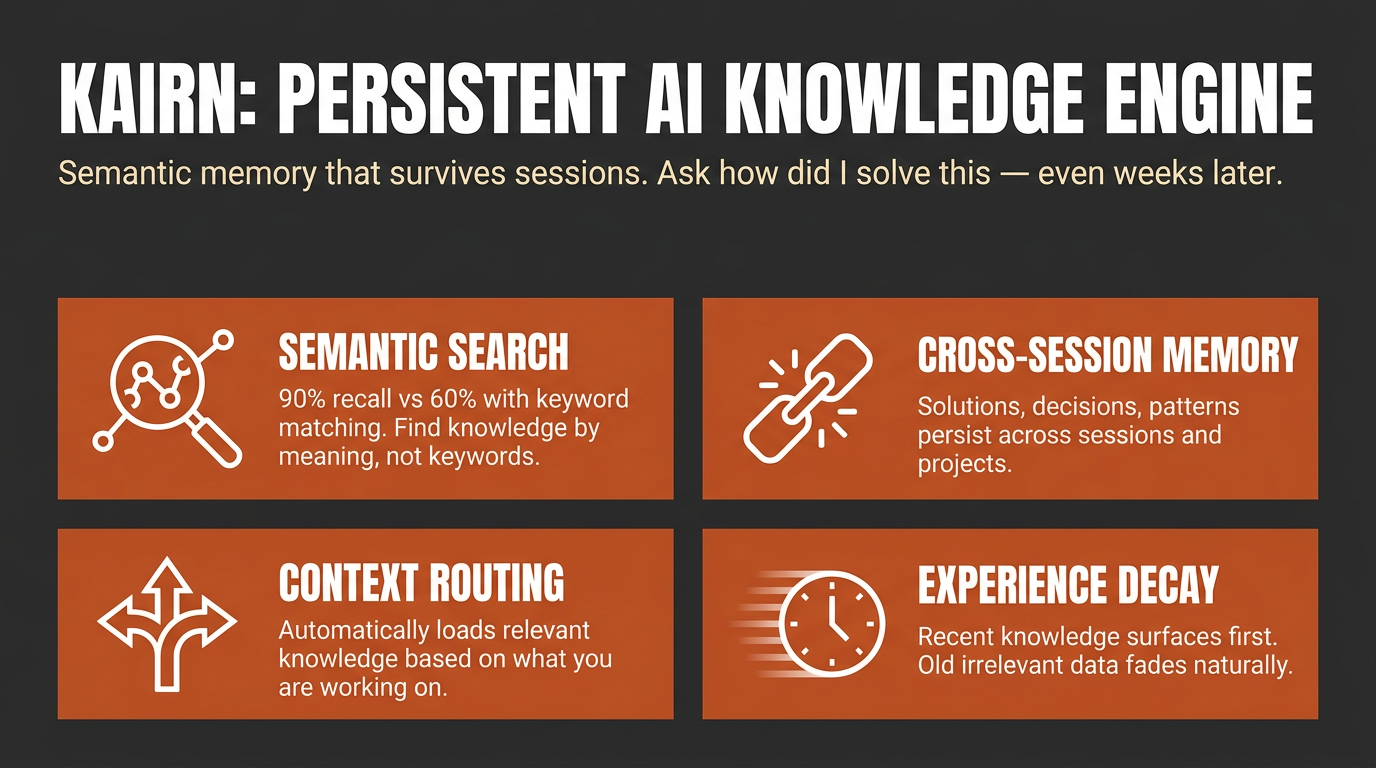
> Context-aware knowledge engine for AI assistants.
**Status: pre-1.0.** In daily use since February 2026, with a test suite that runs on Linux, macOS and Windows (see [Development](https://github.com/primeline-ai/kairn/blob/v0.3.1/README.md#development)) and a published
[LongMemEval-S benchmark](https://github.com/primeline-ai/kairn/blob/v0.3.1/README.md#benchmarks) (measured before 0.3.0). Interfaces may still change between
releases until 1.0. Feedback and issues welcome.
Other tools give your AI a memory. **Kairn** gives it a knowledge graph with intelligent context routing. It knows what to load, when to load it, and how much - so your AI stays focused, not overwhelmed.
```bash
pip install kairn-ai
kairn init ~/brain
kairn serve ~/brain
```
Claude Code and Codex each take one line; `--init` creates `~/brain` and its database on first start, so this works even without `kairn init`:
```bash
claude mcp add kairn -- kairn serve --init ~/brain
codex mcp add kairn -- kairn serve --init ~/brain
```
Or install it as a one-click bundle, no Python setup required: download the
`.mcpb` file from the [latest release](https://github.com/primeline-ai/kairn/releases/latest)
and open it with a bundle-aware app such as Claude Desktop.
For other clients, see [Quick Start](https://github.com/primeline-ai/kairn/blob/v0.3.1/README.md#quick-start) below. New to Kairn? Jump to [First 5 Minutes](https://github.com/primeline-ai/kairn/blob/v0.3.1/README.md#first-5-minutes).
## Install routes
| Route | Who it is for | Command |
|---|---|---|
| PyPI | anyone with Python, and every MCP client | `pip install kairn-ai` |
| MCP Bundle (`.mcpb`) | Claude Desktop and other bundle-aware apps; no Python install needed | download from [Releases](https://github.com/primeline-ai/kairn/releases) and open it |
| Claude Code | one line, uses the PyPI install | `claude mcp add kairn -- kairn serve --init ~/brain` |
| Codex | one line, uses the PyPI install | `codex mcp add kairn -- kairn serve --init ~/brain` |
The bundle carries no Kairn source of its own. It declares `kairn-ai` as a
dependency and the host resolves it with `uv`, so a bundle install and a
`pip install` run identical code. Where the database lives is configurable when
you install the bundle; it defaults to `~/.kairn` and never leaves your machine.
## Why Kairn?
Every AI conversation starts from scratch. Previous insights, decisions, and patterns - gone. Existing memory tools store flat key-value pairs that can't represent relationships or surface the *right* context at the *right* time.
Kairn is different:
- **Context Router + Progressive Disclosure** - Automatically loads relevant subgraphs based on keywords, starting with summaries and drilling into details only when needed. No other tool does this.
- **Knowledge Graph with FTS5** - Not flat storage. Typed relationships (`depends-on`, `resolves`, `causes`) between nodes with provenance tracking and full-text search across everything.
- **Experience Decay + Auto-Promotion** - Experiences lose relevance over time (biological decay model). Frequently-accessed experiences auto-promote to permanent knowledge. Your AI naturally forgets what doesn't matter.
- **22 MCP Tools** - Works with Claude Code, Codex, Claude Desktop, Cursor, VS Code, Windsurf, and any MCP client. Includes `kn_judge` for 5-verb relationship judgments and `kn_doctor` for read-only health diagnostics.
- **Per-Workspace Isolation** - Each workspace is its own isolated SQLite store. JWT auth and role-based access control (owner / maintainer / contributor / reader) ship for team deployments.
## Quick Start
### Claude Desktop
Add to `~/Library/Application Support/Claude/claude_desktop_config.json` on macOS or `%APPDATA%\Claude\claude_desktop_config.json` on Windows:
```json
{
"mcpServers": {
"kairn": {
"command": "kairn",
"args": ["serve", "--init", "~/brain"]
}
}
}
```
### Cursor
Add to `.cursor/mcp.json`:
```json
{
"mcpServers": {
"kairn": {
"command": "kairn",
"args": ["serve", "--init", "~/brain"]
}
}
}
```
### VS Code
Add to `.vscode/mcp.json`:
```json
{
"servers": {
"kairn": {
"type": "stdio",
"command": "kairn",
"args": ["serve", "--init", "~/brain"]
}
}
}
```
### Windsurf
Add to `~/.codeium/windsurf/mcp_config.json`:
```json
{
"mcpServers": {
"kairn": {
"command": "kairn",
"args": ["serve", "--init", "~/brain"]
}
}
}
```
Restart your editor. Kairn's 22 tools appear in the MCP section.
## First 5 Minutes
A guided first run, end to end:
```bash
pip install kairn-ai
kairn init ~/brain # creates the workspace + database (optional: serve --init does it on first start)
```
Add the one-liner from above (or your client's Quick Start snippet), then restart the client. Once connected, ask your assistant to remember something:
> "Remember that we chose Postgres over SQLite for the analytics service because we needed concurrent writers."
That calls `kn_learn` under the hood and returns a JSON envelope like this (captured from a real run, via `kairn learn`, the CLI mirror of the tool):
```json
{"_v": "1.0", "stored_as": "node", "node_id": "002d9c22", "experience_id": "d0710c2f", "type": "decision", "confidence": "high", "namespace": "knowledge", "candidates": []}
```
Start a **new** session and ask it to recall the same thing - that calls `kn_recall` and surfaces what you just stored, no re-explaining required:
```json
{"_v": "1.0", "count": 2, "results": [
{"source": "node", "id": "002d9c22", "name": "Decision: we chose Postgres over SQLite for the analytics service beca", "type": "learned_decision", "description": "we chose Postgres over SQLite for the analytics service because we needed concurrent writers", "relevance": 1.0, "relevance_kind": "match"},
{"source": "experience", "id": "d0710c2f", "type": "decision", "content": "we chose Postgres over SQLite for the analytics service because we needed concurrent writers", "confidence": "high", "relevance": 1.0, "relevance_kind": "recency"}
]}
```
`kn_learn` stored both a permanent graph node and a decaying experience (high confidence does both, see [Confidence routing](https://github.com/primeline-ai/kairn/blob/v0.3.1/README.md#decay-model)); `kn_recall` found both from a three-word topic.
**Read `relevance_kind` before you read `relevance`.** Both rows above show `1.0` and they do not mean the same thing. `match` is lexical match strength (bm25); the experience's `recency` is time-decay - it is 1.0 because the row was created seconds ago, not because it matched well. A third value, `similarity`, is embedding cosine on the semantic-recall path, and `unscored` marks a row the surface had no ranking for and filled in with a constant. The numbers are not comparable across kinds, so do not sort a mixed result set on `relevance` alone. Same caution for `min_relevance` on `kn_recall`: it gates nodes on match strength and experiences on recency, one number against two scales. On `kn_memories` and `kn_prune`, which see experiences only, it is recency - and on `kn_prune` it **deletes**.
Run `kairn status ~/brain` any time as a smoke test - if it prints a JSON stats block (nodes/edges/experiences counts), the workspace is healthy. Want a scripted tour of every core feature instead of doing it by hand? Run `kairn demo ~/brain` - it walks through node creation, querying, experience saving, learning, recall, and context in about 30 seconds.
### Which tool when
22 tools is a lot to hold in your head on day one. Most sessions only need these:
| You want to... | Use | Why |
|---|---|---|
| Remember something new (a decision, gotcha, pattern, solution) | `kn_learn` | Default entry point - auto-routes to a permanent node (high confidence) or a decaying experience (medium/low), no need to decide yourself |
| Capture a stated user preference the moment it is expressed | `kn_preference` | Dedicated preference write path - you (the calling model) state the preference as one explicit sentence; stored with the longest half-life of any type |
| Add a permanent named concept you already know is durable | `kn_add` | Skips decay entirely - for structural knowledge, not day-to-day experience |
| Log a one-off experience with explicit confidence/decay control | `kn_save` | Lower-level primitive `kn_learn` wraps - reach for it when you want to set confidence/decay yourself |
| Search the permanent knowledge graph by text, type, tags, or namespace | `kn_query` | You're looking for nodes, not decaying experiences |
| Search saved experiences, ranked by relevance and decay | `kn_memories` | You're looking for experience content (solutions, gotchas, workarounds), not graph nodes |
| Surface everything relevant to a topic in one call | `kn_recall` (flat list) or `kn_context` (subgraph, progressive disclosure: summary first, full detail on demand) | You don't know yet whether the answer is a node or an experience - let Kairn search both |
Everything else (`kn_crossref`, `kn_related`, `kn_connect`, `kn_judge`, `kn_project`/`kn_projects`/`kn_log`, `kn_idea`/`kn_ideas`, `kn_promote_pending`, `kn_prune`, `kn_remove`, `kn_status`, `kn_doctor`) is advanced usage - see the full [22 Tools](https://github.com/primeline-ai/kairn/blob/v0.3.1/README.md#22-tools-kn_-prefix) reference below once you're past the basics.
## 22 Tools (kn_ prefix)
All tools follow MCP protocol with JSON responses.
### Graph (6)
| Tool | Description |
|------|-------------|
| `kn_add` | Add node to knowledge graph |
| `kn_connect` | Create typed edge between nodes (lax-mode vocabulary) |
| `kn_judge` | Record 5-verb judgment edge (strict mode: `conflicts_with` / `supersedes` / `compatible` / `scoped` / `related`) |
| `kn_query` | Search by text, type, tags, namespace |
| `kn_remove` | Soft-delete node or edge (undo-safe) |
| `kn_status` | Graph stats, health, system overview |
### Project Memory (3)
| Tool | Description |
|------|-------------|
| `kn_project` | Create or update project |
| `kn_projects` | List projects, switch active |
| `kn_log` | Log progress or failure entry |
### Experience Memory (5)
| Tool | Description |
|------|-------------|
| `kn_save` | Save experience with decay |
| `kn_preference` | Capture a stated user preference at utterance time (longest half-life) |
| `kn_memories` | Decay-aware experience search |
| `kn_prune` | Remove expired experiences |
| `kn_promote_pending` | Promote high-access experiences to permanent nodes |
### Ideas (2)
| Tool | Description |
|------|-------------|
| `kn_idea` | Create or update idea |
| `kn_ideas` | List/filter ideas by status, category |
### Intelligence (5)
| Tool | Description |
|------|-------------|
| `kn_learn` | Store knowledge with confidence routing |
| `kn_recall` | Surface relevant past knowledge |
| `kn_crossref` | Find similar past solutions in the current workspace |
| `kn_context` | Keywords → relevant subgraph with progressive disclosure |
| `kn_related` | Graph traversal (BFS) to find connected nodes |
### Diagnostic (1)
| Tool | Description |
|------|-------------|
| `kn_doctor` | Read-only health checks (lock mode, FTS5 parity, promotion backlog, namespace sprawl, orphan edges) - returns structured envelope with per-check verdicts and roll-up summary |
## Resources & Prompts
**Resources** (read-only context for MCP clients):
- `kn://status` - Graph overview, active project
- `kn://projects` - All projects with recent progress
- `kn://memories` - Recent high-relevance experiences
**Prompts** (session management):
- `kn_bootup` - Load active project, recent progress, and top memories (session start)
- `kn_review` - Summarize session and suggest next steps (session end)
## How It Works
### Architecture
```
Any MCP Client (Claude, Cursor, VS Code)
│
▼ MCP Protocol (stdio)
FastMCP Server (22 tools)
│
┌────┼────┐
▼ ▼ ▼
Graph Memory Intelligence
Engine Engine Layer
│ │ │
└────┼──────┘
▼
SQLite + FTS5
(per-workspace)
```
### Decay Model
Experiences decrease in relevance exponentially:
```
relevance(t) = initial_score × e^(-decay_rate × days)
```
| Type | Half-life | Notes |
|------|-----------|-------|
| solution | 120 days | Stable, durable |
| pattern | 90 days | Architectural knowledge |
| decision | 100 days | Context-dependent |
| workaround | 40 days | Temporary fixes fade fast |
| gotcha | 70 days | Tricky pitfalls stay relevant |
| preference | 180 days | Durable user preferences - initial estimate, not yet tail-calibrated |
Half-lives are calibrated against the real access tail of a production experience store, not guessed (one exception: `preference` is a new type with no access history yet, so its value is a documented initial estimate until real data accumulates).
**Confidence routing** via `kn_learn`:
- `high` → Permanent node + experience (no decay)
- `medium` → Experience with 2× decay
- `low` → Experience with 4× decay
- Auto-promotion: 5+ accesses → permanent node
- Node access tracking: `kn_recall`, `kn_context`, and `kn_crossref` log which nodes were accessed, feeding the decay and promotion pipeline
## Benchmarks
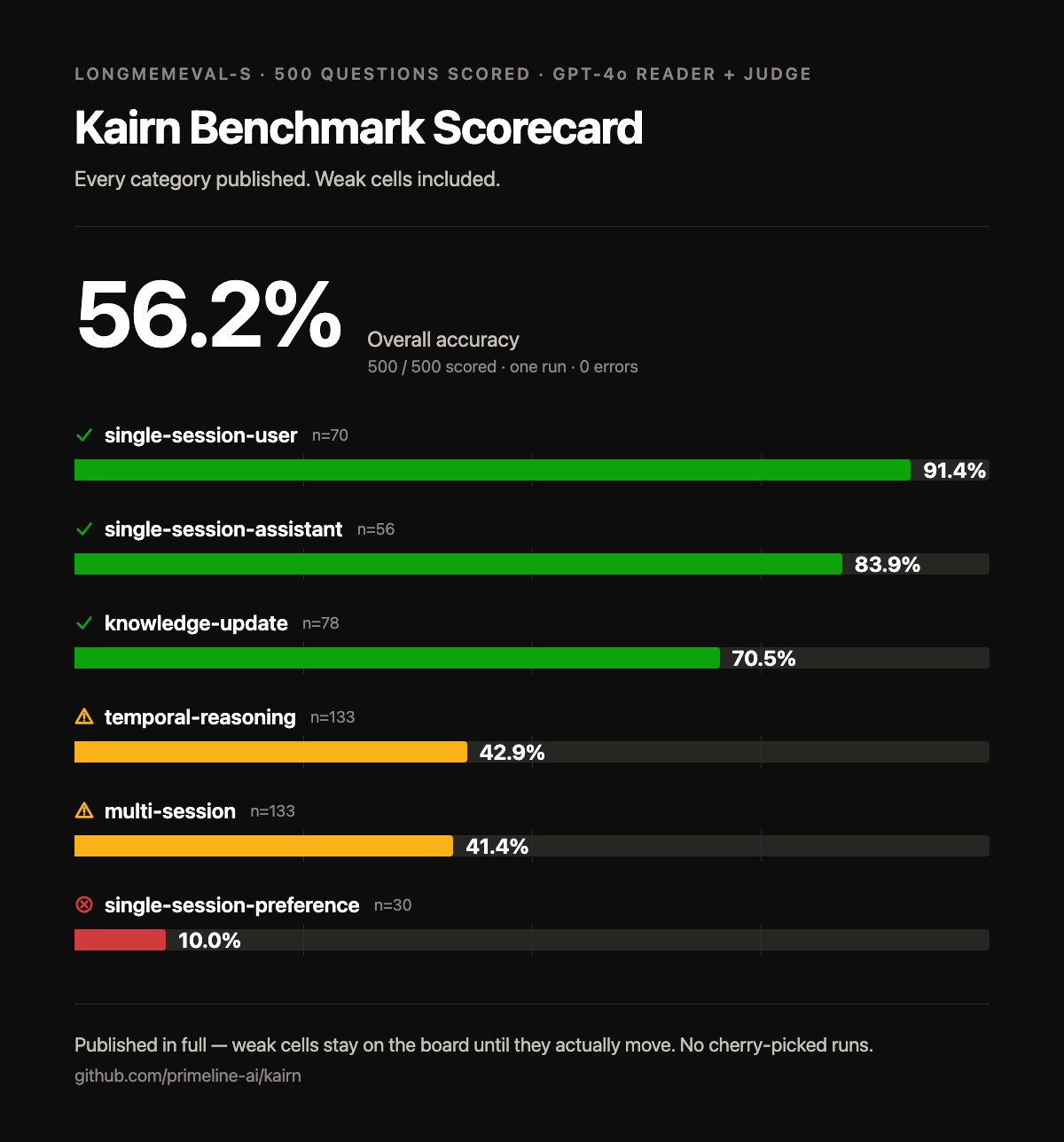
Kairn scored **56.2% overall on LongMemEval-S** in the 2026-06-12 run (500/500 questions scored,
GPT-4o reader + judge, single run, 0 errors). These are the real per-category
numbers, including the bad ones - each red cell links to its diagnosis:
| Category | n | Accuracy | Diagnosis |
|----------|----|----------|-----------|
| single-session-user | 70 | 91.4% | - |
| single-session-assistant | 56 | 83.9% | - |
| knowledge-update | 78 | 70.5% | - |
| temporal-reasoning | 133 | 42.9% | [why](https://github.com/primeline-ai/kairn/blob/main/BENCHMARKS.md#temporal-reasoning-429) |
| multi-session | 133 | 41.4% | [why](https://github.com/primeline-ai/kairn/blob/main/BENCHMARKS.md#multi-session-414) |
| single-session-preference | 30 | 10.0% | [why](https://github.com/primeline-ai/kairn/blob/main/BENCHMARKS.md#single-session-preference-100) |
The 500 questions include 30 abstention variants (the right answer is to
decline); they are counted inside their categories above and scored
separately: Kairn declines correctly on **96.7%** of them.
Recall latency was ~1.4 ms per query in that run (FTS5, in-process, no network). Protocol,
honesty notes, and reproduction steps: [BENCHMARKS.md](https://github.com/primeline-ai/kairn/blob/main/BENCHMARKS.md).
These numbers were measured on 2026-06-12, before the recall changes in 0.3.0 (match-aware experience scoring, coverage-weighted node relevance), and have not been re-measured on 0.3.0 yet. A weak cell stays on the board until the number actually moves. No cherry-picked runs, no hidden categories.
## CLI
```bash
kairn init [] # Initialize workspace; defaults to ~/.kairn
kairn serve [] # Start MCP server (stdio); defaults to ~/.kairn
kairn serve --init [] # Create workspace if needed and start MCP server; defaults to ~/.kairn
kairn status # Graph stats
kairn demo # Interactive tutorial
kairn benchmark # Local performance benchmarks (latency, not LongMemEval)
kairn token-audit # Audit tool token usage
kairn import git ... # Import git commit history (zero-LLM, offline)
kairn import claude-code # Import Claude Code session history (zero-LLM, offline)
```
### Importing your history
`kairn import git ...` backfills a Kairn store from one or
more local git repositories at $0 - no LLM calls, no network calls. Conventional-commit
prefixes map to experience types (`fix:` -> solution, `feat:`/`refactor:`/`perf:` -> pattern,
everything else -> decision); merge commits are skipped. Imported experiences land in a
dedicated `imported-git` namespace, separate from your organic knowledge, so they're always
distinguishable and a bad import is fully reversible.
```bash
kairn import git ~/brain ~/code/my-project --dry-run # Preview first
kairn import git ~/brain ~/code/my-project # Then import for real
kairn import git ~/brain ~/code/proj-a ~/code/proj-b --since 2026-01-01
```
Idempotent - re-running only imports commits that weren't already imported, so it's safe
to run again as a repo's history grows.
#### Claude Code transcripts
`kairn import claude-code ` backfills your Kairn store from your existing
Claude Code session history, also at $0 and fully offline. With no `--root` given it scans
`~/.claude/projects`; `--root PATH` is a repeatable override for any other folder. Imported experiences land in their own
`imported-claude-code` namespace, so they stay distinct from your organic knowledge and a
bad import is reversible.
```bash
kairn import claude-code ~/brain --dry-run # Review exactly what would be stored
kairn import claude-code ~/brain # Import (prompts once before writing)
kairn import claude-code ~/brain --root ~/other/projects --since 2026-01-01 --yes
```
**What gets stored (coarse mode):** one experience per session - the session's title plus
your first prompt of that session. This is deliberately a low-detail, high-precision summary
rather than a fine-grained per-decision extraction: a zero-LLM rule-based extractor cannot
reliably tell a captured decision from ordinary planning chatter, so `import claude-code`
imports a clean session-level pointer instead of noisy fragments. It is not a full transcript
archive, and it is not a one-time migration - it is idempotent and meant to be re-run as your
history grows.
**Privacy.** Every stored string is passed through a deterministic secret redactor first
(API keys, `Authorization`/`Bearer` headers, `password=`/`token=`/`secret=` assignments,
common vendor key shapes, private-key blocks, URL-embedded credentials). Tool outputs and
tool-call blocks are never read, only your own prompt text. The redactor is defense in depth,
not the only control: a real (non-dry-run) run is gated behind an explicit confirmation, and
`--dry-run` shows you the exact post-redaction text before anything is written. Redaction is
bounded by its rule set, so `--dry-run` review before a first real import is recommended;
nothing ever leaves your machine.
## Install as a plugin
The plugin needs [uv](https://docs.astral.sh/uv/getting-started/installation/).
Claude Code:
```bash
claude plugin marketplace add primeline-ai/kairn
claude plugin install kairn@kairn
```
Codex:
```bash
codex plugin marketplace add primeline-ai/kairn
codex plugin add kairn@kairn
```
If you already added Kairn with `claude mcp add kairn` or `codex mcp add kairn`, remove that entry first with `claude mcp remove kairn` or `codex mcp remove kairn`, or keep only one installation route, because both use the name `kairn`.
See [the plugin README](https://github.com/primeline-ai/kairn/blob/main/plugin/README.md) for what it does and the `codex exec` approval note.
## Configuration
```bash
KAIRN_WORKSPACE=~/brain # Sets where config.yaml is read from and where 'kairn workspace' keeps team data; 'kairn serve' opens the store at the given path, or ~/.kairn without one, regardless of KAIRN_WORKSPACE
KAIRN_JWT_SECRET= # Required for team features
KAIRN_LOG_LEVEL=WARNING # Level of Kairn's log lines on stderr: DEBUG, INFO, WARNING, ERROR or CRITICAL; default INFO; overrides log_level in config.yaml
```
Settings live in `/config.yaml`; `kairn init` writes it and `serve --init` does not, so create it by hand if you started with `serve --init`. Without it the defaults apply. Semantic recall is opt-in and off by default. It reranks recall with embeddings from a local Ollama server, so stored content never leaves your machine.
```yaml
semantic_recall: true
embedding_model: bge-m3 # ollama pull bge-m3
embedding_host: http://localhost:11434
semantic_recall_floor: 0.5 # cosine floor below which semantic recall abstains
semantic_recall_top_n: 30 # keyword candidates reranked by embeddings
experience_min_match: 0.0 # match floor for experience recall, 0.0-1.0; 0 turns it off
```
## Development
```bash
git clone https://github.com/primeline-ai/kairn
cd kairn
pip install -e ".[dev,team]"
pytest tests/ -v --cov
ruff check src/ && ruff format src/
```
### Project Structure
```
src/kairn/
├── server.py # FastMCP server + 22 tools
├── cli.py # CLI commands
├── config.py # Configuration
├── core/
│ ├── graph.py # GraphEngine (6 tools)
│ ├── memory.py # ProjectMemory (3 tools)
│ ├── experience.py # ExperienceEngine (4 tools)
│ ├── ideas.py # IdeaEngine (2 tools)
│ ├── intelligence.py # IntelligenceLayer (5 tools)
│ └── router.py # ContextRouter
├── storage/
│ ├── base.py # Storage interface
│ └── sqlite_store.py # SQLite + FTS5 implementation
├── models/ # Data models
├── events/ # Event bus
└── auth/ # JWT + RBAC (team feature)
```
## Performance
Measure it yourself rather than trusting this table:
```bash
kairn benchmark ~/brain --nodes 100
```
One run of that command, 100 nodes, on an Apple M4 Pro:
| Operation | Measured |
|-----------|----------|
| Insert | 0.7ms per node (1,479 ops/sec) |
| FTS5 query | 0.2ms (5,552 ops/sec) |
| Graph traversal | 6.0ms (166 ops/sec) |
Single run on one machine, so treat it as a shape rather than a spec - which is
why the command is above the table. `kn_connect` and `kn_crossref` used to
appear here with figures the benchmark does not produce; they have been removed
rather than estimated.
## Used By
| Project | What It Uses Kairn For |
|---------|----------------------|
| [Quantum Lens](https://github.com/primeline-ai/quantum-lens) | Persistent insight storage, cross-analysis pattern tracking, lens effectiveness metrics |
| [Claude Code Starter System](https://github.com/primeline-ai/claude-code-starter-system) | Session memory, project state, learning persistence |
## License
MIT
---
## Part of the PrimeLine Ecosystem
| Tool | What It Does | Deep Dive |
|------|-------------|-----------|
| [**Evolving Lite**](https://github.com/primeline-ai/evolving-lite) | Self-improving Claude Code plugin - memory, delegation, self-correction | [Blog](https://primeline.cc/blog/knowledge-architecture) |
| [**Kairn**](https://github.com/primeline-ai/kairn) | Persistent knowledge graph with context routing for AI | [Blog](https://primeline.cc/blog/knowledge-architecture) |
| [**tmux Orchestration**](https://github.com/primeline-ai/claude-tmux-orchestration) | Parallel Claude Code sessions with heartbeat monitoring | [Blog](https://primeline.cc/blog/tmux-orchestration) |
| [**UPF**](https://github.com/primeline-ai/universal-planning-framework) | 3-stage planning with adversarial hardening | [Blog](https://primeline.cc/blog/planning-framework-dsv-reasoning) |
| [**Quantum Lens**](https://github.com/primeline-ai/quantum-lens) | 7 cognitive lenses for multi-perspective analysis | [Blog](https://primeline.cc/blog/quantum-lens-multi-agent-analysis) |
| [**PrimeLine Skills**](https://github.com/primeline-ai/primeline-skills) | 5 production-grade workflow skills for Claude Code | [Blog](https://primeline.cc/blog/score-based-auto-delegation) |
| [**Starter System**](https://github.com/primeline-ai/claude-code-starter-system) | Lightweight session memory and handoffs | [Blog](https://primeline.cc/blog/session-management) |
**[@PrimeLineAI](https://x.com/PrimeLineAI)** · [primeline.cc](https://primeline.cc) · [Free Guide](https://primeline.cc/guide)