# The system description
In this example, we will implement the UKF to estimate a simple damped pendulum system. Wikipedia has good explanation for [an undamped system](https://en.wikipedia.org/wiki/Pendulum_(mathematics)#Simple_gravity_pendulum) with good animation, while [this website](http://www.nld.ds.mpg.de/applets/pendulum/eqm2.htm) has explanation for the damped one.
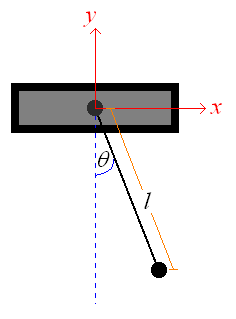
The variables of the system can be seen from this picture:
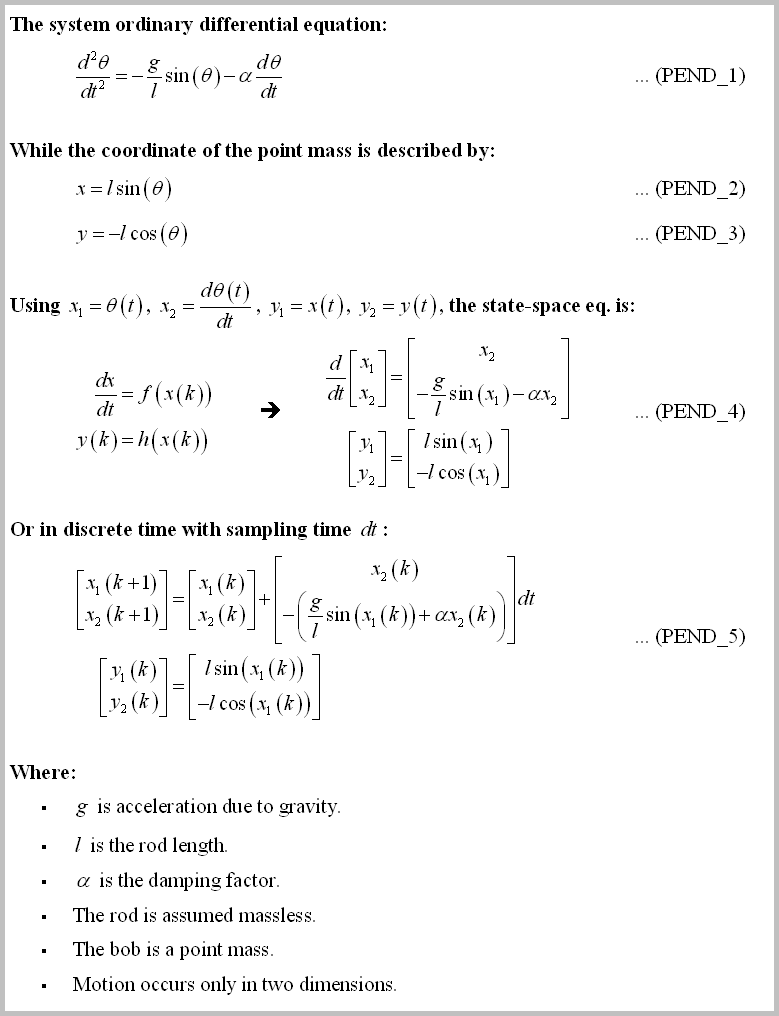
While the system equations can be described as:
# The implementation
First we set the system parameters in `konfig.h`:
/* State Space dimension */
#define SS_X_LEN (2)
#define SS_Z_LEN (2)
#define SS_U_LEN (0)
Then we implement the state space nonlinear update & measurement function in `ukf_pend_engl.ino`:
bool Main_bUpdateNonlinearX(Matrix &X_Next, Matrix &X, Matrix &U)
{
/* The update function in discrete time:
* x1(k+1) = x1(k) + x2(k)*dt
* x2(k+1) = x2(k) - g/l*sin(x1(k))*dt - alpha*x2*dt
*/
...
return true;
}
bool Main_bUpdateNonlinearY(Matrix &Y, Matrix &X, Matrix &U)
{
/* The output (in discrete time):
* y1(k) = sin(x1(k)) * l
* y2(k) = -cos(x1(k)) * l
*/
...
return true;
}
To demonstrate the UKF capability, we add noise at the output system (also in `ukf_pend_engl.ino`):
/* ================== Read the sensor data / simulate the system here ================== */
....
/* Let's add some noise! */
Y[0][0] += (float((rand() % 20) - 10) / 10.); /* add +/- 1 meters noise to x position */
/* ------------------ Read the sensor data / simulate the system here ------------------ */
And set the UKF initial pendulum angle `(theta(k=0))` as different with the true initial pendulum angle:
/* For example, let's set the theta(k=0) = pi/2 (i.e. the pendulum rod is parallel with the horizontal plane) */
X_true[0][0] = 3.14159265359/2.;
/* Observe that we set the wrong initial x_estimated value! (X_UKF(k=0) != X_TRUE(k=0)) */
X_est_init[0][0] = -3.14159265359/2.;
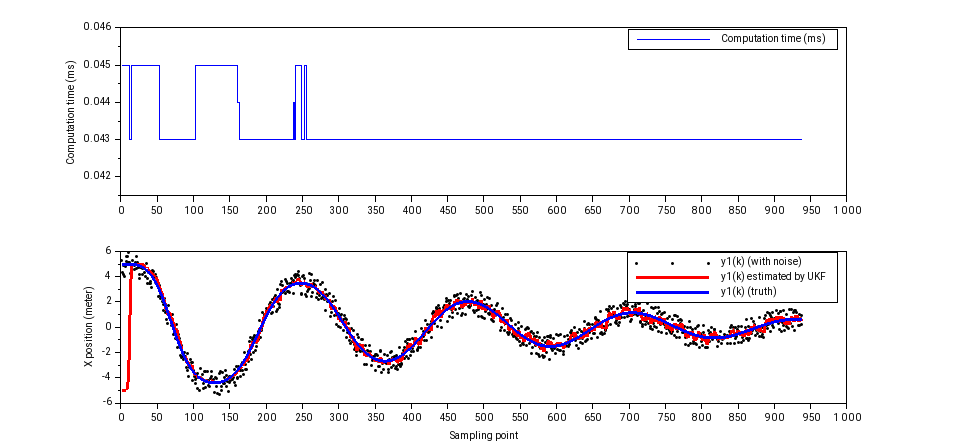
And then plot the estimated x-position of the bob. The result, plotted using [Scilab](https://www.scilab.org/) (you can see at the beginning, the estimated value is converging to the truth despite wrong initial value):