
phi

Docs Discord 中文 License CI Go Release

- 15 MB · ~31 ms · sub-agents · anchored sloppy edits · permission gate · progressive MCP · PXB extensions · native diff review & code selection · OpenAI / Anthropic / Gemini ![phi welcome](assets/phi.png) ![phi TUI](assets/image.png) ![phi diff review](assets/diff.png) - [Sponsors](#sponsors) - [Docs](https://pulseaiclub.github.io/docs/getting-started/) - [Quick start](#quick-start) - [Footprint](#footprint) - [Configuration](#configuration) - [Interactive mode](#interactive-mode) - [Diff review](#diff-review) - [Code viewer](#code-viewer) - [Commands](#commands) - [Sessions](#sessions) - [Headless mode](#headless-mode) - [Skills](#skills) - [Permissions](#permissions) - [Extensions](#extensions) - [MCP](#mcp) - [Tools](#tools) - [Project layout](doc/project-layout.md) ## Sponsors
Infistar.cc
phi is sponsored by Infistar.cc — one API key for every major model, priced for people who run agents all day.

⚙️ Plug and play: set the base URL, API key, and model name, then call it directly.
🧩 One key, every model: switch between Claude, GPT, Gemini, DeepSeek, and other leading models without editing config again.
💰 Cheap and simple: some models cost as little as 1% of official rates, with RMB billing and invoices.
🎁 phi perk: register through our link and get $5 in trial credits 👉
Free ~/.phi/config.yaml — phi ships the whole model block; paste it, swap in your key, start.

models:
    - name: claude-opus-5-5
      api_key: ""
      base_url: https://infistar.cc
      api: Anthropic
    - name: gpt-6-astra
      api_key: ""
      base_url: https://infistar.cc/v1
      api: OpenAIResponses
    - name: gemini-3-pro
      api_key: ""
      base_url: https://infistar.cc
      api: Gemini
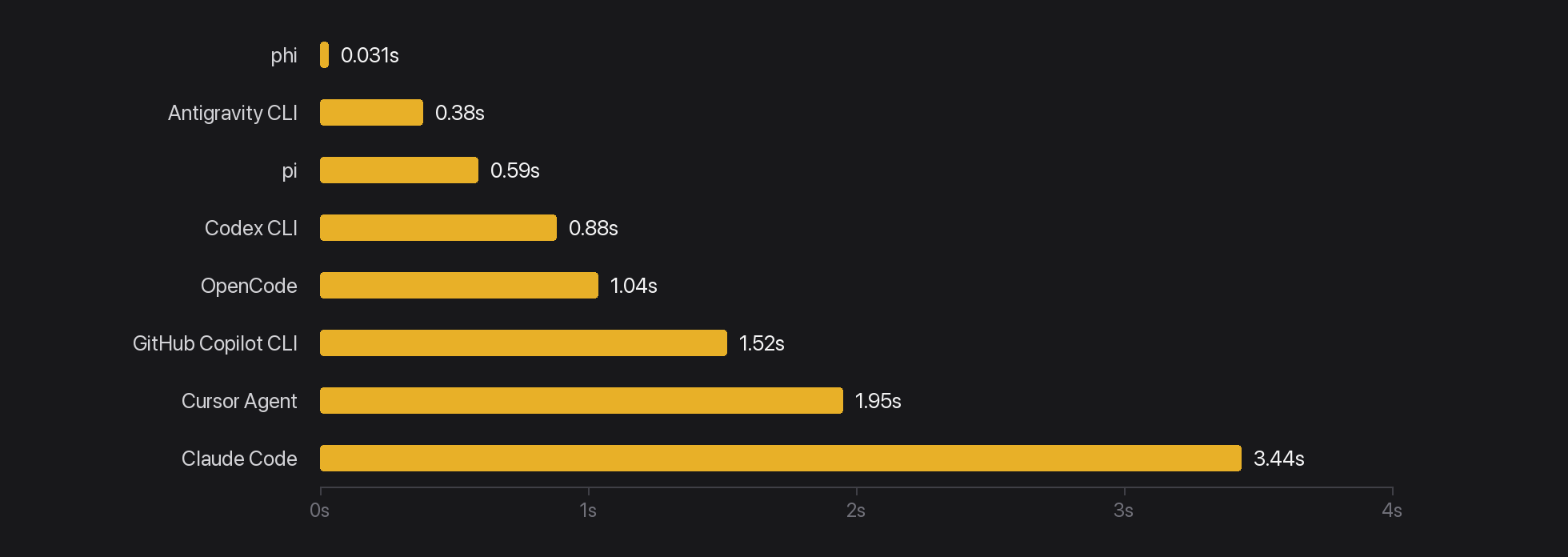
## Quick start Install the latest release (macOS / Linux): ```sh curl -fsSL https://raw.githubusercontent.com/pulseaiclub/phi/main/scripts/install.sh | bash ``` Windows (PowerShell 5.1+): ```powershell irm https://raw.githubusercontent.com/pulseaiclub/phi/main/scripts/install.ps1 | iex ``` First launch needs a model. Open the config editor (creates `~/.phi` layout and writes `~/.phi/config.yaml`): ```sh phi config ``` Or set env vars for a one-off run: ```sh export PHI_MODEL=gpt-4o export PHI_API_KEY=sk-... ``` Then start the TUI: ```sh phi ``` Or build from source (Go 1.26.3+, see `go.mod`): ```sh make build # produces ./phi make install # build and install into $GOBIN ``` On first start, phi automatically creates `~/.phi/{bin,skills,hooks,session}`. Search tools (`fd`, `rg`) download into `~/.phi/bin` in the background when missing. The TUI gives the model four core tools — `read`, `write`, `edit`, and `bash` — plus `grep`, `find`, and `ls`. The model uses these to fulfill your requests. External HTTP fetch is available via MCP when configured. ## Footprint Lean is not enough — phi is built to feel instant and stay cheap under load. phi numbers are a stripped release build (`CGO_ENABLED=0`, `-ldflags="-s -w"`) on macOS arm64. Other harnesses use published Linux PSS / interactive PTY figures. ### Time to first frame

Time to first frame: phi 0.031s vs other terminal harnesses

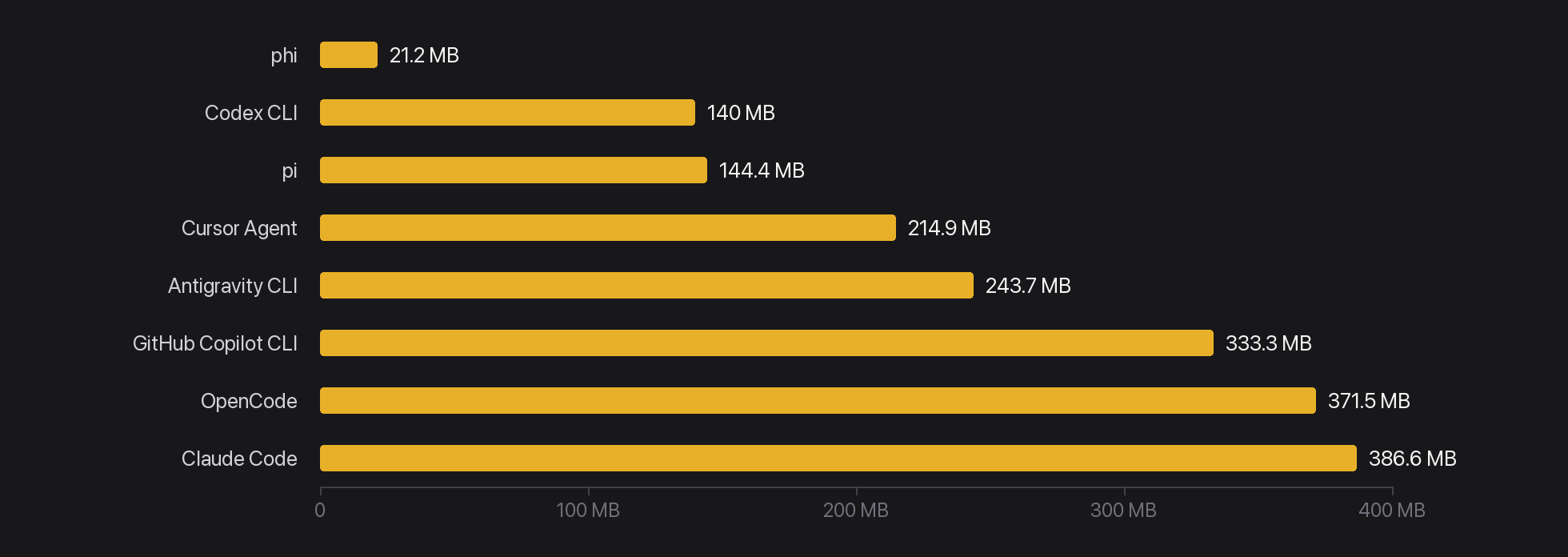
### Idle RAM · 1 session

Idle RAM, 1 session: phi 21.2 MB vs other terminal harnesses

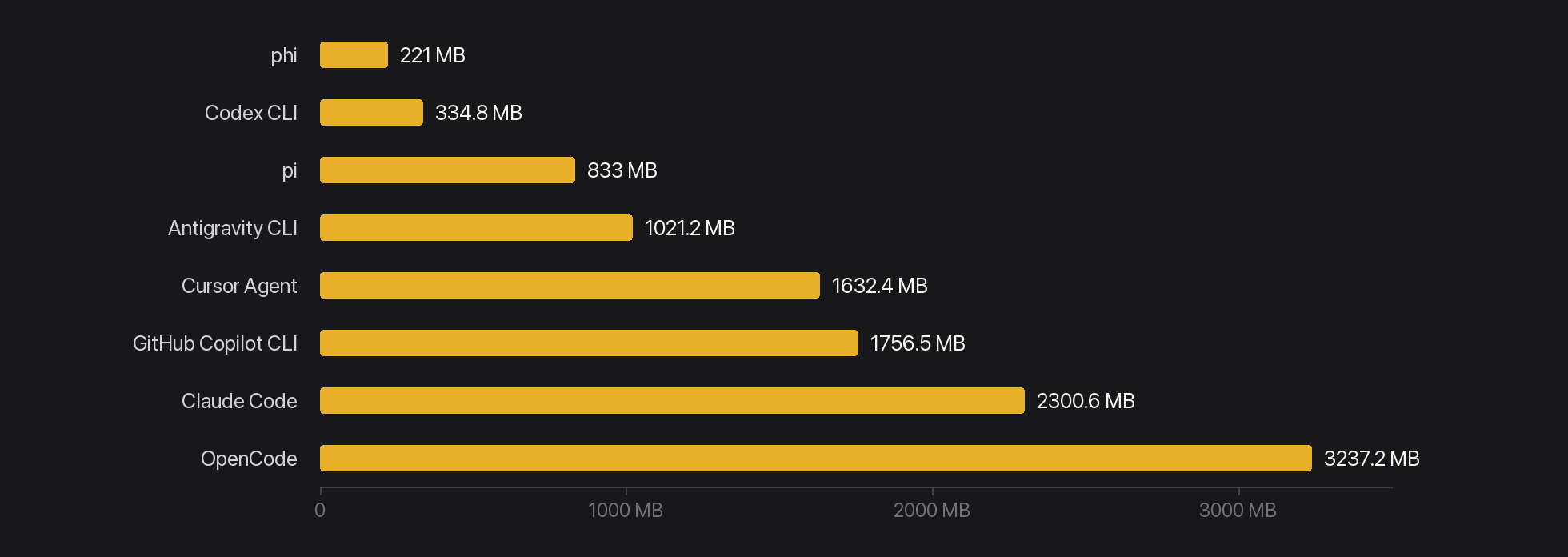
### Idle RAM · 10 sessions

Idle RAM, 10 sessions: phi 221 MB vs other terminal harnesses

| Metric | phi | | --- | ---: | | Release binary | **~15 MB** | | Idle RSS (1 session) | **~21 MB** | | 10 idle sessions (total RSS) | **~221 MB** | | Time to first frame | **~31 ms** (26–49 ms) | | Cold `go build` (empty `GOCACHE`) | **~5.5 s** | | Warm rebuild | **~0.7 s** | | Go source (excl. tests) | **~22k LOC** / 107 files | | Go packages | **32** | | Direct module deps | **6** (15 modules total) | | Linked runtimes | system libs only (no Node / Electron / Python) | ## Configuration phi reads `~/.phi/config.yaml` (standard YAML). Environment variables override it for one-off runs. `phi config` opens a full-screen terminal editor for the same file — nothing is written until you save, and the previous file is kept as `config.yaml.bak`. ``` phi config keys ↑↓ ←→ move / cycle a value a add a model ⏎ edit or open a picker d delete the focused row esc close, or quit f fetch model ids from the provider ^s save s save q quit ``` An empty field means "not set", i.e. the value the loader would fill in; the placeholder shows that value. ```yaml # ~/.phi/config.yaml models: - name: gpt-4o api: OpenAI # OpenAI | OpenAIResponses | Anthropic | Gemini (empty → OpenAI-compatible) api_key: sk-... # or set PHI_API_KEY base_url: https://api.openai.com/v1 # default; PHI_BASE_URL overrides context_window: 128000 # optional default: true # the model used at startup; first entry wins if absent - name: claude-sonnet-4-20250514 api: Anthropic # required — no name/URL guessing api_key: sk-ant-... base_url: https://api.anthropic.com context_window: 200000 - name: deepseek-flash # built-in preset: base_url / context / thinking filled in api_key: sk-... - name: gemini-2.5-flash # built-in preset (api: Gemini) api_key: ... think_level: high # optional: off | minimal | low | medium | high | … skill_path: ~/.phi/skills # where SKILL.md files are loaded from; "~/…" is expanded max_rounds: 64 # tool round budget; 0 → engine default (64) agents: enabled: true # default; set false to disable agent_* sub-agent tools models: # optional per-role defaults; omit → inherit parent model explore: cheap-model review: strong-model worker: coding-model permissions: mode: interactive # interactive | readonly | autopilot | headless-strict bash: default: ask # ask | allow | deny allow: - "go test ./..." deny: - "rm -rf *" rules: # extra rules; deny > ask > allow, always - kind: read resource: url decision: ask reason: external lookup needs approval ``` Built-in presets and thinking wire formats: [doc/models.md](doc/models.md). Environment overrides: | Variable | Overrides | | ---------------- | ------------------ | | `PHI_API_KEY` | `models[].api_key` (default model) | | `PHI_MODEL` | `models[].name` (default model) | | `PHI_BASE_URL` | `models[].base_url` (default model) | | `PHI_SKILL_PATH` | `skill_path` | | `PHI_THINK_LEVEL` | `models[].think_level` (default model; `off` disables) | | `PHI_PROMPT_HISTORY` | Composer prompt recall (`on` enables; off by default, writes `prompts.json` in the project's session directory) | Provider routing uses the explicit `api` field (`OpenAI` / `Anthropic` / `Gemini`). See [Supported models](doc/models.md). ### Workspace layout ``` ~/.phi/ ├── config.yaml # global configuration ├── bin/ # downloaded search tools (fd, ripgrep) ├── skills/ # SKILL.md skill directories ├── extensions/ # PXB binaries + phi.yaml ├── jobs/ # sub-agent job artifacts (meta, logs, result.md) └── session/ # persisted sessions, one dir per working directory └── / ``` ## Interactive mode `phi` (or `phi tui`) starts the TUI: a chat transcript on top, an editor at the bottom, and a footer with the current activity. When a newer release is available, the footer shows a hint like `0.2.0 available · phi update`. Assistant output is rendered as Markdown (CommonMark/GFM): headings, emphasis, strikethrough, links, blockquotes, lists, task checkboxes, and tables are styled with the active theme; fenced code blocks get a muted language caption and per-language syntax highlighting. Structural markers (`#`, `` ` ``, `*`) are stripped. The editor supports: - `@` — fuzzy file mention picker (type `@` and start typing a path) - `/` — slash command picker (`/sessions`, `/branch`, `/new`, `/diff`, `/code`) - `?` — shortcut help picker (lists `/`, `!`, `@`, and key bindings; `Esc` closes) - `!command` — run a shell command locally and stream its output into the transcript (see [Commands](#commands)) - `Ctrl+K` — command palette: settings → model / theme / permissions / agents (incl. per-role models), skills, hooks ### Keyboard shortcuts | Key | Action | | -------------- | ------------------------------- | | `Ctrl+C` | Quit phi | | `Esc` | Cancel the running agent / close pickers | | `Ctrl+K` | Toggle the command palette | | `Ctrl+A` | Jump to the start of the line | | `Ctrl+E` | Jump to the end of the line | | `Ctrl+U` | Clear the composer input, images, and skills | | `Ctrl+Shift+C` | Copy the selected transcript text | Themes: `Dark` (default), `Darcula`, `Pink`, and `Terminal`, switchable from the palette under settings → theme. ## Diff review `/diff` is a full-screen git review inside the TUI — read the change, leave line notes, then hand them to the agent without leaving the terminal. | Command | What opens | | --- | --- | | `/diff` | Working tree (`git diff`) | | `/diff staged` | Staged changes | | `/diff HEAD` | Last commit (`git show`) | | `/diff @path` | Only that file — `@` comes from file completion, the `--` separator is added for you | | `/diff staged @a.go @b.go` | Staged changes in two files | | `/diff HEAD @path` | That file against `HEAD` | | `/diff main..feat @path` | That file across a range | `/diff -- ` runs the given git command instead of a diff — `/diff -- git show HEAD~1` for one. Slash-picker Enter inserts `/diff` plus a trailing space into the composer; submit to open. Inside the overlay: `s` side-by-side, `i` add/edit a note, `x` delete, `a` send notes to the agent, `?` help, `q` / `Esc` close. Notes live in the overlay's memory only — switching diffs drops them and nothing is written to disk. ## Code viewer `/code [:line]` opens a full-screen source viewer: syntax highlighting, a CJK-aware caret (`j`/`k`, `h`/`l`, `gg`/`G`), in-file search (`/`, then `n`/`N`), `:line` to jump to a line, and `v` for lines or `p` for the paragraph under the caret, then `a` to hand the selection to the chat input as a `path:12-18` reference the model reads. The pane reads files itself and answers to the same deny list as the tool gate, so sensitive paths (`~/.ssh`, `.env`, …), binaries and files over 8 MiB are refused with a toast. `Esc` closes, or cancels a search back to where `/` was pressed. The status row shows the path, caret and line count while reading, the selection size while `v` is active, and the match counter (`2/5`) while a search is live. ## Branch switching `/branch` opens the branch picker for the working directory. Two columns: the branch name, and its most recent commit. A `●` marks the branch HEAD is on. Rows are ordered where you are, where you came from (git reflog), the other local branches, then remote-tracking branches. Enter runs `git switch` on the selected row — off the UI goroutine, so a slow checkout does not freeze the composer. Picking a remote row checks out the local branch that tracks it, the same thing `git switch feat` does for `origin/feat`. `/branch ` skips the picker: it switches to that branch, or creates it from HEAD when no branch carries the name yet. Naming is the whole "new branch" flow — three characters typed beat a form. Uncommitted work is never touched: git refuses rather than lose it, and its reason is toasted verbatim. Switching is blocked while a reply or command is running, and while a merge, rebase, cherry-pick, revert, or bisect is unfinished. ## Commands | Command | Description | | ------------------ | --------------------------------------------- | | `phi` / `phi tui` | Start the interactive TUI | | `phi run -p "…"` | Run one agent loop headlessly (see below) | | `phi update` | Download and install the latest GitHub release | | `phi update --check` | Query the latest release without installing | | `phi sessions list`| List persisted sessions for this directory | | `/sessions` | List sessions for this directory (TUI) | | `/branch` | Switch the working branch — see [Branch switching](#branch-switching) | | `/new` | Start a fresh empty session (TUI) | | `/diff` | Full-screen git review — see [Diff review](#diff-review) | | `/code` | Full-screen source viewer — see [Code viewer](#code-viewer) | | `!command` | Run a shell command locally, stream output into the transcript; `Esc` cancels it | In the TUI, `!command` runs locally via `bash -c` — outside the agent loop. It doesn't count toward agent busy state, and the running command can be cancelled with `Esc` without touching an in-flight agent turn. ## Sessions Sessions persist automatically per working directory under `~/.phi/session//` as JSONL trajectories. - `phi sessions list` — list session id, mtime, and preview for the current directory - `/sessions` in the TUI — same, in-app - `/new` — start a fresh session (new id, empty transcript) - `phi run --session ` / `phi run --continue-last` — resume headlessly ## Headless mode ```sh phi run -p "fix the failing test in internal/tools" ``` Runs one agent loop without a TUI. Human logs go to stderr; with `--jsonl`, machine-readable events go to stdout, one JSON object per line. Flags: | Flag | Description | | -------------------- | ---------------------------------------------- | | `-p, --prompt STRING`| Prompt to run (required) | | `--jsonl` | Emit JSONL events to stdout | | `--yolo` | Skip all permission checks for this run (benchmarks / CI only) | | `--max-rounds N` | Cap tool rounds (default 64) | | `--timeout DURATION` | Limit the agent run wall-clock time (e.g. `10m`; disabled by default) | | `--session ID` | Resume a persisted session by id or unique prefix | | `--continue-last` | Resume the newest persisted session for this directory | | `--session-dir DIR` | Override the session storage directory | | `--tools LIST` | Enable only these comma-separated built-in tools | `--tools` accepts built-in names such as `read,ls,grep`. MCP and agent tools still append when configured; the flag only scopes the built-in toolset. Exit codes: `0` success · `1` runtime/LLM error · `2` max rounds reached · `3` config/usage error. In the interactive TUI, exhausting the tool-round budget prompts Continue / Stop. Headless `phi run` has no confirmation UI, so it exits with code 2. In headless mode, permission `ask` decisions are denied (there is no approval UI), so `readonly`-style safety applies without extra flags. For benchmarks that need arbitrary shell (`pytest`, `npm test`, …), pass `--yolo` to skip the permission gate for that run only. ## Skills Skills are directories containing a `SKILL.md` file with YAML frontmatter and a Markdown body. They are loaded from `~/.phi/skills/` (or `skill_path` / `PHI_SKILL_PATH`) and injected into the agent's context, letting you give the model reusable procedures: The Agent Skills locations `~/.agents/skills/` and `.agents/skills/` are read too, so a skill pack installed for another agent works here without configuration. Project `.agents/skills/` directories are discovered from the working directory upward, stopping at the repository root when there is one. Roots are searched in order — `skill_path` first, then `~/.agents/skills`, then the project directories — and the first root wins when two of them define the same skill name. A leading `~` in `skill_path` or `PHI_SKILL_PATH` expands to your home directory. > **Security:** skill files are workspace content, not trusted input — a > project `.agents/skills/` is picked up without confirmation. Review skills > the way you review `AGENTS.md` before trusting a checkout. ```markdown --- name: My Skill description: What this skill does license: MIT compatibility: claude, openai disable-model-invocation: false --- Instructions the agent should follow when this skill is relevant. ``` `disable-model-invocation: true` keeps a skill out of the system prompt catalog — good for the ones you only want on explicit request. It stays in the skills panel and is still applied when you pick it there. Only a case-insensitive `true` counts; any other value means `false`. This is a catalog filter, not access control: the model can still find the file with `ls` / `find`. In the TUI, add skills from the palette (skills → list), then submit the message with the selected skills applied. ## Permissions Tool execution is gated by a permission policy, so the agent can run read-only by default and ask before anything destructive. Configure it under `permissions:` in `~/.phi/config.yaml`. Modes: | Mode | Behavior | | ------------------ | --------------------------------------------------- | | `interactive` | Default. `ask` decisions prompt in the TUI. | | `readonly` | Deny writes / bash; read tools still work. | | `autopilot` | Fold `ask` → allow, run unattended. | | `headless-strict` | Fold `ask` → deny (used by `phi run`). | Per-tool rules: `bash.default` / `bash.allow` / `bash.deny` (regexes against the command). `permissions.rules` adds your own rules by tool, kind, command, path, or workspace scope; they are evaluated strictest-first (`deny` > `ask` > `allow`), so a rule can tighten a policy but never loosen one. Global keys: `workspace_only_writes` (default true), `ask_timeout_sec`, and `dangerously_allow_all` (default false). Full semantics and examples: [doc/permissions.md](doc/permissions.md). In the TUI, an approval dialog replaces the editor with options to approve, deny with feedback, or allow all for the session / for every session. The palette's settings → permissions entry toggles session-wide bypass. ## Extensions Extensions are native binaries speaking the **PXB** binary protocol over stdin/stdout (author SDKs: Go `github.com/pulseaiclub/phi/ext/go/phi`, Rust [`ext/rust`](ext/rust) (`phi-ext`), and TypeScript [`ext/ts`](ext/ts) (`@pulseaiclub/phi-ext`)). They subscribe to tool/session events, register LLM tools, and add slash commands. ```bash go get github.com/pulseaiclub/phi/ext/go@v0.21.0 ``` ```go package main import ( "github.com/pulseaiclub/phi/ext/go" "github.com/pulseaiclub/phi/ext/go/phi" ) func main() { m := phi.New("hello", "0.1.0") m.OnToolCall(func(ev ext.ToolCallEvent) *ext.ToolCallResult { // return &ext.ToolCallResult{Block: true, Reason: "..."} return nil }) _ = m.Run() } ``` Install under `~/.phi/extensions//` with a `phi.yaml` pointing at the binary. In the TUI: `Ctrl+K` → **extensions**. Disable with `PHI_EXTENSIONS=off`. Full guide: [doc/extensions.md](doc/extensions.md). Codec throughput on Apple Silicon (release, single-threaded): | Implementation | Hello encode+decode | Frame write+read (in-memory) | Allocs | |---|---|---|---| | Rust PXB (`phi-ext`) | ~0.12 µs | ~0.06 µs | — | | Go PXB (`ext/go/pxb`) | ~0.11 µs | ~0.05 µs | 3 / op | | Go JSON lines | ~1.2 µs | — | 15 / op | The ~10× gap over JSON lines is the protocol (fixed header + tagged fields), not the language — Rust and Go are within noise on the same codec work. Real extension latency is dominated by process spawn and pipe RTT anyway. Re-probe: `cargo run --release --example bench` in [`ext/rust`](ext/rust). ## MCP **Configure 100 MCP servers. Pay ~0 schema tokens until you call one.** Most MCP hosts dump every `tools/list` schema into the model context before you ask a question — browser stacks alone can burn 50k+ tokens. phi does not. Instead MCP is a **URL namespace** on the regular tools, and the system prompt lists configured **server names** (no schemas): | Action | Call | | --- | --- | | List tools on a server | `ls mcp:///tools/` | | Fetch a slim parameter summary | `read mcp:///tools/` | | Invoke | `write mcp:///tools/` with content = JSON args | Flow: pick a server from the prompt → `ls` → `read` → `write`. Subprocesses start **lazily** on first use. Browsing is read-tier; invokes still go through PreHooks → write Gate / Ask → Run → PostHooks. ```sh phi mcp add browsermcp -- npx @browsermcp/mcp@latest phi mcp doctor # In the TUI, the model can use configured servers without guessing MCP exists ``` Config: `~/.phi/mcp.json` (project `/.phi/mcp.json` overrides by name). Disable with `PHI_MCP=off`. Stdio and HTTP in v1. Full guide: [doc/mcp.md](doc/mcp.md). ## Sub-agents Sub-agent tools (`agent_spawn`, `agent_wait`, …) are **on by default**. To keep a session lean, disable them in `~/.phi/config.yaml`: ```yaml agents: enabled: false ``` Or toggle for the current session via the palette: settings → agents. When disabled, those tools are not registered and the model cannot spawn jobs. Per-role model defaults (optional) under `agents.models` pick which configured model name each role uses when spawned. Omitted roles inherit the parent session model. Switch for the current session only via settings → agents → models → explore|review|worker (same session-only semantics as settings → model; does not write `config.yaml`). Sub-agents themselves use a **role** (`explore` default | `review` | `worker`): | Role | Tools | Use for | |------|--------|---------| | `explore` | no write/edit; bash except hard denies | Multi-hop recon / map structure | | `review` | same as explore | Diffs / checks; report only | | `worker` | full tools except nesting; bash except hard denies | Scoped, self-contained edits | Default stays explore (no edits). Prefer worker when the task is to implement a scoped change in an isolated context. ## Tools Built-in tools the model can call (see `internal/tools/`): | Tool | Purpose | | -------------- | -------------------------------------------- | | `bash` | Run a shell command in the working directory | | `read` | Read a file | | `write` | Write a file (gated by permissions) | | `edit` | Targeted edit of a file | | `grep` | Regex search across files | | `find` | File patterns (fd) | | `ls` | Directory listing | | `agent_spawn` | Start an isolated sub-agent job (async) | | `agent_wait` | Wait for a job; returns short summary only | | `agent_cancel` | Cancel a running job | Sub-agent transcripts live under `~/.phi/jobs//` and are **not** injected into the parent context — only the wait/task summary is. Fast search tools (`fd`, `ripgrep`) are downloaded on first startup into `~/.phi/bin` when missing. See [Project layout](doc/project-layout.md) for the source tree map. See [CONTRIBUTING.md](CONTRIBUTING.md) for development setup, code style, and commit conventions.