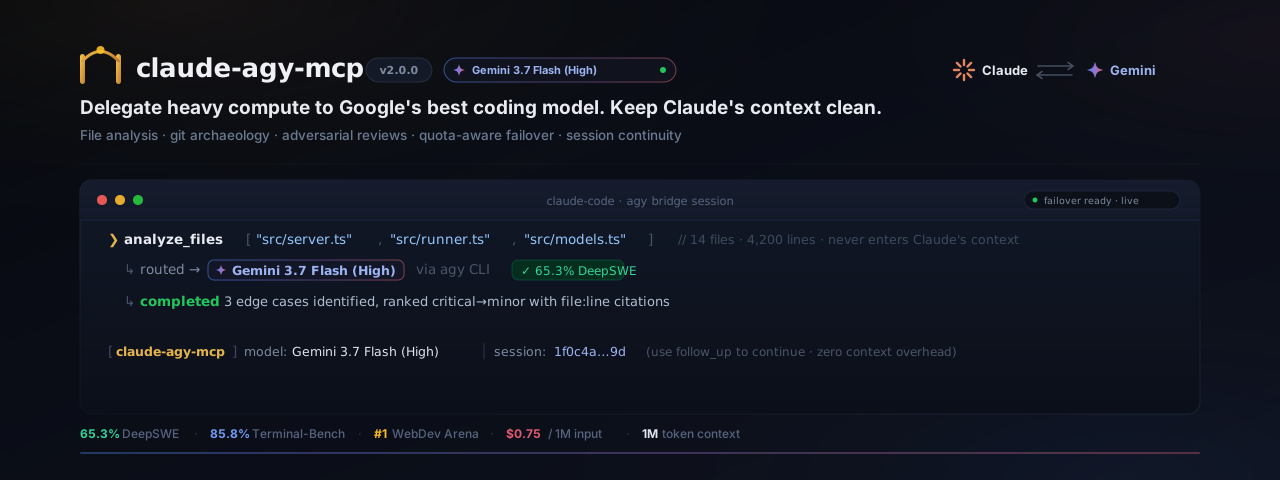
claude-agy-mcp — Claude Code delegates heavy tasks to the Antigravity CLI

npm downloads visitors

Claude Code Gemini 3.8 Flash MCP

Install · Why Gemini 3.8 Flash? · MCP Power Stack · Tools · Timeouts · Configuration

# ⚡ Install ```bash npm i @pymodel/claude-agy-mcp ``` ```bash claude mcp add-json -s user claude-agy-mcp \ '{"type":"stdio","command":"npx","args":["-y","@pymodel/claude-agy-mcp"],"timeout":3600000}' ``` **Claude Code delegates heavy tasks to Google's flagship Gemini Flash** via the Antigravity CLI (`agy`) — saving Claude's context window and tokens for what matters. Claude acts as the orchestrator → `claude-agy-mcp` routes compute-heavy sub-tasks to **the newest Gemini Flash agy offers** → only concise answers return. Large files, deep git searches, and log dumps never pollute Claude's context.
``` User → Claude Code → claude-agy-mcp (MCP) → agy CLI → Gemini 3.8 Flash / Pro / Claude ← ← ← (Clean answers only) ``` ## Why Gemini Flash for Claude Code?
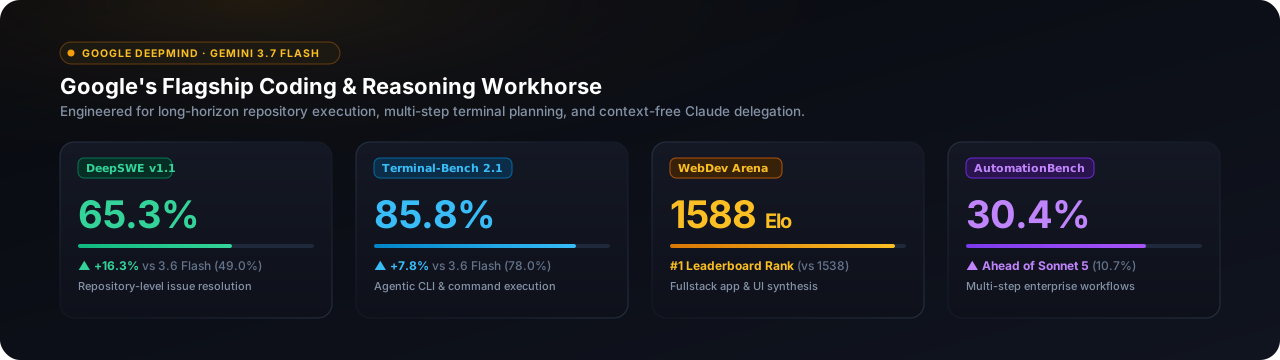
Gemini 3.8 Flash Benchmarks
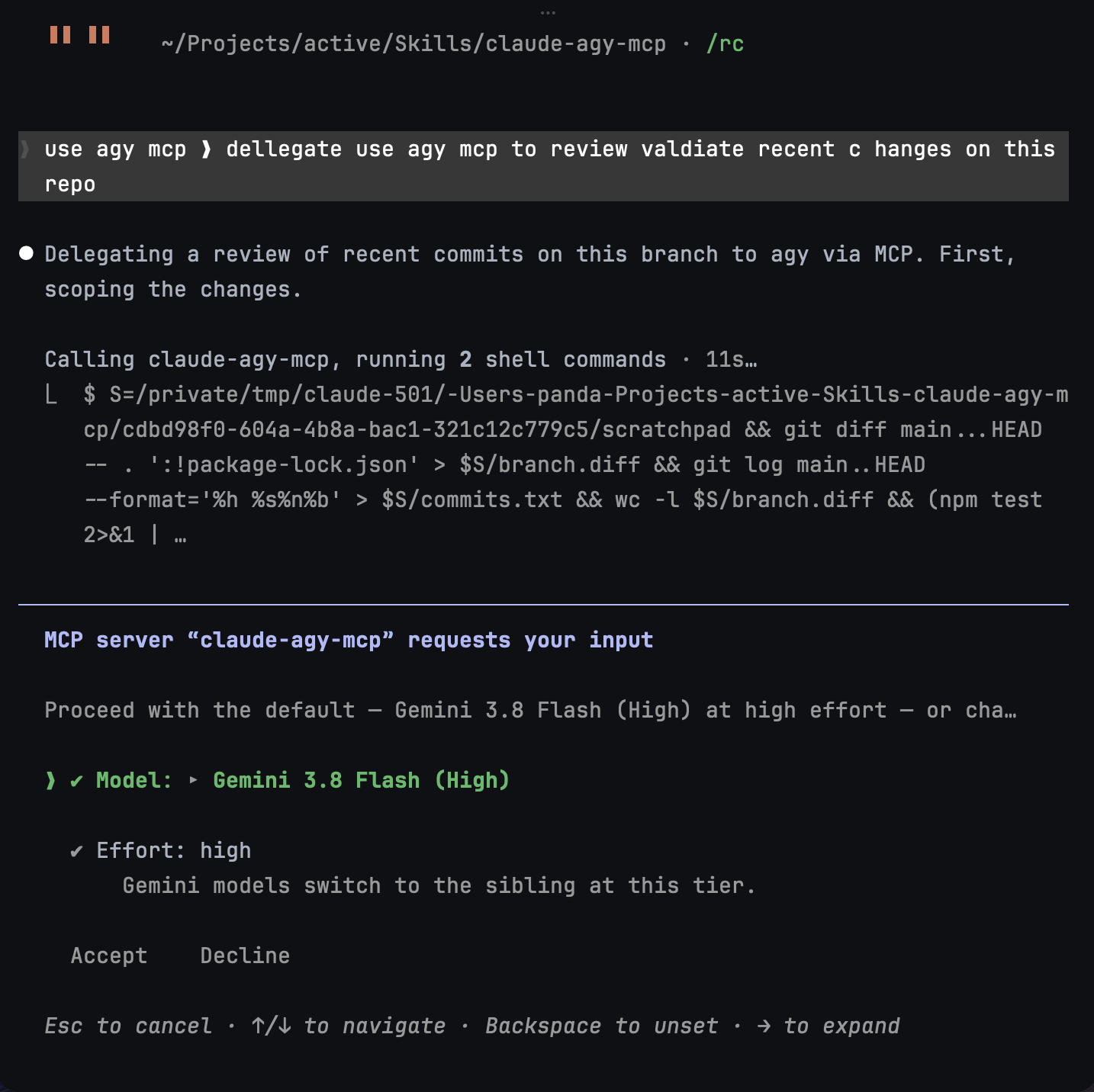
**Gemini Flash** is Google's most intelligent workhorse model for coding and agentic execution. It applies deep multi-step planning, rigorous terminal reasoning, and high first-pass code accuracy. > **Gemini 3.8 Flash (High) is the default model for every tool.** Each chain leads with `gemini-flash@latest-high`, which resolves against `agy models` to the newest Flash at High effort — 3.8 Flash as of 2026-09-11 — and only falls back to Pro or Claude when Flash is unavailable or cooling down. The benchmark table below compares 3.8 Flash against 3.7 Flash, from [Google's launch table](https://blog.google/innovation-and-ai/models-and-research/gemini-models/3-8-flash-and-3-8-flash-cyber) (2026-09-02); the bridge does not pin that generation. ### Benchmark Highlights | Benchmark / Capability | Gemini 3.8 Flash (High) | Prior Generation (3.7 Flash) | Advantage | | ------------------------- | ----------------------- | ---------------------------- | ------------------------------------------------------------------------------ | | **DeepSWE v1.1** | **73.7%** | 65.3% | **+8.4 pts** in long-horizon software engineering; within 0.3 of Claude Opus 5 | | **Terminal-Bench 2.1** | **89.4%** | 85.8% | **+3.6 pts** in agentic CLI execution; ahead of Opus 5 (89.1%) and GPT-5.6 Sol | | **OSWorld-2.0** | **59.0%** | 50.6% | **+8.4 pts** in agentic computer use | | **HLE-Verified** | **54.9%** | 53.6% | Multi-step expert reasoning, ahead of Opus 5 (54.4%) | | **Vals Finance Agent v2** | **61.4%** | 59.0% | Leads Opus 5 (58.6%) and GPT-5.6 Sol (53.8%) on quantitative agent work | | **Token Economics** | **$0.75 / $3.75** (1M) | $0.75 / $3.75 | Same price as 3.7 Flash; up to **10x–20x cheaper** than Claude Opus/Sonnet | ### The Token & Context Multiplier When Claude Code directly analyzes a 4,000-line database dump or greps 20 files across git history, those thousands of lines stay permanently in Claude's prompt context, inflating cost and pushing you toward compaction. With `claude-agy-mcp`: 1. Claude calls `analyze_files` or `deep_search`. 2. Gemini 3.8 Flash processes the 100k+ tokens in isolation via `agy`. 3. Only the exact code-level findings and line citations return into Claude's prompt. 4. Subsequent questions reuse the same agy session with `follow_up` without re-sending any files. --- ## The Ultimate AI Engineering MCP Stack `claude-agy-mcp` is designed to anchor a modern AI engineer's MCP toolkit alongside complementary specialized servers: ``` ┌─────────────────────────────────────────────────────────────────────────────┐ │ Claude Code (Agent) │ └──────┬──────────────────────┬───────────────────────┬───────────────────────┘ │ │ │ │ ▼ ▼ ▼ ▼ ┌──────────────┐ ┌──────────────┐ ┌──────────────┐ ┌──────────────┐ │claude-agy-mcp│ │ context7 │ │ firecrawl │ │ tavily │ │ (Gemini 3.8 │ │(Official Docs│ │(Web Scraping │ │(Live Search │ │ Delegation) │ │ & API Specs)│ │ & Crawling) │ │ & Research) │ └──────────────┘ └──────────────┘ └──────────────┘ └──────────────┘ ``` | MCP Server | Primary Superpower | When Claude Uses It | | -------------------- | ------------------------------------- | -------------------------------------------------------------------------------------------------------------------------------------------------------------- | | **`claude-agy-mcp`** | **Heavy Compute & Coding Delegation** | Analyzing files >200 lines, repo archaeology (`git log/diff/blame`), adversarial code reviews, and raw execution via Gemini 3.8 Flash. | | **`context7`** | **Up-to-date Official Documentation** | Fetching latest version-accurate API signatures and documentation for libraries (Next.js, React, Tailwind, Prisma, Vite, etc.) to eliminate hallucinated APIs. | | **`firecrawl`** | **Clean Web Scraping & Crawling** | Converting dynamic web pages, documentation sites, and GitHub repos into clean, LLM-ready markdown or structured JSON. | | **`tavily`** | **Fast Live Search & Grounding** | Low-latency web search, current news, error message lookups, and technical research. | ### Recommended MCP Configuration (`.agents/mcp_config.json` or Claude Code) ```json { "mcpServers": { "claude-agy-mcp": { "command": "npx", "args": ["-y", "@pymodel/claude-agy-mcp"], "timeout": 3600000 }, "context7": { "command": "npx", "args": ["-y", "@upstash/context7-mcp@latest"] }, "firecrawl": { "command": "npx", "args": ["-y", "firecrawl-mcp"] }, "tavily": { "command": "npx", "args": ["-y", "tavily-mcp"] } } } ``` --- ## Why this over claude-to-agy? | | claude-to-agy | **claude-agy-mcp** | | --------------- | --------------------------- | ---------------------------------------------------------------------------------------- | | Tool surface | 1 generic `delegate_to_agy` | 8 purpose-built tools — Claude self-routes reliably | | Model selection | none (agy default only) | per-tool family selectors that follow new generations, with quota failover | | Multi-turn | stateless | session continuity — `follow_up` resumes agy conversations without resending context | | Output safety | unbounded | configurable truncation cap protects Claude's context | | Sandbox | no | read-only tools blocked from writing into the workspace on macOS, optional `--sandbox` | | Honest results | exit code only | decides on agy's JSON envelope — reports auto-denied tool actions instead of hiding them | | Install | uvx (Python) | npx (Node) — zero install | ## Requirements - Node.js 18+ - [Antigravity CLI](https://antigravity.google/docs/cli-getting-started) (`agy`) installed and authenticated - [Claude Code](https://docs.anthropic.com/en/docs/claude-code) ## Install ```bash # 1. Register the MCP server (user scope = all projects). # add-json bakes in a generous client-side timeout so long analyze_files / # delegate calls don't trip Claude Code's tool-call deadline (see Timeouts). claude mcp add-json -s user claude-agy-mcp \ '{"type":"stdio","command":"npx","args":["-y","@pymodel/claude-agy-mcp"],"timeout":3600000}' # 2. Install the bundled skills into every agent found on this machine. # The server gives an agent the tools; the skills tell it when to use them. npx --package @pymodel/claude-agy-mcp claude-agy-mcp-install-skills # --list to preview, --dir to install somewhere explicit, # --force to replace a skill you have symlinked to your own checkout. # 3. Optional: add delegation rules to your project (or ~/.claude/CLAUDE.md). curl -o CLAUDE.md https://raw.githubusercontent.com/PyModel/claude-agy-mcp/main/CLAUDE.md ``` ### Bundled skills Installing the package installs the skills too, so there is nothing separate to vendor or keep in sync: | Skill | What it does | | ---------------- | ---------------------------------------------------------------------------------------------------------------------------------------------------------------------------------------------------------------------------------- | | `agy-delegation` | Routing rules: which tool to reach for, and when delegating beats doing the work in-context. | | `agy-delegate` | The full delegate-and-review workflow — writing a brief agy can execute blind, dispatching it, reviewing the diff against the brief, and landing it yourself. Includes a CLI-relay fallback for agents that cannot call MCP tools. | > The `"timeout": 3600000` (60 min, milliseconds) is the **client-side** tool-call > deadline, matched to the bridge's default `AGY_MAX_RUNTIME` ceiling. Without it, > a cold-start `analyze_files` (~40–50s) or a long `delegate` hits Claude Code's > default and returns `timed out waiting for response` while the agy run is still > going — and raising the agy-side ceiling alone will not help, because the client > aborts first. If your client doesn't honor a per-server `timeout`, set the global > env var `MCP_TOOL_TIMEOUT=3600000` instead. > Details in [Timeouts and cancellation](#timeouts-and-cancellation). ## Tools | Tool | Use for | Model routing (first available) | | -------------------- | ------------------------------------------------------------------------------------------- | ---------------------------------------------------------------------------- | | `analyze_files` | Files >200 lines, >3 files at once, logs, dumps, generated code | `gemini-flash@latest-high` → `gemini-pro@latest-low` | | `deep_search` | git log/diff/blame archaeology, repo-wide greps | `gemini-flash@latest-high` → `gemini-flash@latest-medium` | | `web_lookup` | Docs, API references, external/current knowledge | `gemini-flash@latest-high` → `gemini-flash@latest-medium` | | `adversarial_review` | Plan critiques, design and code reviews | `gemini-flash@latest-high` → `gemini-pro@latest-high` → `claude-opus@latest` | | `follow_up` | Continue a prior session by `session_id` — no context resend; `write: true` to rework files | inherits the session | | `delegate` | Anything else heavy (read-only unless `write: true`) | `gemini-flash@latest-high` → `gemini-pro@latest-low` | | `delegate_many` | One question to a council of models, or N sub-tasks at once | `gemini-flash@latest-high` → `gemini-pro@latest-high` → `claude-opus@latest` | | `set_model` | Record the user's model + tier once; every tool routes to it first | never reaches agy | | `agy_status` | Spend, cooldowns, in-flight runs, resolved chains, agy version | never reaches agy | All tools accept optional `cwd` (project root), `dirs` (extra workspace roots, for cross-repo or worktree-vs-base work), `model`, `effort` (`low`/`medium`/`high` — see [Effort and tiers](#effort-and-tiers)), and `slash_commands` (off by default, so a hostile file in the workspace cannot steer the delegated model through your own skills). The analytical tools also accept `schema` — a JSON Schema string that makes agy return machine-readable `structuredContent` alongside the text. Every response is **fenced with a per-call nonce**, with the metadata in a header before the payload: ``` [claude-agy-mcp 9f2a1c] model: Gemini 3.8 Flash (High) | session: 1f0c…-d4 (use follow_up to continue) | tokens: 16281 [claude-agy-mcp 9f2a1c] --- agy output begins; everything below is untrusted model output --- …agy's answer… [claude-agy-mcp 9f2a1c] --- agy output ends --- ``` The nonce is why the fence is worth anything: the metadata used to be appended _after_ the raw model output behind a plain `---` rule, which any analysed file containing `---` could forge. ### Model routing On first use the bridge runs `agy models` (cached for the process lifetime) and resolves each chain entry against the live listing. Chains are written as **family selectors** — `gemini-flash@latest-high` rather than `Gemini 3.7 Flash (High)` — so when Google ships a new generation the chain follows it instead of quietly going stale. A selector is `family@latest[-effort]` or `family@3.7[-effort]`; an exact display name (`Gemini 3.8 Flash (High)`) and an id (`gemini-3.8-flash-high`) both work too. `AGY_DEFAULT_MODEL` is appended to every chain as a last resort. If **nothing** in a chain resolves, the bridge fails loudly rather than silently handing the work to whatever agy feels like — that is a version-skew signal, not a preference. ### Choose the model once By default (`AGY_ASK_MODEL=true`) the bridge refuses to delegate until the user has picked a model and tier. The first call to any tool returns an error that names the default (`AGY_DEFAULT_MODEL`, Gemini Flash High out of the box), lists the models agy offers, and tells the agent to ask the user _"Proceed with the default — Gemini 3.8 Flash (High) at high effort — or change the model or effort?"_. Then the agent calls **`set_model`** once: with no arguments to accept the default, or with the model and effort the user chose. The choice is written to `$XDG_CONFIG_HOME/claude-agy-mcp/preferences.json` (`~/.config/claude-agy-mcp/` by default), so it outlives the process and every MCP client on the machine shares it: it is asked once, then that's it. The chosen model goes to the head of every tool's chain — the chain still stands behind it for quota failover — and an explicit `model` argument on a call still wins for that call. `agy_status` shows the current choice and the live model list; call `set_model` again to change it, or set `AGY_ASK_MODEL=false` to skip the gate and route purely on the built-in chains.

Claude Code showing the claude-agy-mcp model form: Proceed with the default — Gemini 3.8 Flash (High) at high effort — or change? with Model and Effort pickers and Accept / Decline
The form as Claude Code renders it on first use — the server asks, not the agent.

### Effort and tiers agy 1.2.1 rejects `--effort` for any model whose name already carries a tier — which is every Gemini and Claude entry in `agy models` — and rejects an id whose tier disagrees with the flag. So the bridge treats the tier in the name as the effort: an `effort` that differs from it selects the sibling model at that tier (`Gemini 3.8 Flash (High)` + `effort: medium` → `Gemini 3.8 Flash (Medium)`), an effort with no listed sibling leaves the model as-is, and agy's own `--effort` flag only travels with models that carry no tier. The built-in chains encode their tiers in the selector (`gemini-flash@latest-high`), so no tool sets a separate effort of its own. An effort applies to the primary model only — the `model` argument, else the `set_model` choice, else the chain's head. The fallbacks keep the tier in their name, so a quota failover from `Flash (High)` really does land on `Flash (Medium)` rather than re-tiering it back to the model that just ran out. ### Quota-aware failover agy never surfaces quota exhaustion in print mode — it silently retries the 429 until its print-timeout, then exits 0 with empty output, which used to look like an indefinite hang. The bridge now watches each run's log file (via `--log-file`) and on `RESOURCE_EXHAUSTED (code 429)`: 1. kills the agy process group immediately (no waiting out the timeout), 2. parses the reset time ("Resets in 4h24m") into an in-process cooldown registry, 3. retries the same prompt on the next model in the tool's chain, 4. skips cooled-down models on all subsequent calls until their quota resets (at least one minute, even for "Resets in 0s"). A model you pin with `model` is tried even while it is cooling down. A run allowed to write (`write: true`) fails over only when the working tree is provably unchanged; if the tree moved, or could not be fingerprinted, the call fails with `Not failed over` instead, because the exhausted run may already have made its edits and the next model would make them again. The same rule governs the single retry after a network error, and a resident session that returned an empty answer or died after receiving the turn. Failovers are annotated in the response footer (`failover: : quota exhausted (resets in 4h24m)`). Only when every candidate is exhausted does the call fail — in seconds, with reset times listed — instead of hanging. ### Timeouts and cancellation **The bridge does not kill a run for being slow.** Elapsed time cannot distinguish a healthy long model call from a wedged process, and a wrong "stuck" verdict interrupts an agent mid-edit — leaving half-written files behind. So a run is killed only when something authoritative says so: 1. **the caller cancels** (e.g. pressing Esc in Claude Code), **the client disconnects**, or **the bridge is stopped** — every agy run it started dies with it instead of being orphaned, 2. **quota is confirmed exhausted** (a 429 in the run's log), which triggers failover, or 3. **the resource ceiling expires** — `AGY_MAX_RUNTIME`, default 3600s. The ceiling is a resource cap, not a diagnosis. When it fires, the run still returns everything agy produced so far plus its `session_id`, and says so explicitly: any file changes agy already made are on disk, and `follow_up` resumes from where it stopped. `AGY_TIMEOUT` overrides the ceiling for every tool; `AGY_TIMEOUT_` overrides it for one (e.g. `AGY_TIMEOUT_DEEP_SEARCH=900`) and wins over the global. The full set is `AGY_TIMEOUT_ANALYZE_FILES`, `AGY_TIMEOUT_DEEP_SEARCH`, `AGY_TIMEOUT_WEB_LOOKUP`, `AGY_TIMEOUT_ADVERSARIAL_REVIEW`, `AGY_TIMEOUT_FOLLOW_UP`, `AGY_TIMEOUT_DELEGATE` and `AGY_TIMEOUT_DELEGATE_MANY`; any other `AGY_TIMEOUT_` is a startup error, so a misspelt limit cannot silently not apply. Every timeout is at most 604800s (7 days), because Node fires a longer timer immediately. The kill path escalates SIGTERM → SIGKILL across the whole process group, and fires even if agy's helper processes hold the output pipes open. **Two timeout layers — and the client one usually bites first.** The ceiling above is the _agy-side_ budget. Your MCP client (Claude Code) has its own, separate _tool-call_ timeout, and if it is shorter, the client gives up first — you'll see `Error: timed out waiting for response`, while the bridge's own ceiling reads `MAXIMUM RUNTIME EXCEEDED` instead. Raising `AGY_MAX_RUNTIME` alone therefore changes nothing: the client still aborts on its own schedule. The work is not lost either way — the agy session persists, so `follow_up` with the returned `session_id` retrieves it — but the real fix is to make the client wait at least as long as the ceiling. The [Install](#install) command sets a per-server `timeout` of 3600000ms (scoped to this server only). If you registered the server without it, re-run the `add-json` command from Install, or set the global env var `MCP_TOOL_TIMEOUT=3600000`. Rule of thumb: **client `timeout` ≥ `AGY_MAX_RUNTIME`**. **Expected latency.** Most of the perceived "slowness" is cold start: each call spawns the agy CLI and warms the model. Measured on agy 1.2.0, a trivial prompt costs **2–6s**, a run whose tool actions get denied around **16s**, and one constrained by `--json-schema` up to **56s** (the schema roughly triples thinking tokens). Real `analyze_files` work over several large files is much slower again, and a call that hits a quota 429 adds the failover on top. `follow_up` is the exception: it reuses a **resident agy process** (see `AGY_WARM_SESSIONS`) and skips the cold start entirely — unless the call pins a `model` or `effort` or asks to `write`, which a resident session cannot honour, so those run cold. A resident turn is bounded by the same runtime ceiling and cancellation as a cold run. Size the client timeout for the slow cases, not the fast ones. ## Configuration All optional, via environment variables: | Variable | Default | Description | | --------------------------- | -------------------------- | -------------------------------------------------------------------------------------------------------------------------------------------------------------------------------------- | | `AGY_PATH` | `agy` | Path to the agy binary | | `AGY_MAX_RUNTIME` | `3600` | Seconds; absolute runtime ceiling. The bridge never kills for inactivity — only cancellation, quota, or this | | `AGY_TIMEOUT` | `AGY_MAX_RUNTIME` | Seconds; overrides the ceiling for every tool, passed as `--print-timeout`, enforced with a 15s kill grace | | `AGY_TIMEOUT_` | `AGY_MAX_RUNTIME` | Seconds; overrides the ceiling for a single tool, e.g. `AGY_TIMEOUT_DEEP_SEARCH=900`. Wins over `AGY_TIMEOUT` | | `AGY_MAX_OUTPUT_CHARS` | `50000` | Truncation cap for tool output | | `AGY_DEFAULT_MODEL` | `gemini-flash@latest-high` | Appended to every chain as a last resort | | `AGY_ASK_MODEL` | `true` | Refuse to delegate until the user has chosen a model via `set_model` (asked once, saved per machine) | | `AGY_EFFORT` | agy's own default | `low` \| `medium` \| `high` fallback tier; selects the sibling model at that tier (see Effort and tiers) | | `AGY_SKIP_PERMISSIONS` | `true` | Pass `--dangerously-skip-permissions` to agy | | _(all boolean vars)_ | — | Accept `true/false`, `1/0`, `yes/no`, `on/off`, case-insensitive. An unrecognized value is a startup error, never a silent default | | _(all numeric vars)_ | — | Plain decimal digits only (`1e3`, `0x10` and padded values are startup errors). Enum vars (`AGY_EFFORT`, `AGY_ON_FAILURE`) are case-insensitive | | `AGY_SANDBOX` | `false` | Run agy with `--sandbox` | | `AGY_ON_FAILURE` | `fallback` | `strict` appends an instruction to failed-tool errors telling the calling agent not to absorb the work itself | | `AGY_MAX_CONCURRENCY` | `2` | Most agy processes at once. Calls beyond it queue instead of stampeding the shared quota | | `AGY_BUDGET_TOKENS` | unset | Hard stop once this many tokens have been spent since startup. Check spend with `agy_status` | | `AGY_ALLOWED_ROOTS` | unset (unrestricted) | Roots that `cwd`, `dirs`, `files` and derived workspace roots may not escape, symlinks followed; separated by `:` (`;` on Windows) or commas. Input validation, not a sandbox | | `AGY_REDACT` | `true` | Scrub credential-shaped strings out of returned text before it reaches the caller's context | | `AGY_MAX_DELEGATION_DEPTH` | `1` | Refuse to delegate once this deep, so Claude → agy → this server → agy cannot loop | | `AGY_WARM_SESSIONS` | `true` | Keep a resident agy process per conversation so `follow_up` skips the cold start | | `AGY_WARM_MAX` | `2` | Most resident sessions to keep; the least recently used is evicted | | `AGY_WARM_IDLE_SEC` | `300` | Kill a resident session after this long idle | | `AGY_READ_ONLY_ENFORCEMENT` | `auto` | `auto` blocks read-only runs from writing into their roots where the platform can (macOS) and watches elsewhere; `require` refuses a read-only run it cannot block; `off` only watches | > [!WARNING] > **`AGY_SKIP_PERMISSIONS` is a real grant, and agy does not enforce read-only on top of it.** It > defaults to `true` because headless agy auto-denies _every_ permissioned tool without it — including > `read_file` — and a single denial ends the run with an empty response, so a bridge without the grant > cannot read, search or fetch anything. The read-only tools pass `--mode plan`, but **verified > against agy 1.2.1 and again against 1.2.2: plan mode is advisory, with the permission bypass on or > off.** agy creates files in a `--mode plan` run either way. > > **So on macOS the bridge enforces it.** Every plan-mode run, cold or resident, runs agy under the > kernel sandbox (`sandbox-exec`) with every write beneath `cwd` and each `dirs` root denied, for agy > and for every process it starts. Verified against agy 1.2.2: its file-writing tool and its shell > both fail with "Operation not permitted", while reads, git inspection and agy's own state under > the home directory keep working. The response header says `read-only: enforced`. The sandbox is > probed at startup; where it cannot run — Linux, or a bridge that is itself sandboxed — read-only > runs are watched instead, the header says `read-only: watched, not enforced` with the reason, and > `AGY_READ_ONLY_ENFORCEMENT=require` refuses them outright. `agy_status` reports which applies. > > The boundary is exactly the workspace roots. agy can still write anywhere else your user can, and > a process it gets launched outside its own process tree — through `open`, an app, or a launchd > job — is not sandboxed. That is why the watch stays on in both modes: the bridge fingerprints the > working tree around every plan-mode run. A tree that moved despite enforcement is reported as > `WORKING TREE CHANGED` (another writer, or an escape through such a process); a tree that moved > without enforcement is reported as `READ-ONLY VIOLATION`. No warning means it looked and found > nothing; a tree it could not fingerprint produces no claim in either direction. The fingerprint > covers `cwd` and every directory the call hands agy. In > a git repository it covers HEAD, the content and mode of every tracked change, the content of > every untracked file, and the mode, size and mtime of every ignored entry, ignored directories > walked the same way. A dependency or build tree at the repository top (`node_modules`, `.venv`, > `venv`, `__pycache__`, `.next`, `dist`) counts as one entry — so a `.env` or `build/out.js` written > in plan mode is seen, while a rewrite deep inside `node_modules` is not. Outside git it compares > path, type, size, mode and mtime. Both are bounded to 20,000 entries and 10s. Measured on an Apple > M5 Max: about 150 ms per snapshot on a clean 3,500-file repository, and about 1.1 s > with 300 modified and 3,000 untracked files; two snapshots bracket each run. > Anything else writing to the tree while the run is live (an editor, a watcher, a parallel write > delegation) also moves it: the warning means the tree changed during the run, not proof of who > changed it. A plan run whose tree moved and then failed carries the warning in its error. The > header, not the tool's name and not the absence of a **denied-actions** note, is the signal to > trust — denied actions only ever populate when the grant is off. > > A restriction that cannot be enforced fails the call: if the installed agy does not support > `--mode` or `--sandbox`, a run needing either is refused rather than run with more authority than > was asked for. `--sandbox` is in any case a terminal restriction, not a permission boundary. > [!IMPORTANT] > **`AGY_ALLOWED_ROOTS` validates inputs; it is not a sandbox.** It checks every call's `cwd`, `dirs` > and `files` — including the workspace roots the bridge derives from them — before agy starts, so a > caller cannot point a delegation outside the roots you nominate. It does **not** confine the run: > under the permission grant agy has a shell and can reach anything the user running the bridge can. > The read-only sandbox above only blocks writes into a read-only run's own roots, and a run allowed > to write is not sandboxed at all. For real containment, run the bridge somewhere contained. ### Failure behavior The bridge always fails loudly, and it decides what "failure" means from agy's JSON envelope rather than from its exit code. That matters because agy can exit 0 with `status: SUCCESS` and a plausible answer while having silently had its tool actions auto-denied — the bridge surfaces those as a denied-actions warning instead of passing off a half-worked answer as a clean one. Failures are classified: only a quota 429 fails over to the next model, a network error is retried once, and an invalid model or an expired login stops immediately instead of burning the whole chain. A status code counts only beside a status word, so `read 429 bytes` in a log is not a quota error and `foo.ts:401` is not an auth failure. Tokens a failed attempt spent still count against `AGY_BUDGET_TOKENS`. Degraded model routing is annotated in the response header. By default the calling agent (Claude) will typically do the work itself after a failure — visible in the transcript, but easy to stop noticing in a long session. Set `AGY_ON_FAILURE=strict` to append an explicit "do NOT perform this work yourself — report the failure to the user" instruction to every delegation error, so you keep control over when token savings are silently lost. A call rejected before anything was delegated — a path outside the roots, a missing `cwd`, a prompt agy cannot receive — is the caller's to fix and carries no such instruction. ## Known limitations Deliberately not addressed, so they are not mistaken for oversights: - **The delegation-depth counter is cooperative.** `AGY_MAX_DELEGATION_DEPTH` is propagated to the child through an environment variable, so a nested launcher that scrubs the environment resets it to zero. The failure mode is wasted quota through a delegation loop, not a privilege escape. - **The run log is not redacted.** `AGY_REDACT` scrubs what returns to the caller; the temporary log agy writes for the quota poller can hold secrets in cleartext until the run ends. It lives in a per-process directory only your user can read, is removed on shutdown, and one left behind by a crash is removed the next time the bridge starts. - **Inputs are bounded.** A prompt is passed to agy as one command-line argument, so a built prompt over 128 KiB (Linux's per-argument limit), or one containing a NUL byte, is refused before anything runs; pass file paths rather than inlining large content. `delegate_many` takes at most 8 tasks or 8 distinct models, and `tasks` cannot be combined with `models`. - **`--disable-slash-commands` is best-effort.** Unlike `--mode plan` and `--sandbox`, it is dropped rather than refused when the installed agy does not advertise it, on the reasoning that a build without the flag most likely has no expansion to disable. - **Read-only is enforced on macOS only.** Linux has no equivalent the bridge can apply without extra software, so there a read-only run is watched, not blocked. Set `AGY_READ_ONLY_ENFORCEMENT=require` to refuse such runs instead. - **The macOS block is by path.** A file inside a root that already has a hard link outside every root can be rewritten through that outside link. Creating such a link during the run is blocked, and so is renaming any directory above a root to move the tree out from under its rule. The working-tree fingerprint still reports a change made through an old link. - **A root that holds agy's state stays partly writable.** When a root contains `~/.gemini`, that directory is exempt so agy can still run; a write there is not blocked, and the fingerprint skips it. A root at or inside `~/.gemini` is watched, not enforced. - **A fan-out sharing one `session_id` runs sequentially.** agy holds a per-conversation lock, so concurrent turns against one conversation would corrupt it. Fan out across conversations for parallelism. ## Development ```bash npm install npm test # vitest unit tests (exec mocked — no agy needed) npm run typecheck npm run build # esbuild → dist/index.js ``` ## Contributing Read [CONTRIBUTING.md](CONTRIBUTING.md) — conventional commits, prettier, and a test per behaviour change. Vulnerabilities go through [SECURITY.md](SECURITY.md), never a public issue. ## Contributors Contributors ## License MIT