# MiniMax-H3 Prompt Rewriter for ComfyUI
ComfyUI nodes for the [LightX2V MiniMax-H3 T2VA Prompt Rewriter LoRA](https://huggingface.co/lightx2v/MiniMax-H3-Prompt-Rewriter-LoRA).
A short prompt goes in; a structured, production-ready audio-video description
for [MiniMax-H3](https://huggingface.co/MiniMaxAI/MiniMax-H3) comes out — entirely locally.
[Русская версия](README_RU.md) · [中文版](README_ZH.md) · [Changelog](CHANGELOG.md)
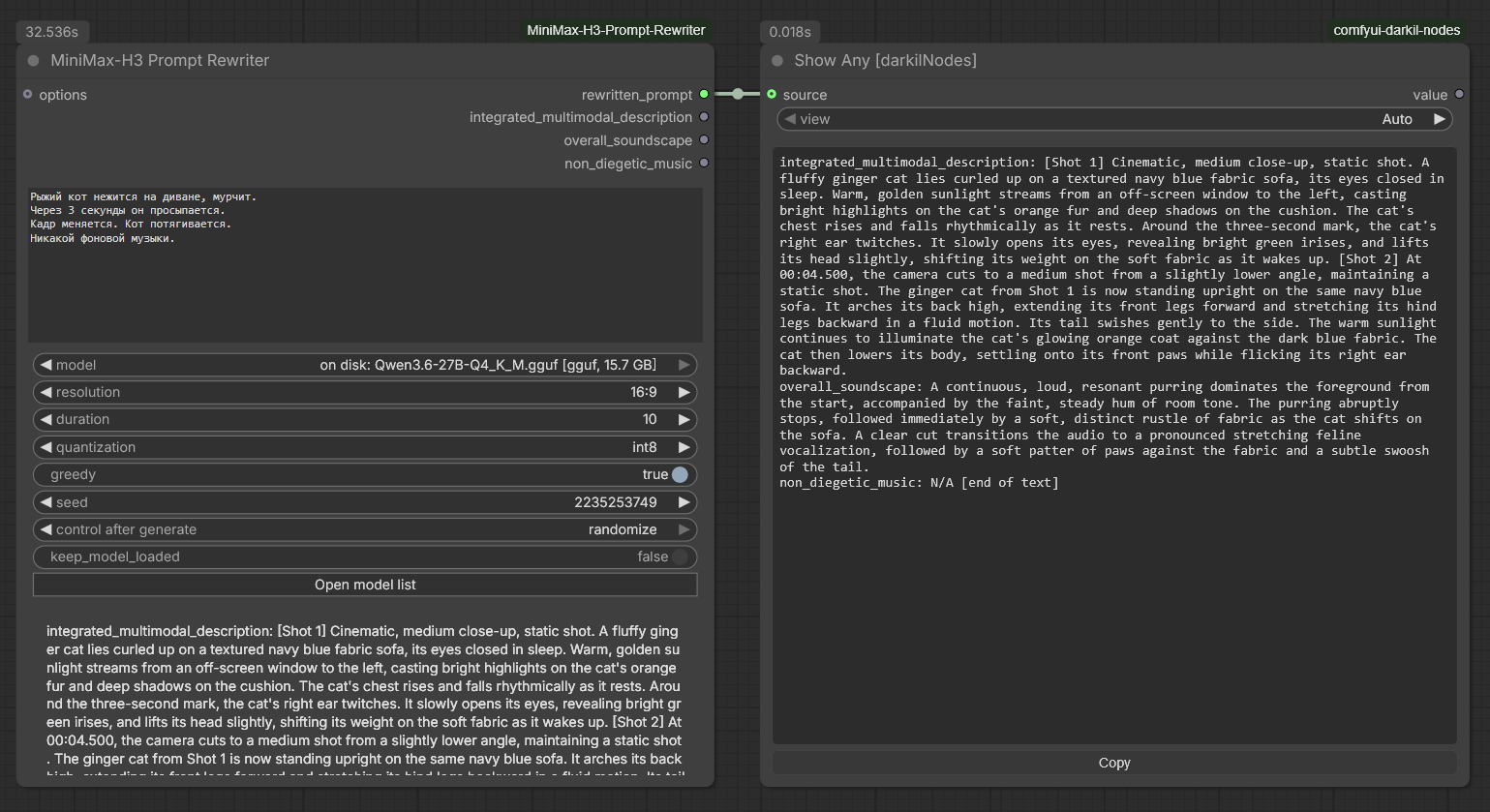
The prompt may be in any language the base model reads; the rewrite comes back in
English, which is what MiniMax-H3 expects.
```text
"A red fox walks through a snowy forest at dawn." + 16:9 + 15s
│
▼
Qwen3.6-27B + Prompt Rewriter LoRA
│
▼
integrated_multimodal_description: [Shot 1] ... [Shot 2] 0:06 ...
overall_soundscape: ...
non_diegetic_music: ...
│
▼
MiniMax-H3 video + synchronized audio
```
There are three ways to get that output, and the pack ships all of them:
| | Rewriter node | Rewriter 8B | Rewriter Omni | Writer nodes |
|---|---|---|---|---|
| Where the format comes from | the LoRA — a 27B trained until H3 output came out of it unprompted | a second LoRA, on a model that also sees | a third LoRA, on a model that also hears | MiniMax's own writing guide, in the system prompt |
| Model | Qwen3.6-27B only | Qwen3-VL-8B-Instruct only | Qwen2.5-Omni-7B only | any instruction-following GGUF |
| Smallest working setup | ~10 GB download, ~13 GB VRAM | ~6.1 GB download, ~9 GB VRAM | ~6.2 GB download, ~9 GB VRAM | **2.6 GB download, ~5 GB VRAM** |
| Tasks | T2VA | T2VA, I2VA, FL2VA, L2VA | T2VA, I2VA, FL2VA, L2VA, **Ref2VA** | T2VA, I2VA, FL2VA, L2VA, Ref2VA |
| Reference frames | described to it in words | **it looks at them** | **it looks at them** | described to it in words |
| Clips and sound | described to it in words | described to it in words | **it watches and listens** | described to it in words |
| Quality | the reference | the same trained contract, at a third of the download; wobblier on the alignment line | the only one that hears; six fields on Ref2VA | close, and it runs on hardware the LoRA cannot touch |
The first three columns are also available as one node — [Universal Rewriter](#minimax-h3-universal-rewriter) — where a tab swaps the adapter and everything else stays where it is.
Two of the four read text only. [Reference Caption](#minimax-h3-reference-caption)
turns an image, an audio clip or a video into the text they need — 3 to 5 seconds
per asset on a 3.4 GB model. When a whole shot's worth of references is waiting,
[Multi Reference Caption](#minimax-h3-multi-reference-caption) does all of them at
once — or [Universal Writer](#minimax-h3-universal-writer) describes them and writes
the prompt in the same node, with their order a widget you can drag rather than a
consequence of which slot you happened to use. The 8B rewriter needs none of that
for its reference *frames*: connect the picture and it reads it. The Omni rewriter
needs none of it at all — a clip and a sound reach it as themselves.
And when the shortest way to a good prompt is somebody else's:
[Prompt Presets](#minimax-h3-prompt-presets) hands over one of a thousand
finished MiniMax-H3 prompts that ship inside the pack, narrowed by look and
subject, each with the frame of the clip it was written for and that clip a click
away. No model is loaded for it and nothing is downloaded.
If your card has 8 GB, skip to [the writer nodes](#minimax-h3-prompt-writer-t2vai2vafl2val2va).
## Contents
- [What you need before installing](#what-you-need-before-installing)
- [Install](#install)
- [Example workflows](#example-workflows)
- [Nodes](#nodes)
- [MiniMax-H3 Prompt Rewriter](#minimax-h3-prompt-rewriter)
- [MiniMax-H3 Prompt Rewriter 8B (sees frames)](#minimax-h3-prompt-rewriter-8b-sees-frames)
- [MiniMax-H3 Prompt Rewriter Omni (sees and hears)](#minimax-h3-prompt-rewriter-omni-sees-and-hears)
- [MiniMax-H3 Universal Rewriter](#minimax-h3-universal-rewriter)
- [MiniMax-H3 Rewriter Options](#minimax-h3-rewriter-options)
- [MiniMax-H3 Prompt Writer (T2VA/I2VA/FL2VA/L2VA)](#minimax-h3-prompt-writer-t2vai2vafl2val2va)
- [MiniMax-H3 Prompt Writer (Ref2VA)](#minimax-h3-prompt-writer-ref2va)
- [MiniMax-H3 Universal Writer](#minimax-h3-universal-writer)
- [MiniMax-H3 Reference Caption](#minimax-h3-reference-caption)
- [MiniMax-H3 Multi Reference Caption](#minimax-h3-multi-reference-caption)
- [Captioning with a model ComfyUI already has loaded](#captioning-with-a-model-comfyui-already-has-loaded)
- [The captioner is loaded once, not once per reference](#the-captioner-is-loaded-once-not-once-per-reference)
- [MiniMax-H3 Guide Prompt (any LLM)](#minimax-h3-guide-prompt-any-llm)
- [MiniMax-H3 Prompt Check](#minimax-h3-prompt-check)
- [MiniMax-H3 Prompt Reducer](#minimax-h3-prompt-reducer)
- [MiniMax-H3 Reduce Prompt (any LLM)](#minimax-h3-reduce-prompt-any-llm)
- [MiniMax-H3 Effect Embeddings](#minimax-h3-effect-embeddings)
- [MiniMax-H3 LoRA Triggers](#minimax-h3-lora-triggers)
- [MiniMax-H3 Reference Adapter](#minimax-h3-reference-adapter)
- [MiniMax-H3 Reference Slots](#minimax-h3-reference-slots)
- [MiniMax-H3 Prompt Presets](#minimax-h3-prompt-presets)
- [The duration widget](#the-duration-widget)
- [Repeating the last answer](#repeating-the-last-answer)
- [The answer is checked](#the-answer-is-checked)
- [Acting on what it found](#acting-on-what-it-found)
- [The prompt library](#the-prompt-library)
- [The guides are fetched, not bundled](#the-guides-are-fetched-not-bundled)
- [The model list](#the-model-list)
- [Models you already pulled for Ollama](#models-you-already-pulled-for-ollama)
- [Where the weights go](#where-the-weights-go)
- [Using a model you already have](#using-a-model-you-already-have)
- [Smaller repackings](#smaller-repackings)
- [If the node says a package is missing](#if-the-node-says-a-package-is-missing)
- [Smallest download without any extra install](#smallest-download-without-any-extra-install)
- [GGUF — smaller still, and nothing to install](#gguf--smaller-still-and-nothing-to-install)
- [Progress on the node](#progress-on-the-node)
- [Environment variables](#environment-variables)
- [Languages](#languages)
- [Notes](#notes)
- [Credits](#credits)
- [Licence](#licence)
## What you need before installing
The LoRA route is a 27-billion-parameter language model, not a small helper.
There is no way around the following, because the adapter is bound to one
specific base model. **The writer nodes have none of these requirements** — see
their table below.
| Resource | Requirement |
|---|---|
| Disk | **~52 GB** for `Qwen/Qwen3.6-27B` + **~3.5 GB** for the adapter — or **~10–16 GB** total on the GGUF route |
| VRAM (`nf4`, default) | **~16 GB** |
| VRAM (`int8`) | ~28 GB |
| VRAM (`bfloat16`) | ~54 GB, spills into system RAM via accelerate |
| VRAM (GGUF) | ~13–19 GB depending on the quant, lower still with fewer offloaded layers |
| Packages | `transformers`, `peft`, `accelerate`, and `bitsandbytes` for `nf4`/`int8`. **Nothing at all on the GGUF route:** `llama-cpp-python` is used when it happens to be installed, and the official llama.cpp binaries are fetched when it is not |
> **The MiniMax-H3 text encoder cannot be reused for this.** It is a different
> model (Qwen3-VL-32B, vocabulary 151936) from the LoRA's base (Qwen3.6-27B,
> vocabulary 248320); it contains none of the linear-attention `in_proj_*`
> modules the adapter targets; it is truncated to the first 50 of 64 layers; and
> it ships without `lm_head` or a final norm, so it cannot generate text at all.
> It only produces hidden states for the DiT.
## Install
Clone into `ComfyUI/custom_nodes/` and install the requirements into the same
Python environment ComfyUI runs on:
```bash
cd ComfyUI/custom_nodes
git clone https://github.com/pytraveler/MiniMax-H3-Prompt-Rewriter-ComfyUI
```
For ComfyUI portable on Windows:
```bat
python_embeded\python.exe -m pip install -r ComfyUI\custom_nodes\MiniMax-H3-Prompt-Rewriter-ComfyUI\requirements.txt
```
Or install it from the Comfy registry through ComfyUI-Manager.
### Example workflows
Seven workflows ship with the pack and appear in ComfyUI's template browser
(*Workflow → Browse Templates*) under this node pack's name once it is
installed. Each is a card of its own and each runs on its own: nothing is
bypassed on open, and there is no second branch to mute before pressing Run.
| | Template | What it needs |
|---|---|---|
| 1 | **Write a prompt** — one line of an idea in, a full H3 audio-video description out | one 2.6 GB GGUF |
| 2 | **Rewrite a prompt with the 27B LoRA** — the LightX2V adapter this pack is named after | one 15.7 GB GGUF |
| 3 | **Write a prompt from references** — the writer describes your pictures and writes from what it saw | two GGUFs, 6 GB together |
| 4 | **Ready-made prompts** — a thousand finished ones, picked in a browser with their frames | nothing at all |
| 5 | **Prompt to video** — ComfyUI's text-to-video template with the writer in front of it | the MiniMax-H3 weights |
| 6 | **References to video** — the same for Ref2VA, the pictures reaching the generator through the writer, in the order its strip numbers them | the MiniMax-H3 ref2va weights |
| 7 | **LoRA triggers and effects** — the words an adapter answers to, and MiniMax's ten effects, put into a finished prompt | nothing at all |
Only 5 and 6 load a MiniMax-H3 checkpoint. The rest end at the text, which is
what most of this pack is for. Those two are ComfyUI's own gallery templates
with the generator folded into a single subgraph box, so what is on screen is
the prompt side plus one node — the checkpoints they name are the ones the
stock templates use, and ComfyUI offers to download any that are missing.
Every one carries a **Read me first** note: what it does, what it downloads,
what to set before pressing Run, and where to go next. The image loaders in 3
and 6 ship **empty** on purpose — a file name saved into a template points at
something your machine does not have — so choose your own pictures first.
The card pictures the browser draws beside each name come from
`python tools/template_cards.py`, which writes them as `.jpg` next to the
workflow, where the browser looks for them.
For a community take, [axiomgraph's workflows](https://github.com/axiomgraph/ComfyUIWorkflow)
pair the Omni rewriter with FL2VA (GPL-3.0, and they use a few extra node
packs — grab them from their repository).
## Nodes
### MiniMax-H3 Prompt Rewriter
The main node. It downloads whatever is missing, loads the model, generates, and
releases the VRAM again.
**Outputs**
| Name | Contents |
|---|---|
| `rewritten_prompt` | The full rewrite, ready to paste into a MiniMax-H3 text input |
| `integrated_multimodal_description` | Just the shot-by-shot visual section |
| `overall_soundscape` | Just the diegetic audio section |
| `non_diegetic_music` | Just the score section |
**Inputs**
- `prompt` — the short prompt to expand.
- `model` — the base model. The list holds every entry from your model list plus
every Qwen3.6-27B already on disk (prefixed `on disk:`). Anything not present
is downloaded on first use, resuming if interrupted. The **Model list**
button edits the list in a window over the graph — see below.
- `resolution` / `duration` — conditions the rewrite is composed for. Keep them
equal to what you pass to MiniMax-H3, or the shot pacing will not match. The
list runs `48:9` down to `9:16`; the two ultrawides are the multi-monitor
case — 32:9 is two 16:9 screens side by side, 48:9 three. They condition how
the shot is composed, which is all this node decides; what a generator will
render at that shape is its own question.
- `aspect_ratio` — **the same setting, on a socket**, and it wins while something
is connected. Every writer and rewriter node in the pack has it, and it takes a
`STRING` or a `COMBO` link, so the primitive that already sets ComfyUI's
**Resolution Selector** can drive this from the same wire. It is there
because the shape of the frame is usually decided elsewhere in the graph and
spelled differently there: ComfyUI's own **Resolution Selector** calls 16:9
`16:9 (Widescreen)`, a size node says `3840x1080`, a divider says `1.78`. All
three are read, and a label around the pair is read through — the number pair
is what counts. A frame size within 2% of a listed ratio is called by its
name, so `1376x768` (which is what Resolution Selector produces for 16:9 at
1 MP) arrives as `16:9` rather than as `43:24`; a ratio that is nothing on the
list passes through as itself, which is how `2.39:1` or `5:4` gets in.
Something that is not a ratio at all is refused by name rather than composed
for. The `resolution` widget itself has no socket, so there is one way in and
it is the one that reads what other nodes write. **The picker greys out while
the wire is connected** — dimmed, nothing lit, clicks refused — because a lit
square would be naming a ratio the run is not going to use. **Unplugging clears
the field**: an upstream node writes its value into the widget — that is how a
wire feeds a widget input at all — so the text would otherwise stay behind, and
it is not inert while it sits there. Anything in `aspect_ratio` outranks the
picker, including a leftover.
- `quantization` — how to load an *unquantized* checkpoint: `nf4` (default,
~16 GB VRAM), `int8` (~28 GB), `bfloat16` / `float16` (~54 GB). Ignored when
the checkpoint brings its own quantization.
- `greedy` — on by default for deterministic output. Turn it off to sample.
- `seed`
- `keep_model_loaded` — **off by default.** The 27B model is released as soon as
the rewrite finishes, so the same GPU can run H3 video generation next. Turn it
on only when iterating on prompts back-to-back.
- `options` — optional; connect a **MiniMax-H3 Rewriter Options** node.
### MiniMax-H3 Prompt Rewriter 8B (sees frames)
The same idea on a much smaller model that is also multimodal. LightX2V's second
adapter is trained on
[Qwen3-VL-8B-Instruct](https://huggingface.co/Qwen/Qwen3-VL-8B-Instruct), so
where the 27B has to be *told* what a reference frame contains, this one is shown
the frame and writes the alignment line from what it sees. It covers four tasks
rather than one, and fits on a card the 27B cannot go near.
![The 8B rewriter node in ComfyUI, set to T2VA: the options node on the left, the rewriter with its first_frame and last_frame inputs in the middle, and the finished rewrite on the right with numbered shots, (S1) and (S2) speaker ids and a [English] Hello. dialogue tag](docs/node_rewriter_8b.png)
**Outputs** are the same four as the rewriter above, so the two are
interchangeable downstream.
**Inputs**
- `prompt`, `resolution`, `duration`, `greedy`, `seed` — as above.
- `model` — a Qwen3-VL-8B base, in either shape the adapter is published for.
A **GGUF** entry is two files from the same conversion, the model and its
projector. A **safetensors** entry is the official
[Qwen3-VL-8B-Instruct](https://huggingface.co/Qwen/Qwen3-VL-8B-Instruct)
folder, which is what the adapter was trained on and what it is published as.
Entries prefixed `on disk:` are already in your model folders.
**Only the 8B fits the adapter**; a Qwen3-VL of another size is refused by name
and number before anything is downloaded.
- `quantization` — how to load a **safetensors** base: `nf4` needs about 8 GB of
VRAM, `int8` about 13, `bfloat16` about 20. Ignored for GGUF, which carries its
own.
- `task` — `T2VA`, `I2VA`, `FL2VA`, `L2VA`. The model's own name for these is
T2AV, I2AV, FL2AV and L2AV; they are the same four tasks.
- `first_frame` / `last_frame` — optional IMAGE inputs. `I2VA` reads
`first_frame`, `L2VA` reads `last_frame`, `FL2VA` reads both, `T2VA` reads
neither. Connect the wrong one and the node says which is missing before
anything loads — which end of the clip a picture belongs to is part of what
the model is told.
- `keep_model_loaded` — on a **safetensors** base every task honours it: the
model is loaded in ComfyUI's own process and stays there. On a **GGUF** base
only `T2VA` can, because the three tasks with frames run through
`llama-mtmd-cli`, a fresh process each time that takes the model with it when
it exits. The node says which it did rather than ignoring the switch.
- `options` — the same options node as everything else. Its `adapter` dropdown
lists both LoRAs; the first entry picks whichever one matches the base model
you chose, so it needs no attention.
**What it costs**
| | Download | VRAM |
|---|---|---|
| Q4_K_M base + projector + Q8_0 adapter | 4.7 + 0.7 + 0.7 GB | ~9 GB |
| Q8_0 base + projector + F16 adapter | 8.1 + 0.7 + 1.3 GB | ~13 GB |
| safetensors base + adapter, `nf4` | 17.5 + 2.8 GB | ~8 GB |
| safetensors base + adapter, `bfloat16` | 17.5 + 2.8 GB | ~20 GB |
The GGUF rows pay for the runtime as well, once per machine: `I2VA`, `FL2VA` and
`L2VA` run through `llama-mtmd-cli`, so the first of them fetches the official
llama.cpp build — 34 MB, or 511 MB where `llama_backend` resolves to CUDA — and
an installed `llama-cpp-python` does not cover it. `T2VA` is the one task that
can take the wheel instead.
The GGUF route is much the smaller download and needs nothing installed. The
safetensors route is the shape the adapter was published in, keeps the model
resident for every task rather than only for `T2VA`, and is the one to reach for
if you already have the checkpoint — but it needs `transformers` and `peft`,
which the pack lists as dependencies.
**What to expect of it.** All four tasks produce the trained shape: `T2VA` starts
straight in on the three fields, and the other three open with the alignment
sentence MiniMax-H3 itself reads. The shot markers are the visible difference the
adapter makes — with `use_lora` off the same model still fills the three fields,
because the contract is in the system prompt, but it stops writing `[Shot 2]`
cut markers and the answer comes back about a third as long.
It is an 8B, and it shows in one place: the alignment line's timestamp is
sometimes formatted to three decimals instead of two, and on `FL2VA` the final
picture is occasionally credited to `Shot 1` rather than the last shot. The
27B does not do this. Nothing downstream parses that line, so it costs
correctness nowhere — but it is worth a glance before pasting.
### MiniMax-H3 Prompt Rewriter Omni (sees and hears)
LightX2V's third adapter, and the first that listens. It is trained on
[Qwen2.5-Omni-7B](https://huggingface.co/Qwen/Qwen2.5-Omni-7B) — the same model
this pack's captioners already use — so a reference reaches it as the asset
itself: the picture, the clip, or the sound. It is also the only one of the three
that covers **Ref2AV**, the full-reference task, which answers with six fields
instead of three.
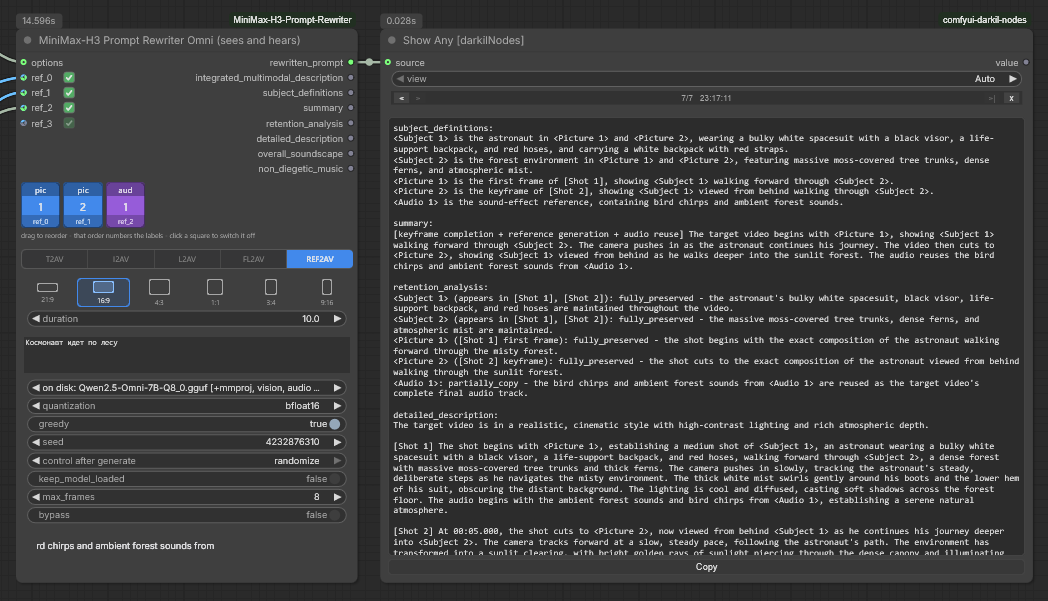
**Outputs.** Seven, and which of them fill depends on the task. The four frame
tasks return the same three as the other two rewriters, so they are
interchangeable downstream. `Ref2AV` returns six: `subject_definitions`,
`summary`, `retention_analysis`, `detailed_description`, `overall_soundscape`
and `non_diegetic_music` — the same set the
[Ref2VA writer](#minimax-h3-prompt-writer-ref2va) produces, and the same meanings.
`rewritten_prompt` always carries the whole answer. After them comes
`references`, which is not text: the switched-on references in strip order, for
[Reference Slots](#minimax-h3-reference-slots) to hand on to
`MiniMaxH3ReferenceToVideo` numbered the way the prompt numbers them.
**Inputs**
- `prompt`, `resolution`, `greedy`, `seed` — as above.
- `references` — one growing socket that takes an IMAGE, a VIDEO or an AUDIO.
There is no wrong socket to plug into: what a reference is called follows from
what it is. Pictures are numbered among pictures and sounds among sounds, so
connecting a sound between two pictures does not renumber them.
- `task` — `T2AV`, `I2AV`, `L2AV`, `FL2AV`, `REF2AV`. Only `REF2AV` takes clips
and sound; the other four are written from pictures alone, and connecting a
sound to one of them is refused by name before anything loads.
- `duration` — **the node snaps it.** MiniMax-H3 generates on a 17n+5 frame grid
at 24 fps, so most lengths do not exist: ask for 10 seconds and it is 243
frames, 10.13 s, and *that* is the number written into the turn and quoted back
in the alignment line. The widget is what you meant; the line and the video
agree because of the snapping.
- `model` — a Qwen2.5-Omni-7B base, as a **GGUF** pair (the model and its
projector) or as the official **safetensors** folder. Entries prefixed
`on disk:` are already in your model folders. Two kinds of near-miss are marked
rather than hidden: a Qwen2.5-Omni-**3B** is `(wrong size for the adapter)`,
and a **Qwen2.5-VL-7B** — which is the same architecture string, the same 28
blocks and the same width, so the adapter *would* attach — is
`(vision only, not an Omni build)`, because its projector has no audio encoder
and the rewrite would be about sound that was never heard. The **Open model
list** button edits the `models_omni` section — see below.
- `quantization` — how to load a **safetensors** base: `nf4` about 9 GB of VRAM,
`int8` about 12, `bfloat16` about 20. Ignored for GGUF. **Pick the largest your
card holds** — see below.
- `max_frames` — how many frames to take from a clip, spread evenly. Each frame
is its own picture to the model.
- `reference_layout` — the strip's state as JSON. It is a widget so the
arrangement travels with the workflow and through the API; the interface draws
it as squares instead.
- `keep_model_loaded` — honoured on a **safetensors** base. On a **GGUF** base a
task with references runs through `llama-mtmd-cli`, a fresh process that takes
the model with it when it exits, and the node says so rather than ignoring the
switch.
- `options` — the same options node as everything else.
**The strip is the ordering.** Every connected reference appears as a coloured
square — blue for a picture, green for a clip, purple for a sound — showing what
it will be called and which socket it came from. Drag to reorder, and that order
is what numbers the labels: dragging the second picture to the front is what
makes it ``. Click a square to switch it off without unplugging it.
The task strip greys out a task the connected references cannot serve and says
why on hover, so `FL2AV` with one picture is visibly unavailable rather than a
failure two minutes later.
There is deliberately **no relabelling here**, unlike the Universal Writer's
strip. There, a picture can be told to stand for a subject or a clip, because the
guide-driven turn names its references by hand. Here the socket settles it — and
a *subject* is something this adapter **produces** in `subject_definitions`, not
something the request supplies.
**What it costs**
| | Download | VRAM |
|---|---|---|
| Q4_K_M base + projector + Q8_0 adapter | 4.4 + 1.4 + 0.34 GB | ~9 GB |
| Q8_0 base + projector + F16 adapter | 8.1 + 1.4 + 0.65 GB | ~13 GB |
| safetensors base + adapter, `nf4` | 22.4 + 1.3 GB | ~9 GB |
| safetensors base + adapter, `bfloat16` | 22.4 + 1.3 GB | ~20 GB |
A GGUF base pays for the llama.cpp runtime as well, once: every task but `T2VA`
carries references and therefore runs through `llama-mtmd-cli` — 34 MB, or
511 MB where `llama_backend` resolves to CUDA, and an installed
`llama-cpp-python` makes no difference to it.
The GGUF adapter is converted from LightX2V's own safetensors with llama.cpp's
`convert_lora_to_gguf.py` and published at
[pytraveler/MiniMax-H3-Prompt-Rewriter-LoRA-Omni-GGUF](https://huggingface.co/pytraveler/MiniMax-H3-Prompt-Rewriter-LoRA-Omni-GGUF).
The `Q8_0` build is half the size of the `F16` and behaves the same.
**Quantization buys VRAM, not speed.** Which is the opposite of the intuition — a
smaller model should move fewer bytes and go faster. Measured on this adapter, on
one card, same prompt, same two pictures, same 256 tokens:
| | VRAM | Generation |
|---|---|---|
| `bfloat16` | 19.4 GB | **18.6 tok/s** |
| `nf4` | 8.6 GB | 15.1 tok/s |
| `int8` | 12.0 GB | 6.0 tok/s |
`int8` is the worst of the three on both counts: slower than `nf4` *and* larger
than it. That is not a quirk of this adapter — bitsandbytes' `load_in_8bit` is
LLM.int8(), which splits every matmul into an fp16 outlier part and an int8 part
and recombines them, casting the activations each time. It is a scheme for
fitting a model that would not fit, and it costs what it costs. `nf4` is the
better small option and dequantizes on every matmul too, which is why it does not
beat `bfloat16` either. So quantize only down to what the card actually holds:
with 24 GB or more, `bfloat16` is both the fastest and the most faithful.
The same applies to any safetensors base in this pack, since the mechanism is
bitsandbytes' rather than the model's. **And none of it applies to the GGUF
route**, where llama.cpp has real quantized kernels: the same FL2AV that takes
26 seconds through `bfloat16` safetensors takes 10 through `Q4_K_M`.
**Pictures are scaled before the model sees them.** LightX2V's own inference
script caps a picture at 301056 pixels — 384 tokens — and a frame from a clip at
100352, and this node does the same. It is not only a saving: a 1616×1616 picture
is 3249 tokens, two of them overflow an 8k context before a word of the prompt is
counted, and the model is being shown a shape it never saw in training. The
context is then sized to what the turn actually costs, so a `Ref2AV` with eight
references widens it instead of failing.
**The safetensors route shows pictures only.** ComfyUI's in-process Transformers
path has no way to hand the model a sound, so a clip or a sound on that base is
refused rather than silently dropped from the turn. Pick a GGUF base to use them.
### MiniMax-H3 Universal Rewriter
All three prompt-rewriter LoRAs in one node, with a tab at the top choosing which
one runs. [Prompt Rewriter](#minimax-h3-prompt-rewriter),
[Prompt Rewriter 8B](#minimax-h3-prompt-rewriter-8b-sees-frames) and
[Prompt Rewriter Omni](#minimax-h3-prompt-rewriter-omni-sees-and-hears) are
unchanged and still there — nothing you have already built stops working.
The three adapters are not three settings of one thing. The 27B is text:
Qwen3.6-27B, one task, and a reference frame reaches it only as a sentence
somebody wrote. The 8B is multimodal: Qwen3-VL-8B, four tasks, and the picture
itself. The Omni is multimodal and hears as well: Qwen2.5-Omni-7B, the same four
tasks and a fifth of its own. Different base, different size, different
download.
Which is exactly why choosing between them by hand is tedious. The prompt is the
same prompt, the aspect ratio is the same aspect ratio, the duration is the same
duration — so trying another adapter meant retyping all of it into a second node
and then keeping them in step.
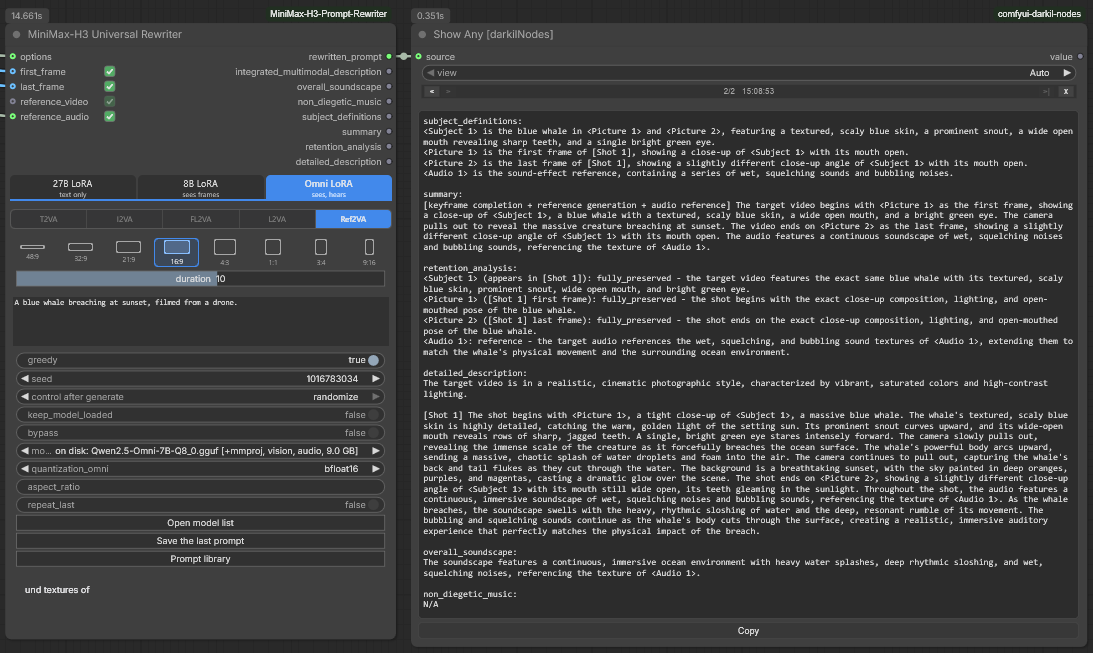
*One node, three tabs. Nothing above the model rows belongs to a tab — the
task, the ratio, the duration and the prompt are one set of values, whichever
adapter is lit. Below them each tab holds its own model and quantization, still
set to whatever you last chose, including across a save and load. The task strip
is the other difference: the 27B tab lights `T2VA` alone, the 8B tab adds the
three frame tasks, and the Omni tab adds `Ref2VA` on top of them, which no other
tab can reach.*
**So the tab carries what differs, and nothing else:**
| Belongs to the tab | Shared between them |
|---|---|
| `model_27b` / `model_8b` / `model_omni` | `prompt`, `task`, `resolution`, `duration` |
| `quantization_27b` / `quantization_8b` / `quantization_omni` | `greedy`, `seed`, `keep_model_loaded`, `bypass`, `options`, both frames, the clip and the sound |
The widget the other tab uses is hidden rather than reset, so it is still set to
whatever you last chose when you switch back — including across a save and load.
> **No captioner on the 27B tab, deliberately.** Folding a description of a
> frame into the prompt does reach that adapter, and it is not wasted — the props,
> surfaces and light in it turn up in the shots, in the trained shape, with
> nothing leaking into the answer. But the picture is absorbed into the scene
> rather than pinned to 0.00 seconds, which is exactly what the
> [LoRA's own page](https://huggingface.co/lightx2v/MiniMax-H3-Prompt-Rewriter-LoRA)
> says: T2VA is finished there and FL2VA is not. A widget for it on this node
> would have looked like the frame task the 27B cannot do. When you want it,
> [Reference Caption](#minimax-h3-reference-caption) writes the description and
> it goes in `prompt` like any other text; when the picture has to *be* a frame,
> the 8B tab is the one that was trained for it.
**The task switch is shared, and the 27B tab does not touch it.** On that tab it
shows `T2VA` lit with the three frame tasks greyed out, because that is the
honest picture of a text-only model, and clicking does nothing at all — the value
the other two tabs had is still there when you switch back. On the 8B and Omni
tabs a frame task greys out until the frame it is written from is actually
connected and switched on, the same way `Ref2VA` does on the Universal Writer.
**`Ref2VA` is on the Omni tab, with a clip socket and a sound socket to feed it.**
`reference_video` and `reference_audio` are read by that task and by nothing else
— the 27B and 8B adapters have no ear, and the four frame tasks take pictures
alone, so connecting a sound to `FL2VA` is refused by name rather than quietly
dropped. On `Ref2VA` everything connected becomes a reference the target video
reuses, in socket order: `first_frame` is ``, `last_frame` is
``, then ``, then ``. The answer comes back in six
fields instead of three; the four extra outputs sit **after** the three every
task fills, so nothing already wired to this node moves. Last of all is
`references`: the references the current tab actually read, for
[Reference Slots](#minimax-h3-reference-slots) to hand on to
`MiniMaxH3ReferenceToVideo`.
> **Four references, not twelve.** Order is the whole labelling rule, and with
> four sockets the order is the order of the sockets. Past that, arranging them
> by hand is the thing you actually want — which is what the draggable strip on
> [Prompt Rewriter Omni](#minimax-h3-prompt-rewriter-omni-sees-and-hears) is for,
> along with `max_frames` and any number of pictures. This tab is for the other
> thing: trying the same prompt on a different adapter without leaving the node.
**Four reference inputs, with a checkbox on each row.** `first_frame` and
`last_frame` are the same two the 8B node has; `reference_video` and
`reference_audio` are the two `Ref2VA` adds. A switched-off row counts as
unplugged — which is how a reference gets parked without dragging the wire off.
Run the 27B tab with any of them connected and the node says on itself that it is
not reading them, and where to put them instead, rather than leaving you to
wonder.
**`duration` is a slider**, reaching 30 seconds until you move it — right-click
the node, `duration`. See [The duration widget](#the-duration-widget). The three
adapters were trained on clips of a few seconds, so a number far past that is a
worse prompt rather than a longer video — MiniMax-H3 gets the length from its own
settings, not from this line.
**There is no "Open guide folder" button**, because none of the three adapters
reads a guide: the format is in the system prompt they were trained with. The
**Model list** button is there, and it opens all three of this node's lists as
tabs in one window — `models` for the 27B tab, `models_8b` for the 8B one,
`models_omni` for the Omni one.
> **If the interface script does not load**, the tab strip, the task switch and
> the ratio picker fall back to the plain dropdowns they are built on, and every
> widget is visible at once instead of a tab's worth at a time. The node runs
> exactly the same either way. Those three controls are HTML and work in both of
> ComfyUI's renderers; the checkboxes on the two frame rows are drawn on the
> canvas, which *Modern Node Design (Nodes 2.0)* does not run, so there a frame
> is left out by unplugging it.
> **This node needs a recent ComfyUI**, being written against the v3 node API,
> exactly as the Universal Writer is. On an older install it goes missing and the
> rest of the pack registers as before.
### MiniMax-H3 Rewriter Options
Everything you rarely touch, kept off the main node. Leave it unconnected and the
rewriter uses the decoding parameters the adapter was published with.
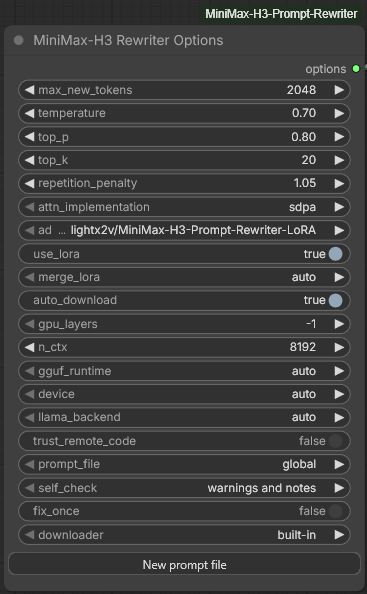
| Input | Default | Purpose |
|---|---|---|
| `max_new_tokens` | 2048 | Generation cap |
| `temperature` / `top_p` / `top_k` | 0.7 / 0.8 / 20 | Sampling, used only when `greedy` is off |
| `repetition_penalty` | 1.05 | |
| `attn_implementation` | `sdpa` | `eager` or `flash_attention_2` if you have it |
| `adapter` | the LightX2V repo | Which build of the LoRA to apply — see below |
| `use_lora` | on | Turn off for the plain base-model baseline |
| `merge_lora` | `auto` | Fold the adapter into the weights at load — twice the tokens a second, see below |
| `auto_download` | on | Turn off to fail loudly instead of fetching 52 GB |
| `downloader` | `built-in` | Which code fetches a Hugging Face repository — see below |
| `device` | `auto` | Which GPU runs the language model — see below |
| `trust_remote_code` | **off** | Allow a checkpoint to run the Python it ships with — see below |
| `prompt_file` | `global` | Which set of saved prompts the nodes wired to this one work in — see [the prompt library](#the-prompt-library) |
| `self_check` | `warnings and notes` | How much of [the self-check](#the-answer-is-checked) is said out loud: everything, warnings only, or nothing |
| `fix_once` | `false` | Let the nodes act on what the check found — [one re-run, never a loop](#acting-on-what-it-found) |
The same options node feeds the writer nodes and the captioner; `adapter` and
`use_lora` simply do not apply there.
#### `merge_lora` — the adapter as weights rather than as a second matmul
PEFT keeps an attached LoRA beside the base model and computes it on every
token, on top of the base weights. Folding it in once at load does the same
arithmetic ahead of time, and the difference is not small. Measured here on
Qwen3-VL-8B with the 8B adapter, 128 tokens on a 5090:
| | adapter attached | folded in | merge costs |
|---|---|---|---|
| `bfloat16` | 8.98 s — 14.3 tokens/s | **5.13 s — 25.0 tokens/s** | 0.07 s |
| `nf4` | 9.43 s — 13.6 tokens/s | **5.09 s — 25.1 tokens/s** | 4.6 s |
`auto`, the default, takes the free half: it folds the adapter into an
unquantized base, where the merge costs a tenth of a second, and leaves it
attached on a bitsandbytes `nf4`/`int8` one, where merging means dequantizing
every layer and quantizing it back. `on` does it there too, if you would rather
pay 4.6 s at load and have the tokens; `off` is the old behaviour. Nothing here
touches the GGUF route, where llama.cpp applies the adapter its own way.
**A folded run is not word-for-word the attached one.** Merging reassociates the
arithmetic — `W + BA` computed once is not bit-for-bit `Wx + B(Ax)` computed per
token — so a token here and there falls differently and the rest of the sentence
follows it. Measured on the pair above at the same seed: two differences in 128
tokens on `bfloat16`, more on `nf4`, where the requantization adds error of its
own and PEFT prints a warning saying so. Neither answer is the better one, but
they are not the same answer, and a workflow you have tuned to the token is a
reason to leave this on `off`.
#### `adapter` — a dropdown, and what is in it
The list holds, in order:
- **`lightx2v/MiniMax-H3-Prompt-Rewriter-LoRA`**, the default and the entry to
leave alone. It means *whichever build the model list names for the base model
you picked* — the PEFT adapter for a `transformers` base, the catalog's GGUF
for a GGUF one, and the 8B adapter on the 8B node.
- **Every published precision of both LoRAs.** F16 and Q8_0 for each; the Q8_0 is
half the download and rewrites the same. Picking one that is not on disk
downloads it from the repository it belongs to.
- **Every `.gguf` LoRA already in your ComfyUI model folders**, prefixed
`on disk:` with its architecture in the label, so `qwen35` and `qwen3vl` are
told apart at a glance. This is how a LoRA you converted yourself gets in:
drop the file in `models/LLM` and it appears.
Choosing a quantisation used to mean editing `models.json` by hand, which is a
power-user path rather than an interface. Saved workflows are unaffected: a combo
serialises as the string it displays, and the old default is still the first
entry, character for character.
Two things are still true of this field, because it is the one setting a
downloaded workflow gets any say in:
- **A network path is refused.** `\\host\share\...` and `//host/share/...` are
rejected before anything reads them, because merely looking at one is an
authentication attempt against whatever host is named. A share of your own is
reachable by drive letter or mount point as usual, and a path in `models.json`
is not restricted at all — that file is yours and does not travel.
- **The adapter that was applied is logged**, every run. Ask for one that is not
the configured adapter and the console says so at warning level. A swapped
LoRA is otherwise invisible: the node still runs and still fills every field,
it just writes something else.
#### `trust_remote_code` — off, and why
A Transformers checkpoint can carry its own modelling code, named by `auto_map`
in its `config.json`, and loading such a model imports and runs that Python with
your user's rights. Nothing in the shipped list does this: every `transformers`
entry is a Qwen3.6-27B variant, an architecture Transformers supports natively,
and the GGUF entries never reach Transformers at all. So this switch is off, and
for the models this node offers it changes nothing.
It exists for the case where it does matter — a model you added to `models.json`
yourself, with an architecture Transformers does not know. Then the node stops
and says so instead of running the code, and turning the switch on is you saying
which model you trust. The decision is yours to make and not `config.json`'s to
make for you, which is the whole point of it being a widget.
#### `device` — and why it changes `keep_model_loaded`
Every node here has carried the same warning: turn `keep_model_loaded` off,
because the card is needed for video generation the moment the rewrite finishes.
That warning exists only because both models want the same device. **With two
cards they need not.**
Values are `auto`, `cpu`, and one `cuda:N` per GPU ComfyUI can see. One spelling,
three backends:
| | `auto` | `cuda:1` | `cpu` |
|---|---|---|---|
| llama.cpp binaries | unchanged | `--device CUDA1` | `--device none`, 0 layers |
| llama-cpp-python | unchanged | `main_gpu=1`, split mode `NONE` | `n_gpu_layers=0` |
| Transformers | `device_map="auto"` | `device_map={"": "cuda:1"}` | `{"": "cpu"}` |
The important part is not the placement. **On another card, ComfyUI's own models
are no longer evicted first.** Every backend here unloads them unconditionally
today, which is right when both want the same VRAM and pure waste when they do
not — it costs a full reload of the diffusion model after every rewrite. Pick a
second card and the rewriter loads beside it, `keep_model_loaded` becomes worth
switching on, and nothing has to move.
Two details worth knowing. A device the machine does not have is **refused, not
quietly demoted** — a workflow carried over from a two-card machine says so,
instead of running on the wrong card and evicting a batch mid-flight. And the
numbering is ComfyUI's own: started with `--cuda-device 1`, ComfyUI sees exactly
one device and it is `cuda:0`, for the subprocesses too.
The values are deliberately plain rather than `cuda:1 · RTX 4090`: a label with
the card's name reads better and breaks every saved workflow the day the card is
replaced. The tooltip names what is in each slot.
#### `downloader` — the built-in transfer, or `huggingface_hub`
The default moves the bytes itself: one ranged HTTP connection at a time,
resumable, needing nothing installed. That is the right floor for something
nobody opted into, and on a fast link it is fine.
It is not fine on a 30 GB checkpoint over a connection that gives one stream 8
MB/s. The Comfy-Org repositories are **Xet-backed**, and `hf_xet` fetches the
chunks of a *single* file over many connections at once — which is the whole of
the difference behind "the CLI took five minutes and the node took an hour".
Setting `downloader` to `huggingface_hub` takes that route instead:
```
python -m pip install huggingface_hub hf_xet
```
into ComfyUI's own Python, then restart. Neither package is a dependency of this
pack, and **nothing fails if they are missing**: the node logs the install line,
notes it in the caption, and downloads with the built-in transfer. That matters
because the setting travels inside the workflow, and a graph authored on a
machine that has them should still run on one that does not.
**It covers Hugging Face repositories only** — base models, GGUF writers, LoRA
adapters, a model and its projector. The llama.cpp binaries come from GitHub
releases and the two writing guides are one small request each; neither goes
through this setting.
**Half-finished files are not interchangeable.** The built-in transfer parks
bytes in `.part` beside the file; `huggingface_hub` parks them under
`.cache/huggingface` inside the destination folder. Switching in the middle of a
download restarts that one file and leaves the other's leftovers to delete by
hand. A file that is already complete is never fetched twice either way — this
pack decides what is missing before either backend is called, which also avoids
`huggingface_hub` re-hashing a finished 30 GB file to adopt it.
One thing worth knowing about disk: `hf_xet` keeps a chunk cache at
`~/.cache/huggingface/xet` (`HF_XET_CACHE`), which on Windows is on `C:` whatever
drive the models live on. The free-space check this pack runs before a download
only looks at the destination.
**Behind an antivirus that inspects HTTPS.** Antiviruses that scan encrypted
connections, and company proxies like them, re-sign huggingface.co with a root
certificate of their own and install that root in the system's certificate store,
which is why the browser still opens the site. The built-in transfer trusts that
store as well as the usual certifi bundle, so it downloads wherever the browser
does. `huggingface_hub` and `hf_xet` bring their own TLS and do not look there:
behind such a filter they stop at `certificate verify failed`, and the node says
so — switch back to the built-in transfer, or add huggingface.co to the filter's
exclusions.
### MiniMax-H3 Prompt Writer (T2VA/I2VA/FL2VA/L2VA)
The same three output fields, without the LoRA and without the 27B. MiniMax's own
[prompt-writing guide](https://huggingface.co/MiniMaxAI/MiniMax-H3/blob/main/docs/VIDEO_PROMPT_WRITING_GUIDE_base_en.md)
goes into the system prompt and any instruction-following GGUF writes to it. A
5.2 GB Qwen3.5-9B fills all three fields, with correct camera vocabulary, speaker
IDs and `[English] … ` dialogue, in about 20 seconds.
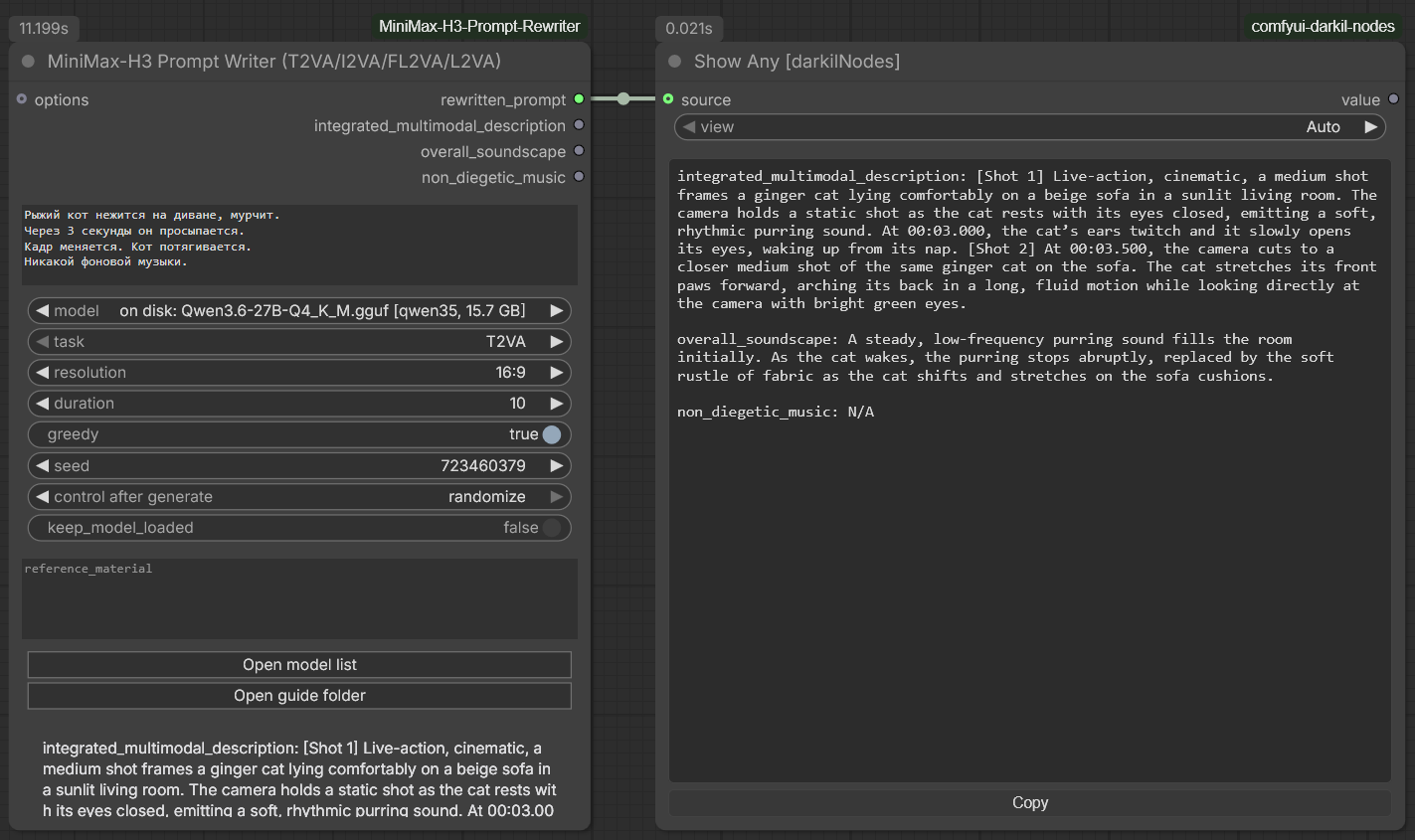
*T2VA, 10 seconds at 16:9, on a local Qwen3.6-27B — 11.2 s. The prompt went in
in Russian and the description came back in H3's English format, with the cut at
00:03.000 that the prompt asked for and `non_diegetic_music: N/A` because it
asked for no music.*
The trade is worth stating plainly. The LoRA **is** the format: a 27B was trained
until H3 output came out of it with a seven-line system prompt. Here the format is
carried by ~4 000 tokens of instructions the model has to follow, so expect the
LoRA's prose to be denser and its formatting more reliable. Expect this to run at
all on hardware the LoRA cannot touch.
Outputs are identical to the rewriter node's — same names, same order — so the two
are interchangeable in a saved workflow.
Beyond the rewriter's inputs:
- `task` — **T2VA**, **I2VA**, **FL2VA** or **L2VA**. Everything but T2VA also
emits the alignment instruction line H3 requires as the very first line, with
the duration already substituted to two decimals; only the final shot number is
left to the model.
- `reference_material` — **this node reads text, not pixels.** For I2VA, FL2VA and
L2VA, describe what the reference frames show, by hand or from the
[Reference Caption](#minimax-h3-reference-caption) node upstream. Without it the
model invents a first frame that has nothing to do with your image.
`model` offers the `writers` section of the model list plus every GGUF already in
your ComfyUI model folders, whatever its architecture. Nothing here has to be
Qwen3.6-27B, and nothing has to be installed: without `llama-cpp-python` the node
runs the official llama.cpp binaries, exactly as the GGUF route below does.
| Suggested writer | Download | VRAM with the guide in context |
|---|---|---|
| Qwen3.5-4B `Q4_K_M` | 2.6 GB | ~5 GB — start here on an 8 GB card |
| Qwen3.5-9B `Q4_K_M` | 5.3 GB | ~8 GB — best writing per gigabyte |
| Qwen3.5-9B Uncensored (HauhauCS) `Q4_K_M` | 5.2 GB | ~8 GB — does not decline scenes the stock model refuses |
| Gemma 3 12B Instruct `Q4_K_M` | 6.8 GB | ~10 GB — non-Qwen alternative |
| Mistral Small 3.2 24B Instruct `Q4_K_M` | 13.4 GB | ~17 GB — for 16 GB cards and up |
`n_ctx` is raised automatically: the base guide needs about 9 200 tokens of
context and the full-reference guide about 12 300, against the 8 192 default that
suits the LoRA's short system prompt. Letting llama.cpp truncate instead would
drop the *front* of the prompt — the guide and the output contract — and the
answer would come back in some other format with nothing to say why.
If a field comes back missing, the node still returns everything it got and says
which fields are absent, on the node. Lower the temperature or move up a size.
#### `system_prompt` — pointing the writer at another model
The guide is the whole of what makes this an H3 writer: it goes into the system
prompt and nothing else in the node knows the format. So replacing that text is
what turns these nodes into a writer for something else — LTX, Krea, Wan, or a
house style of your own. Write it into `system_prompt` and the assembled guide is
not used; on an empty field nothing changes.
The guide is then not even fetched, which matters on a machine kept offline:
there is no 24 KB document downloaded to be ignored.
The shortest way in is
[Guide Prompt (any LLM)](#minimax-h3-guide-prompt-any-llm), which hands you the
stock system prompt on an output. Take it, edit it, connect it back.
Two things do not move. The task message is never replaced — it carries the
prompt, the aspect ratio and the duration, which any guide needs. And the answer
is still split into the H3 sections, so a guide that replies with one paragraph
fills `rewritten_prompt` and leaves the section outputs empty. That is worth
knowing rather than worth avoiding.
### MiniMax-H3 Prompt Writer (Ref2VA)
Full-reference mode, from MiniMax's
[full-reference guide](https://huggingface.co/MiniMaxAI/MiniMax-H3/blob/main/docs/VIDEO_PROMPT_WRITING_GUIDE_ref_en.md).
Six sections instead of three, each its own output:
| Output | Contents |
|---|---|
| `subject_definitions` | what each `` / `` / `` / `` label denotes |
| `summary` | the `[task type]` prefix and the reference relationships in one paragraph |
| `retention_analysis` | per label: `fully_preserved`, `partially_preserved`, `attribute_transfer`, `weak_reference`, `fully_copy`, … |
| `detailed_description` | the body, shot by shot, with labels cited where their roles apply |
| `overall_soundscape` | ambience and physical sound |
| `non_diegetic_music` | audience-only score |
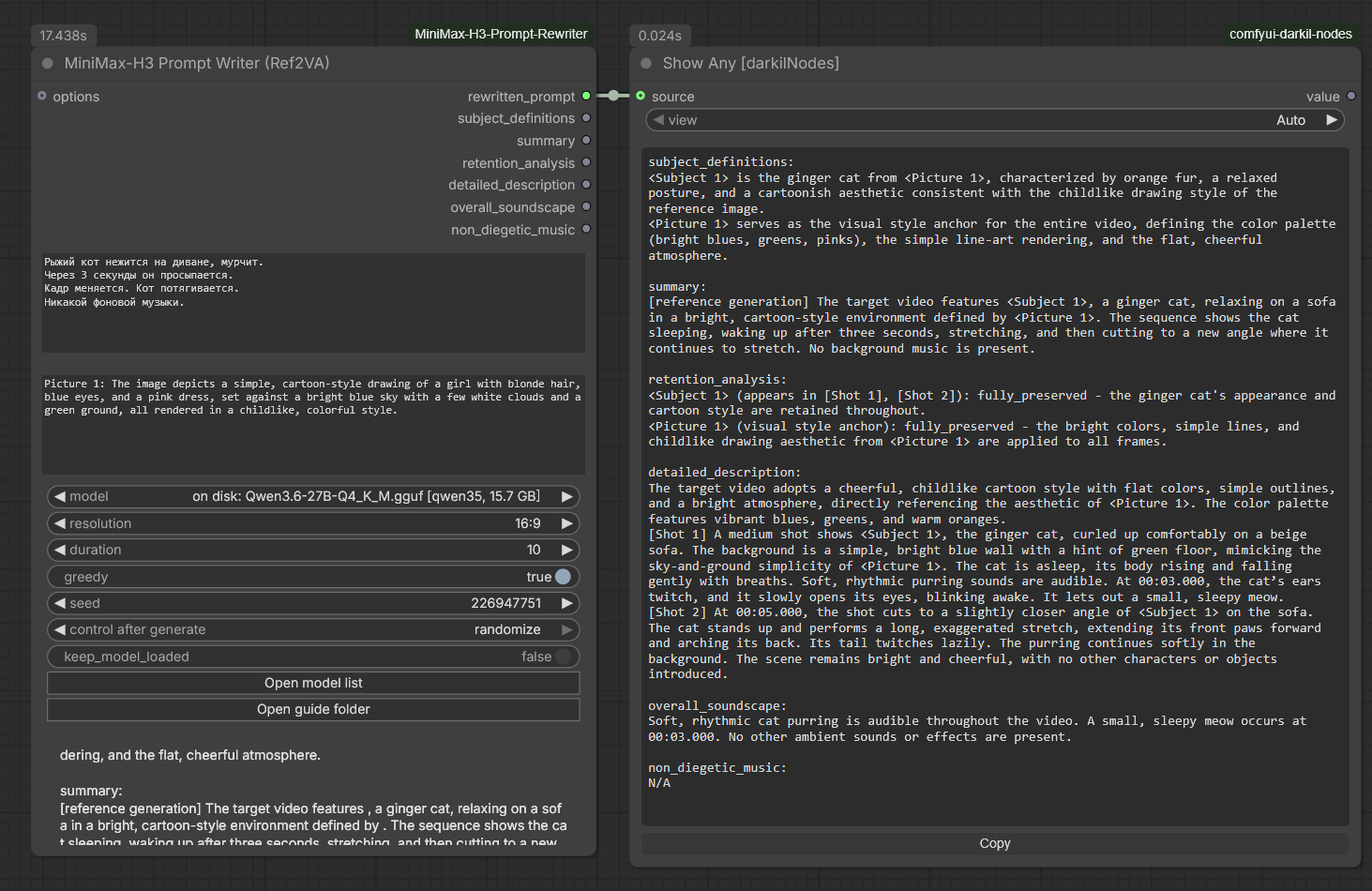
*The same clip as above with one `Picture 1:` line added to `reference_assets` —
17.4 s. The model picked the task type, bound `` to the cat and
`` to the drawing's style, and wrote the retention analysis itself.*
`reference_assets` is **required** and is refused when empty: full-reference mode
describes how a target video reuses assets, so with no assets it is simply T2VA
under another name. One per line —
```text
Picture 1: young woman, long dark hair, blue cardigan, thin silver necklace
Picture 2: corner cafe interior, brick wall, brass lamps, rain on the window
Audio 1: voice-timbre reference for the woman — low, unhurried, slight rasp
```
— and the model binds the labels, picks the task type, and writes the retention
analysis from them. Or let
[MiniMax-H3 Reference Caption](#minimax-h3-reference-caption) write those lines
for you from the assets themselves.
### MiniMax-H3 Universal Writer
One node for a whole shot: the references, the order they are in, and the
rewrite. It does what [Multi Reference Caption](#minimax-h3-multi-reference-caption)
and both writer nodes do, in a single box, for all five tasks. Those three stay
exactly as they are — nothing you have already built stops working.
The reason to fold them together is **order**. `Picture 1` and `Picture 2` are
not interchangeable in FL2VA: one opens the video and the other closes it. Until
now the only thing deciding which was which was the order the caption node
happened to write them in, which came in turn from which slot each was plugged
into. Real, load-bearing, and nowhere on screen.
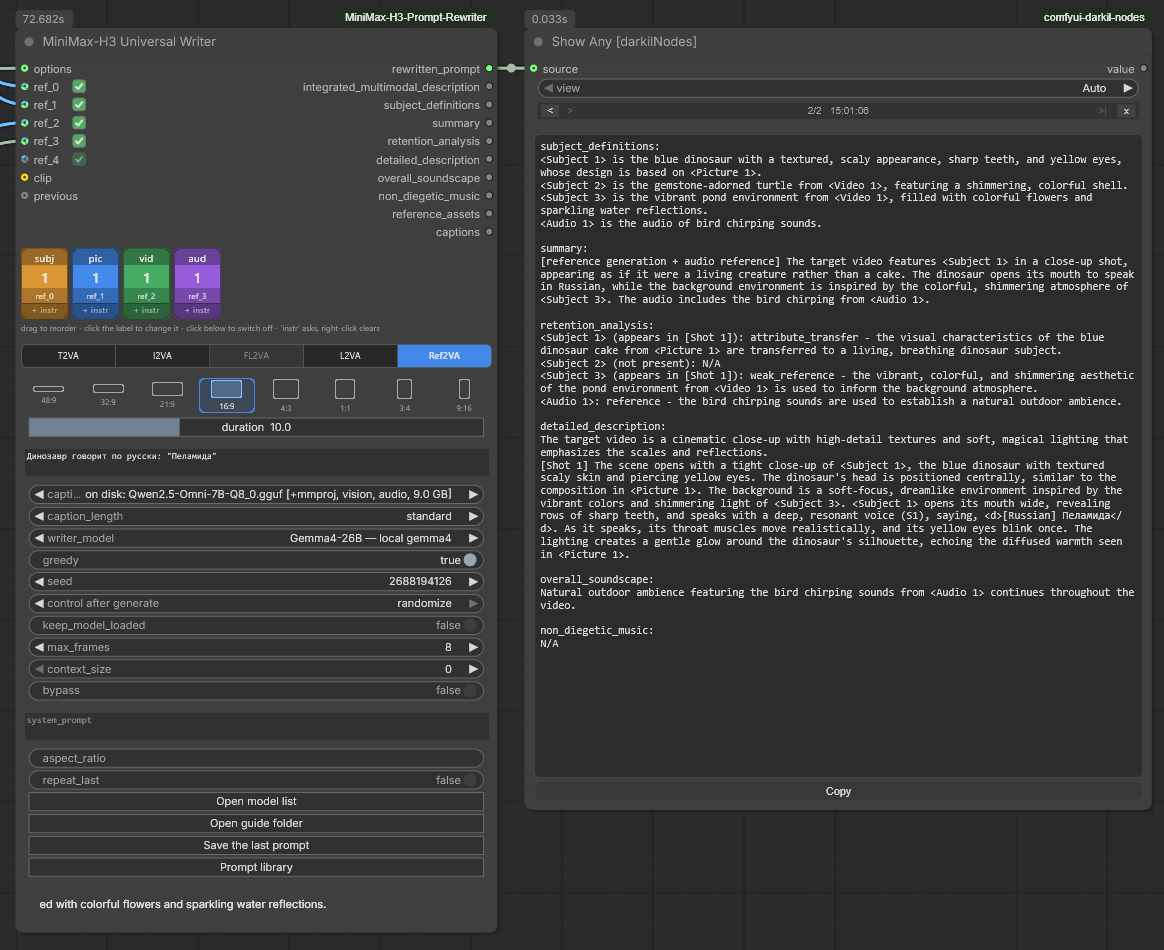
*Four references on one growing socket — an image used as a subject, an image
used as a frame, a clip and a sound — and on the right an answer written around
exactly those labels: ``, ``, ``, ``. The
squares are in slot order here because nothing has been dragged; the number is a
position and renumbers the moment anything moves, while the slot name under it is
what stays with a square.*
**One socket takes an image, a clip or a sound**, and more slots appear as you
fill them. There is no wrong socket to plug into here, because which socket you
used no longer decides anything.
**The strip under the inputs decides it.** Every connected reference gets a
square, coloured by what it is for and numbered exactly as the block will number
it. Under the number is the slot it arrived on, and that is the part of a square
that stays with it: the number is a position, so it renumbers the moment anything
moves.
| Square | Label | What it means |
|---|---|---|
| `pic` | `` | an image serving as an actual frame — first, last, key, composition anchor |
| `subj` | `` | reusable visible content — a person, an animal, a place, a costume, a style |
| `vid` | `` | a clip, or a batch of frames you want read as one |
| `aud` | `` | a voice timbre, music, ambience, an effect |
- **Drag a square** to move it. The numbering follows immediately.
- **Click its label** to change what an image is for: `pic` → `subj` → `vid` and
round again. A clip and a sound are what they are, so those do not cycle.
- **Click its number** to switch that reference off without unplugging it — the
checkbox on the slot's own row does the same thing from the other side.
- **Click the band under it** to ask that one reference something other than its
role's usual question. `+ instr` adds your line to the role's question,
`= instr` asks it instead; right-click takes it back, hovering reads it out.
A square carrying one is ringed in amber for `+` and in orange for `=`, so it
does not go unnoticed.
So one socket still produces the four labels Ref2VA allows, and the distinction
Multi Reference Caption makes structurally — a subject is not a frame — is made
here on the square instead.
**Every square shows what is plugged into it** — here, on Prompt Rewriter Omni
and on Multi Reference Caption. A picture shows its thumbnail, a clip its first
frame with a ▶ in the corner, a sound its waveform with a speaker and the file
name in small type; the number moves to the corner. Hovering plays a clip and
flips through a batch of frames, and the tooltip adds the file, the size, the
frame count and the length. A sound, after a moment's hover, plays its first six
seconds with the wave lighting up as it goes; a press on the square silences it. A square wired to a loader — Load Image, Load Video,
Load Audio or VideoHelperSuite's loaders, through reroutes too — shows the file
straight away, before anything runs. One fed through other nodes shows what
reached the node on its last run, and stays a plain square until then.
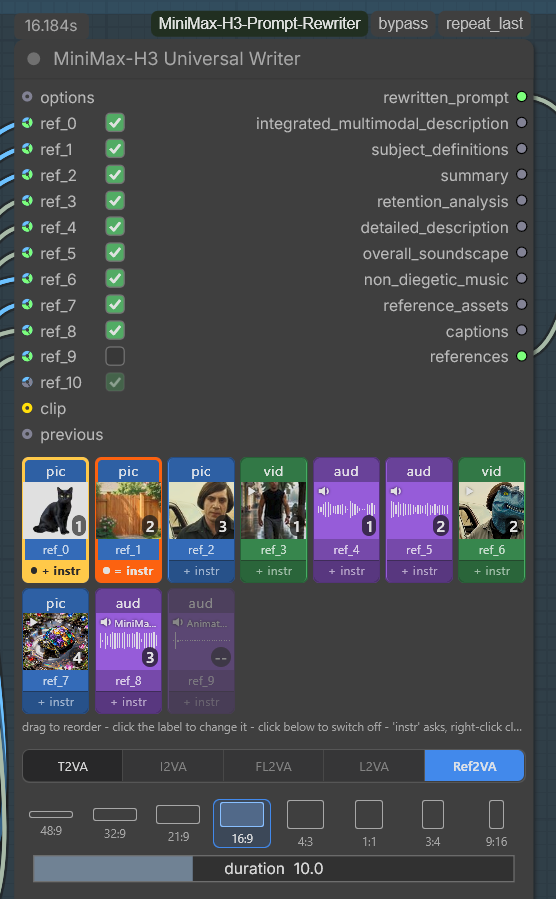
*Pictures, clips and sounds tell apart at a glance, and so do two sounds: ref_8 and
ref_9 come straight from a loader and show their file names, ref_4 and ref_5 came
through other nodes and show the wave from the last run. ref_9 is switched off —
dimmed, numbered `--`, still recognisable. The two squares with an instruction
are the ones ringed.*
**The task switch and the aspect-ratio picker are the same idea**: the choice is
the picture rather than a line of text in a dropdown. And the task switch reads
the strip: a task greys out while the strip cannot supply what it is written
from, so with nothing connected only `T2VA` is lit, one picture lights `I2VA` and
`L2VA`, and two light `FL2VA`. Three pictures grey all three, because three is as
impossible for `I2VA` as none — it is the same count the node refuses on, moved
from the run to the sight of it, and the greyed button carries the same sentence as a tooltip. Badges
are counted, not sockets: turn a picture into a subject and the task it was
blocking lights up. A task already chosen and no longer possible turns red rather
than quietly failing later.
Every rectangle in the picker is drawn to its own proportion within one budget,
so the wide end reads as how little height is left: `21:9`, `32:9` and `48:9`
come out at roughly 15, 10 and 6 pixels tall. A node too narrow to hold the whole
row wraps it onto a second line rather than cutting the last rectangles off, and
grows by exactly that much.
**`duration` is a slider, in tenths of a second**, and how far it reaches is
yours to set — right-click the node, `duration`. See
[The duration widget](#the-duration-widget).
**Two model widgets, because there are two jobs.** `caption_model` reads the
references and `writer_model` writes the prompt from MiniMax's guide; `clip`
works here exactly as it does on the caption nodes, and is used for the
references when connected. On T2VA no captioner is touched at all.
**What each task expects of the strip:**
| Task | Pictures | Everything else on the strip |
|---|---|---|
| T2VA | none | ignored entirely, and the node says so rather than describing them |
| I2VA | exactly one — the first frame | goes in as reference material |
| L2VA | exactly one — the final frame | goes in as reference material |
| FL2VA | exactly two — first, then last | goes in as reference material |
| Ref2VA | any number | at least one reference of some kind is required |
A mismatch is refused before anything is downloaded or loaded, and the message
names the strip rather than the sockets, because the strip is where the fix is:
an image that is in the way gets switched off or given a different label, not
unplugged.
**The outputs are the union of both writers'** — the three T2VA fields, the six
Ref2VA fields, and the reference block itself. A task that does not write a field
leaves it empty, because a node's outputs cannot change with the value of one of
its widgets. The last output, `references`, is not text: it is what the strip
numbered, for [Reference Slots](#minimax-h3-reference-slots) to wire into
`MiniMaxH3ReferenceToVideo` in the same order.
> **One difference from Multi Reference Caption.** That node writes the block in
> the guide's own order — subjects, pictures, videos, audio — whatever the wiring
> says. This one writes it in strip order, because the strip is the whole point.
> An untouched strip is in slot order.
> **If the interface script does not load**, the strip, the task switch and the
> ratio picker fall back to the plain widgets they are built on — one text field
> and two dropdowns — and the node still runs. Those three are HTML and work in
> both of ComfyUI's renderers. The checkboxes on the input rows are drawn on the
> canvas, which *Modern Node Design (Nodes 2.0)* does not run; there the number
> on each square is the way to switch a reference off. Multi Reference Caption
> draws the same squares and needs no checkboxes at all any more.
>
> The three drawn controls are also kept off the right-side **Parameters**
> panel, which has no way to draw a control like this and would have to take it
> off the node to try. The node is where they live. Everything else about the
> node -- the prompt, the models, the duration slider -- is in the panel as
> usual.
> **This node needs a recent ComfyUI**, for the same reason Multi Reference
> Caption does: its growing inputs are `io.Autogrow` from the v3 node API. On an
> older install these two go missing and the rest of the pack registers as
> before.
### MiniMax-H3 Reference Caption
The writer nodes read text, not pixels. This is where the text comes from:
connect an image, an audio clip or a video, and a small multimodal model
describes it into one labelled line of `reference_assets`.
Measured on a 3.4 GB Qwen2.5-Omni-3B: **3 s for a frame, 2 s for an audio clip,
5 s for a video.** It runs `llama-mtmd-cli`, which ships beside
`llama-completion` in the same archive, so a machine whose rewrites already ran
on the binaries downloads no runtime for this.
**A machine whose rewrites did not, pays for it here.** `llama-cpp-python` is
what `gguf_runtime = auto` picks whenever the wheel is importable — and a recent
ComfyUI portable ships one — while a safetensors base never touches llama.cpp at
all; neither route has ever fetched an archive, so the first caption is where it
arrives: 34 MB, or 511 MB where `llama_backend` resolves to CUDA. The wheel does
not spare it either, however it was compiled: multimodal input goes through
`llama-mtmd-cli`, a program, and the wheel is a set of shared libraries with no
executables in it. `gguf_runtime` is therefore a writer setting — the caption
nodes run the binaries whatever it says.
**Chain them by wiring** `reference_assets` into the next node's `previous`. Each
label is numbered *within its own category*, which is the guide's own rule
(«`` and `` are numbered independently»), so four assets come
out as `Picture 1`, `Picture 2`, `Video 1`, `Audio 1` — not 1 through 4.
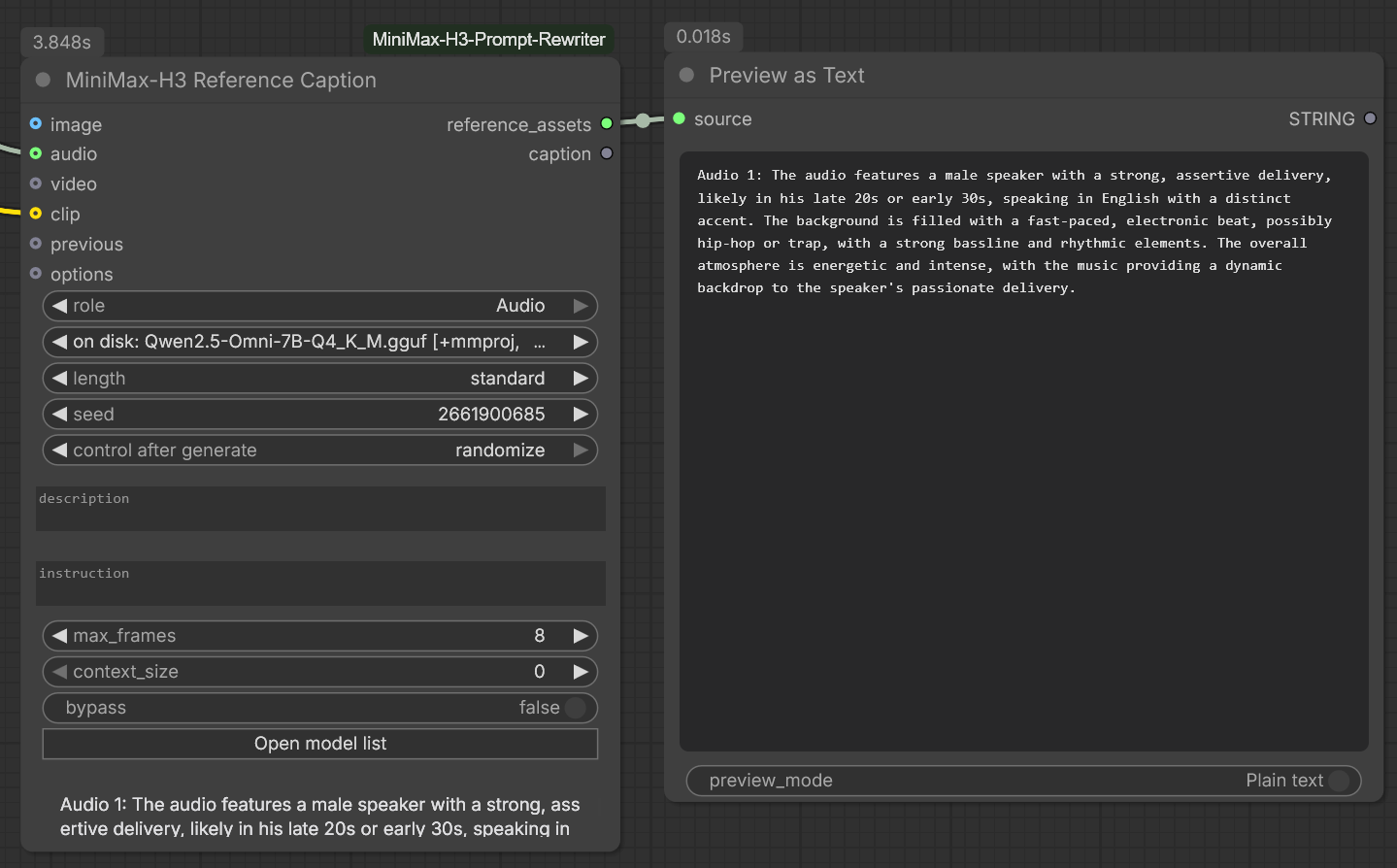
*An image and an audio clip through Qwen2.5-Omni-7B — 4.4 s and 3.7 s. The
second node received the first one's block on `previous` and appended to it, and
the `Audio` role described the voice rather than transcribing it: "a male
speaker with a calm and measured delivery, speaking in Russian".*
`role` picks both the label and the question asked, and the questions differ on
purpose:
| `role` | What the model is asked for |
|---|---|
| `Subject` | the features that must stay consistent across shots — build, hair, clothing and their colours, carried objects |
| `Picture` | the frame as a shot — style, shot size, camera angle, placement, environment, lighting |
| `Video` | subjects, actions in order, camera movement, cuts and pacing |
| `Audio` | **the sound, not the words** — voice timbre, apparent age and gender, delivery and rate, instrumentation, tempo, ambience |
That last row is the one that matters. `` in the guide is usually a
*timbre* reference, and a transcript throws away exactly the part that is needed,
so the instruction says "do not transcribe" outright. If you also want the spoken
words verbatim for a `` block, that is an ASR job — run Whisper alongside and
paste the line in.
Other inputs:
- `description` — type it yourself and **no model runs at all**. The fastest way
to add an asset you can describe in six words.
- `instruction` — override the role's question entirely.
- `max_frames` — how many frames to take from an IMAGE batch **or a VIDEO**,
spread evenly. All of them would overflow both the context and the wall clock:
two seconds at 25 fps is 56 images through the vision tower, and thirty seconds
is 750. This is what makes the cost of describing a clip independent of its
length.
- `context_size` — `0` sizes the context from the references and from the card,
which is not the same as the model's own: llama.cpp reserves the whole KV cache
before it reads a pixel, and a model trained for 262144 tokens asks tens of
gigabytes for it — Qwen3-VL-8B asks 36 GB, on a card that would have captioned
the picture in three seconds. One 1024×1024 frame is already twenty-odd media
chunks, so the count of references is half of the answer and the memory of the
device is the other half. Type a number to say it yourself; too small a value
fails the run instead of truncating it.
**A thinking model does not think into the block.** Whatever a captioner writes
between `` and ` ` is cut before the caption becomes a line of
`reference_assets`, on both the GGUF and the `CLIPLoader` path — otherwise an
empty ` ` opens every caption, and a model that really reasons
sends its whole deliberation on into the writer's prompt.
Cutting it is only half, and the other half cannot be a flag. The writers render
the chat template themselves and pass `enable_thinking=False`; a caption cannot,
because `llama-mtmd-cli` applies the template itself — that is what puts the
media tokens in the right place — and offers no switch for the thought channel.
The reasoning is therefore still charged against `--predict`, so every caption
question ends with a line asking for the description alone. If a model of yours
still insists, `instruction` is where to say so in your own words.
> **Not every multimodal GGUF works here**, and the ones that do not fail loudly.
> llama.cpp's `mtmd` has to understand the projector format: Gemma 4's aborts the
> process outright on `b10310` — with Google's own file and with unsloth's alike,
> on the CUDA and CPU builds alike — while `llama-completion` runs the same model
> as text with no trouble. So the `captioners` list holds only pairs that have
> actually been run:
>
> | Captioner | Download | Modalities |
> |---|---|---|
> | Qwen2.5-Omni-3B `Q4_K_M` + mmproj | 3.4 GB | image, audio, video |
> | Qwen2.5-Omni-7B `Q4_K_M` + mmproj | 5.8 GB | image, audio, video |
>
> A model and its `mmproj` sitting together in one folder under `models/LLM` is
> offered automatically, so you can try another without editing anything.
### MiniMax-H3 Multi Reference Caption
The same job for a whole shot, in one box. A chain is exact, but it grows: five
references are five nodes, five wires and five chances to leave the wrong role on
one of them. This node folds the chain into a single box and takes the role out
of your hands entirely — **the group an asset is plugged into is its label.**
That is the guide's vocabulary made structural. Ref2VA defines exactly four
reference labels and forbids inventing more, so four groups of inputs cover the
format completely, and describing an image as audio stops being *possible* rather
than merely discouraged.
| Group | Label | What belongs here |
|---|---|---|
| `subjects` | `` | reusable visible content — a person, an animal, a place, a costume, a style |
| `pictures` | `` | an image serving as an actual frame: first, last, key, composition anchor, storyboard panel |
| `videos` | `` | whole-video relationships — an edit source, a continuation point, camera work and pacing |
| `audios` | `` | a voice timbre, music, ambience, an effect |
Slots grow as you fill them, one spare always waiting, so the node is as tall as
the shot needs and no taller.
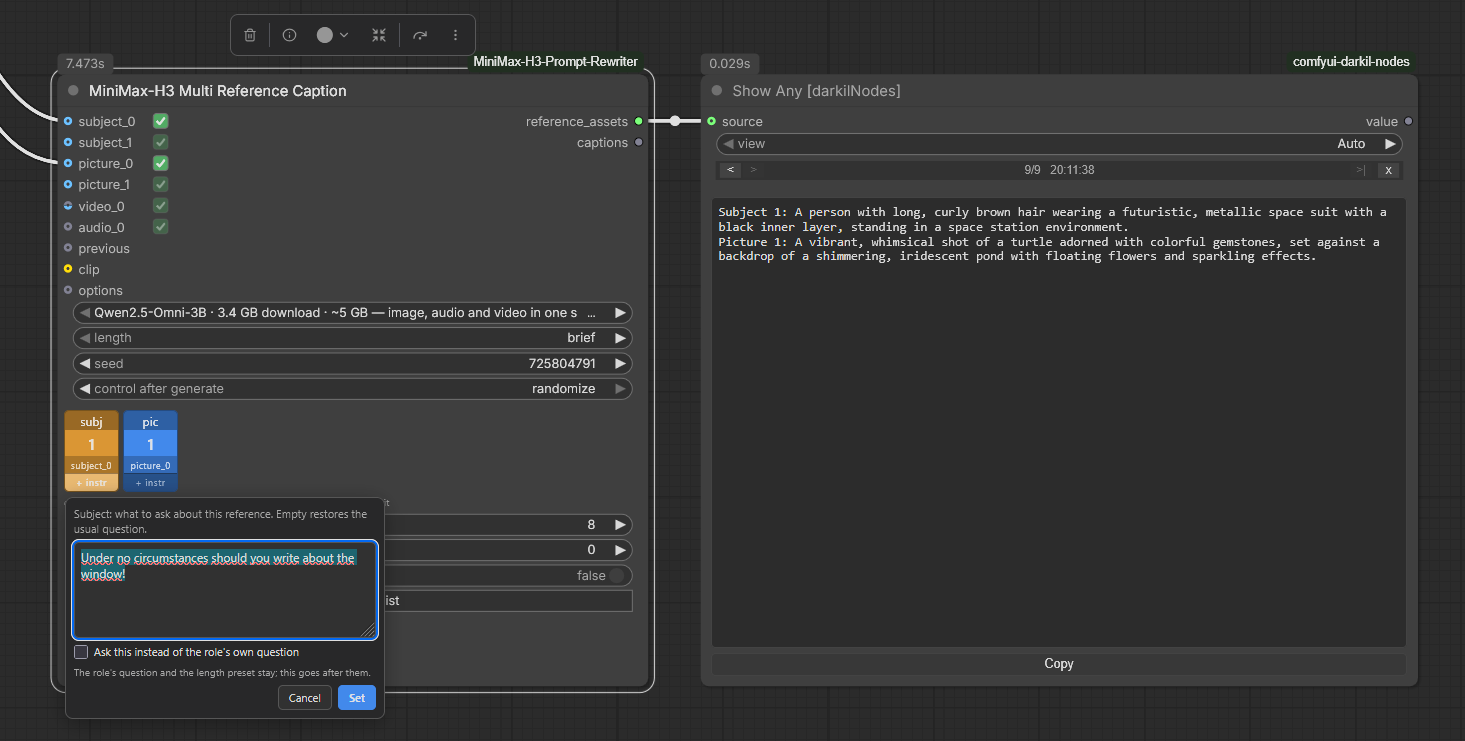
*Two assets through Qwen2.5-Omni-3B — 6.0 s. The video is wired up and switched
off, so the block came out as `Subject 1` and `Audio 1` with no `Video` line at
all: the reference stays in the graph, it just costs nothing on this run.*
**The strip under the inputs is one coloured square per connected reference**,
in the order the block will be written and labelled with what each will be
called. Click a square to switch that reference off without unplugging anything:
a caption costs a model load and seconds to minutes, which makes "everything
except this one" the ordinary thing to want, and pulling the wire out to get it
throws away the wiring you meant to keep. The state is saved with the workflow
and travels through the API like any other value.
Squares here do not drag and their labels do not cycle, unlike the
[Universal Writer](#minimax-h3-universal-writer)'s: this node writes the block in
the guide's own order, and the group an asset is plugged into is what names it.
**The band under a square asks that one reference something else.** Dark while it
is asked its role's usual question, amber once it is not, with a ring of the same
colour round the whole square. Click to write the
question, right-click to take it back, hover to read it. It is per reference
rather than per node on purpose — a node describing a picture, a clip and a sound
at once has no single question that suits all three.
The checkbox in that little window decides which of two things your text is, and
the band then says which: `+ instr` for a line **added** to the role's question,
`= instr`, on an orange band, for one asked **instead** of it. Both are needed.
| What you write | Which mode | Why the other one fails |
|---|---|---|
| `Do not mention the window.` | added | A rule is not a question. Asked on its own it leaves nothing wanting a description, and the model answers the rule: `Subject 1: No`. |
| `Always answer "blah blah blah".` | instead | Left after the role's question it contradicts it, and a small model settles that by describing anyway. |
Asked *instead*, your text also takes over from `length`: whoever writes the
question owns the shape of its answer, so state the length yourself if it
matters. Added, the role's question and the length preset both stay where they
were.
**A `videos` slot takes a `VIDEO` or an `IMAGE` batch**, whichever your loader
hands out — VideoHelperSuite's `Load Video (Upload)` wires straight in. Frames
are sampled evenly up to `max_frames` either way, so the cost of a clip stays
independent of its length.
**The block is written in the guide's order** — subjects, pictures, videos, audio
— rather than in wiring order, and each label is numbered within its own
category, continuing from whatever arrives on `previous`. So this node still sits
in a chain with single caption nodes on either side.
`model`, `length`, `seed`, `max_frames`, `context_size` and `bypass` are shared
by every asset in the node; the question is not, and lives on the band under each
square. `role` and `description` are gone on purpose: the group is the role, and
a description you write out yourself belongs to one asset at a time. Keep
[Reference Caption](#minimax-h3-reference-caption) for an asset you would rather
describe by hand.
> **This node needs a recent ComfyUI.** Its growing inputs are `io.Autogrow` from
> the v3 node API. On an older install it is the only node that goes missing —
> the rest of the pack registers exactly as before.
### Captioning with a model ComfyUI already has loaded
Both caption nodes and the Universal Writer have a `clip` input. Connect a multimodal text encoder from
`CLIPLoader` and every asset is described by *that* model instead of by the GGUF
in `model` — which then stays exactly where ComfyUI's allocator put it.
That is the whole point. The GGUF route runs `llama-mtmd-cli`, one process per
asset, so a shot with five references reads the weights off disk five times. A
loaded encoder is read **once**, and reruns while you tune the wording cost
nothing at all. Measured here: three assets — an image, a clip and its
soundtrack — through Gemma-4 12B in **24 s**, with the log showing a single
`Requested to load` for all of them.
Do not read that as "faster", though. The same three assets through the 3.4 GB
Qwen2.5-Omni-3B on the GGUF route took **16 s**, loads and all: a small model
loads quickly enough that three reloads cost less than a 12B costs to run. What
this route buys is a *bigger* model at no reload penalty, and reruns that skip
the loading entirely — and the gap widens with every asset and every rerun.
Which encoders qualify, and what each can take in:
| Encoder | Sees | Hears |
|---|---|---|
| Qwen3-VL 4B / 8B | yes — a batch of frames is read frame by frame | no |
| Gemma-4 12B | yes | **yes** — the "unified" build, audio projected straight in |
| Gemma-4 E2B / E4B | yes | has the parts, but see below |
| Gemma-4 31B | yes | no |
Gemma-4 is recognised from the checkpoint itself, so the `type` widget on
`CLIPLoader` does not matter for it. Connect a vision-only encoder with audio
wired up and the node refuses before anything runs, the same way it refuses a
projector without an audio tower.
> **Two things to know about Gemma-4 E2B/E4B**, both observed on ComfyUI 0.30
> with an fp8 E4B and both reproduced with ComfyUI's own `Generate Text` node on
> the same file — so neither is something this pack can fix:
>
> - **Audio does not arrive.** The caption comes back saying no clip was
> provided. The node logs a warning when it sees this shape of encoder rather
> than refusing outright, because another checkpoint may behave. Gemma-4 12B
> takes audio correctly.
> - **It reasons out loud.** The prompt primes an empty thought channel and this
> build fills it anyway. The caption nodes cut everything up to the closing
> tag, so what reaches `reference_assets` is the answer alone — but if you wire
> `Generate Text` up yourself, that is yours to strip.
Two widgets are inert on this route and say so in their tooltips: `model`, which
is not consulted at all, and `context_size`, which is a llama.cpp KV-cache knob.
`max_frames` still applies — the frames are thinned here, before the encoder sees
them, rather than being left to the encoder's own 1 fps subsampling.
The GGUF route is not going anywhere: it reaches models ComfyUI has no encoder
for, and it needs nothing loaded in advance. Leave `clip` unconnected and nothing
about either node changes.
### The captioner is loaded once, not once per reference
A strip of six references used to be six model loads. `llama-mtmd-cli` runs one
description and exits, which is right for a single picture and wasteful for a
strip: the model and its projector were read from disk again for every asset,
before a pixel was looked at.
Now the whole loop is served by one `llama-server`, started before the first
reference and stopped after the last. The model, the projector, the sampling,
the seed and the system turn are the same either way, and only the loading
changes. Three references on an 8B captioner with a warm file cache: 8.7 seconds
before, 3.6 after, and the gap widens with every reference you add and with
every gigabyte the captioner weighs.
Each path repeats itself exactly — the same graph at the same seed gives the
same caption every time. Between the two, a caption can still land a word apart,
*a blue circle centered on* against *a blue circle is centered on*, where two
tokens are near-tied and the two runtimes' batching breaks the tie differently.
That is float arithmetic rather than a different question being asked, and it is
why the system turn is stated rather than left out: left out, the difference was
not a word but a different description.
You do not switch this on, and nothing is downloaded for it: `llama-server`
ships in the same release archive as `llama-mtmd-cli`, so it is looked for
beside the captioner that has already been found — and only beside it, since a
server from another build could pair the model with an older mtmd that cannot
read the projector this one just accepted.
It is an optimisation and never a requirement. A build without it, a port that
will not bind, a server that never reports healthy: each is written to the log
and the run carries on one process at a time, slower and otherwise identical.
One reference does not start a server at all, there being no second load to
save. `MINIMAX_H3_MTMD_SERVER` takes `never` to keep the old behaviour and
`always` to use a server even for a single asset.
### MiniMax-H3 Guide Prompt (any LLM)
Builds the guide-based `system_prompt` and `user_prompt` and returns them as
strings, without running anything. Costs no VRAM and no time. Wire them into
whichever LLM node you already use — local, API, remote — when you would rather
not run the model here. It covers all five tasks, Ref2VA included.
A third output, `prompt`, is both of them in one string, because most LLM nodes
take exactly one — **including ComfyUI's own `Generate Text`**, which since 0.30
runs a language model in ComfyUI's own process off a model loaded by `CLIPLoader`.
That is the shortest route to this pack's output with no GGUF downloaded at all,
if you already keep a Qwen3-VL or Gemma-4 text encoder for an image model:
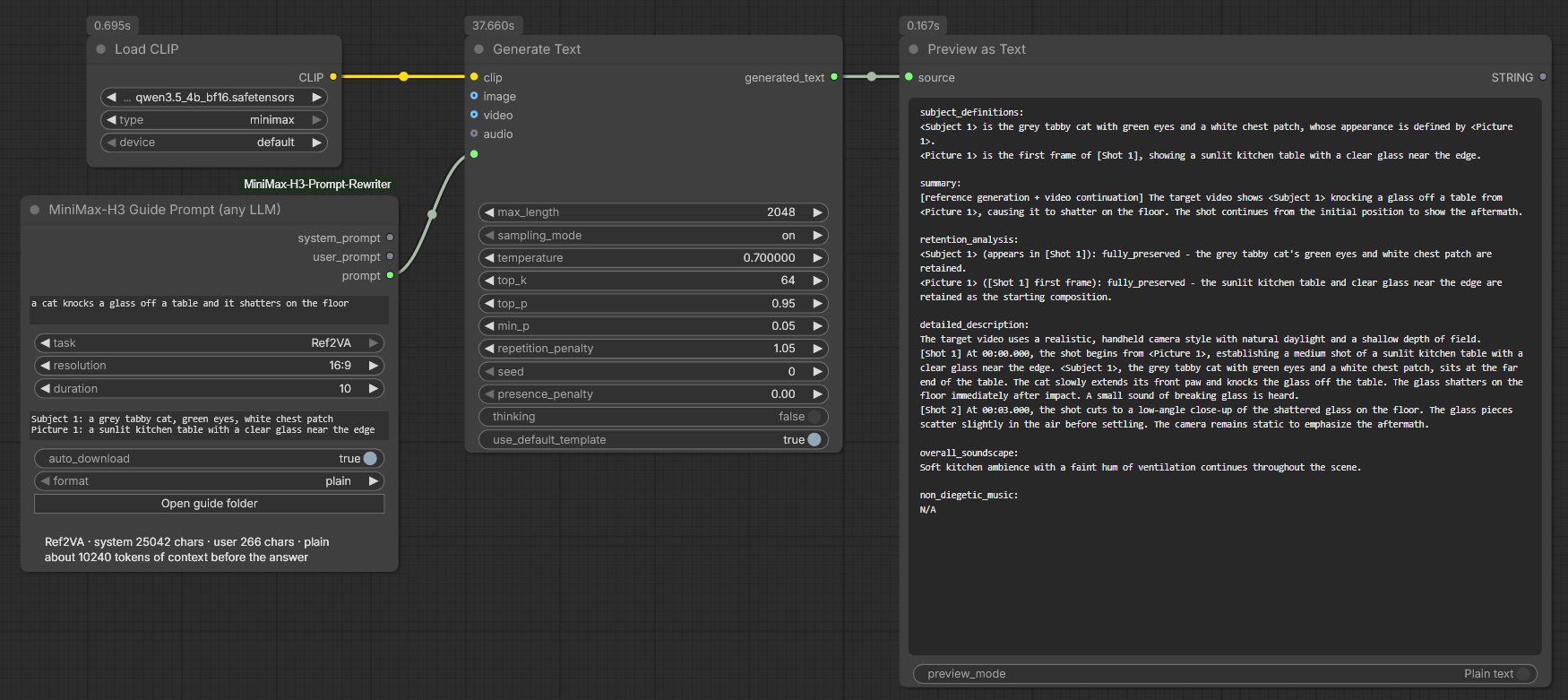
*Ref2VA through a 4B Qwen3.5 — 37.7 s, and all six sections came back. The node's
own status line is the number worth knowing: a 25 042-character system prompt is
**about 10 240 tokens of context** before the model writes a word, which is what
decides whether a given encoder can take this at all.*
Three settings on `Generate Text` decide whether it works:
- **`max_length`** — its default of 512 is the *output* budget, and six Ref2VA
sections do not fit in it. Around **2048** is right, which is what this pack's
own writers use (`max_new_tokens` in the options node). Measured on a 4B
Qwen3-VL: a Ref2VA rewrite came back complete in **53 s including the model
load**, stopping on its own at roughly 580 tokens — inside 2048 with room to
spare, and past 512 by enough that the default would have cut it mid-section.
- **`thinking`** — off. The guide asks for fields and nothing else; reasoning
spends the budget above on prose you then have to strip.
- **`use_default_template`** — leave it on, and leave `format` on `plain`.
`format` is the one knob worth knowing about. On `plain` the two prompts are
joined with a blank line and the LLM node wraps the result in the model's own
chat template, which puts the whole guide inside the *user* turn. On `chatml` the
turns are written out here instead: a Qwen text encoder skips its own template as
soon as the text starts with `<|im_start|>`, so the guide arrives as a real
system message. That branch also skips Qwen's thinking suppression, so the empty
`` block is written for you. It is Qwen-shaped by construction — on Gemma
or anything else, stay on `plain`.
### MiniMax-H3 Prompt Check
Every other node here writes a prompt and then checks what it wrote. This one
only checks, and takes the text on a socket — so a prompt that came from
somewhere else is read by exactly the rules a rewrite from this pack is read by,
and split into the same fields. Anything that produces MiniMax-H3 prose can feed
it: another pack's node, a text file loaded into the graph, a prompt found
online, or something typed into the widget.
No model is loaded and nothing is generated. The run costs a few milliseconds.
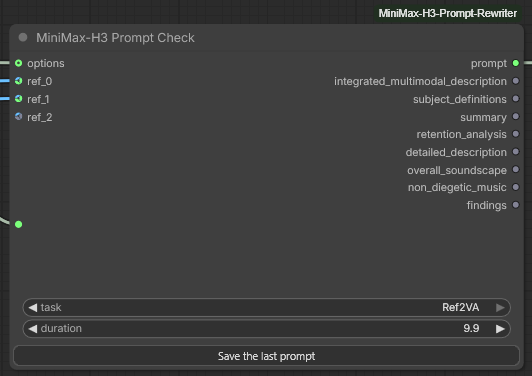
*The outputs are the Universal Writer's, minus the two that describe its own captioning work — so a check node drops into a graph where a writer stood, and a writer drops in where a check node stood. The duration is 9.9 rather than a round number because it is whatever the prompt was written for, not what you would have asked a writer for. And there is one button rather than two: the node runs no model, so there is nothing to repeat and nothing to point at the library — but what it read, it can keep.*
| Input | What it is for |
| --- | --- |
| `prompt` | The text to read. It leaves the first output untouched, so the node can sit in the middle of a graph without changing what reaches the generator. |
| `task` | Which task the prompt was written for. It decides which fields the answer should have, how many references of each kind it may cite, and whether an alignment line belongs at the top — so getting it wrong makes the reading wrong rather than absent. |
| `duration` | How long the target video is. Cut times are read against it, so set it to what the prompt was written for rather than to what you would ask a writer for. |
| `references` | Optional. Only their kind and number are read — nothing is decoded and no captioner runs. With them connected, the reading also covers what the text cites against what is actually here; with nothing connected those two rules are skipped and the rest still apply. |
| `options` | Optional, and only `self_check` is read from it: how much is announced on screen. |
The outputs are the prompt, the seven fields any task can fill, and `findings` —
the same block the node writes under itself, `!` for a warning and `-` for a
note, empty when there is nothing to say. That output always carries everything
found: `self_check` governs what the nodes announce during a run, which is a
question about noise, and wiring the output is asking.
**Save the last prompt** is on it as well, so a prompt that arrived from
elsewhere and read clean can go into [the prompt library](#the-prompt-library)
under a name, a description and groups, exactly like one this pack wrote.
One reading is worth expecting. Most prompts written for H3 by hand are prose:
no field labels, no shot list, no tags. Read as `T2VA` such a text is reported
as missing its fields and its `[Shot 1]`, and that is a true reading rather than
a fault — a prompt like that is an *instruction to a rewriter*, not a finished
H3 answer. Feed it to one of the writers and check what comes back instead.
### MiniMax-H3 Prompt Reducer
Every other node here expands. This one contracts: it turns a finished H3 prompt
back into the short line it could have been written from.
```
integrated_multimodal_description: [Shot 1] Live-action, cinematic, a low-angle medium
shot frames a sleek black cat walking steadily along the top of a weathered wooden
fence in a quiet suburban yard at dusk. The camera tracks right with small amplitude
at slow speed, following the feline as its soft fur catches the fading golden light...
overall_soundscape: A gentle evening breeze rustles through nearby grass and leaves...
non_diegetic_music: A sparse piano melody at a slow tempo...
```
comes back as
```
A black cat walks along a wooden fence in a yard at dusk.
```
Three things it is for. Changing one word of a prompt you liked without
rewriting the other four hundred — reduce, edit the line, feed it back to a
writer. Feeding a prompt written for H3 to a generator that wants a short one:
an H3 prompt is H3-shaped, and Wan, Hunyuan and Kling are not. And putting a
readable line on a prompt you saved, where the card shows a name rather than a
paragraph.
**Half of this is not a job for a model, and that is what makes it work.** An H3
prompt is not prose — it is a known shape: named fields, the fixed alignment
sentence at the top, `[Shot 2] At 0:03` markers through the body, ``
tags wherever a reference is cited, dialogue fenced in ``. All of that is
scaffolding, all of it is recognisable by rule, and all of it comes off before a
model is asked anything. What reaches the model is one paragraph of ordinary
description under a short instruction, which is why a 4B does this well. Asked
to "reverse this document" instead, it would not.
Reference bindings go off with the rest of the scaffolding, and that is
deliberate: for Ref2VA, `subject_definitions` and `retention_analysis` describe
*the assets*, and a short prompt that kept them would describe pictures the next
run will not have.
| Input | What it is for |
| --- | --- |
| `prompt` | The finished prompt to shorten. Any of the five tasks, and you do not have to say which: the text is split against every field name either family uses, and one with no field names at all is read whole as the description. |
| `model` | Any instruction-following GGUF, from the same list the writers use — including `on disk:` and `ollama:` entries — and the **Model list** button under the node edits it. This asks much less of a model than writing does, so the smallest entry in the list is a reasonable choice here even when it is not one there. |
| `detail` | How much comes back. `idea` is the bare line, ten words at most; `sentence` allows the place and the time of day; `paragraph` keeps one sentence per thing that happens, which is what a prompt with several shots needs if the order is to survive. |
| `subjects` | How specifically people are named: `as written`, `age and gender`, or `impersonal`. |
| `keep_camera` | Keep the shot size, the angle and the camera move. Off by default — the camera is usually the writer's invention rather than yours, and leaving it out lets the next rewrite choose again. |
| `keep_audio` | Fold the soundscape and the music into one sentence at the end. Off by default, and off means the sound sections never reach the model at all: they are dropped by the parser, not by the instruction. |
| `keep_style` | Keep the medium and the look the prompt opens with — live-action, animation, cinematic, documentary. |
| `language` | Which language the answer comes back in. Empty means the language of the input. On this node it is a second pass — the line is shortened first and translated afterwards — which is what makes it reliable; the sub-section below says why it has to be. |
| `greedy`, `seed`, `keep_model_loaded` | As on the writers. Greedy is worth keeping on here: sampling is what turns "a black cat" into "a sleek obsidian feline". |
| `options` | Optional. The usual [Rewriter Options](#minimax-h3-rewriter-options) node — `device`, `n_ctx`, `gpu_layers`, `gguf_runtime` and the rest. |
| `bypass` | Hand `prompt` straight to the output and run nothing. |
| `system_prompt` | Replace the whole assembled instruction with your own. `detail`, `subjects` and the three keeps then stop applying — they exist only to build the text you are overriding. `language` still applies, because it is a separate request rather than part of that text. The parsing still happens either way, so what your instruction is handed is the cleaned scene rather than the raw text. |
Two outputs: `short_prompt`, and `scene` — the description with the scaffolding
taken off and nothing else done to it. No model has touched `scene`. Wire it
when the deterministic half is all you wanted.
![The MiniMax-H3 Prompt Reducer node with a Show Any node beside it: an options socket on the left, short_prompt and scene as the two outputs on the right, a tall prompt box holding a full I2VA prompt with its integrated_multimodal_description and [Shot 1] marker, then the widgets — a 35B model on disk, detail on idea, subjects on impersonal, keep_camera and keep_audio true, keep_style false, language reading Chinese, greedy true, a seed set to randomize, keep_model_loaded and bypass false, an empty system_prompt box, and the Model list button under it. Under the node the status line reads '110 words in, 33 characters out - 1 shot markers dropped - translated into Chinese', and below it the two Chinese sentences themselves, which the Show Any node repeats](docs/node_reducer.png)
*Four hundred words of cat, fence and dusk down to two short Chinese sentences, in 25 seconds on a 35B. Three axes are doing visible work at once: `detail` is on `idea`, so what comes back is the bare line; `keep_camera` put the low-angle tracking shot back into it; `keep_audio` folded the whole soundscape into the second sentence; and `keep_style` is off, so the `Live-action, cinematic` the prompt opened with is gone. The count is in characters rather than words because Chinese does not write the spaces a word count needs.
One thing it also shows honestly: `subjects` is on `impersonal`, and the cat still comes back black. The rule asks for the bare kind and this model kept the colour — that axis leans hardest on the model of the three, and it is people it is really aimed at.*
#### What the axes actually do
One prompt, one 4B, the axes moved one at a time. The input was a documentary
I2VA prompt about an elderly fisherman hauling a net, two shots, with a
soundscape and a cello drone:
| Setting | What came back |
| --- | --- |
| default | An elderly fisherman with a thick grey beard and a faded yellow oilskin jacket hauls a dripping net over the gunwale of a small wooden trawler under a bruised pre-dawn sky. |
| `detail: idea` | An elderly fisherman hauls a net on a boat. |
| `subjects: age and gender` | An elderly man hauls a net on a boat under a pre-dawn sky. |
| `subjects: impersonal` | A subject hauls a net over the side of a boat under a pre-dawn sky. |
| `keep_camera` | A handheld close-up follows an elderly fisherman... |
| `keep_style` | Live-action, documentary style. An elderly fisherman... |
| `keep_audio` | ...under a pre-dawn sky. Waves slap the hull, rope creaks, gulls cry overhead, and the man breathes heavily. A low cello drone underneath. |
`impersonal` is for templates you fill in afterwards. Fed to a generator as it
stands, it produces exactly the anonymous nothing it asks for.
There are four axes rather than one abstraction dial because they are
independent. How long the answer is and how specifically it names people are
different questions — a one-line prompt can still say "a woman in a red coat" —
and the camera, the sound and the film look are each kept or dropped on their
own.
#### `language` is a second pass, and it has to be
Asking for the reduction and the language in one request does not work. The
worked example inside the instruction is written in English and cannot be
anything else — nothing here can translate it into a language typed into a
widget — and a model copying the demonstration copies its language along with
everything else it copies from it.
That failure is not uniform, which is what makes it worth describing. With the
three keeps *off*, the example is short and the language rule was obeyed. With
them *on*, which makes the example longer and more elaborate, three models in a
row answered in English however the rule was phrased and wherever it was placed
— including as the last line of the system prompt, after the example.
So the Reducer shortens first and translates the finished line afterwards, in
its own request. That request has one objective, no example to copy and nothing
to trade off against, and the same models obey it: every combination tried came
back in the language asked for, on a 4B, a 9B and a 35B, in Russian and in
Chinese. It costs one short generation on a model that is already loaded, and
the node keeps it loaded between the two whatever `keep_model_loaded` says about
afterwards.
Two things follow from the design:
- **`system_prompt` does not switch it off.** The three keeps, `detail` and
`subjects` all stop applying when you replace the instruction, because they
exist only to build the text you replaced. `language` is not in that text at
all, so it still applies.
- **`Reduce Prompt (any LLM)` cannot do this**, because it builds one request
and runs nothing. There the language is a rule inside the instruction, obeyed
or not depending on the model — which is exactly the behaviour described
above. If a short prompt comes back from that node in the wrong language, this
is why, and the Reducer is the reliable path.
What remains is translation quality rather than translation refusal: a small
model leaves the occasional word untranslated. That is the model, and a larger
one leaves fewer.
#### Effect tokens through the reducer
An [effect embedding](#minimax-h3-effect-embeddings) written into the description
comes out the other side untouched, small `e` and all — the capitalisation that
tidies the start of a sentence knows to leave one alone. A token placed *above*
the first field label does not survive, because the head of a prompt is dropped
along with the alignment sentence and everything else that is not the description
or the sound. That is the reducer's contract rather than an oversight: what it
hands back is a reusable line, and the head of an H3 prompt binds it to
particular reference frames.
Worth knowing too: the word count on both this node and the check counts a token
as one word. Its real cost in prompt positions is on the embeddings node's
`tokens` output.
#### One loop worth knowing
Reducer → edit the line → writer → [Prompt Check](#minimax-h3-prompt-check).
If the cat is still on the fence at the end of that circuit, both halves of the
pack are behaving. It is also the cheapest way to find out whether a given small
model is good enough at this: run it and read the line.
### MiniMax-H3 Reduce Prompt (any LLM)
The same reduction with nothing run: it builds the `system_prompt` and
`user_prompt` and hands them back as strings for whichever LLM node you already
use — local, API, remote. Costs no VRAM and no time. The parsing still happens
here, so the scene your model receives is already clean.
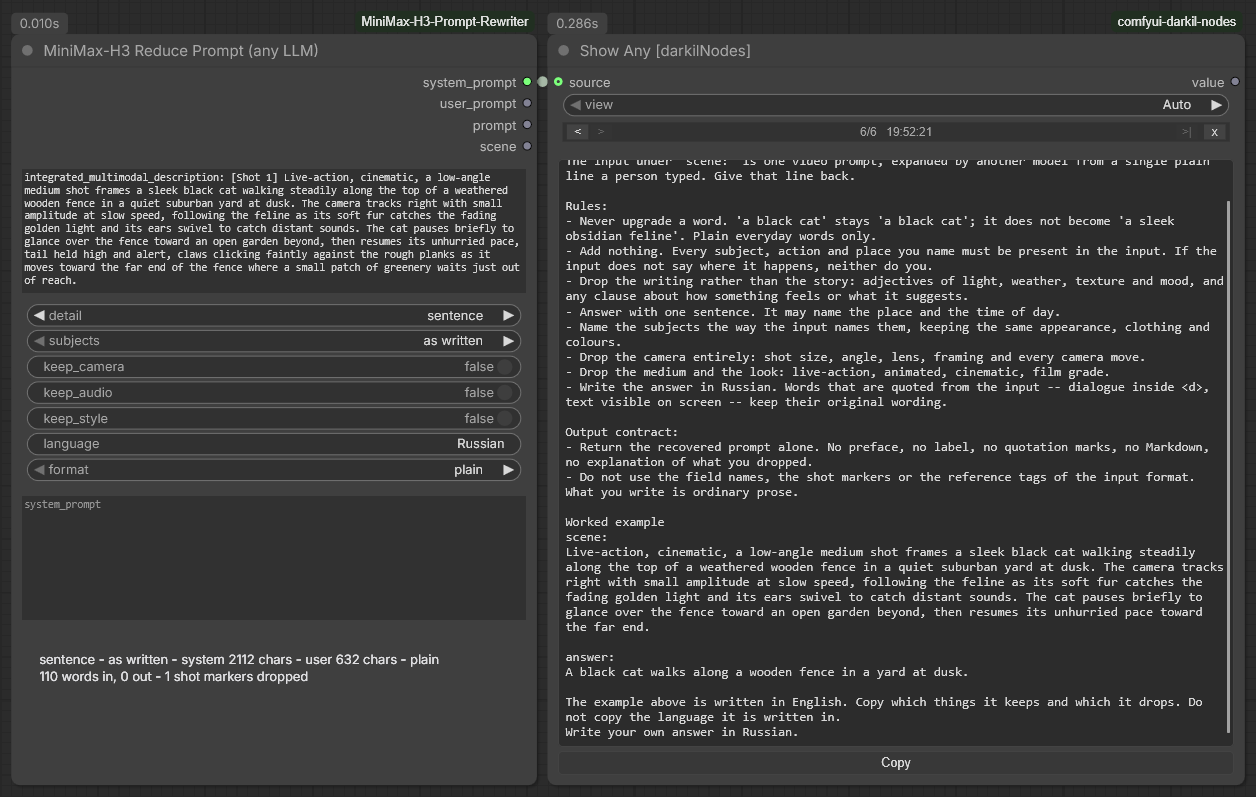
*The same reduction with nothing run, in 0.01 s. The whole instruction is visible here, which is the point of the node: 2112 characters of system prompt, 632 of user prompt, and every rule in it put there by a widget. The last two lines are the single-request language attempt described above — this node can only build one request, so that is the best it can do.*
The same four axes steer it, `format` joins the two outputs the way it does on
[Guide Prompt](#minimax-h3-guide-prompt-any-llm), and the fourth output is
`scene`, as above.
### MiniMax-H3 Effect Embeddings
MiniMax published ten effect embeddings alongside H3 — bullet time, dark magic,
fire breath, the Truman Show pull-back, and six more. This node puts them into a
prompt.
They are not keywords, and the difference matters for everything below. Each file
holds a single tensor of shape `[N, 5120]`: fifty to a hundred and forty
positions of prompt that have **already been through the text encoder**, saved as
numbers. Writing `embedding:minimaxh3_bullet_time` in the text is not a request
for bullet time in words — it is an instruction to ComfyUI's tokenizer to splice
those positions into the sequence at that point. So an effect costs prompt
*length* rather than adjectives, it arrives at full strength or not at all, and
no rewording of it is possible. There is nothing to phrase.
| Effect | Positions | Effect | Positions |
| --- | --- | --- | --- |
| Art is explosion | 50 | Kiss camera | 97 |
| Dark magic | 59 | Fire breath | 118 |
| Truman show | 90 | Blooming flowers | 123 |
| Bullet time | 94 | Spiral ascent | 131 |
| Storm magic | 137 | Four seasons | 142 |
**This needs ComfyUI 0.33.0 or newer.** That is the release where `embedding:`
started reaching the MiniMax-H3 tokenizer; on anything older the token is read as
ordinary words. The node checks your version and says so.
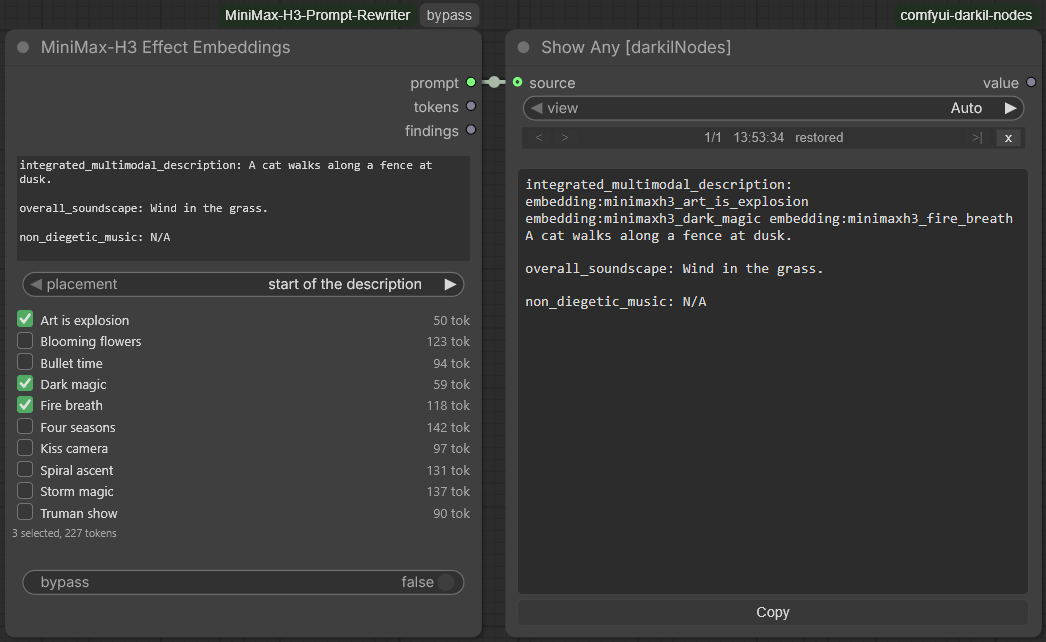
*Nothing here is loaded or generated — the node writes a hundred characters into
a text and reads ten file headers. The download button is absent rather than
disabled: all ten are on disk, so there is nothing to fetch and no reason for the
row to take up space. The costs in the right-hand column are read out of the
files themselves, not from a table in this pack, and 50 + 59 + 118 is the 227
under the grid. This is the `start of the description` placement, which is why
the three tokens open the description field rather than sitting above it — and
why the blank lines that follow them will reach H3 as single spaces, which the
`findings` output says out loud.*
| Input | What it is for |
| --- | --- |
| `prompt` | The prompt to put the tokens into — a writer node's output, a loaded file, something typed. It is passed through character for character apart from the tokens themselves. |
| `placement` | Where the tokens go: the start of the description, the top of the prompt, or the end. Not a matter of taste — see below. |
| `effects` | The grid of ten. A tick, the name, what it costs, and a mark on the ones that are not downloaded yet. |
| `bypass` | Hand `prompt` through and put no tokens in it. `tokens` comes back 0, `findings` empty, no file header is read. The node's title bar carries the switch as a badge, like the writers. |
| Output | What it is |
| --- | --- |
| `prompt` | The prompt with the tokens in it. |
| `tokens` | How many positions the chosen effects take up — read out of each file's own header, so it is the real number rather than a table in this pack. |
| `findings` | What the node noticed, one per line. Empty when there is nothing to say. |
Files are fetched by the button on the node into ComfyUI's own
`models/embeddings` folder, which is the only place `embedding:` looks. All ten
come to about ten megabytes. Running the node twice does not stack the tokens —
it takes its own back out before it puts them in — so unticking an effect removes
it from a prompt that already had it.
#### Every way this fails is a silent one
That is the reason it is a node at all rather than something you type. ComfyUI
drops a token it cannot use with one line in the console and no other sign: the
video generates, it simply generates without the effect, looking exactly like a
prompt that never asked for one. Three ways that happens, all of them things the
self-check now looks for:
- **A capital letter.** The test is `word.startswith("embedding:")` and nothing
else, so `Embedding:` is not a smaller mistake than a typo. (The Prompt Reducer
used to introduce one by capitalising the start of a sentence. It no longer
does.)
- **A token stuck to the word in front of it.** Tokens are found after
whitespace, or at the very start of the text. `a cat.embedding:x` is four
ordinary words.
- **A full stop on the end of the name.** A trailing comma is stripped by
ComfyUI and forgiven; a full stop is looked for as part of the file name. This
one is worth knowing precisely, because it is a trap that hides on Windows:
the path layer there drops a trailing dot, so `embedding:minimaxh3_dark_magic.`
loads on Windows and quietly loses the effect on Linux and macOS. The prompt
you share is not the prompt they run.
Weights do not work either — `(embedding:x:0.8)` is read as literal text, because
H3 tokenizes with weights disabled. There is no way to ask for a weaker effect.
#### Placement is not a matter of taste
ComfyUI's tokenizer joins everything that follows a token onto one line: the text
after `embedding:name`, up to the next token, goes through `' '.join(text.split())`
before H3 sees it. A token at the top of a prompt therefore flattens every blank
line between the fields below it into a single space.
`start of the description` — the default — opens the description field itself,
after its label. That is the field the writers put the scene in and the field
every downstream node reads, and it is the position an effect was meant to
modify. The fields below it are flattened.
`end of the prompt` puts the tokens last. Nothing follows them, so nothing is
flattened, and the prompt reaches H3 with its field separators intact.
`top of the prompt` puts them above everything, before the alignment sentence.
A prompt with no field labels at all has no description to open, so it falls back
to the top and says so on the `findings` output.
One thing to know if you use the Reducer: a token above the first field label is
dropped by it, along with the rest of the prompt's head. The reducer keeps the
description and the sound, not what sits above them. A token inside the
description survives.
What is *not* known here: whether two of these combine into anything sensible.
They are separate pieces of encoded prompt, and asking for a spiral ascent
through four seasons is asking the model to reconcile them. The node allows any
combination because there is no reason to forbid one; whether it is worth
generating is yours to find out.
### MiniMax-H3 LoRA Triggers
A LoRA trained with a trigger word in its caption prefix does nothing at all
until that word is in the prompt. This node keeps the list of those words on the
node, with the workflow, and puts them back into a finished prompt.
Nothing upstream knows about them. The writers write prose, the reducer shortens
it, the self-check judges it — and a word whose only job is to wake an adapter
three nodes later is exactly the sort of thing all three drop. So it gets typed
in by hand after every run, and lost on the next one. That is the only place in
the whole pipeline where finished text has to be edited by hand, and it is the
one part of a prompt that cannot be regenerated.
One row is one adapter: a grip, a tick, a name for your own use, the words that
go into the prompt verbatim, a short mark saying where they go, and a cross to
remove the row. A row can hold several words separated by commas, which is what
an adapter with more than one trigger needs — they are checked and added one at a
time, so a row is never half-duplicated. Triggers that want different parts of
the prompt want different rows.
Drag a row by its grip to move it. The order is not decoration: rows sharing a
placement are written into the prompt in list order, which is the order they read
in.
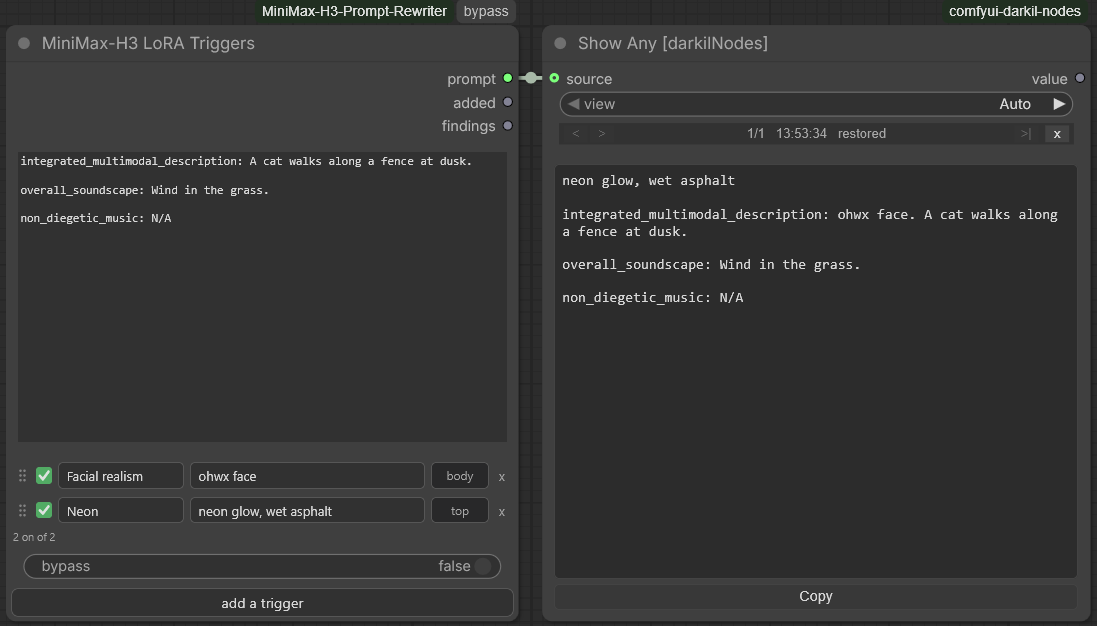
*Two rows, two placements, one pass. `ohwx face` opened the description — after
the label and in front of the prose, which is the position a caption-prefix
trigger was trained in — while the second row went to the top carrying two
triggers at once, checked and written as two. Nothing was taken out to manage
it: run the same text through again and `added` comes back empty, because both
words are already there. The placement marks are a fixed column, which is what
keeps the fields starting and ending on the same pixel in every row; drag a row
by its grip to change the order they are written in.*
| Input | What it is for |
| --- | --- |
| `prompt` | The prompt to put the words into — a writer node's output, a reducer's, a loaded file, something typed. It is passed through character for character apart from the inserted words. |
| `triggers` | The list. A grip, a tick, a name, the words, the placement mark, a cross; a button below adds a row. Saved with the workflow. |
| `bypass` | Hand `prompt` through and add nothing. The text goes out exactly as it came in; `added` and `findings` come back empty. The node's title bar carries the switch as a badge, like the writers. |
| Output | What it is |
| --- | --- |
| `prompt` | The prompt with the words in it. |
| `added` | The words this run actually put in, comma separated. Empty when every switched-on trigger was already there, which is the normal state on a second run. |
| `findings` | What the node did and noticed, one per line. Empty when there is nothing to say. |
Driving it from the API rather than from the interface, the widget takes the JSON
array of `{name, words, where, on}` objects the interface writes — and two
friendlier shapes as well, because they are what anyone writes first: a plain
array of strings is read as a list of trigger words, and text that is not JSON at
all is read as one row's worth of words.
#### Where each word goes
The mark in the row is short on purpose. Seeing where every word is bound for
without opening anything is half of what the list is for, and five full dropdowns
would not fit across a node at any sensible width. Clicking the mark opens the
choice.
| Mark | Placement | Where it lands |
| --- | --- | --- |
| `body` | `start of the description` | Opens the description field itself, after its label. |
| `top` | `top of the prompt` | Above everything, before the field labels. |
| `sound` | `start of the soundscape` | Opens `overall_soundscape`, after its label. |
| `music` | `start of the music` | Opens `non_diegetic_music`, after its label. |
| `end` | `end of the prompt` | Last, after everything. |
The description is the default and usually the right answer: it is the field the
writers put the scene in, the field every downstream node reads, and the position
a caption-prefix trigger was trained in. The top and the end are positions rather
than fields, which is why those two still work on a text carrying no labels at
all.
The field set differs by task — three for T2VA, six for Ref2VA — and the node
only ever sees a text, which does not say which task wrote it. So a placement
naming a field this particular prompt has not got is not an error: the words go
to the top instead and the `findings` output says so.
A field that is there but says `N/A` gets a note of its own. Ref2VA prompts are
full of `non_diegetic_music: N/A`, and words put at the start of one leave a
field that names something and then says there is none of it. The node says so
and changes nothing else. Replacing the marker would have the field claim there
*is* music, called `ohwx face` — and the self-check reads that field; dropping
the words would be the node overruling a placement you asked for. Both are
decisions about your prompt, and this node does not make those.
One difference from the effect embeddings worth knowing, because the habit does
not carry over: ordinary words do not flatten the line breaks below them.
ComfyUI's tokenizer joins everything after an `embedding:` token onto one line,
but only after one. The top of the prompt is a safe place here.
#### It never takes anything out
This is where the node parts company with `MiniMax-H3 Effect Embeddings`, and the
reason is worth stating. Those ten tokens are strings known in advance, so the
node can cut its own back out before it puts them in — which is how unticking an
effect removes it. These words are yours. Cutting out a trigger spelled `detail`
would eat a hole in the prose it was sitting in.
So the rule here is presence, not removal:
- A word already in the text is **not added a second time** — matched on word
boundaries and without regard for case, so `man` is not found inside `woman`
and `Ohwx man` counts as `ohwx man`. It is reported on `findings`.
- **Unticking a row stops it being added. It does not take it away.** The word
may well have come from the writer, and removing somebody else's word is not
this node's call.
Running the same text through twice therefore changes nothing, which is what the
node needs in order to be safe at the tail of a graph that gets run again and
again.
#### `bypass` rather than Ctrl+B
Both of these nodes carry the pack's own `bypass` switch, with the same purple
badge in the title bar the writers have: click the badge or tick the widget, and
the prompt goes through untouched.
ComfyUI's own bypass is not the same thing on a node like this. It stands an
input in for each output by matching types, and there are three outputs here and
one socket to fill them from. Measured on the triggers node: `prompt` arrives,
`findings` is handed the whole prompt as though it were a finding, and `added`
loses its link altogether — which leaves whatever it fed with no input at all.
On the embeddings node `tokens` is an INT with no INT input to stand in for it,
so that link goes the same way. None of it is reported anywhere.
#### Put it at the very end of the graph
After the reducer and after `MiniMax-H3 Prompt Check`. Triggers add words, and
the check counts words against a ceiling — a node that lengthens the text after
it has been measured is fine, one that lengthens it before is arguing with the
measurement. And anything that rewrites the prompt downstream of this will drop
the words again, which is the failure this node exists to prevent.
#### What it does not promise
Only LoRAs that were trained with a trigger in the caption prefix. Sliders and
turbo accelerators need no word at all — they work by weight — and on most
machines those are the majority of what is installed. A trigger list will do
nothing for them, and that is not a fault in the list.
Nothing is read out of the LoRA files, and that is a finding rather than a
shortfall. Of forty-four adapters on the machine this was written on, one carried
`trigger_word`, one carried an empty `trigger_words`, and none carried
`ss_tag_frequency`. The pack can read a safetensors header already, so this is
not about cost: the data is not there. And an adapter often answers to several
words where the metadata has room for one. The list is yours to keep, which is
also what makes it worth keeping.
### MiniMax-H3 Reference Adapter
The writers take one reference per slot, and that is what makes the strip under
them work: every asset gets a square, a role and a switch. It is also what puts
them out of reach of a node that hands its references over *together* — an image
batch, a list from a directory loader, a bundle assembled by another pack. One
value holding many has no slot shape to go into.
This node is the join. Collected in on one socket, separated out on nine picture
sockets, three clip sockets and three sound sockets — which is what the writers
take, so the strip carries on working exactly as it did.
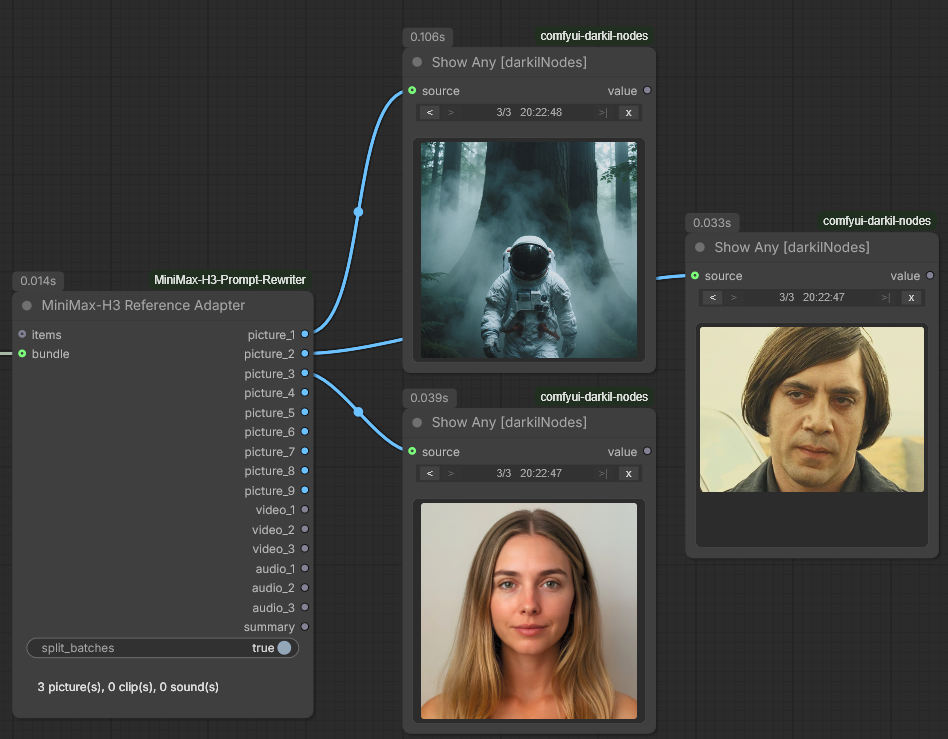
*One wire in, three out — and thirteen outputs sitting idle, which is the ordinary case rather than a sign of something unfinished. The run cost 14 milliseconds because nothing here is loaded, decoded or described: the three photographs were carried through as they arrived. The line under the widget is the same text as the `summary` output, so what came in and where it went is readable off the node without wiring anything to a preview.*
| Input | What it is for |
| --- | --- |
| `items` | References arriving together. Takes any type, because the nodes that produce collections mostly declare none; what each item is gets worked out from the value itself rather than from the wire, and anything that is not an image, a clip or a sound is skipped and counted. |
| `bundle` | A reference bundle from another pack, if you have one. Its pictures, clips and sounds are read out ahead of anything on `items`. A clip that arrives as frames goes out as a clip, not as pictures, with its paired audio track inside it; a track not paired with a clip is a sound of its own. |
| `split_batches` | Whether an image batch becomes one reference per frame, or stays one reference made of several frames. |
That last switch is a real choice rather than a formality. Split, six frames are
six things the video reuses, each described and numbered on its own. Kept, they
are one thing seen six times, described once — which is what a clip is. Turn it
off when the batch is frames of a single shot.
Nine, three and three are what Ref2VA can hold, so that is the room there is.
Anything past it is reported on the `summary` output rather than dropped in
silence, along with anything skipped. Outputs left over hand on nothing, and a
writer skips those already, so there is no harm in wiring a socket that turns out
empty — plug in all nine and let the ones you did not fill sit idle.
It is a node of its own for a reason worth knowing, because it is not a choice.
Receiving a real ComfyUI list means declaring `is_input_list`, and that flag is
not per input: it rewrites the shape of *every* argument the node receives. On a
writer it would change how the prompt, the duration and the options arrive. So it
lives here, on a node that has nothing else to lose by it.
### MiniMax-H3 Reference Slots
`MiniMaxH3ReferenceToVideo` — ComfyUI's own conditioning node for H3's reference
mode — numbers its references by the socket they arrive on: the first picture
socket is ``, the first sound socket ``. The writers here
number theirs by the strip, which you can drag. Wire the same assets to both by
hand and the two orders agree until the first time a square is dragged; from
then on the prompt describes one voice, the video is given another, and nothing
on screen says so. Switching a reference off goes wrong the same way — gone from
the prompt, still in the video.
So every writer that takes references hands on what it numbered, on a last
output called `references`, and this node puts each reference on the socket
carrying its number.
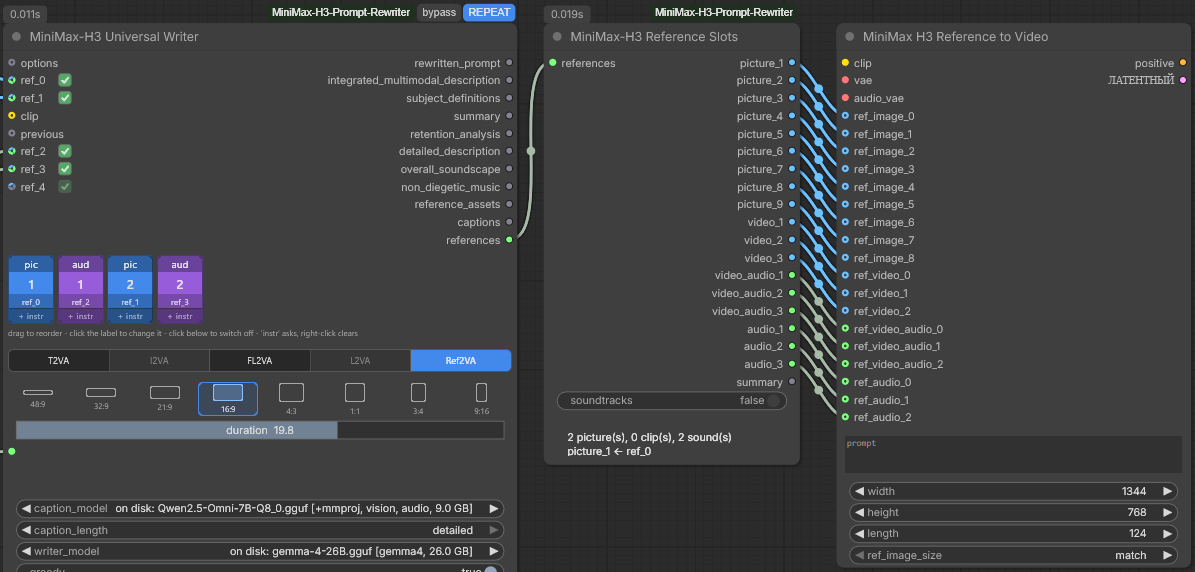
*Wired once, all the way across, and never touched again: the arranging happens in the writer's strip. The squares read ref_0, ref_2, ref_1, ref_3 — so `picture_2` carries ref_1 and `audio_1` carries ref_2, whichever socket they were plugged into, and the generator numbers them exactly as the prompt does. The empty outputs cost nothing: the generator skips an empty socket. Nineteen milliseconds, because pictures and sounds are passed through as they are and there was no clip to decode.*
```
Universal Writer ─ references ─▶ Reference Slots ─ picture_1 ─▶ ref_image_0 ┐
─ picture_2 ─▶ ref_image_1 ├ MiniMaxH3ReferenceToVideo
─ audio_1 ─▶ ref_audio_0 ┘
```
Wire it straight across once, in order — `picture_N` to the N-th `ref_image`,
`video_N` to the N-th `ref_video`, `video_audio_N` to the N-th
`ref_video_audio`, `audio_N` to the N-th `ref_audio` — and do the arranging in
the strip from then on.
| Output | What it is |
| --- | --- |
| `picture_1` … `picture_9` | The pictures, in the writer's order. |
| `video_1` … `video_3` | The clips, as frames at 24 fps. |
| `video_audio_1` … `video_audio_3` | A clip's own sound, paired by number — only with `soundtracks` on. |
| `audio_1` … `audio_3` | The sounds, as they came. |
| `summary` | Which output holds what and which writer slot it came from, plus anything that did not fit. |
**A switched-off reference drops out on both sides.** It is not in `references`
at all, so its socket hands on nothing, and `MiniMaxH3ReferenceToVideo` skips an
empty socket and closes up its numbering around the gap — the same thing the
writer did with its labels.
**A subject goes after the pictures.** On the Universal Writer a picture badged
as a subject is written as `Subject N`, never as ``. The generator
has no subject socket and numbers it as a picture like any other, so it goes
after the last picture: the only numbers the prompt is not already using.
**Clips are decoded here, not in the writer.** A writer runs whether or not
anything is wired to `references`, and fifteen seconds of 1080p as float frames
is several gigabytes, so the clip travels as the VIDEO it arrived as and costs
nothing until this node runs. Here it is read at 24 fps — a 30 fps clip loses one
frame in five, a 12 fps one shows every frame twice — scaled to the canvas
`MiniMaxH3ReferenceToVideo` would give it anyway, and cut at fifteen seconds, the
longest reference it is meant for. A trimmed VIDEO is read over its trim. An
image batch the writer was told to read as a clip is frames already and goes
through as it is.
**`soundtracks` is off by default, and that is deliberate.** The generator gives
a clip's sound an `` of its own, numbered ahead of every standalone
sound, and the writers do not count clip sounds. Switched on, the prompt's
`` is no longer the sound on `audio_1`; the summary says by how many
the labels moved. Turn it on for a prompt written with that in mind.
What each writer hands on is what its prompt names, and nothing it did not read:
| Node | `references` carries |
| --- | --- |
| Universal Writer | Every switched-on square, in strip order. Nothing on T2VA. |
| Prompt Rewriter Omni | Every switched-on square, in strip order. Nothing on T2AV. |
| Universal Rewriter | Nothing on the 27B tab or on T2VA. The frames the task reads on the 8B tab. On the Omni tab the same frames — or, on Ref2VA, every switched-on row in row order. |
The output is built from the live inputs every time, `bypass`, a library pick
and `repeat_last` included, and is never stored: the library and the node's
memory keep text, and a saved prompt comes back with the references connected
now.
> **Not the Reference Adapter.** That node feeds the writers: it sorts whatever
> arrives by kind and hands a clip on as a VIDEO, because a VIDEO is what a writer
> describes. This one feeds the generator, which takes a clip as frames and a
> clip's sound on a socket of its own. `references` is a type of its own for the
> same reason — plugged into a node that expects another pack's bundle, a clip
> would arrive as a VIDEO and fail inside the generator.
> **One chain this does not cover.** A Universal Writer with a block on
> `previous` counts that block's labels first, while its `references` holds its
> own references only and starts from one. Use one writer per shot when the
> output is going to the generator.
### MiniMax-H3 Prompt Presets
A thousand finished MiniMax-H3 prompts ship inside the pack, and this node hands
one of them on. Press **Pick a preset** and the browser opens: twenty shooting
styles, twenty subjects, the shape of the frame, the number of shots and whether
anyone speaks, all as tags that narrow the thousand down, with a search box over
the words themselves. Each row carries the frame of the clip the prompt was
written for — click it and the clip plays.
They are finished T2VA prompts in the format the writers here produce, the same
three labelled fields, which makes them useful in two directions. Wire `prompt`
at the generator and it is used as it stands; wire it into a writer's own
`prompt` and it is the starting point for a rewrite. That choice is a wire rather
than a widget, which is why this is a node of its own.
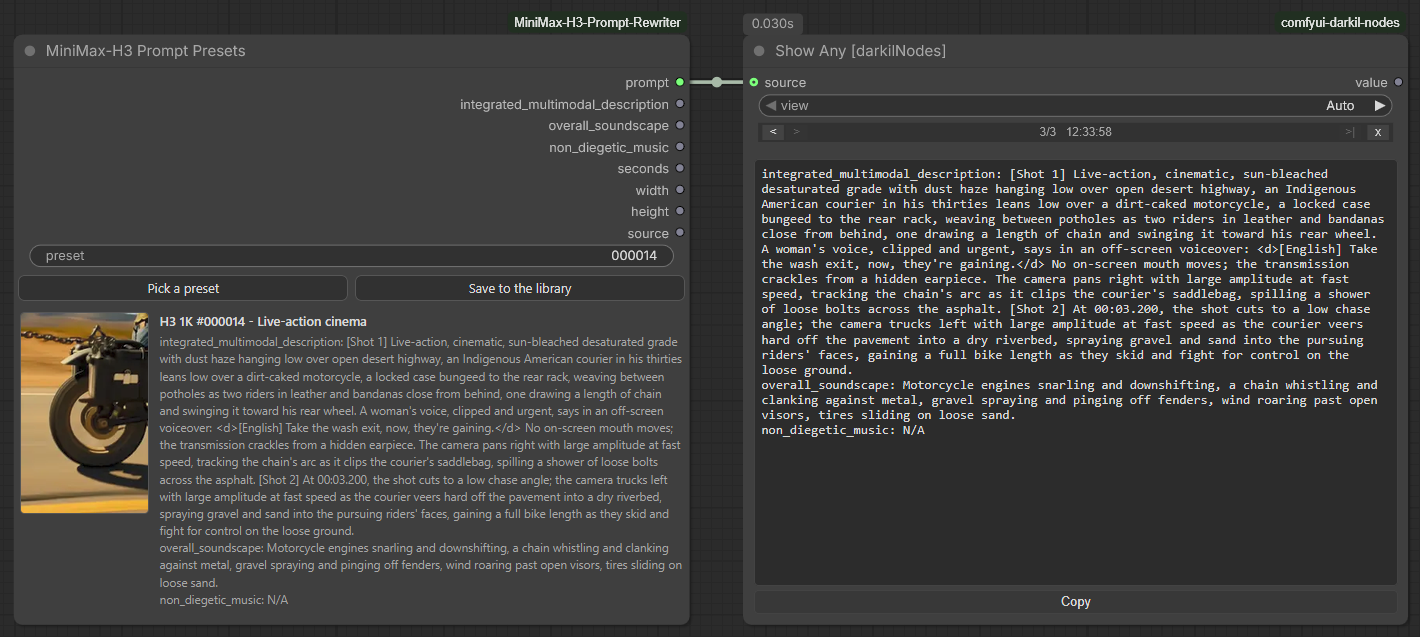
*The preset is on the node rather than behind a dialog: the frame of the clip it was written for and the whole of its text are on the face of it before anything is run. The run itself took thirty milliseconds and loaded nothing — what came out of `prompt` is what the node had been showing all along.*
| Output | What it is |
| --- | --- |
| `prompt` | The whole thing, three labelled fields, exactly as a writer here would have produced it. |
| `integrated_multimodal_description`, `overall_soundscape`, `non_diegetic_music` | The same three, separately. |
| `seconds`, `width`, `height` | The clip the prompt was written for. Every one of them is about five seconds, and the shot times inside the text are written against that. |
| `source` | Its number, both addresses the clip can be watched at, and who is owed the credit — for wiring into a text preview when a workflow is going somewhere else. |
**Nothing is downloaded, at install or during a run.** The prompts, their tags
and one 256-pixel frame each come to 6 MB inside the pack; they are read off disk
and unpacked the first time something asks, so a session that never opens the
browser pays nothing, and a run takes single-digit milliseconds. The one thing
that reaches the network is the clip in the preview, and only when somebody
clicks a frame: huggingface.co first, hf-mirror.com when that does not answer,
which is the address that answers from mainland China. Without a connection the
frames are still there and only the video is missing.
**Save to the library** puts a copy in one of your own prompt sets, through the
same editor the library uses — name, description, groups, and the self-check
running as you type. From that point it is an ordinary record: editable, filed
under your own groups, and available to every writer through the library window.
The copy says in its description where it came from. The bundled preset is not
touched by any of it.
A caution worth stating once: these are T2VA prompts for a five-second clip.
Nothing stops you handing one to a task with references or to a much longer
video, and nothing will complain, but the text describes neither.
The prompts and the clips they describe are ostris's work, carried here with the
author's permission and with credit —
[ostris/minimax_h3_1k](https://huggingface.co/datasets/ostris/minimax_h3_1k). The
prompts are his own and effectively MIT; the clips are MiniMax-H3 output, whose
licence forbids using it to train models, and the frames cut from them here carry
that same restriction. The shooting-style and subject tags are the
[H3 Atlas](https://cohub.live/baize/video-altas/w/h3-atlas)'s reading of that
collection. All thousand pass [the self-check](#the-answer-is-checked) with
nothing to report, which is one way of saying what the format of a good H3 prompt
actually looks like.
### The duration widget
Every node in the pack that writes or reads a prompt has one, and it means the
same thing on all nine: how long the target clip is meant to be, in seconds. It
is a hint rather than a setting — it reaches the model as one line of text,
`duration: 10s`, and decides how many shots the rewrite plans and how it paces
them. How long the clip really turns out to be is settled downstream, by whatever
samples it.
**It takes `FLOAT` and `INT` on the same socket.** The widget itself is a float,
in tenths, because the cut times a rewrite writes are quoted to a thousandth —
`At 00:02.378, the camera cuts to` — and asking for 7.5 seconds is as ordinary as
asking for 8. But most graphs carry a length as a whole number, so the socket
takes either: an `INT` primitive, a node that counts frames, or a `FLOAT` off a
maths node all wire straight in, with no converter between. The two Universal
nodes draw it as a slider and the rest as a number field you can type into; the
range and the menu are the same either way.
**Its upper end is yours to move.** Right-click the node — on the classic canvas,
right-click the widget itself and the entry comes first — and there is a
`duration` submenu with two items:
| Item | What it does |
| --- | --- |
| **Default value** | Puts the widget back to the ten seconds it starts at. |
| **Longest offered…** | Asks for a number and makes it the widget's top end. It is rounded to a tenth of a second and kept in the node, so it travels with the workflow. |
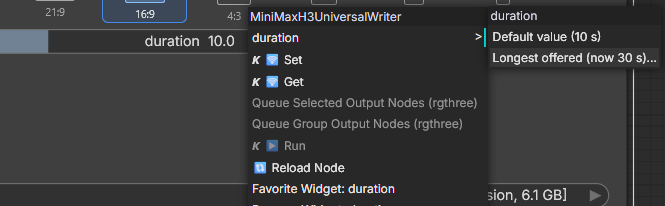
*Right-clicking the widget itself puts `duration` at the top of the menu, as
here; right-clicking anywhere else on the node reaches the same submenu further
down. Both numbers in the submenu are the node's own and are saved with the
workflow.*
Thirty seconds until you change it, and the server accepts up to six hundred. Two
numbers rather than one because a widget's range is fixed when the node is
declared and no single range suits every graph: MiniMax's own guide is written
around clips of a few seconds, while the stretched pipelines the community has
built run well past that. So the server takes anything sane, and the widget spans
what *you* work with — a slider reaching ten minutes is a slider that cannot be
nudged to 9.
That number is the node's own `max_duration` property, so the Properties Panel
reaches the same setting; a workflow saved before this existed simply gets the
thirty.
### Repeating the last answer
Every writer, rewriter and captioner has a `repeat_last` switch. Turn it on and
the node hands back the answer it produced last instead of running the model
again — with nothing kept yet it runs once, keeps what it wrote and says so, and
from then on returns that same text for as long as the switch is on, whatever
else you change. That is the point of it: a fifty-second rewrite is not something
to pay for twice while you wire up everything downstream of it.
ComfyUI's own cache cannot do this. A node's cache key is its class, its
`IS_CHANGED` value and every input it received, so editing the prompt is exactly
what drops the entry — and `IS_CHANGED` can only add invalidation, never mask it.
So the answers are kept in a store of the pack's own, one per node.
That store lives in memory for the ComfyUI session and nowhere else: it is not
written to disk, it does not travel with the workflow, and a restart empties it.
Every run says where its answer came from in three places — the caption under the
node, the ComfyUI console, and the switch's own tooltip, which carries the time
it was kept, its length and the opening of the text. When the inputs no longer
match the ones that produced it, all three say so rather than pretending nothing
changed. `bypass` still wins over it.
**And what is kept can be edited.** `Edit the last prompt` opens the answer the
node is holding in the same editor [the library](#the-prompt-library) uses: the
prompt in a box you can write in, read as you type by the rules the run was read
by. Saving splits the fields out of the new text again, so the section outputs
stay in step with the prose; everything the node kept past its fields belongs to
the run rather than to the prose and stays as it was. Nothing reaches disk — this
is the session store, and an edit worth keeping is saved to the library
afterwards.
The node hands the edited text on the next time `repeat_last` asks it to. An edit
changes none of the node's inputs, so each writer reports what it is holding as
its `IS_CHANGED`, the same way it reports the library record it is pointed at;
without that ComfyUI would go on serving the answer from before the edit.
**Whether the edit reaches the output is a separate question**, and the editor
answers it before you type. A saved prompt wins over the node's own answer, so
while one is chosen the edit waits behind it — clear the choice, or edit that
record instead. With `repeat_last` off the next run simply writes a new answer
over the edit, and on a greedy seed with unchanged inputs that new answer is
byte for byte the old one, which looks exactly like being ignored; so saving
switches `repeat_last` on when nothing else is in the way, the same way choosing
a library record does.
On the two caption nodes it is the caption that is kept, not the assembled block:
the numbering belongs to the chain, so the line is written again around whatever
arrives on `previous`, and an asset connected since is described for real.
The node's own last answer is what the switch hands back by default, and
[the prompt library](#the-prompt-library) is how you point it at something else
instead. One switch either way: `repeat_last` decides whether a kept prompt is
handed on at all, the library window decides which one.
### The answer is checked
Every fresh answer is read back against the rules of MiniMax's own writing
guides before it leaves the node — a self-check, silent when it finds nothing.
When it does find something, it says so in three places: a toast in the ComfyUI
window with the first few findings, because the caption under a node is easy
to miss from the other end of the graph; the caption itself, which holds the
full list above the answer; and the console, for runs nobody is watching. What
it looks at:
- **Shot structure.** `[Shot 1]` opens the description and carries no cut time;
later shots are numbered in order, each with an `At MM:SS.mmm` timestamp that
is later than the one before it and inside the requested duration.
- **Dialogue markup.** `` and ` ` come in pairs, and every block starts
with its `[Language]` tag.
- **Reference tags, both ways.** A tag the task cannot carry — `` in a
frame task, any tag at all in T2VA — is flagged, and so is the opposite: a
reference that reached the node but is never cited, which the generator still
receives with no say in what it is for. The nodes that see their references
check the numbers against what is actually connected; the text-only writers
skip that half rather than guess.
- **Full-reference bookkeeping.** Every `` that
`subject_definitions` introduces owes `retention_analysis` a line, and the
guide's 350–500 words for `detailed_description` is noted when missed.
- **The alignment line.** I2VA, FL2VA and L2VA open with a fixed sentence
telling H3 where the reference frames land; its absence is worth knowing
about before a render finds out.
- **Effect embedding tokens.** The one rule here that is not MiniMax's: a
capital `Embedding:`, a token stuck to the word in front of it, or a full stop
on the end of a name is a token ComfyUI will drop in silence. It is in the
self-check because the failure has the same shape as all the others — nothing
in the output says so — and because that is where you look when
[an effect did nothing](#minimax-h3-effect-embeddings). A name that is not one
of the ten is a note rather than a warning: it may well be your own textual
inversion.
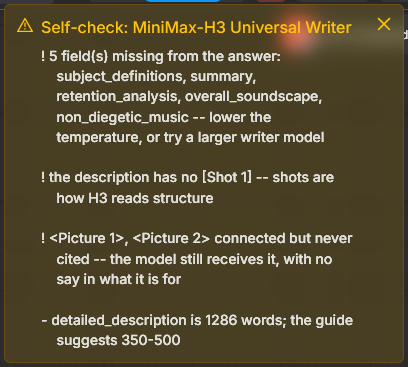
*One deliberately bad run, read back. The `!` lines are warnings — things H3
will likely misread; the `-` line is a note — something the guide merely
suggests. The toast shows the first few findings; the full list sits in the
caption under the node and in the console, where it outlasts the toast however
long the toast is given.*
A refusal is the one thing the nodes do enforce, and it is said the same way: the
sentence appears as a toast under **Stopped** before the exception goes up, so a
run that halts does not look like it failed for no reason.
Findings are said, never enforced: the answer ships exactly as written, because
the model is sometimes right to bend a rule and only you know whether this is
that time. Warnings (`!`) are things H3 will likely misread; notes (`-`) are
things the guide merely suggests. A prompt handed on from the library is not
re-checked — it was checked when it was written, and the caption stays with the
record's name instead.
**How much is said** is `self_check` on the Options node: `warnings and notes`
is everything; `warnings only` drops the guide's softer suggestions, such as the
350–500 words, and keeps what H3 will likely misread; `off` says nothing. The
reading itself always happens — it is regexes over text already in memory and
costs nothing — so this decides what is reported, not what is looked at. An
unreadable setting reports everything: a stale workflow should leave the check
louder than intended, never silent.
The same toast carries the nodes' own warnings, under **Heads-up** instead of
**Self-check**: a reference the chosen task will not read, a saved prompt whose
references no longer match what the node is shown, a captioner that came back
with nothing for a connected asset. Those are about your wiring rather than the
model's prose, so `self_check` does not cover them and they are always said.
They were always in the caption and the console; now they are also impossible to
miss.
**Some of it happens before the run.** A task that cannot use what is connected
has always been refused before any weights move — `I2VA` with two pictures, a
clip wired into a frame task. `Ref2VA` now refuses the same way when the strip
holds more than H3 can take: nine pictures, three clips, three sounds. It used to
be described first and flagged afterwards, which cost a full captioning pass and
a rewrite to learn something countable in advance. Subjects are counted apart
from pictures, so a badge is often the whole fix.
### Acting on what it found
`fix_once` on the Options node lets the nodes do something about the findings
rather than only report them. It is **off by default**, and off means a promise:
the answer you get is exactly what the model wrote, with nothing edited on the
way out.
Turned on, two things happen. **The alignment line goes back on** where it is
missing — that sentence is fixed text the node already formats when it builds
the prompt, so a model that dropped it has not made a judgement worth
respecting. No model runs, nothing can regress. Then, for the mechanical
findings — a cut time past the end, an unbalanced ``, a tag pointing at a
reference that is not there — **the writer is asked once more**, with those
findings folded into the prompt as rules to obey.
Once, never a loop. A model that ignored a rule twice will ignore it a third
time, and every attempt costs a full generation. Three things keep the single
retry safe:
- **It is refused on a hopeless answer.** Half the fields missing means the
model is not holding the format at all, and a second pass will not change
that; the node says to try a larger writer instead of spending another
minute.
- **The constraints travel inside the prompt**, not as a second conversational
turn. That keeps the single-turn shape the LoRAs were trained on, so the
re-run behaves the same on a trained adapter as on a guided model.
- **The second answer is kept only if it is better** — fewer warnings, or the
same warnings and fewer findings overall. A tie keeps the first. So the worst
case is a minute spent, never a worse prompt.
Whatever it did is said on the node: the line restored, the re-run and how much
it gained, or that the first answer stood.
### The prompt library
`repeat_last` holds one answer per node and forgets it when ComfyUI restarts. The
library is the other half: prompts you name and keep, in a JSON file under the
ComfyUI user directory, available to every workflow and every node.
**Saving.** The **Save the last prompt** button on any writer or rewriter opens a
box asking for a name, a description and any number of groups — the groups already
in the file are offered as chips, and a new one is a word and Enter. What gets
saved is the run itself: the text, the sections after it, the task, the model, the
ratio, the duration, the seed, and a 50x50 thumbnail of every reference the node
was shown.
Those thumbnails are taken **during the run**, which is the only moment they can
be. By the time the box opens the node has returned strings and the tensors are
gone, so the picture, the first frame of the clip and the measurements are captured
as the answer is produced and travel with it. What is measured is what genuinely
exists: an image has a size; a clip that arrived as a real `VIDEO` has frames,
seconds and a frame rate, while one that arrived as a batch of images has a frame
count and nothing else, because a batch has no container to ask; a sound has a
duration, a rate and a channel count. References are labelled by position —
`ref1-image`, `ref2-audio` — rather than by file name, which a node cannot see
anyway.
**Using one.** The **Prompt library** button opens the list: this node's own last
answer first, then everything in the file, newest first. Filter by group with the
chips, or type in the search box to keep only the records whose name, description,
prompt, groups, references or settings contain what you typed. **Use** points the
node at a record; **Copy** puts the prompt on the clipboard without pointing the
node at anything; **Edit** opens it for changing; **Delete** removes it from the
file for good.
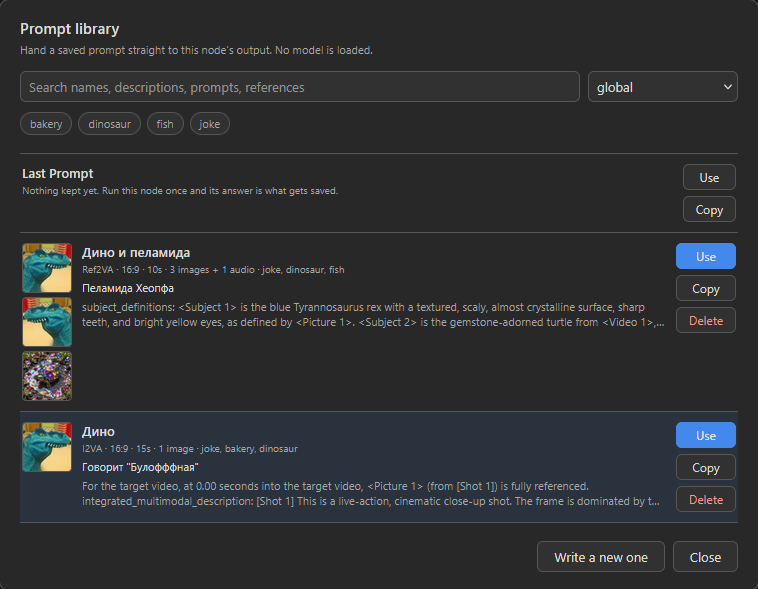
*Everything on a card is searchable — the name, the description, the prompt, the
groups, the settings and the references — which is what keeps a file of a hundred
records usable. The line under the name ends with what the record was written for,
`3 images + 1 audio`, in the same words the node uses when it warns that what it is
being shown no longer matches; the thumbnails beside it say which pictures those
were. The tinted card is the current choice. The Last Prompt row sits above the
file because it is not in it — it is this session’s own answer, which is why it
has no **Delete**.*
A chosen prompt reaches `rewritten_prompt` and the section outputs exactly as a
fresh one would — no model is loaded, nothing is generated, and the run takes about
a tenth of a second. A record written by another kind of node works too: when the
classes match the outputs come back verbatim, and otherwise the text is split into
sections by the node reading it, the same way it splits an answer it wrote itself.
**Editing one.** **Edit** opens the record: its name, its description, its groups,
and the prompt itself in a box you can write in. What *produced* the record — the
writer, the settings, the duration, the reference thumbnails — is shown but not
editable, and does not change. That half is the account of a run, and a card that
misreported its own provenance would be worse than no card.
The prompt is checked as you type, by the same rules the writers run over a model's
answer and out of the same module, and against this record's own task, duration and
references: a cut time that has drifted past the end of the video is named while you
are still looking at it. That is the reason to edit here rather than in the JSON
file — the file will take anything.
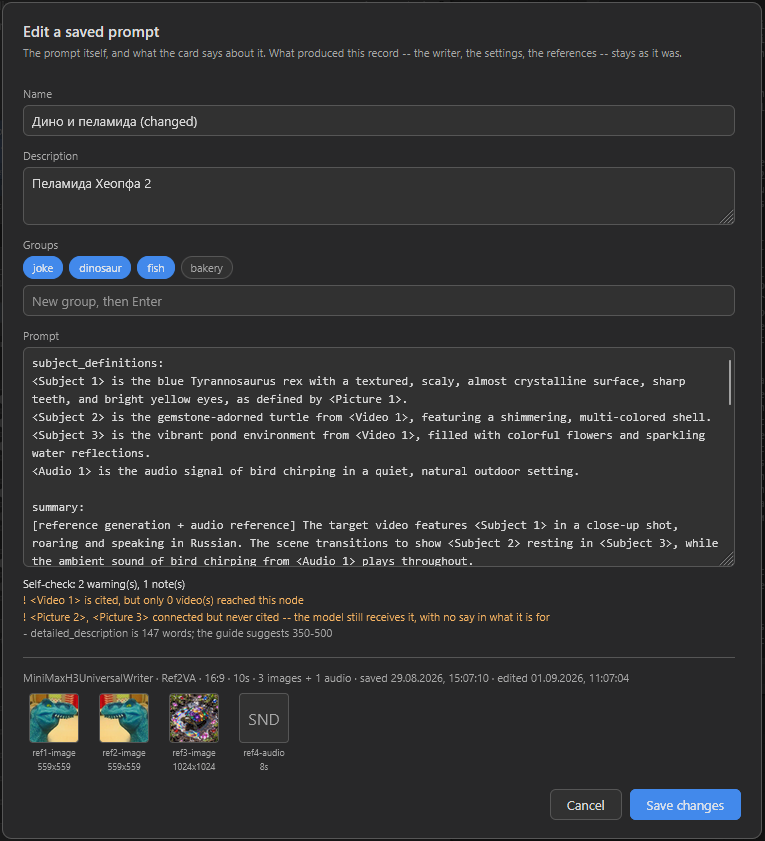
*The findings are read from the record rather than guessed at: the task is Ref2VA, the duration ten seconds, and the references are the four at the foot — which is how it knows that `` is named in a prompt no video ever reached, and that two of the connected pictures are never cited. Amber is a warning, grey a note the guide merely suggests. `self_check` on the Options node governs what the nodes say during a run; the editor always shows both, since you asked for them by opening the box. Everything below the line is the half that cannot be edited.*
Changing the text drops the writer's own split of that answer into fields, because
the split was made from the text as it was. Without it the node reading the record
splits the text itself, which is exactly what it already does with a prompt written
by a different kind of node, so the section outputs stay in step with what you
wrote. Everything else about the record survives, and its card gains the time of
the edit beside the time it was saved.
A node already pointed at the record hands on the new text at its next run.
ComfyUI decides whether to run a node at all from its inputs, and an edit changes
none of them — the pick is still the same id in the same file — so each writer
reports the record's own content as its `IS_CHANGED` and the run happens. Nothing
else about caching moves: with no saved prompt in play the value is constant, and
a record renamed rather than rewritten does not make every node holding it run
again.
**A record with references is pinned to them.** A T2VA prompt is self-contained
and travels anywhere. A prompt for one of the frame tasks or for Ref2VA is not:
it names its references and describes them — `` *is* the blue dinosaur
with the textured scaly skin — so giving that prompt a different set of assets
hands the generator a description of something that is not in front of it. The
thumbnails on the card are how you see what a record was written for, and the
node checks as well: when the kinds and counts of what it is being shown no
longer match what the record was written for, it says so on the node and in the
console before handing the prompt on. It says it rather than refusing — reusing a
description as a template is a legitimate thing to do, and only you know whether
that is what you meant. What no check can catch is one picture swapped for
another of the same kind; that is what the thumbnail is for.
**One switch decides, the window decides what.** Choosing a record switches
`repeat_last` on, because that switch is what hands a kept prompt on at all.
Turning it off gives the node back to the model and leaves the choice waiting;
**Write a new one** does both, forgetting the choice as well. The button says which
it is — `Library: Storm at sea`, or the same with `(repeat_last is off)` after it —
and the badge beside the node title reads `REPEAT` or `LIBRARY`.
The choice itself lives in a hidden widget, so it is saved with the workflow and
reaches an API run: a graph reopened tomorrow returns the same prompt. If the
record has been deleted since, the run stops and says so rather than quietly
writing a new one — the graph asked for a particular prompt.
**Sets.** `prompt_file` on the Options node names the file the nodes wired to it
save into and list, `global` unless you say otherwise, and **New prompt file**
beside it makes another. One file is one working set, which is the cheapest way to
keep a project's prompts apart from everything else. They live in
```text
ComfyUI/user/minimax_h3_rewriter/prompts/
```
as plain JSON, so they can be edited by hand, copied between machines or deleted.
A record with one thumbnail and a full-length prompt is about 11 KB.
### The guides are fetched, not bundled
The two guides are not shipped inside this pack. They are MiniMax's
Documentation, and the MiniMax H3 Community License grants the right to
redistribute the Materials only within its "Applicable Territory" — worldwide
*excluding* the European Union, the United Kingdom, the Republic of Korea and the
United States — and only alongside a copy of the agreement and a NOTICE file. A
node pack on a registry cannot honour a territory boundary, so each installation
fetches its own copy directly from MiniMax on first use: 16 KB and 24 KB, once,
under the same `auto_download` switch as everything else.
They land in
```text
ComfyUI/user/minimax_h3_rewriter/guides/
```
which the **Open guide folder** button opens. Editing a copy changes the system
prompt, and a fetch never overwrites a file that is already there — trimming the
guide is the cheapest way to fit a small model's context.
### The model list
The **Model list** button on any model-loading node opens a window over the
graph: the models that node offers, with **Add a model**, **Edit** and
**Delete** beside them, and a **Check it** that reads the model before you spend
a download on it. Everything is kept in
```text
ComfyUI/user/minimax_h3_rewriter/models.json
```
which is seeded from the packaged copy on first use, so updating the node pack
never overwrites your edits. **Open models.json** in the window's footer still
opens that file in your desktop's JSON editor — on the machine running ComfyUI,
which is not necessarily the one looking at the browser tab — for the two things
the window deliberately leaves alone: the `adapters` sections, and a path to a
network share.
The window shows only the lists the node it was opened from actually reads,
because the adapters take different architectures and an entry from one list
will not load in another's node. The Universal Rewriter therefore opens on three
tabs and the captioner on one. Under the tabs is what that list requires — the
architecture, the block count and width, whether a projector is needed and which
encoders it has to carry — and below the entries, greyed out, the models the pack
found by itself, in your ComfyUI model folders or in an Ollama store: those are
offered in the dropdown too, and there is nothing to edit, because they are files
on disk rather than lines in a file. A file an entry has already downloaded is not
repeated there: the entry carries an **on disk** tag instead, and the dropdown
offers that model once, under the entry's name.
![The Model list window over the graph, headed “Model list” above the line “The models this node offers. Entries are kept in models.json in the ComfyUI user directory, so they outlive an update of the pack and are shared by every workflow.” Two tabs, Captioners lit and Guided writers beside it, over what that list requires: GGUF only, one file run by llama.cpp rather than a folder of safetensors; any architecture as long as the file is a language model with an embedded chat template; and a pair — the model and its ‘mmproj’ projector, from the same conversion. Below them two entries badged FROM THE PACK — Qwen2.5-Omni-3B, a 3.4 GB download needing about 5 GB, and Qwen2.5-Omni-7B, 5.8 GB needing about 8 — each showing its format, repository, file and projector in monospace, with Edit and Delete buttons at the right. Under a rule, “Found in your model folders. These are offered too, and there is nothing to edit: they are files on disk, not entries in the file.” heads three unbuttoned rows: on disk: Qwen3VL-8B-Instruct-Q4\_K\_M.gguf [+mmproj, vision, 5.4 GB], and the Omni 3B and 7B pairs, both marked vision and audio](docs/model_list_dialog.png)
*Opened here from a node that reads two lists, so there are two tabs; the
Universal Rewriter opens on three and the reference captioner on one. What the
list requires sits above the entries, because it is the reason an entry belongs
in this list and not another one.*
**Check it** answers as much as can be answered without moving any weights. A
file already on this machine is read outright, so it reports the architecture and
the shape, whether the model carries a chat template, and whether the projector
carries vision and audio:
```text
- 'Qwen2.5-Omni-7B-Q4_K_M.gguf' is a 'qwen2vl' model, 28 blocks of width 3584. That fits.
- It carries its own chat template.
- 'mmproj-Qwen2.5-Omni-7B-Q8_0.gguf' carries the vision and audio encoder.
```
The chat template matters more than it looks. The 27B rewriter and the guided
writers build their prompt from the model's own template, so a GGUF without one —
typically the base conversion of a model rather than the instruct one — reads as a
perfectly good model and then stops on the first run. There Check it refuses it,
and renders the template once on a system and a user turn, so a template this
pack cannot render is refused too. The captioners and the 8B and Omni rewriters
leave the template to `llama-mtmd-cli`, which falls back to ChatML without one, so
there a missing template is only a warning.
Anything only on Hugging Face is asked what its metadata can say: a transformers
repository is judged from its 4 KB `config.json`, and a GGUF repository is asked
whether the files you named are in it — which is what catches a typo that would
otherwise surface as a download failing minutes in, and fills in `download_gb`
for you while it is there. A GGUF's shape and chat template are in the file
itself, so for one still on the Hub those wait for the first run — or for Check
it again once the file is here.
Two things the window will not do. It refuses a **network path** in `repo`,
`file` or `mmproj`: it is reachable over the ComfyUI API, which has no CSRF
token and is routinely served on `--listen`, and merely looking at a UNC path is
an authentication attempt against the host it names. A path typed into
`models.json` by hand is still unrestricted — that file does not travel. And it
refuses to write at all while the file does not parse, since saving over it
would replace your own entries with the packaged list; it shows the parse error
and every button that would write is dead, leaving **Open models.json**. What it
lists in that state is the packaged copy, because that is what the dropdowns are
offering too until the file parses again.
Editing an entry's download size, VRAM note or note changes what the dropdown
reads, and saved workflows remember that string — but an entry is found by its
name, so a workflow holding the old label still runs it and moves to the new one
when it is opened. Renaming the entry is different, since the name is what it is
found by: the form says so before it commits, the graph you have open is moved
across for you, and other workflows lose the choice.
Deleting an entry leaves the nodes that used it as they are: a run stops and says
the entry is gone, rather than picking another model and starting a download
nobody asked for. The one exception is an entry whose file is already here —
its `on disk:` row is back in the dropdown, and the nodes move to it.
The file holds five lists with the same fields. **`models`** feeds the LoRA
rewriter and has to be Qwen3.6-27B:
```json
{
"name": "Qwen3.6-27B FP8",
"repo": "Qwen/Qwen3.6-27B-FP8",
"download_gb": 28.8,
"vram": "~29 GB, no extra package needed"
}
```
**`models_8b`** feeds the 8B rewriter, has to be Qwen3-VL-8B-Instruct, and needs
an `mmproj` beside the model — being multimodal, it is two files:
```json
{
"name": "Qwen3-VL-8B-Instruct GGUF Q4_K_M",
"repo": "Qwen/Qwen3-VL-8B-Instruct-GGUF",
"file": "Qwen3VL-8B-Instruct-Q4_K_M.gguf",
"mmproj": "mmproj-Qwen3VL-8B-Instruct-Q8_0.gguf",
"format": "gguf",
"download_gb": 5.4,
"vram": "~9 GB with the adapter"
}
```
**`models_omni`** feeds the Omni rewriter, has to be Qwen2.5-Omni-7B, and takes
the same two files — with the difference that its projector has to carry an audio
encoder, or the adapter attaches to a model that cannot hear:
```json
{
"name": "Qwen2.5-Omni-7B GGUF Q4_K_M",
"repo": "ggml-org/Qwen2.5-Omni-7B-GGUF",
"file": "Qwen2.5-Omni-7B-Q4_K_M.gguf",
"mmproj": "mmproj-Qwen2.5-Omni-7B-Q8_0.gguf",
"format": "gguf",
"download_gb": 6.2,
"vram": "~9 GB with the adapter and a 12k context"
}
```
Three lists rather than more entries in `models`, because an entry from any of
them would fail to load in either other node — different architecture, different
adapter. The three adapters live apart for the same reason, under `adapters`,
`adapters_8b` and `adapters_omni`.
**`writers`** feeds the writer nodes and can be anything, as long as it is a GGUF
language model with a chat template:
```json
{
"name": "Qwen3.5-4B",
"repo": "unsloth/Qwen3.5-4B-GGUF",
"file": "Qwen3.5-4B-Q4_K_M.gguf",
"format": "gguf",
"download_gb": 2.6,
"vram": "~5 GB with the guide in context"
}
```
**`captioners`** feeds the reference caption node and needs one extra field,
`mmproj` — a multimodal model is two files and both come from the same
conversion:
```json
{
"name": "Qwen2.5-Omni-3B",
"repo": "ggml-org/Qwen2.5-Omni-3B-GGUF",
"file": "Qwen2.5-Omni-3B-Q4_K_M.gguf",
"mmproj": "mmproj-Qwen2.5-Omni-3B-Q8_0.gguf",
"format": "gguf",
"download_gb": 3.4
}
```
#### Pointing an entry at a file you already have
`repo` need not be a Hugging Face id. Give it a **folder on this machine** and the
file is read straight out of it, with nothing downloaded and nothing copied:
```json
{
"name": "Gemma 4 26B",
"repo": "X:/models/gemma-4-26B-A4B-it-UD-Q8_K_XL",
"file": "gemma-4-26B.gguf",
"format": "gguf"
}
```
Or put the whole path in `file` and leave `repo` out — both forms work, in all
three sections, because both are what people actually type. Two things to watch:
- **Backslashes must be doubled in JSON**, or written as forward slashes.
`"X:\Programs\..."` is not valid JSON at all — `\P` is not an escape — and one
bad character makes the *whole file* unreadable, not just that entry. Windows
accepts `X:/Programs/...` everywhere, so that is the easier habit.
- A path that does not exist is **reported, not downloaded around**. The node
names the file it could not find and stops.
For a whole folder of GGUFs you keep elsewhere, an entry each is the long way
round: point ComfyUI's `extra_model_paths.yaml` at it under the key `LLM` and
every file in it is offered automatically, with `on disk:` in front of the name.
If that folder comes first, new downloads go into it; a model already in any
`LLM` folder is found where it is and not fetched again.
Add an entry, **refresh the browser tab** — ComfyUI need not restart — and it is
in the dropdown. Keep `name` stable: it is what a saved workflow finds the entry
by. A node whose stored choice has vanished stops before anything runs and says
so by name, instead of silently picking something else.
#### When the list itself is broken
A syntax error in `models.json` used to be the quietest failure in the pack: the
parse threw, the packaged defaults were served instead, and the dropdown looked
ordinary. An edit that never took was indistinguishable from an edit that did
nothing.
Now the first entry in every model dropdown says so, with the line and column:
```text
!! models.json is not valid JSON — Invalid \escape: line 3 column 30 (char 46) — showing the packaged list instead
```
The rest of the list is still there and ComfyUI still runs; picking that first
entry and hitting Run repeats the message and names the file to fix. Fix it,
refresh the tab, and it goes away.
#### Updates add new entries without touching yours
Your copy is never overwritten, but models added to the pack after you installed
**are merged in** — otherwise "we will not touch your list" quietly becomes "you
will never see anything new", with nothing anywhere to say the node knew about
more.
The rule is set algebra, not a version check. Beside the lists your file records
`seed_offered`: every name the packaged list has ever put in front of this
installation. An update then adds
```text
names in the pack − names in your file − names you were already offered
```
so an entry you deleted stays deleted, one you renamed is not duplicated, and a
genuinely new one arrives. Deleting a name from `seed_offered` offers that entry
again on the next start, and **Restore the packaged entries** in the model-list
window is that same edit as a button: it drops the record for one list, and the
next read brings back every packaged entry the list is missing. Entries you
wrote yourself are untouched by it.
One exception, once: a file written before this existed has no record of what it
was offered, so on the first update everything missing comes back — including
anything you had deleted by hand. The previous file is kept beside it as
`models.json.bak`, and from then on your deletions stick. That backup records
the merge and nothing else: edits you make in the model-list window do not
spend it, or two clicks would be all it took to lose the copy it exists for.
Merges are logged to the ComfyUI console by name. A file the node cannot parse is
left exactly as it is and the packaged list is used for that session, so a stray
comma costs you a restart, not your edits.
### Models you already pulled for Ollama
If you run Ollama, the writers and captioners this pack wants are on your disk
already, and downloading the same quant a second time would be silly. They are
offered in the `writer_model` and `caption_model` dropdowns, prefixed `ollama:`
and named the way `ollama list` names them:
```text
ollama: qwen3:8b [qwen3, 4.7 GB]
ollama: moondream:latest [+mmproj, vision, 1.7 GB]
```
Nothing is copied, converted or downloaded, and Ollama itself does not have to be
running: what it pulls is a plain GGUF, and llama.cpp reads it where it lies.
This is the file on disk, not Ollama's API — the server can be stopped, disabled
or uninstalled and the models stay usable.
A multimodal model appears in both lists: as a writer without its projector, and
as a captioner with it. The pairing comes out of the model's own manifest, where
the two files are named together, so it is certain in a way that comparing file
names in a folder is not.
Three places are looked at, and Ollama's layout is the same on every platform:
```text
$OLLAMA_MODELS # if you set it
~/.ollama/models # the usual install, Windows included
/usr/share/ollama/.ollama/models # Linux, installed as a service
```
A store anywhere else — inside WSL, in a container, on a drive the server knows
nothing about — is named by hand, in `models.json`
```json
"ollama_stores": ["\\\\wsl$\\Ubuntu\\usr\\share\\ollama\\.ollama\\models"]
```
or in `MINIMAX_H3_OLLAMA_MODELS`, which takes several paths separated the way
`PATH` separates them. Those are not looked for automatically on purpose:
reaching `\\wsl$\...` **starts a stopped WSL distribution**, and these lists are
rebuilt every time a dropdown is filled. Opening a ComfyUI tab should not boot a
virtual machine.
`ollama rm` takes a model out of the dropdowns the way deleting any other file
does. What your workflow saves is the label rather than the path, so re-pulling
the same tag leaves it working — the store is content-addressed, and the same
files land back where they were. The label carries the size, though, and a
different quantisation is a different size, so re-pulling `qwen3:8b` at another
quant comes back as a choice you have to pick again.
## Where the weights go
```text
ComfyUI/models/LLM/
├── Qwen3.6-27B/ # base model, ~52 GB
├── MiniMax-H3-Prompt-Rewriter-LoRA/ # adapter, ~3.5 GB
├── Qwen3.5-9B-Q4_K_M.gguf # a writer model, one file
└── Qwen2.5-Omni-3B/ # a captioner: model + mmproj together
ComfyUI/user/minimax_h3_rewriter/
├── models.json # your model list
├── guides/ # the two writing guides, 40 KB
└── runtime/ # llama.cpp binaries, if fetched
```
**Already downloaded the LoRA?** Point the `adapter` widget at that folder
directly (an absolute path is accepted) and nothing is fetched again.
## Using a model you already have
52 GB is a lot to ask, so the node looks for the base model before offering to
download it. The `model` dropdown lists every Qwen3.6-27B found in
- all directories ComfyUI registers for `LLM`, `transformers`, `diffusers`,
`text_encoders` and `clip` — including anything mapped in through
`extra_model_paths.yaml`, and
- the Hugging Face cache (`HF_HOME` / `HF_HUB_CACHE` / `~/.cache/huggingface/hub`),
so a copy pulled earlier by any other tool is reused instead of downloaded twice.
Only directories whose weights are actually present are listed; a cache entry
holding nothing but `config.json` is not offered.
### Smaller repackings
Any repository you put in the model list is checked from a 4 KB `config.json`
**before** a single weight moves. Every repacking keeps
the same fingerprint (`model_type qwen3_5`, hidden 5120, 64 layers, vocab 248320),
so what actually decides the outcome is the quantization runtime:
| Build | Download | Runtime package | LoRA attaches? | Verdict |
|---|---|---|---|---|
| `quant_method: bitsandbytes` (nf4 repack) | **~17 GB** | `bitsandbytes`, already required | yes | **works as shipped — the low-resource route** |
| `Qwen/Qwen3.6-27B` (bf16) | 52 GB | none; `bitsandbytes` for `nf4`/`int8` | yes | **works as shipped** |
| `Qwen/Qwen3.6-27B-FP8` | 29 GB | `kernels`, plus a kernel fetched from the Hub | yes | advanced only; needs >29 GB of VRAM |
| `quant_method: awq` | ~19 GB | `autoawq` | yes | works after installing it |
| `quant_method: gptq` | ~19 GB | `gptqmodel` | yes | works after installing it |
| `quant_method: compressed-tensors` | ~19 GB | `compressed-tensors` | **no** | not supported |
| `quant_method: modelopt` (NVFP4) | ~20 GB | `nvidia-modelopt` | **no** | not supported |
PEFT ships LoRA dispatchers for bitsandbytes, AWQ, GPTQ, HQQ, EETQ, AQLM and
torchao layers, and plain `nn.Linear` covers bf16/fp16 and FP8. For
compressed-tensors and modelopt there is no dispatcher, so the adapter cannot be
attached at all — no package will fix that.
> A repository's **name** is not its format: `cyankiwi/Qwen3.6-27B-AWQ-INT4` and
> `unsloth/Qwen3.6-27B-NVFP4` are both `compressed-tensors`, so neither can take
> the LoRA. The node reports the real `quant_method` and the exact reason before
> downloading anything.
### If the node says a package is missing
Nothing in the recommended routes needs one. bf16, the nf4 repacks and the
`nf4`/`int8` options all run on packages this pack already declares, so a
missing-package message only appears for a build you went looking for.
When it does appear it names the package **and the command for the interpreter
that is actually running ComfyUI** — `pip install kernels` typed into an
ordinary terminal installs into whichever Python is on PATH, which on a portable
install is never the right one, and the node goes on refusing:
```
This base model cannot run the prompt-rewriter LoRA.
- the 'fp8' checkpoint needs the 'kernels' package, which is not installed in
this Python environment. Install it with:
"…\python_embeded\python.exe" -m pip install kernels
Note: installing it is only half of it: the FP8 matmul is a Triton kernel
that transformers then downloads from 'kernels-community/finegrained-fp8'
on the first generation, and that needs a build matching this torch and
CUDA version.
```
Run the line as printed and restart ComfyUI. The pack installs nothing into your
environment on its own, and never will: a node that silently pip-installs is a
node that can break an unrelated part of ComfyUI while you watch a progress bar.
## Smallest download without any extra install
A `bitsandbytes` nf4 repack of Qwen3.6-27B is **~17 GB to download and ~16 GB of
VRAM**, and it needs nothing this node does not already require. That is the
route to point people at: same code path as the official checkpoint, no new
dependency, a third of the download.
Those repacks are third-party — the node verifies the architecture from
`config.json` before fetching anything, which proves the shape is right, not that
the uploader is trustworthy. Judge that yourself, or make your own repack once
from the official weights.
## GGUF — smaller still, and nothing to install
Pick a `[gguf]` entry from the model list and the rewriter runs under llama.cpp
instead of Transformers. **No pip install is involved.** If `llama-cpp-python`
happens to be in ComfyUI's environment the node uses it; if it is not, it runs an
llama.cpp the machine already has, and failing that fetches the official binaries
(~34 MB, or ~511 MB where `llama_backend` resolves to CUDA — see the table below)
into `ComfyUI/user/minimax_h3_rewriter/runtime/` and runs
`llama-completion` as a subprocess. Same download switch as the weights:
`auto_download`.
The subprocess reloads the model on every run, which costs nothing in practice —
the node's default is `keep_model_loaded = False`, because the card is needed
for video generation the moment the rewrite finishes, and the in-process backend
already unloads after every run too. What the binary backend genuinely cannot do
is honour `keep_model_loaded = True`. Two things come free with it: VRAM is
returned by the operating system rather than by a deallocator, and a llama.cpp
crash takes down a child process instead of ComfyUI and its queue.
Two options in the options node control this, and they answer different
questions. **`gguf_runtime`** picks *what runs the model*:
| `gguf_runtime` | Meaning |
|---|---|
| `auto` | llama-cpp-python if it is importable, the binaries otherwise |
| `llama-cpp-python` | force the wheel; fails with a clear message if it is absent, rather than quietly using something else |
| `llama.cpp` | force the binaries, even when a wheel is installed — the way out when the installed wheel is broken |
Only `llama-cpp-python` can honour `keep_model_loaded`; the binaries hand the
model back to the operating system when the subprocess exits.
**`llama_backend`** then picks *which official build to fetch*, and applies only
when the binaries are in use:
| `llama_backend` | Download | Notes |
|---|---|---|
| `auto` | 34 or 511 MB | **the fastest build this machine can run, not the smallest.** CUDA on Windows with an NVIDIA card of compute capability 8.6, 8.9, 12.0 or 12.1 — the archive carries native SASS for exactly those and no PTX to fall back on — and Vulkan everywhere else |
| `vulkan` | 34 MB | NVIDIA, AMD and Intel alike; about half the CUDA throughput. Pick it explicitly to keep the download small on a card `auto` would send to CUDA |
| `cuda` | 511 MB | ~2× faster on NVIDIA; **Windows only** — upstream publishes no Linux CUDA build, so on Linux you compile one yourself and the node runs it |
| `cpu` | 17 MB | no GPU at all |
**An llama.cpp you already have is run as it is.** Before fetching anything the
node looks in four places, in order: the path in `MINIMAX_H3_LLAMA_BIN`, the
path written in `ComfyUI/user/minimax_h3_rewriter/llama_bin.txt`, the copy it has
already unpacked **for the backend in use**, then `PATH`. A build you compiled
yourself therefore needs no setting at all — put its `build/bin` on `PATH`, or
name it outright:
```sh
export MINIMAX_H3_LLAMA_BIN=/opt/llama.cpp/build/bin # the folder, or the binary in it
```
**On a server, prefer the file.** An export reaches a server started from that
same shell and nothing else — a systemd unit, a container entrypoint or a
launcher script hands the process an environment of its own, and never reads
your `~/.bashrc`. One line in `llama_bin.txt` is read by the node itself and
does not care who started ComfyUI:
```sh
echo /opt/llama.cpp/build/bin > ~/comfy/ComfyUI/user/minimax_h3_rewriter/llama_bin.txt
```
`llama_backend` then stops mattering: it picks which archive to download, not
what an existing binary was compiled against. This is the road to a CUDA
llama.cpp on Linux — build it once with `-DGGML_CUDA=ON`, name it here, and
`device = cuda:0` does what it says. The caption nodes look for
`llama-mtmd-cli` beside it; a build without that target sends the node back to
the archive for that one job.
**The unpacked copy is per backend**, in `runtime/-`, so an
archive already sitting in `runtime/b10310-vulkan` does not answer for a run that
resolved to CUDA — the node fetches that one too. Changing `llama_backend` is
therefore a second download, and unpacking a build by hand means putting it in
the folder named for the backend you will actually run.
A path pointing at nothing is an error rather than a quiet download, so a typo
says so instead of costing half a gigabyte. And when nothing is found anywhere,
the refusal prints what the ComfyUI **process** actually had — the variable, the
file, the folder and its `PATH` — instead of repeating advice you may already
have taken in a shell it never saw.
> **Why not the `llama-cpp-python` CUDA wheels.** Both current ones fail on
> ordinary consumer hardware, in two unrelated ways:
>
> | Wheel | Build flags | What happens |
> |---|---|---|
> | `v0.3.34-cu130` | `AVX512 = 1`, `ARCHS = 750..900` | weights load, then `llama_init_from_model` dies with `0xC000001D` — no consumer Intel 12th–14th gen chip has AVX-512 |
> | `v0.3.34-cu132` | `AVX512 = 0`, `ARCHS = 750..900` | reaches the first kernel, then `the provided PTX was compiled with an unsupported toolchain` — no `sm_120` in the list, so an RTX 50-series card falls back to JIT, which a driver older than the build's toolkit refuses |
> | `v0.3.34-vulkan` | `AVX512 = 0`, no arch list | works, and picks up `NV_coopmat2` where the driver offers it |
>
> The official release archives have neither problem. They carry **14** CPU
> backend variants and choose one at run time, which is why the same model runs
> fine under `llama-cli` on the machine where the cu130 wheel dies. And their
> CUDA archive carries native SASS with no PTX at all —
> `cuobjdump --list-elf` reports `sm_86 sm_89 sm_120a sm_121a` — so the driver
> is never asked to compile anything.
>
> If you want the in-process backend anyway, the Vulkan wheel is the one that
> works: `pip install https://github.com/abetlen/llama-cpp-python/releases/download/v0.3.34-vulkan/llama_cpp_python-0.3.34-py3-none-win_amd64.whl`
| Base quant | Download | VRAM with the adapter |
|---|---|---|
| `Q4_K_M` | 15.7 GB | ~19 GB |
| `IQ4_XS` | 14.4 GB | ~18 GB |
| `UD-Q3_K_XL` | 13.5 GB | ~17 GB |
| `UD-IQ2_M` | 10.1 GB | ~13 GB, noticeably lower fidelity |
Lower `gpu_layers` in the options node to fit a smaller card, at the cost of
speed. With `Q4_K_M` fully offloaded to a high-end consumer NVIDIA card, CUDA
generates at roughly **50 tok/s** with the adapter against 78 tok/s without it —
that ~35% is llama.cpp doing the adapter's matmuls — and Vulkan at roughly half
the CUDA figure.
> **A smaller Qwen3.5 is not a substitute.** Qwen3.5-9B carries the same
> `general.architecture = qwen35` in its header, so it looks like a match and
> the model list will show it — but it has 32 blocks of width 4096 where the
> adapter needs 64 of 5120. llama.cpp refuses to attach the LoRA
> (`tensor 'blk.0.attn_gate.weight' has incorrect shape`) and the run fails.
> The node checks those two header numbers first and says so before anything is
> downloaded, and labels such files `(wrong size for the adapter)` in the
> dropdown. If you see a 9B producing a plausible-looking rewrite, it is running
> **without** the adapter: the format comes from the system prompt, not from the
> LoRA. That is not a dead end — it is precisely what the
> [writer nodes](#minimax-h3-prompt-writer-t2vai2vafl2val2va) do on purpose, with
> the full guide in the prompt instead of seven lines.
> **Neither is a later Qwen.** Qwen3.8-27B is `qwen35` with the same 64 blocks of
> width 5120, so the shape check passes it and llama.cpp attaches the LoRA
> without complaint — to weights it was never trained on. The adapter was
> trained on [Qwen3.6-27B](https://huggingface.co/lightx2v/MiniMax-H3-Prompt-Rewriter-LoRA)
> and nothing else. The node reads the names a GGUF gives itself and warns, on
> the node and in Check it, when none of them is Qwen3.6-27B. It does not
> refuse, because those names are optional and written by whoever quantised the
> file. An **MTP build** of Qwen3.6-27B is fine: it reports 65 blocks because it
> carries a draft head for speculative decoding, and the node counts the head
> out — llama.cpp never loads it here, and the adapter has nothing for it.
The GGUF route uses a **converted** adapter, not the PEFT one — F16 and Q8_0 of
[the 27B LoRA](https://huggingface.co/pytraveler/MiniMax-H3-Prompt-Rewriter-LoRA-GGUF) and of
[the 8B one](https://huggingface.co/pytraveler/MiniMax-H3-Prompt-Rewriter-LoRA-8B-GGUF). It is fetched
without asking; to use one of your own, drop the `.gguf` into `models/LLM` and
pick it from the options node's `adapter` list, or set `adapters.gguf.repo` in
the model list. The prompt is built from the GGUF's own chat template with
`enable_thinking=False`, and the result is byte-identical to what
`transformers.apply_chat_template` produces — the model sees exactly the text the
LoRA was trained on.
When the checkpoint carries its own quantization, the `quantization` widget is
ignored — bitsandbytes is not stacked on top of AWQ or FP8.
### Progress on the node
Downloads, weight loading, and token generation all report onto the node itself
through ComfyUI's own progress channels — a bar plus a caption with the current
file, transferred size, speed and ETA. No custom frontend extension is involved,
so nothing breaks when the ComfyUI frontend updates.
### Environment variables
| Variable | Effect |
|---|---|
| `HF_TOKEN` | Access token for gated or private repositories |
| `HF_ENDPOINT` | Mirror to download from instead of `huggingface.co` |
| `MINIMAX_H3_LLAMA_BIN` | An llama.cpp already on this machine: the executable, or the folder holding it |
| `MINIMAX_H3_MTMD_SERVER` | `auto`, `never` or `always`: whether a caption run holds one model open instead of loading it per reference |
### Languages
Set ComfyUI to Russian (Settings → Comfy → Locale) and the nodes come up in
Russian: what each node is, and every widget's tooltip — the long explanations
are the point of the translation, since they are what you actually read.
**Widget names stay English on purpose.** `repeat_last`, `fix_once`,
`prompt_file` are identifiers, not prose: they are the keys in the workflow
JSON and in an API call, they are what this README and the issue tracker call
things, and the tooltips name widgets by them. Translating the label would
leave every one of those references pointing at nothing, so a Russian tooltip
can say `repeat_last` and it matches what is written on the node.
One tooltip is left in English deliberately — `device` on the Options node,
which is built at run time and ends with the machine's own GPU list. A static
file cannot carry that without shipping one person's hardware to everyone.
Translations live in `locales//nodeDefs.json` at the root of the pack,
which is where ComfyUI looks. Adding a language is adding a folder; nothing in
the Python needs to know. Two things help keep one honest:
```text
python tools/locales.py report ru what is missing, and what has gone stale
python tools/locales.py fill ru add the missing keys, in English, to translate over
```
`report` asks a running ComfyUI what the nodes actually are, so it cannot drift
from the code the way a checked-in copy would; `fill` never overwrites a key
that already has a translation. The test suite covers the rest — that a file is
valid JSON, that it names only this pack's nodes, and that every key is one
ComfyUI actually reads, since a misspelled key fails silently and simply never
appears.
**A node already on the canvas keeps the title it was created with.** Switching
language does not rename it, because that title is saved in the workflow. Add
the node afresh to see the translated name.
## Notes
- **Speed.** Qwen3.6-27B is a hybrid model: 48 of its 64 layers use linear
attention. Without `flash-linear-attention` and `causal-conv1d` installed,
Transformers falls back to a slower pure-PyTorch path and says so in the
console. The fallback is correct, just slower; both packages are optional and
awkward to build on Windows.
- **Determinism.** With `greedy` on, the same prompt, resolution, duration and
seed produce the same rewrite, and ComfyUI caches the node accordingly.
- **Interruption.** Cancelling a run stops both a download and a generation in
progress; a partial download resumes on the next run.
- **Format on the writer nodes is followed, not guaranteed.** A general model is
obeying instructions rather than reproducing a distribution it was trained on.
Keep `greedy` on — small models drift out of the format as soon as they sample —
and if a field is missing the node returns everything it did get and names the
gap on the node rather than failing.
- **A chat template that rejects a system role still works.** Gemma's calls
`raise_exception` on one; the guide is then folded into the first user turn, as
those models' own cards prescribe.
- **Listing your GGUF models is nearly free.** Building the dropdown needs six
values from the first few kilobytes of each file, but `gguf.GGUFReader`
materialises the whole header the moment it opens one — including
`tokenizer.ggml.tokens`, a quarter of a million strings. Ten files in a model
folder cost 31 seconds, paid the first time ComfyUI answered `/object_info`.
The header is now walked directly and skipped past, which is the same six
values in **0.4 s**. A half-downloaded file is still refused, by checking its
tensor offsets against its size rather than by failing to map them.
- **The captioner writes media to a temporary folder** — an IMAGE and a VIDEO
become PNGs, an AUDIO a 16-bit WAV written with the standard library — and
removes the folder afterwards, including when the child process crashes.
- **A VIDEO is sampled here, not passed to `llama-mtmd-cli --video`.** That flag
feeds the file to `ffprobe` through *stdin*, and when the MP4 carries its `moov`
atom at the front — which is what "faststart" means, and what ComfyUI, phones
and most of the web produce — ffprobe has what it needs after a few kilobytes
and exits without reading the rest. llama.cpp is still writing the remaining
megabytes into that pipe and blocks there for good: no output, no error, no end.
Same clip with `moov` moved to the end runs in six seconds. Frames are decoded
in-process instead, which also makes `max_frames` mean something for a VIDEO.
- The rewrite may add details a short prompt never stated. Review it before
generating when identity, dialogue, timing or composition must be exact.
## Credits
The model work is entirely [LightX2V](https://github.com/ModelTC/LightX2V)'s —
this repository only wires their adapter into ComfyUI. If you find it useful,
star **[ModelTC/LightX2V](https://github.com/ModelTC/LightX2V)**, where the
MiniMax-H3 inference support and future rewriter tasks (FL2VA, Ref2VA) are
maintained.
| Component | Source |
|---|---|
| LoRA adapter | [lightx2v/MiniMax-H3-Prompt-Rewriter-LoRA](https://huggingface.co/lightx2v/MiniMax-H3-Prompt-Rewriter-LoRA) |
| LoRA adapter, 8B | [lightx2v/MiniMax-H3-Prompt-Rewriter-LoRA-8B](https://huggingface.co/lightx2v/MiniMax-H3-Prompt-Rewriter-LoRA-8B) |
| Base language model | [Qwen/Qwen3.6-27B](https://huggingface.co/Qwen/Qwen3.6-27B) |
| Base language model, 8B | [Qwen/Qwen3-VL-8B-Instruct](https://huggingface.co/Qwen/Qwen3-VL-8B-Instruct) |
| Video/audio generator | [MiniMaxAI/MiniMax-H3](https://huggingface.co/MiniMaxAI/MiniMax-H3) |
| Prompt-writing guides | [MiniMaxAI/MiniMax-H3 `docs/`](https://huggingface.co/MiniMaxAI/MiniMax-H3/tree/main/docs) — fetched at run time, see above |
| Inference framework | [ModelTC/LightX2V](https://github.com/ModelTC/LightX2V) |
| Bundled prompts, and the clips they describe | [ostris/minimax_h3_1k](https://huggingface.co/datasets/ostris/minimax_h3_1k) — used with the author's permission; the prompts are effectively MIT, the clips and the frames cut from them are MiniMax-H3 output and may not be used to train models |
| Shooting-style and subject tags for them | [H3 Atlas](https://cohub.live/baize/video-altas/w/h3-atlas) |
The prompt templates in `minimax_h3_rewriter/prompt_template.py` and
`prompt_template_8b.py` are reproduced byte-for-byte from their adapter
repositories; changing them degrades the rewrite.
Use of MiniMax-H3 is governed by the licence and acceptable-use terms in the
[official MiniMax-H3 repository](https://huggingface.co/MiniMaxAI/MiniMax-H3).
Thanks to [AxiomGraph](https://www.youtube.com/@AxiomGraph) for the first video
review of these nodes —
[«Stop Struggling With MiniMax H3 Prompts. Do This Instead.»](https://www.youtube.com/watch?v=h3rZTIRB_G8) —
and for the community workflows linked above.
Thanks to [ЭйАй Генератьон](https://www.youtube.com/@AyiTheDeer) for a second and more detailed one, in
Russian, which places these nodes among the other MiniMax-H3 packs rather than
on their own —
[«MiniMax H3 - как создать непрерывное длинное видео. Обзор наборов нод для ComfyUI + рерайтер промта»](https://www.youtube.com/watch?v=PZd9fWX15VA).
## Licence
MIT — see [LICENSE](LICENSE). This covers the ComfyUI integration code only; the
model weights carry their own licences.







-FF0000?logo=youtube&logoColor=white)
-FF0000?logo=youtube&logoColor=white)