# Chapter 6: Training Reasoning Models with Reinforcement Learning
## Bonus materials
- [rlvr_grpo_original_no_kl.py](rlvr_grpo_original_no_kl.py): Script that implements the original GRPO algorithm to train a reasoning model using reinforcement learning with verifiable rewards (RLVR). The algorithm was used by [DeepSeek R1](https://arxiv.org/abs/2501.12948) and originally proposed in the [DeepSeekMath](https://arxiv.org/abs/2402.03300) paper. However, this script omits the KL divergence term (as recommended in [DAPO](https://arxiv.org/abs/2503.14476), [Dr. GRPO](https://arxiv.org/abs/2503.20783), [Olmo 3](https://arxiv.org/abs/2512.13961), and others)
- The KL divergence term ensures that the trained model doesn't deviate too much from the original model, but it can hurt performance (especially on math tasks)
- This script implements conceptually the same code as in chapter 6; however, there are two minor performance tweaks:
1. Removal of the `.cpu()` cast in the `torch.multinomial` sampler to improve throughput by 20%; see [PR #178](https://github.com/rasbt/reasoning-from-scratch/pull/178) for more information on how this was implemented
2. Skipping the model update if all rewards are equal when using the `--skip-zero-advantage-updates` flag, which further speeds up the training and can lower memory requirements (because long sequence that exceed the `--max_new_tokens` are the most expensive ones and often result in zero rewards since the correct answer is not included due to hitting the token limit before generating it); see [PR #186](https://github.com/rasbt/reasoning-from-scratch/pull/186) for more information on how this was implemented
- In case you want to see the script without these two improvements mentioned above, you can view the original code [here](https://github.com/rasbt/reasoning-from-scratch/blob/da009e41aacb17a433968cf84a4a6cf2a0fa4655/ch06/02_rlvr_grpo_scripts_intro/rlvr_grpo_original_no_kl.py)
- [rlvr_grpo_original_no_kl_batched.py](rlvr_grpo_original_no_kl_batched.py): Same as above but supports training in batches. However, note that this increases the memory requirements and may thus require lowering the number of rollouts and rollout lengths. The usage is the same as for the script above, except it adds `--num_batches`.
- Note that unlike the [evaluate_math500_batched.py](https://github.com/rasbt/reasoning-from-scratch/blob/main/ch03/02_math500-verifier-scripts/evaluate_math500_batched.py) code from chapter 3, this code does not need to import the `Qwen3Model` from [qwen3_batched.py](https://github.com/rasbt/reasoning-from-scratch/blob/main/reasoning_from_scratch/qwen3_batched.py) as explained in more detail in [PR #179](https://github.com/rasbt/reasoning-from-scratch/pull/179)
- [rlvr_grpo_original_no_kl_batched_fsdp.py](rlvr_grpo_original_no_kl_batched_fsdp.py): Same as above but supports training on multiple GPUs using PyTorch's FSDP. This is the recommended script to train if you have access to multiple GPUs. The usage is the same as for the script above, except it adds `--num_gpus`.
The scripts import some functionality from the [`reasoning_from_scratch`](../../reasoning_from_scratch) package to avoid code duplication. (See [chapter 2 setup instructions](../../ch02/02_setup-tips/python-instructions.md) for installation details.) However, in this case, the code also reimplements the core functions from the chapter itself to allow for easier inspection and modification.
---
**Note**: If you are not a `uv` user, replace `uv run ...py` with `python ...py` in the examples below.
---
| | Method | Step | Max tokens | Num rollouts | MATH-500 Acc | Avg # of tokens |
| ---- | -------------------------------------- | ---- | ---------- | ------------ | ------------ | --------------- |
| 1 | Base (chapter 3) | - | | | 15.2% | 78.85 |
| 2 | Reasoning (chapter 3) | - | | | 48.2% | 1369.79 |
| 3 | GRPO original (chapter 7) | 50 | 512 | 8 | 33.4% | 910.33 |
| 4 | GRPO original (chapter 7) | 100 | 512 | 8 | 0.4% | 1168.05 |
| 5 | GRPO original but no KL (this chapter) | 50 | 512 | 8 | 47.4% | 586.11 |
| 6 | GRPO original but no KL (this chapter) | 100 | 512 | 8 | 44.0% | 555.95 |
| 7 | GRPO Olmo 3 mod. (chapter 7) | 50 | 512 | 8 | 46.4% | 601.61 |
| 8 | GRPO Olmo 3 mod. (chapter 7) | 100 | 512 | 8 | 45.4% | 589.51 |
| 9 | GRPO DeepSeek V3.2 mod. (chapter 7) | 50 | 512 | 8 | 44.2% | 618.49 |
| 10 | GRPO DeepSeek V3.2 mod. (chapter 7) | 100 | 512 | 8 | 45.2% | 676.96 |
Checkpoints are saved every 50 steps. If you KeyboardInterrupt a script, it will also save the last step as a checkpoint.
Note that the training only allows up to 512 generated tokens (max tokens in the table above) to make it more accessible regarding required compute memory.
However, the evaluation script (same method as in chapter 3) allows up to 2048 generated tokens, and the "Avg # of tokens" column in the table above measures how many tokens are used on average over the MATH-500 test dataset. (The training is done on the 12,000 examples in the MATH dataset that don't overlap with the MATH-500 test set. See [https://github.com/rasbt/math_full_minus_math500](https://github.com/rasbt/math_full_minus_math500) for more details.)
**Row 1**
```bash
uv run ../../ch03/02_math500-verifier-scripts/evaluate_math500.py \
--dataset_size 500 \
--which_model base
```
- Tip: You can add `--show_eta` to the code execution command above to show a time estimate of the total runtime of the script specific to your machine
**Row 2**
```bash
uv run ../../ch03/02_math500-verifier-scripts/evaluate_math500.py \
--dataset_size 500 \
--which_model reasoning
```
**Rows 3 & 4**
```bash
uv run ../../ch07/02_rlvr_grpo_scripts_advanced/rlvr_grpo_original.py \
--num_rollouts 8 \
--max_new_tokens 512
```
Then, to evaluate the model, run the `evaluate_math500.py` script on the generated checkpoint. For instance,
```bash
uv run ../../ch03/02_math500-verifier-scripts/evaluate_math500.py \
--dataset_size 500 \
--which_model base \
--checkpoint_path checkpoints/rlvr_grpo_original/qwen3-0.6B-rlvr-grpo-step00050.pth
```
**Rows 5 & 6**
```bash
uv run rlvr_grpo_original_no_kl.py \
--num_rollouts 8 \
--steps 100 \
--max_new_tokens 512
```
**Rows 7 & 8**
```bash
uv run ../../ch07/02_rlvr_grpo_scripts_original/rlvr_grpo_olmo3.py \
--num_rollouts 8 \
--max_new_tokens 512
```
**Rows 9 & 10**
```bash
uv run ../../ch07/02_rlvr_grpo_scripts_original/rlvr_grpo_deepseek_v32.py \
--num_rollouts 8 \
--max_new_tokens 512
```
If you are low on RAM, consider lowering the number of rollouts (`--num_rollouts`) or response length (`--max_new_tokens`). The table below lists some resource requirements for reference.
| num_rollouts | max_new_tokens | Required RAM (GB) |
| ------------ | -------------- | ----------------- |
| 8 | 1024 | 30.50 GB |
| 8 | 512 | 20.31 GB |
| 8 | 256 | 15.60 GB |
| 4 | 1024 | 14.60 GB |
| 4 | 512 | 12.80 GB |
| 4 | 256 | 10.59 GB |
Please note that lowering the number of tokens or rollouts will likely negatively affect the performance. If you are using a low rollout number, you can somewhat improve the training stability by increasing `--accum_steps` from 1 to 2 or 4 (gradient accumulation); however, this will require more compute time.
Note that the original ("vanilla") GRPO method with these settings is not very stable for more than 50 steps, and you may want to consider the improved versions in chapter 7 if you want to train for more than 50 steps.
Note that the original GRPO algorithm can be improved in several ways to stabilize and improve the training, which is the topic of the [next chapter](../../ch07).
## Plotting training runs
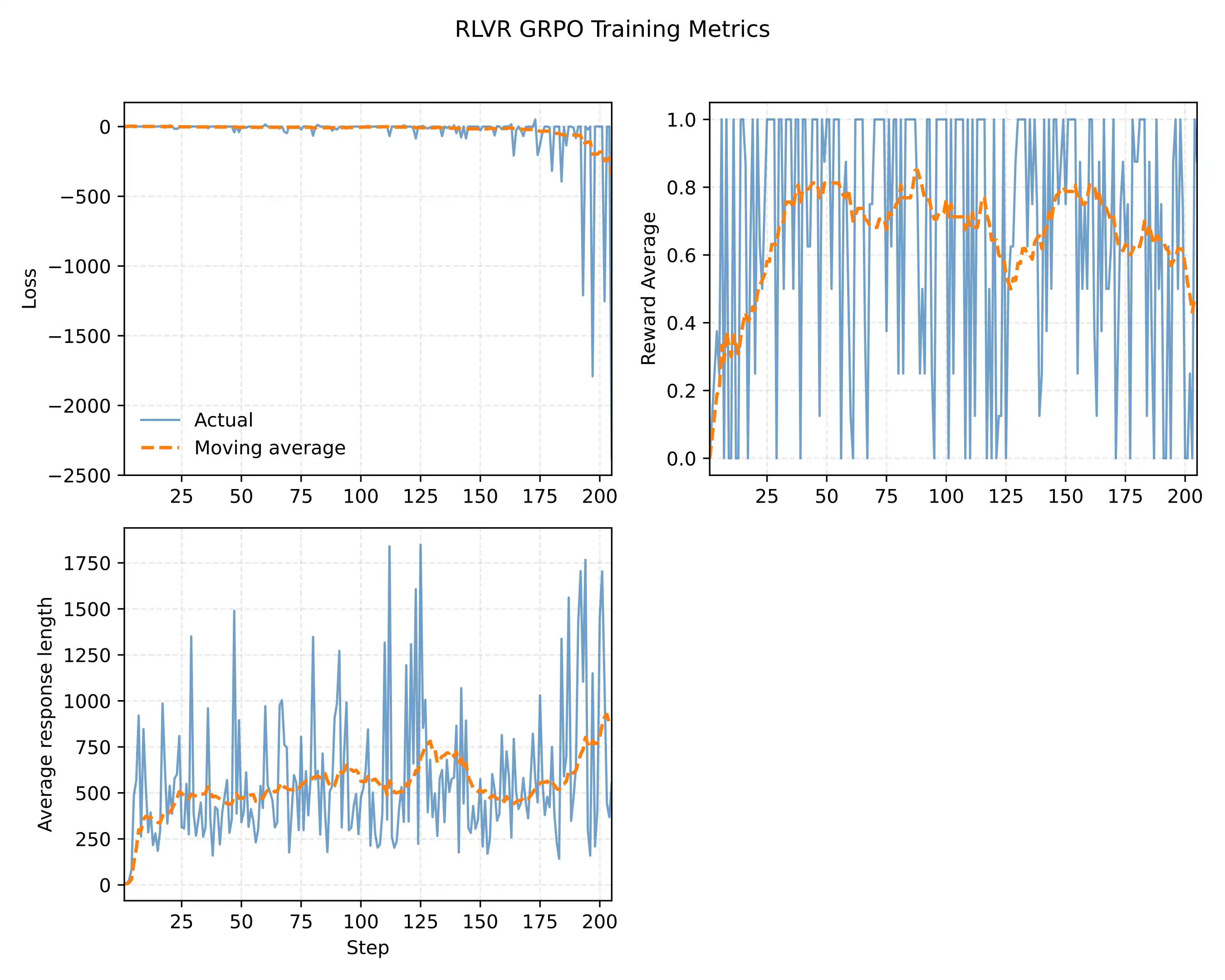
The [plot_metrics.py](plot_metrics.py) can be used to plot the CSV-formatted training runs. A 200-step example run is included in the `logs` folder (the log file was created with default settings except for increasing `--max_new_tokens 2048`):
```bash
uv run plot_metrics.py \
--csv logs/rlvr_grpo_original_no_kl_metrics.csv \
--moving_average 20
```
(The `--moving_average 20` setting averages over 20% of the past steps for a smoother trend line.)