![FastKoko: Dockerized Kokoro-82M TTS, OpenAI-compatible API](assets/banner.png)
remsky%2FKokoro-FastAPI | Trendshift [![Changelog](https://img.shields.io/badge/changelog-white)](./CHANGELOG.md) [![Tests](https://img.shields.io/badge/tests-257-darkgreen)]() [![Coverage](https://img.shields.io/badge/coverage-68%25-tan)]() [![Kokoro](https://img.shields.io/badge/kokoro-0.9.4-BB5420)](https://github.com/hexgrad/kokoro) [![Misaki](https://img.shields.io/badge/misaki-0.9.4-B8860B)](https://github.com/hexgrad/misaki) [![Tested at Model Commit](https://img.shields.io/badge/model-1.0::41e5892-blue)](https://huggingface.co/hexgrad/Kokoro-82M/commit/41e5892b9d8b43e56fc560f892312a328a410973) [![Try on Spaces](https://img.shields.io/badge/%F0%9F%A4%97%20Try%20on-Spaces-blue)](https://huggingface.co/spaces/Remsky/FastKoko) [![Downloads](https://img.shields.io/badge/downloads-2.2M%2B-2496ED?logo=docker&logoColor=white)](https://github.com/remsky?tab=packages&repo_name=Kokoro-FastAPI) Dockerized FastAPI wrapper for [Kokoro-82M](https://huggingface.co/hexgrad/Kokoro-82M) text-to-speech model. Generate hours of high quality speech in minutes. - OpenAI-compatible Speech endpoint, multi-language support - English (US/GB), Spanish, French, Hindi, Italian, Japanese, Brazilian Portuguese, Mandarin Chinese - Optional integrated WebUI; read-along long-generation - Inline multi-speaker generation & voice mixing + aliasing weighted combinations, SSML support - Per-word, or per-chunk timestamped caption generation - Phoneme endpoints: generate phonemes from text, or generate audio from phonemes - Prebuilt multiplatform images - CPU and NVIDIA GPU (CUDA): linux/amd64 + linux/arm64 - AMD GPU (ROCm, experimental): linux/amd64 only - Apple Silicon (MPS) supported when running directly via UV (no image) ### Integration Guides [![Ask DeepWiki](https://deepwiki.com/badge.svg)](https://deepwiki.com/remsky/Kokoro-FastAPI) [![Ask CodeWiki](https://img.shields.io/badge/Ask%20CodeWiki-4285F4?logo=googlegemini&logoColor=white)](https://codewiki.google/github.com/remsky/kokoro-fastapi) [![Helm Chart](https://img.shields.io/badge/Helm%20Chart-black?style=flat&logo=helm&logoColor=white)](docs/deployment/kubernetes.md) [![DigitalOcean](https://img.shields.io/badge/DigitalOcean-black?style=flat&logo=digitalocean&logoColor=white)](docs/deployment/digitalocean.md) [![SillyTavern](https://img.shields.io/badge/SillyTavern-black?style=flat&color=red)](docs/integrations/sillytavern.md) [![OpenWebUI](https://img.shields.io/badge/OpenWebUI-black?style=flat&color=white)](docs/integrations/openwebui.md) ## Get Started
Quickest Start (docker run) Pre-built multi-arch images with models baked in. `:latest` is available, but please pin to a release tag for stable usage. **No GPU** (laptop, CPU-only server) ```bash docker run -p 8880:8880 ghcr.io/remsky/kokoro-fastapi-cpu:latest ``` **NVIDIA** (GTX 900-series through RTX 40; ships cu126) ```bash docker run --gpus all -p 8880:8880 ghcr.io/remsky/kokoro-fastapi-gpu:latest ``` **NVIDIA RTX 50-series / Blackwell** (ships cu128) ```bash docker run --gpus all -p 8880:8880 ghcr.io/remsky/kokoro-fastapi-gpu:latest-cu128 ``` **NVIDIA arm64** (Jetson, GH200; same tag, ships cu129) ```bash docker run --gpus all -p 8880:8880 ghcr.io/remsky/kokoro-fastapi-gpu:latest ``` **AMD GPU** (ROCm, experimental, x86_64 only) ```bash docker run --device=/dev/kfd --device=/dev/dri -p 8880:8880 ghcr.io/remsky/kokoro-fastapi-rocm:latest ``` **Apple Silicon** (native MPS clone; the CPU image also works) ```bash ./start-gpu_mac.sh ``` `gpu:latest` is the same image as `gpu:latest-cu126`. Configuration via environment variables, see [the configuration guide](docs/configuration.md).
Quick Start (docker compose) 1. Install prerequisites, and start the service using Docker Compose (Full setup including UI): - Install [Docker](https://www.docker.com/products/docker-desktop/) - Clone the repository: ```bash git clone https://github.com/remsky/Kokoro-FastAPI.git cd Kokoro-FastAPI cd docker/gpu # For NVIDIA GPU support # or cd docker/cpu # For CPU support # or cd docker/rocm # For AMD GPU (ROCm, experimental, amd64 only) docker compose up --build # *Note for Apple Silicon (M1/M2/M3) users: # The Docker GPU image is CUDA-only and won't run on Apple Silicon. With Docker, use `docker/cpu`. # For native MPS (Apple GPU) acceleration, run directly via UV with `./start-gpu_mac.sh`. cd ../.. # back to repo root for the paths below # Models will auto-download, but if needed you can manually download: python docker/scripts/download_model.py --output api/src/models/v1_0 ``` [Configuration guide](docs/configuration.md) covers image vs build, the volume mounts, and env vars.
Direct Run (via uv) 1. Install prerequisites: - Install [astral-uv](https://docs.astral.sh/uv/) - Install [espeak-ng](https://github.com/espeak-ng/espeak-ng) in your system if you want it available as a fallback for unknown words/sounds. The upstream libraries may attempt to handle this, but results have varied. - Clone the repository: ```bash git clone https://github.com/remsky/Kokoro-FastAPI.git cd Kokoro-FastAPI ``` Run the [model download script](https://github.com/remsky/Kokoro-FastAPI/blob/master/docker/scripts/download_model.py) if you haven't already Start directly via UV (with hot-reload) Linux and macOS ```bash ./start-cpu.sh OR ./start-gpu.sh ``` Windows ```powershell .\start-cpu.ps1 OR .\start-gpu.ps1 ```
Up and Running? Run locally as an OpenAI-Compatible Speech Endpoint ```python from openai import OpenAI client = OpenAI( base_url="http://localhost:8880/v1", api_key="not-needed" ) with client.audio.speech.with_streaming_response.create( model="kokoro", voice="af_sky+af_bella", #single or multiple voicepack combo input="Hello world!" ) as response: response.stream_to_file("output.mp3") ``` - The API will be available at http://localhost:8880 - API Documentation: http://localhost:8880/docs - Web Interface: http://localhost:8880/web
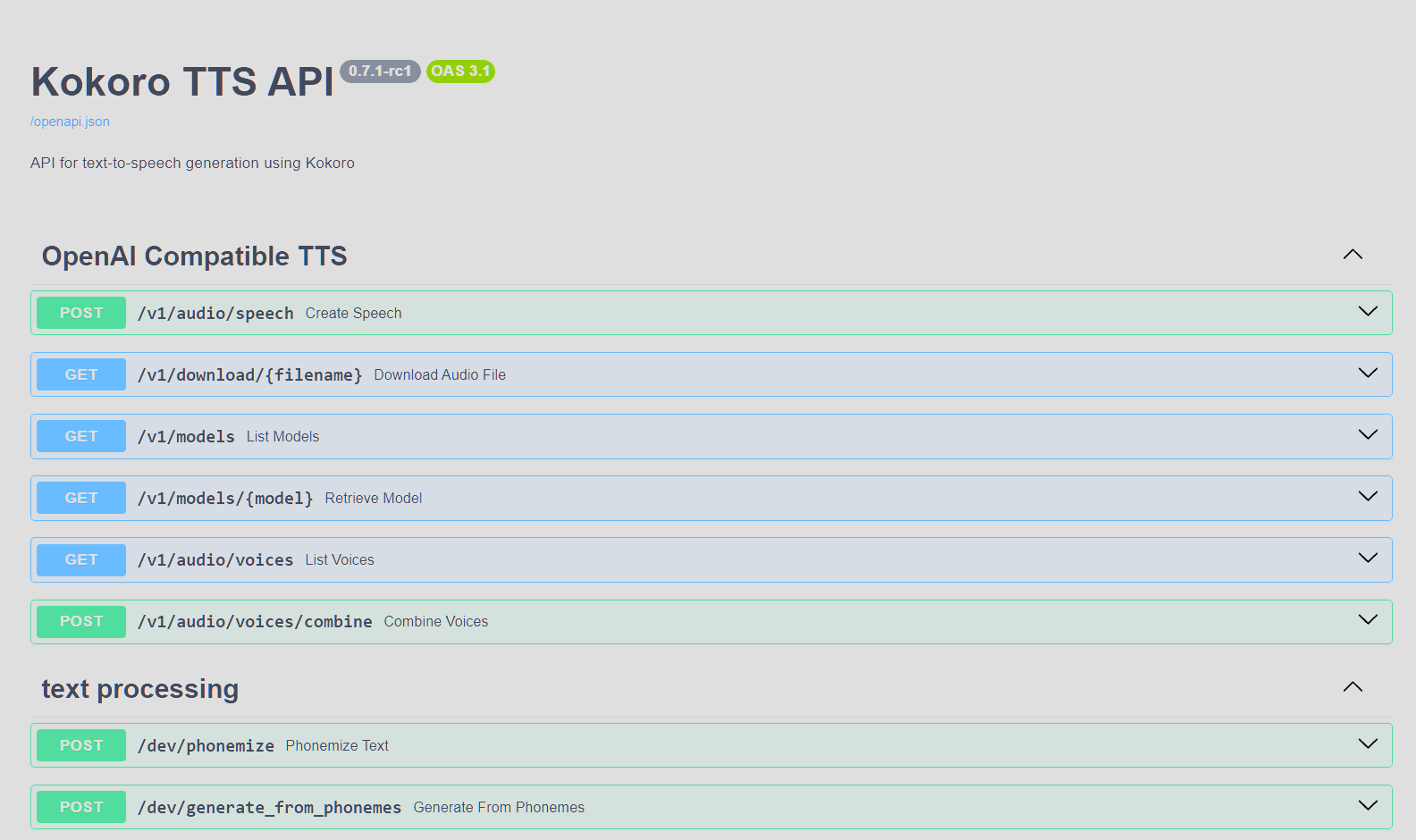
Web UI Screenshot API Documentation
## Features ### Core
OpenAI-Compatible Speech Endpoint ```python # Using OpenAI's Python library from openai import OpenAI client = OpenAI(base_url="http://localhost:8880/v1", api_key="not-needed") response = client.audio.speech.create( model="kokoro", voice="af_bella+af_sky", # see /api/src/core/openai_mappings.json to customize input="Hello world!", response_format="mp3" ) response.stream_to_file("output.mp3") ``` Or Via Requests: ```python import requests response = requests.get("http://localhost:8880/v1/audio/voices") voices = [v["id"] for v in response.json()["voices"]] # Generate audio response = requests.post( "http://localhost:8880/v1/audio/speech", json={ "model": "kokoro", "input": "Hello world!", "voice": "af_bella", "response_format": "mp3", # Supported: mp3, wav, opus, flac, aac, pcm "speed": 1.0 } ) # Save audio with open("output.mp3", "wb") as f: f.write(response.content) ``` Quick tests (run from another terminal): ```bash python examples/assorted_checks/test_openai/test_openai_tts.py # Test OpenAI Compatibility python examples/assorted_checks/test_voices/test_all_voices.py # Test all available voices ```
Streaming Support ```python # OpenAI-compatible streaming from openai import OpenAI client = OpenAI( base_url="http://localhost:8880/v1", api_key="not-needed") # Stream to file with client.audio.speech.with_streaming_response.create( model="kokoro", voice="af_bella", input="Hello world!" ) as response: response.stream_to_file("output.mp3") # Stream to speakers (requires PyAudio) import pyaudio player = pyaudio.PyAudio().open( format=pyaudio.paInt16, channels=1, rate=24000, output=True ) with client.audio.speech.with_streaming_response.create( model="kokoro", voice="af_bella", response_format="pcm", input="Hello world!" ) as response: for chunk in response.iter_bytes(chunk_size=1024): player.write(chunk) ``` Or via requests: ```python import requests response = requests.post( "http://localhost:8880/v1/audio/speech", json={ "input": "Hello world!", "voice": "af_bella", "response_format": "pcm" }, stream=True ) for chunk in response.iter_content(chunk_size=1024): if chunk: # Process streaming chunks pass ```

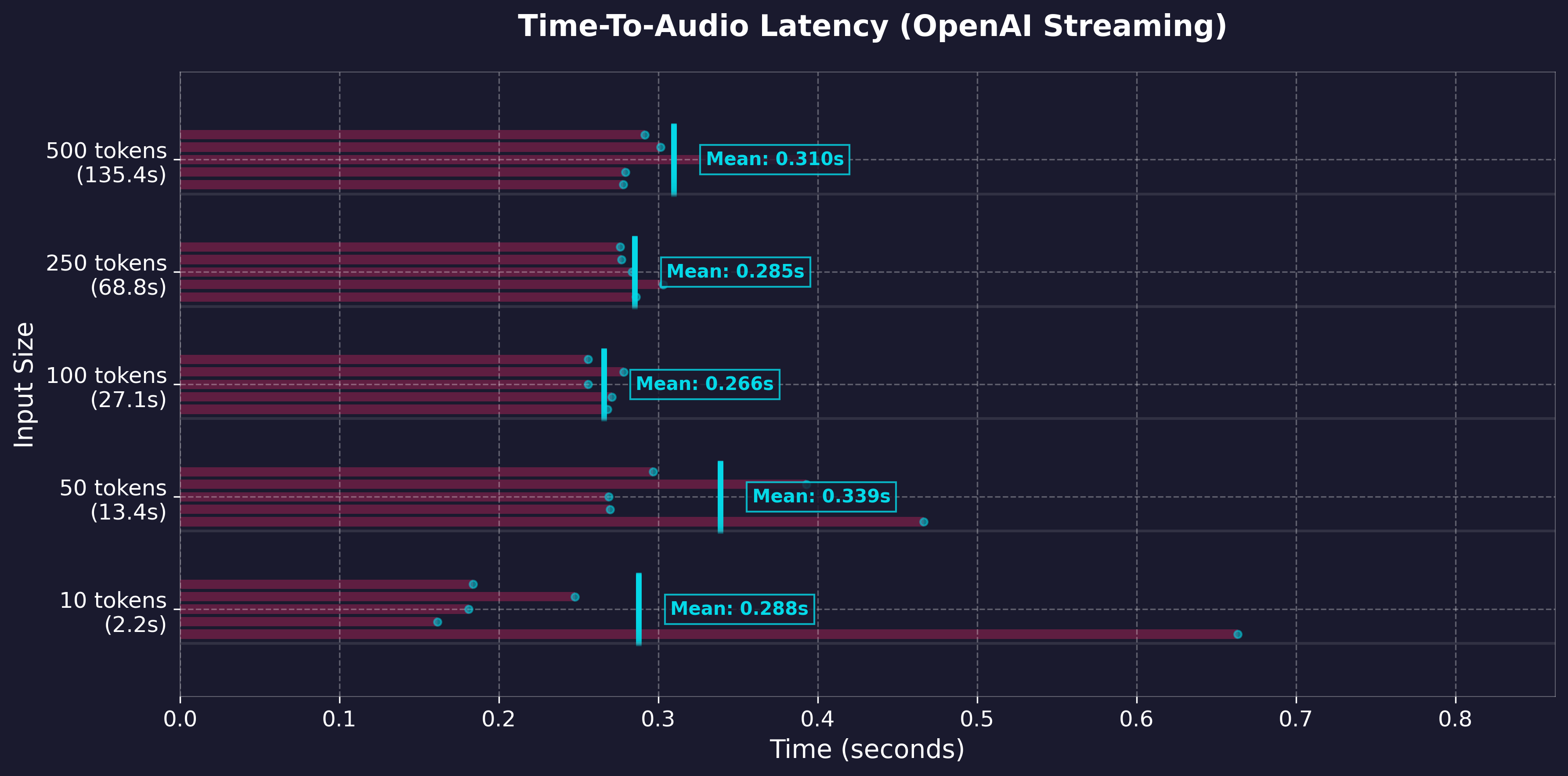
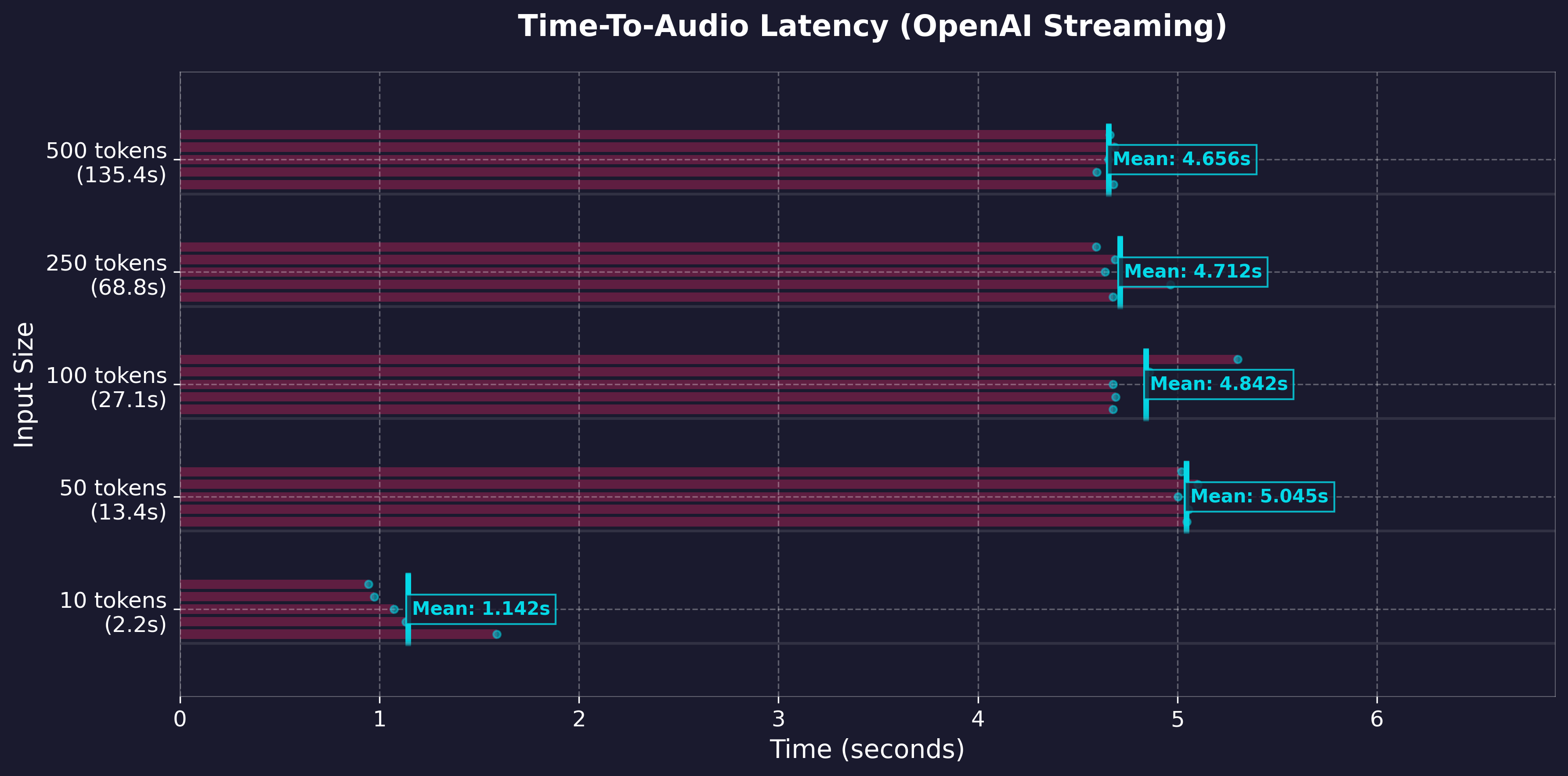
GPU First Token Timeline CPU First Token Timeline

Key Streaming Metrics: - First token latency @ chunksize - ~300ms (GPU) @ 400 - ~3500ms (CPU) @ 200 (older i7) - ~<1s (CPU) @ 200 (M3 Pro) - Adjustable chunking settings for real-time playback *Note: Artifacts in intonation can increase with smaller chunks*
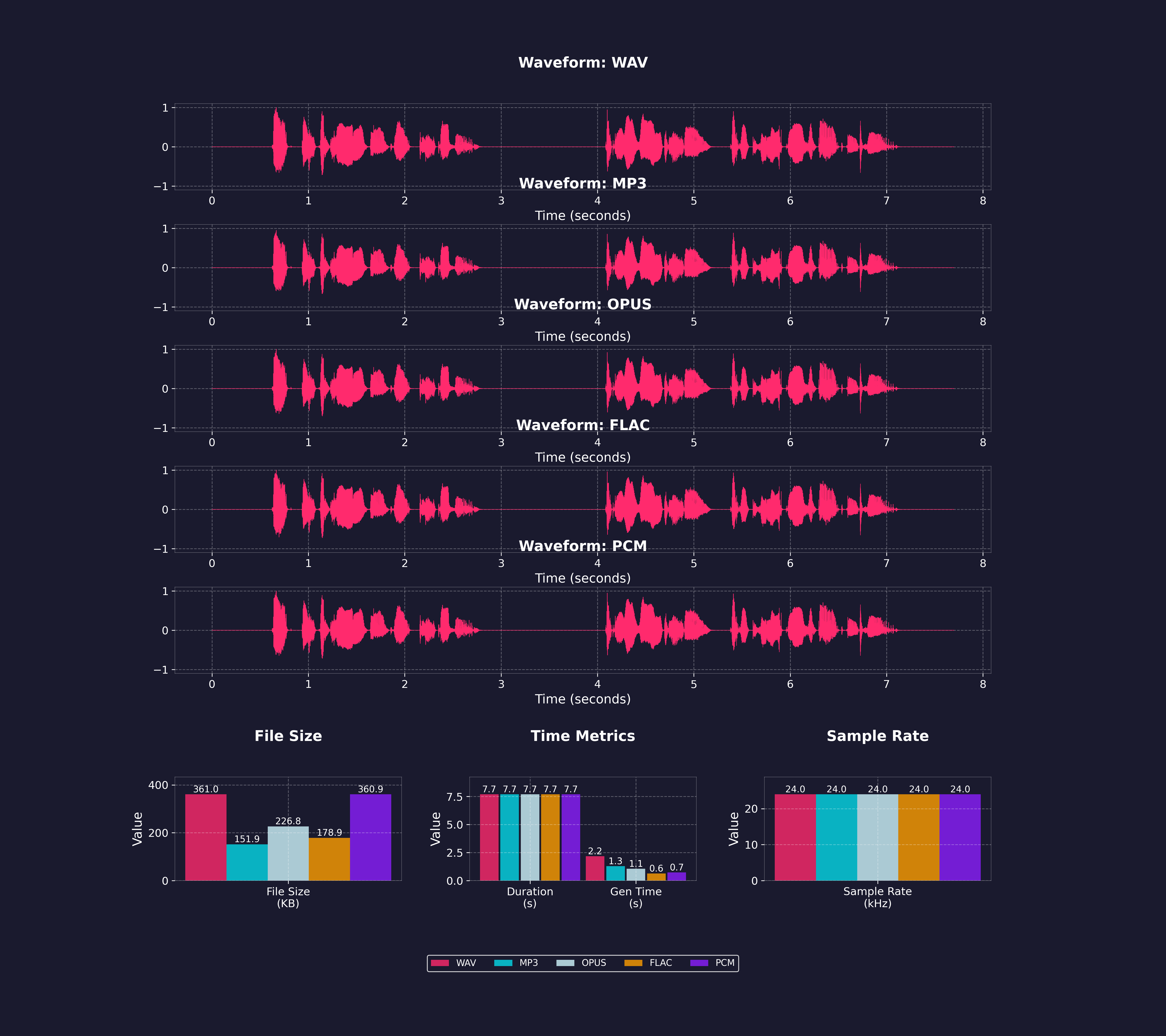
Multiple Output Audio Formats - mp3 - wav - opus - flac - aac - pcm

Audio Format Comparison

### Voices
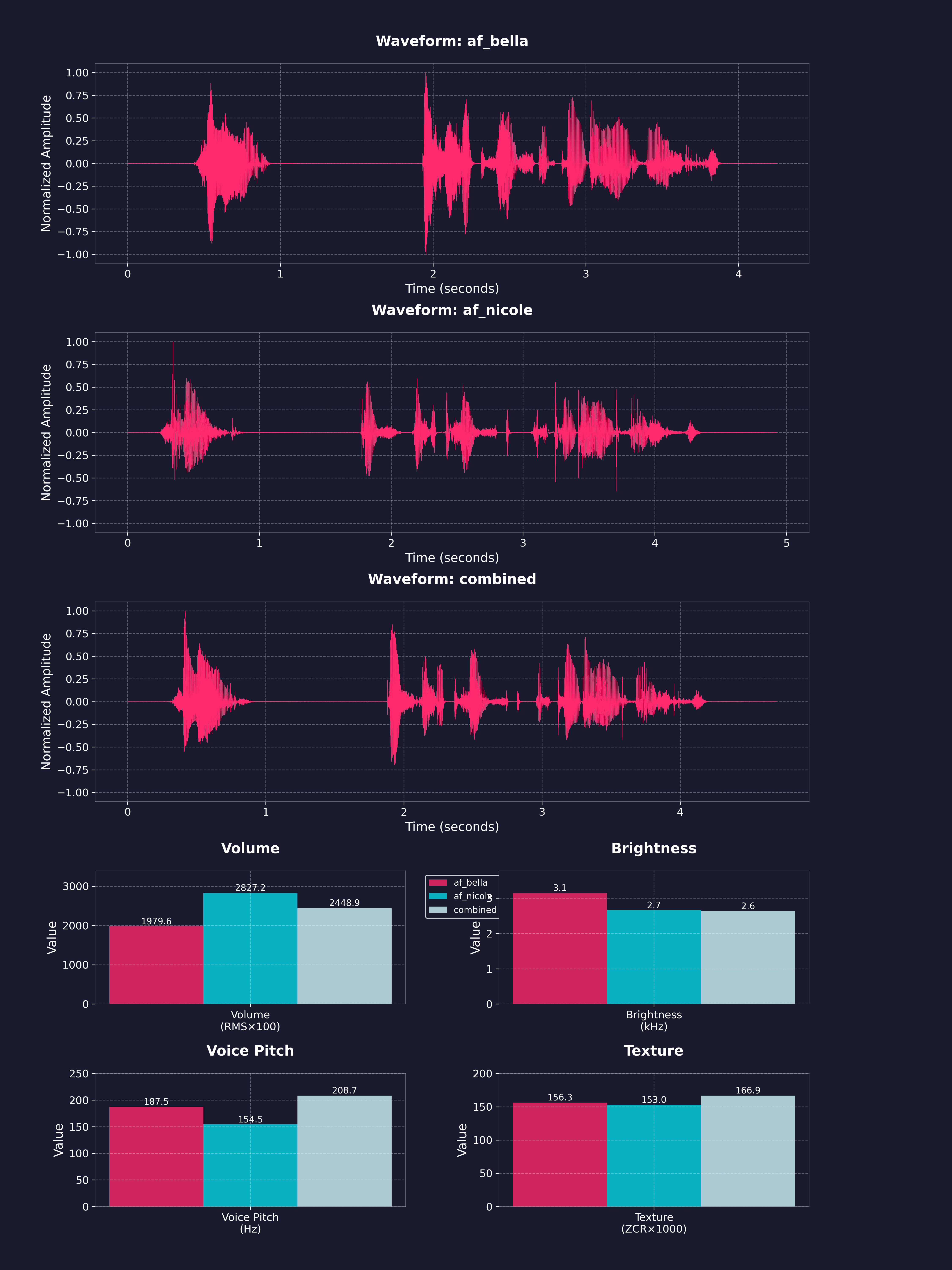
Voice Combination - Weighted voice combinations using ratios (e.g., "af_bella(2)+af_heart(1)" for 67%/33% mix) - Ratios are automatically normalized to sum to 100% - Available through any endpoint by adding weights in parentheses - Saves generated voicepacks for future use Combine voices and generate audio: ```python import requests response = requests.get("http://localhost:8880/v1/audio/voices") voices = [v["id"] for v in response.json()["voices"]] # Weighted voice combination (67%/33% mix) response = requests.post( "http://localhost:8880/v1/audio/speech", json={ "input": "Hello world!", "voice": "af_bella(2)+af_sky(1)", # 2:1 ratio = 67%/33% "response_format": "mp3" } ) # Download combined voice as .pt file response = requests.post( "http://localhost:8880/v1/audio/voices/combine", json="af_bella(2)+af_sky(1)" # 2:1 ratio = 67%/33% ) # Save the .pt file with open("combined_voice.pt", "wb") as f: f.write(response.content) # Use the downloaded voice file response = requests.post( "http://localhost:8880/v1/audio/speech", json={ "input": "Hello world!", "voice": "combined_voice", # Use the saved voice file "response_format": "mp3" } ) ```

Voice Analysis Comparison

Voice Aliases Weighted mixes can get long fast. `voice_aliases` maps a short name per request, for both the `voice` field and `[voice:...]` tags: - Aliases prefer to match case-insensitively (keep lowercase to avoid inconsistencies). - An alias pointing at a nonexistent voice returns a 400. - The web UI's cast exports in the same format e.g. `{"voice_aliases": {...}}`; interchangeable for API calls. ```python from openai import OpenAI client = OpenAI(base_url="http://localhost:8880/v1", api_key="not-needed") client.audio.speech.create( model="kokoro", voice="narrator", input="[voice:narrator] Once upon a time. [voice:villain] Never!", extra_body={ "allow_voice_tags": True, "voice_aliases": {"narrator": "af_bella(2)+af_sky", "villain": "am_michael"}, }, ) ``` or ```bash curl -X POST http://localhost:8880/v1/audio/speech \ -H "Content-Type: application/json" \ -d '{ "model": "kokoro", "voice": "narrator", "input": "[voice:narrator] Once upon a time. [voice:villain] Never!", "allow_voice_tags": true, "voice_aliases": {"narrator": "af_bella(2)+af_sky", "villain": "am_michael"}, "response_format": "mp3" }' --output aliased.mp3 ```
Multi-Speaker / Dialogue - `[voice:...]` tags switch speakers inline, anywhere `input` is accepted - `/v1/audio/speech` needs `allow_voice_tags: true` per request; `/dev/dialogue` allows them by default - `ENABLE_VOICE_TAGS=false` opts out server-wide: the parameter is refused and `/dev/dialogue` 403s ```bash curl -X POST http://localhost:8880/v1/audio/speech \ -H "Content-Type: application/json" \ -d '{ "model": "kokoro", "voice": "af_heart", "input": "The narrator opens. [voice:af_bella] Did it land? [pause:0.3s] [voice:am_michael] It did.", "allow_voice_tags": true, "response_format": "mp3" }' --output dialogue.mp3 ``` With the official OpenAI client, pass the param in `extra_body`: ```python client.audio.speech.create( model="kokoro", voice="af_jadzia", input="The narrator opens. [voice:af_bella] Did it land?", extra_body={"allow_voice_tags": True}, ) ``` `POST /dev/dialogue` uses structured turns, and allows `pause_between_turns` to be controlled by param. ```bash curl -X POST http://localhost:8880/dev/dialogue \ -H "Content-Type: application/json" \ -d '{ "turns": [ {"voice": "af_bella", "text": "Did the multi speaker support land?"}, {"voice": "am_michael", "text": "It did. Turns switch voices inline."} ], "pause_between_turns": 0.4, "response_format": "mp3" }' --output dialogue.mp3 ``` Notes: - Any text before the first tag uses the request's `voice`/default. - Each speaker keeps its own language pipeline based on voice prefix. An explicit `lang_code` will override every speaker. - Consecutive turns sharing a voice are merged automatically. - Tags accept short names from **Voice Aliases** above, instead of full weighted mixes.
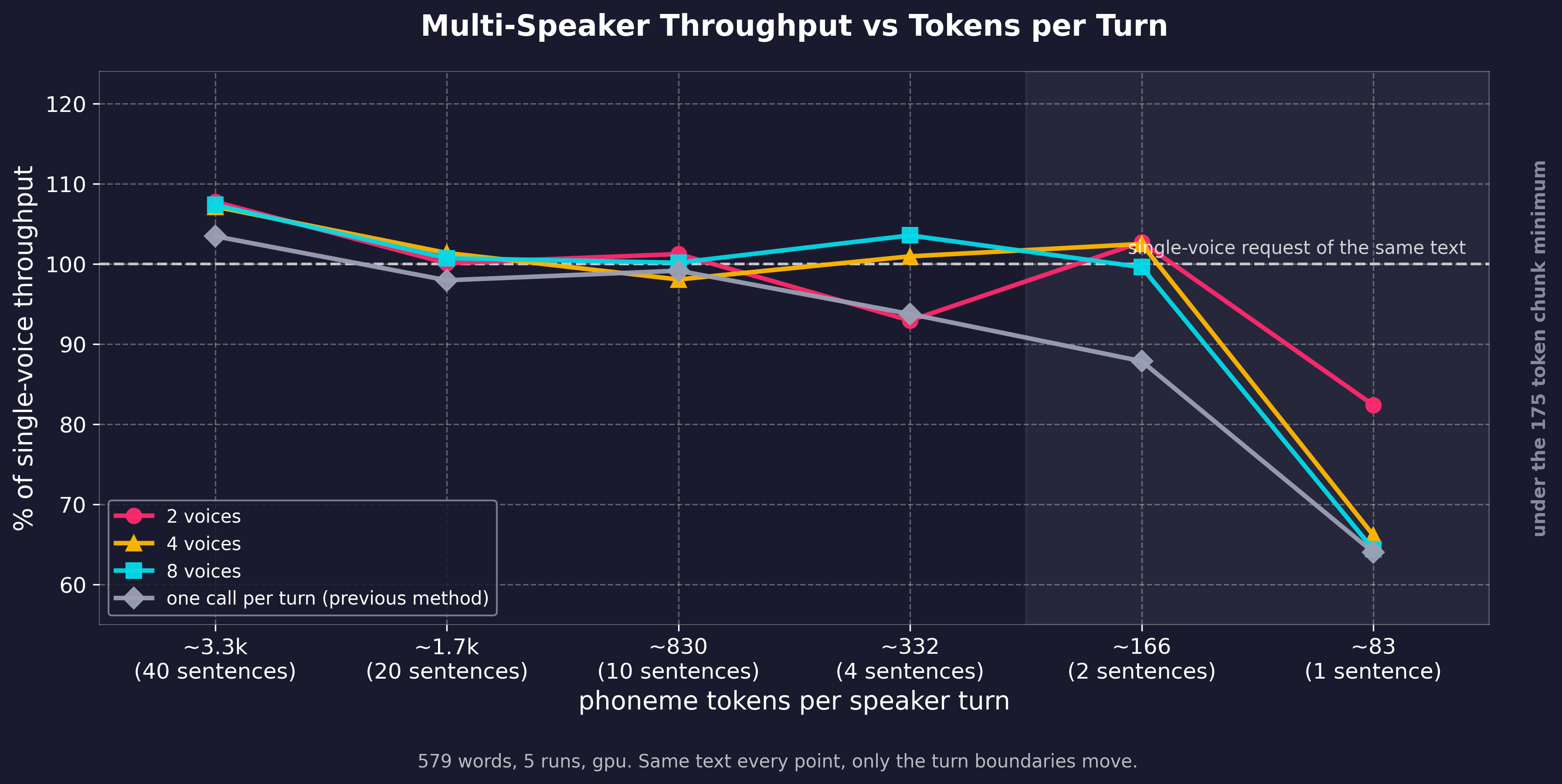
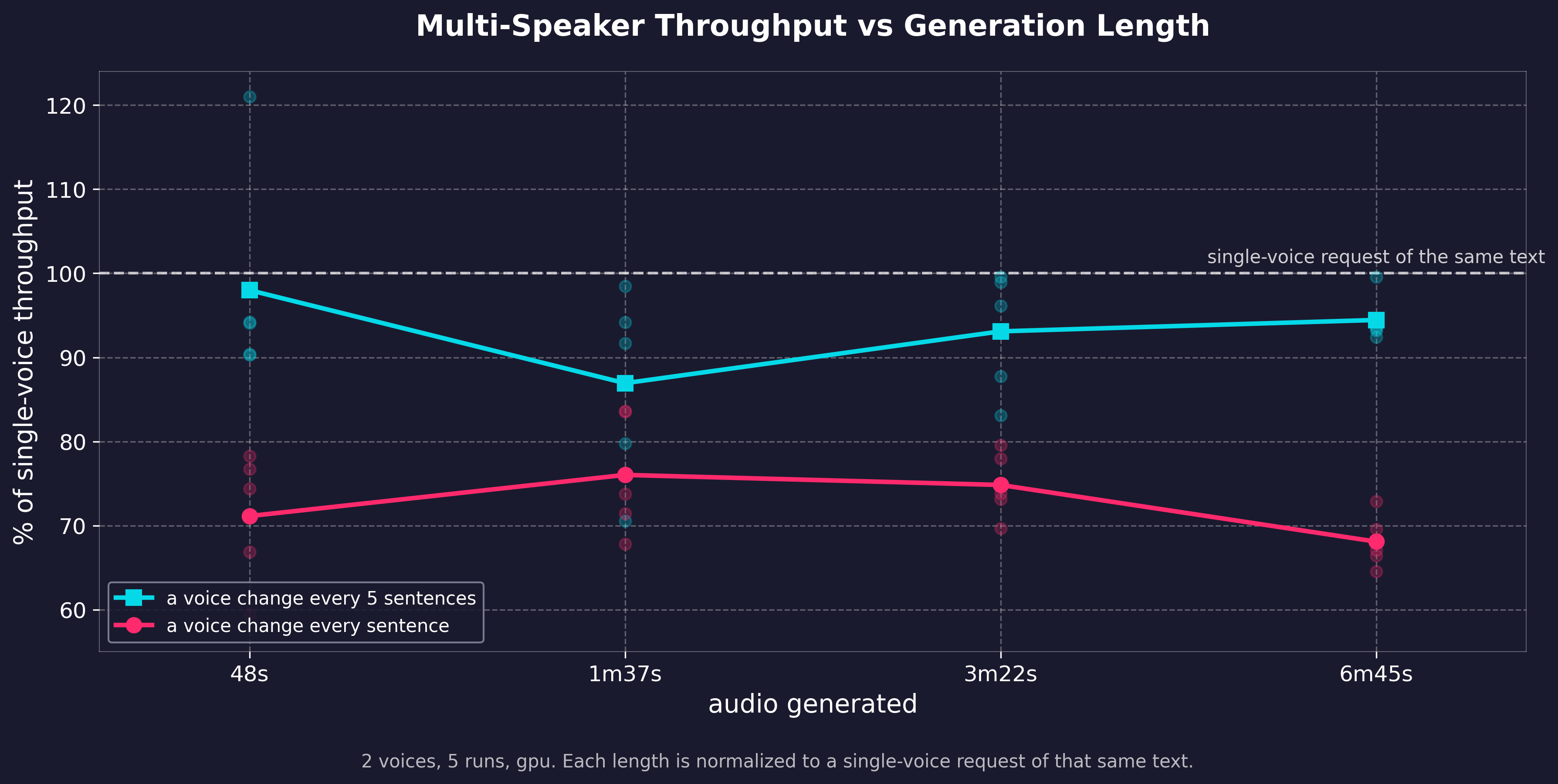
Throughput against the single-voice baseline as speaker turns get shorter Throughput at two voice change rates as the generation grows
Number of voices has minimal impact on generation speed. For continuous swaps though, if each speaker gets less than about 2 sentences, chunking requirements slow generation down. Still a flat cost, not compounding as the text grows. Regenerate with `examples/assorted_checks/test_dialogue/`.
### Text Control
Inline Control Tokens Four tokens can be embedded in the `input` text and are parsed server-side (API, WebUI, or any client): - **Pause**: `[pause:1.5s]` inserts that much silence. Must be exactly this form (colon, trailing `s`, case-insensitive). `[pause=1.5]` and `[PAUSE 1.0]` are not recognized and get read aloud. - **Pronunciation**: `[Worcester](/wˈʊstər/)` speaks the IPA between the slashes instead of the word. English only; use `/dev/phonemize` to find the IPA. - **Voice**: `[voice:am_michael]` switches speaker for everything that follows. - Requires `allow_voice_tags: true` per request, and `ENABLE_VOICE_TAGS` server-side (on by default). Otherwise the tag is spoken as written. - Accepts the same combine syntax as the `voice` parameter (`[voice:af_bella(2)+af_sky]`), - Short names/aliases can be defined in `voice_aliases`, - Unknown values return a 400. - **Rate**: `[rate:1.5]` scales the speaking voice's pace until the next rate tag or voice change; `[rate:1.0]` reverts. Applies on top of the request `speed`, clamped to 0.25-4.0. Same gating as voice tags. - A voice alias can carry a natural pace: `{"grandpa": {"voice": "am_michael", "rate": 0.8}}` applies that rate whenever the alias speaks, as the `voice` parameter or in tags. Useful for voices that read fast or slow, and for named presets over one voice (`narrator_fast`, `narrator_slow`). - Rate belongs to the voice speaking it. A `[rate:]` tag scales the speaker's calibrated pace rather than replacing it, so an alias throttled to `0.8` stays proportionally slower under `[rate:1.1]`. Every `[voice:...]` tag resets to the new voice's own rate, so a calibrated speaker cannot drag its pace onto the next one. Use `speed` for a pace over the whole request. ```text The city of [Worcester](/wˈʊstər/) is easy. [pause:1s] See? ```
SSML Input (experimental) Send `ssml: true` with `allow_voice_tags: true` on `/v1/audio/speech` or `/dev/captioned_speech` to translate and speak in one call. Both flags are needed, since the translation emits `[voice:]` and `[rate:]` spans that would otherwise be read aloud; `ssml` without them is a 400. ```json { "model": "kokoro", "input": "Hithere", "voice": "af_bella", "allow_voice_tags": true, "ssml": true } ``` `POST /dev/ssml` does the translation on its own when you want the tokens back as text rather than audio, or want to inspect them before synthesis. Send `text`, plus `voice` if your speech request uses one, then pass the result back with `allow_voice_tags: true`. Without a voice, ``/`` are stripped and their content kept. - `` becomes `[pause:0.75s]`. `strength=` instead of `time=` gives none/x-weak 0s, weak 0.25s, medium 0.5s, strong 1s, x-strong 1.5s - `` becomes `[voice:am_michael]`, reverts at the closing tag - `` becomes `[rate:0.75]`, and takes `80%` or `1.2` too. Scales the speaking voice's pace on top of the request `speed`, clamped 0.25-4.0, reverts. `pitch`/`volume` ignored - `Worcester` becomes `[Worcester](/wˈʊstər/)`, IPA and English only - `WWW` speaks the alias - `` is dropped with its text, an audio description is not speech - ``, ``, `

`, ``, ``, etc: markup dropped, text spoken - Malformed SSML is a 400, non-SSML passes through unchanged - DTDs are refused and nesting past `SSML_MAX_DEPTH` (10) is a 400; no dialect uses a DTD, real documents nest 2-5 - Prefixed names (`google:style`, `mstts:express-as`, `amazon:effect`) need their `xmlns:` on ``, vendor docs often omit it - `GET /dev/ssml` serves these tables as data, read off the translator itself ```bash curl -s http://localhost:8880/dev/ssml -H "Content-Type: application/json" \ -d '{"text": "The city of Worcester is easy.See?"}' # {"text": "The city of [Worcester](/wˈʊstər/) is easy. [pause:1.0s] See?"} ```
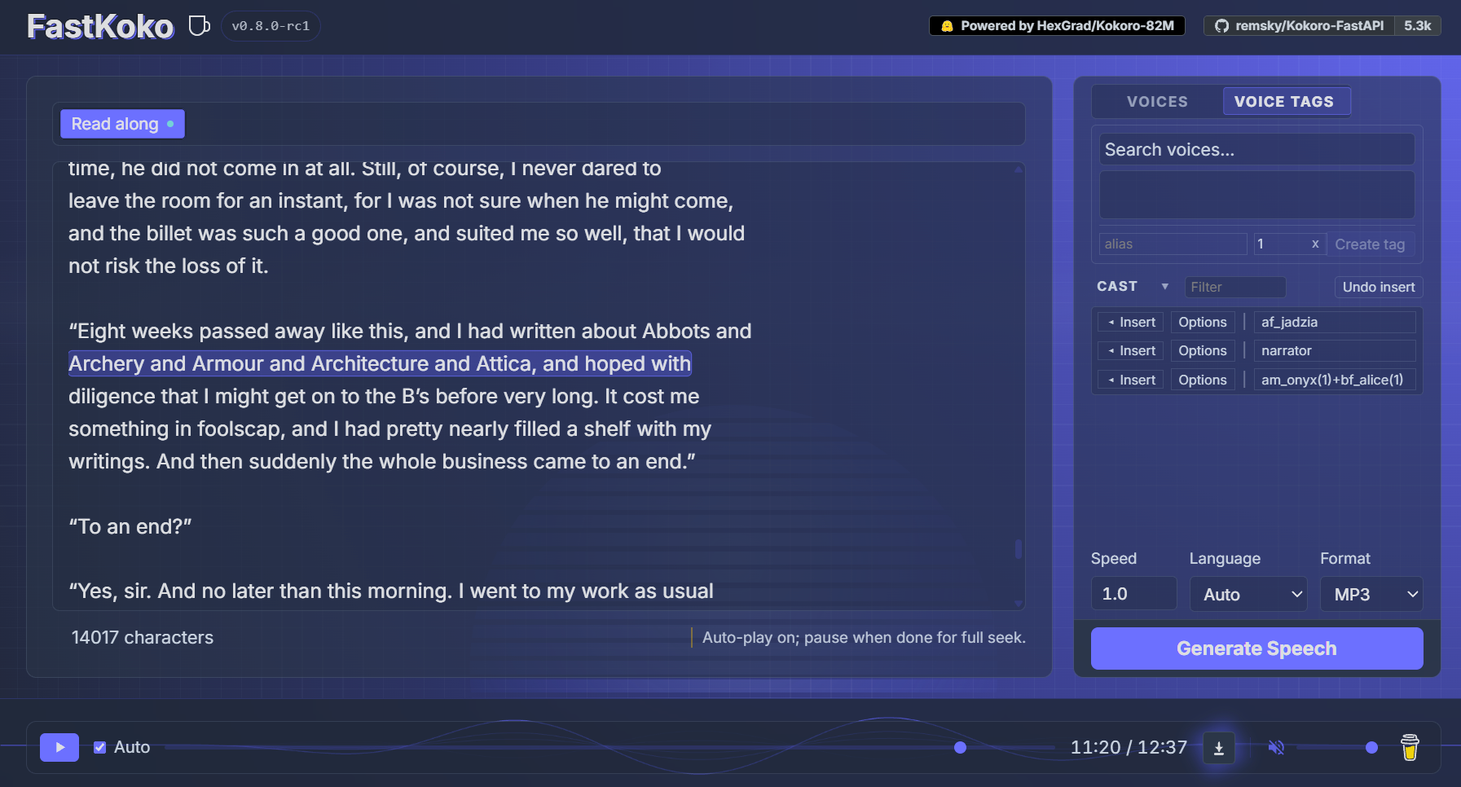
Natural Boundary Detection - Automatically splits and stitches at sentence boundaries - Reduces artifacts, and allows long-form output from a base model configured for roughly 30s at a time The model takes up to 510 phonemized tokens per chunk, but running it that long tends to produce 'rushed' speech and other artifacts. The server adds its own chunking layer on top, sized by `TARGET_MIN_TOKENS`, `TARGET_MAX_TOKENS`, and `ABSOLUTE_MAX_TOKENS` (175, 250, 450 by default, set via environment variables).
Phoneme & Token Routes Convert text to phonemes and/or generate audio directly from phonemes: ```python import requests def get_phonemes(text: str, language: str = "a"): """Get phonemes and tokens for input text""" response = requests.post( "http://localhost:8880/dev/phonemize", json={"text": text, "language": language} # "a" for American English ) response.raise_for_status() result = response.json() return result["phonemes"], result["tokens"] def generate_audio_from_phonemes(phonemes: str, voice: str = "af_bella"): """Generate audio from phonemes""" response = requests.post( "http://localhost:8880/dev/generate_from_phonemes", json={"phonemes": phonemes, "voice": voice}, headers={"Accept": "audio/wav"} ) if response.status_code != 200: print(f"Error: {response.text}") return None return response.content # Example usage text = "Hello world!" try: # Convert text to phonemes phonemes, tokens = get_phonemes(text) print(f"Phonemes: {phonemes}") # e.g. ðɪs ɪz ˈoʊnli ɐ tˈɛst print(f"Tokens: {tokens}") # Token IDs including start/end tokens # Generate and save audio if audio_bytes := generate_audio_from_phonemes(phonemes): with open("speech.wav", "wb") as f: f.write(audio_bytes) print(f"Generated {len(audio_bytes)} bytes of audio") except Exception as e: print(f"Error: {e}") ``` See `examples/phoneme_examples/generate_phonemes.py` for a sample script.
### Captions
Timestamps (word level) Generate audio with word-level timestamps without streaming: ```python import requests import base64 import json response = requests.post( "http://localhost:8880/dev/captioned_speech", json={ "model": "kokoro", "input": "Hello world!", "voice": "af_bella", "speed": 1.0, "response_format": "mp3", "stream": False, }, stream=False ) with open("output.mp3","wb") as f: audio_json=json.loads(response.content) chunk_audio=base64.b64decode(audio_json["audio"].encode("utf-8")) f.write(chunk_audio) print(audio_json["timestamps"]) ``` Generate audio with word-level timestamps with streaming: ```python import requests import base64 import json response = requests.post( "http://localhost:8880/dev/captioned_speech", json={ "model": "kokoro", "input": "Hello world!", "voice": "af_bella", "speed": 1.0, "response_format": "mp3", "stream": True, }, stream=True ) f=open("output.mp3","wb") for chunk in response.iter_lines(decode_unicode=True): if chunk: chunk_json=json.loads(chunk) chunk_audio=base64.b64decode(chunk_json["audio"].encode("utf-8")) f.write(chunk_audio) print(chunk_json["timestamps"]) ``` With `"allow_voice_tags": true`, each timestamp also carries the `voice` that spoke the word, so multi-speaker captions can be labelled without re-deriving the split client side. Without it the field is absent.
Timestamps (streaming chunks) With `stream`, `return_download_link`, and `return_timing` set, the response carries an `X-Timing-Path` header pointing at a JSON sidecar of per-chunk timings. The audio body is unchanged and nothing extra is computed; this is what drives the web UI's read along. ```python response = requests.post( "http://localhost:8880/v1/audio/speech", json={ "input": "Hello world! [pause:1s] Again.", "voice": "af_bella", "stream": True, "return_download_link": True, "return_timing": True, }, stream=True, ) audio = b"".join(response.iter_content(1024)) timings = requests.get(f"http://localhost:8880/v1{response.headers['x-timing-path']}").json() # {"chunks": [{"text": "Hello world!", "start": 0.0, "end": 0.64}, ...]} ``` - Chunk-level (a sentence group, roughly 10-20s of audio), not word-level. For word-level use `/dev/captioned_speech`. - The header arrives up front, but the file is written when generation finishes. Fetch it after the stream ends; earlier is a 404. - `start`/`end` are seconds in the final audio, so pauses and speed are already accounted for. `[pause:Ns]` gaps appear as `{"text": ""}` entries. - `text` is normalized (numbers etc expanded), so align by words rather than exact match. - With `allow_voice_tags`, each spoken chunk also carries its `voice`, same as captioned timestamps. Absent otherwise. - The sidecar sits next to the download file and shares its temp lifetime.
## Performance & Operations
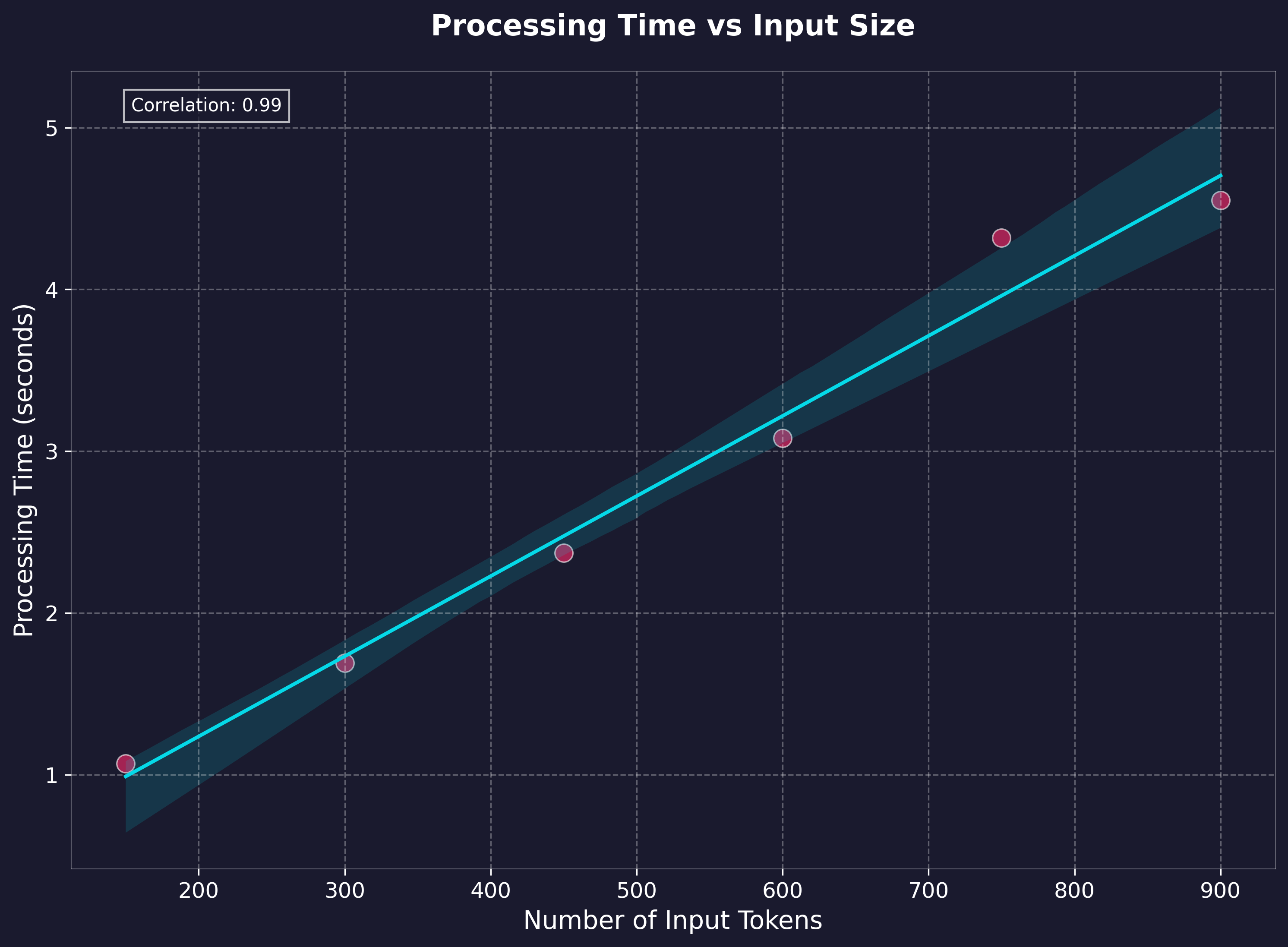
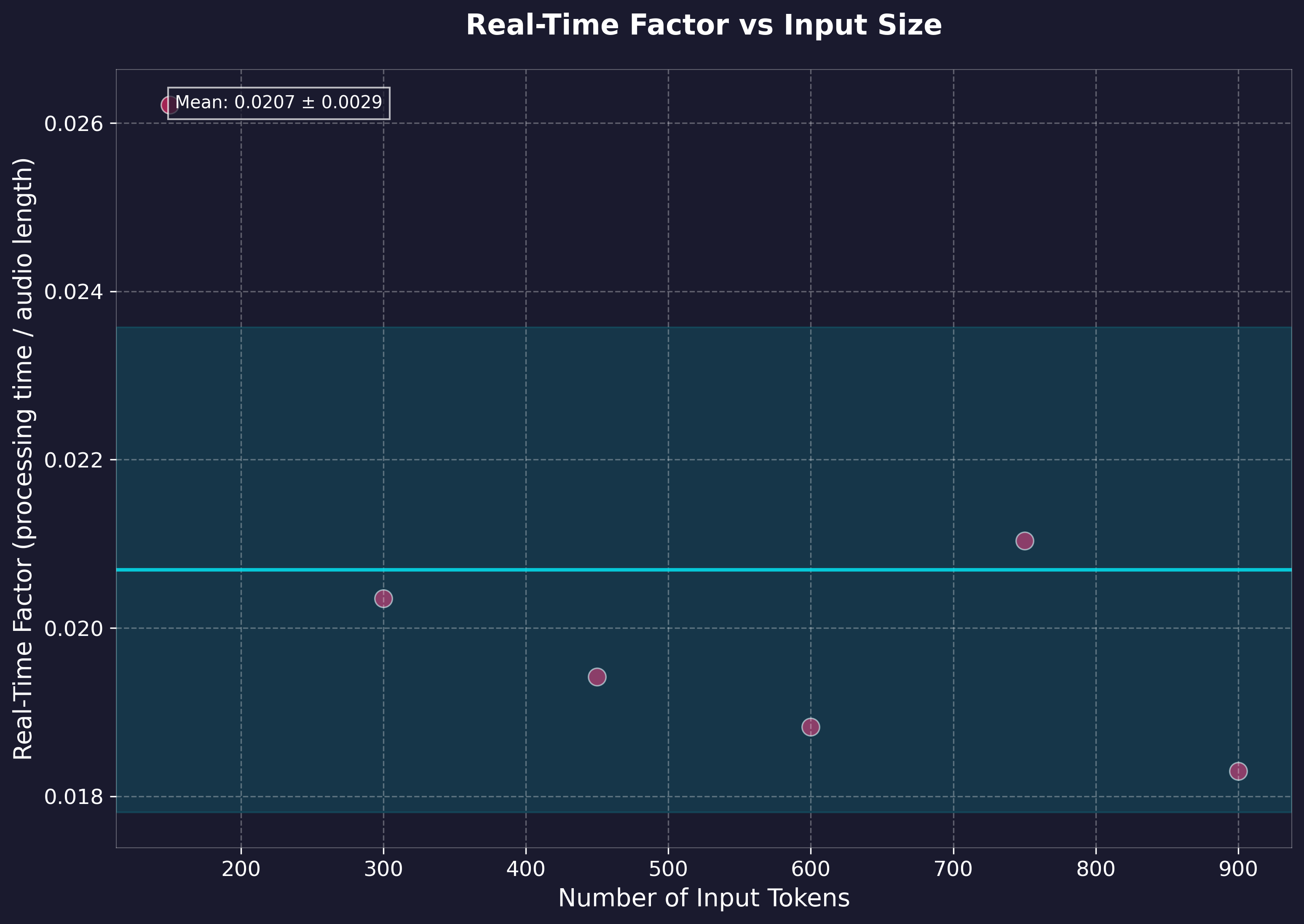
Performance & Benchmarks ### Throughput Generation through the local API, text lengths up to feature-length books (~1.5 hours output), measuring processing time and realtime factor. Run on: - Windows 11 Home w/ WSL2 - NVIDIA 4060Ti 16gb GPU @ CUDA 12.1 - 11th Gen i7-11700 @ 2.5GHz - 64gb RAM - WAV native output - H.G. Wells - The Time Machine (full text)

Processing Time Realtime Factor

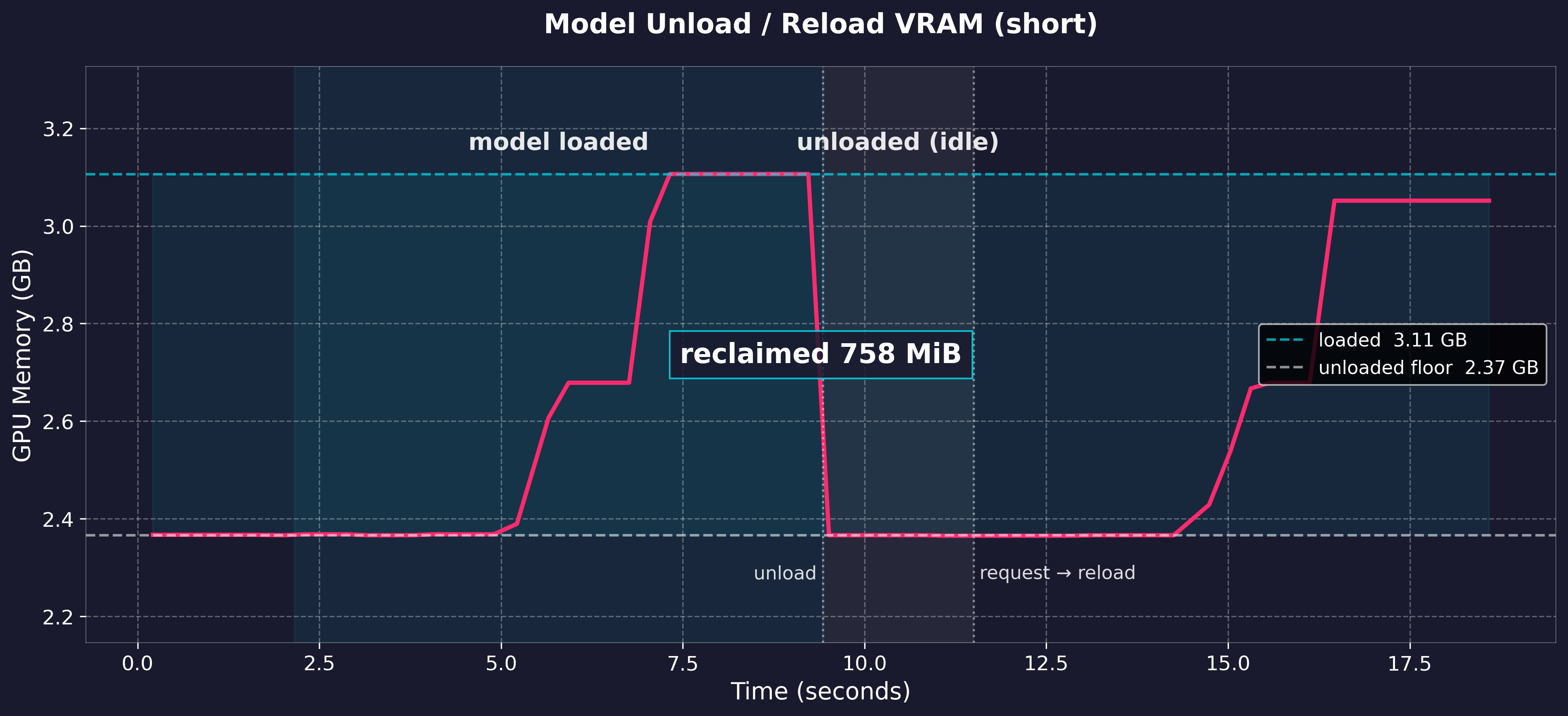
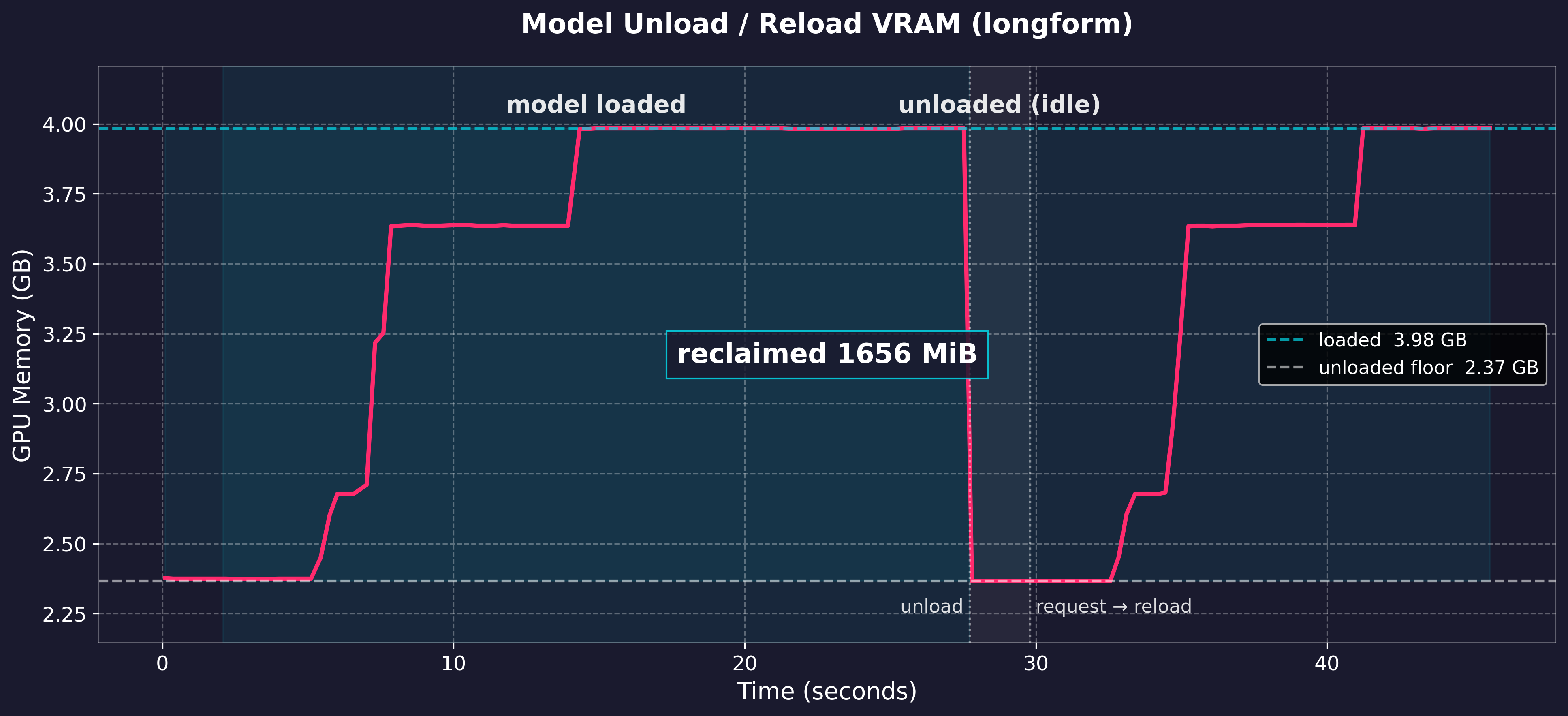
Key Performance Metrics: - Realtime Speed: Ranges between 35x-100x (generation time to output audio length) - Average Processing Rate: 137.67 tokens/second (cl100k_base) ### Model Unload / VRAM Reclaim `POST /dev/unload` frees the model from VRAM and reloads lazily on the next request. Reclaim scales with load (the activation pool, not just weights) but plateaus: chunks cap at 450 tokens. Long-form = ~30 paragraphs. Same setup as above.

Short workload Long-form workload

| Workload | Loaded | Floor | Reclaimed | Reload | | --- | --- | --- | --- | --- | | Short (6s audio) | 3.11 GB | 2.37 GB | 758 MiB | +4.9s | | Long-form (7.5m) | 3.98 GB | 2.37 GB | 1,656 MiB | +5.1s | Floor is host + CUDA context. Reproduce with `uv run --extra benchmarks assorted_checks/benchmarks/benchmark_model_unload.py` from `examples/`. ### Transcription roundtrip (WER/CER) End-to-end roundtrip: synthesize with Kokoro, transcribe the result back with [`faster-whisper`](https://github.com/SYSTRAN/faster-whisper), compare to the source text. Scripts and data live under `examples/assorted_checks/test_transcription/`. **Long-form English** (full book, *A Journey to the Centre of the Earth*, Project Gutenberg, voice `af_heart`, `base.en` Whisper on CUDA float16, baseline captured on cu126 GPU build): | Run | Input chars | Audio length | Synth speedup | Transcribe speedup | WER | | --- | --- | --- | --- | --- | --- | | Short (~ch.7) | 64,996 | 66m 06s | 36.4x rt | 62.4x rt | **0.047** | | Full book | 502,766 | 507m 52s | 45.7x rt | 65.1x rt | **0.033** | See `examples/assorted_checks/test_transcription/BASELINE.md` for the full regression bands. **Per-language check** (single-sentence per voice, multilingual Whisper `small`. WER for Latin scripts, CER for ja/zh/hi): | Language | Voice | Metric | Score | | --- | --- | --- | --- | | English | `af_heart` | WER | 0.000 | | English (UK) | `bf_emma` | WER | 0.111 | | Spanish | `ef_dora` | WER | 0.000 | | French | `ff_siwis` | WER | 0.000 | | Italian | `if_sara` | WER | 0.000 | | Portuguese | `pf_dora` | WER | 0.000 | | Hindi | `hf_alpha` | CER | 0.059 | | Japanese | `jf_alpha` | CER | 0.000 | | Chinese | `zf_xiaobei` | CER | 0.143 | *Caveat: these are single short sentences, not a comprehensive per-language quality benchmark. They confirm each voice produces transcribable audio in its target language; deeper quality evaluation per language is open work.* To reproduce, see `examples/assorted_checks/test_transcription/README.md`.
Configuration Variables Every setting is an environment variable, or a line in a `.env` file at the project root. Full reference in [the configuration guide](docs/configuration.md).
Debug Endpoints System state and resource usage, for debugging exhaustion or performance issues. The `/debug/*` routes expose host and process internals, so they are off by default; set `ENABLE_DEBUG_ENDPOINTS=true` to enable. - `/debug/threads` - Get thread information and stack traces - `/debug/storage` - Disk usage per mounted partition - `/debug/system` - Get system information (CPU, memory, GPU) - `POST /dev/unload` - Release model from VRAM; reloads lazily on next request. Off by default; set `ALLOW_DEV_UNLOAD=true` to enable Stability: the `/v1/*` OpenAI-compatible routes are the stable API. `/dev/*` and `/debug/*` are operational helpers, and may change or move behind flags between minor releases.
Logging Global API [loguru logging level](https://loguru.readthedocs.io/en/stable/api/logger.html#levels) can be set using the `API_LOG_LEVEL` environment variable. Defaults to `DEBUG`. Per run method in [the configuration guide](docs/configuration.md#logging).
## Known Issues & Troubleshooting
Missing words & Missing some timestamps The API normalizes input text, which can incorrectly remove or change some phrases. Disable it with `"normalization_options":{"normalize": false}` in the request json: ```python import requests response = requests.post( "http://localhost:8880/v1/audio/speech", json={ "input": "Hello world!", "voice": "af_heart", "response_format": "pcm", "normalization_options": { "normalize": False } }, stream=True ) for chunk in response.iter_content(chunk_size=1024): if chunk: # Process streaming chunks pass ```
Linux GPU Permissions See [docs/troubleshooting.md#linux-gpu-permissions](docs/troubleshooting.md#linux-gpu-permissions) for container group, host group, and device permission options.
AMD GPU (ROCm) troubleshooting See [docs/troubleshooting.md#amd-gpu-rocm](docs/troubleshooting.md#amd-gpu-rocm) for HSA overrides, MIOpen warmup, hipBLAS fallback, and native Linux host requirement.
WAV duration reported as nonsense in some readers WAV responses use a streaming-sentinel (`0xFFFFFFFF`) for the size fields in the header. Most readers handle this fine: `soundfile`, `pydub`/ffmpeg, browsers, OS players. Python's stdlib `wave` does not, and reports a bogus duration. For exact length use `soundfile.info(path).duration` or `ffprobe`.
## Project
Versioning & Development **Branching Strategy:** * **`release` branch:** Contains the latest stable build, recommended for production use. Docker images tagged with specific versions are built from this branch. * **`master` branch:** Active development. Experimental features, ongoing changes, and fixes not yet released. Use it for the newest code, expect less stability. No images are published from here; `:latest` is built from `release` like every other tag. Note: This is a *development* focused project at its core. If you run into trouble, you may have to roll back a version on the release tags if something comes up, or build up from source and/or troubleshoot + submit a PR. Free and open source is a community effort, and there's only really so many hours in a day. If you'd like to support the work, feel free to open a PR, buy me a coffee, or report any bugs/features/etc you find during use. Working on the code, or pointing an AI agent at it? [AGENTS.md](AGENTS.md) covers the repo layout, commands, and conventions. Buy Me A Coffee
Model This API uses the [Kokoro-82M](https://huggingface.co/hexgrad/Kokoro-82M) model from HuggingFace. Visit the model page for more details about training, architecture, and capabilities. I have no affiliation with any of their work, and produced this wrapper for ease of use and personal projects.
License This project is licensed under the Apache License 2.0 - see below for details: - The Kokoro model weights are licensed under Apache 2.0 (see [model page](https://huggingface.co/hexgrad/Kokoro-82M)) - The FastAPI wrapper code in this repository is licensed under Apache 2.0 to match - The inference code adapted from StyleTTS2 is MIT licensed The full Apache 2.0 license text can be found at: https://www.apache.org/licenses/LICENSE-2.0
Project Structure and Churn ![repoglyph](https://repoglyph.net/remsky/Kokoro-FastAPI.svg?palette=light&commits=40&detail=15&branch=master&prefix=1&border=1&skip_dirs=ui%2Cexamples%2Cscripts%2Cdev%2Cdepr_tests)
## Contributors Made with [contrib.rocks](https://contrib.rocks).