repowise: the codebase intelligence layer for your AI coding agent

Five intelligence layers · Ten MCP tools · 15 languages · Multi-repo workspaces · One pip install

Live demo: repowise.dev Star repowise on GitHub

PyPI version License: AGPL v3 Python 3.11+ MCP compatible GitHub stars

Hosted for teams → · Docs · Discord · Contact

Layers · Learns from you · Code Health · Refactoring · Benchmarks · Languages · Quickstart · MCP tools · Comparison · Hosted

---

measure, locate, and fix what your AI ships
code health that predicts real bugs  ·  ROC AUC 0.74 across 21 repos  ·  2.3× CodeScene's defects under a fixed review budget
graph-aware refactoring plans your agent can execute  ·  up to −96% context tokens  ·  −70% agent tool calls at answer-quality parity

Measured, reproducible, on public codebases. See the benchmarks ↓

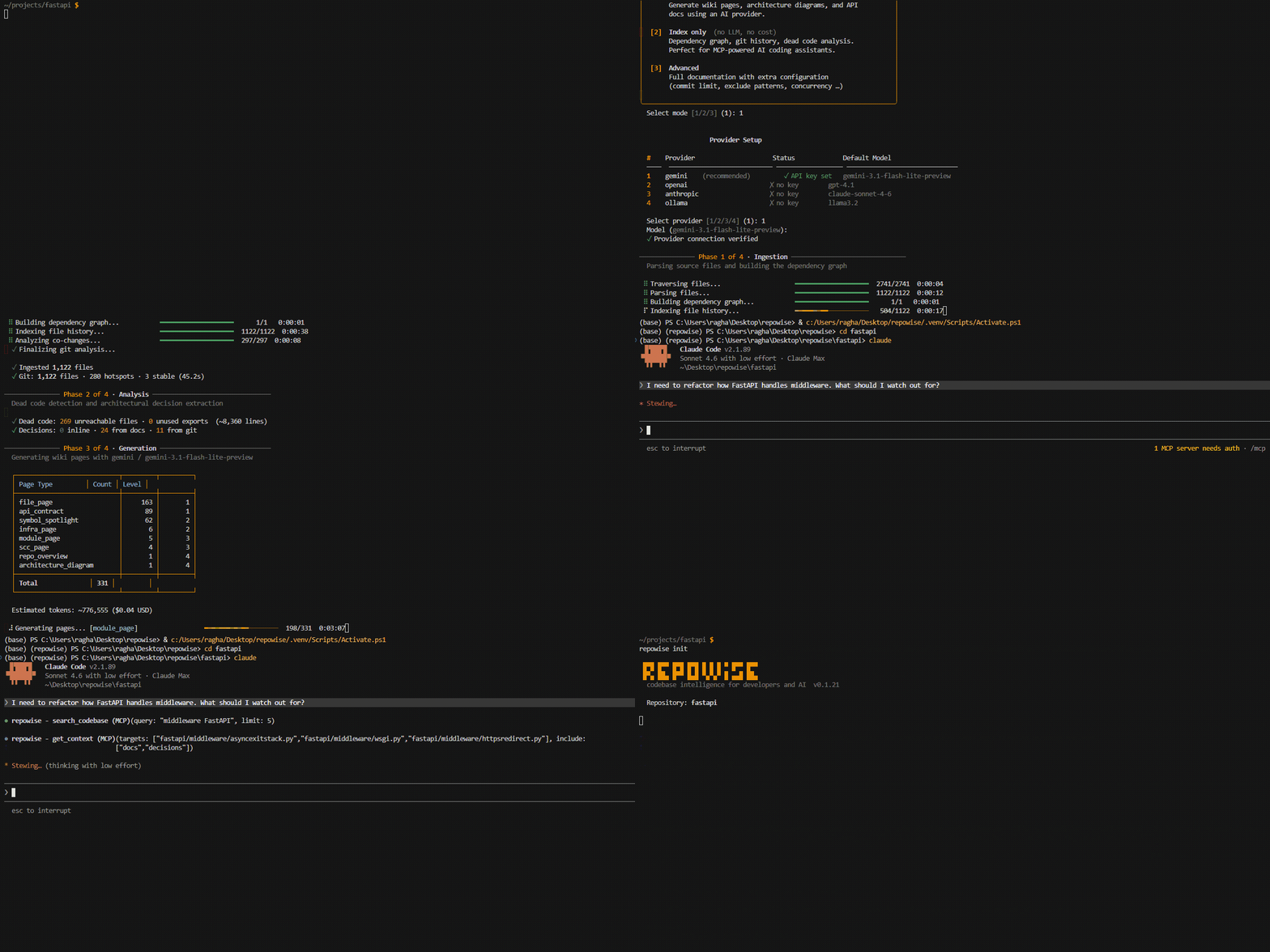
repowise demo: Claude Code querying the codebase through repowise's MCP tools, then a tour of the local dashboard ---
AI now writes a large and growing share of the code, and the humans accountable for it have to trust what ships. A score that says *"this file is risky"* isn't enough: you need to know **where** the risk concentrates and **how** to fix it. repowise closes that loop. It indexes your codebase once and scores **every file for defect risk, maintainability, and performance** from 25 deterministic markers, calibrated against a real defect corpus, no LLM, in under 30 seconds ([the proof ↓](#-code-health-the-layer-nobody-else-nails)). The same index then **locates** the risk through a real dependency graph and git history, and **generates the fix**: concrete, graph-aware refactoring plans (split this god class, move this method, break this dependency cycle, dedup this clone) that your coding agent can execute. And because it is all one index, your agent gets the rest for free: **five intelligence layers**: dependency graph, git history, auto-generated docs, architectural decisions, and code health, exposed to Claude Code, Codex, and any MCP-compatible agent through **ten task-shaped tools**. Your agent answers *"why does auth work this way?"* instead of *"here is what `auth.ts` contains"*, with fewer tool calls, fewer file reads, and lower cost per query, at comparable answer quality ([benchmarks ↓](#benchmarks)). One index: context your agent can use, signals your team can trust, and the fix it can apply. --- ## The five layers repowise runs once, builds everything, then keeps it in sync on every commit. Each layer is queryable from the CLI, the MCP tools, and the local dashboard. | Layer | What it gives you | Edge | |---|---|---| | **◈ Graph** | tree-sitter dependency graph across 15 languages · two-tier file + symbol nodes · 3-tier call resolution · Leiden communities · PageRank / centrality / execution flows · framework-aware route→handler edges | A real graph most tools never build | | **◈ Git** | hotspots (churn × complexity) · ownership % · co-change pairs (hidden coupling) · bus factor · contributor profiles · module health · reviewer suggestions | Behavioral signals static analysis can't see | | **◈ Docs** | LLM-generated wiki per module/file · incremental on every commit · freshness + confidence scoring · hybrid RAG search (FTS + vector via RRF) · selectable wiki styles (comprehensive / reference / tutorial / caveman) · 15 output languages (`init --language zh`) | Stays current, rebuilt every commit | | **◈ Decisions** | architectural decisions mined from **8 sources**, evidence-backed (verified / fuzzy / unverified), linked to graph nodes, connected by `supersedes`/`refines`/`conflicts_with` edges, tracked for staleness | **★ Captured nowhere else** | | **★ Code Health** | **25 deterministic markers**, 1–10 per file · **three signals: defect risk · maintainability · performance** · coverage ingestion · trend alerts · **concrete graph-aware refactoring plans** (Extract Class / Helper / Move Method / Break Cycle / Split File / Extract Method) · **zero LLM, <30s** | **★ Defect-validated, with the fix attached. Our edge** | Full deep-dive on every layer (graph, git, docs, decisions, hooks, auto-sync, dead code, CLAUDE.md generation): **[docs/INTELLIGENCE_LAYERS.md →](docs/INTELLIGENCE_LAYERS.md)** --- ## Learns from how you actually use it repowise doesn't just index once and go stale, it watches how you and your agent work in the repo and tilts itself toward that. All local, all deterministic, no extra LLM calls, and it feeds back through the [hooks](docs/HOOKS.md) at zero agent effort: - **Decisions mined from your own sessions.** repowise reads your Claude Code transcripts for the corrections and conventions you actually enforce ("new endpoints go through the auth middleware", "use the shared HTTP client, not raw requests"), turns the durable ones into tracked decisions, then delivers the relevant ones back: a compact block at session start, and a one-line *"governed by"* notice the moment your agent edits a file that decision governs. If a later session contradicts a decision, it stops being injected. - **Docs that follow your questions.** The wiki generation budget tilts toward the modules you and your agent ask about most (from `get_answer` and `search_codebase` history), so depth lands where you actually work instead of spreading evenly. Silent and byte-identical on a fresh repo with no history. It is a flywheel: **use it → it mines what mattered → it delivers that back on the next session.** How the hooks carry it: **[docs/HOOKS.md →](docs/HOOKS.md)** · decision layer: **[docs/INTELLIGENCE_LAYERS.md →](docs/INTELLIGENCE_LAYERS.md)** --- ## ★ Code Health: the layer nobody else nails Code health is repowise's deepest differentiator: the one layer with no real equivalent, and **the only one we can prove predicts real bugs**. It runs as a loop: **measure** every file across three signals, **locate** where the risk concentrates through the graph and git history, then **fix** it with a concrete refactoring plan your agent can execute.
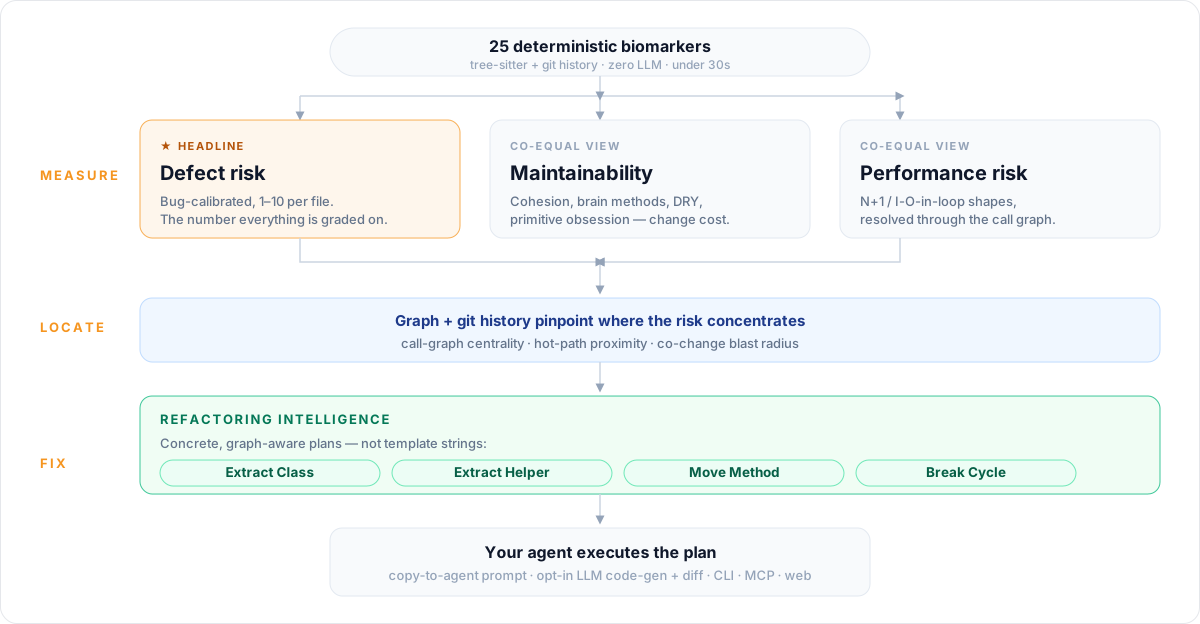
repowise code-health loop: 25 deterministic markers fan into three signals (defect risk, maintainability, performance), the graph and git history locate where risk concentrates, and refactoring intelligence emits concrete plans (Extract Class, Extract Helper, Move Method, Break Cycle, Split File, Extract Method) your agent executes
repowise scores **every file 1–10** from **25 deterministic markers** (McCabe complexity, brain methods, LCOM4 cohesion, god classes, native Rabin–Karp clone detection, untested hotspots, change entropy, prior-defect history, and more), split into **three signals** kept as separate lenses so the headline stays clean: - **Defect risk**, the bug-predictive, defect-calibrated headline 1–10 in the table below. - **Maintainability** (cohesion, brain methods, DRY and god-class smells): what raises change-cost without predicting bugs. - **Performance** (static N+1 / I/O-in-loop risk), traced across files through the call graph: file-local linters found 0 of those cross-function cases on a 12k-file benchmark where repowise surfaced 557. > **Zero LLM calls, zero cloud, zero new runtime dependencies.** Pure Python > over tree-sitter + git data, **under 30 seconds** on a 3,000-file repo, with > marker weights **calibrated against a real defect corpus, not hand-tuned**. ```bash repowise health # KPIs + lowest-scoring files coverage run --contexts=test -m pytest # produce a .coverage with per-test contexts repowise coverage add .coverage # untested-hotspot marker + per-test test-to-code map repowise impacted-tests HEAD~1 # run only the tests a diff actually exercises repowise health --trend # snapshots + declining / predicted-decline alerts ``` It proves itself on *your* repo, not just a benchmark: after every index, repowise checks its own flags against your git history, *"16/20 lowest-health files had a bug fix in the last 6 months, 3.3x the 24% baseline"*. [Does the score find the bugs?](docs/CODE_HEALTH.md#does-the-score-find-the-bugs). **And it out-ranks CodeScene**, the leading commercial code-health tool, on the **same 2,770 files across 9 languages**, scored at the same leakage-free commit against the same defect labels: | Axis (head-to-head, paired tests) | repowise | CodeScene | |---|---:|---:| | **Recall @ 20%-of-lines budget** | **0.173** | 0.074 | | **Effort-aware ranking (Popt)** | **0.607** | 0.462 | | **Defect density, size-normalized (defects/KLOC, Alert:Healthy)** | **2.18×** | 0.56× | Ranking by repowise health surfaces **2.3× the defects under a fixed review budget** (Popt Δ +0.144, recall Δ +0.098, density Δ all p = 0.003, paired and significant). [Full methodology & CIs →](https://github.com/repowise-dev/repowise-bench/blob/master/health-defect/COMPARISON_REPORT.md) User guide & per-marker reference: **[docs/CODE_HEALTH.md](docs/CODE_HEALTH.md)** ### Refactoring intelligence A health score tells you a file is in trouble; every other tool stops there, or prints the same static sentence for every god class. repowise names the **specific** fix, computed deterministically from the graph, class model, and git co-change: **Extract Class**, **Extract Helper**, **Move Method**, **Break Cycle**, **Split File**, **Extract Method**. Each plan names the exact methods, edges, or symbols that move, carries its **blast radius** (callers and co-changing files that must move with it), and is ranked **graph-aware** (`impact × centrality × blast radius`) so a fix on a central hub outranks the same fix on a leaf. That is the wedge: CodeScene's AI refactoring stays inside one function; repowise names the cross-file move and its dependents. Extract Method goes deepest, an intra-procedural dataflow pass (CFG + def/use + reaching definitions) lifts the exact span and infers a behavior-preserving helper signature. The deterministic plan is the product; an optional LLM step (never in the indexing path, only on request) expands any plan into generated code plus a unified diff, fed the graph and co-change context a bare codegen tool throws away. ```bash repowise health --refactoring-targets # ranked plans; get_health(include=["refactoring"]) over MCP ``` The web **Refactoring** tab renders each plan as a card with a **copy-to-agent** button and the opt-in **Generate code** diff view. Per-detector mechanics: **[docs/CODE_HEALTH.md](docs/CODE_HEALTH.md#refactoring-targets)** · full reference: **[docs/REFACTORING.md](docs/REFACTORING.md)** --- ## Change risk & agent provenance Two more deterministic signals, built on the same graph and git history, for the people who have to trust what ships: - **★ Change risk:** score any commit or `base..HEAD` range **0–10** for defect risk from the shape of the diff (Kamei-style just-in-time metrics), with PR-mode directives (`will_break`, `missing_cochanges`, `missing_tests`, `tests_to_run`). One command: `repowise risk main..HEAD`. Reference: **[docs/CHANGE_RISK.md](docs/CHANGE_RISK.md)**. - **★ Agent provenance:** attribute commits to the AI agents that wrote them, straight from git history, so you can see how much of your codebase an agent produced and which of that code is a low-health hotspot owned by a single person. Risk management for AI-era codebases, not developer surveillance. Both are zero-LLM and reproducible. Deep dives on the hosted site: [change risk →](https://www.repowise.dev/features/change-risk) · [agent provenance →](https://www.repowise.dev/features/agent-provenance). --- ## Benchmarks Reproducible, on public codebases. **[repowise-bench →](https://github.com/repowise-dev/repowise-bench)** ### 1 · Agent efficiency: repowise does the exploration once, offline Most of a coding agent's spend goes to *exploration*: greping for symbols, reading candidate files, re-reading them as context grows. repowise does that work once so the agent skips it on every query. Paired SWE-QA runs on real repositories (same model, same harness, with vs without repowise's MCP tools):
**up to −96% tokens to load context  ·  −89% file reads  ·  −70% fewer tool calls  ·  answer quality at parity**
The win is *context*: repowise hands the agent a curated answer instead of a pile of files to read. Loading a commit's context via `get_context` costs **2,391 tokens vs 64,039** raw, **~27× fewer (−96%)**. Across the two benchmarks, agents read **−69% to −89% fewer files** and make **−49% to −70% fewer tool calls** at answer quality on par with raw exploration; on a long, multi-step investigation that compounds to **−41% of the context re-read across the whole session**. Saved tokens are tokens you don't pay for, so dollar cost drops too, though agent-side prompt caching now mutes the cost delta. Reports: [flask48](https://github.com/repowise-dev/repowise-bench/blob/master/BENCHMARK_REPORT_FLASK48.md) · [flask v3](https://github.com/repowise-dev/repowise-bench/blob/master/BENCHMARK_REPORT_FLASK_V3.md) · [sklearn48](https://github.com/repowise-dev/repowise-bench/blob/master/BENCHMARK_REPORT_SKLEARN48.md) ### 2 · Distill: index-aware output distillation Most of what an agent reads from a shell command is noise: 300 lines of passing tests around 4 failures, full commit bodies for "what changed recently". `repowise distill ` compresses command output **before the agent reads it**, errors-first, exit code preserved, and every omission reversible via an inline `[repowise#]` marker (`repowise expand `). Paired runs on a public OSS repo, per command: | Command | Raw → distilled tokens | Saved | |---|---|---:| | `pytest -q` (11 failures) | 3,374 → 1,317 | **61%**, all 11 failure lines preserved | | `git log -50` | 3,064 → 331 | **89%** | | `git diff` (30 commits) | 62,833 → 8,635 | **86%** | Small outputs pass through untouched (net-positive guard), and in an end-to-end spot-check the agent reached the identical root-cause diagnosis from distilled output as from raw. Opt-in Claude Code hook rewrites noisy commands automatically (shown for approval); `repowise saved` tracks tokens and dollars saved. Full guide: **[docs/DISTILL.md →](docs/DISTILL.md)**
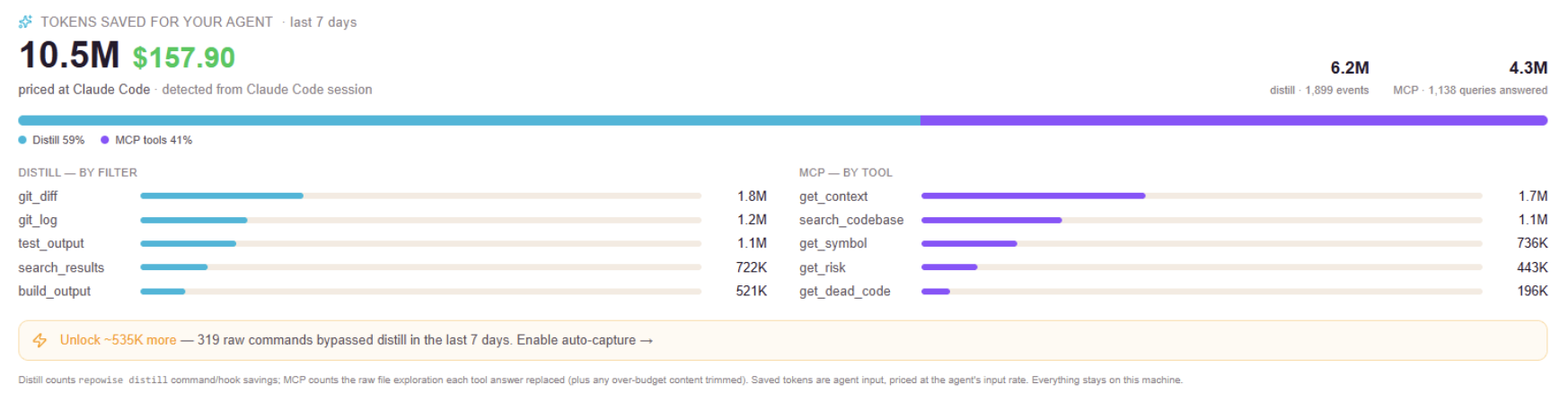
repowise Costs dashboard: tokens and dollars saved across distill and MCP tools

The Costs dashboard tallies both savings surfaces: repowise distill (command output) and the MCP tools (each curated answer replacing the raw file reads it stood in for), priced at your coding agent's own model. Example shown from a week of heavy local use.

### 3 · Code health predicts real defects Health scores are collected at a historical commit (T0); bug-fixing commits are counted over the following 6 months; the two are correlated, with strictly no leakage. Across **21 open-source repositories spanning all 9 Full-tier languages**: - **Cross-project mean ROC AUC 0.74** [95% CI 0.68–0.79] at identifying the files that go on to receive bug-fixes, up to **0.90** on individual repos. - **Survives controlling for file size** (partial Spearman ρ = −0.16), so it is not just "flag the big files." - **Significantly out-discriminates** recent churn (+0.10 AUC) and prior-defect history (+0.12 AUC), DeLong p < 1e-9. - Holds up on an **external published dataset it has never seen** (PROMISE/jEdit CK-metrics: AUC 0.76–0.78, within ~0.03 of the dataset's own tuned model). Full report: **[health-defect/BENCHMARK_REPORT.md →](https://github.com/repowise-dev/repowise-bench/blob/master/health-defect/BENCHMARK_REPORT.md)**
Star the repo if repowise just saved your agent a few greps, it helps the next engineer find it and tells us to keep building.
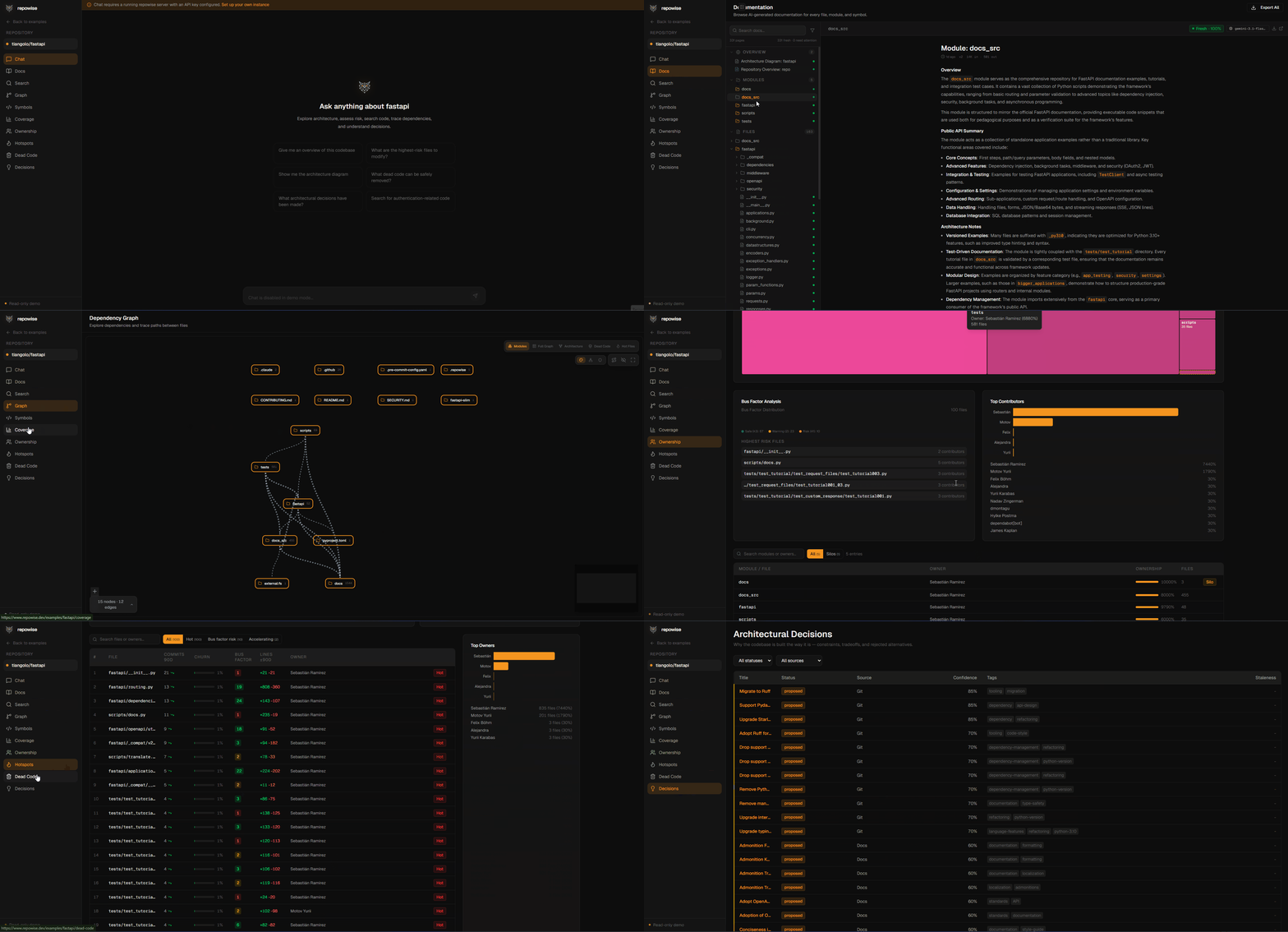
--- ## Local dashboard `repowise serve` starts a full web UI alongside the MCP server, no separate setup. repowise local dashboard: Overview, Knowledge Graph, Code Health map, Commits, Chat, and By the Numbers Highlights: **Chat** (natural-language Q&A) · **Docs** (wiki with Mermaid + graph sidebar) · **Graph** (interactive, 2,000+ nodes, community coloring, path finder) · **C4 Architecture** (Context → Containers → Components) · **Risk** (hotspots, ownership heatmap, module health, dead code, blast radius) · **Contributors** (per-author profiles) · **Decisions** (evidence drawer, evolution timeline, decision-graph) · **Health** (three signals: defect, maintainability, performance; coverage, trends) · **Refactoring** (ranked plan cards, blast radius, copy-to-agent, opt-in code-gen diff) · **Security** (local pattern scan) · **Costs** · **Workspace** (cross-repo contracts & co-changes). Full view-by-view list in [docs/USER_GUIDE.md](docs/USER_GUIDE.md). --- ## VS Code extension The **Repowise** extension puts the index where code gets written: know what your change breaks before you push (your riskiest files ranked, what is downstream, forgotten companion files, missing tests, suggested reviewers), health signals in the gutter and status bar, callers and ownership on hover, refactoring plans as CodeLens, and the full dashboards (health, architecture, knowledge graph, decisions, docs) inside the editor. One install also registers the Repowise MCP server with VS Code, so the same local index serves both you and your AI agent. Quiet by default, everything toggleable, nothing leaves your machine. Install from the Marketplace (search **Repowise**) or Open VSX, then run **Repowise: Set Up This Repository**. Full guide in [docs/VSCODE.md →](docs/VSCODE.md). --- ## Supported languages **15 languages parsed to AST · 11 at the Full tier · framework-aware across all of them.**

Full tier   Python TypeScript JavaScript Java Kotlin Go Rust C++ C# Scala Ruby

Good tier   C Swift PHP Dart  · Partial   Luau

| Tier | Languages | What works | |------|-----------|------------| | **Full** | Python · TypeScript · JavaScript · Java · Kotlin · Go · Rust · C++ · C# · Scala · Ruby | AST parsing, import resolution, named bindings, call resolution, heritage extraction, docstrings; multi-project workspace resolvers; framework-aware edges; per-language dynamic-hint extractors; **code-health markers** | | **Good** | C · Swift · PHP · Dart | AST parsing, import resolution, named bindings, call resolution, heritage (mixins / derive / extensions / traits), docstrings; dedicated workspace-aware resolvers; Laravel / TYPO3 / Flutter framework edges; dynamic-hint extractors; Dart adds code-health + perf markers | | **SQL / dbt** | `.sql` via sqlglot (postgres, mysql, tsql, clickhouse, ...) | Tables / views / functions / procedures as symbols with wiki pages; dbt projects get real `ref()` / `source()` lineage edges: model-level DAG, hotspots, co-change, ownership | | **Shell** | `.sh` · `.bash` · `.zsh` | Functions as symbols, `source` / `.` import edges (`$SCRIPT_DIR` / `dirname` idioms), and function-level code-health complexity. No class metrics, heritage, or dead-code flagging | | **Config / data** | OpenAPI · Protobuf · GraphQL · Dockerfile · Makefile · YAML · JSON · TOML · Terraform · Markdown | Included in the file tree; special handlers extract endpoints / targets where applicable | | **Git-blame only** | Objective-C · Elixir · Erlang · Zig · Julia · Clojure · Haskell · OCaml · F# · … | Tracked in git history (blame, hotspots, co-change); no AST parsing yet | Adding a language needs **one `.scm` query file and one config entry**, with no changes to the parser core. Full per-language matrix, code-health checklist, and the contributor recipe: **[docs/LANGUAGE_SUPPORT.md →](docs/LANGUAGE_SUPPORT.md)** --- ## Who it's for | | Start here | |---|---| | **Individual developers** | `pip install repowise` → `repowise init` → query from Claude Code, Cursor, or any MCP agent. 100% local, BYO API key, free under AGPL-3.0. [For developers →](https://www.repowise.dev/for/developers) | | **Team leads** | Know which PRs to worry about before you merge: change-risk scoring plus the free [**Repowise PR Bot**](https://github.com/apps/repowise-bot) that posts one deterministic comment per PR (hotspots, hidden coupling, declining health), zero LLM. [For team leads →](https://www.repowise.dev/for/teams) | | **Engineering leaders** | See how much of your code AI wrote and whether it is healthy: agent provenance, code-health trends, and bus factor, from git history. [For engineering leaders →](https://www.repowise.dev/for/engineering-leaders) | | **Security & compliance** | Reachability-aware CVE triage, secret detection across full git history, and SBOM, on your real dependency graph. [For security →](https://www.repowise.dev/for/security) | | **Enterprises** | On-prem / air-gapped, SSO/SCIM, commercial licensing (no AGPL obligation), and IP indemnification. [For enterprise →](https://www.repowise.dev/for/enterprise) · [docs/COMMERCIAL.md](docs/COMMERCIAL.md) | --- ## Quick start (under 5 minutes, no API key) *Index once, and give your agent the dependency graph + git history + code-health — not 40 greps.* **1. Install** ```bash pip install repowise # Windows: python -m pip install repowise repowise --version # -> repowise, version 0.27.x ``` **2. Index your repo — no LLM, no key** ```bash cd /path/to/your/repo repowise init --index-only -y ``` Builds the dependency graph, git history, code-health score, and dead-code findings in seconds. (Want the generated wiki + semantic search? Use `repowise init --provider gemini|anthropic|openai` with the matching key.) **3. Connect your agent** — the MCP server is `repowise mcp`, served from the repo dir.
Claude Code ```bash # Plugin (adds 10 tools + slash commands + skills): /plugin marketplace add repowise-dev/repowise /plugin install repowise@repowise # …or wire the MCP server directly: claude mcp add repowise -- repowise mcp ``` Or commit a project `.mcp.json`: ```json { "mcpServers": { "repowise": { "command": "repowise", "args": ["mcp"] } } } ```
Codex CLI Add to `~/.codex/config.toml`: ```toml [mcp_servers.repowise] command = "repowise" args = ["mcp"] ``` Or: `codex mcp add repowise -- repowise mcp`
**4. First real call.** Ask your agent: *"Use repowise `get_overview` to summarize this repo,"* or *"`get_context` for `src/auth.py`."* You get graph-grounded architecture and per-file triage instead of a flurry of greps. ✅ > `get_overview` / `get_context` work in **index-only mode** (no key) — they synthesize > from the graph/git/health layers. `search_codebase` / `get_answer` / `get_why` need > full mode (the generated wiki). Ready for the full picture? Run `repowise init --provider …` for the generated wiki + semantic search, or skip key management entirely with the hosted tier at [repowise.dev](https://www.repowise.dev). Full walkthrough: [docs/QUICKSTART.md](docs/QUICKSTART.md). **Docs:** [Quickstart](docs/QUICKSTART.md) · [User Guide](docs/USER_GUIDE.md) · [CLI Reference](docs/CLI_REFERENCE.md) · [Codex](docs/CODEX.md) · [MCP Tools](docs/MCP_TOOLS.md) · [Hooks](docs/HOOKS.md) · [Distill](docs/DISTILL.md) · [Workspaces](docs/WORKSPACES.md) · [Auto-Sync](docs/AUTO_SYNC.md) · [Upgrading](docs/UPGRADING.md) · [Config](docs/CONFIG.md) --- ## Ten MCP tools Most tools are designed around data entities (one module, one file, one symbol), forcing agents into long chains of sequential calls. repowise tools are designed around **tasks**: pass multiple targets in one call, get complete context back. Every response carries an `_meta` envelope with `index_age_days`, `indexed_commit`, and a `stale_warning` that fires only when the indexed HEAD diverges from live `.git/HEAD`. | Tool | What only this tool answers | |---|---| | `get_overview()` | Architecture summary, module map, entry points, git health, community summary. First call on any unfamiliar codebase. | | `get_answer(question)` | Hybrid retrieval (FTS + vector via RRF) + PageRank bias + 1-hop graph expansion → a cited answer with calibrated `retrieval_quality`. Returns structured `best_guesses` on low confidence. Collapses search → read → reason into one round-trip. | | `get_context(targets, include?)` | Triage card for files / modules / symbols: title, summary, signatures, `hotspot` bit, `governing_decisions`, and `symbol_id`s. `include` opens callers/callees, ownership, metrics, decisions, full_doc. Batch many targets. | | `get_symbol("file.py::Name")` | Raw source bytes for one indexed symbol with exact line bounds, cheaper and safer than `Read` + offset math. | | `search_codebase(query, kind?)` | Semantic search over the wiki, filterable by `kind` (implementation / test / config / doc), tagging each result's `search_method`. | | `get_risk(targets, changed_files?)` | Hotspot scores, dependents, co-change partners, ownership, test gaps, security signals. Pass `changed_files` for PR mode → a `directive` block (`will_break`, `missing_cochanges`, `missing_tests`, `tests_to_run`, `governance_risk`). | | `get_change_risk(revspec, extensions?)` | Pre-merge defect score for a whole commit or `base..head` range from the shape of the diff (Kamei-style JIT metrics), ranked as a `risk_percentile` against recent commits. Scores the change; `get_risk` scores the indexed files it touches. | | `get_why(query?, targets?)` | Architectural decision records, status, evidence spans, and the supersession **lineage chain**. Falls back to git archaeology when no ADRs exist. | | `get_dead_code(...)` | Unreachable code by confidence tier with cleanup-impact estimates; cross-repo consumer detection in workspace mode. | | `get_health(targets?, include?)` | Marker scores per file across three signals (defect · maintainability · performance). Dashboard mode → KPIs + lowest-scoring files + module rollup; targeted mode → per-file findings. Self-check before a PR via `include`: `accuracy` (does the score find the bugs), `signals` (per-file churn / owners / prior defects), `churn_complexity`, a dimension name to filter findings, plus `coverage`, `trend`, and `refactoring` → **structured, graph-aware refactoring plans** (split groups, move target, cut edges + blast radius), not template strings. | Worked example (*"Add rate limiting to all API endpoints"* in 5 calls instead of ~30 greps+reads) and the full reference: **[docs/MCP_TOOLS.md →](docs/MCP_TOOLS.md)** --- ## How it compares | | repowise | Google Code Wiki | DeepWiki | Swimm | CodeScene | |---|---|---|---|---|---| | Self-hostable, open source | ✅ AGPL-3.0 | ❌ cloud only | ❌ cloud only | ❌ Enterprise only | ✅ Docker | | Private repo, no cloud | ✅ | ❌ in development | ❌ OSS forks only | ✅ Enterprise tier | ✅ | | Auto-generated documentation | ✅ | ✅ Gemini | ✅ | ✅ PR2Doc | ❌ | | MCP server for AI agents | ✅ 10 tools | ❌ | ✅ 3 tools | ✅ | ✅ | | Proactive agent hooks | ✅ Claude + Codex hooks | ❌ | ❌ | ❌ | ❌ | | Auto-generated AI instructions (`CLAUDE.md`, `AGENTS.md`) | ✅ | ❌ | ❌ | ❌ | ❌ | | Learns from your usage (session-mined decisions, demand-weighted docs) | ✅ | ❌ | ❌ | ❌ | ❌ | | Code health score (1–10) | ✅ 25 markers | ❌ | ❌ | ❌ | ✅ 25–30 | | Brain Method / LCOM4 / god class | ✅ | ❌ | ❌ | ❌ | ✅ | | Test-coverage intelligence | ✅ LCOV/Cobertura/Clover | ❌ | ❌ | ❌ | ❌ | | Untested-hotspot detection | ✅ coverage × hotspot | ❌ | ❌ | ❌ | ❌ | | Health trend + declining alerts | ✅ rolling snapshots | ❌ | ❌ | ❌ | ✅ | | Refactoring recommendations | ✅ deterministic | ❌ | ❌ | ❌ | ✅ | | Concrete cross-file refactoring plans (Extract Class / Move Method / Break Cycle) | ✅ graph-aware + blast radius | ❌ | ❌ | ❌ | ⚠️ within-function only | | Dataflow-verified within-function plans (Extract Method with inferred signature) | ✅ CFG + reaching definitions | ❌ | ❌ | ❌ | ⚠️ LLM-generated, unverified | | Git intelligence (hotspots, ownership, co-change) | ✅ | ❌ | ❌ | ❌ | ✅ | | Bus factor analysis | ✅ | ❌ | ❌ | ❌ | ✅ | | Dead code detection | ✅ | ❌ | ❌ | ❌ | ❌ | | Architectural decision records | ✅ | ❌ | ❌ | ❌ | ❌ | | Multi-repo workspace intelligence | ✅ co-changes, contracts, federated MCP | ❌ | ❌ | ❌ | ❌ | | Local dashboard | ✅ | ❌ | ❌ | ❌ IDE only | ✅ | **repowise is the intersection:** behavioral git intelligence + a defect-validated code-health score *with the graph-aware fix attached* + auto-generated docs + agent-native MCP + architectural decisions + multi-repo workspace intelligence, self-hostable and open source. Full side-by-side comparisons (CodeScene, DeepWiki, Sourcegraph, Cursor, GitClear): **[repowise.dev/compare →](https://www.repowise.dev/compare)**. --- ## For teams & enterprises [**repowise.dev**](https://www.repowise.dev) is the same engine, fully managed, at feature parity with self-hosted: every CLI command, every MCP tool, the full dashboard. We dogfood it on our own codebase: [live snapshot →](https://www.repowise.dev/s/5a6b93fa9a69) · [explore public repos →](https://www.repowise.dev/explore). **On top of self-hosting:** - **Zero ops**: managed deploys & webhooks, auto re-index on every commit. - **Hosted MCP endpoint**: point any MCP client at one URL, no local server. - **Repowise PR Bot**: free GitHub App, one deterministic comment per PR (hotspot touches, hidden coupling, declining health, dead code), zero LLM calls. [Install →](https://github.com/apps/repowise-bot) · [Learn more →](https://www.repowise.dev/bot) - **CVE-aware security layer**, **cross-repo intelligence at scale**, and **integrations** (Slack, Jira/Linear, Confluence/Notion, PagerDuty) *(rolling out)*. What's GA / in development / planned, on-prem topology, SSO/SCIM/RBAC, and pricing: **[docs/COMMERCIAL.md](docs/COMMERCIAL.md)** · [Get in touch →](https://www.repowise.dev/#contact) --- ## Privacy - **Self-hosted:** your code never leaves your infrastructure, so no code, file paths, or repo names are ever sent. The CLI does report **anonymous, opt-out** usage telemetry (command names + coarse environment only) to help us prioritize; turn it off with `repowise telemetry disable`, `DO_NOT_TRACK=1`, or by running fully offline. [What's collected →](docs/TELEMETRY.md) - **BYOK:** bring your own Anthropic / OpenAI key. We never see your LLM calls. Zero data retention via Anthropic's API policy. - **What's stored:** the NetworkX graph, LanceDB embeddings (non-reversible vectors), generated wiki pages, git metadata. Raw source is processed transiently and never persisted. - **Fully offline:** Ollama + a local embedding model = zero external API calls. --- ## CLI & configuration ```bash repowise init [PATH] # index codebase (one-time; --index-only skips LLM) repowise serve [PATH] # MCP server + local dashboard repowise update [PATH] # incremental update (<30s; --workspace for all repos) # git worktrees auto-seed from the base checkout (docs/WORKTREES.md) repowise search "" # search the wiki (fulltext / semantic / symbol) repowise health # code-health KPIs + lowest-scoring files repowise risk main..HEAD # score a branch / PR range for defect risk repowise dead-code # unreachable-code report repowise distill pytest # compact errors-first output (reversible), saves 60–90% tokens repowise saved # tokens & dollars saved by distillation repowise doctor # check setup, API keys, store drift ``` `repowise init` generates `.repowise/config.yaml` (provider, model, embedder, reasoning mode, exclude patterns, git commit depth). Full command set: **[docs/CLI_REFERENCE.md](docs/CLI_REFERENCE.md)** · config reference: **[docs/CONFIG.md](docs/CONFIG.md)**. --- ## Contributing ```bash git clone https://github.com/repowise-dev/repowise cd repowise uv sync --all-packages uv run repowise --version uv run pytest tests/unit/ ``` Full guide, including how to add languages and LLM providers: [CONTRIBUTING.md](.github/CONTRIBUTING.md). --- ## License AGPL-3.0. Free for individuals, teams, and companies using repowise internally. For commercial licensing (the enterprise security & compliance layer, SSO/SCIM, RBAC, workflow integrations, priority support and SLA, or embedding repowise in a product without AGPL obligations), see **[docs/COMMERCIAL.md](docs/COMMERCIAL.md)** or contact [hello@repowise.dev](mailto:hello@repowise.dev). ---
Built for engineers who got tired of watching their AI agent cat the same file for the fourth time.

⭐ If repowise earns a place in your workflow, give it a star. It costs you nothing, and it's the signal that keeps a small team building this in the open.

repowise.dev · Explore → · Discord · X · hello@repowise.dev