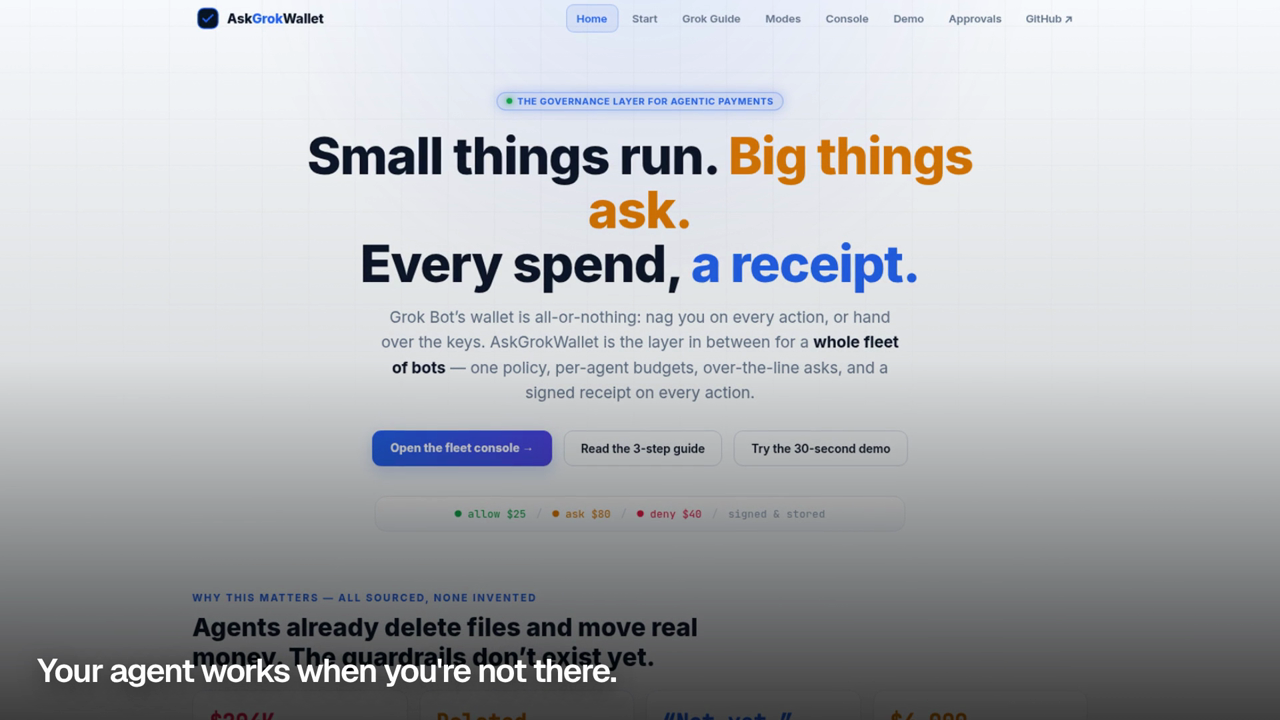
AskGrokWallet — the 30-second product walkthrough

AskGrokWallet

The rules-and-receipts layer for AI agents that spend money.

Small things run · big things ask · everything leaves a receipt

MIT live onchain ERC-8196 20 contract tests passing receipt verifier 1.0.1 Runtime NYC 2026

> **Unaudited developer preview.** The guarded end-to-end path has been exercised > on Ethereum Sepolia with mock assets. Contracts are deployed on Base mainnet, > but no mainnet-value settlement has been demonstrated. Do not use this project > to protect production funds yet. Giving an agent a wallet is easy. Giving it a wallet with **rules** is not. ```text agent request → policy (allow / ask / deny) → execute, or a human decides → signed receipt → anchored log ``` AskGrokWallet sits between the agent and the money. Three things are load-bearing, and each one is checkable from outside this repository: 1. **The policy is enforced, not suggested.** In `guarded` mode the agent's funds live in a vault and an out-of-policy action **reverts at the contract**, before any value moves. The bound is a revert, not a setting. 2. **A human is in the loop for exactly the actions that need one.** "Payments under $50 run, over $50 ask me" compiles to `allow / ask / deny`; only the `ask` cases reach the approval inbox. 3. **Every outcome leaves a receipt a stranger can verify** — four lines from one dependency-free file: the signature over every field that matters (including where the money went), the receipt's fixed position in an append-only hash-chained log, and the log head anchored in a blockchain transaction. No account, no trust in us. **Watch it work (30s):** [walkthrough video](https://askgrokwallet.io/askgrokwallet-demo.mp4) · **Try it:** [interactive demo](https://askgrokwallet.io/demo) · [approval inbox](https://askgrokwallet.io/approvals) · **Live site:** [askgrokwallet.io](https://askgrokwallet.io) --- ## For Judges — Runtime NYC, 19 September 2026 | What | Where | | --- | --- | | Live product | https://askgrokwallet.io | | Submission demo, 2:53 (video) | [askgrokwallet.io/askgrokwallet-demo-runtime.mp4](https://askgrokwallet.io/askgrokwallet-demo-runtime.mp4) — the product walkthrough plus the verification and outside-review segments | | 30-second demo (video) | [askgrokwallet.io/askgrokwallet-demo.mp4](https://askgrokwallet.io/askgrokwallet-demo.mp4) · also committed at [`assets/askgrokwallet-demo.mp4`](assets/askgrokwallet-demo.mp4) | | Interactive demo + approval inbox | [/demo](https://askgrokwallet.io/demo) · [/approvals](https://askgrokwallet.io/approvals) | | Public receipt log (live JSON) | https://askgrokwallet.io/api/receipts/chain | | Receipt verifier — one file, zero dependencies | [release `verify-receipt-v1.0.1`](https://github.com/richard7463/askgrokwallet/releases/tag/verify-receipt-v1.0.1) · sha256 `32de3cad6f3bb23ae8415cd5afe5f54dd8167432a2473814e6ab4ec0b767317a` · check the hash **before** you run the file: `curl -sLO …/SHA256SUMS && shasum -a 256 -c SHA256SUMS` | | Check it yourself, in one command | `node spec/judge-check.mjs` — asserts the verifier is the released bytes, verifies a real receipt against the live log, and reports the log's size and integrity | | Write your own verifier, then check it | [`spec/vectors/`](spec/vectors/) — frozen canonical-bytes, hash and signature vectors, plus two implementations (Node and Python) that must reproduce the same bytes: `node spec/vectors/run-vectors.mjs` | | Show an auditor everything, the public nothing | [`spec/audit-bundle.md`](spec/audit-bundle.md) — receipts plus their log evidence, sealed to an auditor's key; `node spec/verify-audit-bundle.mjs` opens, verifies and reports, including what it cannot prove | | Onchain proof | [transactions and blocks](#live-proof--checked-2026-09-18) · [deployed contracts](#deployed-and-verified-contracts) | | Tests you can run in three minutes | 20 contract tests · 13 verifier behaviour assertions · plugin package smoke test — see [Local run](#local-run) | | Track entered | **Bankr grand prize** — agentic commerce / autonomous financial agents | | Repository map | [below](#repository-map) | ### Judging scorecard Bankr judges in this order: **Product**, **Founder-Market-Fit**, **Execution**. | Criterion | Our answer | Open this to check | | --- | --- | --- | | **Product** — useful, compelling, something people would want | Agents already move money (Grok Bot, Cursor, scripts). The two things their operators cannot get today are a **bound** the agent cannot talk its way past and a **record** a third party will accept. This is both, in one loop: policy → human when needed → execution → receipt. | [30s video](https://askgrokwallet.io/askgrokwallet-demo.mp4) · [live demo](https://askgrokwallet.io/demo) · [three modes](#three-modes--pick-by-where-the-keys-live) | | **Founder-Market-Fit** — disrupting something in the current stack | The stack splits the problem: wallets (MetaMask Guard Mode, Coinbase CDP, Turnkey) hold funds; card rails (Stripe Link) approve per purchase; provider dashboards log what their own service did. None of them hands the operator an enforceable bound *plus* a receipt that survives being shown to someone who does not trust the operator. | [What makes this different](#what-makes-this-different) | | **Execution** — how much actually works | Live product; contracts deployed on Base mainnet and exercised end-to-end on Sepolia with real transfers and anchored receipts; 20 contract tests; a versioned standalone verifier with an offline behaviour test; an outside reviewer broke that verifier, and the fix shipped as a pinned release with their repro kept as a test. | [Live proof](#live-proof--checked-2026-09-18) · [Outside review](#outside-review-kept-as-a-test) | --- ## Live proof — checked 2026-09-18 Every number and address below was read from the chain or from the live service on 2026-09-18. Open the explorers and check them. ### Guarded execution, end to end (Ethereum Sepolia, chainId 11155111) One round, in order: the lease, operator and budget checks pass → the vault moves mock USDC → the receipt-log head is written onchain. | Step | Transaction | Block | Result | | --- | --- | --- | --- | | Guarded vault transfer | [`0xbaf2c3776398e4f8d891b4e3da218361cfa6e79fb72edd603f11e8bf5a5e58e3`](https://sepolia.etherscan.io/tx/0xbaf2c3776398e4f8d891b4e3da218361cfa6e79fb72edd603f11e8bf5a5e58e3) | `11626574` | success → `BoundlessVault` | | Receipt-log anchor | [`0x1bd82e543f2ddb33348f3bd3f5b06ab44946ed26ef857c6efb36e69d88d3628e`](https://sepolia.etherscan.io/tx/0x1bd82e543f2ddb33348f3bd3f5b06ab44946ed26ef857c6efb36e69d88d3628e) | `11626575` | success → `TrustLeaseController` | ### Deployed and verified contracts **Base mainnet (chainId 8453)** — bytecode present at every address, checked 2026-09-18: | Contract | Address | Size | Explorer | | --- | --- | --- | --- | | `TrustLeaseController` (ERC-8196 policy + receipt anchors) | `0x4ACcB1df8cc625AC05743888158CC3B866aC9833` | 18,800 B | [BaseScan](https://basescan.org/address/0x4ACcB1df8cc625AC05743888158CC3B866aC9833) | | `BoundlessVault` (custody; the only contract that moves tokens) | `0xd9526Eb615f5e252341b5a83b3c26eCca4f1284e` | 11,145 B | [BaseScan](https://basescan.org/address/0xd9526Eb615f5e252341b5a83b3c26eCca4f1284e) | | `VerificationScoreRegistry` (ERC-8126 scores the gate reads) | `0x89c8B3d053a79A0bd5A47597aaF97729f504d359` | 2,558 B | [BaseScan](https://basescan.org/address/0x89c8B3d053a79A0bd5A47597aaF97729f504d359) | | Mock USDC (demo asset) | `0x17058C78CFE90314dd349C7fAC71Bb4f0A8f0852` | 1,831 B | [BaseScan](https://basescan.org/address/0x17058C78CFE90314dd349C7fAC71Bb4f0A8f0852) | **Ethereum Sepolia (chainId 11155111)**, where value-moving rounds are demonstrated: controller `0x6f8a3cc28c607462643b0e656f621f3f279afb70` · vault `0x785aaf81456f9d136501f74520dc12d1eb33f5fd` · registry `0xfe5b824c99b413db2d8526c8df10667df3f69026` · mock USDC `0x860ee8efbaf9c72aac3cedcbaf65fb2756f71db2`. Deployment record: [`contracts/deployments/base-mainnet.json`](contracts/deployments/base-mainnet.json). BaseScan source verification has not been submitted yet; the canonical source is [`contracts/`](contracts/) here, which is what the CI suite compiles. ### Receipts, live | Check | Value (live, 2026-09-19) | Where to look | | --- | --- | --- | | Public log | `intact: true`; entries and anchors grow with every receipt | https://askgrokwallet.io/api/receipts/chain | | Verifier version | `verify-receipt 1.0.1` | [release](https://github.com/richard7463/askgrokwallet/releases/tag/verify-receipt-v1.0.1) | | Verifier sha256 | `32de3cad6f3bb23ae8415cd5afe5f54dd8167432a2473814e6ab4ec0b767317a` | `node verify-receipt.mjs --version` | | Live mirror | identical bytes to the release | `curl -sO https://askgrokwallet.io/verify-receipt.mjs && node verify-receipt.mjs --version` | ### The agent's own wallet, on Base mainnet — 2026-09-18 The policy layer is not the only place a bound can live. AskGrokWallet compiles the address-and-amount half of a policy into **wallet-layer rules** that a signing infrastructure enforces before a transaction is signed, and the agent's money sits in a wallet our backend never holds a key for (a server wallet: MPC key shares, API-token auth, no raw key in our process or the agent's). | Rule enforced before signing | Shape | | --- | --- | | No key export, ever | `deny` + `operationRestrictions.blockExport` | | Blocked counterparty | `deny` + `0x9999…9999` | | Allowed payee + USDC (its proxy **and** implementation) | `allow` + `valueLimit.maxPerCall = 50 USDC` | | Action | Transaction | | --- | --- | | Guarded payment, 0.10 USDC from the agent's wallet | [`0x2d73c475be9be8bfee8baffd699ffb34b9d18cf80a7a0c17e5ad1583d1181c0a`](https://basescan.org/tx/0x2d73c475be9be8bfee8baffd699ffb34b9d18cf80a7a0c17e5ad1583d1181c0a) | | Same payment without the rules in place (control) | [`0x93b5b65282fe62569606627789c4b493a4bcd5020aec92ea4eac4a72a21bd97c`](https://basescan.org/tx/0x93b5b65282fe62569606627789c4b493a4bcd5020aec92ea4eac4a72a21bd97c) | | Refused: payment to the blocked counterparty | nothing broadcast | | Refused: payment above the per-call limit | nothing broadcast | This closes the "no mainnet-value settlement has been demonstrated" gap: real USDC, Base mainnet, from a wallet whose key is not in our backend, with the bound enforced inside the signing infrastructure rather than in a log written afterwards. ### Outside review, kept as a test A reviewer on the Cursor forum ran the verifier against the demo and found a real bug: a transaction that was broadcast but still in the mempool (`blockNumber: null`) was reported as `onchain ✓ … block 0`, because `Number(null)` is `0`. A transaction in the mempool can be dropped, replaced or reorged away, so that line claimed the one thing the check exists to prove, before it was true. Fixed in 1.0.0, and their repro now lives in this repository: [`spec/test-verify-receipt.mjs`](spec/test-verify-receipt.mjs) runs the verifier against a stub node and a stub log, with no network. It **fails on the previous build with six assertions** — including `block 0` — and passes now. The same change covers a reverted anchor transaction, which used to read as fixed as well. **A second outside review found the same class of bug one layer deeper.** The maintainer of the Bankr skills repository read the released 1.0.0 bytes and noticed that the receipt question had three non-answers — no receipt, an RPC error, a receipt without a `status` — and all three fell through to `onchain ✓`. Inclusion was checked; execution was assumed. That is fixed in **1.0.1**, and their three cases are the `3b` block of the same test file: they **fail against the 1.0.0 bytes** (`ba066e7c…`) and pass against 1.0.1 (`32de3cad…`). Two outside reviewers, two real holes, both closed with a published release and a failing test kept in the repository. That is what the verification story has to survive to mean anything, and it is why the hash is pinned rather than the URL: you compare bytes, not a promise. --- ## How it works ```mermaid flowchart LR A["Agent
Grok Bot · Cursor · script"] -->|"intent + policy"| P["Policy engine
allow / ask / deny"] P -->|allow| X["Execution boundary"] P -->|ask| H["Human approval inbox"] H -->|approve| X H -->|deny| R["Signed receipt"] P -->|deny| R X -->|guarded mode| V["BoundlessVault
Base mainnet + Sepolia"] X -->|advisory / watchdog| W["Agent wallet
EOA, host-side gate"] X --> R["Signed receipt
Ed25519"] R --> C["Hash-chained receipt log"] C -->|"head anchored"| V C -->|"anyone can re-check"| Z["verify-receipt.mjs
no install · no trust"] ``` ```mermaid sequenceDiagram participant A as Agent participant P as Policy engine participant H as Human participant V as BoundlessVault participant L as Receipt log A->>P: POST /api/approvals (intent + policyText) P->>P: compile + evaluate (deny → ask → allow → default) alt allow — inside the rules P->>V: execute under lease (policy, budget, allowlist) else ask — outside them P->>H: approval request in the inbox H-->>P: approve (signed decision) P->>V: execute under lease else deny — forbidden P-->>A: refused, with the rule that fired end V-->>P: tx hash P->>L: sign receipt (Ed25519) + append to the chain Note over L: the head is anchored onchain — history becomes unrewritable A->>L: verify-receipt.mjs receipt.json (no install, no account) ``` ## What makes this different | | Wallets with limits *(MetaMask Guard Mode, Coinbase CDP, Turnkey)* | Card rails *(Stripe Link)* | Provider dashboards | **AskGrokWallet** | | --- | --- | --- | --- | --- | | Bound on what the agent may do | ✅ per-transaction limits | ✅ per-purchase approval | ✅ inside their own product | ✅ a plain-English policy compiled to `allow / ask / deny`, across amount, action type, counterparty and budget | | Who decides the "ask" cases | app prompt | card holder | their support flow | your operator, in one inbox, with the rule that fired attached | | Enforcement point | their wallet | their network | their service | **contract revert** on the value-moving rail (`guarded`), or a host signing gate (`watchdog`) | | Record of what happened | their log | their statement | their dashboard | an Ed25519 receipt you hold, checkable offline | | Can a third party verify it? | no — self-attested | no | no | **yes** — signature + log position + onchain anchor, with a one-file verifier | | Works across agent hosts | per wallet | one rail | one provider | one policy model over MCP (`Grok Bot`, `Cursor`, scripts) | ## Three modes — pick by where the keys live The mode follows the agent's custody, not preference, and the product never claims protection a mode cannot deliver: | Mode | Who holds the keys | What AskGrokWallet enforces | Where it runs today | | --- | --- | --- | --- | | `advisory` | the agent (EOA, keys local) | policy verdicts + signed receipts. It **cannot** stop a direct chain signature — no third party can, for an EOA. | hosted demo | | `guarded` | `BoundlessVault` contract | everything onchain: policy, budget, drawdown, allowlists. Out-of-rule actions **revert** before funds move; the agent holds no naked key. | Sepolia end-to-end (proof above); Base mainnet deployed | | `watchdog` | the agent, on its host | a signing gate: `sendTransaction` asks first — `allow` signs, `ask` waits for a human, `deny` never signs. Action types pass the same gate. | implemented in the application repository, with unit tests; not part of this public repository | `advisory` and `watchdog` compose with `guarded` (host gate + vault gate). A watchdog still cannot stop an agent from exfiltrating a raw private key — key hygiene is a different layer, and saying otherwise would be a lie. ## Execution rails — the bound moves with the money The policy and the receipt are the same everywhere; what changes is *where the bound is enforced*, and that follows where the agent's funds actually live. Two rails run today, a third is deliberately labelled as the weakest, and the receipt does not care which one produced it — that rail-independence is the point. | Rail | Who holds the funds | Where the bound is enforced | Evidence | | --- | --- | --- | --- | | **Contract (BoundlessVault)** | the vault, under an ERC-8196 lease | the contract **reverts** before value moves | Sepolia [`0xbaf2c377…`](https://sepolia.etherscan.io/tx/0xbaf2c3776398e4f8d891b4e3da218361cfa6e79fb72edd603f11e8bf5a5e58e3) | | **The agent's own wallet** | a server wallet — MPC key shares, no raw key in our backend or the agent's process | **wallet-layer rules evaluated before signing** (allowlist, per-call value limit, key export blocked) | Base mainnet [`0x2d73c475…`](https://basescan.org/tx/0x2d73c475be9be8bfee8baffd699ffb34b9d18cf80a7a0c17e5ad1583d1181c0a) + two refusals that broadcast nothing | | `watchdog` (host gate) | the agent's own EOA | a signing hook inside the agent's process | unit tests — **the weakest rail**, bypassed by anything holding a raw key, and we say so | | **x402 / metered API rails** | planned | the approval boundary is designed to compose with conditional payments | not implemented | Why the second rail matters: a wallet vendor can enforce its own rules on its own wallet, and a host can put a switch in its own UI. Neither can hand the operator a record that a counterparty, an auditor or a marketplace accepts **without trusting the operator**. That is the layer this repository is, and it is the reason the bound and the proof are separate things. ## Quickstart ### 1. Install the plugin package ```bash grok plugin install richard7463/askgrokwallet --trust ``` This repository carries `.grok-plugin/plugin.json`, `.cursor-plugin/plugin.json` and the root `SKILL.md`. The marketplace listing is [xai-org/plugin-marketplace#341](https://github.com/xai-org/plugin-marketplace/pull/341) (open); until it merges, this is the repository install path. Review the package before granting `--trust`. ### 2. Write the policy in plain English ```text # payments payments under $50 run automatically; over $50 ask me; never pay blacklisted merchants; daily budget $200 # trading (examples/policy-trading.txt) trades under $10 run automatically; over $10 ask me; max drawdown $50; daily loss limit $20; never trade pump-dump tokens ``` Beyond amounts, the engine gates **action types**: `transfer · purchase · billPay · refund · trade · cancel · downgrade · upgrade · delete · send · apply · update`. Consequential kinds (`cancel`, `delete`, `send`, …) with no explicit rule default to `ask`, so silence fails safe. Evaluation order is fixed: deny → ask → allow → default. ### 3. Evaluate every money move before it happens ```bash curl -s https://askgrokwallet.io/api/approvals \ -H 'Content-Type: application/json' \ -d '{ "source": "demo", "requester": "my-trading-bot", "summary": "swap 5 USDC for ETH", "amountUsd": 5, "target": "uniswap", "policyText": "trades under $10 run automatically; over $10 ask me; max drawdown $50; daily loss limit $20", "drawdownUsd": 3, "lossTodayUsd": 1 }' ``` | Situation | Verdict (tested live) | | --- | --- | | $5 swap, within limits | `allow` → auto-allowed receipt, Ed25519 signature | | $25 swap, over the $10 line | `ask` → approval request created, `id` returned | | $5 swap while drawdown is $60 ≥ $50 | `ask` → "auto-trading paused" | | Token flagged as a pump-dump | `deny` → denied receipt carrying the reason | `source: "demo"` is the keyless demo identity. Any other source needs `Authorization: Bearer `; unauthenticated non-demo writes get `401`. ### 4. Decide, then verify the receipt without trusting us ```bash # a human decides curl -s -X POST https://askgrokwallet.io/api/approvals/APPROVAL_ID \ -H 'Content-Type: application/json' \ -d '{ "decision": "approve", "by": "operator@demo" }' # anyone checks the outcome — pinned release, not a moving URL BASE=https://github.com/richard7463/askgrokwallet/releases/download/verify-receipt-v1.0.1 curl -LO $BASE/verify-receipt.mjs && curl -LO $BASE/test-verify-receipt.mjs curl -sLO $BASE/SHA256SUMS && shasum -a 256 -c SHA256SUMS # check the bytes BEFORE running them node verify-receipt.mjs --version # 1.0.1 + the sha256 of the bytes you hold node test-verify-receipt.mjs # check the verifier itself — no network node verify-receipt.mjs receipt.json ``` Four lines come back, each marked `✓` (proven), `✗` (provably wrong) or `~` (not checked). The three checks rest on different things: **signature** is fully offline and covers every field that matters, including the payee address and the tx hash; **chain** places this receipt's signing event at a fixed position in an append-only log linked back to entry 1; **onchain** finds that log's head inside a blockchain transaction and requires it to be **in a block, successful**. An anchor that is only broadcast reads as `~` "broadcast but not in a block yet"; a reverted one reads as `~` with the reason. An anchor whose outcome the node would not report — no receipt, an RPC error, no `status` field — also reads as `~`, because unknown is not the same claim as settled. None of them claims to be fixed, because none of them is. And a `✓` is a statement about the **record**, not about a payment: an approval or a denial authenticates exactly as well as a payment, and `~` means *unverified*, not *fine*. If you need "did the money move", read the transaction the receipt names and compare it to what was authorized — the verifier will not make that claim for you. - Three-command quickstart against a real anchored receipt: [`spec/QUICKSTART.md`](spec/QUICKSTART.md) - The full specification, enough to write your own verifier: [`spec/receipt-v3.md`](spec/receipt-v3.md) - Version history of the verifier: [`spec/CHANGELOG.md`](spec/CHANGELOG.md) There is also a hosted check endpoint — deliberately weaker, because it asks the issuer whether the issuer's own receipt is good: ```bash curl -s -X POST https://askgrokwallet.io/api/receipts/verify \ -H 'Content-Type: application/json' -d @receipt.json # { "verified": true } ``` Change the amount, target, payee address, verdict, decision or tx hash after signing and it flips to `false`. Full API reference: [`docs/api.md`](docs/api.md). ## Standards alignment The onchain rail implements [ERC-8196 — AI Agent Authenticated Wallet](https://eips.ethereum.org/EIPS/eip-8196) as a dedicated policy execution module: - **`IAIAgentAuthenticatedWallet`** — `registerPolicy` / `executeAction` / `revokePolicy` / `getPolicy`, with the standard's events and error codes - **EIP-712 `AgentAction` signatures** — the agent signs every action, bound to its `policyHash`; the owner's key never leaves the owner - **Hash-chained audit trail** — every signed action and settled receipt links to the previous entry; `verifyAuditChain` detects tampering - **ERC-8126 risk gate** — `VerificationScoreRegistry` takes EIP-712 attestations from a verification provider, and execution rejects agents whose current score exceeds the policy's `minVerificationScore` - **Entropy commit-reveal** — action signatures carry an entropy commitment with onchain reveal verification - **Active containment** — revoke a policy or pause the operator, and the authority dies immediately Semantics confirmed with the ERC-8196 authors in the official thread (2026-09-04): `minVerificationScore` is a ceiling (reject when the score *exceeds* it), and `executeAction` performs no second identity lookup — the only risk hook is the ERC-8126 score by `policy.agentId`. Alignment notes: [`contracts/docs/erc8196-alignment.md`](contracts/docs/erc8196-alignment.md). ERC-8196 answers "is this action authorized right now?". AskGrokWallet adds the human-in-the-loop middle ground the standard leaves open — *small things run, big things ask* — and every approval or denial is itself signed and anchored into the same tamper-evident chain. ## Repository map | Path | What is in it | | --- | --- | | [`contracts/`](contracts/) | Solidity 0.8.24 Hardhat project: `TrustLeaseController`, `BoundlessVault`, `VerificationScoreRegistry`, four test suites, deployment records | | [`spec/`](spec/) | The receipt specification (`receipt-v3.md`), JSON Schemas for the signature versions that have signed in production, the standalone verifier, its behaviour test, its changelog | | [`npm/verify-receipt/`](npm/verify-receipt/) | npm mirror of the verifier; the tarball is assembled from `spec/` at pack time, so there is never a second copy to drift | | [`assets/`](assets/) | The 30-second walkthrough (mp4 + poster), logo | | [`examples/`](examples/) | Example approval request and policy files (payments, trading) | | [`scripts/smoke.mjs`](scripts/smoke.mjs) | Plugin package structure check | | `SKILL.md`, `.grok-plugin/`, `.cursor-plugin/` | Agent-host packaging (Grok Bot, Cursor) | ## Local run No secrets, no services, no network for the first three: ```bash git clone https://github.com/richard7463/askgrokwallet && cd askgrokwallet # 1. contracts — 20 tests cd contracts && npm ci && npm test && cd .. # 2. one command that checks this whole submission against the live system: the # verifier is the released bytes, a real receipt verifies (signature, log # position, onchain anchor), and the published log is intact node spec/judge-check.mjs # 3. the format is the rules, not our code: two implementations must agree byte-for-byte node spec/vectors/run-vectors.mjs python3 spec/vectors/canonical.py # 4. audit bundles: an honest one verifies, four ways of lying are caught — no network node spec/audit-bundle.test.mjs # 5. the verifier checks itself against a stub node and a stub log — no network node spec/test-verify-receipt.mjs # 6. plugin package structure node scripts/smoke.mjs ``` To exercise the live policy engine instead, the curl examples in [Quickstart](#quickstart) run against `https://askgrokwallet.io` with no key. ## Security - The plugin **never** asks for private keys, passwords or credentials - Policies, budgets and allowlists are always operator-defined; the skill never invents them - Blocked actions return a reason and are **never** executed - Receipts record who, what, how much, verdict, decision and timestamps - Marketplace packaging contains no `curl | bash`, remote code download/exec, or credential exfiltration patterns Disclosure policy: [SECURITY.md](SECURITY.md). The verifier is written so that you do not have to trust us: it re-implements the checks from [`spec/receipt-v3.md`](spec/receipt-v3.md) rather than importing our code, and it pins the signing key inside the file. ## Boundaries — read before real money | Boundary | State (2026-09-18) | | --- | --- | | Value-moving end-to-end | Ethereum Sepolia with mock USDC (transactions above), plus the hosted approve→execute worker — **and now a real Base mainnet USDC payment from the agent's own wallet under wallet-layer rules** (see above). Still an unaudited preview: do not treat one demonstration as a track record. | | Base mainnet | Contracts deployed and readable; a guarded mainnet round needs a funded mainnet vault. | | BaseScan source verification | Not submitted yet. Canonical source is [`contracts/`](contracts/) here, and the suite above is what CI compiles. | | ERC-8126 risk oracle | The optional `erc8126scan` precheck is implemented and off by default. Without a subscription key the paid lookup answers `402`, which tightens the verdict to `ask` — it never silently allows. | | Grok host install | `grok plugin install` from this repository is the documented path; a real host install is not verifiable from here. | | x402 | The approval boundary is designed to compose with conditional payments; an end-to-end x402 payment rail is not implemented. | ## Roadmap **Shipped:** policy engine + approval inbox + receipts (hosted and local) · guarded onchain execution on Sepolia · contracts on Base mainnet · plugin manifests for Grok Bot and Cursor · Postgres persistence · a standalone versioned receipt verifier with a public, offline behaviour test. **Next, in order:** BaseScan source verification · a funded mainnet vault for one guarded mainnet round · a cross-host MCP gateway so one policy governs more than one agent host · an npm release of the verifier · x402 as an additional execution rail. ## Feedback This is experimental infrastructure. If you build with it, review it or audit it, open a [developer feedback issue](https://github.com/richard7463/askgrokwallet/issues/new?template=feedback.yml) — install friction, policy/API design, ERC-8196 interface notes, security concerns. Hard criticism lands faster than praise. ## Contributing See [CONTRIBUTING.md](CONTRIBUTING.md). One logical change per PR, keep the diff minimal, no secrets. All community spaces follow the [Code of Conduct](CODE_OF_CONDUCT.md). ## License MIT © 2026 AskGrokWallet





