MatMul-Free LM
If you like our project, please give us a star ⭐ on GitHub for the latest updates.
This repo is adapted from flash-linear-attention.
[](https://huggingface.co/collections/ridger/matmulfree-lm-665f4d2b4e4648756e0dd13c) [](https://arxiv.org/abs/2406.02528) [](https://doi.org/10.5281/zenodo.22501850) [](LICENSE)
# Introduction
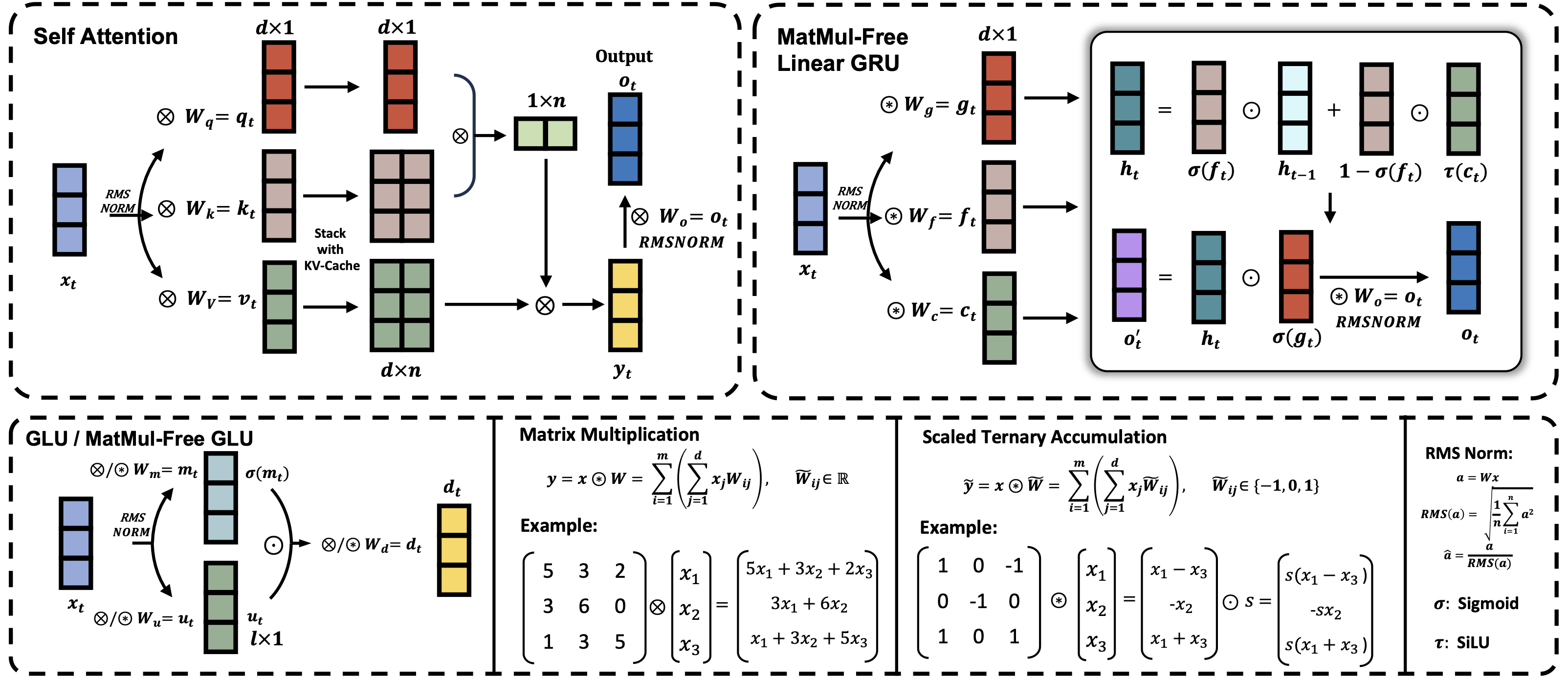
MatMul-Free LM is a language model architecture that eliminates the need for Matrix Multiplication (MatMul) operations. This repository provides an implementation of MatMul-Free LM that is compatible with the 🤗 Transformers library.
# Scaling Law
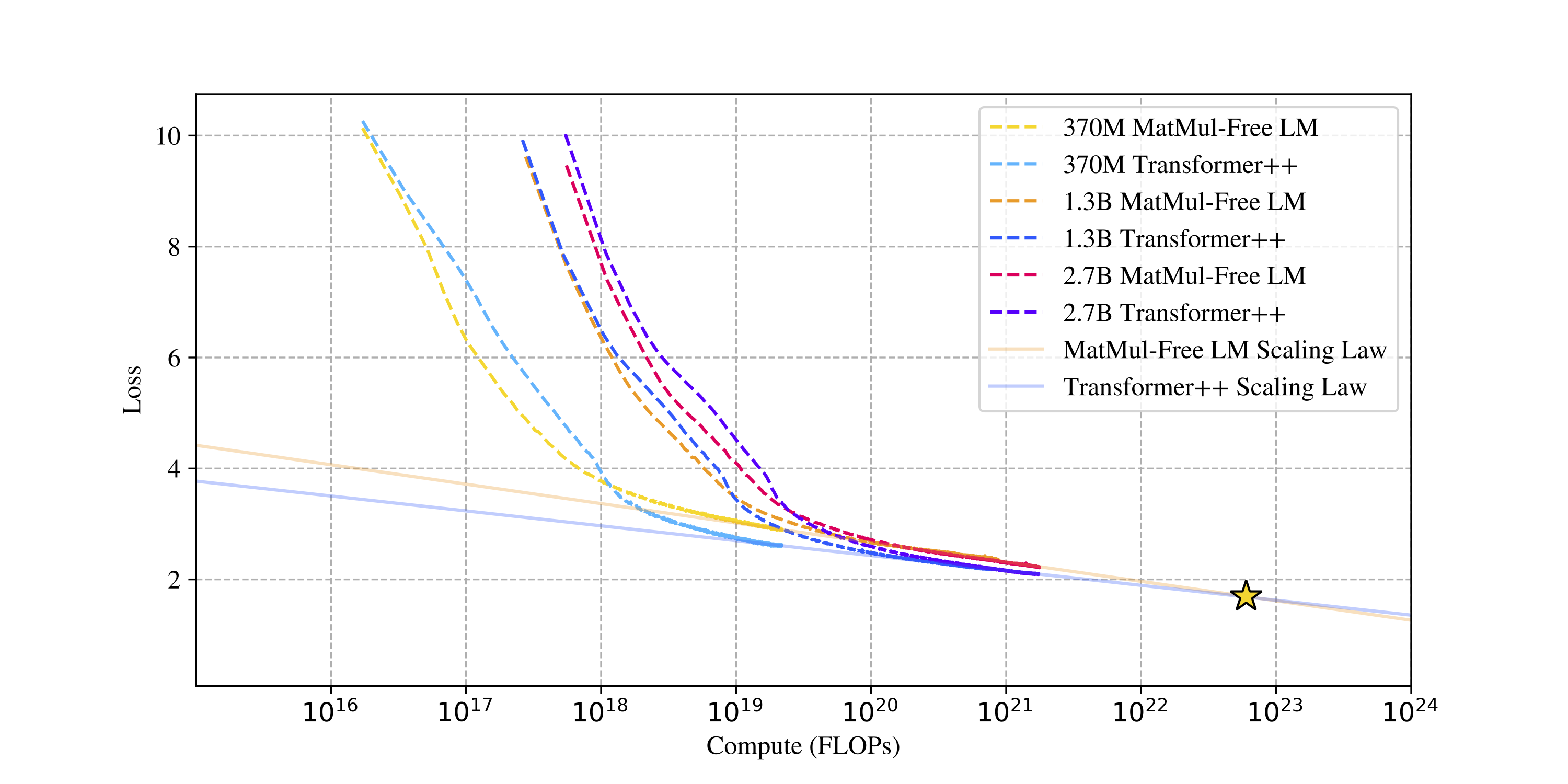
We evaluate how the scaling law fits to the 370M, 1.3B and 2.7B parameter models in both Transformer++ and our model. For a fair comparison, each operation is treated identically, though our model uses more efficient ternary weights in some layers. Interestingly, the scaling projection for our model exhibits a steeper descent compared to Transformer++, suggesting our architecture is more efficient in leveraging additional compute to improve performance.
# Installation
The following requirements should be satisfied
- [PyTorch](https://pytorch.org/) >= 2.0
- [Triton](https://github.com/openai/triton) >=2.2
- [einops](https://einops.rocks/)
```sh
pip install -U git+https://github.com/ridgerchu/matmulfreellm
```
# Usage
## Pre-trained Model Zoo
| Model Size | Layer | Hidden dimension | Trained tokens |
|:----------------|:------------:|:----------------:|:------------------:|
| [370M](https://huggingface.co/ridger/MMfreeLM-370M) | 24 | 1024 | 15B |
| [1.3B](https://huggingface.co/ridger/MMfreeLM-1.3B) | 24 | 2048 | 100B |
| [2.7B](https://huggingface.co/ridger/MMfreeLM-2.7B) | 32 | 2560 | 100B |
## Model
We provide the implementations of models that are compatible with 🤗 Transformers library.
Here's an example of how to initialize a model from the default configs in `matmulfreelm`:
This is a huggingface-compatible library that you can use such command to initialize the model with huggingface `AutoModel`:
```py
>>> from mmfreelm.models import HGRNBitConfig
>>> from transformers import AutoModel
>>> config = HGRNBitConfig()
>>> AutoModel.from_config(config)
HGRNBitModel(
(embeddings): Embedding(32000, 2048)
(layers): ModuleList(
(0): HGRNBitBlock(
(attn_norm): RMSNorm(2048, eps=1e-06)
(attn): HGRNBitAttention(
(i_proj): FusedBitLinear(
in_features=2048, out_features=2048, bias=False
(norm): RMSNorm(2048, eps=1e-08)
)
(f_proj): FusedBitLinear(
in_features=2048, out_features=2048, bias=False
(norm): RMSNorm(2048, eps=1e-08)
)
(g_proj): FusedBitLinear(
in_features=2048, out_features=2048, bias=False
(norm): RMSNorm(2048, eps=1e-08)
)
(g_norm): FusedRMSNormSwishGate()
(o_proj): FusedBitLinear(
in_features=2048, out_features=2048, bias=False
(norm): RMSNorm(2048, eps=1e-08)
)
)
(mlp_norm): RMSNorm(2048, eps=1e-06)
(mlp): HGRNBitMLP(
(gate_proj): FusedBitLinear(
in_features=2048, out_features=11264, bias=False
(norm): RMSNorm(2048, eps=1e-08)
)
(down_proj): FusedBitLinear(
in_features=5632, out_features=2048, bias=False
(norm): RMSNorm(5632, eps=1e-08)
)
(act_fn): SiLU()
)
)
)
>>>
```
## Generation
Upon successfully pretraining a model, it becomes accessible for generating text using the 🤗 text generation APIs.
In the following, we give a generation example in `generate.py`:
```py
import os
os.environ["TOKENIZERS_PARALLELISM"] = "false"
import mmfreelm
from transformers import AutoModelForCausalLM, AutoTokenizer
#Change here to our open-sourced model
name = ''
tokenizer = AutoTokenizer.from_pretrained(name)
model = AutoModelForCausalLM.from_pretrained(name).cuda().half()
input_prompt = "In a shocking finding, scientist discovered a herd of unicorns living in a remote, "
input_ids = tokenizer(input_prompt, return_tensors="pt").input_ids.cuda()
outputs = model.generate(input_ids, max_length=32, do_sample=True, top_p=0.4, temperature=0.6)
print(tokenizer.batch_decode(outputs, skip_special_tokens=True)[0])
```
## Reproducible release
Version `v0.1.0` is the archival software release associated with the Nature Computational Science manuscript. Its runtime code is based on commit [`f24cfe5`](https://github.com/ridgerchu/matmulfreellm/commit/f24cfe58bb76291140d8df603db62dcb5f9cc10a), with citation, version, and license metadata added for the release.
## Citation
If you use this software, please cite both the archived software release (see [`CITATION.cff`](CITATION.cff)) and the associated paper.
Software release:
```bib
@software{zhu2026matmulfree,
title={MatMul-Free LM: Code for Scalable MatMul-free Language Modeling on Neuromorphic Hardware},
author={Zhu, Rui-Jie and Zhang, Yu and Abreu, Steven and Sifferman, Ethan and Sheaves, Tyler and Wang, Yiqiao and Richmond, Dustin and Shrestha, Sumit Bam and Zhou, Peng and Eshraghian, Jason K.},
year={2026},
version={0.1.0},
publisher={Zenodo},
doi={10.5281/zenodo.22501850},
url={https://doi.org/10.5281/zenodo.22501850}
}
```
Associated paper:
```bib
@article{zhu2024scalable,
title={Scalable MatMul-free Language Modeling},
author={Zhu, Rui-Jie and Zhang, Yu and Abreu, Steven and Sifferman, Ethan and Sheaves, Tyler and Wang, Yiqiao and Richmond, Dustin and Shrestha, Sumit Bam and Zhou, Peng and Eshraghian, Jason K.},
journal={arXiv preprint arXiv:2406.02528},
year={2024},
doi={10.48550/arXiv.2406.02528},
url={https://arxiv.org/abs/2406.02528}
}
```
## License
The software is released under the [Apache License 2.0](LICENSE).