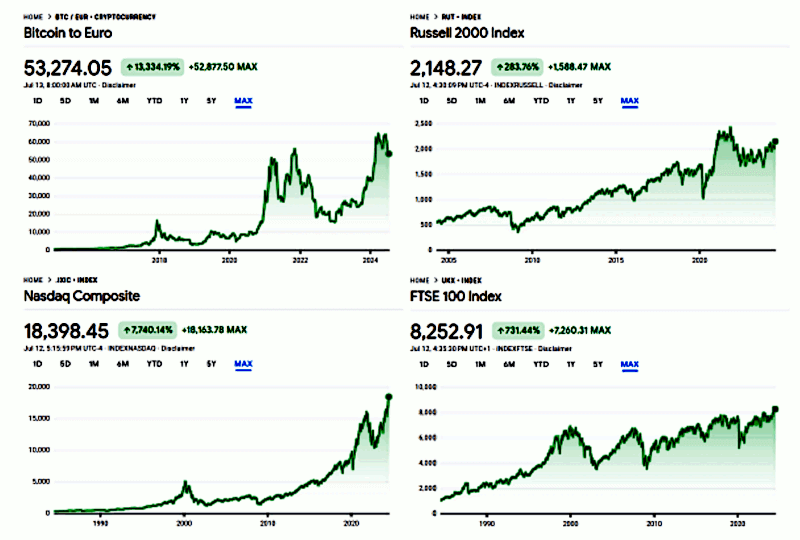
exponential trends VS linear trends, right click to enlarge
Hence, trend matters. We draw BTC and Nasdaq on a linear Y-scale but this presentation is not suitable compared to their trends which are exponential.
You might argue that BTC trend it not completely fits with an exponential trend - not as much as the Nasdaq - but Nasdaq time line started before 1980 while BTC not before than 30 years after.
Drawing the BTC and Nasdaq on a logarithmic Y-scale and adding min/max exponential limit curves would give us a correct measure about its volatility. A visual comparison with the Russel and FTSE min/max lines on a linear Y-scale, will provide us a new PoV.So, it does not matter how many people are involved into Nasdaq (or BTC) in determining its stability (or volatility). In fact, Nasdaq is one of the most popular market but it is still highly volatile.
Volatility depends by what underlies: commodity or ideas? A legal tender, a fiat currency or cryptocurrency that can be exchanged with a fixed rate with a commodity like gold or crude oil, automatically has a intrinsic value. On the opposite side, when a "*coin*" is related to nothing that an idea - this coin is good because we like it - usually is named a "*shitcoin*".
---
## Update 15.07.2024
This algorithm is very interesting because it explains in details why and how the current BTC network can be jeopardized by future quantum computing.
* [Quantum computers and the Bitcoin blockchain](https://www.deloitte.com/nl/en/services/risk-advisory/perspectives/quantum-computers-and-the-bitcoin-blockchain.html) by Deloitte, saved in [data](../data/quantum-computers-and-the-bitcoin-blockchain-deloitte.pdf?target=_blank) folder.
Which is mainly related to
1. current cryptographic algorithms are not quantum safe;
2. people do not keep at their heart best practices and expose themselves reusing their p2pkh addresses.
Fortunately, this is not the whole story but just the half. In order to get the full story we need to know that cryptographic switch to achieve the quantum safety is possible.
* [Quantum Secure Cryptocurrencies of the Future](https://www.btq.com/blog/quantum-secure-cryptocurrencies-of-the-future) by BTQ, saved in [data](../data/quantum-secure-cryptocurrencies-of-the-future.pdf?target=_blank) folder.
In the same way SSH can switch to a cryptographic algorithm to another also the BTC can do. As soon as, the thread is going to became real and its solution.
---
## Update 18.07.2024
Just remember that the most used currencies in the past were fundamentally two:
1. coins contains enough intrinsic value to be worthy their facial value or a little less but enough to not be refused to be accepted which gap is called the "functional value" of the money.
2. legal tender issued by a public institution in name of the people of the country for which the value was granted by the whole society of that country.
About the "functional value" of the money, is somewhat about the risk (nominal value - metal value) people would accept in order to avoid the effort of managing by themselves little quantities of metal which purity might not be trusted entirely unless complicated and expensive tests.
#### How much is worth the "*functional value*" of the money compared with its real value?
History shown that it can be quite the whole amount of the value. Like in the case #2 in which the cost of printing the banknotes and keeping them fresh (retiring and reprinting the damaged ones) is just a little value of the whole monetary M1 mass.
Usually, to protect #2 currencies from the fluctuations (volatility) against others similar currencies a physical gold deposit was created.
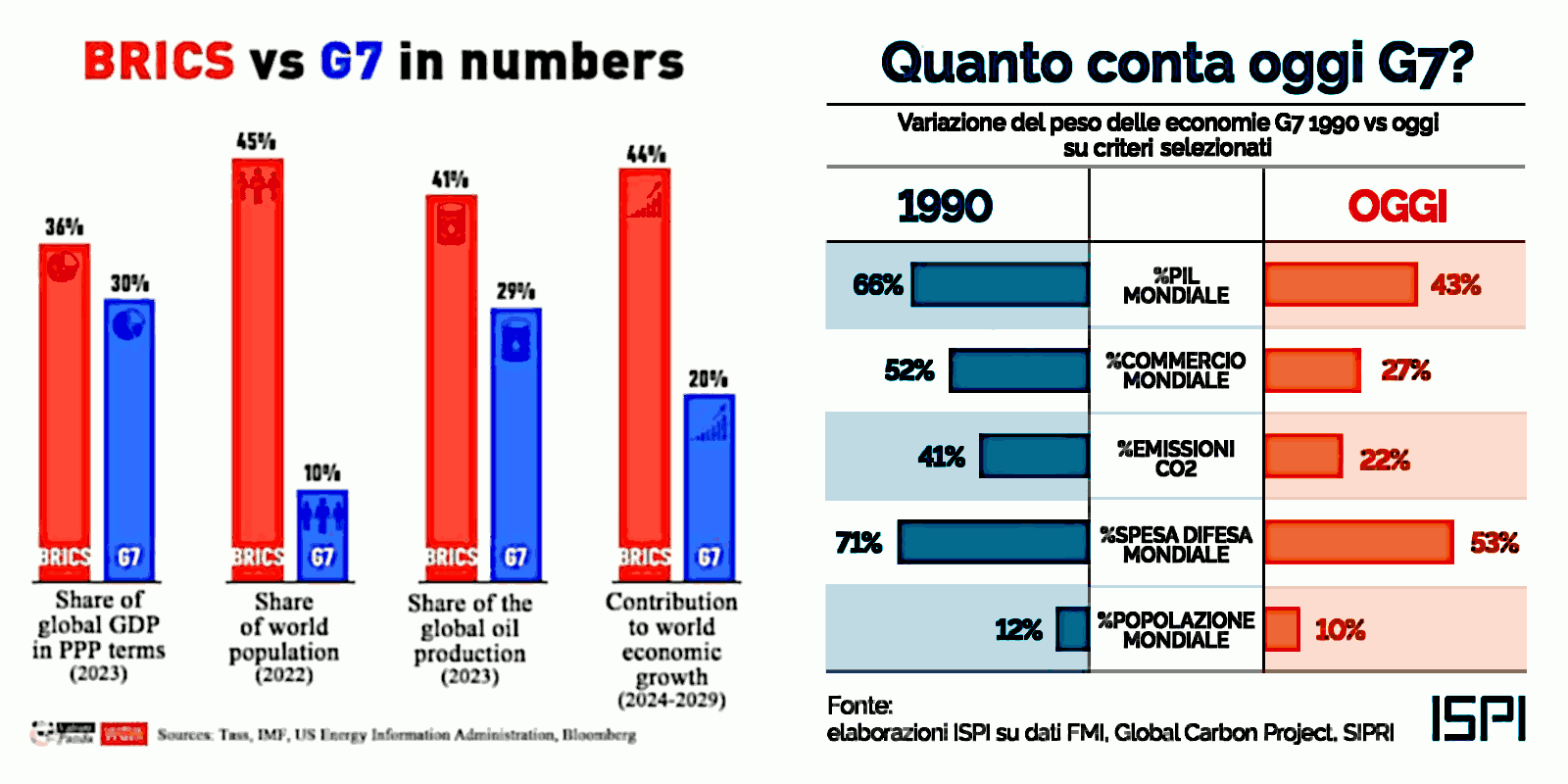
Moreover, this (image attached) explain why Ethereal has a good chance to stand above everything else not-limited cryptocurrencies: its functionality and in particular the smart-contracts.
#### So, the question could be: why people might be interested in having ETH?
Because their intrinsic value? Hard to believe compared to BTC, as Bitcoin Cash shown pretty well.
Nope, ETH is good for quick financial transactions and creating derivatives or anything else that smart contracts can deal with.
This explains why ETH is worth $3K while BTC is worth $60K (18.07.2024) despite keeping running the Ethereal infrastructure costs a small fraction of mining BTC to keep its working. The "*functional value*" of the ETH is higher than BTC while its intrinsic value is lower.
Moreover, ETH and BTC are not competing because their roles are completely different. Complementary, in fact. Like a financial trading/payment platformcompared to an economic exchange/reserve infrastructure.
Finally, the {speed, cost} of transactions defines the time buffers in dealing with ETH, BTC and raw material. In this way just the balances are worth of slower and expensive transactions. Thus the raw material delivery is the ultimate exchange.