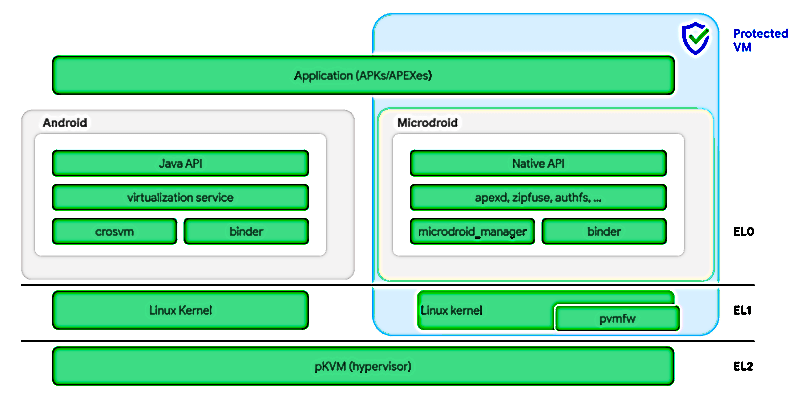
Android Virtualization Framework (AVF) overview - [lnkd.in/dVu8vyQp](https://lnkd.in/dVu8vyQp)
However, not with a virtual machine, which would significantly degrade the system's performance (usually by 1/2), but through segregation, which is absolutely possible, since unlike a generic VM, execution on the processor is supervised but transparent.
Moreover, ARM CPUs already have specific instructions to achieve this type of segregation at the code execution level (e.g. restricting access to RAM to certain segments, only those allocated).
---
### RedFish OS approach
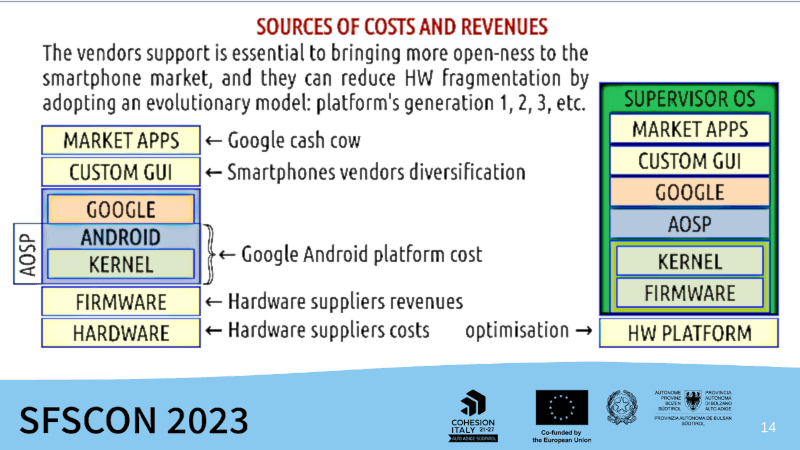
According to the Android documentation, everything is just in place: Linux kernel, hypervisor, separation of layers, but at the same time there is nothing like RedFish OS.
It seems that there is everything and instead there is nothing (cit.) simply because such architecture is ‘normal’ -made at the state of art - but in its development never took into account devices hardware fragmentation and the optimization of costs of scale for a mobile devices market that barely did not even exist before Android or not at that scale.
---
### RedFish OS advantages
> What are the advantages of the RedFish OS approach?
The advantages of an Android container are that all the hardware management part would go out of the picture, so Android would no longer be an operating system but an application run-time framework and a development environment for apps. Just as it is today, but in a container. As it is today, precisely.