Your coding agent remembers everything. No more re-explaining.
Built on iii engine
Persistent memory for Claude Code, Cursor, Gemini CLI, Codex CLI, Hermes, OpenClaw, pi, OpenCode, and any MCP client.
The gist extends Karpathy's LLM Wiki pattern with confidence scoring, lifecycle, knowledge graphs, and hybrid search: agentmemory is the implementation.
---
## Install
```bash
npm install -g @agentmemory/agentmemory # once — bare `agentmemory` on PATH
# If you hit EACCES on macOS/Linux system Node installs, retry with:
# sudo npm install -g @agentmemory/agentmemory
agentmemory # start the memory server on :3111
agentmemory demo # seed sample sessions + prove recall
agentmemory connect claude-code # wire your agent (also: codex, cursor, gemini-cli, ...)
```
Or via `npx` (no install):
```bash
npx @agentmemory/agentmemory
```
Heads-up — npx caches per version. If a bare `npx @agentmemory/agentmemory` serves an older release, force the latest with `npx -y @agentmemory/agentmemory@latest`, or clear the cache once with `rm -rf ~/.npm/_npx` (macOS/Linux; on Windows delete `%LOCALAPPDATA%\npm-cache\_npx`). The first npx run from v0.9.16+ prompts to install globally inline so the bare `agentmemory` command works everywhere afterwards.
Full options at [Quick Start](#quick-start) below. Agent-specific wiring at [Works with every agent](#works-with-every-agent).
---
agentmemory works with any agent that supports hooks, MCP, or REST API. All agents share the same memory server.
Claude Code native plugin + 12 hooks + MCP
Codex CLI native plugin + 6 hooks + MCP
OpenClaw native plugin + MCP
Hermes native plugin + MCP
pi native plugin + MCP
OpenHuman native Memory trait backend
Cursor MCP server
Gemini CLI MCP server
OpenCode 22 hooks + MCP + plugin
Cline MCP server
Goose MCP server
Kilo Code MCP server
Aider REST API
Claude Desktop MCP server
Windsurf MCP server
Roo Code MCP server
Works with any agent that speaks MCP or HTTP. One server, memories shared across all of them.
---
You explain the same architecture every session. You re-discover the same bugs. You re-teach the same preferences. Built-in memory (CLAUDE.md, .cursorrules) caps out at 200 lines and goes stale. agentmemory fixes this. It silently captures what your agent does, compresses it into searchable memory, and injects the right context when the next session starts. One command. Works across agents.
**What changes:** Session 1 you set up JWT auth. Session 2 you ask for rate limiting. The agent already knows your auth uses jose middleware in `src/middleware/auth.ts`, your tests cover token validation, and you chose jose over jsonwebtoken for Edge compatibility. No re-explaining. No copy-pasting. The agent just *knows*.
```bash
npx @agentmemory/agentmemory
```
> **New in v0.9.0** — Landing site at [agent-memory.dev](https://agent-memory.dev), filesystem connector (`@agentmemory/fs-watcher`), standalone MCP now proxies to the running server so hooks and the viewer agree, audit policy codified across every delete path, health stops flagging `memory_critical` on tiny Node processes. Full notes in [CHANGELOG.md](CHANGELOG.md#090--2026-04-18).
---
> Embedding model: `all-MiniLM-L6-v2` (local, free, no API key). Full reports: [`benchmark/LONGMEMEVAL.md`](benchmark/LONGMEMEVAL.md), [`benchmark/QUALITY.md`](benchmark/QUALITY.md), [`benchmark/SCALE.md`](benchmark/SCALE.md). Competitor comparison: [`benchmark/COMPARISON.md`](benchmark/COMPARISON.md) — agentmemory vs mem0, Letta, Khoj, claude-mem, Hippo.
**Reproduce locally:** [`eval/README.md`](eval/README.md) — adapter-pluggable harness for LongMemEval `_s` (public 500-Q) + `coding-agent-life-v1` (in-house 15-session corpus). Grep / vector / agentmemory adapters score side-by-side, NDJSON output, published scorecards land in [`docs/benchmarks/`](docs/benchmarks/).
---
agentmemory
mem0 (53K ⭐)
Letta / MemGPT (22K ⭐)
Built-in (CLAUDE.md)
Type
Memory engine + MCP server
Memory layer API
Full agent runtime
Static file
Retrieval R@5
95.2%
68.5% (LoCoMo)
83.2% (LoCoMo)
N/A (grep)
Auto-capture
12 hooks (zero manual effort)
Manual add() calls
Agent self-edits
Manual editing
Search
BM25 + Vector + Graph (RRF fusion)
Vector + Graph
Vector (archival)
Loads everything into context
Multi-agent
MCP + REST + leases + signals
API (no coordination)
Within Letta runtime only
Per-agent files
Framework lock-in
None (any MCP client)
None
High (must use Letta)
Per-agent format
External deps
None (SQLite + iii-engine)
Qdrant / pgvector
Postgres + vector DB
None
Memory lifecycle
4-tier consolidation + decay + auto-forget
Passive extraction
Agent-managed
Manual pruning
Token efficiency
~1,900 tokens/session ($10/yr)
Varies by integration
Core memory in context
22K+ tokens at 240 obs
Real-time viewer
Yes (port 3113)
Cloud dashboard
Cloud dashboard
No
Self-hosted
Yes (default)
Optional
Optional
Yes
---
Compatibility: this release targets stable `iii-sdk` `^0.11.0` and iii-engine v0.11.x.
### Try it in 30 seconds
```bash
# Terminal 1: start the server
npx @agentmemory/agentmemory
# Terminal 2: seed sample data and see recall in action
npx @agentmemory/agentmemory demo
```
`demo` seeds 3 realistic sessions (JWT auth, N+1 query fix, rate limiting) and runs semantic searches against them. You'll see it find "N+1 query fix" when you search "database performance optimization" — keyword matching can't do that.
Open `http://localhost:3113` to watch the memory build live.
### Recommended: install globally
`npx` caches per-version. If you ran `npx @agentmemory/agentmemory@0.9.14` last week, a bare `npx @agentmemory/agentmemory` may serve the stale 0.9.14 from `~/.npm/_npx/`, not the latest release. Install once and the bare `agentmemory` command works everywhere:
```bash
npm install -g @agentmemory/agentmemory
# If you hit EACCES on macOS/Linux system Node installs, retry with:
# sudo npm install -g @agentmemory/agentmemory
agentmemory # start the server (same as the npx form)
agentmemory stop # tear it down
agentmemory remove # uninstall everything we created
agentmemory connect claude-code # wire one agent
agentmemory doctor # interactive diagnostics + fix prompts
```
From v0.9.16 onward, the first npx run prompts you to install globally inline — answer `Y` once and you're set. If you skip, fall back to either of these for a fresh fetch:
```bash
npx -y @agentmemory/agentmemory@latest # forces latest from npm (cross-platform)
rm -rf ~/.npm/_npx && npx @agentmemory/agentmemory # macOS/Linux only (POSIX shell)
```
On Windows / PowerShell, the equivalent cache clear is `Remove-Item -Recurse -Force "$env:LOCALAPPDATA\npm-cache\_npx"` — the `npx -y ...@latest` form above is the cross-platform option.
### Session Replay
Every session agentmemory records is replayable. Open the viewer, pick the **Replay** tab, and scrub through the timeline: prompts, tool calls, tool results, and responses render as discrete events with play/pause, speed control (0.5×–4×), and keyboard shortcuts (space to toggle, arrows to step).
Already have older Claude Code JSONL transcripts you want to bring in?
```bash
# Import everything under the default ~/.claude/projects
npx @agentmemory/agentmemory import-jsonl
# Or import a single file
npx @agentmemory/agentmemory import-jsonl ~/.claude/projects/-my-project/abc123.jsonl
```
Imported sessions show up in the Replay picker alongside native ones. Under the hood each entry routes through the `mem::replay::load`, `mem::replay::sessions`, and `mem::replay::import-jsonl` iii functions — no side-channel servers.
### Upgrade / Maintenance
Use the maintenance command when you intentionally want to update your local runtime:
```bash
npx @agentmemory/agentmemory upgrade
```
Warning: this command mutates the current workspace/runtime. It can update JavaScript dependencies, may run `cargo install iii-engine --force`, and may pull Docker images.
Implementation details live in `src/cli.ts` (see `runUpgrade` around the `src/cli.ts:544-595` region).
### Claude Code (one block, paste it)
```
Install agentmemory: run `npx @agentmemory/agentmemory` in a separate terminal to start the memory server. Then run `/plugin marketplace add rohitg00/agentmemory` and `/plugin install agentmemory` — the plugin registers all 12 hooks, 4 skills, AND auto-wires the `@agentmemory/mcp` stdio server via its `.mcp.json`, so you get 53 MCP tools (memory_smart_search, memory_save, memory_sessions, memory_governance_delete, etc.) without any extra config step. Verify with `curl http://localhost:3111/agentmemory/health`. The real-time viewer is at http://localhost:3113.
```
For remote or protected deployments, launch Claude Code with `AGENTMEMORY_URL` and `AGENTMEMORY_SECRET` set. The plugin passes both values through to its bundled MCP server; when `AGENTMEMORY_URL` is empty, the MCP shim uses `http://localhost:3111`.
### Codex CLI (Codex plugin platform)
```bash
# 1. start the memory server in a separate terminal
npx @agentmemory/agentmemory
# 2. register the agentmemory marketplace and install the plugin
codex plugin marketplace add rohitg00/agentmemory
codex plugin install agentmemory
```
The Codex plugin ships from the same `plugin/` directory as the Claude Code plugin. It registers:
- `@agentmemory/mcp` as an MCP server (proxies all 51 tools when `AGENTMEMORY_URL` points at a running agentmemory server; falls back to 7 tools locally when no server is reachable)
- 6 lifecycle hooks: `SessionStart`, `UserPromptSubmit`, `PreToolUse`, `PostToolUse`, `PreCompact`, `Stop`
- 4 skills: `/recall`, `/remember`, `/session-history`, `/forget`
Codex's hook engine injects `CLAUDE_PLUGIN_ROOT` into hook subprocesses (per [`codex-rs/hooks/src/engine/discovery.rs`](https://github.com/openai/codex/blob/main/codex-rs/hooks/src/engine/discovery.rs)), so the same hook scripts work across both hosts without duplication. Subagent / SessionEnd / Notification / TaskCompleted / PostToolUseFailure events are Claude-Code-only and are not registered for Codex.
#### Codex Desktop: plugin hooks currently silent (workaround available)
`CodexHooks` and `PluginHooks` are both stable + default-enabled in [`codex-rs/features/src/lib.rs`](https://github.com/openai/codex/blob/main/codex-rs/features/src/lib.rs), but Codex Desktop builds currently do not dispatch plugin-local `hooks.json` ([openai/codex#16430](https://github.com/openai/codex/issues/16430)). MCP tools still work; only the lifecycle observations are missing.
Until upstream lands the fix, mirror the same hook commands into the global `~/.codex/hooks.json`:
```bash
agentmemory connect codex --with-hooks
```
This adds an idempotent block to `~/.codex/hooks.json` referencing absolute paths to the bundled scripts (no `${CLAUDE_PLUGIN_ROOT}` expansion needed at user-scope). Re-run the same command after upgrading agentmemory to refresh paths. User entries in the same file are preserved; only previous agentmemory entries are replaced.
OpenClaw (paste this prompt)
```
Install agentmemory for OpenClaw. Run `npx @agentmemory/agentmemory` in a separate terminal to start the memory server on localhost:3111. Then add this to my OpenClaw MCP config so agentmemory is available with all 51 memory tools:
{
"mcpServers": {
"agentmemory": {
"command": "npx",
"args": ["-y", "@agentmemory/mcp"],
"env": {
"AGENTMEMORY_URL": "http://localhost:3111"
}
}
}
}
Restart OpenClaw. Verify with `curl http://localhost:3111/agentmemory/health`. Open http://localhost:3113 for the real-time viewer. For deeper memory-slot integration, copy `integrations/openclaw` to `~/.openclaw/extensions/agentmemory` and enable `plugins.slots.memory = "agentmemory"` in `~/.openclaw/openclaw.json`.
```
Full guide: [`integrations/openclaw/`](integrations/openclaw/)
Hermes Agent (paste this prompt)
```
Install agentmemory for Hermes. Run `npx @agentmemory/agentmemory` in a separate terminal to start the memory server on localhost:3111. Then add this to ~/.hermes/config.yaml so Hermes can use agentmemory as an MCP server with all 51 memory tools:
mcp_servers:
agentmemory:
command: npx
args: ["-y", "@agentmemory/mcp"]
memory:
provider: agentmemory
Verify with `curl http://localhost:3111/agentmemory/health`. Open http://localhost:3113 for the real-time viewer. For deeper 6-hook memory provider integration (pre-LLM context injection, turn capture, MEMORY.md mirroring, system prompt block), copy integrations/hermes from the agentmemory repo to ~/.hermes/plugins/agentmemory.
```
Full guide: [`integrations/hermes/`](integrations/hermes/)
### Other agents
Start the memory server: `npx @agentmemory/agentmemory`
The agentmemory entry is the **same MCP server block** across every host that uses the `mcpServers` shape (Cursor, Claude Desktop, Cline, Roo Code, Windsurf, Gemini CLI, OpenClaw):
```json
"agentmemory": {
"command": "npx",
"args": ["-y", "@agentmemory/mcp"],
"env": {
"AGENTMEMORY_URL": "${AGENTMEMORY_URL}",
"AGENTMEMORY_SECRET": "${AGENTMEMORY_SECRET}"
}
}
```
**Merge this entry into the existing `mcpServers` object** in the host's config file — don't replace the file. If the file already has other servers, add `agentmemory` next to them as another key inside `mcpServers`. If `mcpServers` is missing entirely, paste the block inside `{ "mcpServers": { ... } }`. The `${VAR}` placeholders inherit `AGENTMEMORY_URL` / `AGENTMEMORY_SECRET` from the shell at MCP-server launch — unset vars pass empty strings and the shim falls back to `http://localhost:3111`. One wired entry covers both local and remote (k8s / reverse-proxied) deployments.
| Agent | Config file | Notes |
|---|---|---|
| **Cursor** | `~/.cursor/mcp.json` | Merge into `mcpServers`. One-click deeplink also available on the website. |
| **Claude Desktop** | `claude_desktop_config.json` (Application Support) | Merge into `mcpServers`. Restart Claude Desktop after editing. |
| **Cline / Roo Code / Kilo Code** | Cline MCP settings (Settings UI → MCP Servers → Edit) | Same `mcpServers` block. |
| **Windsurf** | `~/.codeium/windsurf/mcp_config.json` | Same `mcpServers` block. |
| **Gemini CLI** | `~/.gemini/settings.json` | `gemini mcp add agentmemory npx -y @agentmemory/mcp --scope user` (auto-merges). |
| **OpenClaw** | OpenClaw MCP config | Same `mcpServers` block, or use the deeper [memory plugin](integrations/openclaw/). |
| **Codex CLI (MCP only)** | `.codex/config.toml` | TOML shape: `codex mcp add agentmemory -- npx -y @agentmemory/mcp`, or add `[mcp_servers.agentmemory]` manually. |
| **Codex CLI (full plugin)** | Codex plugin marketplace | `codex plugin marketplace add rohitg00/agentmemory` then `codex plugin install agentmemory`. Registers MCP + 6 lifecycle hooks (SessionStart, UserPromptSubmit, PreToolUse, PostToolUse, PreCompact, Stop) + 4 skills. On Codex Desktop, also run `agentmemory connect codex --with-hooks` until [openai/codex#16430](https://github.com/openai/codex/issues/16430) lands — plugin hooks are currently silent there. |
| **OpenCode (MCP only)** | `opencode.json` | Different shape — top-level `mcp` key, command as array: `{"mcp": {"agentmemory": {"type": "local", "command": ["npx", "-y", "@agentmemory/mcp"], "enabled": true}}}`. |
| **OpenCode (full plugin)** | `plugin/opencode/` | 22 auto-capture hooks covering session lifecycle, messages, tools, errors. Two slash commands (`/recall`, `/remember`). Copy `plugin/opencode/` into your OpenCode workspace and add the plugin entry to `opencode.json`. See [`plugin/opencode/README.md`](plugin/opencode/README.md) for the full hook table + gap analysis. |
| **pi** | `~/.pi/agent/extensions/agentmemory` | Copy [`integrations/pi`](integrations/pi/) and restart pi. |
| **Hermes Agent** | `~/.hermes/config.yaml` | Use the deeper [memory provider plugin](integrations/hermes/) with `memory.provider: agentmemory`. |
| **Goose** | Goose MCP settings UI | Same `mcpServers` block. |
| **Aider** | n/a | Talk to the REST API directly: `curl -X POST http://localhost:3111/agentmemory/smart-search -d '{"query": "auth"}'`. |
| **Any agent (32+)** | n/a | `npx skillkit install agentmemory` auto-detects the host and merges. |
**Sandboxed MCP clients** (Flatpak / Snap / restrictive containers) that can't reach the host's `localhost`: also set `"AGENTMEMORY_FORCE_PROXY": "1"` in the `env` block, and point `AGENTMEMORY_URL` at a route the sandbox can actually reach (e.g. your LAN IP). See [#234](https://github.com/rohitg00/agentmemory/issues/234) for the diagnostic walkthrough.
### Programmatic access (Python / Rust / Node)
agentmemory registers its core operations as iii functions (`mem::remember`, `mem::observe`, `mem::context`, `mem::smart-search`, `mem::forget`). Any language with an iii SDK can call them directly over `ws://localhost:49134` — no separate REST client per language.
```bash
pip install iii-sdk # Python
cargo add iii-sdk # Rust
npm install iii-sdk # Node
```
```python
from iii import register_worker
iii = register_worker("ws://localhost:49134")
iii.connect()
iii.trigger({
"function_id": "mem::smart-search",
"payload": {"project": "demo", "query": "how do tokens refresh"},
})
```
Worked example: [`examples/python/`](examples/python/) (quickstart + observation/recall flow). REST on `:3111` remains available for hosts without an iii runtime.
### From source
```bash
git clone https://github.com/rohitg00/agentmemory.git && cd agentmemory
npm install && npm run build && npm start
```
This starts agentmemory with a local `iii-engine` if `iii` is already installed, or falls back to Docker Compose if Docker is available. REST, streams, and the viewer bind to `127.0.0.1` by default.
Install `iii-engine` manually. **agentmemory currently pins `iii-engine` to `v0.11.2`** — `v0.11.6` introduces a new sandbox-everything-via-`iii worker add` model that agentmemory hasn't been refactored for yet. Pin lifts once the refactor lands. Override with `AGENTMEMORY_III_VERSION=` if you've migrated to the sandbox model manually.
- **macOS arm64:** `mkdir -p ~/.local/bin && curl -fsSL https://github.com/iii-hq/iii/releases/download/iii/v0.11.2/iii-aarch64-apple-darwin.tar.gz | tar -xz -C ~/.local/bin && chmod +x ~/.local/bin/iii`
- **macOS x64:** swap `aarch64-apple-darwin` for `x86_64-apple-darwin`
- **Linux x64:** swap for `x86_64-unknown-linux-gnu`
- **Linux arm64:** swap for `aarch64-unknown-linux-gnu`
- **Windows:** download `iii-x86_64-pc-windows-msvc.zip` from [iii-hq/iii releases v0.11.2](https://github.com/iii-hq/iii/releases/tag/iii%2Fv0.11.2), extract `iii.exe`, add to PATH
Or use Docker (the bundled `docker-compose.yml` pulls `iiidev/iii:0.11.2`). Full docs: [iii.dev/docs](https://iii.dev/docs).
### Windows
agentmemory runs on Windows 10/11, but the Node.js package alone isn't enough — you also need the `iii-engine` runtime (a separate native binary) as a background process. The official upstream installer is a `sh` script and there is no PowerShell installer or scoop/winget package today, so Windows users have two paths:
**Option A — Prebuilt Windows binary (recommended):**
```powershell
# 1. Open https://github.com/iii-hq/iii/releases/tag/iii%2Fv0.11.2 in your browser
# (we pin to v0.11.2 until agentmemory refactors for the new sandbox
# model that engine v0.11.6+ requires)
# 2. Download iii-x86_64-pc-windows-msvc.zip
# (or iii-aarch64-pc-windows-msvc.zip if you're on an ARM machine)
# 3. Extract iii.exe somewhere on PATH, or place it at:
# %USERPROFILE%\.local\bin\iii.exe
# (agentmemory checks that location automatically)
# 4. Verify:
iii --version
# Should print: 0.11.2
# 5. Then run agentmemory as usual:
npx -y @agentmemory/agentmemory
```
**Option B — Docker Desktop:**
```powershell
# 1. Install Docker Desktop for Windows
# 2. Start Docker Desktop and make sure the engine is running
# 3. Run agentmemory — it will auto-start the bundled compose file:
npx -y @agentmemory/agentmemory
```
**Option C — standalone MCP only (no engine):** if you only need the MCP tools for your agent and don't need the REST API, viewer, or cron jobs, skip the engine entirely:
```powershell
npx -y @agentmemory/agentmemory mcp
# or via the shim package:
npx -y @agentmemory/mcp
```
**Diagnostics for Windows:** if `npx @agentmemory/agentmemory` fails, re-run with `--verbose` to see the actual engine stderr. Common failure modes:
| Symptom | Fix |
|---|---|
| `iii-engine process started` then `did not become ready within 15s` | Engine crashed on startup — re-run with `--verbose`, check stderr |
| `Could not start iii-engine` | Neither `iii.exe` nor Docker is installed. See Option A or B above |
| Port conflict | `netstat -ano \| findstr :3111` to see what's bound, then kill it or use `--port ` |
| Docker fallback skipped even though Docker is installed | Make sure Docker Desktop is actually running (system tray icon) |
> Note: there is no `cargo install iii-engine` — `iii` is not published to crates.io. The only supported install methods are the prebuilt binary above, the upstream `sh` install script (macOS/Linux only), and the Docker image.
---
Deploy
One-click templates for managed hosts. Each one ships a self-contained
Dockerfile that pulls `@agentmemory/agentmemory` from npm and copies
the iii engine binary in from the official `iiidev/iii` Docker Hub
image — no pre-built agentmemory image required. Persistent storage
mounts at `/data`; the first-boot entrypoint overwrites the
npm-bundled iii config (which binds `127.0.0.1`) with a deploy-tuned
one that binds `0.0.0.0` and uses absolute `/data` paths, generates
the HMAC secret, then drops privileges from `root` to `node` via
`gosu` before exec'ing the agentmemory CLI.
Render's one-click deploy button requires `render.yaml` at the repository root, which we deliberately keep clean. Use the Render Blueprint flow documented in [`deploy/render/`](./deploy/render/README.md) to point at the in-repo blueprint manually.
Full setup details (HMAC capture, viewer SSH tunnel, rotation, backup,
cost floors) live in [`deploy/`](./deploy/README.md):
- [`deploy/fly`](./deploy/fly/README.md) — single machine with
`auto_stop_machines = "stop"`; cheapest idle.
- [`deploy/railway`](./deploy/railway/README.md) — Hobby plan flat fee,
volume in the dashboard.
- [`deploy/render`](./deploy/render/README.md) — Blueprint flow,
automatic disk snapshots on paid plans.
- [`deploy/coolify`](./deploy/coolify/README.md) — self-hosted on your
own VPS via [Coolify](https://coolify.io/self-hosted); same Docker
Compose stack, you own the host and the data.
Only port `3111` is published. The viewer on `3113` stays bound to
loopback inside the container — every template's README documents the
SSH-tunnel pattern for reaching it.
---
Every coding agent forgets everything when the session ends. You waste the first 5 minutes of every session re-explaining your stack. agentmemory runs in the background and eliminates that entirely.
```
Session 1: "Add auth to the API"
Agent writes code, runs tests, fixes bugs
agentmemory silently captures every tool use
Session ends -> observations compressed into structured memory
Session 2: "Now add rate limiting"
Agent already knows:
- Auth uses JWT middleware in src/middleware/auth.ts
- Tests in test/auth.test.ts cover token validation
- You chose jose over jsonwebtoken for Edge compatibility
Zero re-explaining. Starts working immediately.
```
### vs built-in agent memory
Every AI coding agent ships with built-in memory — Claude Code has `MEMORY.md`, Cursor has notepads, Cline has memory bank. These work like sticky notes. agentmemory is the searchable database behind the sticky notes.
| | Built-in (CLAUDE.md) | agentmemory |
|---|---|---|
| Scale | 200-line cap | Unlimited |
| Search | Loads everything into context | BM25 + vector + graph (top-K only) |
| Token cost | 22K+ at 240 observations | ~1,900 tokens (92% less) |
| Cross-agent | Per-agent files | MCP + REST (any agent) |
| Coordination | None | Leases, signals, actions, routines |
| Observability | Read files manually | Real-time viewer on :3113 |
---
### Memory Pipeline
```
PostToolUse hook fires
-> SHA-256 dedup (5min window)
-> Privacy filter (strip secrets, API keys)
-> Store raw observation
-> LLM compress -> structured facts + concepts + narrative
-> Vector embedding (6 providers + local)
-> Index in BM25 + vector
Stop / SessionEnd hook fires
-> Summarize session
-> Knowledge graph extraction (if GRAPH_EXTRACTION_ENABLED=true)
-> Slot reflection (if SLOT_REFLECT_ENABLED=true)
SessionStart hook fires
-> Load project profile (top concepts, files, patterns)
-> Hybrid search (BM25 + vector + graph)
-> Token budget (default: 2000 tokens)
-> Inject into conversation
```
### 4-Tier Memory Consolidation
Inspired by how human brains process memory — not unlike sleep consolidation.
| Tier | What | Analogy |
|------|------|---------|
| **Working** | Raw observations from tool use | Short-term memory |
| **Episodic** | Compressed session summaries | "What happened" |
| **Semantic** | Extracted facts and patterns | "What I know" |
| **Procedural** | Workflows and decision patterns | "How to do it" |
Memories decay over time (Ebbinghaus curve). Frequently accessed memories strengthen. Stale memories auto-evict. Contradictions are detected and resolved.
### What Gets Captured
| Hook | Captures |
|------|----------|
| `SessionStart` | Project path, session ID |
| `UserPromptSubmit` | User prompts (privacy-filtered) |
| `PreToolUse` | File access patterns + enriched context |
| `PostToolUse` | Tool name, input, output |
| `PostToolUseFailure` | Error context |
| `PreCompact` | Re-injects memory before compaction |
| `SubagentStart/Stop` | Sub-agent lifecycle |
| `Stop` | End-of-session summary |
| `SessionEnd` | Session complete marker |
### Key Capabilities
| Capability | Description |
|---|---|
| **Automatic capture** | Every tool use recorded via hooks — zero manual effort |
| **Semantic search** | BM25 + vector + knowledge graph with RRF fusion |
| **Memory evolution** | Versioning, supersession, relationship graphs |
| **Auto-forgetting** | TTL expiry, contradiction detection, importance eviction |
| **Privacy first** | API keys, secrets, `` tags stripped before storage |
| **Self-healing** | Circuit breaker, provider fallback chain, health monitoring |
| **Claude bridge** | Bi-directional sync with MEMORY.md |
| **Knowledge graph** | Entity extraction + BFS traversal |
| **Team memory** | Namespaced shared + private across team members |
| **Citation provenance** | Trace any memory back to source observations |
| **Git snapshots** | Version, rollback, and diff memory state |
---
Triple-stream retrieval combining three signals:
| Stream | What it does | When |
|---|---|---|
| **BM25** | Stemmed keyword matching with synonym expansion | Always on |
| **Vector** | Cosine similarity over dense embeddings | Embedding provider configured |
| **Graph** | Knowledge graph traversal via entity matching | Entities detected in query |
Fused with Reciprocal Rank Fusion (RRF, k=60) and session-diversified (max 3 results per session).
BM25 tokenizes Greek, Cyrillic, Hebrew, Arabic, and accented Latin out of the box. For Chinese / Japanese / Korean memories, install the optional segmenters (`npm install @node-rs/jieba tiny-segmenter`) to split CJK runs into word-level tokens; without them, agentmemory soft-falls to whole-run tokenization and prints a one-time hint on stderr.
### Embedding providers
agentmemory auto-detects your provider. For best results, install local embeddings (free):
```bash
npm install @xenova/transformers
```
| Provider | Model | Cost | Notes |
|---|---|---|---|
| **Local (recommended)** | `all-MiniLM-L6-v2` | Free | Offline, +8pp recall over BM25-only |
| Gemini | `gemini-embedding-001` | Free tier | 100+ languages, 768/1536/3072 dims (MRL), 2048-token input. Replaces `text-embedding-004` ([deprecated, shutdown Jan 14, 2026](https://ai.google.dev/gemini-api/docs/deprecations)) |
| OpenAI | `text-embedding-3-small` | $0.02/1M | Highest quality |
| Voyage AI | `voyage-code-3` | Paid | Optimized for code |
| Cohere | `embed-english-v3.0` | Free trial | General purpose |
| OpenRouter | Any model | Varies | Multi-model proxy |
---
53 tools, 6 resources, 3 prompts, and 4 skills — the most comprehensive MCP memory toolkit for any agent.
> **MCP shim vs full server:** the published `@agentmemory/mcp` package is a thin shim. It exposes the full 51-tool surface **only when it can reach a running agentmemory server** via `AGENTMEMORY_URL` (proxy mode). With no server reachable, the shim falls back to a 7-tool local set (`memory_save`, `memory_recall`, `memory_smart_search`, `memory_sessions`, `memory_export`, `memory_audit`, `memory_governance_delete`). The `AGENTMEMORY_TOOLS=core|all` env var is a *server-side* flag — setting it in the shim's `env` block has no effect. If you see only 7 tools in Cursor / OpenCode / Gemini CLI, start `npx @agentmemory/agentmemory` (or the Docker stack) and set `AGENTMEMORY_URL=http://localhost:3111`.
### 51 Tools
Core tools (always available)
| Tool | Description |
|------|-------------|
| `memory_recall` | Search past observations |
| `memory_compress_file` | Compress markdown files while preserving structure |
| `memory_save` | Save an insight, decision, or pattern |
| `memory_patterns` | Detect recurring patterns |
| `memory_smart_search` | Hybrid semantic + keyword search |
| `memory_file_history` | Past observations about specific files |
| `memory_sessions` | List recent sessions |
| `memory_timeline` | Chronological observations |
| `memory_profile` | Project profile (concepts, files, patterns) |
| `memory_export` | Export all memory data |
| `memory_relations` | Query relationship graph |
Extended tools (51 total — set AGENTMEMORY_TOOLS=all)
| Tool | Description |
|------|-------------|
| `memory_patterns` | Detect recurring patterns |
| `memory_timeline` | Chronological observations |
| `memory_relations` | Query relationship graph |
| `memory_graph_query` | Knowledge graph traversal |
| `memory_consolidate` | Run 4-tier consolidation |
| `memory_claude_bridge_sync` | Sync with MEMORY.md |
| `memory_team_share` | Share with team members |
| `memory_team_feed` | Recent shared items |
| `memory_audit` | Audit trail of operations |
| `memory_governance_delete` | Delete with audit trail |
| `memory_snapshot_create` | Git-versioned snapshot |
| `memory_action_create` | Create work items with dependencies |
| `memory_action_update` | Update action status |
| `memory_frontier` | Unblocked actions ranked by priority |
| `memory_next` | Single most important next action |
| `memory_lease` | Exclusive action leases (multi-agent) |
| `memory_routine_run` | Instantiate workflow routines |
| `memory_signal_send` | Inter-agent messaging |
| `memory_signal_read` | Read messages with receipts |
| `memory_checkpoint` | External condition gates |
| `memory_mesh_sync` | P2P sync between instances |
| `memory_sentinel_create` | Event-driven watchers |
| `memory_sentinel_trigger` | Fire sentinels externally |
| `memory_sketch_create` | Ephemeral action graphs |
| `memory_sketch_promote` | Promote to permanent |
| `memory_crystallize` | Compact action chains |
| `memory_diagnose` | Health checks |
| `memory_heal` | Auto-fix stuck state |
| `memory_facet_tag` | Dimension:value tags |
| `memory_facet_query` | Query by facet tags |
| `memory_verify` | Trace provenance |
### 6 Resources · 3 Prompts · 4 Skills
| Type | Name | Description |
|------|------|-------------|
| Resource | `agentmemory://status` | Health, session count, memory count |
| Resource | `agentmemory://project/{name}/profile` | Per-project intelligence |
| Resource | `agentmemory://memories/latest` | Latest 10 active memories |
| Resource | `agentmemory://graph/stats` | Knowledge graph statistics |
| Prompt | `recall_context` | Search + return context messages |
| Prompt | `session_handoff` | Handoff data between agents |
| Prompt | `detect_patterns` | Analyze recurring patterns |
| Skill | `/recall` | Search memory |
| Skill | `/remember` | Save to long-term memory |
| Skill | `/session-history` | Recent session summaries |
| Skill | `/forget` | Delete observations/sessions |
### Standalone MCP
Run without the full server — for any MCP client. Either of these works:
```bash
npx -y @agentmemory/agentmemory mcp # canonical (always available)
npx -y @agentmemory/mcp # shim package alias
```
Or add to your agent's MCP config:
Most agents (Cursor, Claude Desktop, Cline, Roo Code, Windsurf, Gemini CLI):
```json
{
"mcpServers": {
"agentmemory": {
"command": "npx",
"args": ["-y", "@agentmemory/mcp"],
"env": {
"AGENTMEMORY_URL": "http://localhost:3111"
}
}
}
}
```
Merge the `agentmemory` entry into your host's existing `mcpServers` object rather than replacing the file. For sandboxed clients that can't reach the host's `localhost`, add `"AGENTMEMORY_FORCE_PROXY": "1"` to the env block and set `AGENTMEMORY_URL` to a route the sandbox can reach.
OpenCode (`opencode.json`):
```json
{
"mcp": {
"agentmemory": {
"type": "local",
"command": ["npx", "-y", "@agentmemory/mcp"],
"enabled": true
}
},
"plugin": ["./plugins/agentmemory-capture.ts"]
}
```
Copy the plugin file from the repo:
```bash
mkdir -p ~/.config/opencode/plugins
cp plugin/opencode/agentmemory-capture.ts ~/.config/opencode/plugins/
cp plugin/opencode/commands/*.md ~/.config/opencode/commands/
```
---
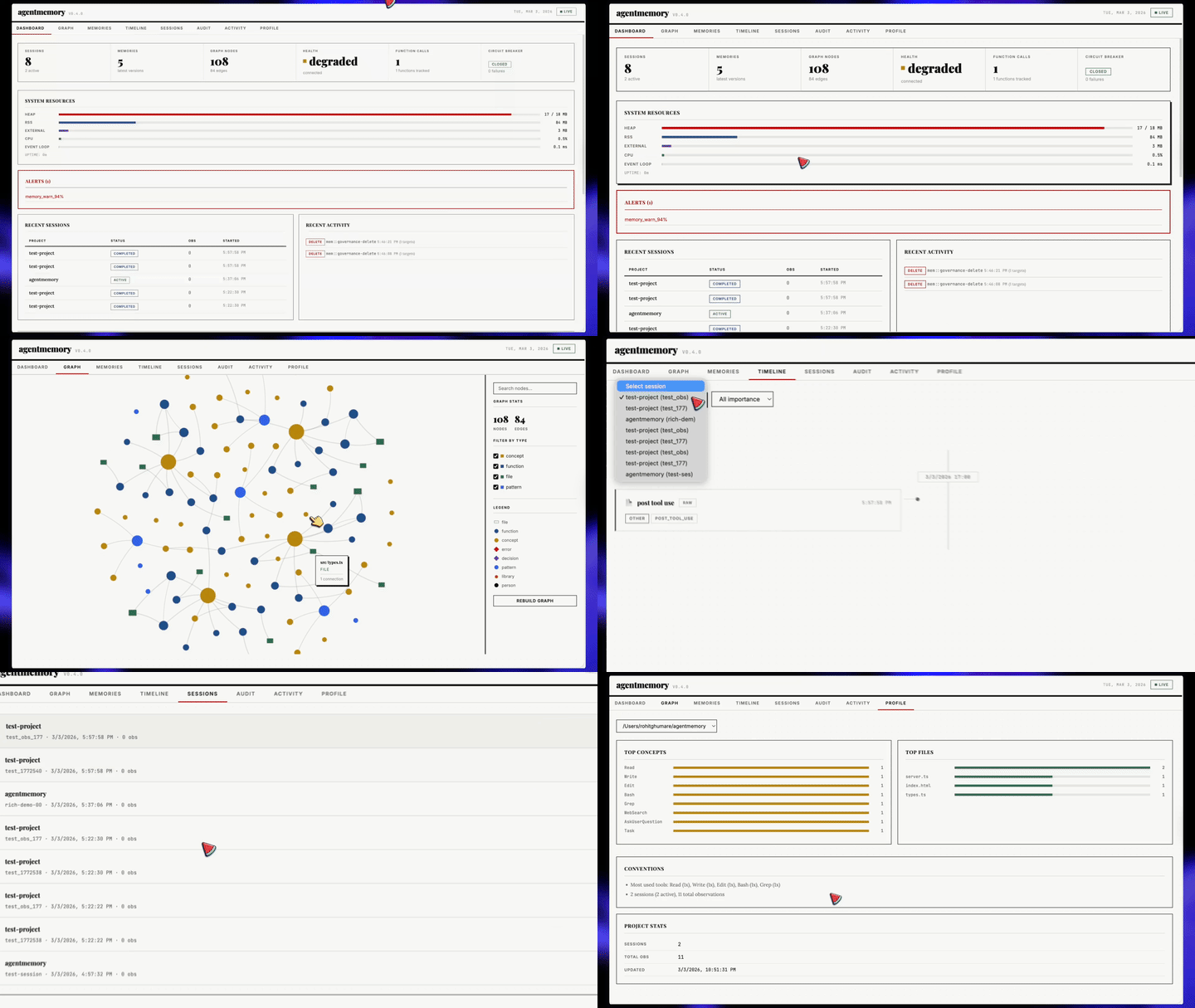
Auto-starts on port `3113`. Live observation stream, session explorer, memory browser, knowledge graph visualization, and health dashboard.
```bash
open http://localhost:3113
```
The viewer server binds to `127.0.0.1` by default. The REST-served `/agentmemory/viewer` endpoint follows the normal `AGENTMEMORY_SECRET` bearer-token rules. CSP headers use a per-response script nonce and disable inline handler attributes (`script-src-attr 'none'`).
---
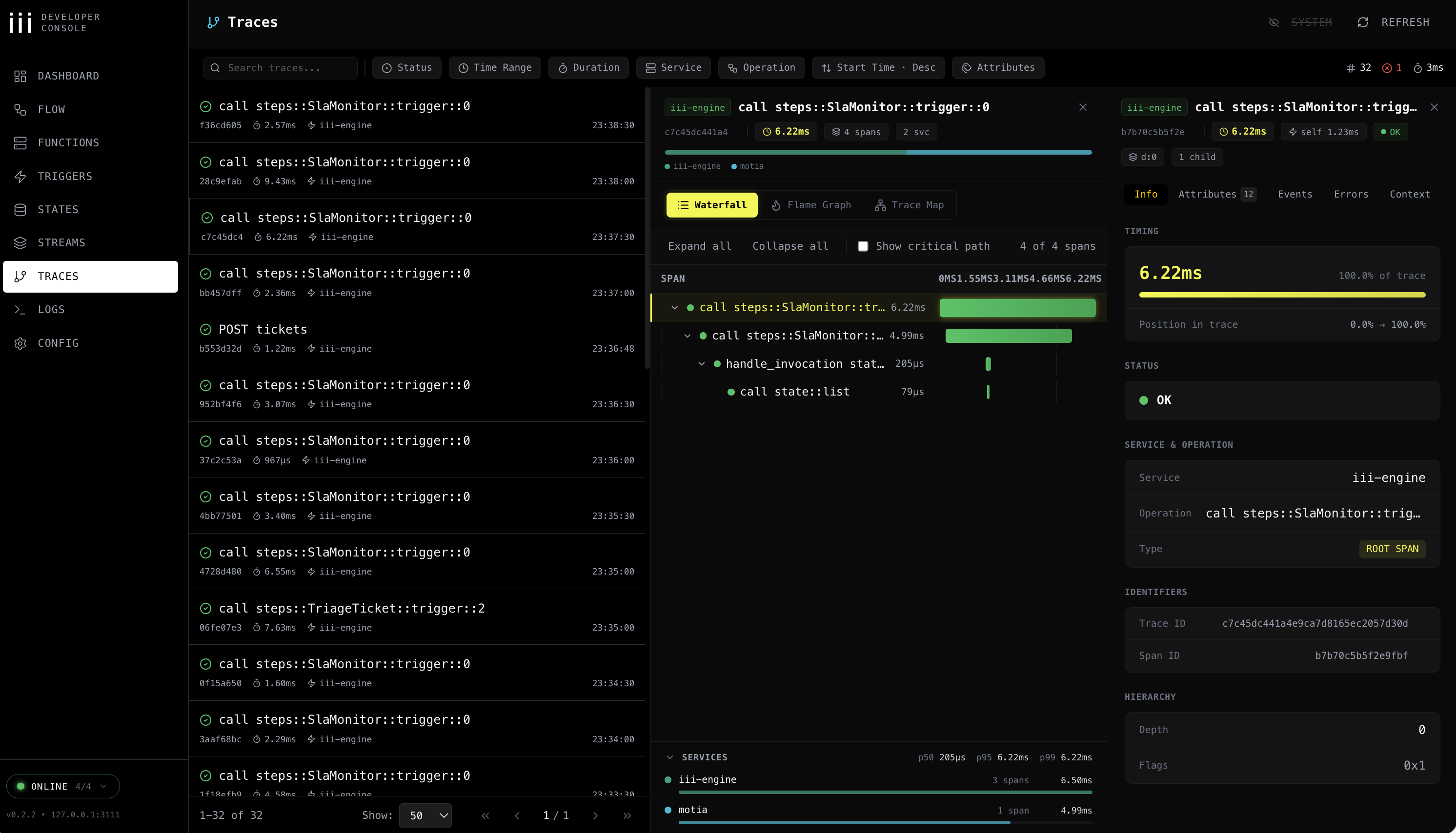
The viewer at `:3113` shows what your agent **remembered**. The [iii console](https://iii.dev/docs/console) shows what your agent **did** — every memory op as an OpenTelemetry trace, every KV entry editable, every function invocable, every stream tappable. Two windows on the same memory: one product-shaped, one engine-shaped.
Watch a `memory_smart_search` fire and see the BM25 scan → embedding lookup → RRF fusion → reranker as a waterfall. Edit a stuck consolidation timer in the KV browser. Replay a `PostToolUse` hook with a tweaked payload. Pin the WebSocket stream and watch observations land live.
agentmemory ships this for free because every function, trigger, state scope, and stream is an iii primitive — nothing custom, nothing to instrument.
Workers page: every connected worker — including agentmemory itself — with PID, function count, runtime, and last-seen.
**Already installed.** The console ships with `iii` — no separate installer.
**Launch alongside agentmemory:**
```bash
# agentmemory viewer holds port 3113, so run the console on 3114.
# Engine REST (3111), WebSocket (3112), and bridge (49134) defaults match agentmemory.
iii console --port 3114
```
Then open `http://localhost:3114`. Add `--enable-flow` for the experimental architecture-graph page.
Override engine endpoints only if you've moved them:
```bash
iii console --port 3114 \
--engine-port 3111 \
--ws-port 3112 \
--bridge-port 49134
```
**What you can do from the console:**
| Page | Use it to |
|------|-----------|
| **Workers** | See every connected worker and its live metrics — including the agentmemory worker itself. |
| **Functions** | Invoke any of agentmemory's functions directly with a JSON payload — handy for testing `memory.recall`, `memory.consolidate`, `graph.query` without wiring a client. |
| **Triggers** | Replay HTTP, cron, event, and state triggers — fire the consolidation cron manually, retry an HTTP route, emit a state change. |
| **States** | KV browser with full CRUD — sessions, memory slots, lifecycle timers, embeddings index — edit values in place. |
| **Streams** | Live WebSocket monitor for memory writes, hook events, and observation updates as they flow through iii streams. |
| **Queues** | Durable queue topics + dead-letter management. Replay or drop failed embedding / compression jobs. |
| **Traces** | OpenTelemetry waterfall / flame / service-breakdown views. Filter by `trace_id` to see exactly which functions, DB calls, and embedding requests a single `memory.search` produced. |
| **Logs** | Structured OTEL logs filtered and correlated to trace/span IDs. |
| **Config** | Runtime configuration — see exactly which workers, providers, and ports your engine is running with. |
| **Flow** | (Optional, `--enable-flow`) Interactive architecture graph of every worker, trigger, and stream. |
Traces: waterfall / flame / service breakdown for every memory operation.
**Traces are already on:**
`iii-config.yaml` ships with the `iii-observability` worker enabled (`exporter: memory`, `sampling_ratio: 1.0`, metrics + logs). No extra config needed — the moment agentmemory starts, every memory operation emits a trace span and a structured log the console can read.
If you want to export to Jaeger/Honeycomb/Grafana Tempo instead, change `exporter: memory` to `exporter: otlp` and set the collector endpoint per iii's observability docs.
> **Heads-up:** no auth is enforced on the console itself — keep it bound to `127.0.0.1` (the default) and never expose it publicly.
---
agentmemory is **already a running [iii](https://iii.dev) instance**. Functions, triggers, KV state, streams, OTEL traces — all of it is iii primitives. You didn't install Postgres, Redis, Express, pm2, or Prometheus, because iii replaces them.
That means one more command extends agentmemory with an entire new capability.
### Extend agentmemory with one command
```bash
iii worker add iii-pubsub # fan memory writes out to every connected instance
iii worker add iii-cron # scheduled consolidation, decay sweeps, snapshot rotation
iii worker add iii-queue # durable retries for embedding + compression jobs
iii worker add iii-observability # OTEL traces on every memory op (default on)
iii worker add iii-sandbox # run recalled code inside an isolated microVM
iii worker add iii-database # swap in a SQL-backed state adapter
iii worker add mcp # generic MCP host alongside the agentmemory MCP
```
Each `iii worker add` registers new functions and triggers into the same engine agentmemory is already running on. The viewer and console pick them up immediately — no reload, no new integration, no new container.
| `iii worker add` | What you get on top of agentmemory |
|---|---|
| [`iii-pubsub`](https://workers.iii.dev/workers/iii-pubsub) | Multi-instance memory: every `remember` fans out, every `search` reads the union |
| [`iii-cron`](https://workers.iii.dev/workers/iii-cron) | Scheduled lifecycle — nightly consolidation, weekly snapshots, decay on a fixed clock |
| [`iii-queue`](https://workers.iii.dev/workers/iii-queue) | Durable retries: failed embedding + compression jobs survive restart, no lost observations |
| [`iii-observability`](https://workers.iii.dev/workers/iii-observability) | OTEL traces, metrics, logs on every function — wired in `iii-config.yaml` from day one |
| [`iii-sandbox`](https://workers.iii.dev/workers/iii-sandbox) | Code that came out of `memory_recall` runs inside a throwaway VM, not your shell |
| [`iii-database`](https://workers.iii.dev/workers/iii-database) | SQL-backed state adapter when you outgrow the in-memory KV defaults |
| [`mcp`](https://workers.iii.dev/workers/mcp) | Stand up extra MCP servers next to agentmemory's, share the same engine |
Full registry: [workers.iii.dev](https://workers.iii.dev). Every worker there composes through the same primitives agentmemory uses — and the agentmemory you already have is one of them.
### What iii replaces
| Traditional stack | agentmemory uses |
|---|---|
| Express.js / Fastify | iii HTTP Triggers |
| SQLite / Postgres + pgvector | iii KV State + in-memory vector index |
| SSE / Socket.io | iii Streams (WebSocket) |
| pm2 / systemd | iii engine worker supervision |
| Prometheus / Grafana | iii OTEL + health monitor |
| Custom plugin systems | `iii worker add ` |
**118 source files · ~21,800 LOC · 950+ tests · 123 functions · 34 KV scopes** — all on three primitives. No `agentmemory plugin install`. The plugin system is iii itself.
---
### LLM Providers
agentmemory auto-detects from your environment. By default, no LLM calls are made unless you configure a provider or explicitly opt in to the Claude subscription fallback.
| Provider | Config | Notes |
|----------|--------|-------|
| **No-op (default)** | No config needed | LLM-backed compress/summarize is DISABLED. Synthetic BM25 compression + recall still work. See `AGENTMEMORY_ALLOW_AGENT_SDK` below if you used to rely on the Claude-subscription fallback. |
| Anthropic API | `ANTHROPIC_API_KEY` | Per-token billing |
| MiniMax | `MINIMAX_API_KEY` | Anthropic-compatible |
| Gemini | `GEMINI_API_KEY` | Also enables embeddings |
| OpenRouter | `OPENROUTER_API_KEY` | Any model |
| Claude subscription fallback | `AGENTMEMORY_ALLOW_AGENT_SDK=true` | Opt-in only. Spawns `@anthropic-ai/claude-agent-sdk` sessions — used to cause unbounded Stop-hook recursion (#149 follow-up) so it is no longer the default. |
### Config File
Put agentmemory runtime configuration in `~/.agentmemory/.env` instead of exporting variables in every shell. If the viewer shows a setup hint like `export ANTHROPIC_API_KEY=...`, copy it into this file as `ANTHROPIC_API_KEY=...` without the `export` prefix, then restart agentmemory.
Process environment variables still work and take precedence over values in the file.
On Windows, the same file lives at `%USERPROFILE%\.agentmemory\.env`:
```powershell
New-Item -ItemType Directory -Force $HOME\.agentmemory
notepad $HOME\.agentmemory\.env
```
To test with a Claude Code Pro/Max subscription instead of an API key, opt in explicitly:
```env
AGENTMEMORY_ALLOW_AGENT_SDK=true
AGENTMEMORY_AUTO_COMPRESS=true
```
Turn on graph or consolidation features in the same file if you want them:
```env
GRAPH_EXTRACTION_ENABLED=true
CONSOLIDATION_ENABLED=true
```
### Environment Variables
Create `~/.agentmemory/.env`:
```env
# LLM provider (pick one — default is the no-op provider: no LLM calls)
# ANTHROPIC_API_KEY=sk-ant-...
# ANTHROPIC_BASE_URL=... # Optional: Anthropic-compatible proxy / Azure
# GEMINI_API_KEY=...
# OPENROUTER_API_KEY=...
# MINIMAX_API_KEY=...
# OPENAI_API_KEY=*** # NOTE: this same key auto-activates BOTH the
# # OpenAI LLM provider (here) AND the OpenAI
# # embedding provider (further below). Set
# # OPENAI_API_KEY_FOR_LLM=false to scope it
# # to embeddings only.
# OPENAI_BASE_URL=https://api.openai.com # Optional: override for Azure / vLLM / LM Studio / proxies
# # Azure: https://.openai.azure.com/openai/deployments/
# # Auto-detected from `.openai.azure.com` hostname; uses
# # api-key header + api-version query param.
# OPENAI_API_VERSION=2024-08-01-preview # Optional: Azure api-version query param
# OPENAI_MODEL=gpt-4o-mini # Optional: default model
# OPENAI_TIMEOUT_MS=60000 # Optional: OpenAI-scoped alias for the outbound fetch
# # timeout. Takes precedence over AGENTMEMORY_LLM_TIMEOUT_MS
# # for back-compat with v0.9.17. New configs should
# # prefer the global AGENTMEMORY_LLM_TIMEOUT_MS below.
# OPENAI_REASONING_EFFORT=none # Optional: "low" | "medium" | "high" | "none"
# # Honored only by OpenAI's reasoning models (o1, o3,
# # gpt-*-reasoning) and providers that mirror that
# # schema (Ollama Cloud thinking models). Standard
# # chat models reject this field with 400. Set to
# # "none" for thinking models that return reasoning
# # but no content.
# OPENAI_API_KEY_FOR_LLM=false # Optional: set to false to skip OpenAI auto-detection
# # for LLM (useful if you only want OpenAI for embeddings)
# Opt-in Claude-subscription fallback (spawns @anthropic-ai/claude-agent-sdk);
# leave OFF unless you understand the Stop-hook recursion risk (#149 follow-up):
# AGENTMEMORY_ALLOW_AGENT_SDK=true
# Embedding provider (auto-detected, or override)
# EMBEDDING_PROVIDER=local
# VOYAGE_API_KEY=...
# OPENAI_API_KEY=sk-...
# OPENAI_BASE_URL=https://api.openai.com # Override for Azure / vLLM / LM Studio / proxies
# OPENAI_EMBEDDING_MODEL=text-embedding-3-small
# OPENAI_EMBEDDING_DIMENSIONS=1536 # Required when the model is not in the known-models table
# Outbound LLM / embedding timeout
# AGENTMEMORY_LLM_TIMEOUT_MS=60000 # Default: 60 000 ms (60 s). Applies to every
# raw-fetch provider (Gemini, OpenRouter, MiniMax,
# OpenAI LLM, OpenAI/Cohere/Voyage/OpenRouter
# embedding). For the OpenAI LLM path, the
# OpenAI-scoped OPENAI_TIMEOUT_MS alias (above)
# takes precedence when set, for back-compat
# with v0.9.17.
# Increase for slow networks or large batch calls;
# decrease to fail-fast on rate-limit holds.
# Search tuning
# BM25_WEIGHT=0.4
# VECTOR_WEIGHT=0.6
# TOKEN_BUDGET=2000
# Auth
# AGENTMEMORY_SECRET=your-secret
# Ports (defaults: 3111 API, 3113 viewer)
# III_REST_PORT=3111
# Features
# AGENTMEMORY_AUTO_COMPRESS=false # OFF by default (#138). When on,
# every PostToolUse hook calls your
# LLM provider to compress the
# observation — expect significant
# token spend on active sessions.
# AGENTMEMORY_SLOTS=false # OFF by default. Editable pinned
# memory slots — persona,
# user_preferences, tool_guidelines,
# project_context, guidance,
# pending_items, session_patterns,
# self_notes. Size-limited; agent
# edits via memory_slot_* tools.
# Pinned slots addressable for
# SessionStart injection.
# AGENTMEMORY_REFLECT=false # OFF by default. Requires SLOTS=on.
# Stop hook fires mem::slot-reflect:
# scans recent observations, auto-
# appends TODOs to pending_items,
# counts patterns in
# session_patterns, records touched
# files in project_context. Fire-
# and-forget; does not block.
# AGENTMEMORY_INJECT_CONTEXT=false # OFF by default (#143). When on:
# - SessionStart may inject ~1-2K
# chars of project context into
# the first turn of each session
# (this is what actually reaches
# the model — Claude Code treats
# SessionStart stdout as context)
# - PreToolUse fires /agentmemory/enrich
# on every file-touching tool call
# (resource cleanup, not a token
# fix — PreToolUse stdout is debug
# log only per Claude Code docs)
# Observations are still captured via
# PostToolUse regardless of this flag.
# GRAPH_EXTRACTION_ENABLED=false
# CONSOLIDATION_ENABLED=true
# LESSON_DECAY_ENABLED=true
# OBSIDIAN_AUTO_EXPORT=false
# AGENTMEMORY_EXPORT_ROOT=~/.agentmemory
# CLAUDE_MEMORY_BRIDGE=false
# SNAPSHOT_ENABLED=false
# Team
# TEAM_ID=
# USER_ID=
# TEAM_MODE=private
# Tool visibility: "core" (8 tools) or "all" (51 tools)
# AGENTMEMORY_TOOLS=core
```
---
124 endpoints on port `3111`. The REST API binds to `127.0.0.1` by default. Protected endpoints require `Authorization: Bearer ` when `AGENTMEMORY_SECRET` is set, and mesh sync endpoints require `AGENTMEMORY_SECRET` on both peers.
Key endpoints
| Method | Path | Description |
|--------|------|-------------|
| `GET` | `/agentmemory/health` | Health check (always public) |
| `POST` | `/agentmemory/session/start` | Start session + get context |
| `POST` | `/agentmemory/session/end` | End session |
| `POST` | `/agentmemory/observe` | Capture observation |
| `POST` | `/agentmemory/smart-search` | Hybrid search |
| `POST` | `/agentmemory/context` | Generate context |
| `POST` | `/agentmemory/remember` | Save to long-term memory |
| `POST` | `/agentmemory/forget` | Delete observations |
| `POST` | `/agentmemory/enrich` | File context + memories + bugs |
| `GET` | `/agentmemory/profile` | Project profile |
| `GET` | `/agentmemory/export` | Export all data |
| `POST` | `/agentmemory/import` | Import from JSON |
| `POST` | `/agentmemory/graph/query` | Knowledge graph query |
| `POST` | `/agentmemory/team/share` | Share with team |
| `GET` | `/agentmemory/audit` | Audit trail |
Full endpoint list: [`src/triggers/api.ts`](src/triggers/api.ts)
---
```bash
npm run dev # Hot reload
npm run build # Production build
npm test # 950+ tests
npm run test:integration # API tests (requires running services)
```
**Prerequisites:** Node.js >= 20, [iii-engine](https://iii.dev/docs) or Docker