# memtrust
[](https://github.com/RudrenduPaul/memtrust/actions/workflows/ci.yml)
[](https://github.com/RudrenduPaul/memtrust/blob/main/LICENSE)
[](https://pypi.org/project/memtrust-cli/)
[](https://www.npmjs.com/package/memtrust-cli)
[](https://pypi.org/project/memtrust-cli/)
 Agent memory backends each publish their own benchmark numbers, on different tests, measured
different ways. memtrust runs the same evals against all four and publishes the raw logs. Run
against the vendors, not by them.
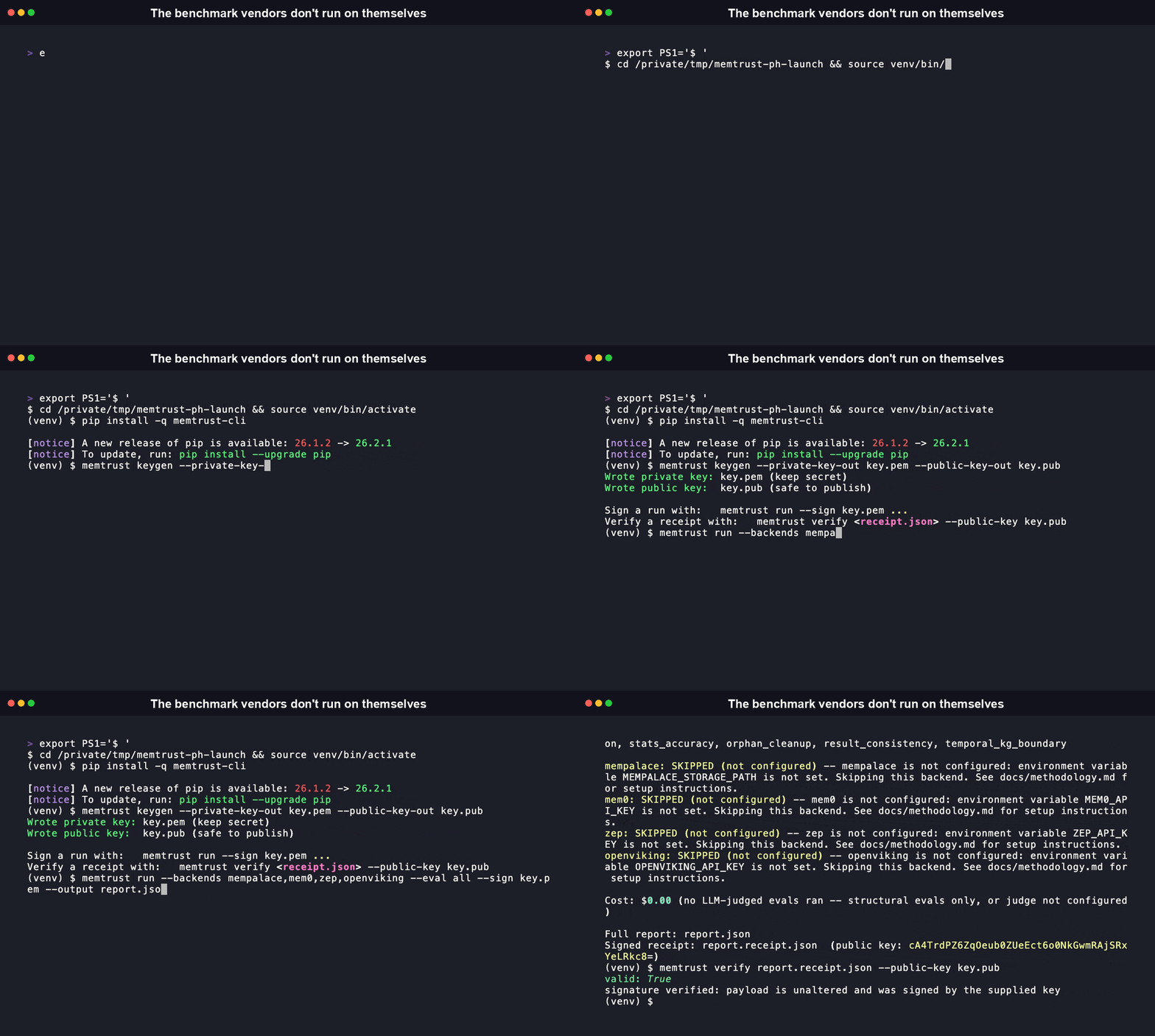
```bash
pip install memtrust-cli
memtrust run --backends mempalace,mem0,zep,openviking --eval all
```
(For contributing to this repo instead of just running it, see [Development](#development) --
`pip install -e ".[dev]"` from a clone.)
**Contents:** [Why this exists](#why-this-exists) · [What it does](#what-it-does) ·
[Commands](#commands) · [How this differs](#how-this-differs-from-trusting-a-vendors-own-numbers) ·
[Contradiction detection](#the-eval-that-actually-matters-contradiction-detection) ·
[Compression fidelity](#the-eval-built-for-the-other-headline-overclaim-compression-fidelity) ·
[Temporal-KG boundary](#the-eval-built-from-mempalaces-own-bug-temporal-kg-boundary-detection) ·
[The landscape](#the-landscape-verified-not-benchmarked) · [Benchmarks](#benchmarks) ·
[GitHub Actions usage](#github-actions-usage) · [Self-host](#self-host) · [Install](#install) ·
[Hosted layer](#what-a-hosted-trust-layer-would-add) · [Backend coverage](#backend-coverage) ·
[Development](#development) · [FAQ](#faq) · [License](#license) · [Success stories](#success-stories)
## Why this exists
If you've compared agent-memory backends recently, you've probably noticed each one leads with a
different accuracy number, on a different benchmark, measured a different way. MemPalace's own
community already flagged the problem in public. Issue [#27](https://github.com/MemPalace/mempalace/issues/27)
on the MemPalace repository, opened April 7, 2026 and still open, documents that a headline 100%
LongMemEval figure, measured with Haiku reranking, wasn't reproducible from the repository's own
benchmark scripts and was pulled from the README as unverifiable. A separate 96.6% figure people
cite everywhere turns out to be mostly ChromaDB's default embeddings doing the work in raw mode,
not MemPalace's own architecture. A "lossless" compression claim (the "AAAK" mode) drops the same
LongMemEval score from 96.6% to 84.2% in practice, a 12.4 percentage point gap. Two internal pull
requests attempting to fix the reporting problem, #433 and #729, were both closed without merging
on April 12, 2026 -- #729 within seven minutes of being opened. As of this writing, the issue has
232 thumbs-up reactions and 39 comments.
None of that means MemPalace, or any other backend, doesn't work. It means nobody outside the
vendor had run the same test, the same way, against every option, and published the raw logs.
memtrust does that. It runs LongMemEval, LoCoMo, and a growing set of evals built specifically for
this project -- 17 of them as of this writing, all registered in the CLI's `--eval` flag. The two
that matter most for understanding what this project is actually for:
contradiction detection, because neither LongMemEval nor LoCoMo tests the question that actually
matters once a memory system sits underneath a production agent -- what happens when a new fact
contradicts an old one? Does the backend flag the conflict? Silently overwrite the old fact with no
audit trail? Serve whichever version it happens to retrieve first? None of the four backends this
project tracks publish a number for that. And compression/round-trip fidelity, built to directly
test claims like the "lossless" one above: it stores content, retrieves it, and scores literal
reconstruction fidelity rather than semantic accuracy, per operating mode a backend exposes (see
`MemoryBackendAdapter.supported_modes`) -- the mechanism that would let a contributor with live
MemPalace credentials actually reproduce the 12.4-point compressed-mode accuracy drop
mempalace/mempalace#27 documents, instead of just citing it. **Neither has been run against a live
MemPalace instance as of this writing** -- both have, however, been run against a live
self-hosted `mem0ai` install; see "Benchmarks" below. The other evals -- ranking quality,
crash recovery, extraction quality, embedding drift, scale/volume stress, lock contention, stats
accuracy, orphan cleanup, result consistency, migration rollback, filter injection, resource-sync
safety, and temporal-KG boundary detection -- each grew out of a specific real bug report against
one of the four tracked backends; see "Success stories" below for the full list.
**Where this stands right now, in one place:** [live benchmark results](#benchmarks) for one
backend (`mem0_direct`, self-hosted `mem0ai`), including a real bug this project's own attempt to
get those numbers surfaced in mem0's default configuration; and [197 real GitHub issues and PRs](#success-stories)
filed against MemPalace, Mem0, Zep/Graphiti, and OpenViking independently root-caused against this
codebase -- 55 (28%) PASS, 16 (8%) PARTIAL, 42 (21%) a genuine capability gap, 84 (43%) not
applicable, every verdict re-verified by a reviewer independent of whoever built the fix.
## What it does
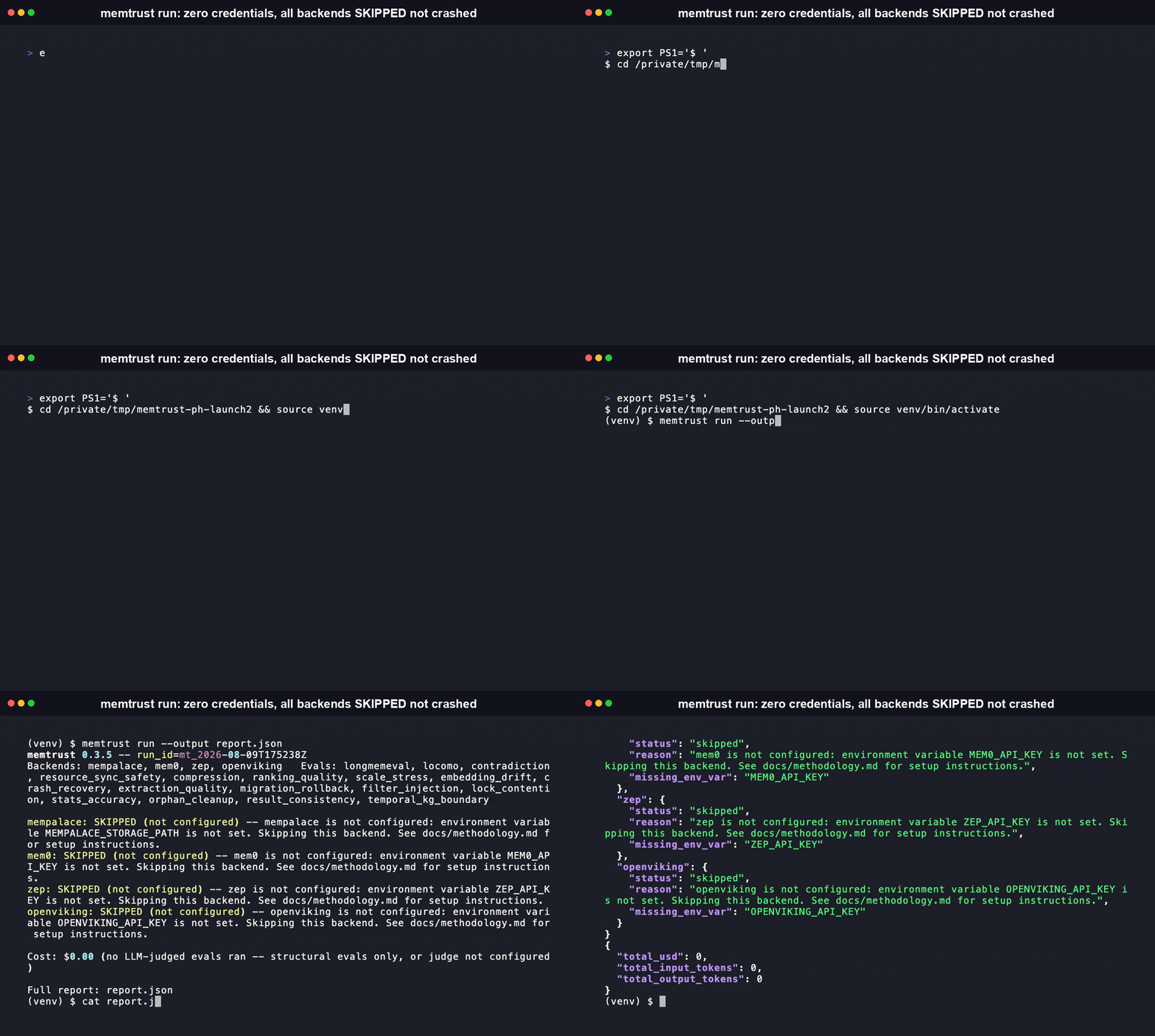
Every command below was actually run against this repo, with zero vendor API keys configured, to
produce the output shown. Nothing here is simulated.
```
$ memtrust run --backends mempalace,mem0,zep,openviking --eval all
memtrust 0.3.4 -- run_id=mt_2026-08-04T061759Z
Backends: mempalace, mem0, zep, openviking Evals: longmemeval, locomo, contradiction,
resource_sync_safety, compression, ranking_quality, scale_stress, embedding_drift, crash_recovery,
extraction_quality, migration_rollback, filter_injection, lock_contention, stats_accuracy,
orphan_cleanup, result_consistency, temporal_kg_boundary
mempalace: SKIPPED (not configured) -- mempalace is not configured: environment variable
MEMPALACE_STORAGE_PATH is not set. Skipping this backend. See docs/methodology.md for setup
instructions.
mem0: SKIPPED (not configured) -- mem0 is not configured: environment variable MEM0_API_KEY is not
set. Skipping this backend. See docs/methodology.md for setup instructions.
zep: SKIPPED (not configured) -- zep is not configured: environment variable ZEP_API_KEY is not set.
Skipping this backend. See docs/methodology.md for setup instructions.
openviking: SKIPPED (not configured) -- openviking is not configured: environment variable
OPENVIKING_API_KEY is not set. Skipping this backend. See docs/methodology.md for setup
instructions.
Cost: $0.00 (no LLM-judged evals ran -- structural evals only, or judge not configured)
Full report: memtrust-report-2026-08-03.json
```
That's the real, reproducible behavior of a fresh clone with no credentials: every backend reports
SKIPPED, the command exits cleanly, and a valid JSON report is still written. `memtrust --version`
now correctly prints the installed version, matching `pip show memtrust-cli`. Earlier releases printed
`0.0.0+unknown` even when properly installed, because `src/memtrust/__init__.py` read
`importlib.metadata.version("memtrust")` while the installed distribution is actually named
`memtrust-cli` -- kept in the FAQ below for the record rather than deleted, since silently erasing
a bug the moment it's fixed is exactly the kind of curation this project exists to push back on in
other people's benchmarks. Set the relevant environment variable for any backend you want to
actually test (`MEM0_API_KEY`, `ZEP_API_KEY`, `OPENVIKING_API_KEY`, `MEMPALACE_STORAGE_PATH`) and
that backend runs for real against its live API instead of being skipped.
The eval logic itself is proven offline, against the bundled synthetic fixtures and, for several
adapters, the real installed vendor packages with only the network boundary mocked, by the test
suite:
```
$ pytest --cov=memtrust --cov-report=term-missing
... (33 module rows total; the 11 most relevant to this README are shown below)
Name Stmts Miss Cover
-------------------------------------------------------------------------------------
src/memtrust/adapters/base.py 290 1 99%
src/memtrust/adapters/mempalace_adapter.py 265 15 94%
src/memtrust/adapters/mem0_adapter.py 140 12 91%
src/memtrust/adapters/mem0_direct_adapter.py 281 34 88%
src/memtrust/adapters/openviking_adapter.py 178 18 90%
src/memtrust/adapters/zep_graphiti_adapter.py 63 3 95%
src/memtrust/adapters/zep_graphiti_selfhosted_adapter.py 165 24 85%
src/memtrust/evals/contradiction.py 127 2 98%
src/memtrust/evals/compression.py 86 1 99%
src/memtrust/evals/temporal_kg_boundary.py 90 3 97%
src/memtrust/receipt.py 118 10 92%
-------------------------------------------------------------------------------------
TOTAL 4167 265 94%
590 passed, 8 skipped in 5.92s
```
This is an excerpt, not the full table -- the weakest-covered module in the repo,
`evals/mempalace_metadata_scale.py` (70%), isn't one of the 11 shown above; run the command
yourself for the complete per-module breakdown.
590 passing tests across 33 source modules, 94% overall statement coverage, 98% on the
contradiction-detection eval, 99% on compression/round-trip fidelity, 97% on the temporal-KG
boundary eval, 85-99% across the adapter layer. The 8 skips are live-`mempalace`-package tests that
only run with the optional `mempalace-direct` extra installed (`pip install -e
'.[dev,mempalace-direct]'`). Every test mocks its HTTP or wire
layer, or uses an in-memory fake backend -- none of them touch a real network, though a meaningful
share of the adapter tests now import and exercise *real installed vendor classes* directly
(`mem0ai==2.0.12`'s embedder and vector-store modules, and -- gated behind the optional
`mempalace-direct` extra -- the real `mempalace.mcp_server` functions), mocking only the outermost
network or wire-client boundary rather than the whole library. `graphiti-core` is not installed in
this environment, so its self-hosted adapter's tests still run against a hand-written Protocol
double built to match the real package's confirmed method signatures, not the real classes -- see
`docs/methodology.md`'s adapter confidence table for exactly which claim rests on which kind of
verification.
## Commands
```
$ memtrust --help
Usage: memtrust [OPTIONS] COMMAND [ARGS]...
memtrust: an independent, reproducible benchmark harness for agent-memory
backends.
Options:
--version Show the version and exit.
--help Show this message and exit.
Commands:
keygen Generate a new Ed25519 keypair for signing `memtrust run`...
report Read a prior `memtrust run` JSON report and print a formatted...
run Run the eval suite against the requested backends.
verify Verify a signed receipt produced by `memtrust run --sign`.
```
| Command | Flags | What it does |
|---|---|---|
| `memtrust run` | `--backends TEXT` comma-separated list or `all` (default `all`) · `--eval TEXT` comma-separated from `longmemeval,locomo,contradiction,resource_sync_safety,compression,ranking_quality,scale_stress,embedding_drift,crash_recovery,extraction_quality,migration_rollback,filter_injection,lock_contention,stats_accuracy,orphan_cleanup,result_consistency,temporal_kg_boundary`, or `all` (default `all`) · `--output FILE` (defaults to `./memtrust-report-.json`) · `--locomo-dataset-path FILE` points the LoCoMo eval at a real, downloaded `locomo10.json` instead of the bundled synthetic fixture (memtrust does not bundle or auto-fetch the real dataset) · `--locomo-exclude-question-ids-file FILE` excludes known-bad-ground-truth LoCoMo question IDs from scoring · `--scale-stress-n-records INTEGER` (default `500`) sets how many synthetic records the scale-stress eval stores and re-queries · `--sign FILE` writes a signed `