# TokenTrust
[](https://github.com/RudrenduPaul/TokenTrust-CLI/actions/workflows/ci.yml)
[](./LICENSE)
[](https://www.npmjs.com/package/tokentrust-cli)
[](https://pypi.org/project/tokentrust-cli/)
[Install](#install) • [What it measures](#what-it-measures) • [Commands](#commands) • [Agent-native / MCP](#agent-native--mcp) • [FAQ](#faq)
Vendor-neutral CLI that independently verifies the token and cost savings AI-coding-agent
context-reduction proxies actually deliver, by running the proxy for real against a labeled
task corpus instead of trusting the maintainer's own number.
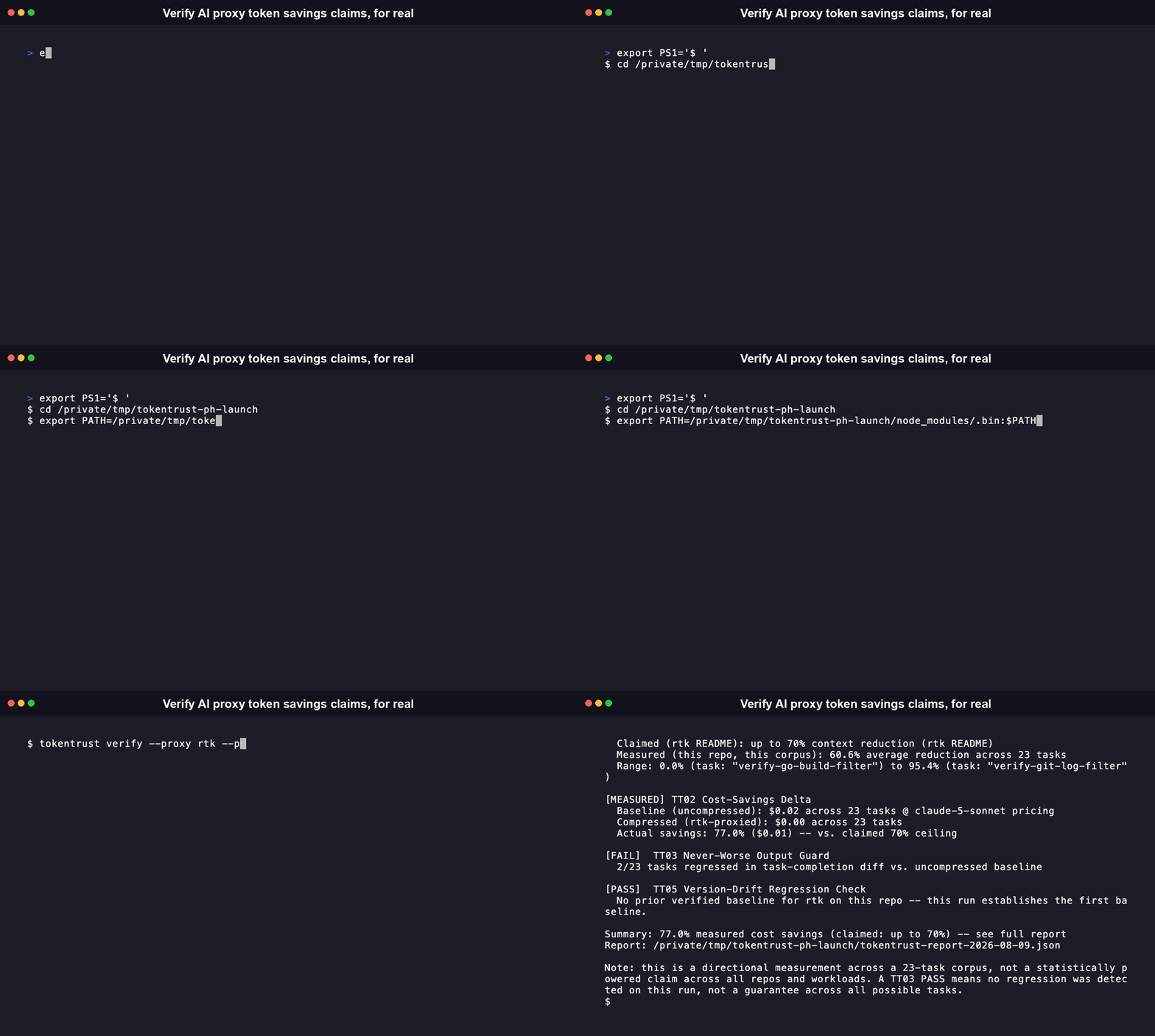
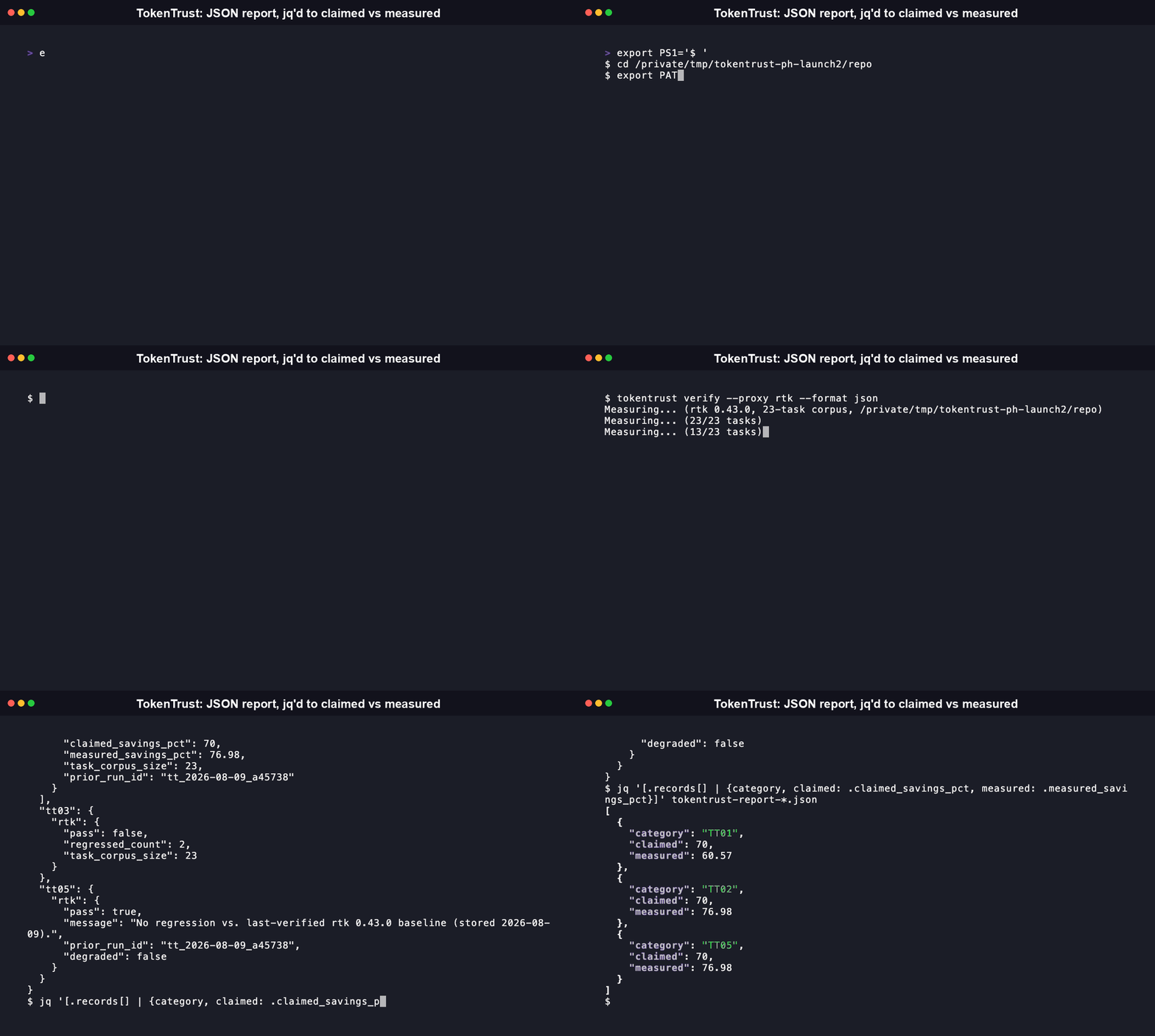 Exit code is `0` when the run completes with no gated failure, non-zero otherwise. The bundled
GitHub Action's `--fail-on-regression` maps that straight to a failed CI step, so a version-drift
regression breaks the build instead of shipping silently.
Add it to CI with the bundled GitHub Action (`action/action.yml`) so verification reruns
automatically whenever a proxy's version bumps:
```yaml
- uses: RudrenduPaul/TokenTrust-CLI@main
with:
proxy: rtk
fail-on-regression: 'true'
cli-version: '
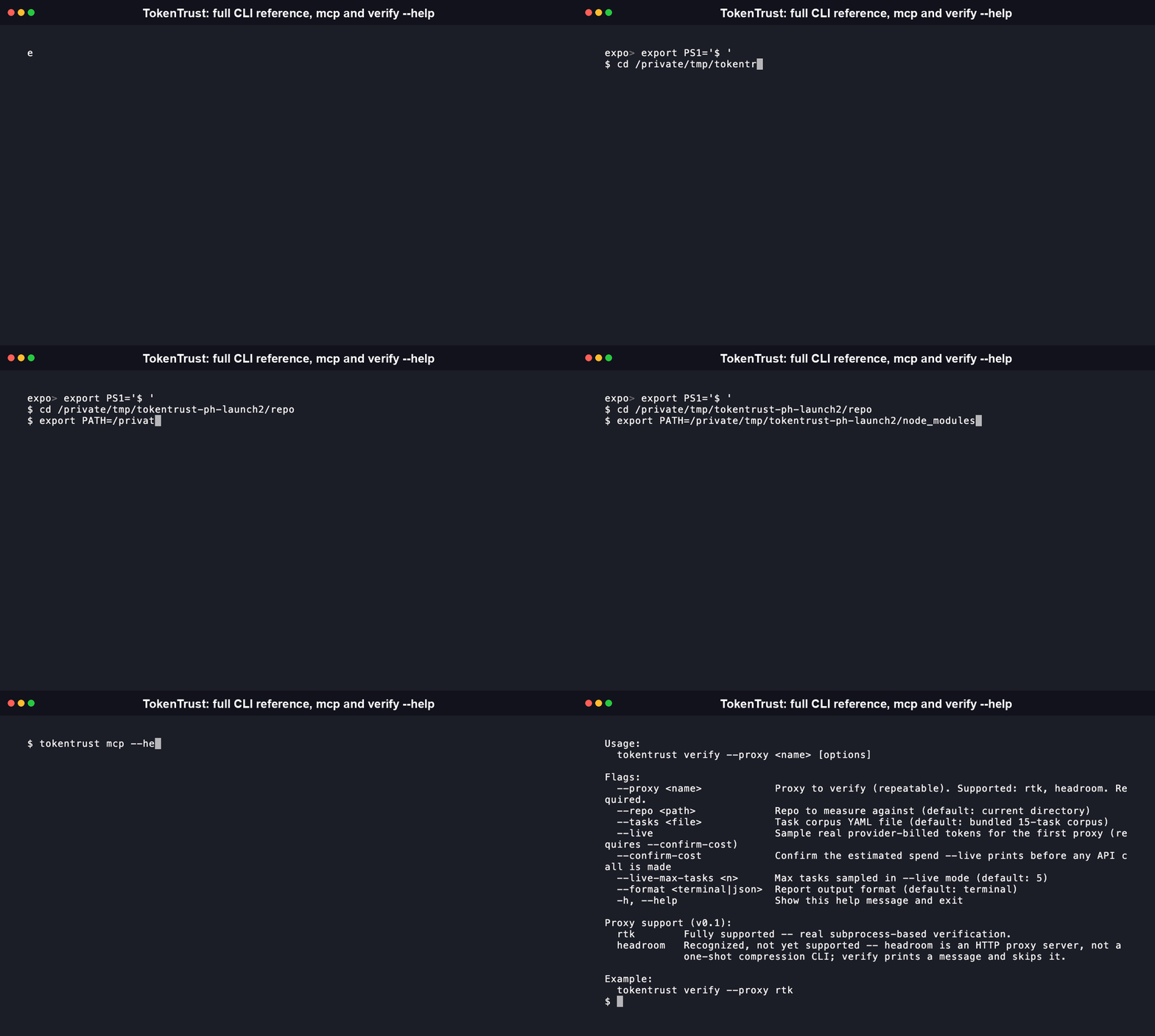 ### Register it with an MCP client
Point the client's server config at this binary with the `mcp` argument. For Claude Code,
Claude Desktop, or any other client that reads an `mcpServers` block:
```json
{
"mcpServers": {
"tokentrust": {
"command": "npx",
"args": ["tokentrust-cli", "mcp"]
}
}
}
```
### The tool
| Field | Description |
|---|---|
| `verify_proxy_savings` | Tool name. Mirrors `verify`'s flags one-for-one, minus `--format` -- an MCP call is always machine-facing, so the tool always returns the structured JSON report. |
| `proxy` (required) | A single proxy name (`"rtk"`) or an array (`["rtk", "headroom"]`) to run the TT04 cross-tool comparison in one call. Supported: `rtk`, `headroom`. |
| `repo` | Same as `--repo`. Defaults to the MCP server process's current working directory. |
| `tasks` | Same as `--tasks`. Defaults to the bundled task corpus. |
| `live` / `confirmCost` | Same `--live`/`--confirm-cost` safety gate as the CLI: no live, provider-billed API call is made unless BOTH are explicitly `true` in the same call. Neither has a default of `true`. |
| `liveMaxTasks` | Same as `--live-max-tasks`. Defaults to 5. |
This is the tool's real, unedited `tools/list` schema, captured from a running `tokentrust mcp`
server (`inputSchema` trimmed of per-field descriptions here for length; the live server returns
them in full):
```json
{
"name": "verify_proxy_savings",
"title": "Verify proxy token/cost savings",
"inputSchema": {
"type": "object",
"properties": {
"proxy": { "anyOf": [{ "type": "string", "enum": ["rtk", "headroom"] }, { "type": "array", "items": { "type": "string", "enum": ["rtk", "headroom"] }, "minItems": 1 }] },
"repo": { "type": "string" },
"tasks": { "type": "string" },
"live": { "type": "boolean" },
"confirmCost": { "type": "boolean" },
"liveMaxTasks": { "type": "integer", "exclusiveMinimum": 0 }
},
"required": ["proxy"]
}
}
```
A real `tools/call` against this repo, `{"name": "verify_proxy_savings", "arguments": {"proxy":
"rtk"}}`, returns the same shape as the CLI's `--format json` output (trimmed here; the live
call returns the full `records` array with TT01/TT02/TT05 entries):
```json
{
"content": [
{
"type": "text",
"text": "{\n \"run_id\": \"tt_2026-07-18_f88644\",\n \"repo\": \"...\",\n \"task_corpus_size\": 23,\n \"proxies\": [\"rtk\"],\n \"records\": [ /* TT01, TT02, TT05 -- same shape as `verify --format json` */ ],\n \"tt03\": { \"rtk\": { \"pass\": false, \"regressed_count\": 2, \"task_corpus_size\": 23 } },\n \"tt05\": { \"rtk\": { \"pass\": true, \"message\": \"No regression vs. last-verified rtk 0.43.0 baseline (stored 2026-07-18).\", \"prior_run_id\": \"tt_2026-07-18_608b74\", \"degraded\": false } }\n}"
}
],
"isError": false
}
```
`isError` is `true` (with no report) whenever the underlying `runVerify()` call itself would
have exited non-zero on the CLI -- a missing proxy binary, an invalid task corpus, or the
`--live` safety gate refusing an under-confirmed call. Progress output and the trace log
`tokentrust verify` normally prints to stdout are rerouted to stderr in MCP mode, since stdout
is the live JSON-RPC wire once a stdio transport is connected.
## Proxy support
| Proxy | Status |
|---|---|
| `rtk` | Fully supported: real subprocess-based verification (`rtk pipe --filter