# rumdl - A high-performance Markdown linter, written in Rust
[](https://github.com/rvben/rumdl/actions)
[](https://opensource.org/licenses/MIT)
[](https://crates.io/crates/rumdl)
[](https://pypi.org/project/rumdl/)
[](https://github.com/rvben/rumdl/releases/latest)
[](https://github.com/rvben/rumdl/stargazers)
[](https://discord.gg/ADTJFSFUyn)
[](https://github.com/sponsors/rvben)
## A modern Markdown linter and formatter, built for speed with Rust
| [**Docs**](https://rumdl.dev)
| [**Rules**](https://rumdl.dev/rules)
| [**Configuration**](https://rumdl.dev/global-settings)
| [**Markdown Flavors**](https://rumdl.dev/flavors)
| [**vs markdownlint**](https://rumdl.dev/markdownlint-comparison) |
## Quick Start
```bash
# Install using Cargo
cargo install rumdl
# Lint Markdown files in the current directory
rumdl check .
# Format files (exits 0 on success, even if unfixable violations remain)
rumdl fmt .
# Auto-fix and report unfixable violations (exits 0 if all fixed, 1 if violations remain)
rumdl check --fix .
# Create a default configuration file
rumdl init
```
## Overview
rumdl is a high-performance Markdown linter and formatter that helps ensure consistency and best practices in your Markdown files. Inspired by [ruff](https://github.com/astral-sh/ruff) 's approach to
Python linting, rumdl brings similar speed and developer experience improvements to the Markdown ecosystem.
> Questions or feedback? Join us on [Discord](https://discord.gg/ADTJFSFUyn).
It offers:
- ⚡️ **Built for speed** with Rust - significantly faster than alternatives
- 🔍 **75 lint rules** covering common Markdown issues
- 🛠️ **Automatic formatting** with `--fix` for files and stdin/stdout
- 📦 **Zero dependencies** - single binary with no runtime requirements
- 🔧 **Highly configurable** with TOML-based config files
- 🎯 **Multiple Markdown flavors** - [GFM, MkDocs, MDX, Quarto, MyST](docs/flavors.md) support with auto-detection
- 🌐 **Multiple installation options** - Rust, Python, standalone binaries
- 🐍 **Installable via pip** for Python users
- 📏 **Modern CLI** with detailed error reporting
- 🔄 **CI/CD friendly** with non-zero exit code on errors
### Performance
rumdl is designed for speed. Benchmarked on the [Rust Book](https://github.com/rust-lang/book) repository (478 markdown files, October 2025):
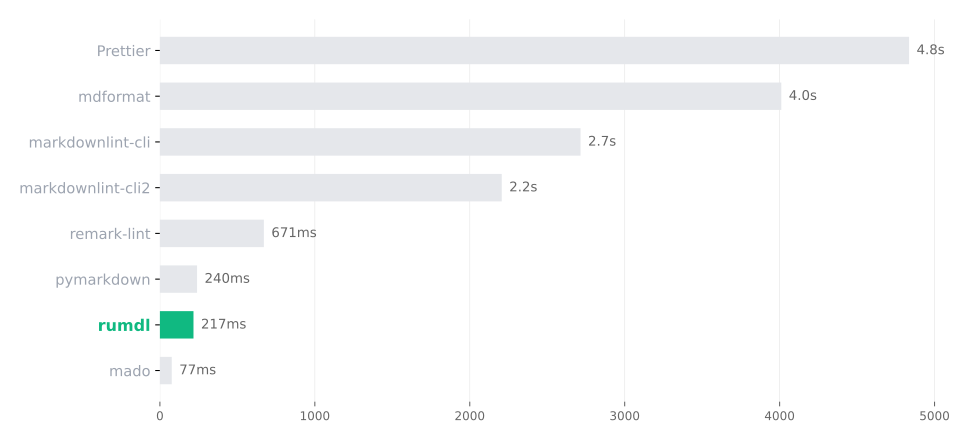
With intelligent caching, subsequent runs are even faster - rumdl only re-lints files that have changed, making it ideal for watch mode and editor integration.
## Table of Contents
- [Installation](#installation)
- [Using Homebrew (macOS/Linux)](#using-homebrew-macoslinux)
- [Using Cargo (Rust)](#using-cargo-rust)
- [Using npm](#using-npm)
- [Using pip (Python)](#using-pip-python)
- [Using uv](#using-uv)
- [Using mise](#using-mise)
- [Using Nix (macOS/Linux)](#using-nix-macoslinux)
- [Using Termux User Repository (TUR) (Android)](#using-termux-user-repository-tur-android)
- [Using pacman (Arch Linux)](#using-pacman-arch-linux)
- [Download binary](#download-binary)
- [Editor Plugins](#editor-plugins)
- [Shell Completions](#shell-completions)
- [Usage](#usage)
- [Stdin/Stdout Formatting](#stdinstdout-formatting)
- [Editor Integration](#editor-integration)
- [Pre-commit Integration](#pre-commit-integration)
- [Excluding Files in Pre-commit](#excluding-files-in-pre-commit)
- [CI/CD Integration](#cicd-integration)
- [GitHub Actions](#github-actions)
- [Inputs](#inputs)
- [Examples](#examples)
- [Rules](#rules)
- [Flavors](#flavors)
- [Supported Flavors](#supported-flavors)
- [Configuring Flavors](#configuring-flavors)
- [Command-line Interface](#command-line-interface)
- [Commands](#commands)
- [`check [PATHS...]`](#check-paths)
- [`fmt [PATHS...]`](#fmt-paths)
- [`init [OPTIONS]`](#init-options)
- [`import [OPTIONS]`](#import-file-options)
- [`rule []`](#rule-rule)
- [`config [OPTIONS] [COMMAND]`](#config-options-command)
- [`server [OPTIONS]`](#server-options)
- [`vscode [OPTIONS]`](#vscode-options)
- [`completions [SHELL]`](#completions-shell)
- [`version`](#version)
- [Global Options](#global-options)
- [Exit Codes](#exit-codes)
- [Usage Examples](#usage-examples)
- [LSP](#lsp)
- [Configuration](#configuration)
- [Configuration Discovery](#configuration-discovery)
- [Editor Support (JSON Schema)](#editor-support-json-schema)
- [Global Configuration](#global-configuration)
- [Markdownlint Migration](#markdownlint-migration)
- [Inline Configuration](#inline-configuration)
- [Configuration File Example](#configuration-file-example)
- [Style Guide Presets](#style-guide-presets)
- [Initializing Configuration](#initializing-configuration)
- [Configuration in pyproject.toml](#configuration-in-pyprojecttoml)
- [Configuration Output](#configuration-output)
- [Effective Configuration (`rumdl config`)](#effective-configuration-rumdl-config)
- [Example output](#example-output)
- [Defaults Only (`rumdl config --defaults`)](#defaults-only-rumdl-config---defaults)
- [Non-Defaults Only (`rumdl config --no-defaults`)](#non-defaults-only-rumdl-config---no-defaults)
- [Output Style](#output-style)
- [Output Format](#output-format)
- [Text Output (Default)](#text-output-default)
- [JSON Output](#json-output)
- [Stability](#stability)
- [Development](#development)
- [Prerequisites](#prerequisites)
- [Building](#building)
- [Testing](#testing)
- [JSON Schema Generation](#json-schema-generation)
- [Used By](#used-by)
- [Sponsors](#sponsors)
- [License](#license)
## Installation
Choose the installation method that works best for you:
### Using winget (Windows)
```powershell
winget install --id rvben.rumdl --exact
```
### Using Homebrew (macOS/Linux)
```bash
brew install rumdl
```
### Using Cargo (Rust)
```bash
cargo install rumdl
```
### Using npm
```bash
npm install -g rumdl
```
Or as a dev dependency:
```bash
npm install --save-dev rumdl
```
### Using pip (Python)
```bash
pip install rumdl
```
### Using uv
For faster installation and better dependency management with [uv](https://github.com/astral-sh/uv):
```bash
# Install directly
uv tool install rumdl
# Or run without installing
uvx rumdl check .
```
### Using mise
For dependency management with [mise](https://github.com/jdx/mise):
```bash
# List available versions
mise ls-remote rumdl
# Install the latest version
mise install rumdl
# Use a specific version for the project
mise use rumdl@0.2.19
```
### Using Nix (macOS/Linux)
```bash
nix-channel --update
nix-env --install --attr nixpkgs.rumdl
```
Alternatively, you can use flakes to run it without installation.
```bash
nix run --extra-experimental-features 'flakes nix-command' nixpkgs/nixpkgs-unstable#rumdl -- --version
```
### Using Termux User Repository (TUR) (Android)
After enabling the TUR repo using
```bash
pkg install tur-repo
```
```bash
pkg install rumdl
```
### Using pacman (Arch Linux)
rumdl is available in the [official Arch Linux repositories](https://archlinux.org/packages/extra/x86_64/rumdl/):
```bash
pacman -S rumdl
```
### Download binary
```bash
# Linux/macOS
curl -LsSf https://github.com/rvben/rumdl/releases/latest/download/rumdl-linux-x86_64.tar.gz | tar xzf - -C /usr/local/bin
# Windows PowerShell
Invoke-WebRequest -Uri "https://github.com/rvben/rumdl/releases/latest/download/rumdl-windows-x86_64.zip" -OutFile "rumdl.zip"
Expand-Archive -Path "rumdl.zip" -DestinationPath "$env:USERPROFILE\.rumdl"
```
### Using Docker
Multi-arch images (amd64, arm64) are published to the GitHub Container Registry on every release. Mount your project at `/data` (the working directory inside the container):
```bash
docker run --rm --user "$(id -u):$(id -g)" -v "$PWD:/data" ghcr.io/rvben/rumdl:latest check .
# Pin a specific version
docker run --rm --user "$(id -u):$(id -g)" -v "$PWD:/data" ghcr.io/rvben/rumdl:0.3.0 check .
```
The image runs as a non-root user by default, so it never writes root-owned files into your project.
Passing `--user` runs rumdl as your own user, which lets the lint cache (`.rumdl_cache`) be written into the mounted project with your ownership; without it the cache is skipped gracefully.
The image contains only the static rumdl binary, so there is no shell to enter; pass rumdl arguments directly.
For environments that need a shell inside the image, such as GitLab CI job containers, an Alpine-based flavour is published as `ghcr.io/rvben/rumdl:alpine` (or pin `:-alpine`).
It has no rumdl entrypoint; invoke the binary by name:
```bash
docker run --rm -v "$PWD:/data" ghcr.io/rvben/rumdl:alpine rumdl check .
```
```yaml
# .gitlab-ci.yml
lint-markdown:
image: ghcr.io/rvben/rumdl:alpine
script:
- rumdl check .
```
### Editor Plugins
| Editor | Install |
| ----------------------------------- | ------------------------------------------------------------------------------------------------ |
| VS Code / Cursor / Windsurf | `rumdl vscode` or [Marketplace](https://marketplace.visualstudio.com/items?itemName=rvben.rumdl) |
| JetBrains (PyCharm, IntelliJ, etc.) | [JetBrains Marketplace](https://plugins.jetbrains.com/plugin/29943-rumdl) |
All plugins provide real-time linting, formatting on save, hover documentation, and automatic configuration discovery.
### Shell Completions
rumdl can generate tab-completion scripts via `rumdl completions [SHELL]`. Supported shells: `bash`, `zsh`, `fish`, `powershell`, `elvish`.
When `SHELL` is omitted, rumdl auto-detects it from `$SHELL`. Run `rumdl completions --list` to see all supported shells.
**Bash** — add to `~/.bashrc`:
```bash
source <(rumdl completions bash)
```
**Zsh** — add to `~/.zshrc`:
```bash
source <(rumdl completions zsh)
```
Or install system-wide for `zsh`:
```bash
rumdl completions zsh > "${fpath[1]}/_rumdl"
```
**Fish** — write the completion file once:
```fish
rumdl completions fish > ~/.config/fish/completions/rumdl.fish
```
**PowerShell** — add to your `$PROFILE`:
```powershell
rumdl completions powershell | Out-String | Invoke-Expression
```
**Elvish** — add to `~/.config/elvish/rc.elv`:
```elvish
eval (rumdl completions elvish | slurp)
```
## Usage
Getting started with rumdl is simple:
```bash
# Lint a single file
rumdl check README.md
# Lint all Markdown files in current directory and subdirectories
rumdl check .
# Format a specific file
rumdl fmt README.md
# Create a default configuration file
rumdl init
```
Common usage examples:
```bash
# Lint with custom configuration
rumdl check --config my-config.toml docs/
# Override config inline without touching any file (Ruff-compatible syntax)
rumdl check --config 'MD013.line-length=120' --config 'MD013.reflow=true' docs/
# See docs/cli-config-overrides.md for the full reference.
# Disable specific rules
rumdl check --disable MD013,MD033 README.md
# Enable only specific rules
rumdl check --enable MD001,MD003 README.md
# Exclude specific files/directories
rumdl check --exclude "node_modules,dist" .
# Include only specific files/directories
rumdl check --include "docs/*.md,README.md" .
# Watch mode for continuous linting
rumdl check --watch docs/
# Combine include and exclude patterns
rumdl check --include "docs/**/*.md" --exclude "docs/temp,docs/drafts" .
# Don't respect gitignore files (note: --respect-gitignore defaults to true)
rumdl check --respect-gitignore=false .
# Disable all exclude patterns from config
rumdl check excluded.md --no-exclude
```
### Stdin/Stdout Formatting
rumdl supports formatting via stdin/stdout, making it ideal for editor integrations and CI pipelines:
```bash
# Format content from stdin and output to stdout
cat README.md | rumdl fmt --silent - > README_formatted.md
# Alternative: cat README.md | rumdl fmt --silent --stdin > README_formatted.md
# Use in a pipeline
echo "# Title " | rumdl fmt --silent -
# Output: # Title
# Format clipboard content (macOS example)
pbpaste | rumdl fmt --silent - | pbcopy
# Provide filename context for better error messages (useful for editor integrations)
cat README.md | rumdl check - --stdin-filename README.md
```
Use `--silent` whenever stdout should contain only formatted Markdown. Plain `rumdl fmt -` may also emit remaining diagnostics.
### Editor Integration
For editor integration, use stdin/stdout mode with the `--silent` flag when you want pure formatted output on stdout.
Use `--quiet` if you still want diagnostics but want to suppress summary lines:
```bash
# Format selection in editor (example for vim)
:'<,'>!rumdl fmt - --silent
# Format entire buffer
:%!rumdl fmt - --silent
```
## Pre-commit Integration
You can use `rumdl` as a pre-commit hook to check and format your Markdown files.
The recommended way is to use the official pre-commit hook repository:
[rumdl-pre-commit repository](https://github.com/rvben/rumdl-pre-commit)
Add the following to your `.pre-commit-config.yaml`:
```yaml
repos:
- repo: https://github.com/rvben/rumdl-pre-commit
rev: v0.2.19
hooks:
- id: rumdl # Lint only; add args [--fix] to auto-fix
- id: rumdl-fmt # Pure format, always exits 0
```
Two hooks are available:
- **`rumdl`** - Lints files and exits 1 if violations are found; non-destructive by default (recommended as the primary hook)
- **`rumdl-fmt`** - Formats files in place and always exits 0; relies on pre-commit's file-change detection
This mirrors the `ruff` + `ruff-format` split: the linter hook reports by default and never rewrites your files unless you opt in. To auto-fix violations in place, add `args: [--fix]`:
```yaml
repos:
- repo: https://github.com/rvben/rumdl-pre-commit
rev: v0.2.19
hooks:
- id: rumdl
args: [--fix] # Auto-fix violations in place
```
When you run `pre-commit install` or `pre-commit run`, pre-commit will automatically install `rumdl` in an isolated Python environment using pip. You do **not** need to install rumdl manually.
### Excluding Files in Pre-commit
By default, when pre-commit explicitly passes files to rumdl, the exclude patterns defined in your `.rumdl.toml` configuration file are respected.
However, for pre-commit workflows where you want to include all files, even when they're excluded in the config, you can use the `--no-exclude` flag in your pre-commit config, e.g.:
```yaml
repos:
- repo: https://github.com/rvben/rumdl-pre-commit
rev: v0.2.19
hooks:
- id: rumdl
args: [--no-exclude] # Disable all exclude patterns
```
## CI/CD Integration
### GitHub Actions
We have a companion Action you can use to integrate rumdl directly in your workflow:
```yaml
jobs:
rumdl-check:
runs-on: ubuntu-latest
steps:
- uses: actions/checkout@v6
- uses: rvben/rumdl@v0
```
The `v0` tag always points to the latest stable release, following GitHub Actions conventions.
#### Inputs
| Input | Description | Default |
| ------------- | -------------------------------------- | -------------- |
| `version` | Version of rumdl to install | latest |
| `path` | Path to lint | workspace root |
| `config` | Path to config file | auto-detected |
| `report-type` | Output format: `logs` or `annotations` | `logs` |
#### Examples
**Lint specific directory with pinned version:**
```yaml
- uses: rvben/rumdl@v0
with:
version: "0.1.71"
path: docs/
```
**Use custom config and show annotations in PR:**
```yaml
- uses: rvben/rumdl@v0
with:
config: .rumdl.toml
report-type: annotations
```
The `annotations` report type displays issues directly in the PR's "Files changed" tab with error/warning severity levels and precise locations.
The action ref (`rvben/rumdl@v0`) selects the GitHub Action version, while the optional `version` input pins the `rumdl` CLI version installed inside the workflow.
## Rules
rumdl implements 75 lint rules for Markdown files. Here are some key rule categories:
| Category | Description | Example Rules |
| -------------- | ---------------------------------------- | ------------------- |
| **Headings** | Proper heading structure and formatting | MD001, MD002, MD003 |
| **Lists** | Consistent list formatting and structure | MD004, MD005, MD007 |
| **Whitespace** | Proper spacing and line length | MD009, MD010, MD012 |
| **Code** | Code block formatting and language tags | MD040, MD046, MD048 |
| **Links** | Proper link and reference formatting | MD034, MD039, MD042 |
| **Images** | Image alt text and references | MD045, MD052 |
| **Style** | Consistent style across document | MD031, MD032, MD035 |
For a complete list of rules and their descriptions, see our [documentation](https://rumdl.dev/rules/) or run:
```bash
rumdl rule
```
## Flavors
rumdl supports multiple Markdown flavors to accommodate different documentation systems. Each flavor adjusts rule behavior for syntax specific to that system, reducing false positives.
### Supported Flavors
| Flavor | Use Case | Key Features |
| -------------------------------------------- | ---------------------------- | --------------------------------------------------- |
| [standard](docs/flavors/standard.md) | Default Markdown | CommonMark + GFM extensions (tables, task lists) |
| [gfm](docs/flavors/gfm.md) | GitHub Flavored Markdown | Extended autolinks, security-sensitive HTML |
| [mkdocs](docs/flavors/mkdocs.md) | MkDocs / Material for MkDocs | Admonitions, content tabs, mkdocstrings |
| [mdx](docs/flavors/mdx.md) | MDX (JSX in Markdown) | JSX components, ESM imports, expressions |
| [quarto](docs/flavors/quarto.md) | Quarto / RMarkdown | Citations, shortcodes, executable code blocks |
| [pandoc](docs/flavors/pandoc.md) | Pandoc Markdown | Fenced divs, attribute lists, citations, math |
| [obsidian](docs/flavors/obsidian.md) | Obsidian | Tag syntax (#tagname treated as tags, not headings) |
| [kramdown](docs/flavors/kramdown.md) | Jekyll / kramdown | IALs, ALDs, extension blocks |
| [azure_devops](docs/flavors/azure_devops.md) | Azure DevOps Wiki | Colon code fences (:::lang ... :::) |
| [myst](docs/flavors/myst.md) | MyST / Jupyter Book / Sphinx | Directives, roles, `%` comments |
### Configuring Flavors
Set a global flavor in your configuration:
```toml
[global]
flavor = "mkdocs"
```
Or configure per-file patterns:
```toml
[per-file-flavor]
"docs/**/*.md" = "mkdocs"
"**/*.mdx" = "mdx"
"**/*.qmd" = "quarto"
```
When no flavor is configured, rumdl auto-detects based on file extension (`.mdx` → mdx, `.qmd`/`.Rmd` → quarto, `.md` → standard).
For complete flavor documentation, see the [Flavors Guide](docs/flavors.md).
## Command-line Interface
```bash
rumdl [options] [file or directory...]
```
### Commands
#### `check [PATHS...]`
Lint Markdown files and print warnings/errors (main subcommand)
**Arguments:**
- `[PATHS...]`: Files or directories to lint. If provided, these paths take precedence over include patterns
**Options:**
- `-f, --fix`: Automatically fix issues where possible
- `--diff`: Show diff of what would be fixed instead of fixing files
- `-w, --watch`: Run in watch mode by re-running whenever files change
- `-l, --list-rules`: List all available rules
- `-d, --disable `: Disable specific rules (comma-separated)
- `-e, --enable `: Enable only specific rules (comma-separated)
- `--exclude `: Exclude specific files or directories (comma-separated glob patterns)
- `--include `: Include only specific files or directories (comma-separated glob patterns)
- `--respect-gitignore`: Respect .gitignore files when scanning directories (does not apply to explicitly provided paths)
- `--no-exclude`: Disable all exclude patterns from config
- `-v, --verbose`: Show detailed output
- `--profile`: Show profiling information
- `--statistics`: Show rule violation statistics summary
- `-q, --quiet`: Print diagnostics, but suppress summary lines
- `--output-format `: Output format for diagnostics
- `--stdin`: Read from stdin instead of files
#### `fmt [PATHS...]`
Format Markdown files and apply fixes. Unlike `check --fix`, `fmt` keeps formatter-style exit codes and exits 0 after successful formatting, making it ideal for editor integration.
**Arguments:**
- `[PATHS...]`: Files or directories to format. If provided, these paths take precedence over include patterns
**Options:**
All the same options as `check` are available (except `--fix` which is always enabled), including:
- `--stdin`: Format content from stdin and output to stdout
- `-d, --disable `: Disable specific rules during formatting
- `-e, --enable `: Format using only specific rules
- `--exclude/--include`: Control which files to format
- `-q, --quiet`: Print diagnostics, but suppress summary lines
- `-s, --silent`: Suppress diagnostics and summaries for pure formatter output
**Examples:**
```bash
# Format all Markdown files in current directory
rumdl fmt
# Format specific file
rumdl fmt README.md
# Format from stdin (using dash syntax)
cat README.md | rumdl fmt --silent - > formatted.md
# Alternative: cat README.md | rumdl fmt --silent --stdin > formatted.md
```
#### `init [OPTIONS]`
Create a default configuration file in the current directory
**Options:**
- `--pyproject`: Generate configuration for `pyproject.toml` instead of `.rumdl.toml`
#### `import [OPTIONS]`
Import and convert markdownlint configuration files to rumdl format
**Arguments:**
- ``: Path to markdownlint config file (JSON/JSONC/YAML)
**Options:**
- `-o, --output `: Output file path (default: `.rumdl.toml`)
- `--format `: Output format: `toml` or `json` (default: `toml`)
- `--dry-run`: Show converted config without writing to file
#### `rule []`
Show information about a rule or list all rules
**Arguments:**
- `[rule]`: Rule name or ID (optional). If provided, shows details for that rule. If omitted, lists all available rules
**Useful options:**
- `--list-categories`: List available rule categories and exit
- `--category `: Filter rules by category when listing
- `--output-format `: Emit structured output such as `json` or `json-lines`
- `--explain`: Include full documentation in `json` and `json-lines` output
#### `config [OPTIONS] [COMMAND]`
Show configuration or query a specific key
**Options:**
- `--defaults`: Show only the default configuration values
- `--no-defaults`: Show only non-default configuration values (exclude defaults)
- `--output `: Output format (e.g. `toml`, `json`)
**Subcommands:**
- `get `: Query a specific config key (e.g. `global.exclude` or `MD013.line_length`)
- `file`: Show the absolute path of the configuration file that was loaded
#### `server [OPTIONS]`
Start the Language Server Protocol server for editor integration
**Options:**
- `--port `: TCP port to listen on (for debugging)
- `-v, --verbose`: Enable verbose logging
#### `vscode [OPTIONS]`
Install the rumdl VS Code extension
**Options:**
- `--force`: Force reinstall even if already installed
- `--update`: Update to the latest version (only if newer version is available)
- `--status`: Show installation status without installing
#### `completions [SHELL]`
Print a shell completion script for `rumdl` to stdout. See [Shell Completions](#shell-completions) for installation snippets.
**Arguments:**
- `[SHELL]`: One of `bash`, `zsh`, `fish`, `powershell`, `elvish`. Auto-detected from `$SHELL` when omitted.
**Options:**
- `-l, --list`: List available shells and exit
#### `version`
Show version information
### Global Options
These options are available for all commands:
- `--color `: Control colored output: `auto` (default), `always`, `never`
- `--config `: Path to configuration file
- `--no-config`: Ignore all configuration files and use built-in defaults
- `--isolated`: Hidden compatibility alias for `--no-config`
### Exit Codes
- `0`: Success (no violations found, or all violations were fixed)
- `1`: Violations found (or remain after `--fix`)
- `2`: Tool error
**Note:** `rumdl fmt` exits 0 on successful formatting (even if unfixable violations remain), making it compatible with editor integrations. `rumdl check --fix` exits 0 if all violations are fixed, or
1 if violations remain after fixing (useful for pre-commit hooks and CI/CD).
### Usage Examples
```bash
# Lint all Markdown files in the current directory
rumdl check .
# Format files (exits 0 on success, even if unfixable violations remain)
rumdl fmt .
# Auto-fix and report unfixable violations (exits 0 if all fixed, 1 if violations remain)
rumdl check --fix .
# Preview what would be fixed without modifying files
rumdl check --diff .
# Create a default configuration file
rumdl init
# Create or update a pyproject.toml file with rumdl configuration
rumdl init --pyproject
# Import a markdownlint config file
rumdl import .markdownlint.json
# Convert markdownlint config to JSON format
rumdl import --format json .markdownlint.yaml --output rumdl-config.json
# Preview conversion without writing file
rumdl import --dry-run .markdownlint.json
# Show information about a specific rule
rumdl rule MD013
# List all available rules
rumdl rule
# Query a specific config key
rumdl config get global.exclude
# Show the path of the loaded configuration file
rumdl config file
# Show configuration as JSON instead of the default format
rumdl config --output json
# Show only non-default configuration values
rumdl config --no-defaults
# Lint content from stdin
echo "# My Heading" | rumdl check --stdin
# Get JSON output for integration with other tools
rumdl check --output-format json README.md
# Show statistics summary of rule violations
rumdl check --statistics .
# Disable colors in output
rumdl check --color never README.md
# Use built-in defaults, ignoring all config files
rumdl check --no-config README.md
# Show version information
rumdl version
```
## LSP
rumdl is also available as an LSP server for editor integration.
For editors that support generic LSP configuration, the minimal stdio setup is:
```toml
command = ["rumdl", "server"]
```
For editor-specific information on setting up the LSP, refer to our [LSP documentation](https://rumdl.dev/lsp/)
## Configuration
rumdl can be configured in several ways:
1. Using a `.rumdl.toml` or `rumdl.toml` file in your project directory or parent directories
2. Using a `/.config/rumdl.toml` file (following the [config-dir convention](https://github.com/pi0/config-dir))
3. Using the `[tool.rumdl]` section in your project's `pyproject.toml` file (for Python projects)
4. Using command-line arguments
5. Using a **global user config** at `~/.config/rumdl/rumdl.toml` or a home-directory dotfile at `~/.rumdl.toml` (see [Global Configuration](#global-configuration) below)
6. **Automatic markdownlint compatibility**: rumdl automatically discovers and loads existing markdownlint config files (`.markdownlint.json`, `.markdownlint.yaml`, etc.)
### Configuration Discovery
rumdl automatically searches for configuration files by traversing up the directory tree from the current working directory, similar to tools like `git` , `ruff` , and `eslint` . This means you can
run rumdl from any subdirectory of your project and it will find the configuration file at the project root.
The search follows these rules:
- Searches upward for `.rumdl.toml`, `rumdl.toml`, `/.config/rumdl.toml`, or `pyproject.toml` (with `[tool.rumdl]` section)
- Precedence order: `.rumdl.toml` > `rumdl.toml` > `/.config/rumdl.toml` > `pyproject.toml`
- Stops at the first configuration file found
- Warns when more than one of these files exists in the same directory, so you can tell which is winning (`rumdl config file` prints the loaded config's path)
- Stops searching when it encounters a `.git` directory (project boundary)
- Maximum traversal depth of 100 directories
- Falls back to markdownlint config files (`.markdownlint.yaml`, etc.) using the same upward traversal
- Falls back to user configuration if no project configuration is found (see Global Configuration below)
#### Per-Directory Configuration
When running `rumdl check .` from the project root, rumdl resolves configuration
on a **per-directory** basis. Files in subdirectories with their own `.rumdl.toml`
use that config instead of the root config. This matches the behavior of
[Ruff](https://docs.astral.sh/ruff/) and
[markdownlint-cli2](https://github.com/DavidAnson/markdownlint-cli2).
Subdirectory configs are **standalone** by default. Use `extends` to inherit from a parent config:
```toml
# docs/.rumdl.toml — inherits root config, overrides line-length
extends = "../.rumdl.toml"
[global]
line-length = 120
```
`extends` paths support `~/`, absolute, and relative paths, plus `$VAR` / `${VAR}`
environment-variable expansion (e.g. `extends = "$GEM_PATH/gems/my-style/.rumdl.toml"`)
for a base config delivered at a machine-dependent location. See
[Config inheritance](docs/global-settings.md#extends) for details.
Per-directory resolution is disabled when `--config` or `--no-config` is used (`--isolated` is still accepted as a compatibility alias).
To disable all configuration discovery and use only built-in defaults, use the `--no-config` flag:
```bash
# Use discovered configuration (default behavior)
rumdl check .
# Ignore all configuration files
rumdl check --no-config .
```
### Editor Support (JSON Schema)
rumdl provides a JSON Schema for `.rumdl.toml` configuration files, enabling autocomplete, validation, and inline documentation in supported editors like VS Code, IntelliJ IDEA, and others.
The schema is available at `https://raw.githubusercontent.com/rvben/rumdl/main/rumdl.schema.json`.
**Automatic Setup (via SchemaStore):**
The schema is registered with [SchemaStore](https://www.schemastore.org/), so editors with TOML support will automatically provide autocomplete and validation for `.rumdl.toml` and `rumdl.toml` files.
**VS Code:** Install the "Even Better TOML" extension - schema association is automatic.
**Manual Schema Association:**
If your editor doesn't support SchemaStore, associate this schema URL with `.rumdl.toml` or `rumdl.toml` in the editor's TOML schema settings:
`https://raw.githubusercontent.com/rvben/rumdl/main/rumdl.schema.json`
### Global Configuration
When no project configuration is found, rumdl looks for a user-level configuration file in two locations, in this order:
**1. Platform user-config directory** (preferred):
- **Linux/macOS**: `~/.config/rumdl/` (respects `XDG_CONFIG_HOME` if set)
- **Windows**: `%APPDATA%\rumdl\`
Files checked (in order): `.rumdl.toml`, `rumdl.toml`, `pyproject.toml` (must contain `[tool.rumdl]` section).
**2. Home-directory dotfile** (fallback):
If nothing is found in the platform config directory, rumdl also checks for `~/.rumdl.toml`, then `~/rumdl.toml`. This honors the classic Unix dotfile convention used by tools like `git` and `npm`.
This allows you to set personal preferences that apply to all projects without local configuration.
**Example:** Create `~/.config/rumdl/rumdl.toml` (preferred) or `~/.rumdl.toml`:
```toml
[global]
line-length = 100
disable = ["MD013", "MD041"]
[MD007]
indent = 2
```
**Note:** User configuration is only used when no project configuration exists.
Project configurations always take precedence. When both a platform user-config
file and a home-directory dotfile exist, the platform user-config file wins.
### Markdownlint Migration
rumdl provides seamless compatibility with existing markdownlint configurations:
**Automatic Discovery**: rumdl automatically detects and loads markdownlint config files by traversing up the directory tree (just like `.rumdl.toml`):
- `.markdownlint.json` / `.markdownlint.jsonc`
- `.markdownlint.yaml` / `.markdownlint.yml`
- `markdownlint.json` / `markdownlint.yaml`
This means you can place a `.markdownlint.yaml` at your project root and run rumdl from any subdirectory - it will find and use the config automatically.
**Explicit Import**: Convert markdownlint configs to rumdl format:
```bash
# Convert to .rumdl.toml
rumdl import .markdownlint.json
# Convert to JSON format
rumdl import --format json .markdownlint.yaml --output config.json
# Preview conversion
rumdl import --dry-run .markdownlint.json
```
For comprehensive documentation on global settings (file selection, rule enablement, etc.), see our [Global Settings Reference](docs/global-settings.md).
### Inline Configuration
rumdl supports inline HTML comments to disable or configure rules for specific sections of your Markdown files. This is useful for making exceptions without changing global configuration:
```markdown
This line can be as long as needed without triggering the line length rule.
```
Note: `markdownlint-disable`/`markdownlint-enable` comments are also supported for compatibility with existing markdownlint configurations.
For complete documentation on inline configuration options, see our [Inline Configuration Reference](docs/inline-configuration.md).
### Configuration File Example
Here's an example `.rumdl.toml` configuration file:
```toml
[global]
line-length = 100
exclude = ["node_modules", "build", "dist"]
respect-gitignore = true
flavor = "mkdocs" # Use MkDocs flavor (see Flavors section)
disable = ["MD013", "MD033"]
# Per-file flavor overrides
[per-file-flavor]
"**/*.mdx" = "mdx"
# Disable specific rules for specific files
[per-file-ignores]
"README.md" = ["MD033"] # Allow HTML in README
"SUMMARY.md" = ["MD025"] # Allow multiple H1 in table of contents
"docs/api/**/*.md" = ["MD013", "MD041"] # Relax rules for generated docs
# Configure individual rules
[MD007]
indent = 2
[MD013]
line-length = 100
code-blocks = false
tables = false
reflow = true # Enable automatic line wrapping (required for --fix)
[MD025]
level = 1
front-matter-title = "title"
[MD044]
names = ["rumdl", "Markdown", "GitHub"]
[MD048]
code-fence-style = "backtick"
# Code block tools (optional)
[code-block-tools]
enabled = true
normalize-language = "linguist"
on-error = "warn"
timeout = 30000
[code-block-tools.language-aliases]
py = "python"
bash = "shell"
[code-block-tools.languages.python]
lint = ["ruff:check"]
format = ["ruff:format"]
```
### Style Guide Presets
Ready-to-use configurations for popular style guides are available in the [`examples/`](examples/) directory:
- **[Google Style](examples/google-style.rumdl.toml)** - Google's Markdown style guide
- **[Prettier-compatible](examples/prettier-compatible.rumdl.toml)** - Aligns with Prettier's markdown formatting
Copy one to your project as `.rumdl.toml` to use it.
### Initializing Configuration
To create a configuration file, use the `init` command:
```bash
# Create a .rumdl.toml file (for any project)
rumdl init
# Create or update a pyproject.toml file with rumdl configuration (for Python projects)
rumdl init --pyproject
```
### Configuration in pyproject.toml
For Python projects, you can include rumdl configuration in your `pyproject.toml` file, keeping all project configuration in one place. Example:
```toml
[tool.rumdl]
# Global options at root level
line-length = 100
disable = ["MD033"]
include = ["docs/*.md", "README.md"]
exclude = [".git", "node_modules"]
respect-gitignore = true
# Rule-specific configuration
[tool.rumdl.MD013]
code_blocks = false
tables = false
[tool.rumdl.MD044]
names = ["rumdl", "Markdown", "GitHub"]
```
Both kebab-case (`line-length`, `respect-gitignore`) and snake_case (`line_length`, `respect_gitignore`) formats are supported for compatibility with different Python tooling conventions.
### Configuration Output
#### Effective Configuration (`rumdl config`)
The `rumdl config` command prints the **full effective configuration** (defaults + all overrides), showing every key and its value, annotated with the source of each value. The output is colorized and
the `[from ...]` annotation is globally aligned for easy scanning.
#### Example output
```text
[global]
enable = [] [from default]
disable = ["MD033"] [from .rumdl.toml]
include = ["README.md"] [from .rumdl.toml]
respect_gitignore = true [from .rumdl.toml]
[MD013]
line_length = 200 [from .rumdl.toml]
code_blocks = true [from .rumdl.toml]
...
```
- ** Keys** are cyan, **values** are yellow, and the `[from ...]` annotation is colored by source:
- Green: CLI
- Blue: `.rumdl.toml`
- Magenta: `pyproject.toml`
- Yellow: default
- The `[from ...]` column is aligned across all sections.
### Defaults Only (`rumdl config --defaults`)
The `rumdl config --defaults` command shows only the default configuration values, useful for understanding what the built-in defaults are.
### Non-Defaults Only (`rumdl config --no-defaults`)
The `rumdl config --no-defaults` command shows only configuration values that differ from defaults, making it easy to see what you've customized. This is particularly useful when you want to see only
your project-specific or user-specific overrides without the noise of default values.
**Example:**
```bash
$ rumdl config --no-defaults
[global]
disable = ["MD013"] [from project config]
line_length = 100 [from pyproject.toml]
[MD004]
style = "asterisk" [from project config]
```
This helps you quickly identify what customizations you've made to the default configuration.
The `--defaults` flag prints only the default configuration as TOML, suitable for copy-paste or reference:
```toml
[global]
enable = []
disable = []
exclude = []
include = []
respect_gitignore = true
force_exclude = false # Set to true to exclude files even when explicitly specified
[MD013]
line_length = 80
code_blocks = true
...
```
## Output Style
rumdl produces clean, colorized output similar to modern linting tools:
```text
README.md:12:1: [MD022] Headings should be surrounded by blank lines [*]
README.md:24:5: [MD037] Spaces inside emphasis markers: "* incorrect *" [*]
README.md:31:76: [MD013] Line length exceeds 80 characters
README.md:42:3: [MD010] Hard tabs found, use spaces instead [*]
```
When running with `--fix`, rumdl shows which issues were fixed:
```text
README.md:12:1: [MD022] Headings should be surrounded by blank lines [fixed]
README.md:24:5: [MD037] Spaces inside emphasis markers: "* incorrect *" [fixed]
README.md:42:3: [MD010] Hard tabs found, use spaces instead [fixed]
Fixed 3 issues in 1 file
```
For a more detailed view, use the `--verbose` option:
```text
✓ No issues found in CONTRIBUTING.md
README.md:12:1: [MD022] Headings should be surrounded by blank lines [*]
README.md:24:5: [MD037] Spaces inside emphasis markers: "* incorrect *" [*]
README.md:42:3: [MD010] Hard tabs found, use spaces instead [*]
Found 3 issues in 1 file (2 files checked)
Run `rumdl fmt` to automatically fix issues
```
### Output Format
#### Text Output (Default)
rumdl uses a consistent output format for all issues:
```text
{file}:{line}:{column}: [{rule_id}] {message} [{fix_indicator}]
```
The output is colorized by default:
- Filenames appear in blue and underlined
- Line and column numbers appear in cyan
- Rule IDs appear in yellow
- Error messages appear in white
- Fixable issues are marked with `[*]` in green
- Fixed issues are marked with `[fixed]` in green
#### JSON Output
For integration with other tools and automation, use `--output-format json`:
```bash
rumdl check --output-format json README.md
```
This produces a flat JSON array of warning objects, one per issue. Fixable issues
include a `fix` object with the byte `range` to replace and the `replacement` text:
```json
[
{
"file": "README.md",
"line": 12,
"column": 1,
"rule": "MD022",
"message": "Headings should be surrounded by blank lines",
"severity": "warning",
"fixable": true,
"fix": {
"range": { "start": 142, "end": 142 },
"replacement": "\n"
}
}
]
```
## Stability
rumdl is currently **Beta** while its compatibility policy and 1.0 exit criteria are formalized. The core CLI, configuration model, and rule set are already intended for production use.
See [Stability and Compatibility](docs/stability.md) for the compatibility guarantees, versioning, deprecation, and MSRV policies, and a dateless checklist of what remains before 1.0.
If a release breaks something documented as stable, that is a bug.
## Development
### Prerequisites
- Rust 1.94 or higher
- Make (for development commands)
### Building
```bash
make build
```
### Testing
```bash
make test
```
### JSON Schema Generation
If you modify the configuration structures in `src/config.rs`, regenerate the JSON schema:
```bash
# Generate/update the schema
make schema
# Or: rumdl schema generate
# Check if schema is up-to-date (useful in CI)
make check-schema
# Or: rumdl schema check
# Print schema to stdout
rumdl schema print
```
The schema is automatically generated from the Rust types using `schemars` and should be kept in sync with the configuration structures.
## Used By
rumdl is used by these notable open source projects:
| Project | Stars |
| ------------------------------------------------------------------------------------------- | -------------------------------------------------------------------------------------------------- |
| [aio-libs/aiobotocore](https://github.com/aio-libs/aiobotocore) |  |
| [apache/lucene](https://github.com/apache/lucene) |  |
| [beeware/beeware.github.io](https://github.com/beeware/beeware.github.io) |  |
| [beeware/briefcase](https://github.com/beeware/briefcase) |  |
| [beeware/toga](https://github.com/beeware/toga) |  |
| [callowayproject/bump-my-version](https://github.com/callowayproject/bump-my-version) |  |
| [chrisgrieser/nvim-scissors](https://github.com/chrisgrieser/nvim-scissors) |  |
| [chrisgrieser/nvim-spider](https://github.com/chrisgrieser/nvim-spider) |  |
| [chrisgrieser/nvim-various-textobjs](https://github.com/chrisgrieser/nvim-various-textobjs) |  |
| [chrisgrieser/shimmering-focus](https://github.com/chrisgrieser/shimmering-focus) |  |
| [chrisgrieser/shimmering-obsidian](https://github.com/chrisgrieser/shimmering-obsidian) |  |
| [copier-org/copier](https://github.com/copier-org/copier) |  |
| [Hexlet/ru-test-assignments](https://github.com/Hexlet/ru-test-assignments) |  |
| [kreuzberg-dev/html-to-markdown](https://github.com/kreuzberg-dev/html-to-markdown) |  |
| [matrix-org/matrix-rust-sdk](https://github.com/matrix-org/matrix-rust-sdk) |  |
| [matrix-org/matrix.org](https://github.com/matrix-org/matrix.org) |  |
| [mikavilpas/yazi.nvim](https://github.com/mikavilpas/yazi.nvim) |  |
| [modular/modular](https://github.com/modular/modular) |  |
| [mopidy/mopidy](https://github.com/mopidy/mopidy) |  |
| [mozilla-firefox/firefox](https://github.com/mozilla-firefox/firefox) |  |
| [PyO3/pyo3](https://github.com/PyO3/pyo3) |  |
| [Ravencentric/awesome-arr](https://github.com/Ravencentric/awesome-arr) |  |
| [rust-lang/rustlings](https://github.com/rust-lang/rustlings) |  |
| [scop/bash-completion](https://github.com/scop/bash-completion) |  |
| [Ulauncher/Ulauncher](https://github.com/Ulauncher/Ulauncher) |  |
| [WeblateOrg/weblate](https://github.com/WeblateOrg/weblate) |  |
| [wfxr/forgit](https://github.com/wfxr/forgit) |  |
*Using rumdl? [Let us know!](https://github.com/rvben/rumdl/issues/307)*
## Sponsors
rumdl is free and open source. If it saves you time, consider [sponsoring the project](https://github.com/sponsors/rvben).
- [David Hewitt](https://github.com/davidhewitt)
## License
rumdl is licensed under the MIT License. See the [LICENSE](LICENSE) file for details.