
Codevira — persistent memory and decision enforcement for AI coding agents
Stop re-explaining your codebase to every AI tool — and stop the next agent from undoing the fix that took you three hours.


Quick Start ·
See it in action ·
Reference ·
vs. other memory tools ·
FAQ ·
Website
Codevira is a **local-first MCP server** ([Model Context Protocol](https://modelcontextprotocol.io))
that gives every AI coding agent on your machine **one shared, in-repo memory** of the decisions
you've made and *why*. What one tool learns, all of them know — and a decision you lock, **none of
them can silently undo:** codevira refuses the edit in Claude Code and the commit in any editor.
```bash
pipx install codevira # ~66 MB pipx venv, no ML deps, no vectors
cd ~/Projects/my-project
codevira init # opt this project in
codevira setup # wire it into the AI tools on this machine
```
| | |
|---|---|
| **What it is** | A local MCP server that stores your project's decisions **together with the reasoning behind them**, in your repo. |
| **What's different** | It doesn't just remember — mark a decision `do_not_revert` and it **physically blocks the edit** (Claude Code) and, once you install the git hook, **the commit** (any editor) that would undo it. |
| **Who it's for** | Anyone running two or more AI coding tools on the same repo. |
| **Default scope** | Per-machine — memory is not git-tracked. `codevira init --shared` commits `.codevira/` so teammates on the same repo share one decision log. |
| **Cost** | MIT · local-first · no cloud · no account · no vectors · nothing phones home. |






Claude Code · Claude Desktop · Cursor · Google Antigravity · OpenAI Codex · GitHub Copilot · any MCP-compatible AI tool
30-second demo:
MP4 ·
WebM ·
offline HTML player (no network, after cloning)
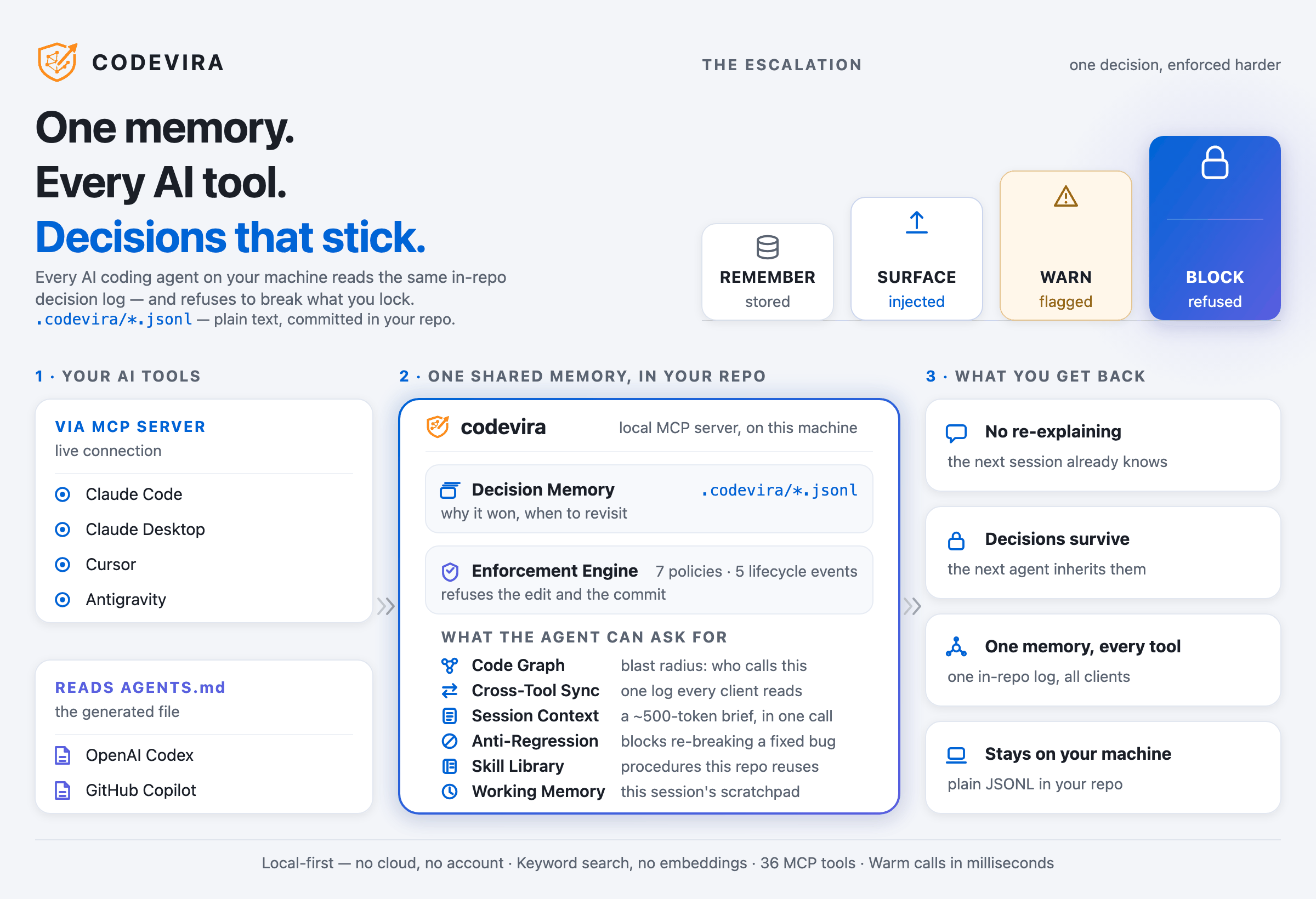
The whole thing on one page — solution blueprint
---
## Why Codevira
AI agents write a large share of your code now. They're fast and capable, but each one is
**stateless across sessions and blind to the others** — so *you* quietly became the memory.
| The pain | What Codevira does |
|---|---|
| **Re-explaining your codebase every session** — ten minutes and thousands of tokens, then again tomorrow | Every tool opens with the project's decisions already loaded |
| **An agent "simplifies" a fix it never knew the reason for** — three hours of debugging, undone | A locked decision is refused at the edit (Claude Code) and at the commit (any editor), with the original reasoning attached |
| **Cross-tool amnesia** — plan in Claude Code, code in Cursor, nothing carries over | One in-repo memory every MCP client reads |
| **Token budget burned on re-discovery** — the same dozen files re-read every session | Summary-first recall of only what's relevant |
The root cause under all four: **your decisions live in your head, not anywhere the AI can be
held to them.**
> **Codevira is not a knowledge base.** A knowledge base answers *"what is true?"* and hopes the
> agent reads it. Codevira answers *"what did we decide, and why?"* — then blocks the edit that
> would break it.
---
## See it in action: record, block, recall
**1. You (or the AI) record a decision — one MCP call, ~50 tokens.**
```text
record_decision(
decision="Use bcrypt for password hashing",
context="md5 considered and rejected — rainbow-table risk. Re-examine only if NIST guidance changes.",
tags=["auth", "security"],
do_not_revert=true,
)
→ D000412 recorded and locked.
```
It lands in `/.codevira/decisions.jsonl` — plain text, human-readable, and diffable (and
git-tracked as soon as you run `codevira init --shared`). Codevira regenerates a slim `AGENTS.md`
contract from it — that file is always committed.
**2. Weeks later, a fresh Claude Code session tries to swap bcrypt for md5.**
The `Edit` goes through Claude Code's `PreToolUse` hook first. Because the diff touches the
locked decision's subject, the hook **denies the tool call** and hands the agent the original
reasoning:
```text
✗ Edit blocked — decision_lock (do_not_revert)
D000412: "Use bcrypt for password hashing"
context: md5 rejected — rainbow-table risk.
The file was not modified. Surface this to the human and re-decide deliberately.
```
The regression never reaches disk. An orthogonal edit to the same file — one whose diff doesn't
touch the decision's subject — is *allowed* through and downgraded to a warn. Precision, not
paranoia.
**3. You switch to Cursor the next morning — and it already knows.**
You never re-explained anything. Cursor reads the same repo `AGENTS.md` and, over MCP, can call
`search_decisions("auth")` — D000412 comes back with its full context. A decision recorded in
one tool is visible to every tool.
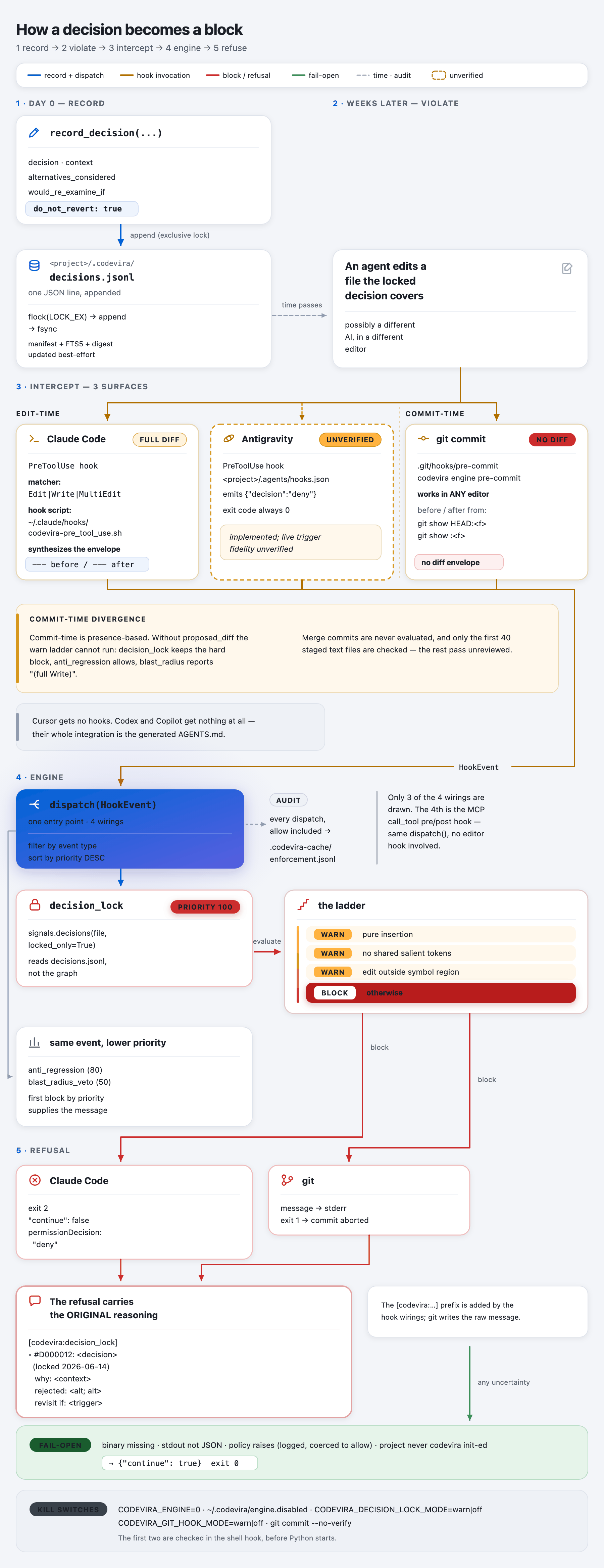
> **Where the block is physical.** Edit-time in Claude Code; commit-time in *every* editor via
> `codevira engine install-git-hook` — because they all commit with git. Overrides, kill-switches
> and the precise boundary: [Enforcement engine](#enforcement-engine) (expand).
The whole path, in one diagram — record → violate → intercept → engine → refuse
---
## What you get
| | What it means |
|---|---|
| **One memory, every AI tool** | A decision logged in Claude Code is visible to Cursor, Antigravity, Codex, Copilot — all read the same `.codevira/decisions.jsonl` and generated `AGENTS.md`. No per-tool re-onboarding, no cloud sync. |
| **Enforcement, not notes** | `do_not_revert` refuses the edit in Claude Code and refuses the commit in any editor. An Anti-Regression guard also blocks re-introducing a previously-fixed bug. Every guard ships a warn/off kill-switch. |
| **One-command setup** | `codevira setup` detects installed AI tools via strong signals (binary on PATH + valid config file) and configures only what's actually there. `--force` overrides a missed detect. |
| **Local-first, no ML** | Decision search is pure keyword/BM25 over SQLite FTS5 — no vectors, no ChromaDB, no sentence-transformers, no torch, nothing phones home. ~1–2 MB of memory per project. |
| **Frugal by design** | Tools return summaries by default; `get_session_context()` is one ~500-token call; the server cold-starts in well under a second with no ML model to load. |
| **Concurrent-safe** | Every write is a crash-safe atomic write behind a Posix `fcntl.flock`, so two IDEs on one project don't race. [Details](#concurrency--safety) (expand) |
Latest: 4.2.0. Upgrade if you use codevira in more than one project: a stray registration at $HOME could make register-all discover exactly one project and discard every real one as “nested” (measured on a real machine: 1 found, 11 excluded). 4.2.0 also stops background work writing false entries to the crash log — 39 of 45 entries on that machine were one harmless line — and adds codevira reconcile to report duplicate and contradicting decisions. Upgrading is automatic, but a registration that was already wrong is not repaired for you: run codevira register-all once after upgrading to recover projects that went missing. Full release notes →
---
## Quick Start
```bash
# 1. Install (production install: ~66 MB pipx venv, no ML deps)
pipx install codevira
# 2. Opt this project in (writes .codevira/, AGENTS.md, .gitignore)
cd ~/Projects/my-project
codevira init
# 3. Wire codevira into every AI tool detected on this machine
codevira setup
# 4. Install the universal commit-time backstop (enforces do_not_revert in ANY editor)
codevira engine install-git-hook
```
Step 4 is what makes enforcement universal. `codevira init` installs only a `post-commit`
reindex hook; the **enforcing** `pre-commit` hook is this separate, explicit opt-in.
Open any IDE — codevira's MCP server is ready. **Then, in your AI tool, ask:**
*"Use `get_session_context` to brief me on this project."* You get a ~500-token structured
project state in one tool call instead of the AI re-reading docs.
**Verify the install:**
```bash
codevira doctor # health checks: ✓/⚠/✗ + a fix command for each
codevira replay # browse the decisions timeline
codevira sync # regenerate AGENTS.md from current decisions.jsonl
```
**Team sharing.** By default codevira keeps decision memory **per-machine** (not committed), so
unrelated projects never bleed into each other; `AGENTS.md` and `.gitignore` are still committed.
To share memory with teammates on the same GitHub repo, run `codevira init --shared` — it keeps
`.codevira/` git-tracked, and a built-in git merge driver reconciles concurrent edits.
> **Opt-in tracking.** `codevira init` is the explicit opt-in. Codevira tracks **only** projects
> you've `init`-ed; a project you merely open stays inert (its tools return a "run `codevira init`"
> hint and nothing is written), so `~/.codevira/projects/` never fills with projects you didn't
> choose. Set `CODEVIRA_AUTO_ADOPT=1` to track every project you open instead.
---
## How it works
A local MCP server. Decisions live in `/.codevira/*.jsonl` — plain text, human-readable,
diffable, and git-tracked once you opt in with `init --shared`. A slim `AGENTS.md` is generated
from them for every IDE to read, and Claude Code lifecycle hooks — plus the opt-in git
`pre-commit` hook — enforce the ones you locked.
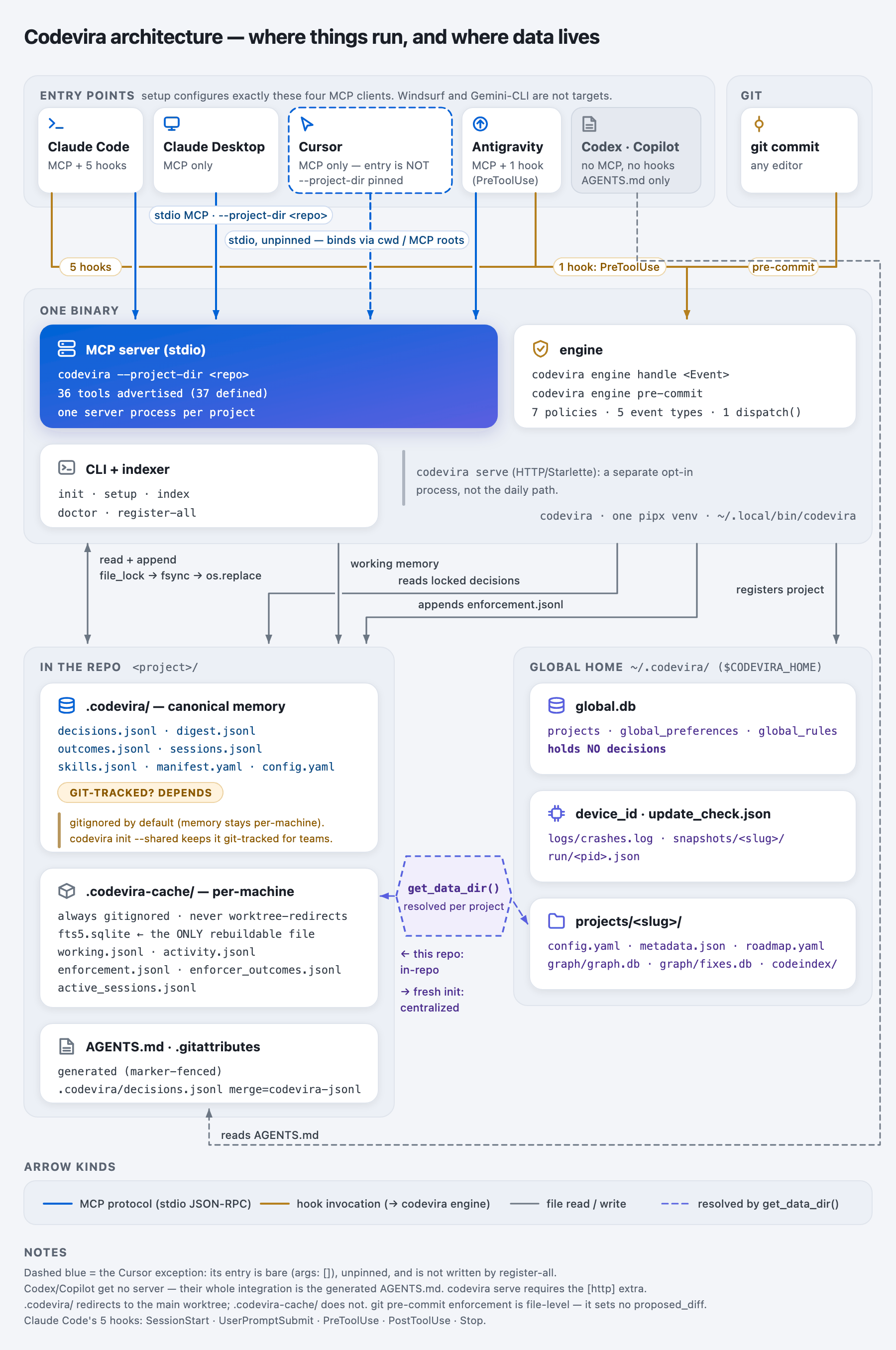
Full file layout and hook flow
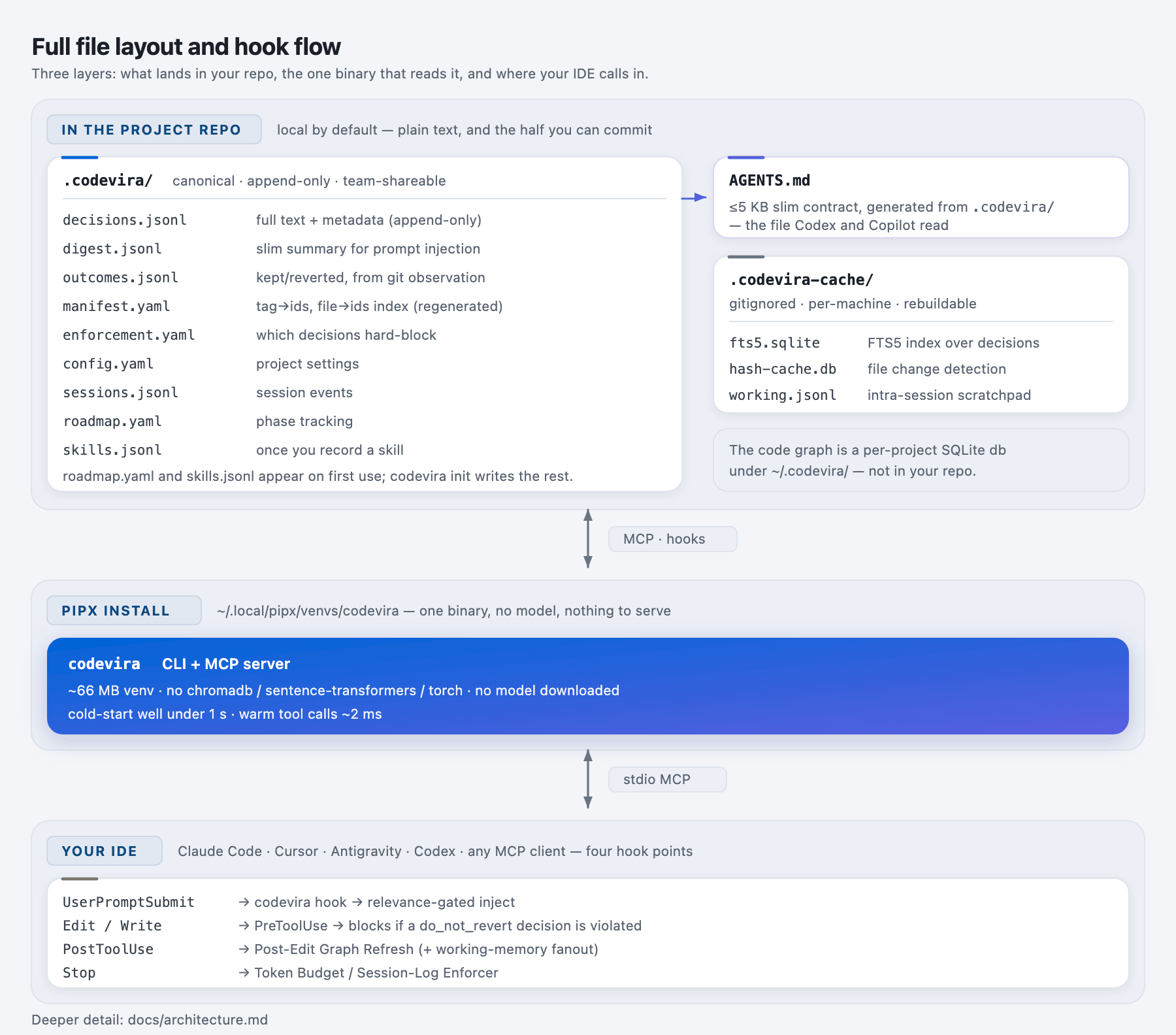
`codevira init` scaffolds everything above except `roadmap.yaml` and `skills.jsonl`, which are
written on first use. Deeper detail: [`docs/architecture.md`](https://github.com/sachinshelke/codevira/blob/main/docs/architecture.md).
---
## Built to be trusted
Codevira holds a team's architectural decisions and can refuse your AI's edits. Every guarantee
below is checked by the build, not asserted in this file.
| | |
|---|---|
| **Test suite** | **3,499 tests** across 165 test files. More test code than product code (60,960 vs 46,782 lines). |
| **CI** | Every push to `main` and every pull request runs the suite on **Python 3.10 / 3.11 / 3.12 / 3.13**, plus a separate random-order run (collection-order blindness had hidden real state-leak bugs) and a `mypy` type-check job. |
| **"Local-first" is enforced, not promised** | [`tests/test_egress_boundary.py`](https://github.com/sachinshelke/codevira/blob/main/tests/test_egress_boundary.py) walks the import graph of the shipped package with an AST scan and **fails the build** if any module other than `egress.py` imports a network client. |
| **Adversarial testing** | [`scripts/chaos_smoke.py`](https://github.com/sachinshelke/codevira/blob/main/scripts/chaos_smoke.py) runs 8 hostile scenarios — SIGKILL during a held lock, symlink traversal, malformed MCP payloads, corrupt-JSONL degradation, read-only directories. |
| **No destructive MCP tools** | Every MCP tool carries `destructiveHint=false`. The only destructive operations (`reset`, `uninstall`) are CLI-only and require a typed confirmation — an autonomous agent cannot reach them. |
| **Reversible memory** | After a default `init`, `.codevira/` is not git-tracked — so `git revert` can't undo a bad migration or an accidental wipe. `codevira memory snapshot` + `codevira memory undo` can, and the undo is itself undoable. |
---
## What's solid, what's not
| Production-stable | Known-limited |
|---|---|
| Cross-IDE decision memory via in-repo JSONL | Hard `PreToolUse` enforcement at **edit time** is Claude Code only; other IDEs read `AGENTS.md` (advisory) and are backstopped at the commit boundary |
| `do_not_revert` enforced at the Claude Code hook **and**, in any editor, at the commit boundary (`codevira engine install-git-hook`) | Graph tools cover Python / TS / JS / Go / Rust; other languages → the AI `Read`s the file directly |
| FTS5/BM25 decision search | Real-time multi-machine sync — by design local-first; for team sharing, run `codevira init --shared` |
| Per-project + cross-machine project inventory (`global.db`) | No web UI — use the `codevira://decisions` MCP resource, or `codevira replay --format html` |
| 36 MCP tools advertised in `tools/list` (37 defined — `refresh_graph` is hidden) + 26 CLI commands + 7 engine policies | The HTTP server (`codevira serve`) is single-project per launch — for daily use, stick with stdio |
| Concurrent-safe storage (Posix `fcntl.flock` + Windows sentinel), thread + subprocess + chaos-tested | Windows sentinel fallback is verified in unit tests but not yet load-tested on real Windows |
| Anti-Regression on small `Edit`/`MultiEdit` hunks | Anti-Regression does not yet detect full-file `Write` reverts; accuracy depends on `fix:` commit hygiene |
---
# Reference
Everything below is depth for when you need it. Each section is collapsed — open the one you came
for. **Browser find-in-page does not search inside a closed section, so expand before Ctrl+F.**
What's in them:
```text
CLI init setup doctor status projects untrack index sync repair-ids observe-git
replay search graph memory export import engine prune reset uninstall serve
working induce-skills eval register-all merge-driver
Env CODEVIRA_ENGINE CODEVIRA_TOOL_PROFILE CODEVIRA_DECISION_LOCK_MODE
CODEVIRA_ANTI_REGRESSION_MODE CODEVIRA_BLAST_RADIUS_MODE CODEVIRA_GIT_HOOK_MODE
CODEVIRA_DECISION_LOCK_CONTENT_AWARE CODEVIRA_SESSION_LOG_ENFORCER_MODE
CODEVIRA_AUTO_ADOPT CODEVIRA_IDE
```
## MCP tool surface
36 tools advertised (37 defined) — the lean-12 profile, every read/write tool, and what 4.0 removed
**36 tools** are advertised to AI clients via `tools/list` (**37 are defined** — a 37th,
`refresh_graph`, is registered but hidden; humans invoke it via `codevira sync`). Every tool
carries MCP `ToolAnnotations` (`readOnlyHint` / `destructiveHint=false` / `idempotentHint`): most
are read-only and can run without a confirmation prompt, and **no MCP tool is destructive** — the
only destructive ops (`reset` / `uninstall`) are CLI-only, never exposed over MCP. Good to know
for anyone wiring codevira into an autonomous agent.
The **lean 12** (`CODEVIRA_TOOL_PROFILE=lean`) are the ones you keep — set that in the MCP
server's `env` block to cut `tools/list` from 36 tools to 12, roughly a two-thirds smaller
payload (~8.9K → ~3.5K tokens of fixed per-session cost). Hidden tools still work when called
explicitly.
```text
get_session_context · get_impact · get_node · get_roadmap · search_decisions
list_decisions · expand · record_decision · update_phase_status
complete_phase · update_next_action · write_session_log
```
**Reads — the memory surface**
| Tool | Description |
|---|---|
| `get_session_context` | **THE "catch me up" call.** ~500 tokens: current phase, next action, recent decisions, top tags, last session brief. |
| `search_decisions(query)` | FTS5/BM25 over `decisions.jsonl`. Top 5 truncated by default; `full=true` / `summary_only=true`. `all_projects=true` searches every registered repo, tagging each result with its project. |
| `expand(ids=[…])` | Fetch full records for just the ids you care about — the summary-first complement to `search_decisions` / `list_decisions`. Read-only; in the lean 12. |
| `list_decisions` | Paginate / filter: `since_date`, `file_pattern`, `protected_only`, `tags`, `include_superseded`. |
| `list_tags` | All tags with decision counts. |
| `get_history(file_path)` | Recent decisions touching a file. |
| `check_conflict(decision_text)` | Surface duplicate / contradictory decisions BEFORE you write. |
**Writes — capturing decisions**
| Tool | Description |
|---|---|
| `record_decision` | Capture a decision. `do_not_revert=true` triggers Claude Code `PreToolUse` enforcement; `symbol="login"` scopes the lock to one function/class. It **supersedes** a strong unprotected near-duplicate instead of appending a twin. |
| `supersede_decision(old_id, new_decision, reason)` | Retire an old decision, link to its replacement, keep the audit trail. |
| `mark_decision_outdated(decision_id, reason)` | Retire a decision that's simply no longer true (no successor) so it stops surfacing. Reversible via `set_decision_flag`. `do_not_revert` needs `force=True`. |
| `reaffirm_decision(decision_id)` | Re-confirm a soft-expired `do_not_revert` lock. |
| `set_decision_flag(decision_id, …)` | Toggle `do_not_revert` / tags / `is_outdated`. |
| `write_session_log` | Structured session record. |
**Roadmap** — `get_roadmap` · `get_phase` · `add_phase` · `update_phase_status` ·
`update_next_action` · `complete_phase` · `defer_phase` · `bulk_import_phases`.
**Code graph** — `get_node` (file metadata) · `get_impact` (blast radius) · `query_graph`
(function-level callers/callees/tests/dependents/symbols) · `get_playbook` (curated rules for
`add_tool` / `add_service` / `add_schema` / `debug_pipeline` / `commit` / `write_test`). Plus the
hidden `refresh_graph`.
**Memory subsystems**
| Subsystem | Tools | What it covers |
|---|---|---|
| Working memory (4) | `working_add`, `working_get`, `working_promote`, `get_working_context` | Intra-session scratchpad, decay-scored (`importance × e^(−Δt/τ=6h) + 0.5·access_count`), capacity-bounded. Auto-populated by the `PostToolUse` fan-out. |
| Skill library (6) | `record_skill`, `get_skill`, `apply_skill_outcome`, `list_skills`, `supersede_skill`, `promote_skill_to_playbook` | Reusable procedures; FTS5 composite ranking (BM25 + tag-Jaccard + recency); auto-archive at 5 consecutive failures or 90 unused days (`do_not_revert` exempt). |
| Provenance (1) | `origin_of` | Which IDE, which machine, when — what attributes an amendment across a two-host merge. (`CODEVIRA_IDE` is a cooperative signal, spoofable, not a security boundary.) |
**Workflow prompt** — `onboard_session`: full project catch-up for new sessions; wraps
`get_session_context()`.
**Removed in 4.0** (52 tools → 37 defined; 36 advertised). Cut on measured usage across 4,203
transcripts, not taste — the data they wrote is untouched, and `codevira export` still includes
everything. See [MIGRATING.md](https://github.com/sachinshelke/codevira/blob/main/MIGRATING.md).
| Removed | Instead |
|---|---|
| `consensus_check`, `consensus_status`, `consensus_propose_supersession`, `consensus_resolve` | `origin_of` |
| `reflect`, `get_reflections`, `list_reflections` | — |
| `spatial_nearby`, `spatial_heat`, `spatial_neighborhood`, `spatial_affordances` | `get_impact` |
| `distill_preferences`, `search_preferences` | the `style` panel in `get_session_context` |
| `get_code`, `get_signature` | read the file — both measured **zero** calls in 2.5 months |
## Enforcement engine
The 7 default policies, how verdicts combine, and every kill-switch
Codevira ships **7 default engine policies** ("heroes"), each hooked to Claude Code lifecycle
events: `SessionStart`, `PreToolUse`, `PostToolUse`, `UserPromptSubmit`, `Stop`.
| Policy | Event | What it does |
|---|---|---|
| **Decision Lock** | PreToolUse | Blocks an edit that touches a `do_not_revert` decision's subject. **Content-aware:** a provably-orthogonal edit downgrades to a warn; a token-touching edit blocks. Strict file-level locking via `CODEVIRA_DECISION_LOCK_CONTENT_AWARE=0`. |
| **Anti-Regression** | PreToolUse | Blocks edits that look like reverts of previously-fixed bugs. Fix-history is scanned from `fix:` / `bug:` / `hotfix:` / `fixes #N` commit messages and self-freshens on read when git HEAD advances. *Caveat: calibrated for small `Edit`/`MultiEdit` hunks; full-file `Write` reverts are deliberately exempt (future work).* |
| **Blast-Radius Veto** | PreToolUse | Blocks a signature-*removing/modifying* edit to a high-fan-in file (purely-additive signatures pass). Shows the callers. |
| **Relevance Inject** | UserPromptSubmit | Injects ≤3 relevant decisions per prompt; 0 tokens when off-topic. |
| **Session-Log Enforcer** | SessionStart + Stop | Blocks (or, in `warn` mode, nudges) a session that shipped commits without a `write_session_log`. A second consecutive block degrades to a warn so a session that genuinely cannot log still finishes. |
| **Post-Edit Graph Refresh** | PostToolUse | Reindexes edited files in the background. |
| **Token Budget / telemetry** | Stop | Records outcome telemetry. |
**How verdicts combine.** The three edit guards compose into a single verdict — **first block wins
by priority** (Decision Lock 100 > Anti-Regression 80 > Blast-Radius 50). The highest-priority
block's message is what you see; the rest are recorded as telemetry.
**Fail-open and opt-in.** The dispatcher never raises: each policy is wrapped in try/except and
returns *allow* on failure. `CODEVIRA_ENGINE=0` disables all policies; each edit guard also has a
per-policy `off|warn|block` env override (`CODEVIRA_DECISION_LOCK_MODE`,
`CODEVIRA_ANTI_REGRESSION_MODE`, `CODEVIRA_BLAST_RADIUS_MODE`). Enforcement is **not** global
across all Claude Code projects — in any project you never ran `codevira init` on, the hooks stay
fully inert.
**The universal backstop (4.0).** `codevira engine install-git-hook` installs a `pre-commit` hook
that runs locked decisions against staged changes through the same engine — so a `do_not_revert`
decision is enforced in *any* editor, because they all commit with git. `git commit --no-verify`
overrides a single commit; `CODEVIRA_GIT_HOOK_MODE=warn` (or `off`) changes it globally; merge
commits are never blocked.
**Why edit-time blocking is Claude Code only.** The hard-block path is Claude Code's real
`PreToolUse` hook. Edits from Cursor / Codex / Copilot go straight to the filesystem — they never
reach codevira's `PreToolUse` engine — so those IDEs get decisions as advisory `AGENTS.md`
context, with the git `pre-commit` hook as the universal backstop. Verified: Claude Code returns
`permissionDecision: deny` (exit 2) with the decision's reasoning, rejected alternatives and
re-examination trigger attached; the git hook refuses the commit with the same reasoning. Other
IDEs are supported but verified one at a time rather than inferred.
## CLI commands
26 commands — the daily-use table, plus what's safe vs destructive
26 subcommands. Two are internal (`merge-driver`, invoked by git's merge driver, and
`register-all`, a setup helper); three more are advanced (`working`, `induce-skills`, `eval`).
The daily-use ones are below — run `codevira --help` for full flags:
| Command | What it does |
|---|---|
| `codevira init` | Opt this project in: `.codevira/` + AGENTS.md + .gitignore + git merge driver. Add `--shared` to commit memory for team sharing (default keeps it per-machine) |
| `codevira setup` | Detect installed AI tools + write MCP configs + Claude Code hooks |
| `codevira doctor` | Health checks (read-only; ✓/⚠/✗ + a fix command each) |
| `codevira status` | Index health + project state |
| `codevira projects` | List tracked projects with staleness; `projects archive ` drops one |
| `codevira untrack ` | Remove one stray or temporary project entry |
| `codevira index` | Build / refresh the code-graph cache |
| `codevira sync` | Regenerate AGENTS.md + manifest + digest from `decisions.jsonl` |
| `codevira repair-ids` | Detect/repair cross-engineer decision-id collisions (`--apply`; `--semantic` reports near-duplicates) |
| `codevira observe-git` | Classify past decisions as kept/modified/reverted from git history |
| `codevira replay` | Browse the decisions timeline (terminal / markdown / HTML) |
| `codevira search ` | Search decisions from the terminal (FTS5/BM25); `--all-projects`, `--json` |
| `codevira graph` | Render an interactive, offline HTML viewer of decision memory |
| `codevira memory` | `snapshot` / `undo` the memory store — the rollback path `git revert` can't give you |
| `codevira export` / `import` | Back up / restore project memory + global learning across machines |
| `codevira engine` | `install-git-hook` installs the universal `pre-commit` backstop; `status` / `disable` / `enable` |
| `codevira prune` | Remove orphaned project dirs, dead `global.db` rows, ghost dirs and legacy backups. Never touches decisions, IDE configs or hooks. `--dry-run` first |
| `codevira reset` | Destructive cleanup of this project's memory (auto-exports first; requires a typed confirmation) |
| `codevira uninstall` | Reverse every system write codevira made — `~/.codevira/` including snapshots, every IDE config entry, the launchd service. Preserves user content outside markers. Requires typing `uninstall` |
| `codevira clean` | **Removed in 4.0.1** — it was a full uninstall mis-named as tidy-up, and its old description destroyed a real install. It now errors `invalid choice`. Use `prune` to tidy, `uninstall` to remove |
| `codevira serve` | Start the single-project MCP HTTP server (stdio is the daily mode) |
To fully remove codevira: run the uninstall command above, then `pipx uninstall codevira`.
## Language support
What's language-agnostic vs. what needs a grammar
| Feature | Python | TS/JS | Go | Rust | Others |
|---|:---:|:---:|:---:|:---:|:---:|
| Decision capture + search | ✓ | ✓ | ✓ | ✓ | ✓ |
| Cross-IDE memory via AGENTS.md | ✓ | ✓ | ✓ | ✓ | ✓ |
| Roadmap / sessions | ✓ | ✓ | ✓ | ✓ | ✓ |
| Code graph + blast radius | ✓ | ✓ | ✓ | ✓ | — |
| Symbol-level `query_graph` | ✓ | ✓ | ✓ | ✓ | — |
Decisions / `AGENTS.md` / roadmap are **language-agnostic** — they work for any language.
**Code-graph and symbol tools** cover exactly Python (stdlib `ast`) plus TS / TSX / JS / JSX / Go
/ Rust (bundled tree-sitter grammars). For any other language the AI `Read`s the file directly.
The legacy 17-grammar `[all-languages]` pack was removed in v2.2.0 to keep the install lean.
## Concurrency & safety
Atomic writes, file locking, and how they're stress-tested
Every on-disk write goes through `mcp_server/storage/atomic.py`: a crash-safe atomic write
(`mkstemp` + `fsync` + `os.replace`) behind a Posix `fcntl.flock` (with an in-process
`threading.Lock` first, and a Windows `O_EXCL` sentinel fallback). Appends to the JSONL logs are
line-atomic — concurrent appenders never interleave bytes. Result: two IDEs hitting the same
project don't race on `manifest.yaml` / `roadmap.yaml` / `AGENTS.md`.
This is exercised by a 50-operation stress over a 10-thread pool, a 20-subprocess cross-process
stress (`spawn`), and an adversarial chaos harness ([`scripts/chaos_smoke.py`](https://github.com/sachinshelke/codevira/blob/main/scripts/chaos_smoke.py)
— 8 scenarios including SIGKILL during a held lock, symlink traversal, malformed MCP payloads,
corrupt-JSONL graceful degradation, and read-only-directory hostility). See
[`docs/architecture.md`](https://github.com/sachinshelke/codevira/blob/main/docs/architecture.md) § "Concurrent-write safety".
---
## Upgrading & troubleshooting
**Upgrading is automatic** — codevira migrates your memory on the first server start after an
upgrade, and your existing decisions stay put. (After a `pipx upgrade codevira`, restart your IDE
so its MCP server reloads the new binary.)
**One exception, if you are coming from 4.1.0 or earlier.** A bug could register `$HOME` itself as
a project, and every genuine project below it was then discarded as a "nested sub-store". 4.2.0
stops that happening, but it does **not** repair a registration that is already wrong — nothing
prunes the bad row on upgrade. If projects went missing from an IDE, run this once:
```bash
codevira register-all --dry-run # read-only; shows what IS registered
```
If that prints one project at your home directory with your real ones listed as *excluded
nested*, that is this bug. Before clearing it, look at what would be removed:
```bash
codevira untrack --dry-run "$HOME" # read-only; lists IDE entries AND the data dir
```
**Read that output.** `untrack` deletes the project's data directory, not just the registry
entry. If you were bound to `$HOME` by mistake, any decisions recorded during that time live in
*that* directory and will go with it. If the dry-run lists a data dir you might want, copy it
aside first (`cp -R` the path it names). Your other projects each have their own directory and
are not affected.
Then clear and re-register:
```bash
codevira untrack -y "$HOME"
codevira register-all
```
Restart the IDE afterwards.
(`codevira doctor` will not catch this one: its checks cover the *current* binding and whether
`global.db` opens, not what is registered inside it.)
If an IDE then shows the wrong project, doesn't show codevira at all, or memory looks missing,
it's almost always a stale IDE-config entry rather than lost data. Two fixes cover most cases:
remove a stray or temporary entry with `codevira untrack ` (or sweep dead ones with
`codevira prune --ghosts`), then run `codevira doctor` — it names the bound project and ships the
exact fix for each ⚠/✗.
Full guides: [IDE config hygiene](https://github.com/sachinshelke/codevira/blob/main/docs/troubleshooting/config-hygiene.md) ·
[Antigravity](https://github.com/sachinshelke/codevira/blob/main/docs/troubleshooting/antigravity.md) · [FAQ](https://github.com/sachinshelke/codevira/blob/main/FAQ.md)
---
## Frequently asked
### How do I give Claude Code persistent memory across sessions?
Install codevira and run `codevira init` in the project. Every new session starts with
`get_session_context()` — a ~500-token brief of the project's decisions, current phase and next
action — instead of you re-explaining the codebase.
### Does this work with Cursor and Antigravity, or only Claude Code?
Memory works everywhere: every tool reads the same in-repo `.codevira/decisions.jsonl` and the
generated `AGENTS.md`. `codevira setup` writes MCP server config automatically for the tools that
support it (Claude Code, Claude Desktop, Cursor, Antigravity); Codex, Copilot and other agents are
covered by the generated `AGENTS.md`. Hard *edit-time* blocking is Claude Code only — every other
editor is covered at the commit boundary by `codevira engine install-git-hook`.
### How is this different from a hand-written `CLAUDE.md` or `AGENTS.md`?
Those are static text you maintain by hand. Codevira **generates** `AGENTS.md` from a queryable
decision log, keeps the *reasoning* attached to each decision, and blocks the edit that would
break a locked one.
### Does it use vectors or embeddings?
No. Decision search is SQLite FTS5/BM25 keyword search — no ChromaDB, no sentence-transformers,
no torch. An AST scan in CI fails the build if any module but `egress.py` imports a network
client.
### Is my code or my memory sent anywhere?
No. Everything lives in `/.codevira/` and `~/.codevira/` on your machine. MIT-licensed, no
account, no API key, no cloud.
### What does it cost in tokens?
Tools return summaries by default, `get_session_context()` is one ~500-token call, and the
lean-12 tool profile cuts `tools/list` from 36 tools to 12 (~8.9K → ~3.5K tokens per session).
Longer answers: [FAQ.md](https://github.com/sachinshelke/codevira/blob/main/FAQ.md).
---
## How Codevira compares
Most memory tools for AI agents *retrieve*. Codevira also *enforces*, and it is per-project across
*many* tools rather than per-session inside one. If you need cross-machine cloud memory, a
temporal knowledge graph at enterprise scale, or the top LongMemEval score, other tools are the
better pick — that comparison is written out honestly, including where codevira loses:
**[Codevira vs other AI memory tools](https://github.com/sachinshelke/codevira/blob/main/docs/vs-other-memory-tools.md)** (Mem0, claude-mem, Zep,
MemPalace and others).
**Deeper reading:** [Architecture](https://github.com/sachinshelke/codevira/blob/main/docs/architecture.md) ·
[Wire protocol](https://github.com/sachinshelke/codevira/blob/main/PROTOCOL.md) ·
[How we dogfood it](https://github.com/sachinshelke/codevira/blob/main/DOGFOOD.md) ·
[Roadmap](https://github.com/sachinshelke/codevira/blob/main/ROADMAP.md) ·
[Changelog](https://github.com/sachinshelke/codevira/blob/main/CHANGELOG.md) ·
[Migrating to 4.0](https://github.com/sachinshelke/codevira/blob/main/MIGRATING.md) ·
[How I built persistent memory for AI coding agents](https://github.com/sachinshelke/codevira/blob/main/docs/how-i-built-persistent-memory-for-ai-agents.md)
---
## Contributing
Contributions are genuinely welcome, and the backlog is open — see
[CONTRIBUTING.md](https://github.com/sachinshelke/codevira/blob/main/CONTRIBUTING.md) for the dev setup and PR checklist.
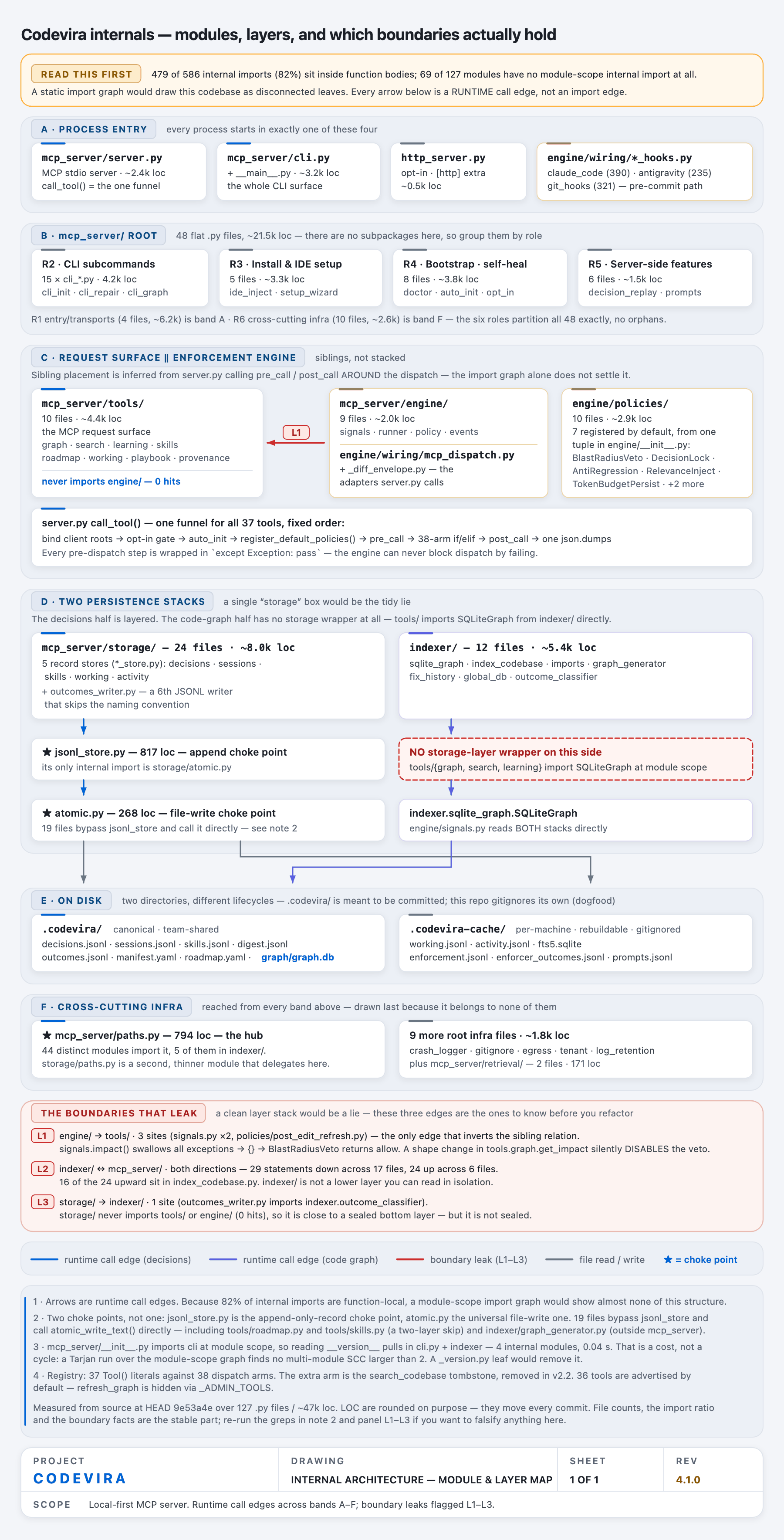
How the codebase is laid out — layers, the two persistence stacks, and where to add a tool / command / policy
Start here before your first PR. One caveat it makes loud: **82% of codevira's internal
imports sit inside function bodies**, so a static import graph draws this codebase as
disconnected leaves — the arrows below are runtime call edges. The diagram also marks the
boundaries that *don't* hold, rather than pretending the layering is clean.
**Good places to start:**
- **Run it in an IDE you use and report what happened.** That's how the support matrix grows.
- **Windows.** The sentinel-lock fallback is unit-tested but never load-tested on real hardware.
- **Docs.** Anything wrong or slow to find in this README or the [FAQ](https://github.com/sachinshelke/codevira/blob/main/FAQ.md) is a bug — file it.
Channels:
- **Bug?** [Open a bug report](https://github.com/sachinshelke/codevira/issues/new?template=bug_report.md)
- **Feature or idea?** [Open a feature request](https://github.com/sachinshelke/codevira/issues/new?template=feature_request.md)
- **Security issue?** Read [SECURITY.md](https://github.com/sachinshelke/codevira/blob/main/SECURITY.md) — please don't use public issues for
vulnerabilities.
- **Conduct:** [CODE_OF_CONDUCT.md](https://github.com/sachinshelke/codevira/blob/main/CODE_OF_CONDUCT.md)
If Codevira saves you tokens or sanity, a ⭐ helps other developers find it.
## License
MIT — free to use, modify, and distribute. See [LICENSE](https://github.com/sachinshelke/codevira/blob/main/LICENSE).