{
"cells": [
{
"cell_type": "markdown",
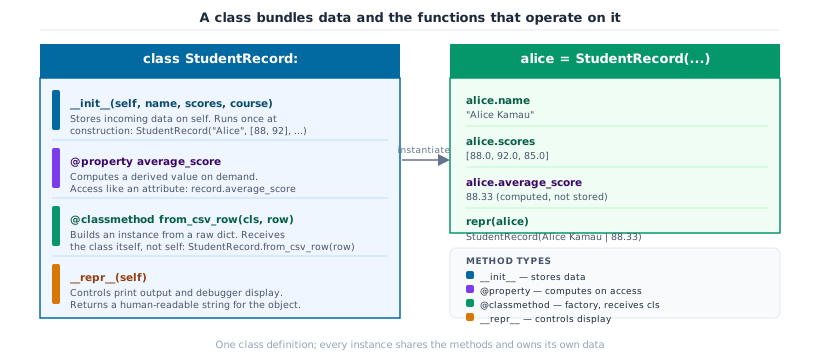
"id": "0",
"metadata": {},
"source": [
"---\n",
"title: \"Chapter 4: Classes and patterns\"\n",
"---"
]
},
{
"cell_type": "markdown",
"id": "1",
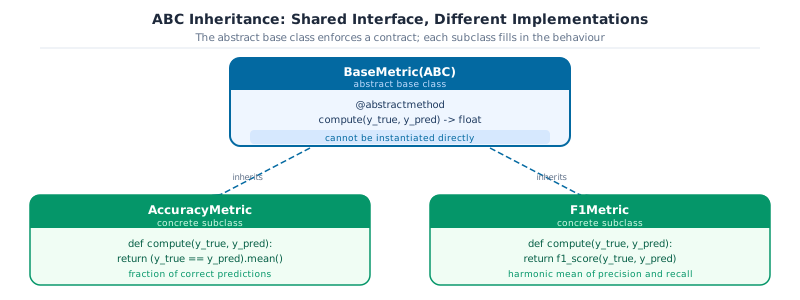
"metadata": {},
"source": [
"[](https://colab.research.google.com/github/sambaiga/ds-mlops-path/blob/main/tutorials/01-python-basics/04-classes.ipynb) [](https://raw.githubusercontent.com/sambaiga/ds-mlops-path/main/tutorials/01-python-basics/04-classes.ipynb)"
]
},
{
"cell_type": "markdown",
"id": "2",
"metadata": {},
"source": [
"A student record is not three separate variables; it is one thing. A class lets you treat it that way: one `__repr__()`, one place where the rules about valid scores live, one factory method that builds it from a raw CSV row.\n",
"\n",
"Chapter 3 built functions: the logic. A function only holds logic; the data it operates on lives somewhere else, as loose variables the function accepts and returns. A class bundles data and the functions that operate on it under one name.\n",
"\n",
"This chapter adds the tools that Chapter 3 could not carry: classes, dataclasses, NamedTuples, TypedDicts, exceptions, and file I/O. Chapter 5 (`05-math-statistics.ipynb`) uses these patterns throughout as it introduces the standard library math and statistics modules."
]
},
{
"cell_type": "markdown",
"id": "3",
"metadata": {},
"source": [
"::: {.callout-note collapse=\"true\" icon=false}\n",
"## Learning objectives\n",
"\n",
"By the end of Chapter 4 you will be able to:\n",
"\n",
"| # | Skill | Covered in |\n",
"|---|---|---|\n",
"| 1 | Define classes with `__init__`, `__repr__`, `@property`, and `@classmethod` | Sec. 1 |\n",
"| 2 | Use inheritance and abstract base classes | Sec. 1 |\n",
"| 3 | Create dataclasses and frozen dataclasses | Sec. 2 |\n",
"| 4 | Use NamedTuple for immutable typed records | Sec. 3 |\n",
"| 5 | Use TypedDict and type aliases for structured dicts | Sec. 4 |\n",
"| 6 | Handle exceptions with `try`/`except`/`finally` and custom exception classes | Sec. 5 |\n",
"| 7 | Read and write files with `pathlib`, `csv`, and `json` | Sec. 6 |\n",
"| 8 | Recognise and avoid common Python gotchas | Sec. 7 |\n",
":::"
]
},
{
"cell_type": "markdown",
"id": "4",
"metadata": {},
"source": [
"## 1. Classes\n",
"\n",
"A **class** is a blueprint for creating objects. Each object (instance) bundles its own data (attributes) with the functions (methods) that operate on it. You create the blueprint once with `class`, then stamp out as many instances as you need.\n",
"\n",
"Three things make a class useful rather than just a namespace:\n",
"- `__init__`: sets the initial state of each instance\n",
"- `__repr__`: returns a readable string when you print or inspect the object\n",
"- **methods**: functions that always have access to the instance's data via `self`"
]
},
{
"cell_type": "markdown",
"id": "5",
"metadata": {},
"source": [
"{fig-alt=\"Left: class StudentRecord box showing __init__, @property, @classmethod, __repr__ methods with colored role indicators. Right: alice instance showing attribute values after construction. Arrow from class to instance labeled instantiate.\"}"
]
},
{
"cell_type": "markdown",
"id": "6",
"metadata": {},
"source": [
"### `__init__` and `__repr__`\n",
"\n",
"Every class needs two methods before it's useful in interactive work. `__init__` runs the moment you create an instance: it receives the raw data and stores it on `self`. `__repr__` is what Python prints when you inspect the object in the REPL or call `print()` on it.\n",
"\n",
"Without `__repr__`, Python shows something like `<__main__.StudentRecord object at 0x7f3a2c1d4e50>`. That address tells you nothing. With a good `__repr__` you can see the name, program, and average in one glance, which makes debugging feel like reading, not guessing.\n",
"\n",
"The rule: `__repr__` should produce a string that is both human-readable and, where possible, copy-pasteable back into Python to re-create the object."
]
},
{
"cell_type": "code",
"execution_count": null,
"id": "7",
"metadata": {},
"outputs": [],
"source": [
"class StudentRecord:\n",
" \"\"\"A single student's academic record.\n",
"\n",
" Args:\n",
" name: Student's full name.\n",
" scores: List of numeric assessment scores (0-100).\n",
" program: Degree program name.\n",
" \"\"\"\n",
"\n",
" def __init__(\n",
" self,\n",
" name: str,\n",
" scores: list[float] | None = None,\n",
" program: str = \"Undeclared\",\n",
" ) -> None:\n",
" self.name = name\n",
" self.scores: list[float] = scores if scores is not None else []\n",
" self.program = program\n",
"\n",
" def __repr__(self) -> str:\n",
" avg = sum(self.scores) / len(self.scores) if self.scores else 0.0\n",
" return f\"StudentRecord(name={self.name!r}, program={self.program!r}, avg={avg:.1f})\""
]
},
{
"cell_type": "code",
"execution_count": null,
"id": "8",
"metadata": {},
"outputs": [],
"source": [
"alice = StudentRecord(\n",
" name=\"Alice Kamau\",\n",
" scores=[88.0, 92.0, 85.0, 90.0],\n",
" program=\"Computer Science\",\n",
")\n",
"bob = StudentRecord(\n",
" name=\"Bob Mwangi\",\n",
" scores=[62.0, 70.0, 58.0, 74.0],\n",
" program=\"Mathematics\",\n",
")\n",
"\n",
"print(alice) # __repr__ in action: no print formatting needed\n",
"print(bob)"
]
},
{
"cell_type": "markdown",
"id": "9",
"metadata": {},
"source": [
"### `@property`: computed attributes\n",
"\n",
"You could store the average as an attribute set in `__init__`: `self.average = sum(scores) / len(scores)`. The problem is stale state. If someone appends a score later, `student.scores.append(95.0)`, the stored average is now wrong, and nothing tells you.\n",
"\n",
"A `@property` computes the value fresh every time you access it. From the caller's side it looks exactly like reading a plain attribute: `student.average`, no parentheses. Under the hood Python calls the method. You get the right answer regardless of when scores were added.\n",
"\n",
"Use `@property` for any value that is derived from other attributes. Store it explicitly only if the computation is genuinely expensive and you have a caching strategy."
]
},
{
"cell_type": "code",
"execution_count": null,
"id": "10",
"metadata": {},
"outputs": [],
"source": [
"class StudentRecord:\n",
" \"\"\"A single student's academic record with computed grade properties.\n",
"\n",
" Args:\n",
" name: Student's full name.\n",
" scores: List of numeric assessment scores (0-100).\n",
" program: Degree program name.\n",
" \"\"\"\n",
"\n",
" def __init__(\n",
" self,\n",
" name: str,\n",
" scores: list[float] | None = None,\n",
" program: str = \"Undeclared\",\n",
" ) -> None:\n",
" self.name = name\n",
" self.scores: list[float] = scores if scores is not None else []\n",
" self.program = program\n",
"\n",
" def __repr__(self) -> str:\n",
" return f\"StudentRecord(name={self.name!r}, program={self.program!r}, avg={self.average:.1f})\"\n",
"\n",
" @property\n",
" def average(self) -> float:\n",
" \"\"\"Mean of all scores; 0.0 if no scores recorded.\"\"\"\n",
" return sum(self.scores) / len(self.scores) if self.scores else 0.0\n",
"\n",
" @property\n",
" def letter_grade(self) -> str:\n",
" \"\"\"Letter grade derived from current average.\"\"\"\n",
" avg = self.average\n",
" if avg >= 90:\n",
" return \"A\"\n",
" if avg >= 80:\n",
" return \"B\"\n",
" if avg >= 70:\n",
" return \"C\"\n",
" if avg >= 60:\n",
" return \"D\"\n",
" return \"F\""
]
},
{
"cell_type": "code",
"execution_count": null,
"id": "11",
"metadata": {},
"outputs": [],
"source": [
"alice = StudentRecord(\"Alice Kamau\", [88.0, 92.0, 85.0], \"Computer Science\")\n",
"print(f\"Before: avg={alice.average:.1f} grade={alice.letter_grade}\")\n",
"\n",
"# Add a new score: the property recomputes on the fly\n",
"alice.scores.append(95.0)\n",
"print(f\"After : avg={alice.average:.1f} grade={alice.letter_grade}\")\n",
"\n",
"print(alice)"
]
},
{
"cell_type": "markdown",
"id": "12",
"metadata": {},
"source": [
"### `@classmethod` factory methods\n",
"\n",
"A `@classmethod` is an alternative constructor: it builds an instance from a different kind of input without requiring the caller to know what `__init__` expects.\n",
"\n",
"The pattern is useful whenever your data arrives in a format different from what `__init__` expects. A CSV row is a `dict[str, str]` where every value is a string. Putting the parsing logic inside a `@classmethod` keeps `__init__` clean and makes the intent explicit at the call site: `StudentRecord.from_dict(row)` reads like documentation."
]
},
{
"cell_type": "code",
"execution_count": null,
"id": "13",
"metadata": {},
"outputs": [],
"source": [
"class StudentRecord:\n",
" \"\"\"A student record with factory method support.\n",
"\n",
" Args:\n",
" name: Student's full name.\n",
" scores: List of numeric assessment scores (0-100).\n",
" program: Degree program name.\n",
" \"\"\"\n",
"\n",
" def __init__(\n",
" self,\n",
" name: str,\n",
" scores: list[float] | None = None,\n",
" program: str = \"Undeclared\",\n",
" ) -> None:\n",
" self.name = name\n",
" self.scores: list[float] = scores if scores is not None else []\n",
" self.program = program\n",
"\n",
" def __repr__(self) -> str:\n",
" return f\"StudentRecord(name={self.name!r}, program={self.program!r}, avg={self.average:.1f})\"\n",
"\n",
" @property\n",
" def average(self) -> float:\n",
" \"\"\"Mean of all scores; 0.0 if no scores recorded.\"\"\"\n",
" return sum(self.scores) / len(self.scores) if self.scores else 0.0\n",
"\n",
" @property\n",
" def letter_grade(self) -> str:\n",
" \"\"\"Letter grade derived from current average.\"\"\"\n",
" avg = self.average\n",
" if avg >= 90:\n",
" return \"A\"\n",
" if avg >= 80:\n",
" return \"B\"\n",
" if avg >= 70:\n",
" return \"C\"\n",
" if avg >= 60:\n",
" return \"D\"\n",
" return \"F\"\n",
"\n",
" @classmethod\n",
" def from_dict(cls, record: dict[str, object]) -> \"StudentRecord\":\n",
" \"\"\"Construct a StudentRecord from a raw CSV row dict.\n",
"\n",
" Args:\n",
" record: Dict with keys 'name', 'scores' (comma-separated string\n",
" or list of floats), and 'program'.\n",
"\n",
" Returns:\n",
" A new StudentRecord instance.\n",
" \"\"\"\n",
" raw_scores = record.get(\"scores\", \"\")\n",
" if isinstance(raw_scores, str):\n",
" scores = [float(s.strip()) for s in raw_scores.split(\",\") if s.strip()]\n",
" else:\n",
" scores = list(raw_scores) # type: ignore[arg-type]\n",
" return cls(\n",
" name=str(record.get(\"name\", \"\")),\n",
" scores=scores,\n",
" program=str(record.get(\"program\", \"Undeclared\")),\n",
" )"
]
},
{
"cell_type": "code",
"execution_count": null,
"id": "14",
"metadata": {},
"outputs": [],
"source": [
"# Simulated rows as they would arrive from csv.DictReader\n",
"raw_rows: list[dict[str, object]] = [\n",
" {\"name\": \"Carol Osei\", \"scores\": \"91.0, 95.0, 89.0\", \"program\": \"Data Science\"},\n",
" {\"name\": \"Dan Kimani\", \"scores\": \"74.0, 68.0, 80.0\", \"program\": \"Mathematics\"},\n",
"]\n",
"\n",
"records = [StudentRecord.from_dict(row) for row in raw_rows]\n",
"for r in records:\n",
" print(r)"
]
},
{
"cell_type": "markdown",
"id": "15",
"metadata": {},
"source": [
"### Inheritance and abstract base classes\n",
"\n",
"Inheritance is often introduced as a code-reuse tool: put shared logic in a parent class. That is true, but it misses the more important use case in ML engineering: enforcing a contract.\n",
"\n",
"When you define an Abstract Base Class (ABC), you're saying: any class that claims to be a `BaseMetric` must implement `compute(actual_labels, predicted_labels)`. Python will refuse to instantiate a subclass that forgets to implement it. This isn't a convention or a code review comment, it's a runtime guarantee.\n",
"\n",
"This is how scikit-learn's `BaseEstimator` enforces that every estimator has `.fit()` and `.predict()`, and how PyTorch's `nn.Module` enforces `forward()`. You will implement the same pattern here for evaluation metrics."
]
},
{
"cell_type": "markdown",
"id": "16",
"metadata": {},
"source": [
"The inheritance chain makes the contract visible. `BaseMetric` declares what every metric must implement; concrete classes fill in the details. Python refuses to instantiate `BaseMetric` directly, you can only create `AccuracyMetric` or `F1Metric`."
]
},
{
"cell_type": "markdown",
"id": "17",
"metadata": {},
"source": [
"{fig-alt=\"Three boxes connected by arrows. Top: BaseMetric(ABC) in blue with abstractmethod compute. Bottom-left: AccuracyMetric in green. Bottom-right: F1Metric in green.\"}"
]
},
{
"cell_type": "code",
"execution_count": null,
"id": "18",
"metadata": {},
"outputs": [],
"source": [
"from abc import ABC, abstractmethod\n",
"\n",
"\n",
"class BaseMetric(ABC):\n",
" \"\"\"Abstract base class for all evaluation metrics.\n",
"\n",
" Subclasses must implement `compute`; Python will refuse to instantiate\n",
" any subclass that does not.\n",
" \"\"\"\n",
"\n",
" @abstractmethod\n",
" def compute(self, actual_labels: list[int], predicted_labels: list[int]) -> float:\n",
" \"\"\"Compute the metric value.\n",
"\n",
" Args:\n",
" actual_labels: Ground-truth labels.\n",
" predicted_labels: Predicted labels.\n",
"\n",
" Returns:\n",
" Scalar metric value.\n",
" \"\"\"\n",
"\n",
"\n",
"class AccuracyMetric(BaseMetric):\n",
" \"\"\"Fraction of predictions that match the ground truth.\"\"\"\n",
"\n",
" def compute(self, actual_labels: list[int], predicted_labels: list[int]) -> float:\n",
" if not actual_labels:\n",
" return 0.0\n",
" correct = sum(t == p for t, p in zip(actual_labels, predicted_labels, strict=False))\n",
" return correct / len(actual_labels)\n",
"\n",
"\n",
"class F1Metric(BaseMetric):\n",
" \"\"\"Binary F1 score: harmonic mean of precision and recall.\"\"\"\n",
"\n",
" def compute(self, actual_labels: list[int], predicted_labels: list[int]) -> float:\n",
" tp = sum(t == 1 and p == 1 for t, p in zip(actual_labels, predicted_labels, strict=False))\n",
" fp = sum(t == 0 and p == 1 for t, p in zip(actual_labels, predicted_labels, strict=False))\n",
" fn = sum(t == 1 and p == 0 for t, p in zip(actual_labels, predicted_labels, strict=False))\n",
" if tp == 0:\n",
" return 0.0\n",
" precision = tp / (tp + fp)\n",
" recall = tp / (tp + fn)\n",
" return 2 * precision * recall / (precision + recall)"
]
},
{
"cell_type": "code",
"execution_count": null,
"id": "19",
"metadata": {},
"outputs": [],
"source": [
"actual_labels = [1, 0, 1, 1, 0, 1, 0, 0]\n",
"predicted_labels = [1, 0, 1, 0, 0, 1, 1, 0]\n",
"\n",
"metrics: list[BaseMetric] = [AccuracyMetric(), F1Metric()]\n",
"for metric in metrics:\n",
" score = metric.compute(actual_labels, predicted_labels)\n",
" print(f\"{metric.__class__.__name__:<18}: {score:.4f}\")\n",
"\n",
"# Demonstrate the ABC contract: Python refuses to instantiate BaseMetric directly\n",
"try:\n",
" _ = BaseMetric() # type: ignore[abstract]\n",
"except TypeError as exc:\n",
" print(f\"\\nABC contract enforced: {exc}\")"
]
},
{
"cell_type": "markdown",
"id": "20",
"metadata": {},
"source": [
" Key Concept: class vs @dataclass: when to use whichBoth are classes. The difference is how much Python generates for you.
| Need | Reach for |
|---|
Store fields, get free __repr__ and __eq__ | @dataclass |
Computed properties (@property) | class |
Alternative constructors (@classmethod) | class |
| Enforce an interface (ABC) | class |
| Immutable, hashable record | @dataclass(frozen=True) |
They can coexist: a
@dataclass can have
@property methods and
@classmethod factories. Start with
@dataclass when you only need structured storage; graduate to a plain
class when you need the full toolkit shown in this section.
"
]
},
{
"cell_type": "markdown",
"id": "21",
"metadata": {},
"source": [
"\n",
" Activity 1: CourseRecord class
\n",
"Define a CourseRecord class (not a dataclass) that stores code: str, semester: str, instructor: str, and students: list[str]. Add a @property enrolment that returns the student count, a __repr__ that prints CourseRecord(CS101 / 2024-S1), and a @classmethod from_dict(cls, row) that builds a record from a raw dict. Instantiate two records and print their enrolment counts.\n",
"
"
]
},
{
"cell_type": "code",
"execution_count": null,
"id": "22",
"metadata": {},
"outputs": [],
"source": [
"# TODO: define CourseRecord\n",
"...\n",
"\n",
"# Quick test\n",
"row = {\n",
" \"code\": \"CS101\",\n",
" \"semester\": \"2024-S1\",\n",
" \"instructor\": \"Dr. Mwangi\",\n",
" \"students\": [\"Alice\", \"Bob\", \"Carol\", \"Dan\"],\n",
"}\n",
"# cr = CourseRecord.from_dict(row)\n",
"# print(cr) # CourseRecord(CS101 / 2024-S1)\n",
"# print(cr.enrolment) # 4"
]
},
{
"cell_type": "markdown",
"id": "23",
"metadata": {},
"source": [
"## 2. Dataclasses\n",
"\n",
"Writing `__init__` by hand for every class is repetitive when the class is just a container for data. The `@dataclass` decorator generates `__init__`, `__repr__`, and `__eq__` automatically from the field annotations."
]
},
{
"cell_type": "markdown",
"id": "24",
"metadata": {},
"source": [
"\n",
" Key Concept: @dataclass vs a plain class
\n",
"Use @dataclass when the class is primarily a data container: a fixed set of typed fields with no complex initialisation logic. Use a plain class when you need a non-trivial __init__, inheritance, or methods that go well beyond reading and writing fields.
\n",
"Rule of thumb: if the __init__ would be nothing but self.x = x assignments, reach for @dataclass.\n",
"
"
]
},
{
"cell_type": "markdown",
"id": "25",
"metadata": {},
"source": [
"A `CourseConfig` holds the settings for one course. Without `@dataclass` you would write twelve lines of boilerplate. With it, you write the fields:"
]
},
{
"cell_type": "code",
"execution_count": null,
"id": "26",
"metadata": {},
"outputs": [],
"source": [
"from dataclasses import dataclass, field\n",
"\n",
"\n",
"@dataclass\n",
"class CourseConfig:\n",
" \"\"\"Configuration for a single course.\"\"\"\n",
"\n",
" code: str\n",
" semester: str\n",
" pass_mark: float = 50.0\n",
" max_attempts: int = 2\n",
" tags: list[str] = field(default_factory=list)"
]
},
{
"cell_type": "markdown",
"id": "27",
"metadata": {},
"source": [
"`@dataclass` generates `__init__`, `__repr__`, and `__eq__`. Fields with `field(default_factory=list)` get a fresh list per instance, which is the fix for the mutable default problem from Chapter 3:"
]
},
{
"cell_type": "code",
"execution_count": null,
"id": "28",
"metadata": {},
"outputs": [],
"source": [
"cfg = CourseConfig(code=\"CS101\", semester=\"2024-S1\", pass_mark=55.0)\n",
"cfg.tags.append(\"core\")\n",
"cfg.tags.append(\"required\")\n",
"\n",
"print(cfg)\n",
"print(f\"pass mark : {cfg.pass_mark}\")\n",
"print(f\"tags : {cfg.tags}\")"
]
},
{
"cell_type": "markdown",
"id": "29",
"metadata": {},
"source": [
"### frozen=True: immutable and hashable\n",
"\n",
"`frozen=True` prevents field mutation after creation. A frozen dataclass is hashable, so it can be used as a dict key or put in a set:"
]
},
{
"cell_type": "code",
"execution_count": null,
"id": "30",
"metadata": {},
"outputs": [],
"source": [
"from dataclasses import dataclass\n",
"\n",
"\n",
"@dataclass(frozen=True)\n",
"class GradeScale:\n",
" \"\"\"Immutable grade boundary configuration.\"\"\"\n",
"\n",
" pass_mark: float = 50.0\n",
" distinction_mark: float = 75.0\n",
" max_score: float = 100.0\n",
"\n",
" def __post_init__(self) -> None:\n",
" if not (0 <= self.pass_mark < self.distinction_mark <= self.max_score):\n",
" raise ValueError(f\"Invalid grade boundaries: {self.pass_mark} / {self.distinction_mark} / {self.max_score}\")"
]
},
{
"cell_type": "markdown",
"id": "31",
"metadata": {},
"source": [
"`__post_init__` runs automatically after `__init__` and is the right place for cross-field validation:"
]
},
{
"cell_type": "code",
"execution_count": null,
"id": "32",
"metadata": {},
"outputs": [],
"source": [
"standard = GradeScale(pass_mark=50.0, distinction_mark=75.0)\n",
"strict = GradeScale(pass_mark=60.0, distinction_mark=80.0)\n",
"\n",
"# Frozen dataclasses are hashable: use as dict keys\n",
"cohort_results: dict[GradeScale, list[str]] = {\n",
" standard: [\"Alice\", \"Carol\"],\n",
" strict: [\"Dan\"],\n",
"}\n",
"\n",
"print(standard)\n",
"print(f\"Standard scale cohort: {cohort_results[standard]}\")"
]
},
{
"cell_type": "markdown",
"id": "33",
"metadata": {},
"source": [
"\n",
" Activity 2: ExamResult dataclass
\n",
"Define a frozen ExamResult dataclass with fields: student_id: str, course: str, score: float, semester: str. Add a __post_init__ that raises ValueError if score is outside 0-100. Instantiate a valid result and one that should fail, catching the error.\n",
"
"
]
},
{
"cell_type": "code",
"execution_count": null,
"id": "34",
"metadata": {},
"outputs": [],
"source": [
"from dataclasses import dataclass\n",
"\n",
"\n",
"@dataclass(frozen=True)\n",
"class ExamResult:\n",
" \"\"\"Immutable record of one exam attempt.\"\"\"\n",
"\n",
" student_id: str\n",
" course: str\n",
" score: float\n",
" semester: str\n",
"\n",
" def __post_init__(self) -> None: ... # TODO: validate score in range 0-100\n",
"\n",
"\n",
"# Tests\n",
"r = ExamResult(\"S1042\", \"CS101\", 88.5, \"2024-S1\")\n",
"print(r)\n",
"try:\n",
" ExamResult(\"S1043\", \"CS101\", 105.0, \"2024-S1\") # should raise\n",
"except ValueError as e:\n",
" print(f\"Caught: {e}\")"
]
},
{
"cell_type": "markdown",
"id": "35",
"metadata": {},
"source": [
"## 3. NamedTuple\n",
"\n",
"A `NamedTuple` is a tuple whose fields have names. It gives you a lightweight, immutable record: you access fields by name instead of by index, which makes the code self-documenting."
]
},
{
"cell_type": "markdown",
"id": "36",
"metadata": {},
"source": [
"\n",
"
Key Concept: NamedTuple vs dataclass\n",
"
\n",
"- Use NamedTuple when the record is read-only and you want tuple semantics: unpacking, indexing, and value-based comparison.
\n",
"- Use @dataclass when you need mutability, a
__post_init__, or methods beyond reading fields. \n",
"
\n",
"
\n",
" Key Concept: TypedDict
\n",
"A TypedDict is purely a type-checker hint. At runtime, a TypedDict is still an ordinary dict: no __init__, no field validation, no overhead. Use it when you receive raw dicts from external sources and want your editor to catch missing or misspelled keys before the code runs.\n",
"
"
]
},
{
"cell_type": "markdown",
"id": "44",
"metadata": {},
"source": [
"Define a schema for the raw student rows that arrive from a CSV or API:"
]
},
{
"cell_type": "code",
"execution_count": null,
"id": "45",
"metadata": {},
"outputs": [],
"source": [
"from typing import TypedDict\n",
"\n",
"\n",
"class StudentRow(TypedDict):\n",
" \"\"\"Schema for a single row from the student CSV.\"\"\"\n",
"\n",
" student_id: str\n",
" name: str\n",
" gpa: float\n",
" major: str"
]
},
{
"cell_type": "markdown",
"id": "46",
"metadata": {},
"source": [
"The TypedDict annotates the variable. The dict itself is still a plain dict at runtime:"
]
},
{
"cell_type": "code",
"execution_count": null,
"id": "47",
"metadata": {},
"outputs": [],
"source": [
"row: StudentRow = {\n",
" \"student_id\": \"S1042\",\n",
" \"name\": \"Alice\",\n",
" \"gpa\": 3.95,\n",
" \"major\": \"CS\",\n",
"}\n",
"\n",
"print(row[\"name\"])\n",
"print(type(row)) # still a plain dict at runtime"
]
},
{
"cell_type": "markdown",
"id": "48",
"metadata": {},
"source": [
"### Type aliases\n",
"\n",
"A type alias gives a long type expression a short, meaningful name. Use `type` (Python 3.12+) for new code:"
]
},
{
"cell_type": "code",
"execution_count": null,
"id": "49",
"metadata": {},
"outputs": [],
"source": [
"type ScoreList = list[float]\n",
"type CohortData = dict[str, ScoreList]\n",
"\n",
"cohort: CohortData = {\n",
" \"CS101\": [88.0, 91.0, 74.0, 55.5],\n",
" \"MATH201\": [72.0, 84.0, 67.0, 90.0],\n",
"}\n",
"\n",
"for course, scores in cohort.items():\n",
" mean = sum(scores) / len(scores)\n",
" print(f\"{course}: mean={mean:.1f}\")"
]
},
{
"cell_type": "markdown",
"id": "50",
"metadata": {},
"source": [
"## 5. Exception handling\n",
"\n",
"An **exception** is an error that occurs while your program is running. By default, Python stops immediately and prints a traceback. Exception handling lets you catch the error, respond to it gracefully, and keep the program running.\n",
"\n",
"```python\n",
"# Without handling - program crashes:\n",
"int(\"abc\") # ValueError: invalid literal for int() with base 10: 'abc'\n",
"\n",
"# With handling - program continues:\n",
"try:\n",
" int(\"abc\")\n",
"except ValueError:\n",
" print(\"That was not a number, skipping\")\n",
"```\n",
"\n",
"In data pipelines and ML training loops, unhandled exceptions can discard hours of computation. Always handle errors at system boundaries (user input, file I/O, APIs).\n",
"\n",
"\n",
"
Key Concept: try / except / else / finally\n",
"
\n",
"try: code that might raise an exceptionexcept ExcType as e: handle a specific exceptionelse: runs only if NO exception was raised in tryfinally: always runs, even if an exception propagates (use for cleanup)
\n",
"Catch the most specific exception you can. Bare
except: or
except Exception: hides bugs and silences keyboard interrupts.\n",
"
\n",
"
Activity 4: safe batch parser\n",
"Write
parse_batch(rows) that returns
(valid, errors): a list of successfully parsed floats and a list of error messages.\n",
"
rows = ['85.0', '92', 'n/a', '-5', '78.5', '110', '63']\n",
    "\n",
    "valid, errors = parse_batch(rows)\n",
    "# valid  = [85.0, 92.0, 78.5, 63.0]\n",
    "# errors = [\"'n/a' isn't a valid number\",\n",
    "#           \"'-5' out of range [0, 100]\",\n",
    "#           \"'110' out of range [0, 100]\"]
\n",
"
\n",
" Key Concept: pathlib.Path, the modern way to handle paths
\n",
"Since Python 3.4, pathlib.Path is the standard for file-system work. It is cross-platform, composable with /, and carries methods for existence checks, directory creation, and reading/writing, all in one object.
Always use with open(...) as fh (context manager) so the file is closed automatically, even if an exception occurs.\n",
"
\n",
"\n",
"\n",
" Common Mistake: Bare string paths
\n",
"open('data/file.csv') works but gives you no path-manipulation methods and is fragile on Windows vs. macOS/Linux. Use Path('data') / 'file.csv' instead.\n",
"
"
]
},
{
"cell_type": "code",
"execution_count": null,
"id": "67",
"metadata": {},
"outputs": [],
"source": [
"from pathlib import Path\n",
"\n",
"# Path composition: / operator joins parts, cross-platform\n",
"project_root: Path = Path()\n",
"data_dir: Path = project_root / \"data\"\n",
"output_file: Path = data_dir / \"results\" / \"run_001.json\"\n",
"\n",
"print(f\"data_dir : {data_dir}\")\n",
"print(f\"output_file : {output_file}\")"
]
},
{
"cell_type": "markdown",
"id": "68",
"metadata": {},
"source": [
"Every `Path` object knows its own parts: no string slicing to extract a filename or extension. `mkdir(exist_ok=True)` is the safest way to create a directory (no error if it already exists):"
]
},
{
"cell_type": "code",
"execution_count": null,
"id": "69",
"metadata": {},
"outputs": [],
"source": [
"# Path properties: inspect parts of a path without string slicing\n",
"p = Path(\"tutorials/03-data-analysis/data/primary.csv\")\n",
"print(f\"p.name : {p.name}\") # 'primary.csv'\n",
"print(f\"p.stem : {p.stem}\") # 'primary'\n",
"print(f\"p.suffix : {p.suffix}\") # '.csv'\n",
"print(f\"p.parent : {p.parent}\") # 'tutorials/03-data-analysis/data'\n",
"print(f\"p.parts : {p.parts}\")\n",
"\n",
"# Safe directory creation: no error if it already exists\n",
"tmp_dir = Path(\"tmp_activity\")\n",
"tmp_dir.mkdir(exist_ok=True)\n",
"print(f\"\\ntmp_dir exists: {tmp_dir.exists()}\")"
]
},
{
"cell_type": "markdown",
"id": "70",
"metadata": {},
"source": [
"### Reading and writing files\n",
"Always use the `with` statement. It closes the file automatically, even if an exception occurs. `DictWriter` writes rows as dicts keyed by column name:"
]
},
{
"cell_type": "code",
"execution_count": null,
"id": "71",
"metadata": {},
"outputs": [],
"source": [
"import csv\n",
"from pathlib import Path\n",
"\n",
"tmp = Path(\"tmp_activity\")\n",
"tmp.mkdir(exist_ok=True)\n",
"\n",
"csv_path = tmp / \"students.csv\"\n",
"rows: list[dict[str, object]] = [\n",
" {\"name\": \"Alice Kamau\", \"gpa\": 3.95, \"major\": \"CS\"},\n",
" {\"name\": \"Bob Mwangi\", \"gpa\": 3.45, \"major\": \"Math\"},\n",
" {\"name\": \"Carol Osei\", \"gpa\": 3.88, \"major\": \"CS\"},\n",
"]\n",
"\n",
"with csv_path.open(\"w\", newline=\"\", encoding=\"utf-8\") as fh:\n",
" writer = csv.DictWriter(fh, fieldnames=[\"name\", \"gpa\", \"major\"])\n",
" writer.writeheader()\n",
" writer.writerows(rows)\n",
"\n",
"print(f\"Wrote: {csv_path}\")"
]
},
{
"cell_type": "markdown",
"id": "72",
"metadata": {},
"source": [
"`DictReader` reads each row back as a `dict` keyed by header names, with no positional index access needed:"
]
},
{
"cell_type": "code",
"execution_count": null,
"id": "73",
"metadata": {},
"outputs": [],
"source": [
"import csv\n",
"from pathlib import Path\n",
"\n",
"csv_path = Path(\"tmp_activity\") / \"students.csv\"\n",
"\n",
"with csv_path.open(encoding=\"utf-8\") as fh:\n",
" reader = csv.DictReader(fh)\n",
" loaded: list[dict[str, str]] = list(reader)\n",
"\n",
"for row in loaded:\n",
" print(f\" {row['name']:<15} GPA={row['gpa']} {row['major']}\")"
]
},
{
"cell_type": "markdown",
"id": "74",
"metadata": {},
"source": [
"For single-document JSON files, `Path.write_text()` + `json.dumps()` and `Path.read_text()` + `json.loads()` is the most concise round-trip:"
]
},
{
"cell_type": "code",
"execution_count": null,
"id": "75",
"metadata": {},
"outputs": [],
"source": [
"import json\n",
"from pathlib import Path\n",
"\n",
"tmp = Path(\"tmp_activity\")\n",
"json_path = tmp / \"run_result.json\"\n",
"run_data = {\"run_id\": \"exp-001\", \"accuracy\": 0.923, \"tags\": [\"baseline\"]}\n",
"\n",
"# Write: write_text is the cleanest one-liner for JSON\n",
"json_path.write_text(json.dumps(run_data, indent=2), encoding=\"utf-8\")\n",
"print(f\"Wrote: {json_path}\")\n",
"\n",
"# Read: read_text + json.loads\n",
"reloaded: dict[str, object] = json.loads(json_path.read_text(encoding=\"utf-8\"))\n",
"print(f\"Read back: {reloaded}\")"
]
},
{
"cell_type": "markdown",
"id": "76",
"metadata": {},
"source": [
" Activity 2: experiment log
Write a function save_experiment(result: dict, log_dir: Path) -> Path that saves a result dict as a timestamped JSON file (run_20240101_120000.json) inside log_dir, creating the directory if it doesn't exist. Return the path to the written file. Then read it back and verify the round-trip.
Hint: Use datetime.now(tz=UTC).strftime('%Y%m%d_%H%M%S') for the timestamp and Path.mkdir(parents=True, exist_ok=True) for the directory.
"
]
},
{
"cell_type": "code",
"execution_count": null,
"id": "77",
"metadata": {},
"outputs": [],
"source": [
"from pathlib import Path\n",
"\n",
"# TODO: implement save_experiment\n",
"..."
]
},
{
"cell_type": "markdown",
"id": "78",
"metadata": {},
"source": [
"### Finding files\n",
"`Path.iterdir()` yields the immediate children of a directory. `Path.rglob(pattern)` searches the entire subtree recursively:"
]
},
{
"cell_type": "code",
"execution_count": null,
"id": "79",
"metadata": {},
"outputs": [],
"source": [
"tmp = Path(\"tmp_activity\")\n",
"print(\"Files in tmp_activity:\")\n",
"for f in sorted(tmp.iterdir()):\n",
" size = f.stat().st_size\n",
" print(f\" {f.name:<30} {size:>6} bytes\")"
]
},
{
"cell_type": "markdown",
"id": "80",
"metadata": {},
"source": [
"`rglob('*.ipynb')` finds all matching files at any depth. After exploring, clean up the temporary directory with `shutil.rmtree()`:"
]
},
{
"cell_type": "code",
"execution_count": null,
"id": "81",
"metadata": {},
"outputs": [],
"source": [
"import shutil\n",
"\n",
"# rglob: recursive search by pattern\n",
"notebooks = list(Path(\"tutorials\").rglob(\"*.ipynb\"))\n",
"print(f\"Notebooks found: {len(notebooks)}\")\n",
"for nb in sorted(notebooks)[:5]:\n",
" print(f\" {nb}\")\n",
"\n",
"# Clean up tmp directory\n",
"tmp = Path(\"tmp_activity\")\n",
"shutil.rmtree(tmp)\n",
"print(f\"\\nCleaned up: {tmp} exists = {tmp.exists()}\")"
]
},
{
"cell_type": "markdown",
"id": "82",
"metadata": {},
"source": [
"### Creating and checking directories\n",
"\n",
"`Path.mkdir()` creates directories; `Path.exists()` and `Path.is_dir()` check state without raising an error. Always prefer `mkdir(parents=True, exist_ok=True)` over conditionally calling `os.makedirs()`:"
]
},
{
"cell_type": "code",
"execution_count": null,
"id": "83",
"metadata": {},
"outputs": [],
"source": [
"results_dir = Path(\"results\") / \"experiment_001\"\n",
"print(f\"Exists before : {results_dir.exists()}\")\n",
"\n",
"# parents=True creates any missing parent directories\n",
"# exist_ok=True is silent if the directory already exists\n",
"results_dir.mkdir(parents=True, exist_ok=True)\n",
"print(f\"Exists after : {results_dir.exists()}\")\n",
"print(f\"Is directory : {results_dir.is_dir()}\")\n",
"\n",
"# Write a file into the new directory\n",
"log_file = results_dir / \"metrics.txt\"\n",
"log_file.write_text(\"accuracy=0.923\\nval_loss=0.218\\n\")\n",
"print(f\"Log file size : {log_file.stat().st_size} bytes\")\n",
"\n",
"# Clean up\n",
"log_file.unlink()\n",
"results_dir.rmdir()\n",
"results_dir.parent.rmdir()\n",
"print(\"Cleaned up\")"
]
},
{
"cell_type": "markdown",
"id": "84",
"metadata": {},
"source": [
"\n",
"
Activity 5: experiment logger\n",
"Write a function that appends an experiment result as a JSON line to a log file, then reads and prints all logged runs.\n",
"
log_experiment(Path('runs.jsonl'), run_id='run-001', accuracy=0.901, loss=0.312)\n",
    "log_experiment(Path('runs.jsonl'), run_id='run-002', accuracy=0.923, loss=0.218)\n",
    "\n",
    "# runs.jsonl contents:\n",
    "# {\"run_id\": \"run-001\", \"accuracy\": 0.901, \"loss\": 0.312}\n",
    "# {\"run_id\": \"run-002\", \"accuracy\": 0.923, \"loss\": 0.218}
\n",
"
Hint: JSONL (JSON Lines), one JSON object per line, is the standard format for streaming experiment logs. Use
mode='a' to append.\n",
"
\n",
" Key Concept: Python's most dangerous bugs don't crash, they silently give wrong answers
\n",
"Three gotchas account for most silent data bugs in Python:
1. Mutable default arguments: def f(x=[]):, the list is created once and shared across all calls. Use None as the sentinel instead.
2. is vs ==: is tests object identity (same object in memory); == tests value equality. Use == for values, is only for None.
3. Late-binding closures: a lambda inside a loop captures the variable, not its value at that moment. The loop ends, the variable has its final value, and every lambda returns the same thing.\n",
"
"
]
},
{
"cell_type": "markdown",
"id": "88",
"metadata": {},
"source": [
"\n",
" Common Mistake: late binding in closures
\n",
"When a closure captures a loop variable, it captures the variable by reference, not by value. By the time the closure runs, the loop has finished and the variable holds its final value.
\n",
"Fix: use a default argument to bind the current value at definition time: lambda i=i: ...\n",
"
"
]
},
{
"cell_type": "code",
"execution_count": null,
"id": "89",
"metadata": {},
"outputs": [],
"source": [
"# Late binding: i is looked up when called, not when defined\n",
"closures_bad = [lambda: i for i in range(4)] # noqa: B023\n",
"print([f() for f in closures_bad]) # [3, 3, 3, 3] not [0, 1, 2, 3]\n",
"\n",
"# Fix: bind i at definition time via a default argument\n",
"closures_ok = [lambda i=i: i for i in range(4)]\n",
"print([f() for f in closures_ok]) # [0, 1, 2, 3]"
]
},
{
"cell_type": "markdown",
"id": "90",
"metadata": {},
"source": [
"\n",
" Common Mistake: class-level vs instance-level mutable attributes
\n",
"A mutable attribute defined at class level (outside __init__) is shared across all instances. Appending to it from one instance affects every other.
\n",
"Fix: always initialise mutable attributes inside __init__, or use field(default_factory=list) in a dataclass.\n",
"
"
]
},
{
"cell_type": "code",
"execution_count": null,
"id": "91",
"metadata": {},
"outputs": [],
"source": [
"class Cohort:\n",
" students: list[str] = [] # shared across ALL instances\n",
"\n",
"\n",
"c1 = Cohort()\n",
"c2 = Cohort()\n",
"c1.students.append(\"Alice\")\n",
"print(c2.students) # ['Alice'], c2 was not touched\n",
"\n",
"\n",
"# Fix: initialise inside __init__\n",
"class CohortFixed:\n",
" def __init__(self) -> None:\n",
" self.students: list[str] = [] # fresh list per instance\n",
"\n",
"\n",
"c3 = CohortFixed()\n",
"c4 = CohortFixed()\n",
"c3.students.append(\"Alice\")\n",
"print(c4.students) # []"
]
},
{
"cell_type": "code",
"execution_count": null,
"id": "92",
"metadata": {},
"outputs": [],
"source": [
"# GOTCHA 1: Mutable default argument\n",
"# The default [] is created ONCE at function definition time - shared across all calls!\n",
"def append_score_bad(score: float, history: list[float] = []) -> list[float]: # noqa: B006\n",
" history.append(score)\n",
" return history\n",
"\n",
"\n",
"print(\"Bad default: the list leaks between calls:\")\n",
"print(append_score_bad(82.0)) # [82.0] expected\n",
"print(append_score_bad(91.0)) # [82.0, 91.0] WRONG: previous call leaked in!"
]
},
{
"cell_type": "markdown",
"id": "93",
"metadata": {},
"source": [
"The fix: use `None` as the default sentinel and create a fresh list inside the function body on each call:"
]
},
{
"cell_type": "code",
"execution_count": null,
"id": "94",
"metadata": {},
"outputs": [],
"source": [
"def append_score(score: float, history: list[float] | None = None) -> list[float]:\n",
" if history is None:\n",
" history = [] # new list created on every call where history is not provided\n",
" history.append(score)\n",
" return history\n",
"\n",
"\n",
"print(\"Fixed: independent list each time:\")\n",
"print(append_score(82.0)) # [82.0]\n",
"print(append_score(91.0)) # [91.0] fresh list\n",
"\n",
"# Rule: never use a mutable object (list, dict, set) as a default argument value.\n",
"# With @dataclass use field(default_factory=list) instead (shown in Sec. 4)."
]
},
{
"cell_type": "markdown",
"id": "95",
"metadata": {},
"source": [
"**Gotcha 2: assignment isn't a copy.** `b = a` creates a second name for the **same** list. Shallow `.copy()` creates a new outer container but inner objects are still shared. Use `copy.deepcopy()` for fully independent nested structures:"
]
},
{
"cell_type": "code",
"execution_count": null,
"id": "96",
"metadata": {},
"outputs": [],
"source": [
"# GOTCHA 2: Assignment is NOT a copy\n",
"# For nested structures, .copy() is a SHALLOW copy: inner objects are still shared.\n",
"\n",
"import copy\n",
"\n",
"original: list[list[int]] = [[1, 2], [3, 4]]\n",
"\n",
"ref = original # same object\n",
"shallow_copy = original.copy() # new outer list, shared inner lists\n",
"deep_copy = copy.deepcopy(original) # completely independent\n",
"\n",
"original[0].append(99)\n",
"print(f\"original : {original}\") # [[1, 2, 99], [3, 4]]\n",
"print(f\"ref : {ref}\") # [[1, 2, 99], [3, 4]] : same object\n",
"print(f\"shallow_copy : {shallow_copy}\") # [[1, 2, 99], [3, 4]] : inner list shared!\n",
"print(f\"deep_copy : {deep_copy}\") # [[1, 2], [3, 4]] : fully independent"
]
},
{
"cell_type": "markdown",
"id": "97",
"metadata": {},
"source": [
"## Capstone exercise\n",
"\n",
"This exercise ties together Classes (Sec. 1), Exception Handling (Sec. 2), and File I/O (Sec. 3)."
]
},
{
"cell_type": "markdown",
"id": "98",
"metadata": {},
"source": [
" Capstone exercise: student registryBuild a
StudentRegistry class that:
- Stores a list of
StudentRecord objects (from Sec. 1). - Has a method
add(record: StudentRecord) -> None. - Has a method
top_n(n: int = 3) -> list[StudentRecord] that returns the top n students by average. - Has a
@classmethod from_csv(cls, path: Path) -> 'StudentRegistry' that reads a CSV file and populates the registry using StudentRecord.from_dict(), raising a DataLoadError (custom exception) if the file doesn't exist. - Has a method
save_report(path: Path) -> None that writes a JSON summary of all students to disk.
Test it by creating a CSV file from the university dataset, loading the registry, printing the top 3 students, and saving a report.
"
]
},
{
"cell_type": "code",
"execution_count": null,
"id": "99",
"metadata": {},
"outputs": [],
"source": [
"from pathlib import Path\n",
"\n",
"# TODO: define DataLoadError and StudentRegistry\n",
"...\n",
"\n",
"# registry = StudentRegistry.from_csv(Path('data/students.csv'))\n",
"# print(registry.top_n(3))\n",
"# registry.save_report(Path('data/report.json'))"
]
},
{
"cell_type": "markdown",
"id": "100",
"metadata": {},
"source": [
"## Further reading\n",
"\n",
"| Resource | Why it matters |\n",
"|---|---|\n",
"| [Python Data Model](https://docs.python.org/3/reference/datamodel.html) | Complete reference for `__repr__`, `__eq__`, and all dunder methods |\n",
"| [ABC module docs](https://docs.python.org/3/library/abc.html) | `abstractmethod`, `ABCMeta`, and `@abstractproperty` |\n",
"| Gamma, E. et al. (1994). *Design Patterns*. | Factory Method and Template Method patterns underpinning classmethod factories and ABCs |\n",
"| [Python exceptions hierarchy](https://docs.python.org/3/library/exceptions.html) | Full exception tree; shows which exceptions to catch and at what level |\n",
"| [pathlib docs](https://docs.python.org/3/library/pathlib.html) | Complete reference for Path; covers `glob`, `walk`, `chmod`, and more |\n"
]
},
{
"cell_type": "markdown",
"id": "101",
"metadata": {},
"source": [
"## Summary\n",
"\n",
"| Concept | Key rule |\n",
"|---|---|\n",
"| `__init__` | Receives raw data and stores it on `self`; never compute derived values here |\n",
"| `__repr__` | Return a human-readable, ideally re-creatable string; it's your first debugging tool |\n",
"| `@property` | Compute derived values fresh each access; avoids stale state |\n",
"| `@classmethod` | Alternative constructor for different input formats; keeps `__init__` clean |\n",
"| ABC | Enforce a contract at instantiation time, not at code review time |\n",
"| Exceptions | `except SpecificError` not bare `except`; `else` for success path; `finally` for cleanup |\n",
"| `pathlib.Path` | Cross-platform paths; compose with `/`; read with `.read_text()`, write with `.write_text()` |\n",
"| Context manager | `with open(...) as fh` always; file closes automatically |\n",
"| Gotchas | Mutable defaults, `=` is not copy, late binding, class-level mutable attributes |\n",
"\n",
"**Next:** `05-math-statistics.ipynb`, arrays, broadcasting, and vectorised operations.\n"
]
}
],
"metadata": {
"kernelspec": {
"display_name": "ark",
"language": "python",
"name": "ark"
},
"language_info": {
"codemirror_mode": {
"name": "ipython",
"version": 3
},
"file_extension": ".py",
"mimetype": "text/x-python",
"name": "python",
"nbconvert_exporter": "python",
"pygments_lexer": "ipython3",
"version": "3.12.12"
}
},
"nbformat": 4,
"nbformat_minor": 5
}