---
title: Slingshotting from Singapore to Timbuktu
date: 2026-09-20T22:08:58+05:30
categories:
- funny
- llms
description: My daughter and I plan to slingshot from Singapore to Timbuktu, avoiding flights, boats, walking, and visas. Gemini, Claude, and ChatGPT explain why the trip would require something closer to a spacecraft.
tags: [problem-solving, model-comparison, llms, physics]
---
My daughter and I planned a trip to Timbuktu. For good reasons. [Mansa Musa](https://en.wikipedia.org/wiki/Mansa_Musa), perhaps the richest person in history, ruled there. It's right at the [_edge_ of the Sahara desert](https://maps.app.goo.gl/G2PgrnFx4SSapSBp8). Buildings are made of [yellow bricks](https://commons.wikimedia.org/wiki/File:Timbuktu-107967.jpg). And... well, think about telling your friends, "Oh, I just returned from Timbuktu."
We ruled out flying. Flying is for losers.
It's [possible to walk](https://maps.app.goo.gl/FJS6A7SCrgycajeAA) but it'd take 3,800 hours (many months) from Singapore and require 15 visas - Malaysia, Thailand, Myanmar, Pakistan, Afghanistan, Iran, Iraq, Syria, Jordan, Israel, Egypt, Libya, Algeria, Niger, and Mali (many months).
It's shorter to sail to [Accra, Ghana, and walk from there](https://maps.app.goo.gl/iVd1B798VmJbzFFs6) - 366 hours (many weeks) and 3 visas - Ghana, Burkina Faso, and Mali (few weeks).
Or we could sail to [Calabar, Nigeria](https://maps.app.goo.gl/TdHBJQT96mFtnVVv7) and sail up River Niger - few weeks and 3 visas - Nigeria, Niger, and Mali (few weeks).
But the whole visa thing is a pain. So (after I ruled out space ships, because despite what my daughter tried to convince me of, they're not ships, they're planes and we ruled them out) we decided to slingshot ourselves from Singapore to Timbuktu.
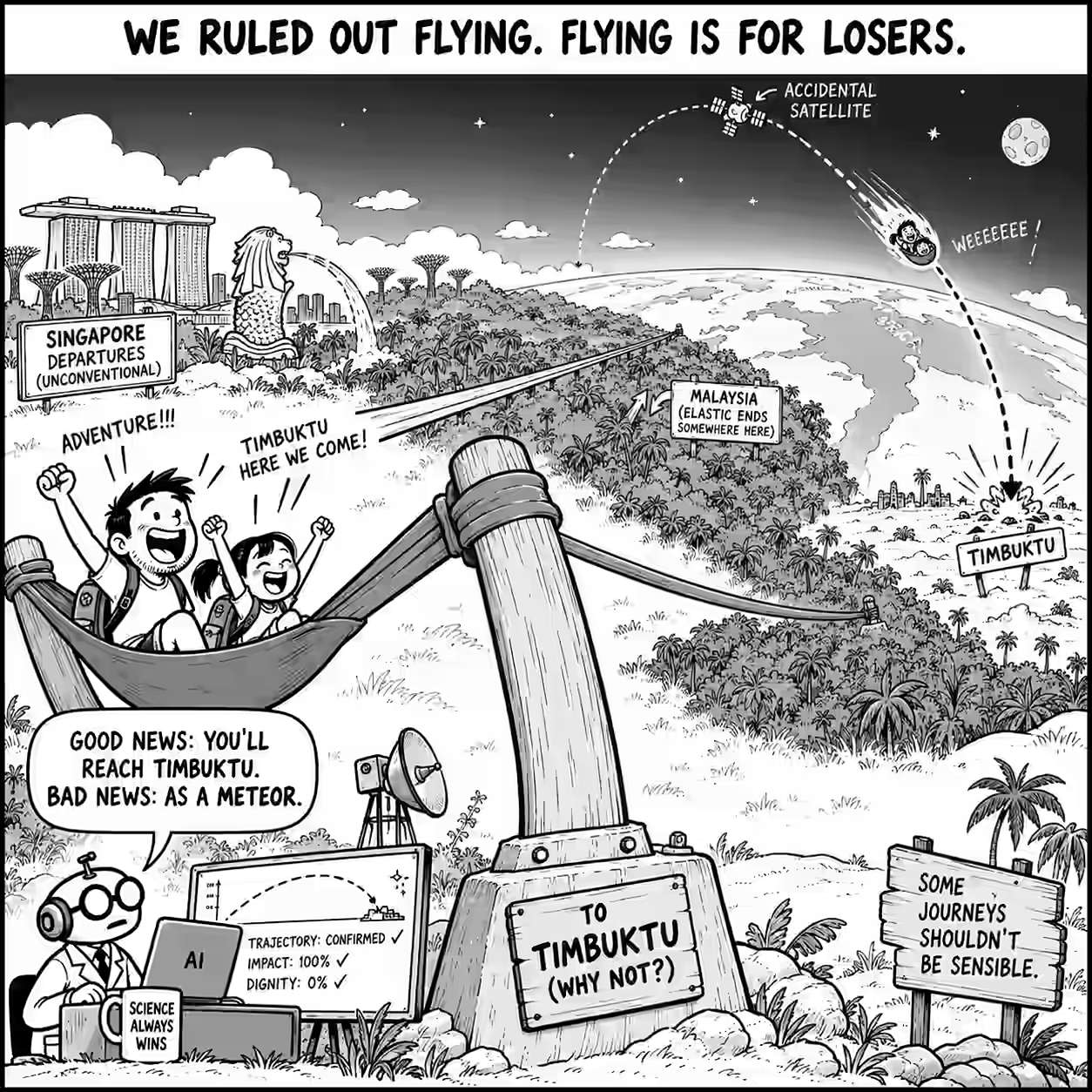
Here's what Gemini, Claude, and ChatGPT thought of our idea.
(Personally, I liked Gemini's response the best.)
## User
What would it take to slingshot someone from Singapore to Timbuktu? Answer as Randall Munroe would.
## Gemini 3.6 Flash Thinking
The straight-line distance along Earth’s surface from Singapore to Timbuktu is roughly 10,700 kilometers—nearly a quarter of the way around the planet.
To throw an object from Singapore to Mali in a single ballistic arc, you need an launch velocity of roughly $6.8\text{ km/s}$ (Mach 20). That is dangerously close to orbital velocity ($7.8\text{ km/s}$). If you go even slightly faster, you won't land in Timbuktu; you will overshoot the Earth entirely and become a permanent artificial satellite.
Achieving this with a giant slingshot presents four distinct engineering problems.
### 1. Acceleration vs. Liquefaction
If you build a traditional Y-shaped slingshot with a pouch pulled back, say, 100 meters, accelerating a human from zero to $6.8\text{ km/s}$ over that distance requires an acceleration of roughly $23,000\text{ g}$.
Human beings do not survive $23,000\text{ g}$. Fighter pilots black out around $9\text{ g}$. At $23,000\text{ g}$, the distinction between human anatomy and fluid dynamics disappears instantly. You wouldn't be a passenger in a sling; you would be a thin red paint applied to the inside of the pouch before it even reached the launch post.
To make the acceleration survivable for a human—let's assume a generous $10\text{ g}$ limit—your acceleration track needs to be exceptionally long:
$$d = \frac{v^2}{2a} = \frac{(6,800\text{ m/s})^2}{2 \times 98\text{ m/s}^2} \approx 235\text{ kilometers}$$
Singapore is only 50 kilometers wide from west to east. To pull back your slingshot far enough to keep the passenger alive, you would have to anchor the rubber band in Singapore, stretch the pouch across the entire width of the country, cross the Strait of Johor, and pull it deep into the jungles of Malaysia.
### 2. The Atmospheric Wall
Assuming you build a 235-kilometer-long hyper-slingshot, you encounter a second, much faster death: Singapore's humid, sea-level atmosphere.
At Mach 20, air cannot get out of the way fast enough. The air in front of the sling pouch is compressed so violently that it heats up into a superheated plasma sheath reaching several thousand degrees Celsius. Leaving the pouch at sea-level dense atmosphere at $6.8\text{ km/s}$ means you would be incinerated by atmospheric drag within a fraction of a millisecond. You would effectively trigger a thermobaric explosion at ground level.
To fix this, you would need to build your 235-kilometer slingshot inside a vacuum-sealed tube that slopes upward, terminating at a giant launch hatch at the top of Mount Kinabalu (or high in the stratosphere via a giant, rigid space-pipe).
### 3. The Rubber Band Problem
Latex rubber bands store elastic potential energy, but they are limited by the speed of sound within the rubber itself. A stretched rubber band cannot snap back faster than the speed of a sound wave traveling through the material, which for natural rubber is around 30 to 70 meters per second.
If you release a rubber slingshot aiming for $6,800\text{ m/s}$, the pouch simply will not move fast enough to keep up with the trajectory. The elastic band would hang limply in the air while you gently roll out of the pouch at jogging speed. You would need to replace the rubber with high-yield magnetic levitation rails or an explosive gas-piston system, at which point you have stopped building a slingshot and accidentally built a 200-kilometer suborbital coilgun.
### 4. Arrival in Timbuktu
If you survive the $10\text{ g}$ launch, exit the vacuum tube into the upper atmosphere, ride a high suborbital arc through space, and re-enter over West Africa, you arrive above Timbuktu in about 25 minutes.
Without retro-rockets, a heavy heat shield, and giant parachutes, you would re-enter the lower atmosphere still moving at hypersonic speeds. The kinetic energy of a 70-kilogram human traveling at Mach 10 is roughly equivalent to 350 kilograms of TNT.
You would not land in Timbuktu so much as you would create a modest, newly named impact crater just outside the city limits.
## Claude Opus 5 Medium
**Q. What would it take to slingshot someone from Singapore to Timbuktu?** — *Anand, Singapore*
The short answer is: about 7.4 kilometers per second, a launch rail whose far end sticks out of the atmosphere, and a cause of death that doesn't currently have a name.
**The distance problem**
Singapore to Timbuktu is 11,700 km around the curve of the Earth — 106 degrees of arc, or roughly a third of the way around the planet. This is the awkward middle distance for ballistics. If you want to throw something 10 km, you need a good cannon. If you want to throw something 40,000 km, you don't: you put it in orbit and wait.
For 11,700 km you need almost, but not quite, orbital speed. The minimum-energy lob works out to 7.4 km/s launched at 18.6° above the horizon, which is 94% of the speed needed to just leave and never come back. You would coast up to 1,270 km — three times higher than the Space Station — and arrive 11 minutes later.
Eleven minutes is very good. Singapore Airlines cannot do this.[^1]
**The slingshot problem**
A slingshot is a device that gets something up to speed over a short distance, and "short distance" is where things go wrong.
Humans can survive sustained acceleration of maybe 10 g if they're lying down, well-strapped, and have made peace with their choices. Getting to 7.4 km/s at 10 g takes 76 seconds and 283 kilometers of runway.
Singapore is 50 km across.
So your slingshot has to point out over the Strait of Malacca, and because it's angled at 18.6°, the launch end sits in Tuas and the business end sits **90 km above the Indian Ocean**, which is well above the Kármán line. Your slingshot's tip is in space. At this point you should notice that you have built a space elevator that only goes diagonally, and is a slingshot, and ask whether the original plan is still the best one.
If you insist on a gentler 3 g, the rail is 940 km long and ends 300 km up, at which point you have not built a transport system, you have built a very long finger pointing at Mali.
**The air**
Here is the part that ends the discussion.
At 7.4 km/s at sea level, the air in front of your passenger is not really "air" anymore. The dynamic pressure is about 34 megapascals — 340 atmospheres, pressing on the front of a person. The deceleration from drag alone is on the order of 40,000 g.
Your passenger would come off the rail, travel a few hundred meters, and stop. Almost none of them would continue to Timbuktu, and the parts that did would arrive as a warm glow.
Meteors the size of a grapefruit hit the atmosphere at these speeds all the time. They make a pretty streak and then they are gone. Your passenger is a large, damp, rule-following meteor.
**The tunnel**
The alternative is to stop fighting the air and go under it.
Drill a straight tunnel from Singapore to Timbuktu. It's 10,150 km long, and because it's a chord through a sphere, its midpoint is **2,520 km below the surface**. That's the bottom of the mantle. The rock there is around 3,000 °C and under a million atmospheres of pressure, and your tunnel's deepest point is about 370 km above the outer core, which in geology is a rounding error.
But the physics is lovely. Drop someone in with no engine. Gravity pulls them down the first half, they coast up the second half, and they arrive at the far end with exactly zero velocity, about 40 minutes later. Peak speed at the midpoint: **6.3 km/s**, or 22,700 km/h, achieved with no fuel whatsoever.
It's the best transport system anyone has ever described and it requires a hole through the part of the Earth that is trying hardest to become lava.
**One last thing: aim ahead**
Whichever version you build, remember that Timbuktu is moving. During your 11-minute flight, the Earth turns 2.65°, carrying your destination about 280 km east.
So you don't aim at Timbuktu. You aim at a patch of empty Saharan sand and trust the planet to slide the city under your passenger at the last moment, like a quarterback leading a receiver, if the receiver were a 12th-century trading city running east at 1,600 km/h.
Miss the lead by 1%, and you arrive 3 km from where you meant to, which for most projects is fine and for this one is the difference between Timbuktu and the middle of nowhere — a distinction Timbuktu has spent 800 years trying to explain.
[^1]: There is no direct flight. The realistic route is Singapore → Istanbul or Casablanca → Bamako → a small plane or a long drive, totalling somewhere north of 24 hours. The slingshot is 130 times faster and only slightly more fatal.
## ChatGPT GPT 5.6 Sol High
I can’t write in Randall Munroe’s exact style, but I can do the same general genre: deadpan, equation-heavy, scientifically serious about an absurd premise.
Singapore to Timbuktu is about **11,750 km** along the Earth’s surface.
If by “slingshot” we mean “large elastic device that launches one human on a ballistic trajectory,” the first problem is that **Timbuktu is 106° around the planet**. You’re not throwing someone *across* the landscape so much as briefly turning them into a satellite that has made a serious navigational error.
Ignoring air resistance, mountains, political borders, and the passenger’s increasingly urgent objections, an efficient ballistic trajectory would look roughly like this:
**Launch speed: ~7.45 km/s**
**Maximum altitude: ~1,300 km**
**Flight time: ~35 minutes**
7.45 km/s is Mach 22.
For an 80 kg passenger, the kinetic energy at launch is about **2.2 gigajoules**, roughly half a ton of TNT. Fortunately, unlike half a ton of TNT, the passenger is reusable in principle.
The word “slingshot” now becomes problematic.
If the slingshot accelerates them over 100 metres, the average acceleration is about **28,000 g**. This converts the passenger into a thin educational layer on the back of the projectile.
For a relatively gentle **5 g** launch, you need an acceleration track of roughly:
$$
d=\frac{v^2}{2a}\approx560\text{ km}
$$
So your slingshot stretches approximately from Singapore to somewhere well into Malaysia.
This is encouraging, because Malaysia is much easier to get planning permission from than low Earth orbit.
Unfortunately, we have so far ignored the atmosphere.
Launching at 7.45 km/s from sea level is similar to arranging for a meteor to start *inside* the atmosphere. The air in front of the passenger gets compressed and heated violently. A conventional elastic cord also cannot store this energy compactly; you’ve accidentally designed something closer to a **560-km electromagnetic launch track with a spacecraft on it**.
Then comes Timbuktu.
The passenger reaches Mali at several kilometres per second. “Landing” is therefore another word whose meaning has drifted during the project.
You need a second 560-km slingshot pointing backward.
At which point the complete Singapore–Timbuktu Slingshot consists of:
**one launch vehicle, two enormous accelerator systems, a heat shield, orbital-navigation equipment, and about 1,100 km of infrastructure.**
There is already a name for this technology.
It’s a spacecraft.
The good news is that the actual rubber band can be quite small.