---
title: Sonnet 4.6 vs MiniMax M2.7
date: 2026-03-24T17:06:02+08:00
categories:
- llms
- coding
description: Even when two models can complete the same task, they differ noticeably in narrative quality, visual ambition, and implementation details, so model choice meaningfully affects outcomes.
keywords: [LLM comparison, Sonnet, MiniMax, evaluation, data stories, model capabilities]
---
Based on several (i.e. two) recommendations, I subscribed to [MiniMax](https://platform.minimax.io/). At $10/month, you get 1,500 requests every 5 hours and 15,000 every week. That's a LOT!
Using the [same prompt](https://sanand0.github.io/talks/2025-07-18-tug-true-but-irrelevant-rob-schrauwen/prompts.md) I had [Claude Code](https://platform.minimax.io/docs/token-plan/claude-code) generate two data stories:
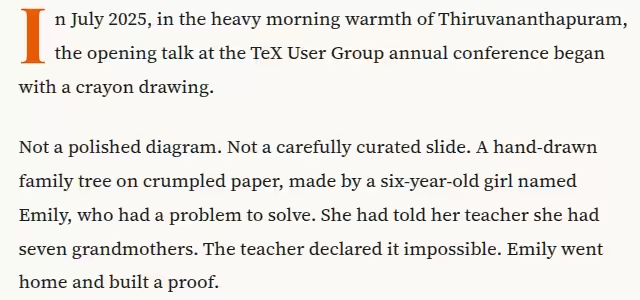
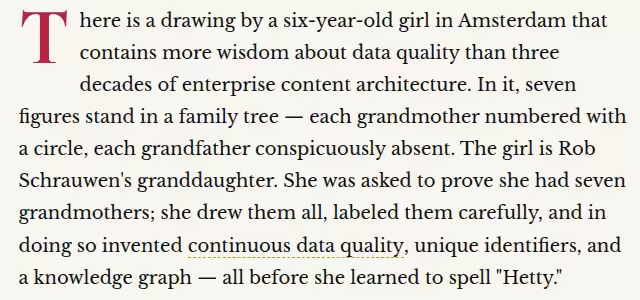
The first paragraph, by Claude Sonnet 4.6The first paragraph, by MiniMax M2.7
Here's my comparison of the two. It's partly based on [Claude Opus 4.6's comparison](https://sanand0.github.io/talks/2025-07-18-tug-true-but-irrelevant-rob-schrauwen/comparison.md) but I felt the same way.
| Dimension | Sonnet 4.6 | MiniMax M2.7 |
| ----------------------- | ------------------------------------------- | --------------------------- |
| **Narrative quality** | Immersive | |
| **Content coverage** | Comprehensive | |
| **Visual design** | More varied, ambitious bands, no errors | |
| **CSS** | | Better use of CSS variables |
| **Tooltips** | Richer, comprehensive, `data-tip` | |
| **Modals/popups** | Richer, more types, more details | |
| **Animated SVGs** | Richer, visually distinctive, sophisticated | |
| **Slides** | Larger readable grid | |
| **Code samples** | XML vs JSON-LD side-by-side | |
| **External references** | Far more authoritative links | |
| **Accessibility** | ARIA, keyboard, alt text | |
| **Generation quality** | Clean, no Chinese character artifacts | |
In other words, Sonnet 4.6 is a _clear_ winner on nearly every dimension.
But the cost factor is _too_ big a difference to ignore. It feels like a 10x difference. So the question probably is: what can I do with a _reasonably_ good model that can generate 10X the quantity at the same price?
(To be fair, [GPT 5.4 Mini at 75c/MTok](https://openrouter.ai/openai/gpt-5.4-mini) and [Gemini 3 Flash at 50c/MTok](https://openrouter.ai/google/gemini-3-flash-preview) are not far from [MiniMax M2.7 at 30c/MTok](https://openrouter.ai/minimax/minimax-m2.7) - but their [code quality](https://arena.ai/leaderboard/code) seems lower. I generated a [Codex - GPT 5.4 Mini version](https://sanand0.github.io/talks/2025-07-18-tug-true-but-irrelevant-rob-schrauwen/gpt-5.4-mini-xhigh.html) and while it has fewer errors it has even less visual style and narrative quality.)
**Computer use** feels like a candidate. I used [Rodney](https://github.com/simonw/rodney) to research what drives my LinkedIn reach & engagement, and update my [SKILL.md](https://github.com/sanand0/scripts/blob/f08ffd11e221c5a9ef58d5da814aaad9985bd422/agents/linkedin-cdp/SKILL.md).
I could try experimenting with sub-agents, doing bulk analysis (e.g. of code, transcripts, images), data discovery, etc. The crux of these is parallelization - something I have not explored much.
It looks like twe're entering an era where there are two kinds of use cases: high-quality for the best models, large-scale for the cheap models. The question is: how do I make the most of both?
---
[Source Code](https://github.com/sanand0/talks/tree/52ad2aa775cd4e0f1e0ad8e6199ce7754a2663ac/2025-07-18-tug-true-but-irrelevant-rob-schrauwen)
---
**UPDATE**: Cheap models (or at least MiniMax M2.7) may be far less useful than I thought. I used MiniMax M2.7 with Claude Code for:
- 24 Mar 2026: Email analysis. I had it review my 15-year Gramener email archive for key events for a book. But it fetched too few results, so I switched to Codex (GPT 5.4 xhigh).
- 25 Mar 2026: [Capture The Flag](https://play.picoctf.org/practice). But it couldn't solve problems, so I switched to Codex (GPT 5.4 xhigh).
- 25 Mar 2026: Songs download. I had it find popular Tamil songs and download them from YouTube. But the metadata was poor, so I switched to my own song collection.
- 26 Mar 2026: LEAN proofs. It started making too many basic mistakes (spelling errors in code!) I switched to Copilot (GPT 5.4 xhigh).
- 29 Mar 2026: Calvin & Hobbes image analysis. It couldn't even read the images and confidently saw "Hobbes stuck to a baseball bat with Mom & Dad" in a strip that only featured Calvin & Susie.
The main problems are:
- **It errs confidently**. It doesn't do ROT13 well. It can't see images. It mis-understands error messages. It assigned my earlier company's incorporation date (NGIMAGE) as Gramener's. It made Vijay Sethupathi a lyricist. When a process failed with just 12% coverage, it just continued. It just _reported what's done, not what's missing_.
- **It's a slow learner**. For [picoCTF](https://picoctf.org/), it had the pieces but couldn't assemble them. Claude Code resets the cwd, but it never switched to absolute paths. It mixed `uv run` with `python3`. It rewrites, resets or waits instead of diagnosing.
It's best for simple, single-step tasks. Not where knowledge, accuracy, research matters. When using it, keep tasks small and verify correctness, completeness.