
One pass. Every outlier.
Streaming anomaly detection in Python. Score each data point the moment it arrives,
with 16 online detectors, calibrated alerts and streaming evaluation.










Documentation ·
Quick start ·
Detectors ·
Examples ·
Try it in Colab ·
Cite
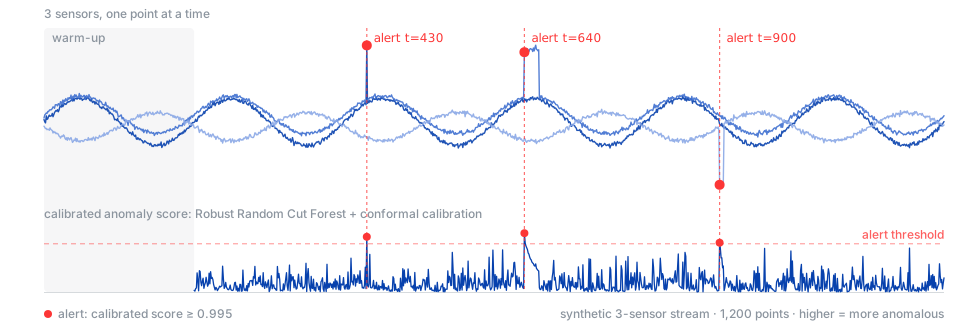
A Robust Random Cut Forest scores three sensors one point at a time, and conformal calibration turns its scores into alerts. Synthetic data.
## Why pysad
Batch detectors assume you have the whole dataset. On a stream you don't: points arrive one at a time, the data drifts, and a decision is needed before the next point lands. pysad is built for that setting. It is cited in more than 60 publications on [Google Scholar](https://scholar.google.com/scholar?q=%22PySAD%3A+A+Streaming+Anomaly+Detection+Framework+in+Python%22) and used by [30+ public repositories](https://github.com/selimfirat/pysad/network/dependents) on GitHub.
**Built for streams**
Every detector learns and scores one instance at a time with `fit_partial`, `score_partial` and `fit_score_partial`. Most keep a fixed-size window, sketch or set of trees instead of the whole history.
|
**16 detectors from the literature**
From robust statistics (MAD, 3-sigma, Seasonal Hybrid ESD) to forests, sketches and projections (Half-Space Trees, Robust Random Cut Forest, RS-Hash, xStream, LODA). Each one cites its paper.
|
**From scores to alerts**
Conformal and Gaussian-tail calibrators turn raw scores into the share of recent scores they exceed, so a threshold such as `0.99` means the same thing for every detector.
|
**Evaluate as you stream**
Stream simulators replay data one instance at a time, and 17 labelled benchmark datasets download on first use. Metrics (AUROC, AUPR, precision, recall, and a windowed variant for drifting streams) update after every point.
|
**Your batch models, on a stream**
Wrap any [PyOD](https://github.com/yzhao062/pyod) detector to refit on a sliding reference window.
|
**A complete pipeline**
Preprocessors, random projections, score postprocessors, ensemblers and running statistics compose with any detector.
|
**How pysad differs.** Batch outlier detectors such as [PyOD](https://github.com/yzhao062/pyod) are fitted on a fixed dataset and have to be refitted to take in new data. pysad detectors update with every point, and pysad can still run PyOD models on a stream through `ReferenceWindowModel`. General online-learning frameworks such as [River](https://github.com/online-ml/river) treat anomaly detection as one module among many. pysad is dedicated to it: 16 streaming detectors, with calibration, postprocessing, ensembling and evaluation built around them.
## Installation
```bash
pip install pysad
```
pysad supports Python 3.10+ on Linux, macOS and Windows.
## Quick start
[](https://colab.research.google.com/github/selimfirat/pysad/blob/master/examples/quickstart.ipynb)
Score a stream point by point and evaluate the detector as it goes:
```python
import numpy as np
from pysad.evaluation import AUROCMetric
from pysad.models import LODA
from pysad.utils import ArrayStreamer
# A stream of 2,000 points with 4 features; every 50th point is an anomaly.
rng = np.random.default_rng(42)
X = rng.normal(size=(2000, 4))
y = np.zeros(2000, dtype=int)
y[::50] = 1
X[y == 1, :2] += 3 # anomalies are shifted in two of the four features
model = LODA()
metric = AUROCMetric()
for x, label in ArrayStreamer().iter(X, y):
score = model.fit_score_partial(x) # update the model with x, then score it
metric.update(label, score)
print(f"AUROC: {metric.get():.3f}") # about 0.96; LODA is randomized, so it varies a little
```
### Turn scores into alerts
A higher score means a more anomalous point, but raw scores have no fixed scale. A conformal calibrator converts each score into the share of recent scores below it, so higher still means more anomalous. Continuing the example above, alert when it's close to 1:
```python
from pysad.transform.probability_calibration import ConformalProbabilityCalibrator
model = LODA()
calibrator = ConformalProbabilityCalibrator(window_size=500)
for t, x in enumerate(ArrayStreamer().iter(X)):
score = model.fit_score_partial(x)
calibrated = calibrator.fit_transform_partial(score)
if t >= 200 and calibrated >= 0.99: # skip a short warm-up
print(f"alert at t={t}: higher than {calibrated:.1%} of recent scores")
```
### Stream your own data
A detector takes one NumPy array per instance, so any loop works: a CSV reader, a socket, or a message queue consumer.
```python
import json
for message in consumer: # for example, a Kafka consumer
x = np.asarray(json.loads(message.value)["features"], dtype=float)
score = model.fit_score_partial(x)
```
`ArrayStreamer` and `PandasStreamer` replay arrays and DataFrames as streams, which is handy for experiments.
### Use a PyOD model on a stream
```python
from pyod.models.iforest import IForest
from pysad.models.integrations import ReferenceWindowModel
# Refit a batch Isolation Forest on the latest 200 points, every 50 points.
model = ReferenceWindowModel(IForest, window_size=200, sliding_size=50, initial_window_X=X[:100])
for x in ArrayStreamer().iter(X[100:]):
score = model.fit_score_partial(x)
```
More examples, from ensembles to seasonal time series, are in [`examples/`](https://github.com/selimfirat/pysad/tree/master/examples) and the [Colab quick start](https://colab.research.google.com/github/selimfirat/pysad/blob/master/examples/quickstart.ipynb).
## Detectors
### Which detector should I start with?
| Your data | Start with | Why |
|---|---|---|
| One metric with daily or weekly cycles | `SeasonalHybridESD` | Built for seasonal cloud metrics, and robust to earlier anomalies in the window |
| One metric without strong seasonality | `MedianAbsoluteDeviation` | A robust baseline (running median and MAD) that works with its defaults |
| Several features, first try | `LODA` | Lightweight and learns incrementally |
| Features with known value ranges | `HalfSpaceTrees` | Constant time per point over a sliding window |
| Many features, or features that appear and disappear | `xStream` | Designed for high-dimensional, feature-evolving streams |
| Network traffic | `KitNet` | Built for online network intrusion detection |
| A PyOD model you already trust | `ReferenceWindowModel` | Refits it on a sliding reference window |
These are starting points drawn from each method's design, not benchmark rankings. Compare two or three on your own data with the metrics in `pysad.evaluation`.
### All detectors
**Multivariate**
| Class | Method |
|---|---|
| `xStream` | xStream (Manzoor et al., KDD 2018) |
| `LODA` | Lightweight on-line detector of anomalies (Pevný, *Machine Learning* 2016) |
| `HalfSpaceTrees` | Half-Space Trees (Tan et al., IJCAI 2011) |
| `RobustRandomCutForest` | Robust Random Cut Forest (Guha et al., ICML 2016) |
| `RSHash` | RS-Hash subspace outlier detection (Sathe & Aggarwal, ICDM 2016) |
| `IForestASD` | Isolation Forest on sliding windows (Ding & Fei, IFAC 2013) |
| `KitNet` | KitNET ensemble of autoencoders (Mirsky et al., NDSS 2018) |
| `ExactStorm` | Exact-STORM distance-based outliers (Angiulli & Fassetti, CIKM 2007) |
| `LocalOutlierProbability` | Local Outlier Probabilities (Kriegel et al., CIKM 2009) |
| `Inqmad` | InQMAD quantum-measurement density (Gallego-Mejia et al., ICDMW 2022) |
**Univariate**
| Class | Method |
|---|---|
| `SeasonalHybridESD` | Seasonal Hybrid ESD (Hochenbaum et al., 2017) |
| `SeasonalESD` | Seasonal ESD (Hochenbaum et al., 2017) |
| `KNNCAD` | Conformalized k-NN anomaly detection (Burnaev & Ishimtsev, 2016) |
| `RelativeEntropy` | Relative entropy over windows (Wang et al., IM 2011) |
| `MedianAbsoluteDeviation` | Running median absolute deviation (Hochenbaum et al., 2017) |
| `StandardAbsoluteDeviation` | Running 3-sigma rule (Hochenbaum et al., 2017) |
Plus `ReferenceWindowModel` and `OneFitModel`, which run any [PyOD](https://github.com/yzhao062/pyod) detector on a stream. Full references and parameters are in the [API documentation](https://pysad.readthedocs.io/en/latest/api.html).
## Beyond detectors
| Stage | What pysad provides |
|---|---|
| Preprocessing | `InstanceStandardScaler`, `InstanceUnitNormScaler`, `SeasonalTrendDecomposer`, `ModifiedSTLResidualTransformer` |
| Projection | `StreamhashProjector`, `GaussianRandomProjector`, `SparseRandomProjector` |
| Postprocessing | Running and windowed average, max, median and z-score of scores |
| Calibration | `ConformalProbabilityCalibrator`, `GaussianTailProbabilityCalibrator` |
| Ensembling | Average, maximum, median, average-of-maximum and maximum-of-average score ensemblers |
| Evaluation | `AUROCMetric`, `AUPRMetric`, `PrecisionMetric`, `RecallMetric`, `WindowedMetric` |
| Streaming data | `ArrayStreamer`, `PandasStreamer`, and `Data` for 17 labelled ODDS benchmark datasets, downloaded on first use |
| Statistics | Running mean, variance, median, min, max, sum and count trackers |
## Contributing
Issues and pull requests are welcome, and I aim to reply to both within a few days. Questions and show-and-tell go in [Discussions](https://github.com/selimfirat/pysad/discussions). New to the codebase? Start with a [good first issue](https://github.com/selimfirat/pysad/labels/good%20first%20issue), and see the [contributing guide](https://github.com/selimfirat/pysad/blob/master/.github/CONTRIBUTING.md).
pysad follows [semantic versioning](https://semver.org/) and [trunk-based development](https://trunkbaseddevelopment.com/): changes reach `master` through short-lived branches and pull requests checked by CI, and every example runs in CI.

Thanks to everyone who has reported a bug, fixed one, or improved the docs.
## Citing pysad
If you use pysad in a scientific publication, please cite the paper:
```bibtex
@article{pysad,
title={PySAD: A Streaming Anomaly Detection Framework in Python},
author={Yilmaz, Selim F and Kozat, Suleyman S},
journal={arXiv preprint arXiv:2009.02572},
year={2020}
}
```
To cite a specific version of the software, use its Zenodo DOI: [10.5281/zenodo.22983312](https://doi.org/10.5281/zenodo.22983312) always resolves to the latest release, and each release has its own DOI listed there.
## License
pysad is released under the [BSD 3-Clause License](https://github.com/selimfirat/pysad/blob/master/LICENSE).
---
If pysad is useful to you, a star helps other people find it.
To hear about new detectors and releases, choose Watch → Custom → Releases.