


 ## 🧩 Key Components
- 🗂️ **LegalAssistantState**
A centralized data model that holds all user inputs, case details, legal topic, jurisdiction, search results (laws, cases, templates), generated reports, and the final PDF. It manages the overall workflow state.
- 🔄 **Reducers for State Management**
Functions that merge concurrent updates to ensure consistent and reliable state during parallel searches (laws, cases, templates).
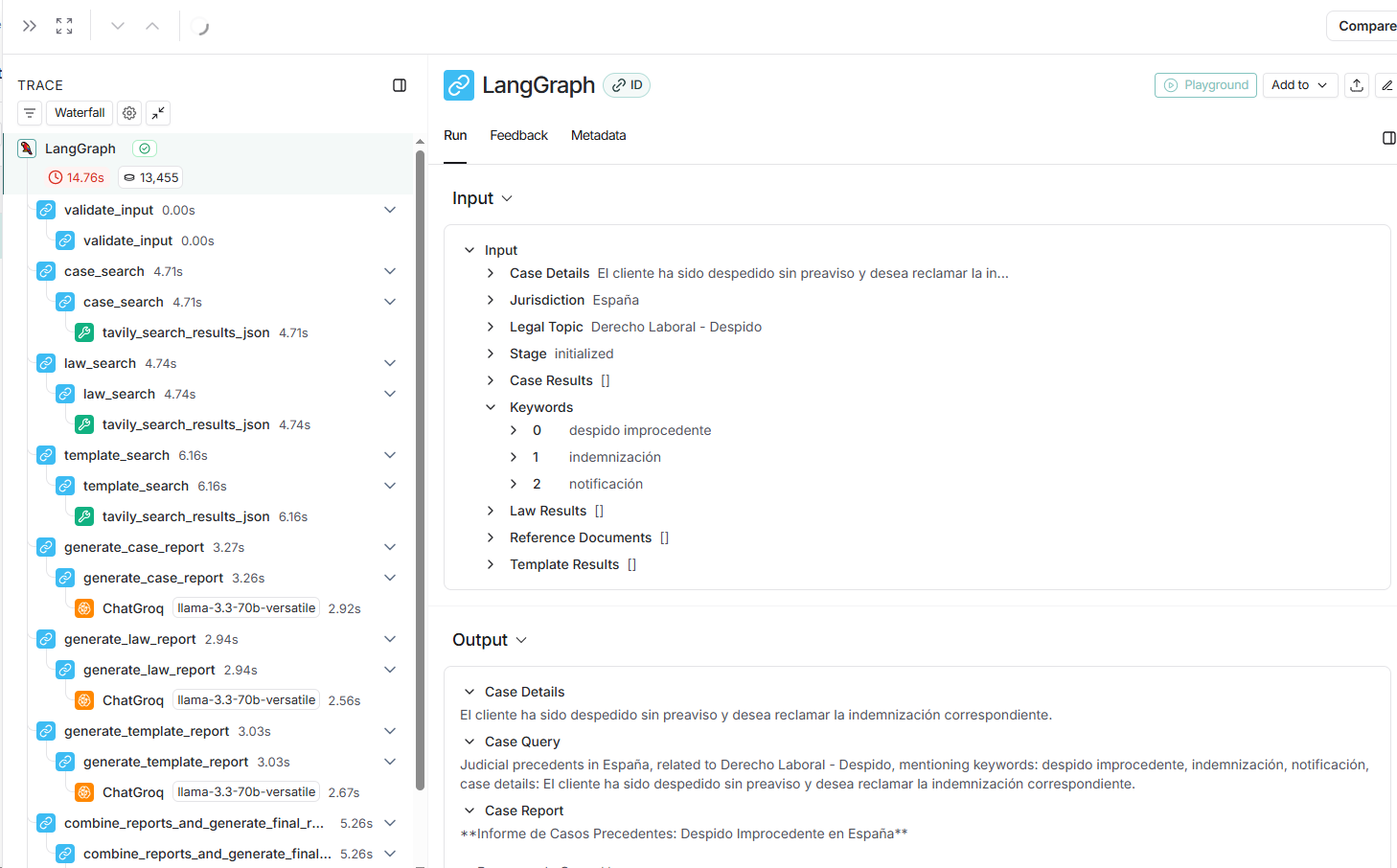
- 🚦 **Parallel Search Nodes**
Independent nodes that simultaneously perform searches for laws & regulations, case precedents, and legal document templates.
- 🤖 **Language Model Nodes**
Use the `llama-3.3-70b-versatile` model to generate detailed legal reports, summarize case law, and produce actionable recommendations based on aggregated data.
- 🔗 **Workflow Orchestration with LangGraph**
Orchestrates the entire legal research process as a graph of interconnected nodes, supporting parallel execution and state merging.
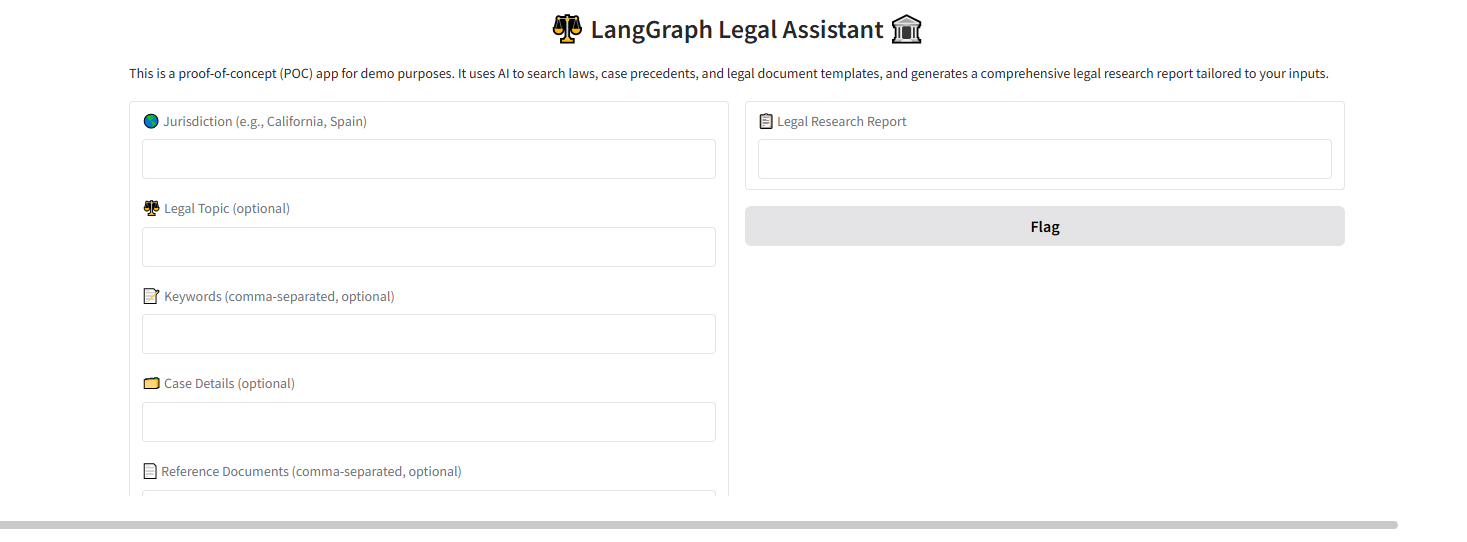
- 🖥️ **Gradio Interface**
An intuitive web UI for entering legal case details, keywords, jurisdiction, and reference documents, and viewing the personalized legal research report and PDF in real time.
## 🧩 Key Components
- 🗂️ **LegalAssistantState**
A centralized data model that holds all user inputs, case details, legal topic, jurisdiction, search results (laws, cases, templates), generated reports, and the final PDF. It manages the overall workflow state.
- 🔄 **Reducers for State Management**
Functions that merge concurrent updates to ensure consistent and reliable state during parallel searches (laws, cases, templates).
- 🚦 **Parallel Search Nodes**
Independent nodes that simultaneously perform searches for laws & regulations, case precedents, and legal document templates.
- 🤖 **Language Model Nodes**
Use the `llama-3.3-70b-versatile` model to generate detailed legal reports, summarize case law, and produce actionable recommendations based on aggregated data.
- 🔗 **Workflow Orchestration with LangGraph**
Orchestrates the entire legal research process as a graph of interconnected nodes, supporting parallel execution and state merging.
- 🖥️ **Gradio Interface**
An intuitive web UI for entering legal case details, keywords, jurisdiction, and reference documents, and viewing the personalized legal research report and PDF in real time.
 ## 🎓 Learning Outcomes
- 🚀 **Building agentic workflows**: Gained hands-on experience designing and orchestrating multi-agent systems with LangGraph to tackle complex legal research tasks.
- 🔄 **Concurrent state management**: Learned how to implement reducers for safe merging of simultaneous updates and consistent application state.
- 🤖 **Prompt engineering & LLM integration**: Developed effective prompts to guide large language models in summarizing laws, analyzing case precedents, and recommending legal templates.
- 🌐 **API integration**: Integrated Tavily’s real-time search API to fetch live legal documents, case law, and templates, expanding understanding of external data sources.
- 🧩 **Parallel processing & orchestration**: Explored how parallel node execution can optimize workflow performance and reduce report generation times.
- 🖥️ **User interface development**: Built an interactive Gradio app to connect backend workflows with a user-friendly front end for legal research.
## ⚠️ Disclaimer
This project was created solely for **educational and experimental purposes**. It is a personal initiative to explore the capabilities of **generative AI**, **multi-agent architectures**, and **LangGraph** in the context of **automated homebuying assistance**.
This system is a **proof of concept** to experiment with agent collaboration, real-time search integration using **Tavily**, and structured decision-making workflows. It demonstrates how agentic applications can reason, search, and plan autonomously using tools like **LangGraph**, **Tavily**, and **large language models**.
## 🙏 Acknowledgements
This proof of concept (POC) is a personal project developed from scratch as a hands-on exercise to apply and consolidate the knowledge gained during the [Bootcamp 2025: Understand and Build Professional AI Agents](https://www.udemy.com/course/bootcamp-2025-comprender-y-crear-agentes-ia-profesionales). The course offered a strong foundation for designing and implementing AI agents using tools such as LangGraph and LangChain. Special thanks to the instructors and the Udemy team for providing such a clear, well-structured, and practical learning experience. Official resources and examples from the course can be found at [GitHub - AI-LLM-Bootcamp](https://github.com/AI-LLM-Bootcamp/001-LANGGRAPH-ROUND2-ESP).
I would also like to acknowledge the [doomL LangChain-LangGraph Tutorial](https://github.com/doomL/langchain-langgraph-tutorial), which offered valuable complementary insights and best practices for working with LangChain, LangGraph, and LangSmith. These resources greatly enriched my understanding and ability to build modular, agent-driven AI systems.
Finally, I’m thankful for the open-source community and ecosystem that makes it possible to explore, experiment, and learn with cutting-edge AI technologies.
## License ⚖️
This project is licensed under the MIT License, an open-source software license that allows developers to freely use, copy, modify, and distribute the software. 🛠️ This includes use in both personal and commercial projects, with the only requirement being that the original copyright notice is retained. 📄
Please note the following limitations:
- The software is provided "as is", without any warranties, express or implied. 🚫🛡️
- If you distribute the software, whether in original or modified form, you must include the original copyright notice and license. 📑
- The license allows for commercial use, but you cannot claim ownership over the software itself. 🏷️
The goal of this license is to maximize freedom for developers while maintaining recognition for the original creators.
```
MIT License
Copyright (c) 2025 Sergio Sánchez
Permission is hereby granted, free of charge, to any person obtaining a copy
of this software and associated documentation files (the "Software"), to deal
in the Software without restriction, including without limitation the rights
to use, copy, modify, merge, publish, distribute, sublicense, and/or sell
copies of the Software, and to permit persons to whom the Software is
furnished to do so, subject to the following conditions:
The above copyright notice and this permission notice shall be included in all
copies or substantial portions of the Software.
THE SOFTWARE IS PROVIDED "AS IS", WITHOUT WARRANTY OF ANY KIND, EXPRESS OR
IMPLIED, INCLUDING BUT NOT LIMITED TO THE WARRANTIES OF MERCHANTABILITY,
FITNESS FOR A PARTICULAR PURPOSE AND NONINFRINGEMENT. IN NO EVENT SHALL THE
AUTHORS OR COPYRIGHT HOLDERS BE LIABLE FOR ANY CLAIM, DAMAGES OR OTHER
LIABILITY, WHETHER IN AN ACTION OF CONTRACT, TORT OR OTHERWISE, ARISING FROM,
OUT OF OR IN CONNECTION WITH THE SOFTWARE OR THE USE OR OTHER DEALINGS IN THE
SOFTWARE.
```
## 🎓 Learning Outcomes
- 🚀 **Building agentic workflows**: Gained hands-on experience designing and orchestrating multi-agent systems with LangGraph to tackle complex legal research tasks.
- 🔄 **Concurrent state management**: Learned how to implement reducers for safe merging of simultaneous updates and consistent application state.
- 🤖 **Prompt engineering & LLM integration**: Developed effective prompts to guide large language models in summarizing laws, analyzing case precedents, and recommending legal templates.
- 🌐 **API integration**: Integrated Tavily’s real-time search API to fetch live legal documents, case law, and templates, expanding understanding of external data sources.
- 🧩 **Parallel processing & orchestration**: Explored how parallel node execution can optimize workflow performance and reduce report generation times.
- 🖥️ **User interface development**: Built an interactive Gradio app to connect backend workflows with a user-friendly front end for legal research.
## ⚠️ Disclaimer
This project was created solely for **educational and experimental purposes**. It is a personal initiative to explore the capabilities of **generative AI**, **multi-agent architectures**, and **LangGraph** in the context of **automated homebuying assistance**.
This system is a **proof of concept** to experiment with agent collaboration, real-time search integration using **Tavily**, and structured decision-making workflows. It demonstrates how agentic applications can reason, search, and plan autonomously using tools like **LangGraph**, **Tavily**, and **large language models**.
## 🙏 Acknowledgements
This proof of concept (POC) is a personal project developed from scratch as a hands-on exercise to apply and consolidate the knowledge gained during the [Bootcamp 2025: Understand and Build Professional AI Agents](https://www.udemy.com/course/bootcamp-2025-comprender-y-crear-agentes-ia-profesionales). The course offered a strong foundation for designing and implementing AI agents using tools such as LangGraph and LangChain. Special thanks to the instructors and the Udemy team for providing such a clear, well-structured, and practical learning experience. Official resources and examples from the course can be found at [GitHub - AI-LLM-Bootcamp](https://github.com/AI-LLM-Bootcamp/001-LANGGRAPH-ROUND2-ESP).
I would also like to acknowledge the [doomL LangChain-LangGraph Tutorial](https://github.com/doomL/langchain-langgraph-tutorial), which offered valuable complementary insights and best practices for working with LangChain, LangGraph, and LangSmith. These resources greatly enriched my understanding and ability to build modular, agent-driven AI systems.
Finally, I’m thankful for the open-source community and ecosystem that makes it possible to explore, experiment, and learn with cutting-edge AI technologies.
## License ⚖️
This project is licensed under the MIT License, an open-source software license that allows developers to freely use, copy, modify, and distribute the software. 🛠️ This includes use in both personal and commercial projects, with the only requirement being that the original copyright notice is retained. 📄
Please note the following limitations:
- The software is provided "as is", without any warranties, express or implied. 🚫🛡️
- If you distribute the software, whether in original or modified form, you must include the original copyright notice and license. 📑
- The license allows for commercial use, but you cannot claim ownership over the software itself. 🏷️
The goal of this license is to maximize freedom for developers while maintaining recognition for the original creators.
```
MIT License
Copyright (c) 2025 Sergio Sánchez
Permission is hereby granted, free of charge, to any person obtaining a copy
of this software and associated documentation files (the "Software"), to deal
in the Software without restriction, including without limitation the rights
to use, copy, modify, merge, publish, distribute, sublicense, and/or sell
copies of the Software, and to permit persons to whom the Software is
furnished to do so, subject to the following conditions:
The above copyright notice and this permission notice shall be included in all
copies or substantial portions of the Software.
THE SOFTWARE IS PROVIDED "AS IS", WITHOUT WARRANTY OF ANY KIND, EXPRESS OR
IMPLIED, INCLUDING BUT NOT LIMITED TO THE WARRANTIES OF MERCHANTABILITY,
FITNESS FOR A PARTICULAR PURPOSE AND NONINFRINGEMENT. IN NO EVENT SHALL THE
AUTHORS OR COPYRIGHT HOLDERS BE LIABLE FOR ANY CLAIM, DAMAGES OR OTHER
LIABILITY, WHETHER IN AN ACTION OF CONTRACT, TORT OR OTHERWISE, ARISING FROM,
OUT OF OR IN CONNECTION WITH THE SOFTWARE OR THE USE OR OTHER DEALINGS IN THE
SOFTWARE.
```