 [](http://pyss3.readthedocs.io/en/latest/?badge=latest)
[](https://app.travis-ci.com/github/sergioburdisso/pyss3)
[](https://codecov.io/gh/sergioburdisso/pyss3)
[](https://badge.fury.io/py/pyss3)
[](https://pepy.tech/project/pyss3)
[](https://mybinder.org/v2/gh/sergioburdisso/pyss3/master?filepath=examples)
---
# PySS3: Interpretable Machine Learning for Text Classification (Try our [**Live Demo**](https://sergioburdisso.github.io/ss3/)! :cake:)
PySS3 implements **SS3**, a simple supervised machine learning model for **interpretable text classification**. SS3 can **self-explain its rationale**, making it a reliable choice for tasks where understanding model decisions is critical.
It was originally introduced in Section 3 of _["A text classification framework for simple and effective early depression detection over social media streams"](https://dx.doi.org/10.1016/j.eswa.2019.05.023)_ ([arXiv preprint](https://arxiv.org/abs/1905.08772)) and obtained the best and second-best results, consecutively, in the three [CLEF eRisk](https://erisk.irlab.org/) editions from 2019 to 2021 [[Burdisso *et al.* 2019](http://ceur-ws.org/Vol-2380/paper_103.pdf); [Loyola *et al.* 2021](http://ceur-ws.org/Vol-2936/paper-81.pdf)].
PySS3 also includes **variants of SS3**, such as _t-SS3_, which dynamically recognizes variable-length word n-grams "on the fly" for early risk detection ([paper](https://doi.org/10.1016/j.patrec.2020.07.001), [arXiv](https://arxiv.org/abs/1911.06147)).
---
## What is PySS3?
[PySS3](https://github.com/sergioburdisso/pyss3) is a **Python library for working with SS3 in a visual, interactive, and straightforward way**.
It provides tools to:
- Analyze, monitor, and understand what your model has learned.
- Visualize classification decisions and model insights.
- Evaluate and optimize hyperparameters efficiently.
The library is organized into **three main components**:
---
### :point_right: ``SS3`` class
The core classifier with a clean API similar to `sklearn`:
```python
from pyss3 import SS3
clf = SS3()
clf.fit(x_train, y_train)
y_pred = clf.predict(x_test)
```
Other useful methods include:
- [`extract_insight()`](https://pyss3.rtfd.io/en/latest/tutorials/extract-insight.html) – Returns a **list of text fragments** involved in the classification decision, allowing you to understand the rationale behind the model’s predictions.
- [`classify_multilabel()`](https://pyss3.rtfd.io/en/latest/api/index.html#pyss3.SS3.classify_multilabel) – Multi-label classification support:
```python
doc = "Liverpool CEO Peter Moore on Building a Global Fanbase"
label = clf.classify_label(doc) # 'business'
labels = clf.classify_multilabel(doc) # ['business', 'sports']
```
See [all tutorials](https://pyss3.readthedocs.io/en/latest/user_guide/getting-started.html#tutorials) for step-by-step guidance.
---
### :point_right: ``Live_Test`` class
Interactively test models in your browser, **with one line of code**:
```python
from pyss3.server import Live_Test
Live_Test.run(clf, x_test, y_test)
```
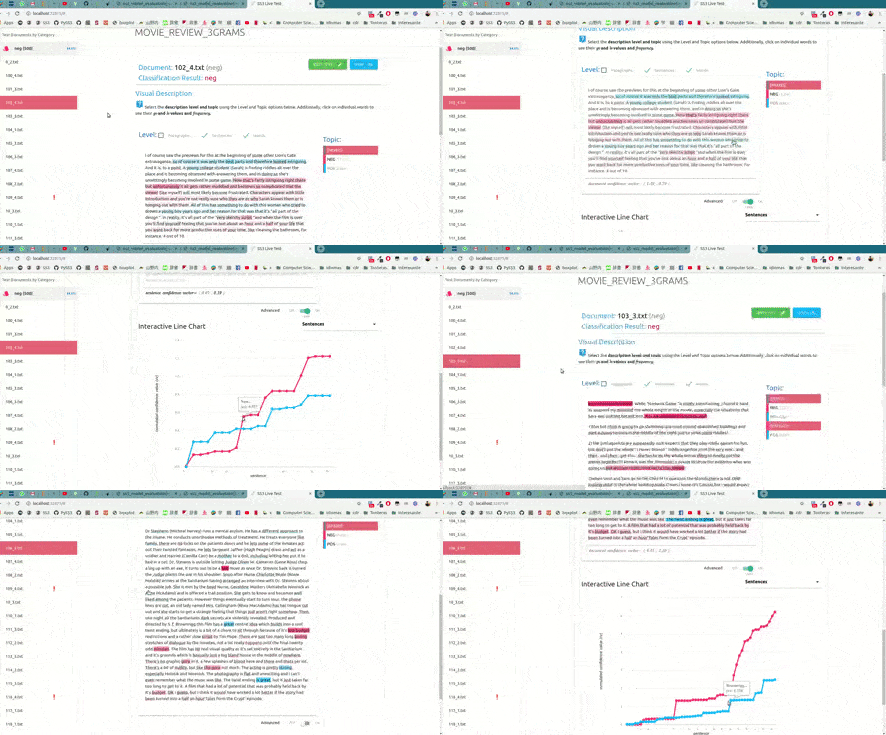
Try our **online live demos**:
- [Movie Review (Sentiment Analysis)](https://sergioburdisso.github.io/ss3/live_test_online/#30305)
- [Topic Categorization](https://sergioburdisso.github.io/ss3/live_test_online/#30303)
---
### :point_right: `Evaluation` class
Evaluate and optimize your model easily:
```python
from pyss3.util import Evaluation
best_s, best_l, best_p, _ = Evaluation.grid_search(
clf, x_train, y_train,
s=[0.2, 0.32, 0.44, 0.56, 0.68, 0.8],
l=[0.1, 0.48, 0.86, 1.24, 1.62, 2],
p=[0.5, 0.8, 1.1, 1.4, 1.7, 2],
k_fold=4
)
Evaluation.plot()
```
- Interactive 3D plots for hyperparameter evaluation
- Automatic history tracking of experiments
- Exportable HTML plots for sharing and reporting
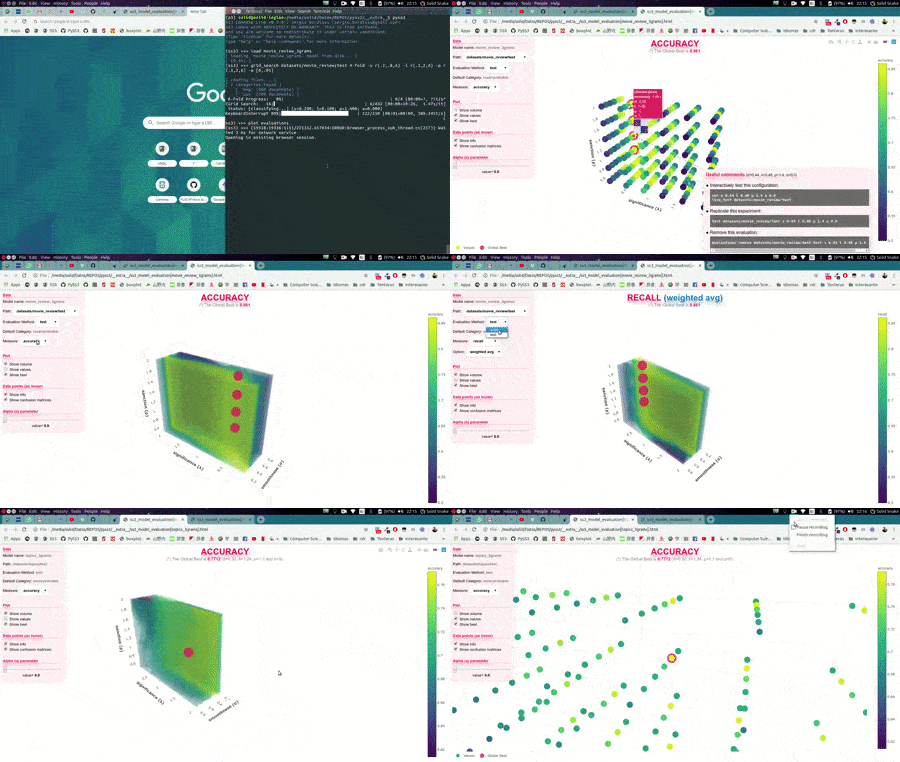
Explore example evaluation plots:
- [Sentiment Analysis (Movie Reviews)](https://pyss3.readthedocs.io/en/latest/_static/ss3_model_evaluation[movie_review_3grams].html)
- [Topic Categorization](https://pyss3.readthedocs.io/en/latest/_static/ss3_model_evaluation[topic_categorization_3grams].html)
---
## Getting Started :eyeglasses: :coffee:
### Installation
```bash
pip install pyss3
```
[Full tutorial and documentation](https://pyss3.readthedocs.io/en/latest/user_guide/getting-started.html)
---
## Contributing :sparkles::octocat::sparkles:
Any contributions are welcome! Code, bug reports, documentation, examples, or ideas – everything helps.
Use the "Edit" button on GitHub to propose changes directly, and follow [these guidelines](https://chris.beams.io/posts/git-commit/) for commit messages.
---
### Contributors :muscle::sunglasses::+1:
Thanks goes to these awesome people ([emoji key](https://allcontributors.org/docs/en/emoji-key)):
This project follows the [all-contributors](https://github.com/all-contributors/all-contributors) specification. Contributions of any kind welcome!
## Further Readings :scroll:
[Full documentation](https://pyss3.readthedocs.io)
[API documentation](https://pyss3.readthedocs.io/en/latest/api/)
[Paper preprint](https://arxiv.org/abs/1912.09322)


