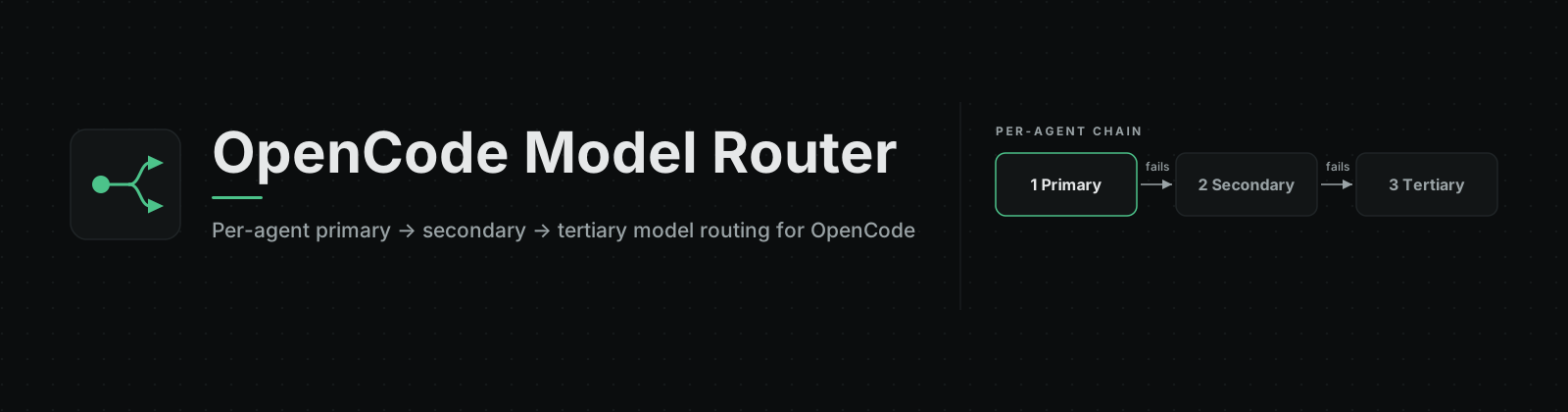
![OpenCode Model Router](assets/banner.svg) **English** | [Türkçe](README.tr.md) [![License: MIT](https://img.shields.io/badge/License-MIT-4cc38a.svg)](LICENSE) ![Platform: Windows](https://img.shields.io/badge/platform-Windows-0078D6.svg) ![Zero dependencies](https://img.shields.io/badge/dependencies-0-4cc38a.svg) ![OpenCode v2.x plugin](https://img.shields.io/badge/OpenCode-v2.x_plugin-6e7681.svg) ![Works with OMO-Slim](https://img.shields.io/badge/works%20with-oh--my--opencode--slim-4cc38a.svg) **Give every OpenCode agent a primary, secondary, and tertiary model — and a local web UI to manage them.** **First-class support for [oh-my-opencode-slim](https://github.com/alvinunreal/oh-my-opencode-slim) (OMO-Slim):** chains are written as native `agents..model` arrays, and OMO-Slim's own failover engine picks them up. **Built for OpenCode v2.x** — uses the OpenCode V2 plugin API. Stop editing config files by hand. Pick the models your setup actually has, chain them for failover, and apply everything with one click.
--- ## Why this exists OpenCode lets you set **one model per agent**. When that model hits a rate limit, gets overloaded, or goes down, the agent stops working — and fixing it means hand-editing JSON files that are easy to get wrong. **OpenCode Model Router** adds a missing layer on top of OpenCode: - 🧩 **3-slot model chains** — `primary → secondary → tertiary` per agent, with automatic fallback. - 🖥️ **Local web UI** — a clean, dark-themed control panel served by the plugin itself. No npm install, no build step, no cloud. - ✅ **Only real models** — the picker lists exactly the models that are enabled in your OpenCode **Settings → Models** screen. No phantom entries, no guesses. - 🔁 **Provider-aware refs** — the same model served by two different providers counts as two independent chain steps (`deepseek/deepseek-flash` ≠ `opencode-go/deepseek-v4.1-flash`). - 🛡️ **Safe apply** — every write takes a `.model-router.bak` backup first, then updates the right file for `oh-my-opencode-slim` or plain OpenCode. - 📦 **Zero dependencies** — one plugin file, built entirely on Bun/Node built-ins (`Bun.serve`, `bun:sqlite`, `node:fs`). ## How it works ![How it works](assets/how-it-works.svg) Every agent gets a chain. When the primary model can't answer, the next step in the chain takes over — so a single rate limit no longer breaks your whole session. Chains live in **one JSON state file**. The web UI reads and writes it; the plugin applies it to your real OpenCode configuration. ## Features | | | |---|---| | **Agent coverage** | Works with every agent OpenCode knows: `orchestrator`, `explorer`, `librarian`, `oracle`, `designer`, `fixer`, `observer`, `build`, `plan`, and any custom agents you define. | | **oh-my-opencode-slim first** | When the oh-my plugin is detected, chains are written as native `agents..model` arrays — oh-my's own failover engine picks them up. Otherwise chains are written to the host `opencode.jsonc`. | | **Variant preservation** | Models with reasoning variants (e.g. `max`, `xhigh`) keep their variant through save/apply cycles. | | **Visibility-aware picker** | The model list mirrors your desktop app's *visible/enabled* models — read directly from the settings store. | | **Terminal fallback** | Prefer keyboards? The `/model-router` command walks you through the same selection flow with interactive questions. | | **Safe by default** | Apply never invents new config keys, never touches preset blocks, and leaves a backup next to every file it edits. | ## Quick start ### Requirements - **OpenCode desktop app v2.x** — [opencode.ai](https://opencode.ai) (the plugin uses the OpenCode V2 plugin API) - **Windows** (the install script targets Windows paths; macOS/Linux work by copying files manually — see [Configuration](#configuration)) - Optional but recommended: **oh-my-opencode-slim** plugin ### Install ```powershell git clone https://github.com/sertdisk/OpenCode-Model-Router cd OpenCode-Model-Router powershell -ExecutionPolicy Bypass -File tools\install-dev.ps1 ``` The script copies two things: | From (repo) | To (OpenCode) | |---|---| | `src\model-router.js` | `~\.config\opencode\plugins\model-router.js` | | `web\` | `~\.config\opencode\model-router-web\` | **Restart OpenCode** to load the plugin. ### First run 1. Open **[http://127.0.0.1:37337](http://127.0.0.1:37337)** in your browser. The server starts automatically with OpenCode — no separate process. 2. Pick an agent from the left panel. 3. Click a slot (`1. Primary`, `2. Secondary`, `3. Tertiary`) and choose a model from the searchable drawer. 4. Hit **Save** — your chains are written to the state file. 5. Hit **Apply** — the plugin writes the chains to your real configuration (with backups) and reloads agents. > 💡 An agent with an empty primary slot is left exactly as it is — the router only touches what you configure. ## The web UI The interface is served locally at `127.0.0.1:37337` — it never leaves your machine. - **Agent list** — every agent, its current effective model, and 1-2-3 chain badges. - **Chain editor** — three slots with a visible "if it fails → next" flow, per-slot clear buttons, and unsaved-change tracking. - **Model drawer** — search across provider, model ID, and display name; grouped by provider; keyboard navigable (`↑ ↓`, `Enter`, `Esc`). - **Save / Apply** — Save snapshots your selection; Apply writes backups and updates your configuration. - **Status bar** — catalog size, visible model count, whether oh-my is detected, and the state file path. If the server can't be reached, the UI tells you plainly instead of showing stale data. ## Concepts ### Provider-qualified model references A model reference is a triple: **`{ providerID, id, variant? }`**. This matters because the same underlying model can be served by different providers with different quotas, speeds, and costs: ``` 1. Primary deepseek/deepseek-flash (your DeepSeek account) 2. Secondary opencode-go/deepseek-v4.1-flash (the same model, different provider) 3. Tertiary commandcode/xiaomi/mimo-v2.6-flash (a genuinely different model) ``` Chain steps are deduplicated by the full triple — `deepseek/deepseek-flash` and `opencode-go/deepseek-v4.1-flash` are distinct steps even though both are "DeepSeek Flash". ### Where chains are applied | Detected setup | Written where | Fallback handled by | |---|---|---| | **oh-my-opencode-slim** present | `oh-my-opencode-slim.json` → `agents..model` (array) | oh-my's native model-chain failover | | Plain OpenCode | `opencode.jsonc` → existing `agent..model` entries | Primary model only (host config) | Host config updates only touch agents **already present** in `opencode.jsonc` — the router never adds new keys behind your back. ## Configuration ### State file `~\.config\opencode\model-router.json` — the single source of truth for your chains: ```json { "version": 1, "updatedAt": "2026-10-05T19:54:16.363Z", "chains": { "orchestrator": { "primary": { "providerID": "deepseek", "id": "deepseek-flash", "variant": "max" }, "secondary": { "providerID": "commandcode", "id": "deepseek/deepseek-v4.1-flash" }, "tertiary": { "providerID": "opencode", "id": "mimo-v2.6-flash-free" } } } } ``` ### Environment overrides Useful for development and custom setups: | Variable | Default | |---|---| | `MODEL_ROUTER_PORT` | `37337` | | `MODEL_ROUTER_STATE_PATH` | `~\.config\opencode\model-router.json` | | `MODEL_ROUTER_OHMY_PATH` | `~\.config\opencode\oh-my-opencode-slim.json` | | `MODEL_ROUTER_HOST_CONFIG` | `~\.config\opencode\opencode.jsonc` | | `MODEL_ROUTER_WEB_DIR` | `~\.config\opencode\model-router-web` | ### Manual install (macOS / Linux) ```sh cp src/model-router.js ~/.config/opencode/plugins/model-router.js mkdir -p ~/.config/opencode/model-router-web cp web/* ~/.config/opencode/model-router-web/ ``` ## The `/model-router` command Prefer staying in the terminal? The plugin also registers a `/model-router` command inside OpenCode. It asks you 4 questions (agent → primary → secondary → tertiary) using OpenCode's native question UI and writes the same state file — no browser required. ## HTTP API The local server exposes a small JSON API (handy for scripting): | Endpoint | Description | |---|---| | `GET /api/state` | Agents, chains, visible models, catalog counts, detected setup | | `GET /api/models` | Visible models only (`?all=1` for the full catalog) | | `POST /api/save` | Merge chains into the state file — body: `{ "chains": { "": { "primary": "provider/id", "secondary": null, "tertiary": null } } }` | | `POST /api/apply` | Apply stored chains to real configs (with `.model-router.bak` backups) | | `GET /api/probe` | Runtime diagnostics | ## Development ```sh bun tools/dev-server.mjs ``` Runs the plugin standalone against a mock context (12 agents, sample models), executes a full self-test of `state → save → apply` on **temporary files only** — your real configuration is never touched — then keeps the server open for manual testing. Syntax check: ```sh node --check src/model-router.js node --check tools/dev-server.mjs ``` ## Troubleshooting | Symptom | Fix | |---|---| | Web UI unreachable | Is OpenCode running? The server starts with the plugin. Check `~\.config\opencode\model-router-server.log`. | | `EADDRINUSE` in the log | Another instance already owns port 37337 — close the duplicate or set `MODEL_ROUTER_PORT`. | | Picker shows no models | Make sure at least one provider is connected and models are enabled in OpenCode's settings. | | Apply says "skipped" | Some agents (e.g. `build`, `plan`) aren't oh-my agents — the router intentionally leaves them alone. | | Changes don't take effect | Restart OpenCode. oh-my reads its config at startup; host config changes apply after a reload/restart. | ## Status & roadmap - [x] Web UI with agent chain editor, provider-grouped model picker, save/apply - [x] Visibility-aware model catalog (mirrors Settings → Models) - [x] oh-my-opencode-slim integration with variant-preserving writes - [x] Backups on every apply - [ ] In-session retry steering (switch to the next chain step on failure, without restarting) - [ ] Cross-platform install script - [ ] npm package publishing ## Contributing Issues and pull requests are welcome — especially if you test the plugin against setups I don't have (Linux, plain OpenCode without oh-my, custom agents). If this saved you from a dead agent mid-session, **star the repo** ⭐ — it helps more people find it, and it tells me to keep building. Fork it and adapt it to your own workflow; the whole plugin is one readable file. ## License [MIT](LICENSE) — use it, fork it, ship it.


