# audit-ledger-mcp
**Connect Claude, Cursor, LangGraph, or your own agent to the [AI Audit Ledger](https://github.com/shahidh68/audit-ledger).** This MCP server gives an agent the tools to record, check, and list decisions in a tamper-evident log with one line of config.
It is built for teams that need a clear record of AI decisions: EU AI Act Article 12 logging, FCA SS1/23 model risk evidence, and GDPR data minimisation. Raw personal data is hashed locally before anything is sent, so the ledger only sees fingerprints.
[](https://www.npmjs.com/package/audit-ledger-mcp) [](./LICENSE) [](https://modelcontextprotocol.io)
> **The AI Audit Ledger family.** This MCP server writes decisions to the
> [ledger](https://github.com/shahidh68/audit-ledger), which proves what happened
> and whether the record was changed. The
> [**AI Decision Evidence Hub**](https://github.com/shahidh68/evidence-hub) sits
> above the ledger, read-only. It turns each lightweight decision record into an
> audit case file by showing what evidence is present, what is still missing, who
> owns each gap, and the current readiness score. Family:
> [audit-ledger](https://github.com/shahidh68/audit-ledger) · **audit-ledger-mcp** ·
> [evidence-hub](https://github.com/shahidh68/evidence-hub).
**[Try the live dashboard →](https://d2pfirb2397ixy.cloudfront.net/?demo=1)** · 30 synthetic decisions written via this MCP server, queryable and verifiable.
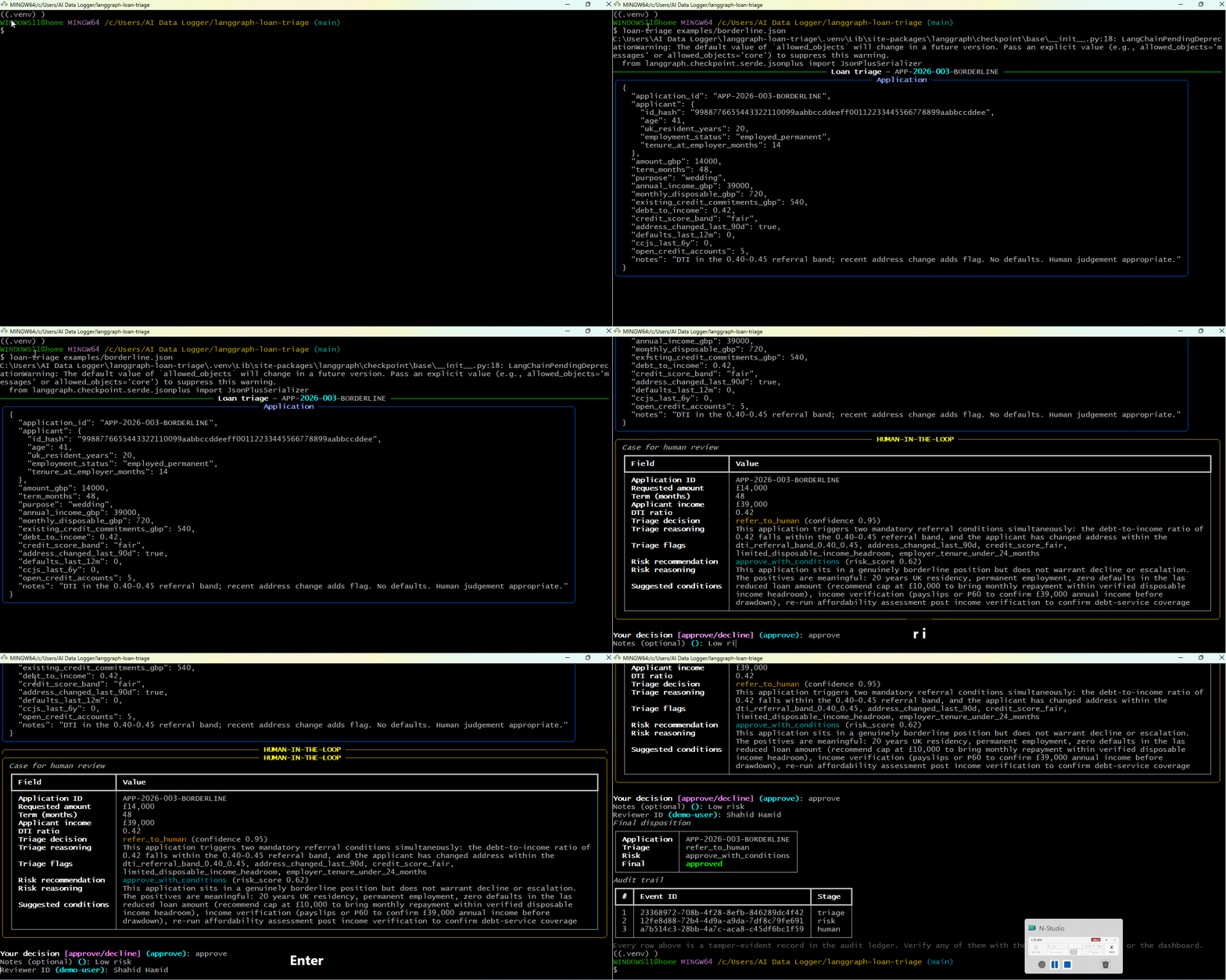
> A LangGraph workflow calls `record_decision` after each agent step. Three audit events written to the live ledger; every one independently verifiable.
---
## What it does
Exposes four tools to any MCP-compatible agent:
| Tool | What it does |
|---|---|
| `record_decision` | Log an AI decision. Hashes inputs locally, then writes through to the ledger. Returns an event ID. |
| `verify_decision` | Cross-check a stored record against the immutable S3 Object Lock copy. Returns `integrity_verified: true/false`. |
| `verify_completeness` | Detect deleted or missing records. Compares the ledger's per-tenant counter against the rows actually present and returns any sequence numbers that are gone. The answer to "can you prove the log is complete?" |
| `list_decisions` | Query recent decisions, optionally filtered by time window. Tenant-scoped by API key. |
Each call ends up as a regulator-grade audit record in your deployed ledger — DynamoDB for query, S3 Object Lock COMPLIANCE mode for the immutable copy, 7-year retention by default.
---
## Quick start — zero configuration
```bash
npx -y audit-ledger-mcp
```
That's it. With no environment variables, the server boots into **sandbox mode** and writes records to a shared public tenant on a hosted ledger. You can try every tool — `record_decision`, `verify_decision`, `verify_completeness`, `list_decisions` — without provisioning anything.
When sandbox mode is active, you'll see a banner on stderr:
```
[audit-ledger-mcp] ─────────────── SANDBOX MODE ───────────────
[audit-ledger-mcp] No AUDIT_API_URL configured.
[audit-ledger-mcp] Using the public sandbox at sandbox-public.
[audit-ledger-mcp] View: https://d2pfirb2397ixy.cloudfront.net
[audit-ledger-mcp] Do NOT write real personal data...
```
### Sandbox properties
| | |
|---|---|
| **Hosted by** | github.com/shahidh68/audit-ledger (same AWS deployment) |
| **Tenant** | `sandbox-public` (shared, public) |
| **Rate limit** | 100 requests/minute per IP |
| **Retention** | 7 years (records cannot be deleted) |
| **Audience** | Tyre-kickers, integration tests, framework demos |
| **NOT for** | Production data, customer PII, real compliance records |
### Wire it into Claude Desktop with zero config
```json
{
"mcpServers": {
"audit-ledger-sandbox": {
"command": "npx",
"args": ["-y", "audit-ledger-mcp"]
}
}
}
```
Restart Claude Desktop. The four tools appear in the MCP menu immediately. Try asking Claude to "record this decision: should X be approved?" and watch a record land in the sandbox dashboard.
---
## Production install
For real workloads, deploy your own audit ledger and point the MCP server at it:
```bash
npm install -g audit-ledger-mcp
```
Configure with the API URL plus your tenant keys (any of them being set switches off sandbox mode). `AUDIT_HMAC_KEY` is technically optional for backwards compatibility but strongly recommended — see the note above the value below:
```bash
export AUDIT_API_URL="https://.execute-api..amazonaws.com/prod"
export AUDIT_WRITE_KEY=""
export AUDIT_READ_KEY=""
# Strongly recommended. Tenant-held secret used to HMAC PII and prompts
# locally before sending. Generate once, store next to AUDIT_WRITE_KEY:
# node -e "console.log(require('crypto').randomBytes(32).toString('hex'))"
# If unset, the MCP falls back to plain SHA-256 and warns once (back-compat).
export AUDIT_HMAC_KEY=""
# Optional
export AUDIT_TIMEOUT_MS=5000 # default 5000
export AUDIT_RETRY_ATTEMPTS=3 # default 3
```
The full template lives in [`.env.example`](./.env.example).
---
## Wire it into an agent
### Claude Desktop
Edit your `claude_desktop_config.json` (macOS: `~/Library/Application Support/Claude/claude_desktop_config.json`, Windows: `%APPDATA%\Claude\claude_desktop_config.json`):
```json
{
"mcpServers": {
"audit-ledger": {
"command": "npx",
"args": ["-y", "audit-ledger-mcp"],
"env": {
"AUDIT_API_URL": "https://.execute-api..amazonaws.com/prod",
"AUDIT_WRITE_KEY": "",
"AUDIT_READ_KEY": "",
"AUDIT_HMAC_KEY": ""
}
}
}
}
```
`AUDIT_HMAC_KEY` is the tenant secret used to keyed-hash PII locally before any payload leaves the MCP server process. Generate it once with `node -e "console.log(require('crypto').randomBytes(32).toString('hex'))"` and store the result in the `env` block above. The MCP never transmits this value, only reads it.
Restart Claude Desktop. You'll see "audit-ledger" in the MCP tools menu. Ask Claude something like *"Record this decision: I declined the application because…"* and watch it call `record_decision` automatically.
### Cursor
In Cursor settings → MCP → add server:
```json
{
"mcpServers": {
"audit-ledger": {
"command": "npx",
"args": ["-y", "audit-ledger-mcp"],
"env": {
"AUDIT_API_URL": "https://.execute-api..amazonaws.com/prod",
"AUDIT_WRITE_KEY": "",
"AUDIT_READ_KEY": "",
"AUDIT_HMAC_KEY": ""
}
}
}
}
```
### LangGraph (Python)
Using [`langchain-mcp-adapters`](https://github.com/langchain-ai/langchain-mcp-adapters):
```python
from langchain_mcp_adapters.client import MultiServerMCPClient
from langgraph.prebuilt import create_react_agent
from langchain_anthropic import ChatAnthropic
import os
client = MultiServerMCPClient({
"audit-ledger": {
"command": "npx",
"args": ["-y", "audit-ledger-mcp"],
"transport": "stdio",
"env": {
"AUDIT_API_URL": os.environ["AUDIT_API_URL"],
"AUDIT_WRITE_KEY": os.environ["AUDIT_WRITE_KEY"],
"AUDIT_READ_KEY": os.environ["AUDIT_READ_KEY"],
"AUDIT_HMAC_KEY": os.environ["AUDIT_HMAC_KEY"],
},
}
})
tools = await client.get_tools()
agent = create_react_agent(
ChatAnthropic(model="claude-sonnet-4-7-20251022"),
tools,
)
# The agent can now call record_decision, verify_decision, verify_completeness, list_decisions
result = await agent.ainvoke({
"messages": [{"role": "user", "content": "Triage this loan application…"}]
})
```
### Custom client (raw MCP)
```bash
AUDIT_API_URL=... AUDIT_WRITE_KEY=... AUDIT_READ_KEY=... AUDIT_HMAC_KEY=... npx -y audit-ledger-mcp
```
The server speaks MCP over stdio. Send `initialize`, `tools/list`, and `tools/call` requests per the [MCP specification](https://modelcontextprotocol.io/specification).
---
## How a `record_decision` call flows
```
Agent audit-ledger-mcp AWS (your ledger)
| | |
|--- record_decision ----->| |
| raw_user_input | (hash locally — no PII over |
| raw_system_prompt | the wire from this point) |
| decision_output | |
| human_in_loop | |
| |--- HTTPS POST /audit/events --->|
| | {hashes + decision + |
| | x-api-key} |
| | |
| |<--- 202 Accepted ---------------|
| | { event_id, ... } |
|<--- event_id ------------| |
| recorded_at | |
| note | |
```
Storage on the AWS side happens asynchronously through SQS → Processor Lambda → DynamoDB + S3 Object Lock. See the [main repo's ARCHITECTURE.md](https://github.com/shahidh68/audit-ledger/blob/main/ARCHITECTURE.md) for the full path.
---
## Tool reference
### `record_decision`
Record an AI decision to the ledger.
| Parameter | Type | Required | Notes |
|---|---|---|---|
| `model_version` | string | Yes | e.g. `"claude-sonnet-4-7-20251022"` |
| `raw_system_prompt` | string | Yes | Hashed locally |
| `raw_user_input` | string | Yes | Hashed locally |
| `ai_decision_output` | object | Yes | Stored verbatim — must not contain raw PII |
| `human_in_loop` | boolean | Yes | Critical for EU AI Act Article 14 |
| `event_id` | uuid v4 | No | Auto-generated if omitted |
| `timestamp` | ISO 8601 | No | Defaults to now |
### `verify_decision`
Tamper-check a stored record.
| Parameter | Type | Required | Notes |
|---|---|---|---|
| `event_id` | uuid v4 | Yes | The ID of the record to verify |
Returns the DynamoDB record, the S3 record, and `integrity_verified: true/false`.
### `verify_completeness`
Detect missing records. Sister tool to `verify_decision`: that one proves a record that exists has not been altered; this one proves no records have been deleted.
| Parameter | Type | Required | Notes |
|---|---|---|---|
| `from` | integer | No | Inclusive lower bound on sequence_no. Defaults to 1. |
| `to` | integer | No | Inclusive upper bound on sequence_no. Defaults to the tenant's current counter. |
| `tenant_id` | string | No | Required only with the admin read key; ignored otherwise. |
Returns the requested range, the expected vs found count, the list of missing sequence numbers, and a human-readable note.
```json
{
"tenant_id": "acme-prod",
"range": { "from": 1, "to": 142 },
"expected_count": 142,
"found_count": 140,
"missing": [47, 91],
"note": "Found 2 missing sequence number(s) in range. Each gap represents a deleted, lost, or never-written record. Cross-check against burned_sequence log entries before treating as a deletion."
}
```
### `list_decisions`
List recent decisions for the calling tenant.
| Parameter | Type | Required | Notes |
|---|---|---|---|
| `from` | ISO 8601 | No | Defaults to 7 days ago |
| `to` | ISO 8601 | No | Defaults to now |
| `limit` | integer 1–500 | No | Defaults to 100 |
---
## Security
- **PII hashing happens in this process, not in the ledger.** HMAC-SHA256 over UTF-8, keyed off the `AUDIT_HMAC_KEY` you set in your environment. The key never leaves your process; only the 64-char hex digest is sent. Plain SHA-256 of low-entropy values (names, emails) is brute-forceable in seconds and under ICO/EDPB guidance still counts as personal data, which is why the keyed version is the default for new installs. For backwards compatibility, if `AUDIT_HMAC_KEY` is unset the MCP falls back to plain SHA-256 and logs a one-time deprecation warning on stderr; existing setups keep working unchanged.
- **API keys are never logged.** They come from environment variables, are passed in the `x-api-key` header, and are never echoed back to the agent or written to disk.
- **Two key namespaces.** Write keys cannot read; read keys cannot write. A leaked write key cannot exfiltrate data; a leaked read key cannot plant fake records.
- **Errors are propagated with HTTP status passthrough.** Rate limit, invalid key, and validation errors surface to the agent so it can react appropriately rather than retry blindly.
---
## What this is not
- **Not legal advice.** This is infrastructure that produces audit evidence. Whether that evidence satisfies any specific regulatory obligation is a question for your legal team.
- **Not a substitute for a model risk audit.** It records what the AI did, not whether it was right.
- **Not a bias or fairness testing tool.** It is the audit layer underneath whatever testing you already do.
---
## Companion: AI Decision Evidence Hub
This MCP server **writes** decisions to the ledger — the immutable record of *what
happened*. The **[AI Decision Evidence Hub](https://github.com/shahidh68/evidence-hub)**
is the read-only workbench above the ledger. It answers the next question an
auditor asks: *the decision is recorded, but is the evidence complete enough to
review?*
For every recorded decision it produces:
- an **audit-readiness score (0–100)** across nine evidence categories (model, data,
policy, human review, monitoring, prompt, integrity, retention, decision);
- exactly **what evidence is present vs missing**, and **who owns** each expected
gap;
- a per-decision **audit pack** that can be printed, saved as PDF, or downloaded
as JSON;
- a dashboard (cross-linked with the ledger's), plus a manifest-based resolver that
auto-fills static evidence.
Open gaps are normal. The ledger keeps the decision record small and
tamper-evident; Evidence Hub shows the follow-up evidence needed to make that
decision audit-ready. It reads the ledger over its API and never modifies a
record. Serverless on AWS (Lambda + DynamoDB). See its
[Customer Guide](https://github.com/shahidh68/evidence-hub/blob/master/docs/CUSTOMER-GUIDE.md)
and [Admin Runbook](https://github.com/shahidh68/evidence-hub/blob/master/docs/ADMIN-RUNBOOK.md).
**The family:** [audit-ledger](https://github.com/shahidh68/audit-ledger) (what happened) ·
**audit-ledger-mcp** (this server — how agents write decisions) ·
[evidence-hub](https://github.com/shahidh68/evidence-hub) (audit-readiness).
---
## Development
```bash
git clone https://github.com/shahidh68/audit-ledger-mcp.git
cd audit-ledger-mcp
npm install
npm run build
npm test
```
The server is TypeScript on Node 20+, ESM, stdio transport, using `@modelcontextprotocol/sdk`.
---
## Related
- **[shahidh68/audit-ledger](https://github.com/shahidh68/audit-ledger)** — the AWS infrastructure this server talks to. CDK stack, Python and Node SDKs, compliance dashboard, full architecture documentation.
- **[shahidh68/evidence-hub](https://github.com/shahidh68/evidence-hub)** — the audit workbench above the ledger. It scores each decision's evidence, treats open gaps as expected follow-up work, and generates printable/downloadable audit packs. ([Customer Guide](https://github.com/shahidh68/evidence-hub/blob/master/docs/CUSTOMER-GUIDE.md) · [Admin Runbook](https://github.com/shahidh68/evidence-hub/blob/master/docs/ADMIN-RUNBOOK.md))
---
## License
Apache License 2.0 — see [LICENSE](./LICENSE).
The patent grant is intentional. Compliance infrastructure sits adjacent to enterprise legal review and the explicit grant matters there.
---
## Author
Built by [Shahid](https://github.com/shahidh68). Available for Principal AI Engineering and Head of AI Engineering roles, and fractional advisory engagements, in UK regulated fintech.