---
title: AI Governance Watch
description: "A continuously-watched reference library of AI governance standards — NIST AI RMF, EU AI Act, ISO/IEC 42001 & 23894, DORA, Swiss DSG/EDÖB, the Council of Europe AI Convention (CETS 225), CSA Agentic Profile, Berkeley CLTC — by Siegfried-Thor Bolz, Enterprise AEMaaCS architect & AI risk auditor near Munich, Germany."
keywords: "AI Risk Auditor, AI Governance, AI Compliance, CMS AI Audit, AI audit for enterprise CMS, EU AI Act, NIST AI RMF, ISO/IEC 42001, ISO/IEC 27001, ISO/IEC 23894, DORA, OWASP LLM & Agentic Top 10, MITRE ATLAS, CSA Agentic Profile, Berkeley CLTC, Adobe Experience Manager, AEMaaCS, AEM Exit, Headless CMS, RAG, Vertex AI, Cybersecurity, Siegfried-Thor Bolz"
---
# AI Governance Watch
Last updated:
A continuously-watched, **PR-gated reference library** of the AI governance
standards an external AI risk auditor has to keep current. Each standard has
its own page with a short, audit-oriented summary, a plain-language explainer,
the clauses you would cite, and a rolling log of what changed. Every page traces
back to a verifiable observation of a public source at a documented point in time.
> Built and maintained by **[Siegfried-Thor Bolz](https://www.siegfried-bolz.de)** —
> Enterprise **Adobe Experience Manager (AEM / AEMaaCS) architect & developer** and
> **AI risk auditor**, near Munich, Germany. *"Most compliance auditors don't read
> code. I do."*
> [Website](https://www.siegfried-bolz.de) ·
> [LinkedIn](https://www.linkedin.com/in/sbolz/) ·
> [GitHub](https://github.com/siegfriedbolz/ai-governance-watch)
!!! tip "How to use this library"
New here? Start with **[Standards at a glance](at-a-glance.md)** to compare
all eleven, or browse the **[glossary](glossary.md)**. Use the **search** (top
of the page, or press `/`) to look across every standard at once. Open a
standard to read its summary and audit anchors, and check the
[changelog](changelog.md) to see what changed recently.
## Watched standards
### Frameworks & management systems
- **[NIST AI RMF](reference_nist_ai_rmf.md)**
---
The GOVERN / MAP / MEASURE / MANAGE framework, the GenAI Profile (600-1),
and the Playbook. Voluntary, widely adopted, the common backbone.
- **[ISO/IEC 42001](reference_iso_42001.md)**
---
The first certifiable AI Management System (AIMS) standard, plus the
surrounding 42000-series (incl. 42006 for certification bodies).
- **[ISO/IEC 23894](reference_iso_23894.md)**
---
Guidance on AI risk management — the "how" companion to ISO/IEC 42001 and
ISO 31000.
### Regulation & law
- **[EU AI Act](reference_eu_ai_act.md)**
---
Regulation (EU) 2024/1689 — risk tiers, high-risk obligations, GPAI rules,
and the Digital Omnibus (Reg. (EU) 2026/1744, in force since 27 July 2026)
that moved the high-risk deadlines to 2027/28.
- **[UK AI White Paper](reference_uk_ai_white_paper.md)**
---
The UK's principles-based, sector-led "pro-innovation" approach (2023 White
Paper + 2024 response), now evolving toward regulatory sandboxes.
- **[DORA](reference_dora.md)**
---
The EU Digital Operational Resilience Act — ICT and third-party resilience
for finance; relevant to AI vendor and outage risk.
- **[Switzerland — AI & data protection](reference_ch_ai_data_protection.md)**
---
No Swiss AI act yet: the technology-neutral DSG applied to AI by the EDÖB,
the Federal Council's sectoral decision (2025), and the ratification path
for the Council of Europe AI Convention — consultation draft due end of 2026.
- **[Council of Europe AI Convention (CETS 225)](reference_coe_ai_convention.md)**
---
The first binding international AI treaty (2024): obligations on states,
not companies; who has signed and ratified, why it is not yet in force, and
how the EU, Switzerland and the UK implement it.
### Agentic, thresholds & landscape
- **[CSA Agentic Profile](reference_csa_agentic_profile.md)**
---
Cloud Security Alliance's agentic extension of the NIST AI RMF, plus the
AI Controls Matrix and catastrophic-risk work.
- **[Berkeley CLTC](reference_berkeley_cltc.md)**
---
UC Berkeley's intolerable-risk and AI-enabled cyber-threat thresholds —
the "red lines" layer of AI governance.
- **[NIST ITL Standards Landscape](reference_nist_itl_landscape.md)**
---
NIST ITL's map of the global AI standards landscape — the meta-source that
flags new standards worth tracking.
## How this library stays current
A single scheduled watch routine checks each source on its cadence. When it
detects a substantive change, it opens a **pull request** with the proposed
update, the before/after snapshot hashes, and an auditor note. **Nothing lands
on a page without a human reviewing that diff** — the same provenance
discipline an external auditor must demonstrate to a client. See the
[changelog](changelog.md) for the running history.
About the author · professional services — the reference library above stands on its own
## About the author — work with me

This library is built and maintained by **Siegfried-Thor Bolz** — an Enterprise
**Adobe Experience Manager (AEM / AEMaaCS) architect & developer** and **AI risk
auditor** near Munich, Germany, and Managing Director of CQ-Factory GmbH (Adobe
Solution Partner, Silver). The red thread of my work: *from a rock-solid CMS to a
governed, secure, end-to-end AI integration.* I can both **build** AI platforms
and **audit** them against regulation — a rare combination. This watch system is
a live demonstration of that discipline: it's how I keep a regulatory map current
against a fast-moving target, with a defensible, provenance-backed trail.
??? note "How I can help — services, credentials & contact"
- **AI governance, compliance & risk auditing** — assessing AI systems against
the EU AI Act, NIST AI RMF, ISO/IEC 42001 & 27001, the OWASP LLM & Agentic
Top 10 and MITRE ATLAS; risk classification, model cards, AI-SBOM, a living
risk register and control testing along Three Lines of Defence.
- **Active monitoring** — standing up watch pipelines like this one so your
compliance map never silently drifts out of date.
- **Secure, cloud-ready AEM & AI engineering** — AEM / AEMaaCS architecture,
migrations and the *AEM Exit* to headless, plus RAG / agentic AI on Google
Cloud — with web-application security and clean code at the core.
See my applied guide: **[AI audit for enterprise CMS](ai-audit-for-cms.md)**.
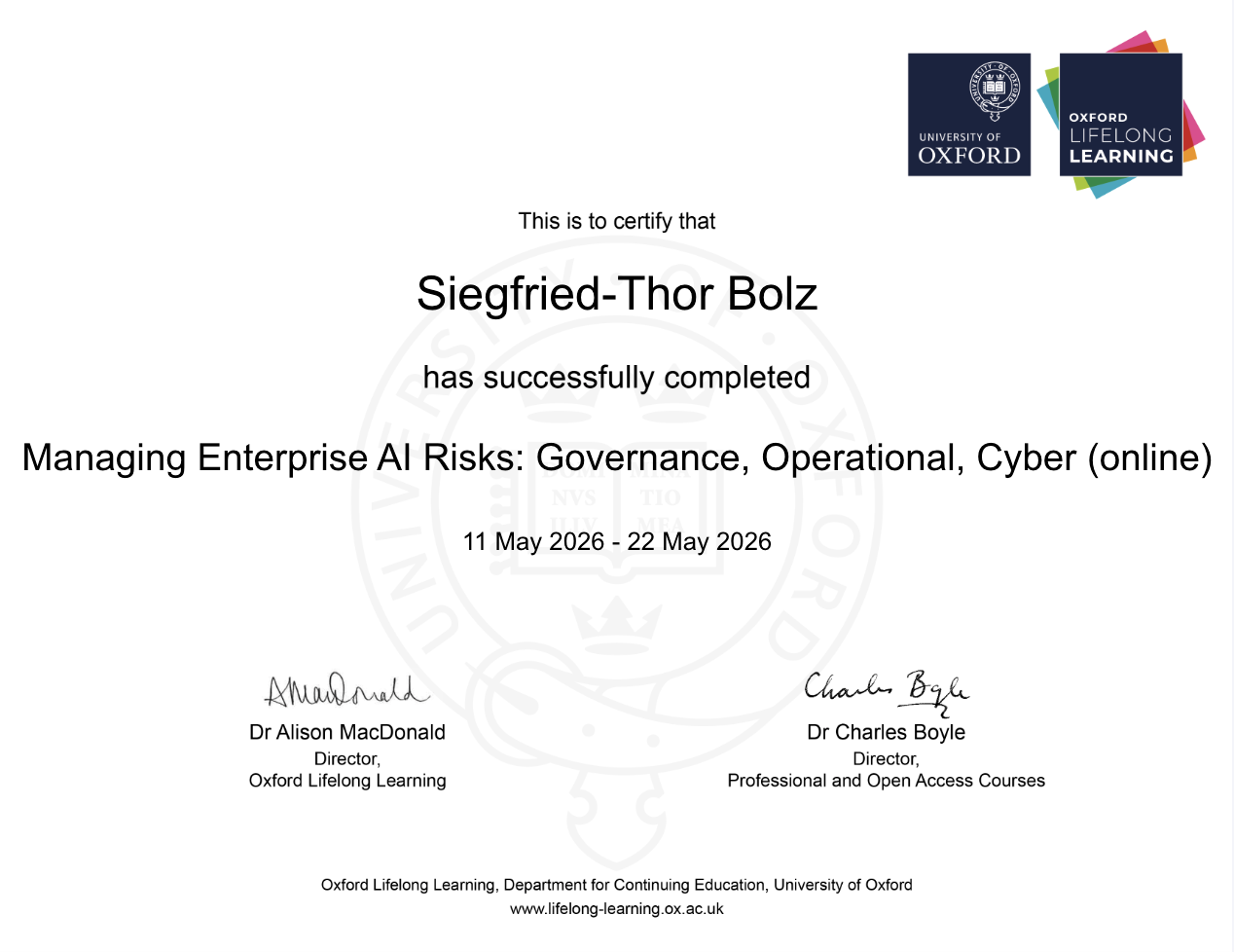
**Credentials** — University of Oxford, *"Managing Enterprise AI Risks"* (2026)
· [Verify ↗](https://certificates.conted.ox.ac.uk/5d483a65-dba2-47a2-92b0-8acfe0dcfd3a)
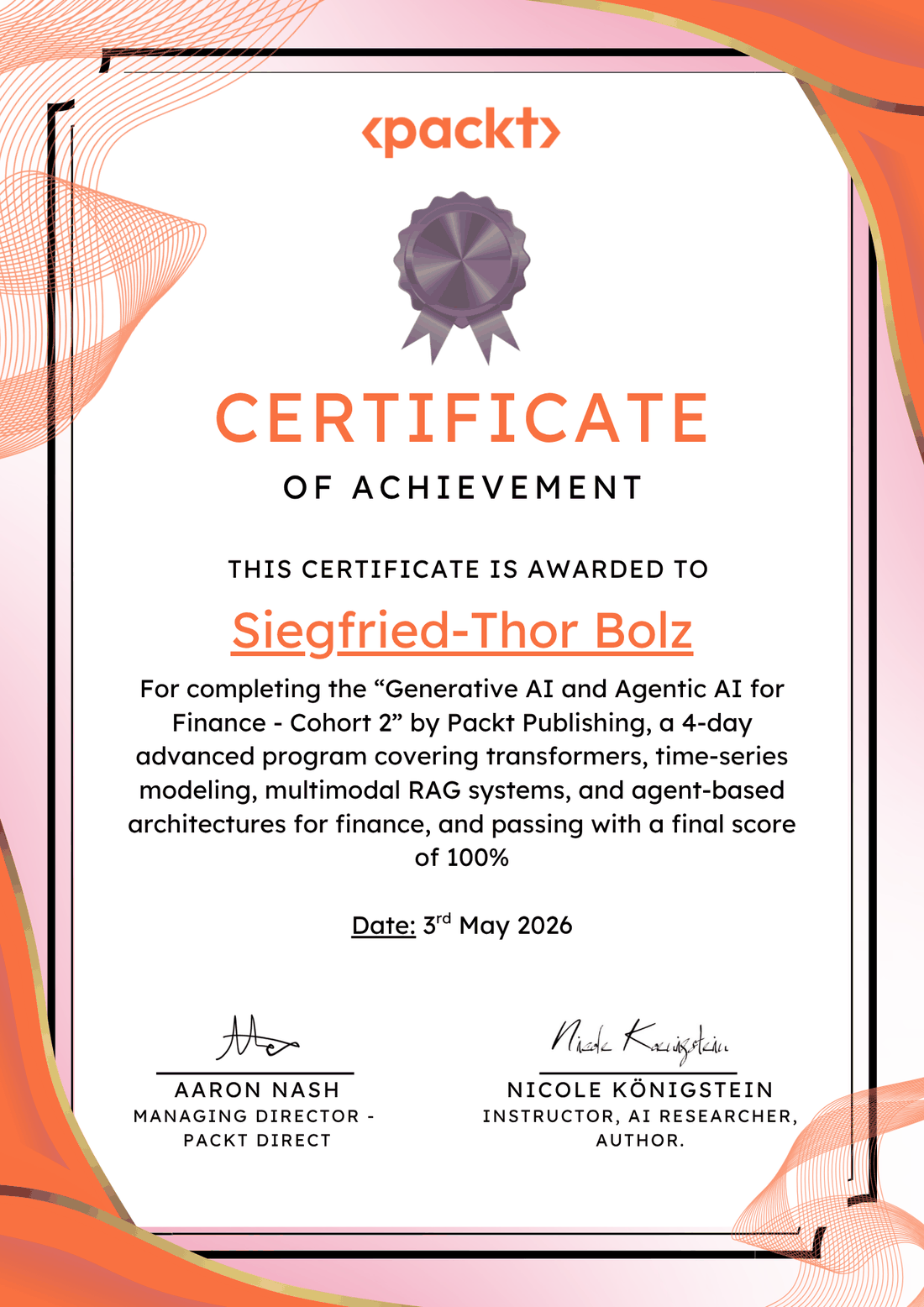
· Packt, *"Generative AI & Agentic AI for Finance"*, Cohort 2 — **100%** (2026)
· Adobe Solution Partner — Silver (via CQ-Factory GmbH).
{ .sb-cert }
{ .sb-cert }
**Let's talk:** [siegfried-bolz.de](https://www.siegfried-bolz.de) · [LinkedIn](https://www.linkedin.com/in/sbolz/) · [info@siegfried-bolz.de](mailto:info@siegfried-bolz.de) · [GitHub](https://github.com/siegfriedbolz/ai-governance-watch)
## Acknowledgement
This project is the operational realisation of **Phase 5 — Active Monitoring**
from **[Ajit Jaokar's](https://www.linkedin.com/in/ajitjaokar/)** concept of an *"Enterprise (collective) Second Brain using
Claude Skills"*: the idea that a plain-Markdown knowledge base becomes an
*executable* second brain when skills **reason over** what you know rather than
merely store it. Ajit (University of Oxford) was my tutor on the *Managing
Enterprise AI Risks* programme, and his framing is the intellectual backbone of
this watch system. Read the original:
[*The Enterprise (collective) Second Brain using Claude Skills*](https://www.linkedin.com/pulse/enterprise-collective-second-brain-using-claude-skills-ajit-jaokar-ykode/)
— Ajit Jaokar, LinkedIn (May 2026).
!!! note "Scope, licence & disclaimer"
Each page has an **"In plain language"** explainer written in our own words —
these are explanations, **not** the official or normative text, and **not
legal advice**. We track **metadata, structure, and short quoted anchors**,
never the full text. How much may be reproduced follows each source's
licence, shown in every page's "Provenance & licence" box (e.g. NIST =
public domain; EU/UK = reuse with attribution; CSA = CC BY-NC-SA; ISO =
metadata only). Every page links back to its primary source.