# Wiki and Memory
**On day one, it catches up on your past. Every day after, it keeps up with
you.**
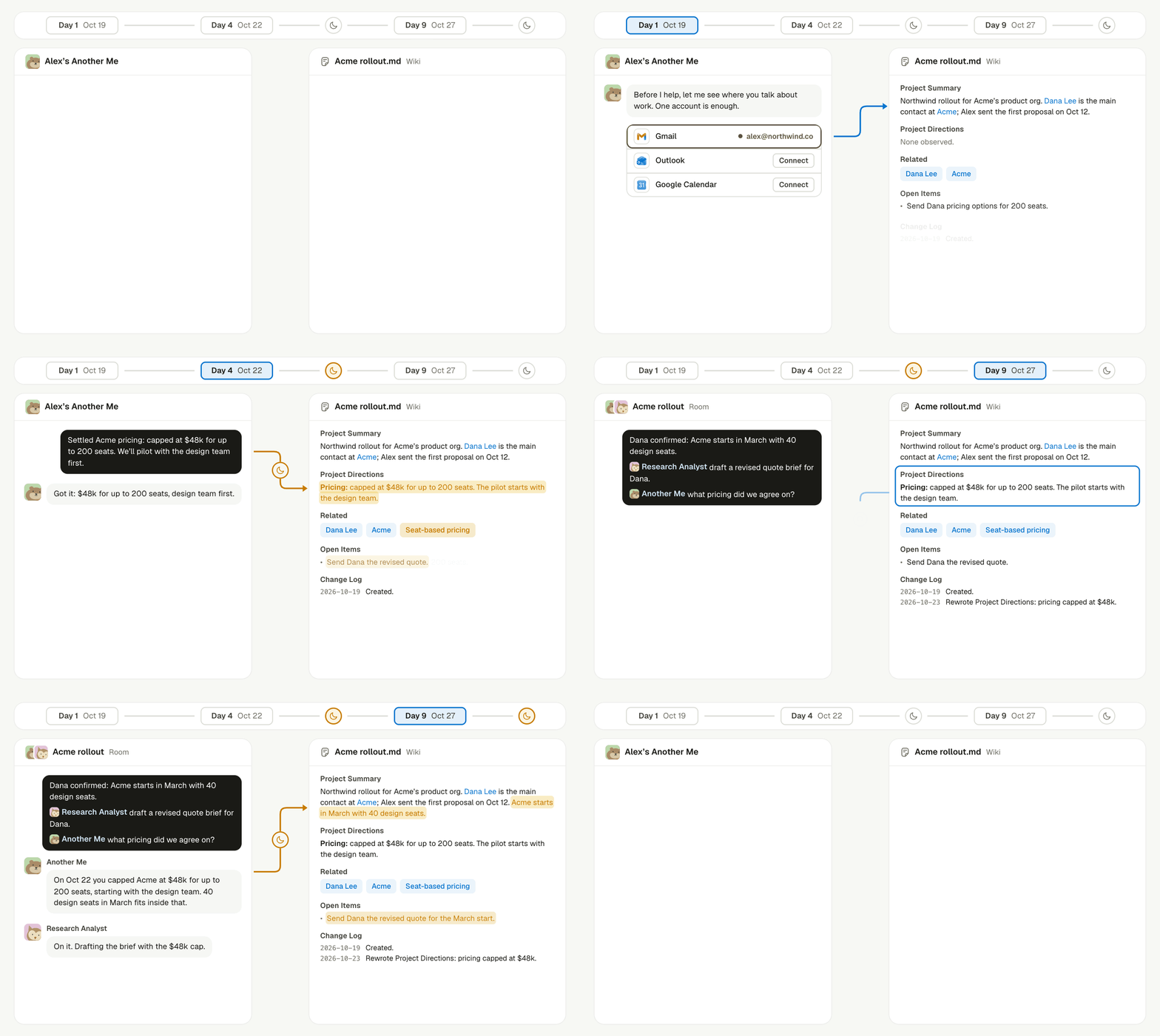
Connect your inbox, and Another Me reads back through the last few months to
start a wiki of your work: the people, the clients, the projects. From then on,
every conversation with your agents flows back in each night, and when a fact
changes, the page is rewritten and the change is logged. Tell it something
once, in any chat, and every agent working for you can find it later, in any
Room.
Linger remembers at two levels: a personal wiki about your work, which
every agent working for you can search, and a memory that each agent keeps of
its own conversations.
## Personal wiki
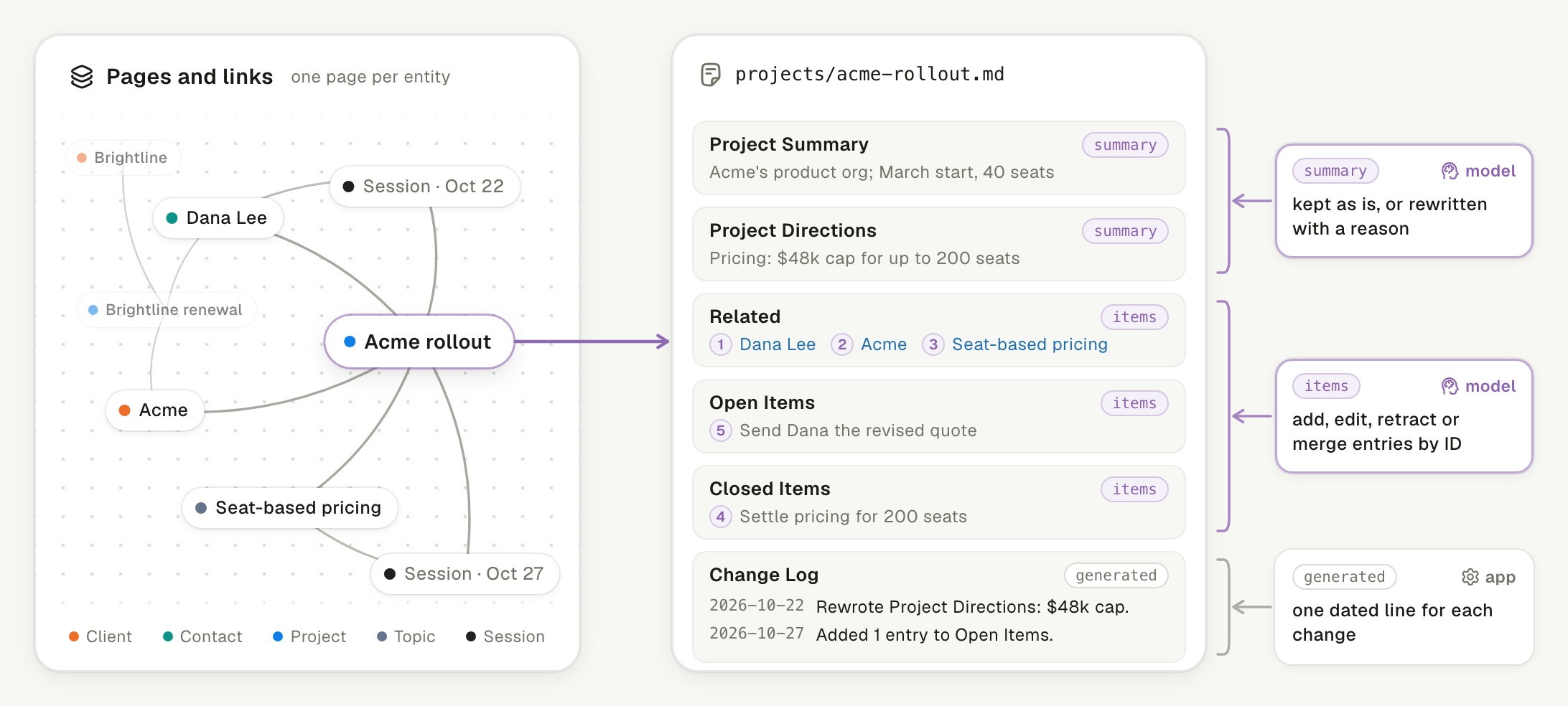
The wiki is a set of typed Markdown pages. Clients, contacts, projects and
topics each get one page per real-world entity, so every fact has one home, and
each meeting gets a Session page that links to the entities it touched.
| Page | What it remembers |
| ------- | --------------------------------------------------------------------------------------- |
| Client | Who they are, how they work, needs and constraints, open and closed items, past contact |
| Contact | Role, how you know them, how they work, what they care about, past contact |
| Project | Where it stands, its directions, open and closed items |
| Topic | An overview and your current understanding |
| Session | One meeting: summary, topics, decisions, action items, and patterns in how you work |
A model reads each new conversation or file and proposes changes section by
section, and the app checks every change against the page it replaces. A summary
section is either kept as it is or rewritten with a stated reason. A list
section changes one entry at a time, by an ID the app assigns, so entries the
update does not mention stay exactly as they were. Facts cite the message or
file version they came from, and a rewrite must keep every source the old text
cited or say why it dropped one. The Change Log is written by the app, not the
model: one dated line for each rewrite, edit, retraction or merge.
A summary section holds up to 3,000 characters. A list holds 20 entries of
up to 500 characters; past that, the model merges the oldest into one dated
entry. The Change Log keeps its newest 20 lines.
## Search
Agents search with the `teamhub knowledge` command, from any Room. The server
decides whose knowledge it is from the agent's registration, so an agent can
only search the knowledge of the person it works for. One search returns two
separately ranked lists: the wiki pages and Daily/Weekly reports for overviews,
and the original messages, transcripts, documents and emails for exact details.
The top entries of each list come with the text around their match. An agent
can search one list on its own, and must search the originals before it says
something was never recorded.
| Step | Wiki pages | Originals |
| -------- | ----------------------------------------------------------------------------------- | -------------------------------------------------------------- |
| Index | One chunk per page, or per section for long pages; headings weigh most in keywords | Chunks of each conversation, transcript, document or email |
| Keywords | PostgreSQL full-text search, once for the query and once for each alternate wording | Same |
| Time | Session pages: matches from the period asked about; other pages take no time vote | Matches from the period or recorded then; nearer a day |
| Fusion | Reciprocal rank fusion of all lists | Same |
| Extra | | A separate list of facts from chats, recordings, notes, emails |
| Result | Its own ranked list; the top entries carry the text near the match | Its own ranked list; the same |
Agents pass up to six alternate wordings, such as synonyms and
translations, so a Chinese question can find an English page. Search uses
keywords only, with no embedding or reranker model. A time the question names
only ranks matches higher and never hides others: when something happened,
when it was recorded, or, among close matches, what was said nearest before a
day. Another Me also has the
wiki as read-only files in its workspace.
When an answer needs more than the knowledge search, such as a project's state
across Slack and the calendar, who is free next week, what is still owed, or a
plan built on the person's constraints, Another Me and General agents follow
the personal context method in their instructions. It searches knowledge first
and then only the live sources the answer still needs: the calendar, Tracking Items, Slack, live
mail, Drive, Notion, GitHub or the web. Anything memory says that can change,
such as a date, a role or an amount, is checked against its latest source before
the answer states it as current.
## Agent memory
Each agent also learns from its own conversations, separately from your wiki.
Its memory crosses Rooms but not agents: what an agent learns in one Room it can
use in the next, and no other agent sees it. It keeps your preferences, proven
procedures, decisions, facts about the environment and lessons from failures,
and leaves out progress notes, generic advice, secrets and guesses.
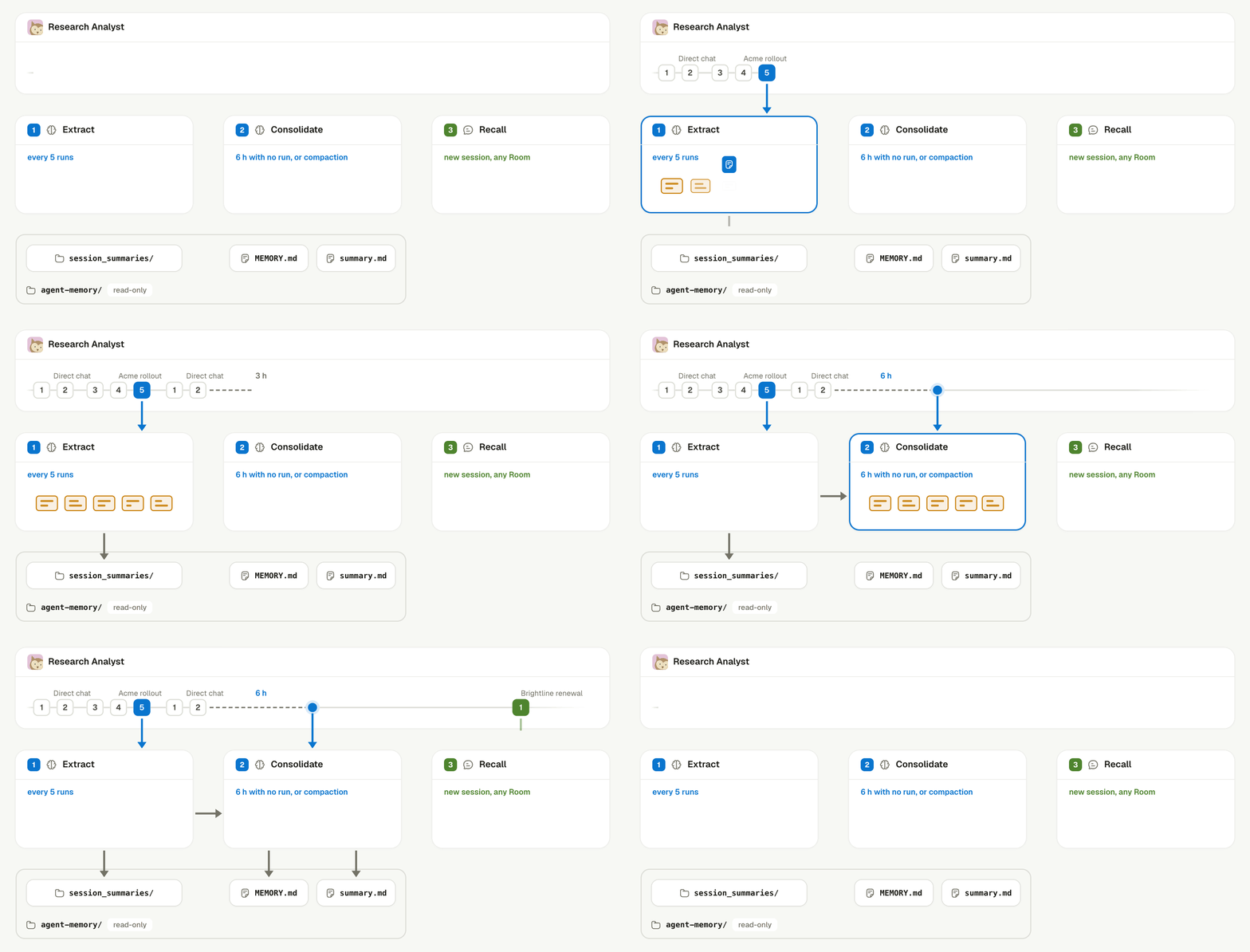
| Stage | When | What happens |
| ----------- | -------------------------------------------------------------- | ---------------------------------------------------------------------------- |
| Extract | Every 5 successful runs of the agent | New messages and tool calls become a session summary and candidate memories |
| Consolidate | After 6 hours with no run, or when the context is compacted | Candidates merge into the memory; duplicates and disproven facts are removed |
| Recall | First message of a new session, first message after compaction | The summary index is attached to that message; the rest is read on demand |
Extraction and consolidation are model calls without tools on the agent's own
computer, with its Codex or Claude Code and the user's subscription. Extraction
waits for five runs because it shares the model with the conversation it reads.
Consolidation rewrites the whole memory, so it waits until the agent is idle.
The result is a read-only `agent-memory/` folder in every workspace of that
agent: `summary.md` as a short index, `MEMORY.md` organized by topic, and one
file per conversation under `session_summaries/`. The summary
travels as a hidden note on a message, never in the system prompt, so a new
memory does not invalidate the prompt cache or restart the agent.
Only Room conversations are read; delegated Tasks and document work are
not. Waiting candidates are merged early once they reach 64 KB or 30
conversations.