/`, local only. Ten a day, nine dead: in the repo that's just garbage. Promotion requires **both** "walked twice (at least once successfully)" and "can state the counterfactual"; even then the system only *proposes* — commit and push stay a human gate.
- **The panel and the agent read the same data** — render-only means the agent reads nothing. Node states (`refuted` / `trusted` / `stale` / `candidate`) are derived from run records, never authored; there is no run-record sink yet, so every node is `candidate` — which is exactly why that beta label has to be on the surface.
Off by default (`actionPipelineEnabled`). Design trade-offs and pitfalls: [docs/WORKFLOWS.md](dsh-mneme/docs/WORKFLOWS.md) (Chinese).
## Screenshots
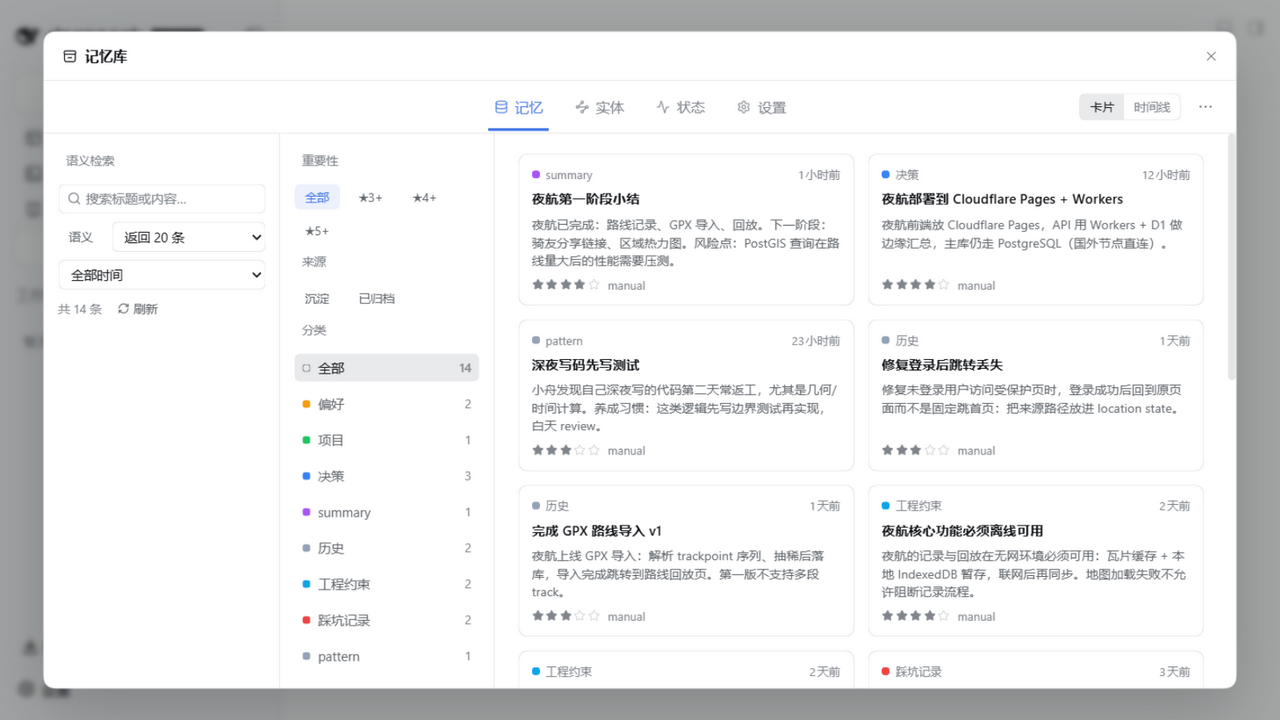
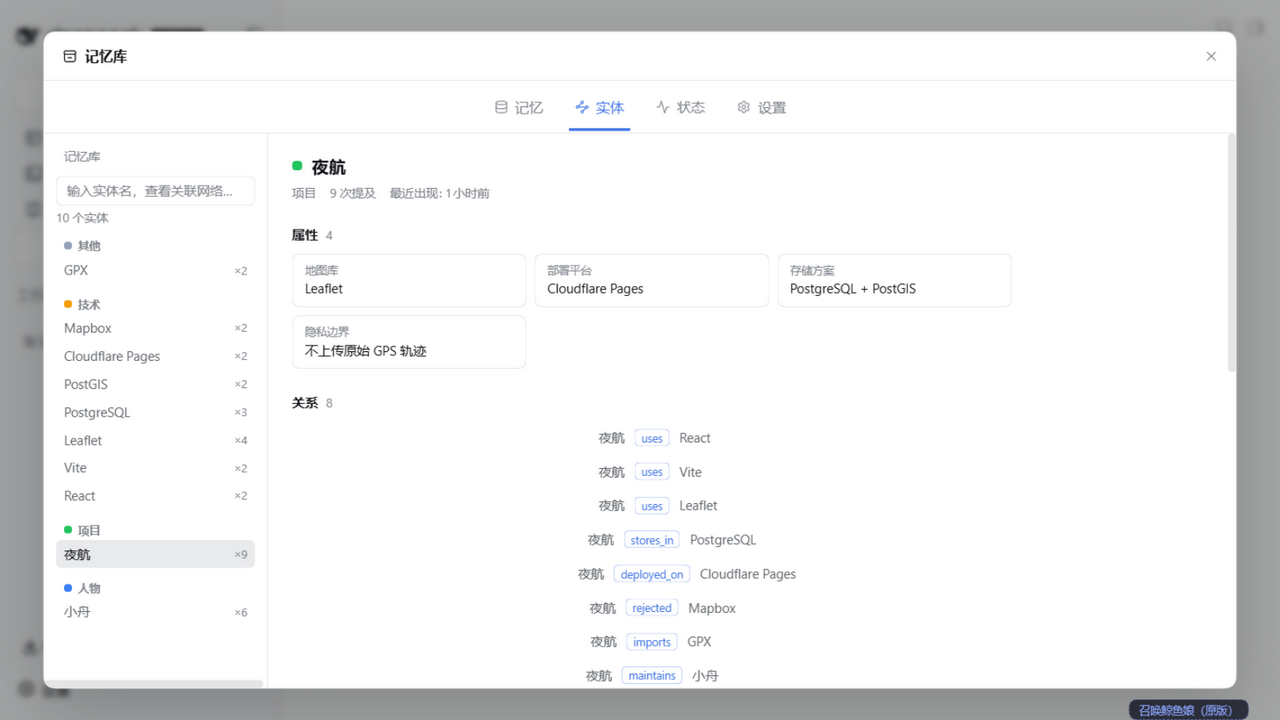
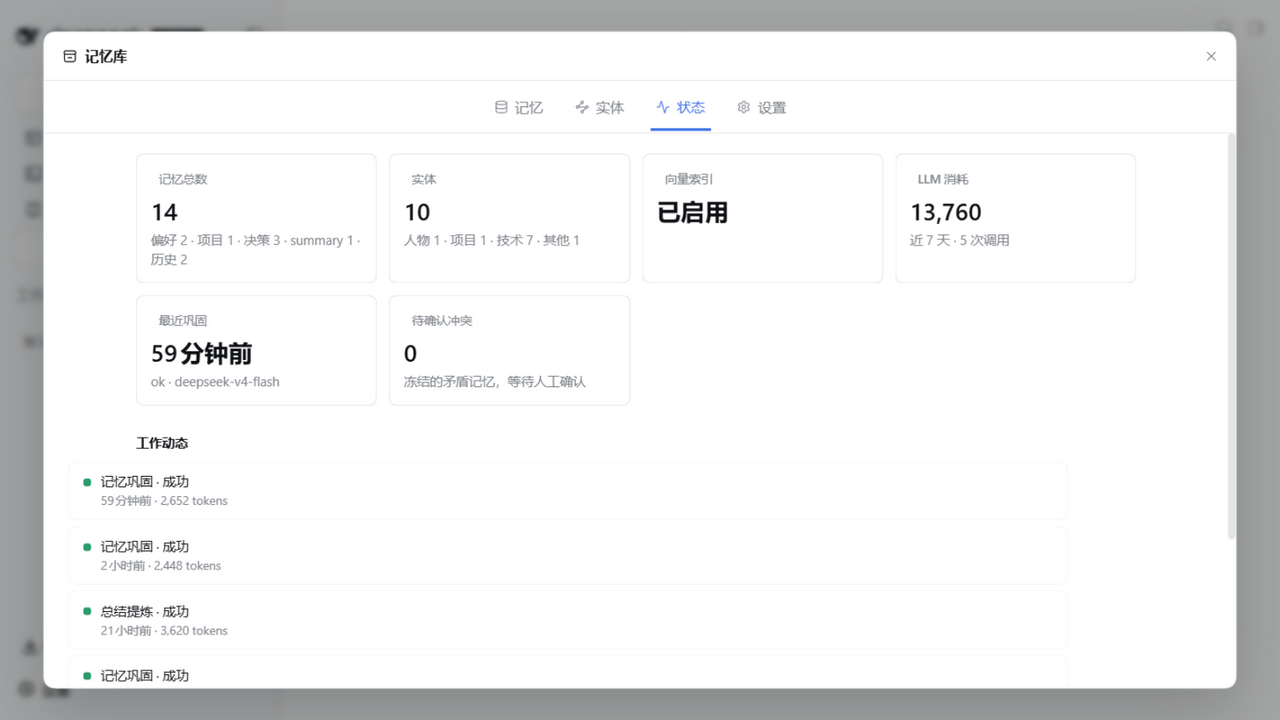
> The panel is bilingual and follows your DSH interface language. English shots below; see the [Chinese](#中文) section for the localized UI.
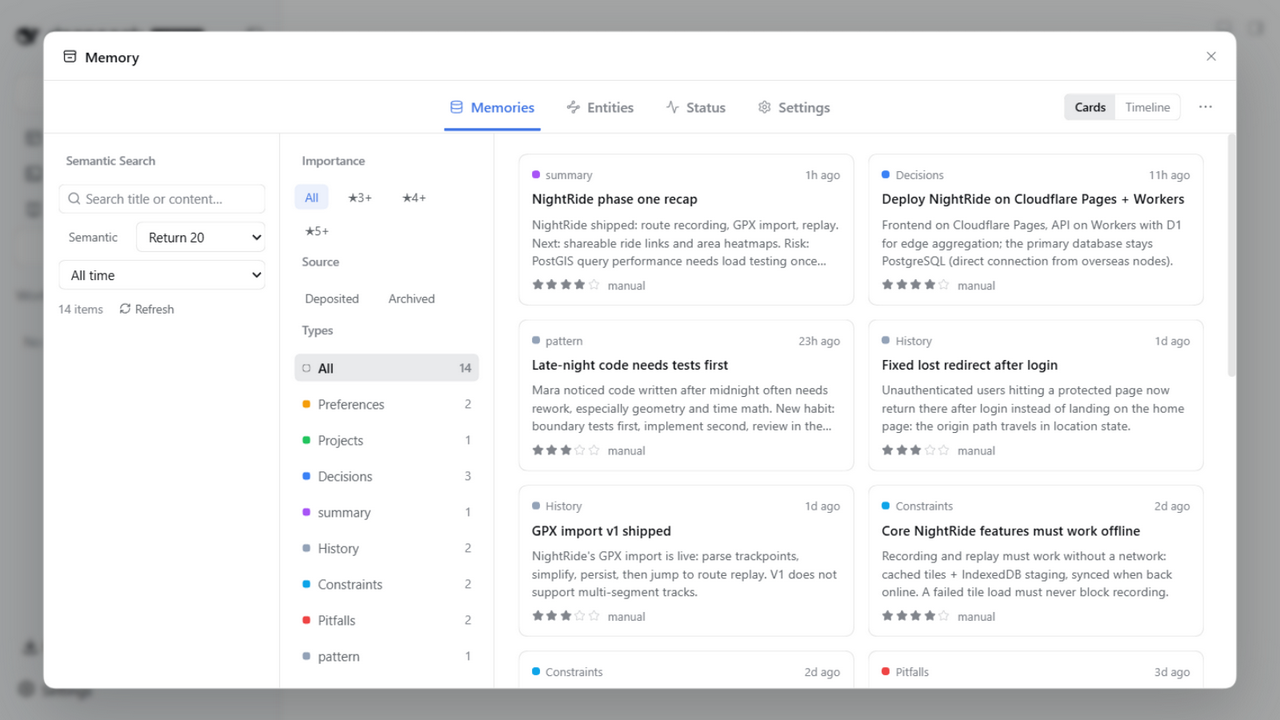
Record, browse and filter your memories.
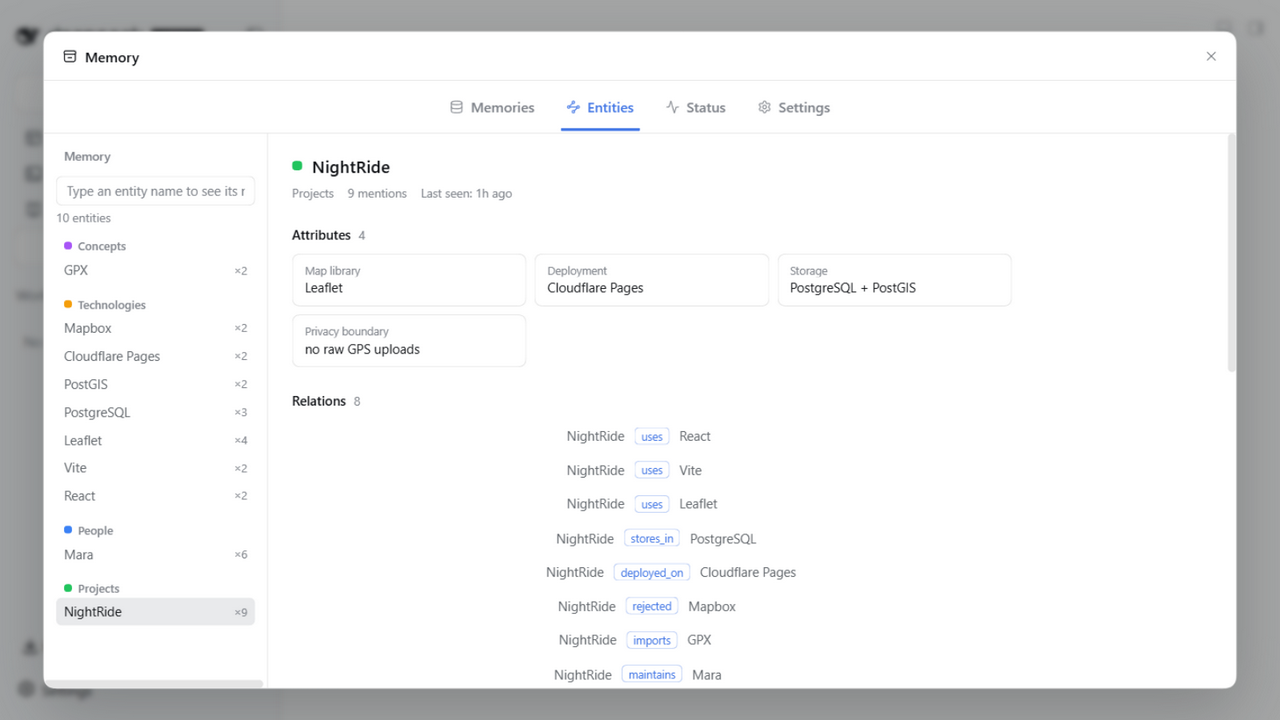
Entities are extracted from your memories, building a relation graph with attributes.
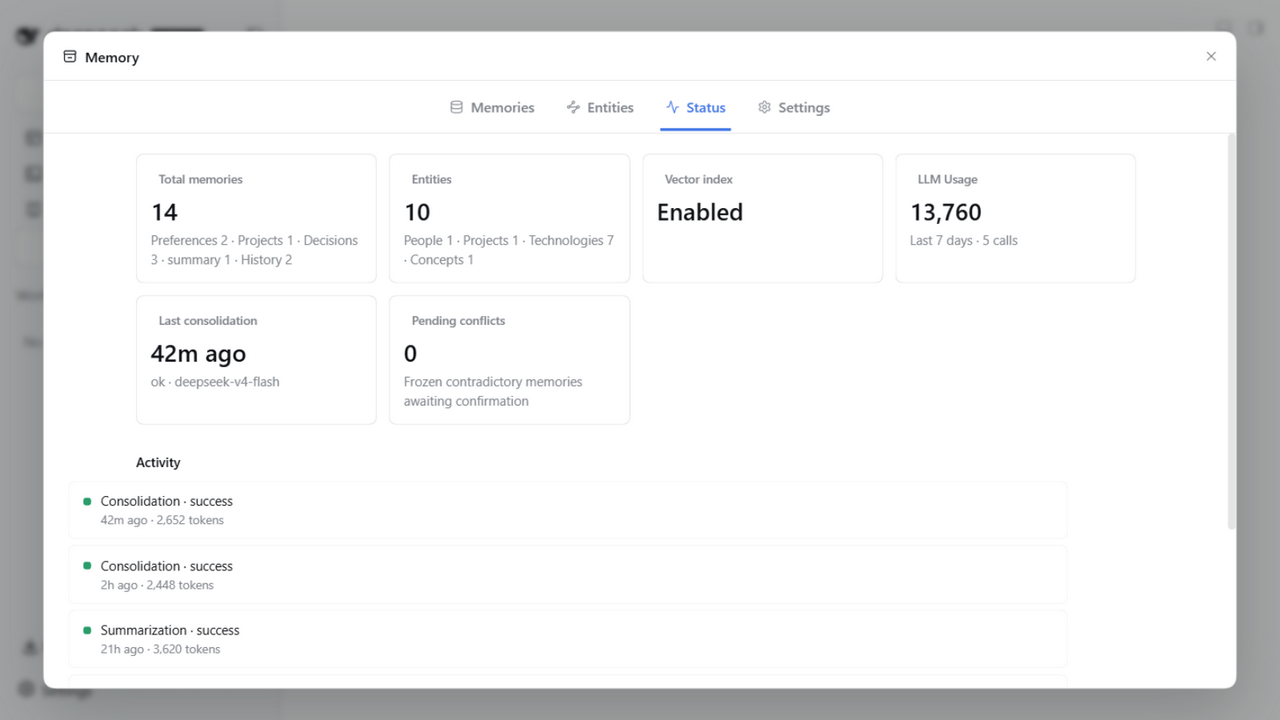
The status panel shows your vector index, LLM spend and consolidation activity at a glance.
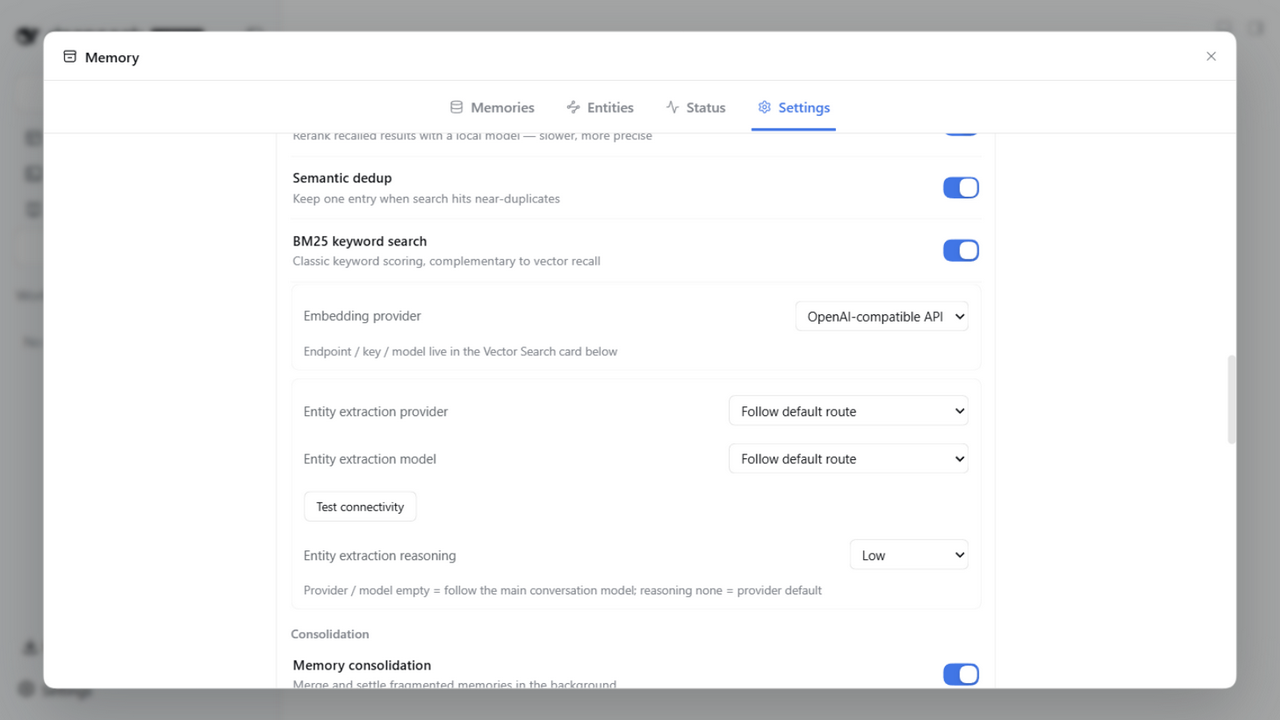
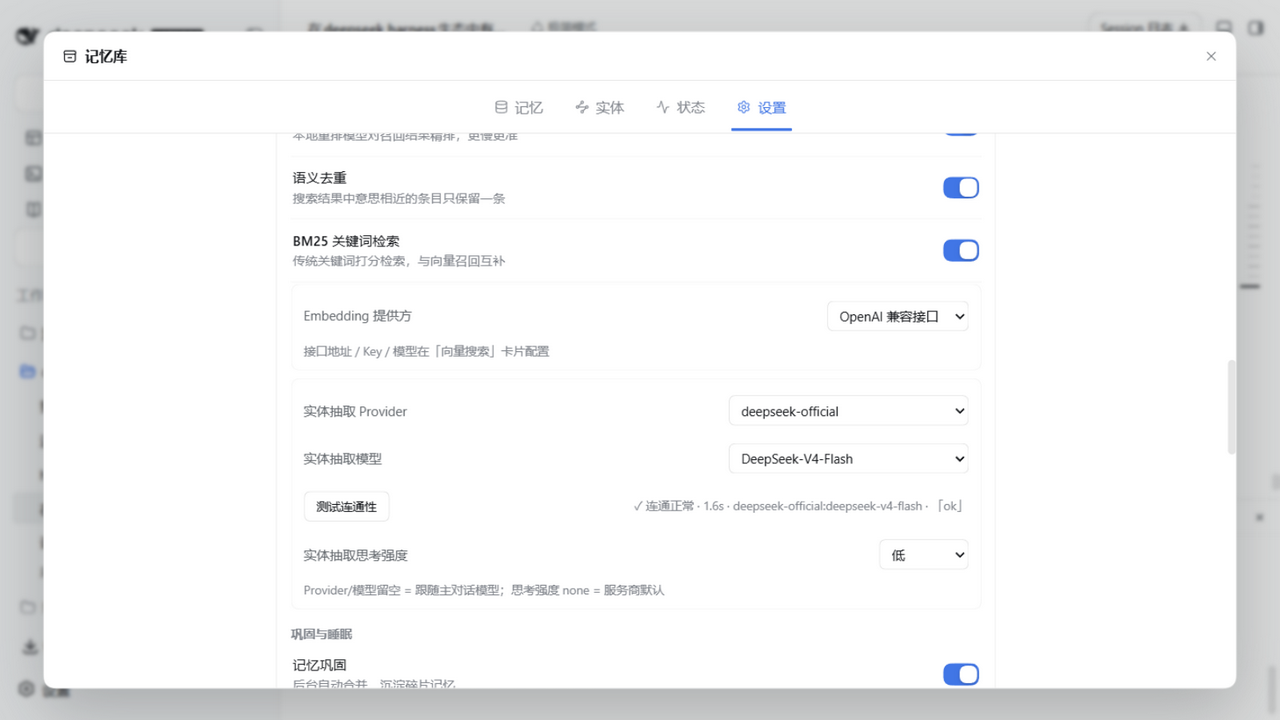
Retrieval, entity extraction and consolidation toggles are all configured in one place.
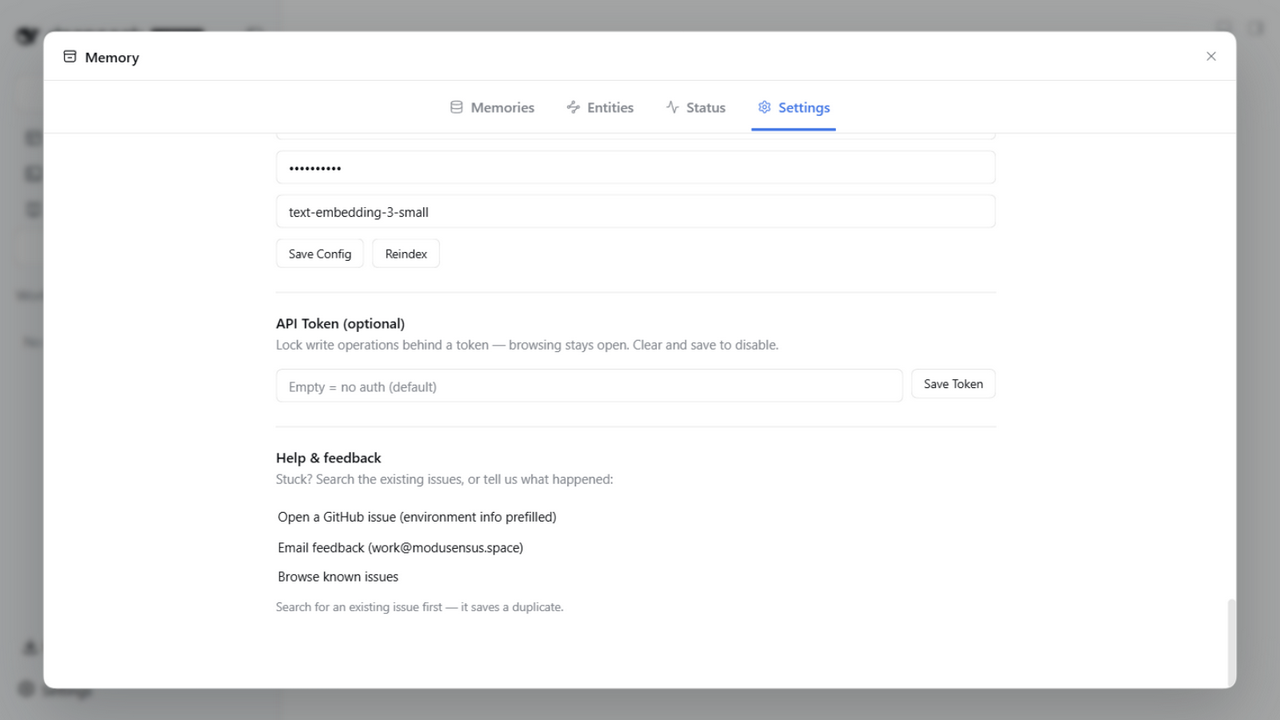
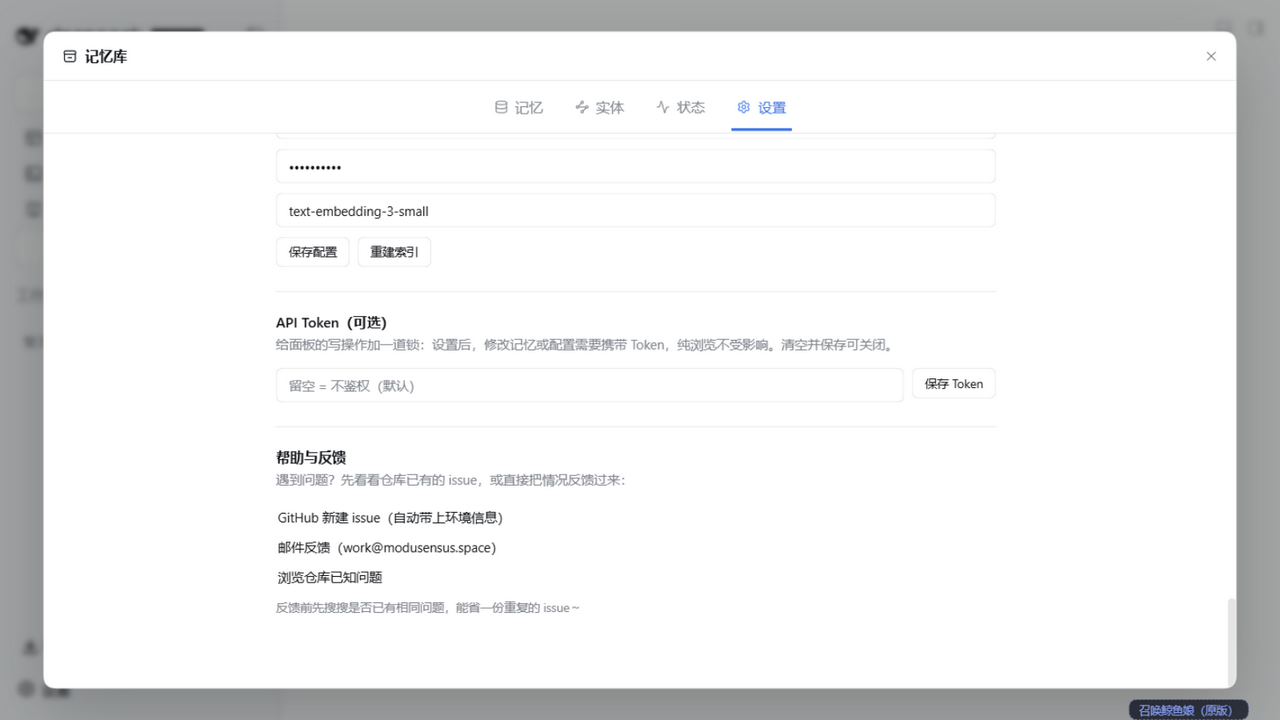
Optional write-protect token and feedback channels for a fully local, auditable setup.
## Privacy
- Memories stay on your machine: a local SQLite store plus editable Markdown mirrors, with no mneme server in the path
- Memories are Markdown files, human-readable and editable
- No mneme API key required; consolidation and summarization use the host model you already configured (`autoDream` / `autoSummarize` are on by default)
- Want consolidation fully offline too? Point the host at a local model **and** clear `dreamProvider` / `dreamModel` plus `summarizeProvider` / `summarizeModel` (setting those routes talks straight to that provider, so switching the host alone will not help) — or just turn off `autoDream` / `autoSummarize`
- No telemetry, no analytics, no remote logging
## Use it in other AI tools (MCP)
The plugin ships a zero-dependency stdio MCP server (standalone npm package **`mneme-memory`**, bin `mneme-mcp`). Any MCP client can mount the six memory tools (`memory_save` / `memory_search` / `memory_list` / `memory_get` / `memory_update` / `memory_delete`).
**One-time prerequisites**:
1. DSH is running with the plugin installed (the MCP data plane goes through the plugin's standalone API at `127.0.0.1:8790`)
2. Generate a token in the DSH panel under **Settings → External API**
**Per-client setup** (replace `` with the value from the previous step):
| Client | Setup |
|--------|-------|
| **Claude Code** | Project-root `.mcp.json`: `{"mcpServers": {"mneme-memory": {"command": "mneme-mcp", "env": {"MNEME_TOKEN": ""}}}}` |
| **Cursor** | Settings → MCP → Add Server; command `mneme-mcp`, env `MNEME_TOKEN` |
| **Codex** | `~/.codex/config.toml`: `[mcp_servers.mneme-memory]` section, `command = "mneme-mcp"`, `env = { MNEME_TOKEN = "" }` |
| **Hermes** | `mcp_servers:` section of `~/.hermes/config.yaml`: `mneme-memory: {command: "mneme-mcp", env: {MNEME_TOKEN: ""}}`, then restart |
| **OpenCode** | `opencode.json`: `{"mcp": {"mneme-memory": {"type": "local", "command": ["mneme-mcp"], "environment": {"MNEME_TOKEN": ""}}}}` |
| **OpenClaw** | `openclaw mcp add mneme-memory --command mneme-mcp --env MNEME_TOKEN=`, or Control UI → Settings → MCP |
> **Legacy mounts keep working**: `dsh-mneme-mcp` + `DSH_MNEME_TOKEN` remain supported (both the bin and env vars are preserved; no migration needed). If the npm package is not installed globally, use `npx` as the command with args `-p mneme-memory mneme-mcp` (an args array in Claude Code/OpenCode; `args = ["-p", "mneme-memory", "mneme-mcp"]` in Codex). Full config details and security notes: [full docs](dsh-mneme/README.md#mcp-server任意-mcp-客户端接入) (Chinese).
## Serve memories without DSH (standalone daemon)
`dsh-mneme-serve` runs the memory store as a long-lived data plane — with DSH closed, third-party integrations (web-bridge tools, scripts, your own panels) still read and write the same memories: the Bearer token is shared with the DSH panel/CLI, routes mirror the external API, and a busy port is a hard error (pick either the daemon or DSH's external API, not both). Phase 1 is LLM-free (consolidation/distillation stay with the DSH host); retrieval defaults to local embeddings (runtime + model auto-provisioned on first boot, `--embed off` to disable).
```bash
npm i -g @modusensus/dsh-mneme
dsh-mneme-serve # defaults: ~/.dsh/memory + 127.0.0.1:8790
```
## Community adapters
Community projects that wire mneme into more platforms — not part of this repository; compatibility is tracked by their maintainers:
| Project | Platform | Description |
|---------|----------|-------------|
| [Mneme-Bridge](https://github.com/SternChiri/Mneme-Bridge) | DeepSeek web | Browser extension + local service: web chats are distilled into the mneme store and DSH memories are injected back by topic, so both sides share one memory. Embedded (mounts the lib) and remote (standalone API — pairs with the daemon above) modes |
> Want your project listed? Open a Discussion or send a PR adding a row to this table.
## Docs
| Doc | Path |
|-----|------|
| Full plugin docs (features / install / config / architecture) | [dsh-mneme/README.md](dsh-mneme/README.md)(中文) |
| stdio MCP server — plug the six memory tools into any MCP client (Claude Code / Cursor / …) | [dsh-mneme/README.md · MCP Server](dsh-mneme/README.md#mcp-server任意-mcp-客户端接入)(中文) |
| Standalone daemon (serve memories without DSH) | [dsh-mneme/docs/DAEMON.md](dsh-mneme/docs/DAEMON.md)(中文) |
| Configuration reference (all keys) | [dsh-mneme/docs/CONFIGURATION.md](dsh-mneme/docs/CONFIGURATION.md)(中文) |
| Distill record retention & memory-level provenance (#399) | [dsh-mneme/docs/DISTILL.md](dsh-mneme/docs/DISTILL.md)(中文) |
| Entity structure design | [dsh-mneme/docs/ENTITIES.md](dsh-mneme/docs/ENTITIES.md) |
| Workflows (M.O.): the workflow lives in the repo, the evidence in memory | [dsh-mneme/docs/WORKFLOWS.md](dsh-mneme/docs/WORKFLOWS.md)(中文) |
| Semantic architecture | [dsh-mneme/docs/SEMANTIC.md](dsh-mneme/docs/SEMANTIC.md) |
| Local model guide | [dsh-mneme/docs/LOCAL_MODEL.md](dsh-mneme/docs/LOCAL_MODEL.md) |
| Capability comparison vs Zep / Mem0 / Letta / Hindsight | [docs/COMPARISON.md](docs/COMPARISON.md)(中文) |
| Changelog | [dsh-mneme/CHANGELOG.md](dsh-mneme/CHANGELOG.md) |
| Security | [SECURITY.md](SECURITY.md) |
## 🗺️ Roadmap
```
🧬 Gene → 🛡️ Audit hardening → 💤 Sleep maintenance → 🕸️ Recall fusion & graph → ✨ Panel enhancement → 🌡️ Self-evolving memory → 🔐 Scope isolation → 🌐 Ecosystem (MCP / daemon) → 🧭 M.O. (project-level workflows)
```
| Version | Theme | Status |
|---------|-------|--------|
| **v0.3** | Gene: entities / time-boxed attributes / relations | ✅ |
| **v0.4** | Sleep Mode: idle 4-phase deep maintenance | ✅ |
| **v0.5** | Recall fusion & visualization: BM25 + graph + hot memory | ✅ |
| **v0.6** | Session lifecycle: delete session ≠ delete memory | ✅ |
| **v0.7** | Self-evolving memory: heat decay + sleep dual-protection + desktop workbench/feature toggles | ✅ |
| **v0.8** | Scope isolation (agent/workspace stamping + retrieval weighting + opt-in hard filter) + conflict review queue + explicit attribution + ecosystem (stdio MCP server / graph recall axis / cold-start bootstrap / injection truncation & status bar / distill reliability / injection shaping & agent-driven organize / configuration reference & issue templates) | ✅ Released (up to v0.8.16) |
| **v0.9** | M.O. (Modus Operandi) beta: project-level workflows + candidate tiering & promotion criteria + panel list-and-graph view; settings panel re-folded at "beyond the newcomer" (#427); security & supply-chain hardening (declarative route auth, OSV gate, signed releases); **v0.9.1 adds the write side**: execution windows, run ledger, attribution candidates, observation sidecar with drift detection, step `assert`/`optional`, draft mining from session logs, persona page (per-agent cards); **v0.9.2 makes silent failures visible**: feature-flag third state "pending restart", scope-level reversible gate (#471), automatic max_tokens downgrade for consolidation (#478); **v0.9.3 wires up auto-distillation**: resolves the project bucket from the session header's `cwd`, hooks `turn/end`, 10-minute cooldown, 4-second budget, proposals only and never drafts (#489), and fixes the scope reverse-lookup that had been silently degrading since v0.8.0 (#487), the `/nudge` write gate missing `PATCH`/`DELETE`, and a multi-frame zstd counter-assertion bound to Node's whole-buffer decode semantics (#490); **v0.9.4 supplies the missing last link on three chains**: the agent-driven organizing interface finally gets a tool (`memory_organize`, behind `organizeEnabled`, off by default — off means the model cannot even see it), the profile can be drafted from memory (`profileExtractEnabled`, off by default; a draft only — applying it is another user action, and hand-written text is never rewritten by the model), and the persona `default` card is no longer handed to identities that simply have no card (#497, `personaStrictAddressing`, off by default); the panel's "injected text" card is now rendered by a single backend source, plus the distillation transcript fence and parse-failure guard (#494) | ✅ Released (v0.9.4) |
> Full per-minor-version changelog in [CHANGELOG](dsh-mneme/CHANGELOG.md).
## 🧪 Local development
```bash
cd dsh-mneme && npm install
npm test # 2302 tests
npm run stress # three-axis stress test
npm run sync # src → lib sync
```
---
## Acknowledgements
Provenance of the autoDream concept (ideas credited, implementation original):
- **[Auto Dream in Claude Code](https://code.claude.com/docs/en/memory)** (Anthropic, Memory 2.0): the conceptual origin — a background sub-agent consolidates memory files between sessions (dedupe, resolve contradictions, prune decay).
- **[Sleep-time Compute: Beyond Inference Scaling at Test-time](https://arxiv.org/abs/2504.13171)** (UC Berkeley & Letta, arXiv:2504.13171): the academic thread behind the offline-consolidation idea.
- **cc-haha**: an early reference for the implementation approach.
On top of these, dsh-mneme adds its own engineering: K-Means++ cluster pre-grouping, a typed decision list (keep / merge / archive / conflict / update, plus supersede / differentiate on the sleep side), and a replayable sha256-digest audit chain (`dream_runs` / `receipt_chain`). If any source of inspiration is missing, please open an issue.
## Related Research
dsh-mneme's design echoes the following public research (every citation below has been verified against its arXiv page; the mechanism mappings are our own, not the papers' claims):
- **Fast write + slow consolidation**: [Dual-Layer Agentic Memory](https://arxiv.org/abs/2608.22215) (arXiv:2608.22215) — mirrors autoDream's online-write / offline-consolidate split.
- **Heat decay & access reinforcement**: [FadeMem](https://arxiv.org/abs/2601.18642) (arXiv:2601.18642) — academic kin of the heat model (exponential decay × access reinforcement × importance modulation).
- **Conflict resolution & state tracking**: [StateMemBench](https://arxiv.org/abs/2608.19652) (arXiv:2608.19652) — a benchmark for tracking evolving state; C1 conflict adjudication (no stale reads after supersede) treats it as its acceptance target.
- **When to forget / scope gating**: [PersistBench](https://arxiv.org/abs/2602.01146) (arXiv:2602.01146); presentation-layer mitigation in [Structured Memory](https://arxiv.org/abs/2608.08300) (arXiv:2608.08300).
- **Field survey**: [Write–Manage–Read survey](https://arxiv.org/abs/2603.07670) (arXiv:2603.07670) — the write/manage/read taxonomy matches the plugin's overall shape.
- **Months-scale reliability**: [Memory as Infrastructure](https://arxiv.org/abs/2609.05510) (arXiv:2609.05510) — the same "memory as infrastructure" school as the sha256 audit chain and fail-safe degradation.
- **Adjacent systems (contrast)**: [Zep](https://arxiv.org/abs/2501.13956) (temporal knowledge graph), [Mem0](https://arxiv.org/abs/2504.19413) (production-grade extraction) and [Hindsight](https://arxiv.org/abs/2512.12818) (retain / recall / reflect) extract with LLM at write time and retrieve via vectors/graphs; dsh-mneme instead keeps consolidation replayable with a full audit trail, freezes conflicts for human review, and keeps memory local by default.
## 📜 License
MIT