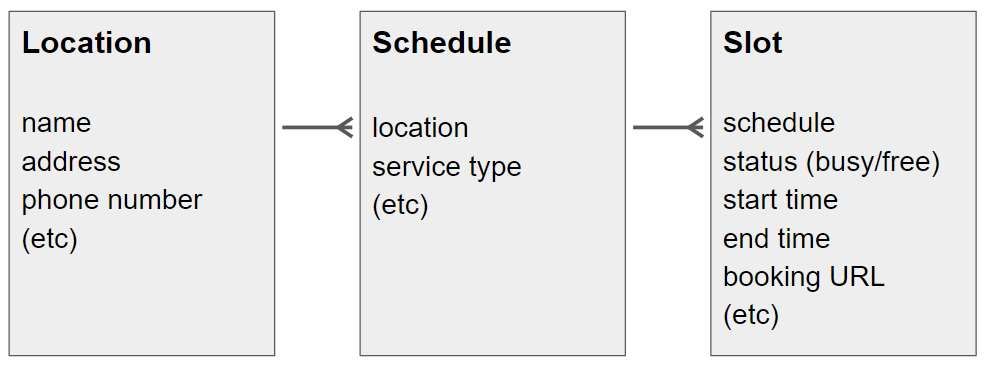
# Slot Publisher API This guide explains how a _Slot Publisher_ makes vaccination or other appointment information available to a _Slot Discovery Client_. **For background and role definitions, see [README.md](./README.md)**. ## Goals for Slot Discovery * **Low implementation effort** -- publishers can expose available slots with nothing more than static web hosting (e.g., from a cloud storage bucket or off-the-shelf web server) * **Scales up and down** -- publishers can expose information about a few vaccination sites and a few slots, or large-scale programs such as nationwide pharmacies or mass vaccination sites * **Progressive enhancement** -- publishers can expose coarse-grained data like "we have 20 slots available today" or fine-grained data with specific timing for each slot * **Builds on standards** -- publishers expose data according to the FHIR standard, but don't need specific experience with FHIR to follow this guide ## Quick Start Guide A _Slot Publisher_ hosts not only appointment slots, but also Locations and Schedules associated with these slots: Scheduling ER Diagram Concretely, a _Slot Publisher_ hosts four kinds of files: * **Bulk Publication Manifest**. The manifest is a JSON file serving as the entry point for slot discovery. It provides links that clients can follow to retrieve all the other files. The manifest is always hosted at a URL that ends with `$bulk-publish` (a convention used when publishing data sets using FHIR; this convention applies any time a potentially large data set needs to be statically published). * [Details on JSON structure](#manifest-file) * [Example file](https://raw.githubusercontent.com/smart-on-fhir/smart-scheduling-links/master/examples/$bulk-publish) showing a manifest for the fictional "SMART Vaccine Clinic", a regional chain with ten locations in Massachusetts. * **Location Files**. Each line contains a minified JSON object representing a physical location where appointments are available. * [Details on JSON structure](#location-file) * [Example file](https://raw.githubusercontent.com/smart-on-fhir/smart-scheduling-links/master/examples/locations.ndjson) showing ten locations for the fictional "SMART Vaccine Clinic". Each line provides details about a single physical location in the MA area. * **Schedule Files**. Each line contains a minified JSON object representing the calendar for a healthcare service offered at a specific location. * [Details on JSON structure](#schedule-file) * [Example file](https://raw.githubusercontent.com/smart-on-fhir/smart-scheduling-links/master/examples/schedules.ndjson) showing ten locations for the fictional "SMART Vaccine Clinic". Since SMART Vaccine Clinics are offer only COVID-19 services, there is a single Schedule (the COVID-19 vaccination schedule) for each location. Each line provides details about a single schedule. * **Slot Files**. Each line contains a minified JSON object representing an appointment slot (busy or free) for a healthcare service at a specific location. * [Details on JSON structure](#slot-file) * [Example file](https://raw.githubusercontent.com/smart-on-fhir/smart-scheduling-links/master/examples/slots-2021-W09.ndjson) showing coarse-grained slots for a single week, across all ten "SMART Vaccine Clinic" sites. (_Note: The choice to break down slots into weekly files is arbitrary; the fictional Clinic could instead choose to host a single slot file, or produce location-specific files, or even group slots randomly._) Each of the published slots in this example includes a "capacity" extension indicating that the slot has a capacity of 100 patients; furthermore the slots include only coarse-grained timing (indicating they fall sometime beetween 9a and 6p ET, the clinic's fictional hours of operation). Ideally, Slot Publishers should provide finer-grained slot information with specific timing (see "progressive enhancement" in [Goals](#goals-for-slot-discovery) above), but coarse-grained slots provide an easy way to get started. A client queries the manifest on a regular basis, e.g. once every 1-5 minutes. The client iterates through the links in the manifest file to retrieve any Location, Schedule, or Slot files it is interested in. (Clients SHOULD ignore any output items with types other than Location, Schedule, or Slot.) ### Timestamps Wherever “timestamps” are used in this specification, they SHALL be in the format `YYYY-MM-DDThh:mm:ss.sss+zz:zz` (e.g. `2015-02-07T13:28:17.239+02:00` or `2017-01-01T00:00:00Z`). The time SHALL specified at least to the second and SHALL include a time zone offset (for UTC, the offset MAY be `Z`). These timestamps match [FHIR’s “instant” format][fhir-instant], and are also valid ISO 8601 timestamps. ### `Accept` Headers For Bulk Publication Manifest requests, servers SHALL support at least the following `Accept` headers from a client, returning the same FHIR JSON payload in all cases: 1. No `Accept` header present 1. `Accept: application/json` For Bulk Output File requests, servers SHALL support at least the following `Accept` headers from a client, returning the same FHIR NDJSON payload in all cases: 1. No `Accept` header present 1. `Accept: application/fhir+ndjson` ### Performance Considerations * _Slot Publishers_ SHOULD annotate each output with a list of states or jurisdictions as a hint to clients, allowing clients to focus on fetching data for the specific states or geographical regions where they operate; this is helpful for clients with limited regions of interest. * _Slot Publishers_ SHOULD include a [`Cache-Control: max-age=` header](https://developer.mozilla.org/en-US/docs/Web/HTTP/Caching) as a hint to clients about how long (in seconds) to wait before polling next. For example, `Cache-Control: max-age=300` indicates a preferred polling interval of five minutes. * Clients SHOULD NOT request a manifest or any individual data file more than once per minute * Clients MAY include standard HTTP headers such as `If-None-Match` or `If-Modified-Since` with each query to prevent retrieving data when nothing has changed since the last query. * Clients MAY include a `?_since={}` query parameter with a [timestamp](#timestamps) when retrieving a manifest file to request only changes since a particular point in time. Servers are free to ignore this parameter, meaning that clients should be prepared to retrieve a full data set. ### Access Control Considerations * _Slot Publishers_ SHOULD host `$bulk-publish` content at open, publicly accessible endpoints when sharing COVID-19 appointment availability (no required access keys or client credentials). This pattern ensures that data can be used widely and without pre-coordination to meet public health use cases. * These data will be publicly available downstream in consumer-facing apps, so confidentiality is a non-goal. * Public health goals require flexibility in access to non-confidential information. * With the `$bulk-publish` pattern, _Slot Publishers_ host static files, which scale well to open publication ### API Testing You can test your implementation with https://inferno.healthit.gov/suites/smart_scheduling_links ## Manifest File The manifest file is the entry point for a client to retrieve scheduling data. The manifest JSON file includes: | field name | type | description | |---|---|---| | `transactionTime` | [timestamp](#timestamps) as string | the time when this data set was published. See [“timestamps”](#timestamps) for correct formatting. | | `request` | url as string | the full URL of the manifest | | `output` | array of JSON objects | each object contains a `type`, `url`, and `extension` field | |   → `type` | string | whether this output item represents a `"Location"`, `"Schedule"`, or `"Slot"` file | |   → `url` | url as string | the full URL of an NDJSON file for the specified type of data | |   → `extension` | JSON object | contains tags to help a client decide which output files to download | |   →   → `state` | JSON array of strings | state or jurisdiction abbreviations (e.g., `["MA"]` for a file with data pertaining solely to Massachusetts) | (For more information about this manifest file, see the [FHIR bulk data spec](http://build.fhir.org/ig/HL7/bulk-data/branches/bulk-publish/bulk-publish.html).) ### Example Manifest File ```js { "transactionTime": "2021-01-01T00:00:00Z", "request": "https://example.com/covid-vaccines/$bulk-publish", "output": [ { "type": "Schedule", "url": "https://example.com/data/schedule_file_1.ndjson" }, { "type": "Location", "url": "https://example.com/data/location_file_1.ndjson" }, { "type": "Slot", "url": "https://example.com/data/slot_file_MA.ndjson", "extension": { "state": ["MA"] } }, { "type": "Slot", "url": "https://example.com/data/slot_file_NEARBY.ndjson", "extension": { "state": ["CT", "RI", "NH"] } } ], "error": [] } ``` ## Location File Each line of the Location File is a minified JSON object that conveys a physical location where appointments are available. Each Location includes at least: | field name | type | required | description | | --- | --- | :---: | --- | | `resourceType` | string | Y | fixed value of `"Location"` | | `id` | string | Y | unique identifier for this location (up to 64 alphanumeric characters and may include `-` and `.`) | | `name` | string | Y | the human-readable name of the location. Name SHOULD include consumer-relevant branding (e.g., the brand name of a pharmacy chain that a consumer would be familiar with)| | `telecom` | array of JSON objects | Y | each object conveys a contact point for this location. The array SHALL include at least one contact point, and SHOULD include both a phone number and a URL. (*Note: this field conveys "general information" contact points such as a front desk for the location, not necessarily for booking appointments; see Slot details for booking URLs and booking phone numbers*)| |   → `system` | string | Y | `"phone"` or `"url"`| |   → `value` | string | Y | phone number or URL for this location| | `address` | JSON object | Y | each object conveys a USPS [complete address](https://pe.usps.com/text/pub28/28c2_001.htm) | |   → `line` | array of strings | Y | each string is line in the address | |   → `city` | string | Y | | |   → `state` |string | Y | | |   → `postalCode` | string | Y | | |   → `district` | string | N | optional county | | `description` | string | N | additional information about this location (e.g., where to find it) | | `position` | JSON object | N | geocoordinates of the location | |   → `latitude` | number | N | must be populated if position is included | |   → `longitude` | number | N | must be populatd if position is included | | `identifier` | array of JSON objects | Y | Identifiers for this location (e.g., Store Number or VTrckS PIN). See below.| Each `identifier` object includes a `system` and a `value`. * If a Location is associated with one or more "VTRckS PIN"s (see https://cdc.gov/vaccines/programs/vtrcks for VTrckS program details), publishers SHOULD include these: | field name | type | description | |---|---|---| |`system`| string | fixed value of `"https://cdc.gov/vaccines/programs/vtrcks"`| |`value` | string | VTrckS PIN for this location | * If a Location is associated with a "Store Number" or other organization-specific Identifiers, publishers SHOULD include these. The `system` should be a page on the publisher's web site (e.g. `{"system": "https://pharmacy.example.com/store-locator", "value": "123"}`) * Additional identifiers: Any number of additional identifiers MAY be included. Each should populate `system` and `value` as appropriate. ### Example `Location` ```json { "resourceType": "Location", "id": "123", "identifier": [{ "system": "https://cdc.gov/vaccines/programs/vtrcks", "value": "CV1654321" }], "name": "Flynn's Pharmacy in Pittsfield, MA", "description": "Located behind old Berkshire Bank building", "telecom": [{ "system": "phone", "value": "413-000-0000" }, { "system": "url", "value": "https://pharmacy.example.com" }], "address": { "line": ["173 Elm St"], "city": "Pittsfield", "state": "MA", "postalCode": "01201-7223" } } ``` ### Example Location File * Example [file](https://raw.githubusercontent.com/smart-on-fhir/smart-scheduling-links/master/examples/locations.ndjson) ## Schedule File Each line of the Schedule File is a minified JSON object that conveys a information about a Schedule to which slots are attached. The Schedule represents a particular service (e.g., COVID-19 immunizations) offered at a specific location. Each Schedule includes at least:
field nametypedescription
resourceTypestringfixed value of "Schedule"
idstringa unique identifier for this schedule (up to 64 alphanumeric characters and may include - and .)
actorarray with one JSON object
  → referencestringthe location where appointments are available formed as Location + / + the id value of an entry in a Location File (e.g., "Location/123")
serviceTypearray of JSON objectsEach object is a standardized concept indicating what services are offered. For COVID-19 immunization Schedules, two standardized codings must be included:
[{
  "system": "http://terminology.hl7.org/CodeSystem/service-type",
  "code": "57",
  "display": "Immunization"
}, {
  "system": "http://fhir-registry.smarthealthit.org/CodeSystem/service-type",
  "code": "covid19-immunization"
  "display": "COVID-19 Immunization Appointment"
}]
Additional serviceTypes may be included if this schedule offers services beyond COVID-19 immunizations; or additional codings may be included to convey more nuanced information about the COVID-19 immunizations offered. The example resource below shows a serviceType that can be used verbatim to advertise a COVID-19 immunization schedule. (Why two Codings? One expresses the fact that the slot is for an immunization service, and the other is specific to COVID-19. This structure follows a convention in FHIR for expressing "codeable concepts" -- see here for details.)
extensionarray of JSON objectssee details below
Each Schedule object may optionally include the following extension JSON objects in the Schedule's `extension` array. * "Vaccine Product" extension: used to convey a product code for a vaccine available at appointments on this Schedule. This extension SHOULD NOT repeat; providers SHOULD represent each available vaccine product on a separate schedule to facilitate directed booking. | field name | type | description | |---|---|---| |`url`| string | fixed value of `"http://fhir-registry.smarthealthit.org/StructureDefinition/vaccine-product"`| |`valueCoding` | JSON object| Coded representation of a vaccine product (CVX code)| |   → `system` | string | Fixed value of `"http://hl7.org/fhir/sid/cvx"`| |   → `code` | string | Any valid CVX code (e.g., `"207"`, `"208"`, `"210"`, `"212"`) | |   → `display` | string | Display name for the code | * "Dose Number" extension: used to convey a dose sequence number (e.g., "first dose" or "second dose') offered at appointments on this Schdule. This extension MAY repeat, if this Schedule offers both "first dose" and "second dose" appointments. | field name | type | description | |---|---|---| |`url`| string | fixed value of `"http://fhir-registry.smarthealthit.org/StructureDefinition/vaccine-dose"`| |`valueInteger` | number | indicates sequence number (should be be `1` or `2` for current vaccines)| ### Example `Schedule` ```json { "resourceType": "Schedule", "id": "456", "serviceType": [ { "coding": [ { "system": "http://terminology.hl7.org/CodeSystem/service-type", "code": "57", "display": "Immunization" }, { "system": "http://fhir-registry.smarthealthit.org/CodeSystem/service-type", "code": "covid19-immunization", "display": "COVID-19 Immunization Appointment" } ] } ], "actor": [ { "reference": "Location/123" } ] } ``` ### Example Schedule File * Example [file](https://raw.githubusercontent.com/smart-on-fhir/smart-scheduling-links/master/examples/schedules.ndjson) ## Slot File Each line of the Slot File is a minified JSON object that conveys information about an appointment slot. Publishers are encouraged to represent slots with fine-grained timing details (e.g. representing appointments at specific times of the day), but MAY represent slots with coarse grained timing (e.g., "between 9 a.m. and 5 p.m." or "between noon and five p.m."). *Note: When publishing a Slot with `"status": "free"`, Publishers should ensure that the Slot is in fact available for booking, given current business rules. For example, if a pharmacy won't allow a first-dose vaccine slot to be booked because no follow-up second-dose appointments are available, then the pharmacy SHOULD NOT advertise the first-dose slot as available.* Each `Slot` has: | field name | type | required | description | |---|---|:---:|---| | `resourceType` | string | Y | fixed value of `"Slot"` | | `id` | string | Y | a unique identifier for this slot (up to 64 alphanumeric characters and may include `-` and `.`) | | `schedule` | JSON object | Y | has a single field indicating the Schedule this slot belongs to | |   → `reference` | string | Y | the schedule for this slot formed as `Schedule` + `/` + the `id` value of an entry in a Schedule File (e.g., `"Schedule/123"`). | | `status` | string | Y | either `"free"` or `"busy"`. Publishers SHOULD include busy slots in addition to free slots to help clients monitor total capacity | | `start` | [timestamp](#timestamps) as string | Y | the start time of this slot. Together `start` and `end` SHOULD identify a narrow window of time for the appointment, but MAY be as broad as the clinic's operating hours for the day, if the publisher does not support fine-grained scheduling. Timestamp SHALL be expressed with an accurate offset suffix, which SHOULD reflect the local timezone offset of the Location this slot belongs to (e.g., `-05:00` suffix for UTC-5) or use UTC (i.e., `Z` suffix). For example, to represent a start time of 10:45AM in America/New_York on 2021-04-21, this could be returned as either `2021-04-21T10:45:00.000-04:00` or `2021-04-21T14:45:00.000Z`.| | `end` | [timestamp](#timestamps) as string | Y | the end time of this slot. See notes about offset suffix for `start`.| | `extension` | array of JSON objects | N | see details below | Each Slot object may optionally include one or both of the following extension JSON objects in the Slot's `extension` array. * "Booking link" extension: used to convey a web link into the Provider Booking Portal (see [below](#deep-links-hosted-by-provider-booking-portal)) where the user can begin booking this slot. | field name | type | description | |---|---|---| |`url`| string | fixed value of `"http://fhir-registry.smarthealthit.org/StructureDefinition/booking-deep-link"`| |`valueUrl` | string | URL that's a deep link into the Provider Booking Portal | * "Booking phone" extension: used to convey a phone number the user can call to book this slot. | field name | type | description | |---|---|---| |`url`| string | fixed value of `"http://fhir-registry.smarthealthit.org/StructureDefinition/booking-phone"`| |`valueString` | string | Phone number the user can call to book this slot. * "Capacity" extension: used to enable aggregated discovery at mass vaccination sites. Slot Publishers SHOULD advertise discrete slots, but MAY for performance or scalability reasons choose to aggregate otherwise identical slots (same schedule, status, start, and end times) with this extension. Slot Publishers MAY provide estimated capacity if precise capacity cannot be determined. | field name | type | description | |---|---|---| |`url`| string | fixed value of `"http://fhir-registry.smarthealthit.org/StructureDefinition/slot-capacity"`| |`valueInteger` | number | indicates capacity (e.g., `"valueInteger": 300` to advertise a capacity of 300) ### Example `Slot` ```json { "resourceType": "Slot", "id": "789", "schedule": { "reference": "Schedule/456" }, "status": "free", "start": "2021-03-10T15:00:00-05", "end": "2021-03-10T15:20:00-05", "extension": [{ "url": "http://fhir-registry.smarthealthit.org/StructureDefinition/booking-deep-link", "valueUrl": "https://ehr-portal.example.org/bookings?slot=opaque-slot-handle-89172489" }] } ``` ### Example Slot File * Example [file](https://raw.githubusercontent.com/smart-on-fhir/smart-scheduling-links/master/examples/slots-2021-W09.ndjson) ## Deep Links hosted by _Provider Booking Portal_ The Booking Portal is responsible for handling incoming deep links. Each Slot exposed by the _Slot Publisher_ can include an extension indicating the Booking Deep Link, a URL that the Slot Discovery Client can redirect a user to. The Slot Discovery Client can attach the following URL parameters to a Booking Deep Link: * `source`: a correlation handle indicating the identity of the Slot Discovery Client, for use by the Provider Booking Portal in tracking the source of incoming referrals. * `booking-referral`: a correlation handle for this specific booking referral. This parameter can optionally be retained by the Provider Booking Portal throughout the booking process, which can subsequently help the Slot Discovery Client to identify booked slots. (Details for this lookup are out of scope for this specification.) ### Example of deep linking into a booking portal For the `Slot` example above, a client can construct the following URL to provide a deep link for a user to book a slot: 1. Parse the Booking Deep Link URL 2. Optionally append `source` 3. Optionally append `booking-referral` In this case, if the `source` value is `source-abc` and the `booking-referral` is `34d1a803-cd6c-4420-9cf5-c5edcc533538`, then the fully constructed deep link URL would be: https://ehr-portal.example.org/bookings?slot=opaque-slot-handle-89172489&source=source-abc&booking-referral=34d1a803-cd6c-4420-9cf5-c5edcc533538 (Note: this construction is *not* as simple as just appending `&source=...` to the booking-deep-link, because the booking-deep-link may or may not already include URL parameters. The Slot Discovery Client must take care to parse the booking-deep-link and append parameters, e.g., including a `?` prefix if not already present.) ## Slot Aggregators Systems that re-publish data from multiple other APIs or from other _Slot Publishers_ are referred to as _Slot Aggregators_. If you are a _Slot Aggregator_, you may wish to use some additional extensions and FHIR features to supply useful provenance information or describe ways that your aggregated data may not exactly match the definitions in the _SMART Scheduling Links_ specification. The practices and approaches in this section are _recommendations_; none are _required_ for a valid implementation. ### Preserve Source Identifiers _Slot Aggregators_ usually need to assign new `id` values to resources in order to make sure they are unique across the aggregated dataset. The `id` of the original resource SHOULD be preserved in the `identifier` list, alongside the identifiers from the original resource. The specific `system` and `value` used for the identifier is left up to the implementer. For example, given this Location resource from an underlying source: ```js { "resourceType": "Location", "id": "123", "identifier": [ { "system": "https://cdc.gov/vaccines/programs/vtrcks", "value": "CV1654321" } ], "name": "Flynn's Pharmacy in Pittsfield, MA", // additional Location fields here... } ``` A _Slot Aggregator_ might publish a Location like: ```js { "resourceType": "Location", "id": "456", "identifier": [ { "system": "https://cdc.gov/vaccines/programs/vtrcks", "value": "CV1654321" }, { "system": "https://flynnspharmacy.example.org/", "value": "123" } ], "name": "Flynn's Pharmacy in Pittsfield, MA", // additional Location fields here... } ``` In this example, `https://flynnspharmacy.example.org/` is an arbitrary string that defines “Flynn’s Pharmacy” as the identifier system. _Slot Aggregators_ should only use a URL that is not under their control in cases where the URL is predictable and might reasonably be chosen by other _Slot Aggregators_. When this is not the case, _Slot Aggregators_ SHOULD choose a URL under their control. For example, an aggregator at `usdr.example.org` might choose a URL like `https://usdr.example.org/fhir/identifiers/flynns`. When the source system is a SMART Scheduling Links implementation, a _Slot Aggregator_ SHOULD use [FHIR’s `Resource.meta.source` field][resource_meta] to describe it. The value is a URI that SHOULD include the URL of the source system, and MAY add the resource `id`. For example, given the above example resource at `https://api.flynnspharmacy.example.org/fhir/smart-scheduling/$bulk-publish`, a _Slot Aggregator_ might publish a location like: ```js { "resourceType": "Location", "id": "456", "meta": { "source": "https://api.flynnspharmacy.example.org/fhir/smart-scheduling/Location/123" }, "identifier": [ { "system": "https://cdc.gov/vaccines/programs/vtrcks", "value": "CV1654321" }, { "system": "https://flynnspharmacy.example.org/", "value": "123" } ], "name": "Flynn's Pharmacy in Pittsfield, MA", // additional Location fields here... } ``` ### Indicate Data “Freshness” Aggregators may request or receive information from publishers at different times, and understanding how recently data about a Location, Schedule, or Slot was retrieved can help end users gauge the accuracy of items in an aggregated dataset. _Slot Aggregators_ SHOULD use the `lastSourceSync` extension on the `meta` field of any resource to indicate the last time at which the data was known to be accurate: ```js { "resourceType": "Schedule", "id": "123", "meta": { "extension": [{ "url": "http://hl7.org/fhir/StructureDefinition/lastSourceSync", "valueDateTime": "2021-04-19T20:35:05.000Z" }] } // additional Schedule fields here... } ``` **Note:** `lastSourceSync` has been tentatively approved, but is not yet finalized as part of FHIR as of April 28, 2021. (You can keep up-to-date on the status of this extension in FHIR’s issue tracker at [FHIR-31567][].) ### Describe Unknown Availability, Capacity, or Slot Times Because source systems may experience errors or may not conform to the SMART Scheduling Links specification, _Slot Aggregators_ need additional tools to describe unusual situations that are not relevant to first-party _Slot Publishers_. Specifically, _Slot Aggregators_ may describe Schedules where: - Whether any Slots are associated with the Schedule is unknown (e.g. because a source system is unreachable), - The capacity or times of Slots are unknown (e.g. slots are known to be free or busy only _at some time_ in the near future). Use the **optional "Has Availability" extension** to convey that a Schedule has non-zero or unknown future availability, without conveying details about when or how much. When used on a Schedule, that Schedule MAY have no associated Slots. _Slot Publishers_ SHALL NOT use this capacity in place of publishing granular Slots; it is defined to support Slot Aggregators (i.e. systems that re-publish Slot data from other APIs). | field name | type | description | |---|---|---| |`url`| string | Fixed value of `"http://fhir-registry.smarthealthit.org/StructureDefinition/has-availability"` | |`valueCode` | string | One of: | Example usage on a Schedule: ```json { "resourceType": "Schedule", "id": "456", "serviceType": [ { "coding": [ { "system": "http://terminology.hl7.org/CodeSystem/service-type", "code": "57", "display": "Immunization" }, { "system": "http://fhir-registry.smarthealthit.org/CodeSystem/service-type", "code": "covid19-immunization", "display": "COVID-19 Immunization Appointment" } ] } ], "extension": [ { "url": "http://fhir-registry.smarthealthit.org/StructureDefinition/has-availability", "valueCode": "some" } ], "actor": [ { "reference": "Location/123" } ] } ``` [resource_meta]: http://hl7.org/fhir/resource.html#Meta [FHIR-31567]: https://jira.hl7.org/browse/FHIR-31567 [fhir-instant]: http://hl7.org/fhir/datatypes.html#instant