"Even a pair of scissors deserves to be smart. Welcome to cybernetic boundary shearing."
"Even a pair of scissors deserves to be smart. Welcome to cybernetic boundary shearing."
 Manifesto
**Y**et **A**nother **S**entence **B**oundary **D**etector is a pair of smart scissors for text. Pointer-based, from-scratch [SBD](https://en.wikipedia.org/wiki/Sentence_boundary_disambiguation) for production NLP pipelines. Features a drop-in adapter for pysbd to fix edge cases without heavy refactoring.
It was born out of [chunklet-py](https://github.com/speedyk-005/chunklet-py/pull/49), an all-in-one chunker for sentences, documents, and code.
### ✂ Why do I need a pair of "smart scissors" for text?
Running `re.split(r'(?<=[.!?])(?=\s+[A-Z])')` and praying. This blunt tool instantly shears titles like `Mr. Smith` or French corporate markers like `Sté. Générale` in half, scattering semantic fragments across the pipeline.
Punctuation is the most overloaded glyph set in text. A period alone does six jobs and only one is "sentence end." Generic split-on-punctuation fails on:
- `Dr.` `Inc.` `U.S.A.` (abbreviation markers, not boundaries. ~47% of periods in news text are these)
- `3.5M` `3.14` (decimal points, not sentence ends)
- `D. H. Lawrence` (initials. Two periods, zero boundaries)
- `...` (ellipsis. Trailing off or sentence end? ambiguous)
- `1.` `a.` at line start (inline list markers impersonating sentence ends)
- `?!` inside quotes (punctuation nesting across boundaries)
And multilingual quirks a naive splitter never saw coming.
###
 Are these shears just a rusty regex loop spray-painted in carbon fiber?
Nope!! It is a two-pass pipeline:
**Pass 1** Candidate boundary finder. Finds every position that could plausibly end a sentence: periods, question marks, exclamation points followed by whitespace, uppercase, or a newline. Deliberately over-inclusive. Better to catch a false positive than miss a real boundary.
**Pass 2** Cross-references 9+ mid-sentence patterns to surgically excise false positives:
- Newline inside sentence
- Title/initialism protection
- Abbreviation lists
- Geopolitical + case markers
- Quote/parenthesis span filtering
- TOC leader suppression
- List marker re-alignment
- Contiguous terminator collapsing
- Language-specific final fixups
---
## 💡 Use Cases
Yasbd shines in real-world text processing scenarios where robust sentence boundaries matter, such as:
- **📰 News & Article Processing**: Split articles without mangling titles (`Dr.`, `Inc.`), decimals (`3.5M`, `$199.99`), or citations (`Smith et al. (2021)`).
- **🤖 NLP Pipelines & Text Analytics**: A fast preprocessor for tokenizers, NER, and sentiment analysis across 39 languages.
- **📚 Document Chunking & RAG**: Clean sentence boundaries for vector database ingestion and retrieval-augmented generation.
- **💬 Chat & Social Media Analysis**: Handles informal punctuation (`!!!`, `...`) and emoji without fragmenting conversational intent.
- **🧹 OCR & Noisy Text Cleanup**: Combine with `StreamCleaner` to fix artifacts and mojibake before segmentation.
- **📦 CLI Text Processing**: Pipe documents into the command line for one-off batch segmentation.
> [!TIP]
> Want it in action? Browse [`examples/`](examples/). The example code is [MIT Licensed](examples/LICENSE-MIT) so you can freely copy snippets into your own projects.
---
## 🌐 Supported Languages ([API](https://github.com/speedyk-005/yasbd-lib/blob/main/API_REFERENCES.md#yasbdrules))
39 languages supported.
> [!NOTE]
> **v1.x freeze:** The built-in language set is locked for the v1.x series (reached with Armenian; see #132 / #198).
> New languages are **not** accepted as built-in modules. They should be distributed as external packs.
> Use [lang packs](#-lang-packs) via `BoundaryDetector(external_lang_packs=[...])` instead. Focus for core
> stays on bug fixes, edge cases, and API stabilization. Non-breaking improvements
> to *existing* language rules are still welcome.
 Benchmarks
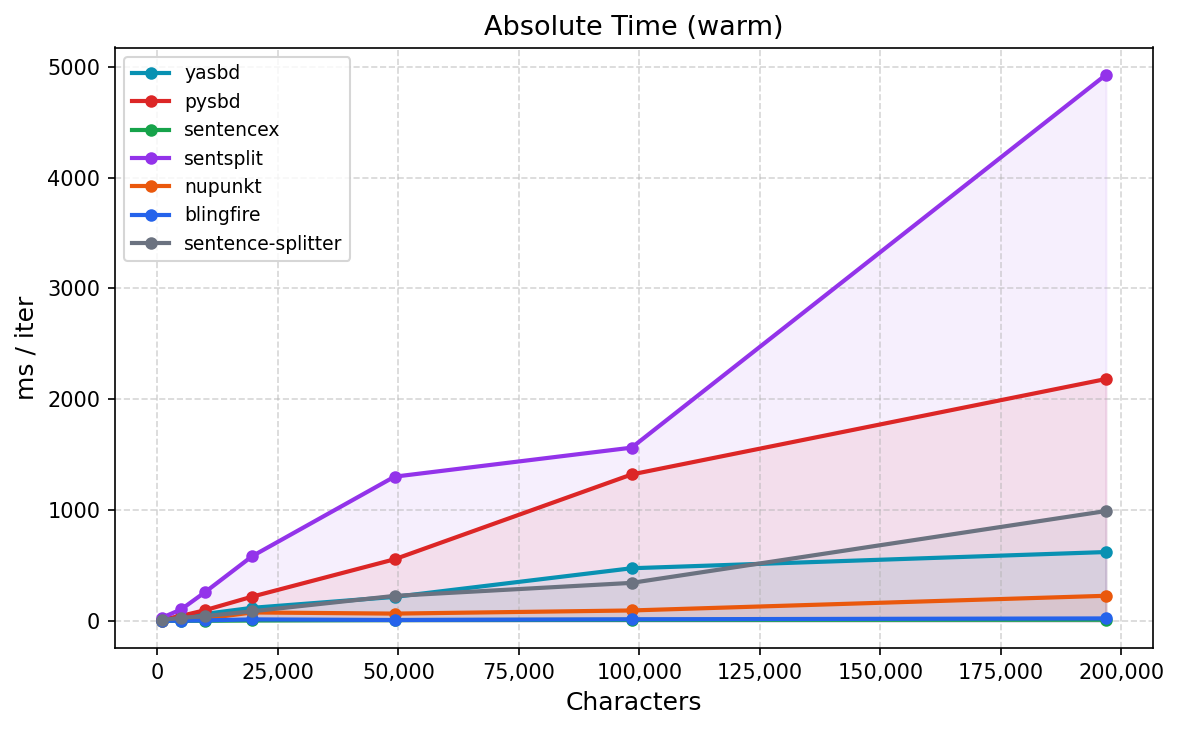
Tested against 7 competitors (pysbd, sentencex, sentsplit, nupunkt, blingfire, sentence-splitter, spaCy-sentencizer) across multiple languages and 7 edge cases: compound abbreviations, CJK quotes, newline wrapping, chat logs, URLs, decimals, and nested punctuation.
**TL;DR:** yasbd ranked #1 in accuracy across almost every test, while staying competitive on speed as pure Python. blingfire is faster but brittle. pysbd and sentencex shred French abbreviations.
On our [golden benchmark](https://github.com/speedyk-005/yasbd-lib/tree/main/benchmarks#en-golden-benchmark) (102 English edge cases, expanded from pysbd's original 48 with fixes and additions): yasbd scores **99.0%**, pysbd **82.4%**, spaCy-sentencizer **52.0%**, etc. Against same boundary-level metrics, yasbd leads in **Precision 100.0%** / **Recall 99.4%** / **F1 99.7%**, with pysbd next at F1 **92.9%**.
Full results, terminal output, boundary-level (Precision/Recall/F1) metrics, and a performance graph can be found in **[benchmarks/](https://github.com/speedyk-005/yasbd-lib/tree/main/benchmarks)**
**SPOILER**: Yasbd aced 'em all in accuracy while offering balanced speed. On _Adventures of Sherlock Holmes_ (594k chars), yasbd is ~10.8× faster than pysbd (1.5s vs 15.7s warm) with far fewer false splits.
 ---
## 📥 Installation
Ready to do some cybernetic boundary shearing? Let's get you set up quickly and painlessly.
### The Quick & Easy Way
The simplest way to get started is with pip:
```bash
pip install yasbd-lib -U
```
That's it! Blade is armed.
### The From-Source Way
Prefer building from source? Clone and install manually for full control:
```bash
git clone [https://github.com/speedyk-005/yasbd-lib.git](https://github.com/speedyk-005/yasbd-lib.git)
cd yasbd-lib
pip install .
```
(But honestly, the pip way is way easier.)
### Want to Help Make yasbd Even Better?
That's awesome. See [**Contributing Guide**](https://github.com/speedyk-005/yasbd-lib/blob/main/CONTRIBUTING.md).
---
##
 Usage ([API](https://github.com/speedyk-005/yasbd-lib/blob/main/API_REFERENCES.md#yasbdboundary_detector))
> [!TIP]
> Not a Pythonista? Jump straight to the [CLI](#cli-api) section.
>
> Looking for the pysbd drop-in replacement? Jump straight to the [Adapter](#adapter) section.
### Initialization
```python
from yasbd.boundary_detector import BoundaryDetector
# Or from yasbd import BoundaryDetector
# Basic setup
detector = BoundaryDetector(lang="en")
# With all options (so far.)
# fmt: off
detector = BoundaryDetector(
# ISO 639 code (e.g., en, fr, es, ...). Required.
# Use "auto" for automatic detection.
# [https://en.wikipedia.org/wiki/List_of_ISO_639_language_codes](https://en.wikipedia.org/wiki/List_of_ISO_639_language_codes)
lang="fr",
# Optional external language pack modules to load. Defaults to `None`.
# Each pack is validated and stored in a private registry for this detector only.
# Check #-lang-packs for more.
external_lang_packs=["yasbd_auxlang"],
# Don't split inside them. (It won't protect block quotes) Defaults to `True`.
# [https://en.wikipedia.org/wiki/Block_quotation](https://en.wikipedia.org/wiki/Block_quotation)
preserve_quote_and_paren=True,
# hook: Optional per-paragraph post-processing callback.
# Receives a dict with ``text``, ``lang``, ``boundaries`` and``paragraph_index`` keys;
# mutate ``boundaries`` in place to add or remove sentence boundaries.
# Defaults to None.
hook = None,
# Enable verbose logging. Defaults to `False`.
verbose=True,
)
```
If you want to know more about Lang Packs check the [Lang packs](#-lang-packs) section.
> [!TIP]
> **Language tag normalization:**
>
> Normalize any language tag to its ISO-639-1 two-letter code.
>
> ```python
> from yasbd.utils.lang_code_normalizer import normalize_lang
> normalize_lang("en-US") # "en"
> normalize_lang("pt-BR") # "pt"
> ```
> Requires the `langcodes` v3+ to be installed. Install it separately: `pip install langcodes -U`
Switching languages at runtime is a property set:
```python
detector.lang = "es"
```
**FUN FACT:** Each language rule initialized once globally. Once loaded, a language stays cached. Switching back or creating a new instance is instant.
> [!TIP]
> **Auto-detect**
>
> Pass `lang="auto"` if you want the system to figure out the language for you.
> I wouldn't lean on it too hard though, it's a bit slower, and short phrases can throw it off sometimes.
>
> Requires the `py3langid` package. Install it separately: `pip install py3langid`
### Core Methods
The two primary APIs are detect() and segment().
Both methods accept plain strings, open text streams (TextIOBase), or a StreamCleaner instance. Inputs are processed lazily as a stream of paragraphs, allowing large documents to be handled without loading everything into memory at once.
> [!WARNING]
> When passing an open file handle, it gets wrapped in a ``ParagraphStream``
> that closes the handle on garbage collection. If you need deterministic
> cleanup, call ``.close()`` on the handle after the generator is exhausted,
> or use a ``with`` block.
- `detect()` yields sentence boundary offsets.
- `segment()` yields sentence strings.
#### Boundary detection
[`detect()`](https://github.com/speedyk-005/yasbd-lib/blob/main/API_REFERENCES.md#yasbd.boundary_detector.BoundaryDetector.detect) tells you where each sentence stops. Integer offsets into the original input stream.
Two detection modes:
- **absolute**: (default) offsets count from the start of the entire input stream.
- **relative**: offsets reset at each paragraph boundary. A `ParagraphEOF` sentinel signals the gap between paragraphs.
```python
# absolute mode (default)
res = list(
detector.detect('She turned to him, "This is great." She held the book out to show him.')
)
print(res)
# [35, 70]
# relative mode with paragraph break
detector.lang = "es"
res = list(
detector.detect(
"El Sr. García llegó ayer. La Sra. López también.\n\nVéase la pág. 55 del libro.",
relative=True,
)
)
print(res)
# [25, 48, ParagraphEOF, 27]
```
Need `(start, end)` spans instead of bare offsets? Fair enough! Pair each boundary with the previous one, starting from 0:
```python
from itertools import chain, pairwise
text = "Hello world. How are you? I am fine."
offsets = list(detector.detect(text)) # [12, 25, 36]
for start, end in pairwise(chain((0,), offsets)):
print((start, end), repr(text[start:end].strip()))
# (0, 12) 'Hello world.'
# (12, 25) 'How are you?'
# (25, 36) 'I am fine.'
```
#### Segmentation
If you do not want to manage boundary offsets yourself (and who would?), [`segment()`](https://github.com/speedyk-005/yasbd-lib/blob/main/API_REFERENCES.md#yasbd.boundary_detector.BoundaryDetector.segment) slices text for you.
```python
detector.lang = "en"
# Basic sentence splitting
res = list(detector.segment("Hello world. How are you? I am fine."))
print(res)
# ['Hello world.', 'How are you?', 'I am fine.']
# Multi-paragraph with whitespace preserved
res = list(
detector.segment(
"First para.\nStill first.\n\nSecond para.\nFinished.",
preserve_whitespace=True,
)
)
print(res)
# ['First para.', '\nStill first.', '\n\n', 'Second para.', '\nFinished.']
```
> [!TIP]
> **ParagraphStream** - yasbd uses [`ParagraphStream`](https://github.com/speedyk-005/yasbd-lib/blob/main/API_REFERENCES.md#yasbd.utils.paragraph_stream.ParagraphStream) internally to split text into paragraph blocks. You can import it directly if you need paragraph-level processing in your own code:
> ```python
> from yasbd.utils.paragraph_stream import ParagraphStream # or yasbd.paragraph_stream
>
> for para in ParagraphStream(text): # or an opened file
> print(para) # each paragraph block
> ```
> You can also skip empty lines with `skip_empty_lines=True`
### Cleaner ([API](https://github.com/speedyk-005/yasbd-lib/blob/main/API_REFERENCES.md#yasbdutilscleaner))
OCR'd a PDF, parsed a DOCX, or scraped noisy HTML? `StreamCleaner` normalizes text before it reaches the language detector or sentence segmenter.
StreamCleaner accepts either a string or an open text stream and yields cleaned paragraphs lazily.
You can pass a `StreamCleaner` instance directly to `detect()` or `segment()` to clean text as it is processed.
```python
from yasbd.utils.cleaner import StreamCleaner
# Or from yasbd.cleaner import StreamCleaner
cleaner = StreamCleaner(
"Hello world. This is messy.",
verbose=True, # Default to False
)
list(cleaner)
# ['Hello world. This is messy.']
```
"StreamCleaner" implements the iterator protocol and yields cleaned paragraphs one at a time. It can consume plain strings, open text files, and other text streams.
```python
with open("document.txt", encoding="utf-8") as f:
for paragraph in StreamCleaner(f):
print(paragraph)
```
Common cleanup operations include:
- Normalizing line endings (`\r\n` and `\r` to `\n`)
- Fixing mojibake and OCR artifacts
- Removing HTML markup (lightweight preprocessor, not a full HTML parser)
- Normalizing whitespace
- Rejoining hyphenated words split across lines
- Preserving word boundaries across single line breaks
**Skip** built-in steps you don't want:
```python
cleaner = StreamCleaner(
text,
steps_to_skip=[
"fix_ocr_text",
"normalize_spaces",
],
)
```
**Add** custom cleaning steps:
```python
cleaner = StreamCleaner(
text,
extra_steps=[
lambda t: t.replace("TM", ""),
lambda t: t.upper(),
],
)
```
Each extra step must accept and return a `str`. If a step raises or returns a non-string, a `CleanStepError` is raised with the original exception chained.
Available built-in steps:
| Step | What it does |
|------|-------------|
| `normalize_newlines` | Normalizes Windows (`\r\n`) and Mac (`\r`) line endings to Unix (`\n`) |
| `fix_mojibake` | Fixes common UTF-8 mojibake (cp1252/latin-1 misreads) and unescapes HTML entities |
| `fix_ocr_text` | Repairs OCR artifacts, rejoins hyphenated words, removes page markers |
| `unwrap_htmls` | Removes most HTML markup while preserving visible text. ``, ``, and `` tags are preserved |
| `normalize_spaces` | Collapses multiple spaces into one |
### CLI ([API](https://github.com/speedyk-005/yasbd-lib/blob/main/API_REFERENCES.md#yasbdcli))
Do you just want to split text into sentences without writing Python?
The `yasbd` command works right from your terminal. Install once, pipe
anything into it, get sentences back.
```bash
# List supported language codes
yasbd langs
# auto, af, am, ar, de, el, en, es, ...
# Split text into sentences
yasbd segment "Dr. Smith works here. Is he there?"
# [1] 'Dr. Smith works here.'
# [2] 'Is he there?'
# Detect boundary offsets
yasbd detect "Hello world. How are you?"
# [1] 12
# [2] 24
# Read from file
yasbd segment --file document.txt
yasbd segment --file input.txt --destination output.txt # JSONL output
# Pipe support - auto-detects, skips [N] enumeration
echo "Hello. World." | yasbd segment | cat
# Hello.
# World.
# Load external Multi-profile pack with explicit --lang
pip install yasbd-auxlang
yasbd segment --from-pack yasbd_auxlang --lang eo "Saluton. Kiel vi fartas?"
# [1] 'Saluton.'
# [2] 'Kiel vi fartas?'
# Clean noisy text (HTML, mojibake, OCR artifacts)
yasbd clean "Hello world."
# [1] 'Hello world.'
# Clean with extra shell command step (e.g., transliterate via external tool)
yasbd clean "naïve café" --extra-step "sed 's/é/e/g; s/ï/i/g'"
# [1] 'naive cafe'
# Repeatable --extra-step for multiple shell commands
yasbd clean "HELLO." -e "tr 'A-Z' 'a-z'" -e "sed 's/\./!/g'"
# [1] 'hello!'
# Chaining: Skip HTML unwrap then segment in Spanish with verbosity
yasbd clean --file dirty.html --skip unwrap_htmls | yasbd segment --lang es -v
# Version
yasbd --version
# Full help
yasbd --help # top-level commands
yasbd segment --help # per-command options
yasbd detect --help
yasbd clean --help
```
#### About JSONL
When writing to a file with `--destination`, output is JSONL (one JSON object per line):
- **segment / clean**: `{"no": 1, "text": "Hello."}`
- **detect**: `{"no": 1, "offset": 6}` or `{"no": 2, "offset": 13}`
- **detect --relative**: `{"no": 3, "eof": true}` on paragraph boundaries
### Adapter ([API](https://github.com/speedyk-005/yasbd-lib/blob/main/API_REFERENCES.md#yasbdutilspysbd_adapter))
Migrating from pysbd? Swap the import and keep your pipeline:
```python
# Before: from pysbd import Segmenter
from yasbd.utils.pysbd_adapter import Segmenter
# Or from yasbd.Pysbd_adapter import Segmenter
seg = Segmenter(language="ja")
res = seg.segment(
"田中さんは「準備は完了しました」そう言って部屋を出た。U.S.A.の経済政策は非常に複雑です。"
)
print(res)
# ['田中さんは「準備は完了しました」そう言って部屋を出た。', 'U.S.A.の経済政策は非常に複雑です。']
```
Same API surface. Same [`Segmenter`](https://github.com/speedyk-005/yasbd-lib/blob/main/API_REFERENCES.md#yasbd.utils.pysbd_adapter.Segmenter) class. Same [`segment()`](https://github.com/speedyk-005/yasbd-lib/blob/main/API_REFERENCES.md#yasbd.utils.pysbd_adapter.Segmenter.segment) method signature. Even the lovely `TextSpan` with `.sent`, `.start`, `.end` is included.
---
### spaCy component ([API](https://github.com/speedyk-005/yasbd-lib/blob/main/API_REFERENCES.md#yasbdutilsspacy_component))
Even your spaCy pipeline deserves smart scissors. Call `register_spacy_component()` once, then add `yasbd` to any pipeline:
> [!NOTE]
> `spacy` is **not** a dependency of yasbd. Install it separately: `pip install spacy -U`
```python
import spacy
from yasbd import register_spacy_component
register_spacy_component() # requires spaCy v3+
nlp = spacy.blank("en")
nlp.add_pipe("yasbd", first=True, config={"lang": "en"})
doc = nlp("Dr. Smith arrived. He was late.")
for sent in doc.sents:
print(sent.text)
# Dr. Smith arrived.
# He was late.
```
> [!NOTE]
> **Pipeline position matters.**
> `first=True` ensures yasbd runs before the parser, so its sentence boundaries aren't overwritten. Adding it after the parser will have no effect on the final `doc.sents`.
When `lang` is omitted from the config, it inherits the pipeline's language:
```python
nlp.add_pipe("yasbd", first=True) # lang defaults to nlp.lang
```
Automatic language detection also works:
```python
nlp.add_pipe("yasbd", first=True, config={"lang": "auto"})
```
Tweak the detector at runtime:
```python
pipe = nlp.get_pipe("yasbd")
pipe.detector.lang = "fr"
pipe.detector.verbose = True
pipe.preserve_quote_and_paren = False
```
---
## 📦 Lang Packs ([API](https://github.com/speedyk-005/yasbd-lib/blob/main/API_REFERENCES.md#yasbdrules))
Need support for a language that isn't built in? Plug in your own lang pack. A lang pack is simply a Python module that exposes a `PROFILES` list of `Rules` subclasses.
```python
from yasbd import BoundaryDetector
detector = BoundaryDetector(lang="eo", external_lang_packs=["yasbd_auxlang"])
detector.segment("Saluton. Kiel vi fartas?")
```
> [!CAUTION]
> **Security**: `load_external_lang_packs()` imports arbitrary Python modules by name. Only load lang packs from sources you trust; an untrusted module can execute arbitrary code at import time.
Want to build a lang pack? Start with the [language template](https://github.com/speedyk-005/yasbd-lib/blob/main/src/yasbd/rules/_template.py).
### Official Lang Packs
| Package | Languages | Description |
|---------|-----------|-------------|
| [`yasbd-auxlang`](https://github.com/speedyk-005/yasbd-auxlang) | `eo`, `ia`, `ie`, `io` | Esperanto, Interlingua, Interlingue, Ido — constructed auxiliary languages |
| [`yasbd-union`](https://github.com/speedyk-005/yasbd-union) | `xx` | Experimental multi-language profile for mixed-text segmentation without language constraints |
### Other packs
| Package | Languages | Description |
|---------|-----------|-------------|
| [yasbd-eu-packs](https://github.com/brunnojob/yasbd-eu-packs) | `lv` , `hu`, `hr`, `fi`, `sl` | External Latvian, Hungarian, Croatian, Finnish and Slovenian language profiles |
| [yasbd-ca](https://github.com/gon-zalo/yasbd-ca) | `ca` | External Catalan support for yasbd-lib |
---
##
 Integrations & Ecosystem
See [**INTEGRATIONS.md**](https://github.com/speedyk-005/yasbd-lib/blob/main/INTEGRATIONS.md) for the full list.
The list only shows projects we've stumbled across. If yasbd does real work in yours, put it on the list so others can find it [#374](https://github.com/speedyk-005/yasbd-lib/issues/374).
---
##
 Contributors
See [**CONTRIBUTORS.md**](https://github.com/speedyk-005/yasbd-lib/blob/main/CONTRIBUTORS.md) for the full list.
Interested in contributing? See the [**Contributing Guide**](https://github.com/speedyk-005/yasbd-lib/blob/main/CONTRIBUTING.md) to get started!
---
##
 Last note
**yasbd** is maintained by [speedyk-005](https://github.com/speedyk-005). Licensed under [Mozilla Public License 2.0](https://github.com/speedyk-005/yasbd-lib/blob/main/LICENSE).
If you find this project helpful, please consider giving it a ⭐!