Your AI agent wastes thousands of tokens reading files over and over.
Give it a code graph instead.
Install •
CLI •
MCP Server •
Graph Server •
Languages
---
StakGraph parses source code into a graph of **functions, classes, endpoints, data models, tests**, and their relationships -- using [tree-sitter](https://tree-sitter.github.io/tree-sitter/), instantly, with zero config.
1. **CLI** -- install in 10 seconds, point at any file or directory
2. **MCP server** -- plug into Cursor, Claude Code, Windsurf, OpenCode
3. **Graph server** -- Neo4j-backed querying, embedding, and visualization
## Install
```bash
curl -fsSL https://raw.githubusercontent.com/stakwork/stakgraph/refs/heads/main/install.sh | bash
```
Pre-built binaries for **Linux** (x86_64, aarch64), **macOS** (Intel, Apple Silicon), and **Windows**.
## CLI
Point `stakgraph` at a file, directory, or git scope to inspect code structure instead of raw text.
### Most useful commands
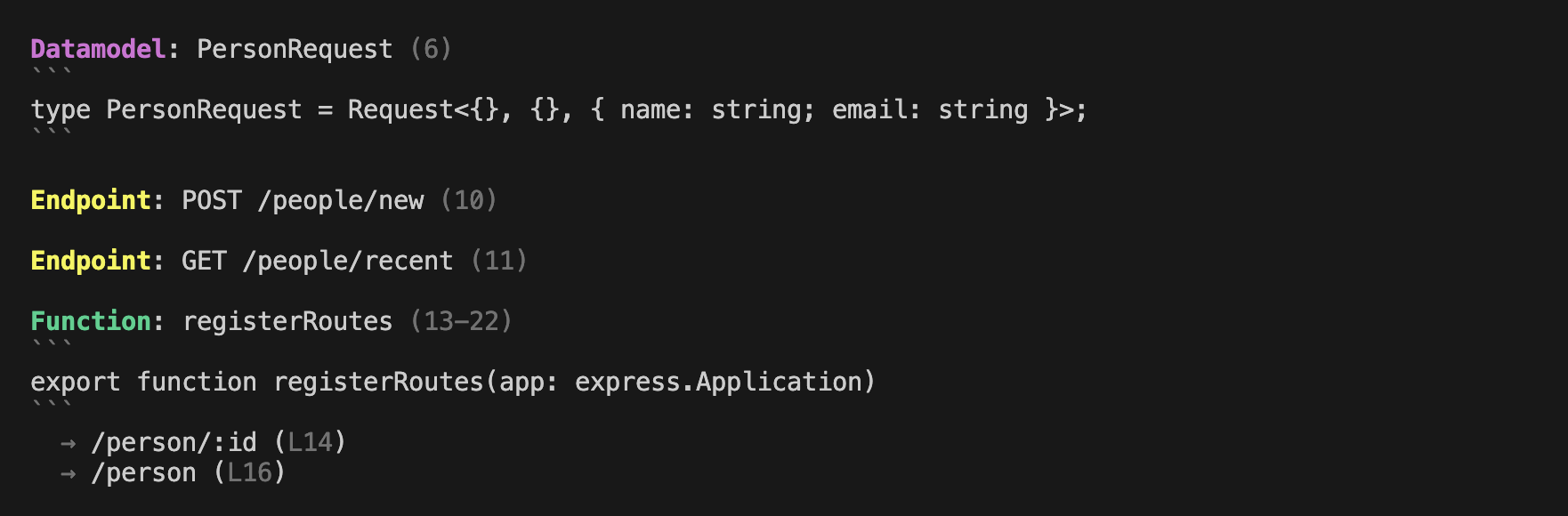
Parse a file and print extracted nodes:
```bash
stakgraph mcp/src/index.ts
stakgraph cli/src/main.rs --stats
```
 Get a compact repo overview:
```bash
stakgraph overview .
```
Search for endpoints, functions, models, or tests:
```bash
stakgraph search GET --type Endpoint mcp/src
stakgraph search batch_process --context ast/src
```
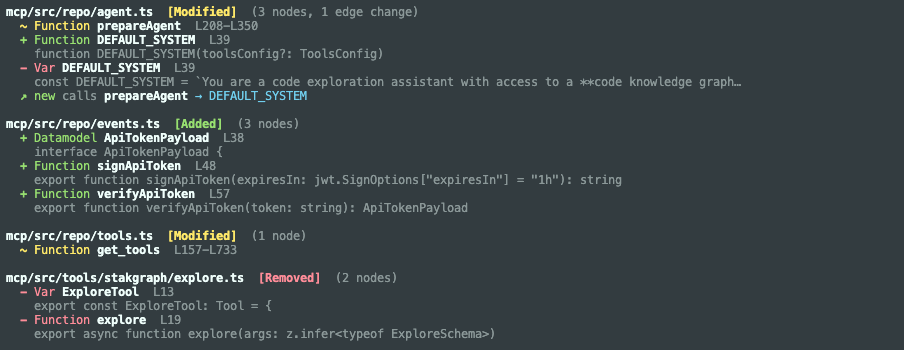
Inspect structural git changes:
```bash
stakgraph changes diff --last 5 mcp/src/
stakgraph changes list cli/src
```
Get a compact repo overview:
```bash
stakgraph overview .
```
Search for endpoints, functions, models, or tests:
```bash
stakgraph search GET --type Endpoint mcp/src
stakgraph search batch_process --context ast/src
```
Inspect structural git changes:
```bash
stakgraph changes diff --last 5 mcp/src/
stakgraph changes list cli/src
```
 Trace dependencies forward or backward:
```bash
stakgraph deps batch_process ast/src
stakgraph impact --name cn cli/
```
Useful flags:
```bash
stakgraph --json # machine-readable output
stakgraph --type Class # filter node types
stakgraph --name main # print a single named node
stakgraph completions zsh # shell completions
```
---
## What it extracts
StakGraph understands the semantic structure of code, not just syntax:
| Node Type | Examples |
| ------------- | ----------------------------------------------------- |
| **Function** | Functions, methods, handlers, callbacks |
| **Endpoint** | HTTP routes (`GET /users`, `POST /api/v1/login`) |
| **Request** | HTTP client calls to external services |
| **DataModel** | Structs, interfaces, types, enums, schemas |
| **Class** | Classes with method ownership |
| **Trait** | Interfaces, abstract classes, protocols |
| **Test** | Unit tests, integration tests, E2E tests (classified) |
| **Import** | Module imports with resolution |
And the relationships between them:
| Edge Type | Meaning |
| -------------- | ----------------------------------- |
| **Calls** | Function A calls Function B |
| **Handler** | Endpoint handled by Function |
| **Contains** | File/Module contains Function/Class |
| **Operand** | Class owns Method |
| **Implements** | Class implements Trait |
| **ParentOf** | Class inheritance |
---
## Languages
16 languages with framework-aware parsing:
| Language | Frameworks |
| -------------- | ------------------------- |
| **TypeScript** | React, Express, Nest.js |
| **JavaScript** | React, Express |
| **Python** | FastAPI, Django, Flask |
| **Go** | Gin, Echo, net/http |
| **Rust** | Axum, Actix, Rocket |
| **Ruby** | Rails (routes, ERB, HAML) |
| **Java** | Spring Boot |
| **Kotlin** | Spring, Ktor |
| **Swift** | Vapor |
| **C#** | ASP.NET |
| **PHP** | Laravel |
| **C / C++** | |
| **Angular** | Components, services |
| **Svelte** | Components |
| **Bash** | |
| **TOML** | Config parsing |
---
## MCP Server
The MCP server exposes StakGraph's graph intelligence to AI agents running in Cursor, Claude Code, Windsurf, OpenCode, or any MCP-compatible editor.
### Tools
| Tool | What it does |
| ------------------------- | ------------------------------------------------------------------------------- |
| `stakgraph_search` | Fulltext or vector (semantic) search across the codebase graph |
| `stakgraph_map` | Visual map of code relationships from any node (configurable depth & direction) |
| `stakgraph_code` | Retrieve actual code from a subtree |
| `stakgraph_shortest_path` | Find shortest path between two nodes in the graph |
| `stakgraph_rules_files` | Fetch rules/instructions files (.cursorrules, AGENTS.md, etc.) |
### Built-in agents
- **Explore Agent** -- AI-driven codebase exploration using the "zoom pattern" (Overview → Files → Functions → Dependencies). Configurable LLM provider (Anthropic, OpenAI, Google, OpenRouter).
- **Describe Agent** -- Generates descriptions for undocumented nodes and stores embeddings for semantic search.
- **Docs Agent** -- Summarizes documentation and rules files across the repo.
- **Mocks Agent** -- Scans for 3rd-party service integrations and records mock coverage.
### Gitree: Feature knowledge from git history
Gitree extracts feature-level knowledge from PR and commit history using LLM analysis:
```bash
yarn gitree process # extract features from PR history
yarn gitree summarize-all # generate docs for all features
yarn gitree search-clues "auth flow" # semantic search across architectural clues
```
Builds a knowledge base of **Features**, **PRs**, **Commits**, and **Clues** (architectural insights like patterns, conventions, gotchas, data flows). Links them to code entities in the graph.
---
## Graph Server
For full-scale codebase indexing, StakGraph runs as an HTTP server backed by **Neo4j**:
```bash
docker-compose up # starts Neo4j + StakGraph server on port 7799
```
### Ingest repositories
```bash
# Parse one or more repos into the graph
export REPO_URL="https://github.com/org/backend.git,https://github.com/org/frontend.git"
cargo run --bin index
```
Endpoints and requests are linked across repos -- a `POST /api/users` endpoint in the backend connects to the `fetch("/api/users")` request in the frontend.
### Query the graph
Trace dependencies forward or backward:
```bash
stakgraph deps batch_process ast/src
stakgraph impact --name cn cli/
```
Useful flags:
```bash
stakgraph --json # machine-readable output
stakgraph --type Class # filter node types
stakgraph --name main # print a single named node
stakgraph completions zsh # shell completions
```
---
## What it extracts
StakGraph understands the semantic structure of code, not just syntax:
| Node Type | Examples |
| ------------- | ----------------------------------------------------- |
| **Function** | Functions, methods, handlers, callbacks |
| **Endpoint** | HTTP routes (`GET /users`, `POST /api/v1/login`) |
| **Request** | HTTP client calls to external services |
| **DataModel** | Structs, interfaces, types, enums, schemas |
| **Class** | Classes with method ownership |
| **Trait** | Interfaces, abstract classes, protocols |
| **Test** | Unit tests, integration tests, E2E tests (classified) |
| **Import** | Module imports with resolution |
And the relationships between them:
| Edge Type | Meaning |
| -------------- | ----------------------------------- |
| **Calls** | Function A calls Function B |
| **Handler** | Endpoint handled by Function |
| **Contains** | File/Module contains Function/Class |
| **Operand** | Class owns Method |
| **Implements** | Class implements Trait |
| **ParentOf** | Class inheritance |
---
## Languages
16 languages with framework-aware parsing:
| Language | Frameworks |
| -------------- | ------------------------- |
| **TypeScript** | React, Express, Nest.js |
| **JavaScript** | React, Express |
| **Python** | FastAPI, Django, Flask |
| **Go** | Gin, Echo, net/http |
| **Rust** | Axum, Actix, Rocket |
| **Ruby** | Rails (routes, ERB, HAML) |
| **Java** | Spring Boot |
| **Kotlin** | Spring, Ktor |
| **Swift** | Vapor |
| **C#** | ASP.NET |
| **PHP** | Laravel |
| **C / C++** | |
| **Angular** | Components, services |
| **Svelte** | Components |
| **Bash** | |
| **TOML** | Config parsing |
---
## MCP Server
The MCP server exposes StakGraph's graph intelligence to AI agents running in Cursor, Claude Code, Windsurf, OpenCode, or any MCP-compatible editor.
### Tools
| Tool | What it does |
| ------------------------- | ------------------------------------------------------------------------------- |
| `stakgraph_search` | Fulltext or vector (semantic) search across the codebase graph |
| `stakgraph_map` | Visual map of code relationships from any node (configurable depth & direction) |
| `stakgraph_code` | Retrieve actual code from a subtree |
| `stakgraph_shortest_path` | Find shortest path between two nodes in the graph |
| `stakgraph_rules_files` | Fetch rules/instructions files (.cursorrules, AGENTS.md, etc.) |
### Built-in agents
- **Explore Agent** -- AI-driven codebase exploration using the "zoom pattern" (Overview → Files → Functions → Dependencies). Configurable LLM provider (Anthropic, OpenAI, Google, OpenRouter).
- **Describe Agent** -- Generates descriptions for undocumented nodes and stores embeddings for semantic search.
- **Docs Agent** -- Summarizes documentation and rules files across the repo.
- **Mocks Agent** -- Scans for 3rd-party service integrations and records mock coverage.
### Gitree: Feature knowledge from git history
Gitree extracts feature-level knowledge from PR and commit history using LLM analysis:
```bash
yarn gitree process # extract features from PR history
yarn gitree summarize-all # generate docs for all features
yarn gitree search-clues "auth flow" # semantic search across architectural clues
```
Builds a knowledge base of **Features**, **PRs**, **Commits**, and **Clues** (architectural insights like patterns, conventions, gotchas, data flows). Links them to code entities in the graph.
---
## Graph Server
For full-scale codebase indexing, StakGraph runs as an HTTP server backed by **Neo4j**:
```bash
docker-compose up # starts Neo4j + StakGraph server on port 7799
```
### Ingest repositories
```bash
# Parse one or more repos into the graph
export REPO_URL="https://github.com/org/backend.git,https://github.com/org/frontend.git"
cargo run --bin index
```
Endpoints and requests are linked across repos -- a `POST /api/users` endpoint in the backend connects to the `fetch("/api/users")` request in the frontend.
### Query the graph
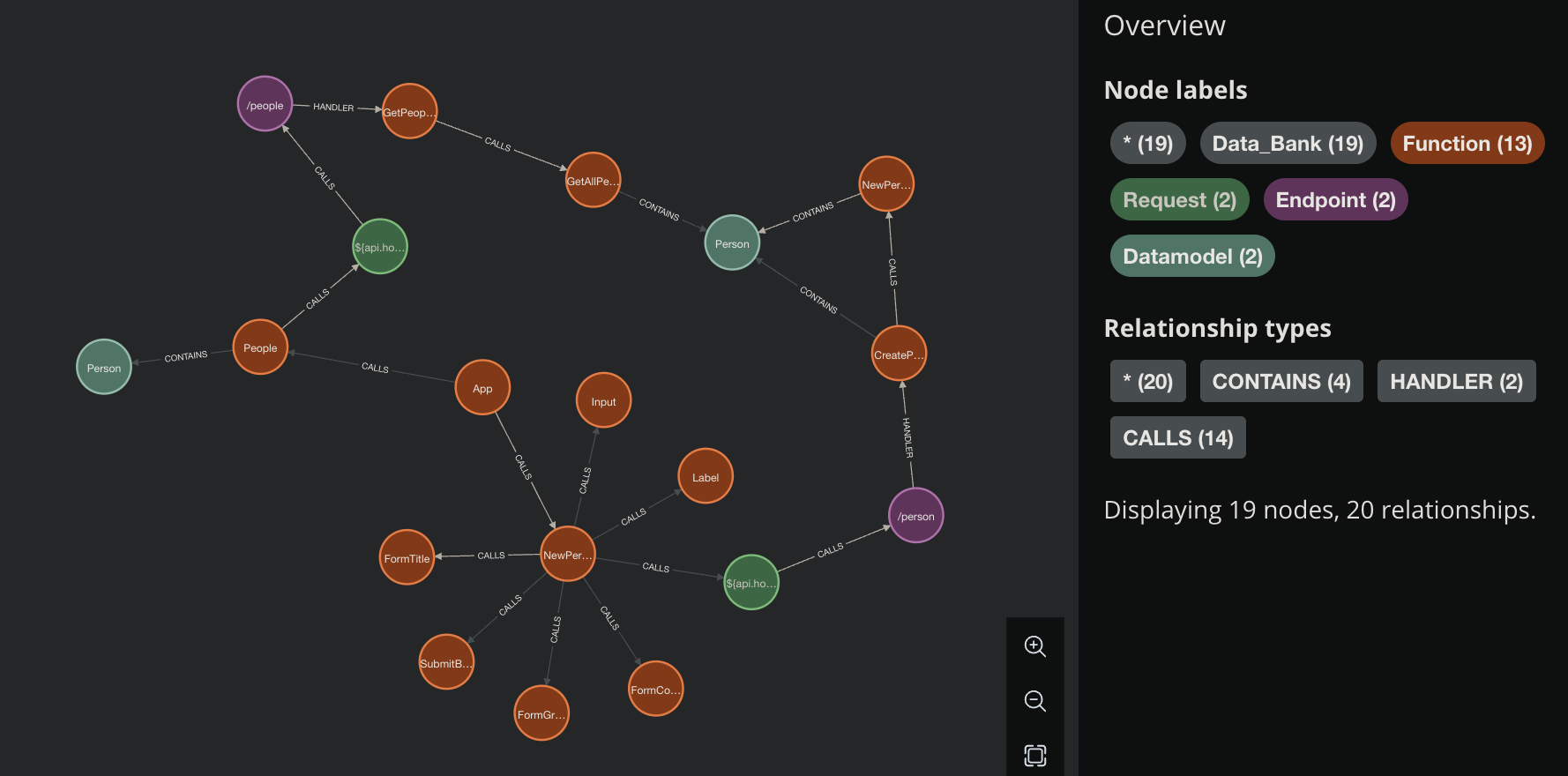 The graph stores 21 node types and 13 edge types. Query with Cypher, search with fulltext or vector similarity, or use the MCP tools.
### Vector search
Code is embedded using **BGE-Small-EN-v1.5** (384 dimensions) via fastembed. Weighted pooling prioritizes function signatures. Search semantically across the entire codebase:
```
POST /search
{ "query": "user authentication middleware", "limit": 10 }
```
### API endpoints
| Endpoint | Description |
| --------------------- | --------------------------------------- |
| `POST /process` | Parse and index a repository |
| `POST /embed_code` | Generate embeddings for code |
| `GET /search` | Fulltext or vector search |
| `GET /map` | Relationship map from a node |
| `GET /shortest_path` | Path between two nodes |
| `GET /tests/coverage` | Test coverage analysis |
| `POST /ingest_async` | Background repo ingestion with webhooks |
---
## Architecture
```
stakgraph/
├── ast/ # Core Rust library: tree-sitter parsing → graph of nodes & edges
├── cli/ # CLI binary: parse, summarize, diff
├── lsp/ # LSP integration for precise symbol resolution
├── standalone/ # Axum HTTP server wrapping the ast library
├── mcp/ # TypeScript MCP server with agents, gitree, vector search
└── shared/ # Shared types
```
The `ast` crate is the engine. It takes source files, runs tree-sitter queries to extract nodes, resolves cross-file calls (optionally via LSP), and produces a graph. The graph can be:
- **In-memory** (`ArrayGraph`) -- used by the CLI, fast, no dependencies
- **Neo4j** (`Neo4jGraph`) -- persistent, queryable, used by the server
---
## Contributing
```bash
cargo test # run tests
USE_LSP=1 cargo test # run tests with LSP resolution
```
You may need to install LSPs:
```bash
# TypeScript
npm install -g typescript typescript-language-server
# Go
go install golang.org/x/tools/gopls@latest
# Rust
rustup component add rust-analyzer
# Python
pip install python-lsp-server
```
---
The graph stores 21 node types and 13 edge types. Query with Cypher, search with fulltext or vector similarity, or use the MCP tools.
### Vector search
Code is embedded using **BGE-Small-EN-v1.5** (384 dimensions) via fastembed. Weighted pooling prioritizes function signatures. Search semantically across the entire codebase:
```
POST /search
{ "query": "user authentication middleware", "limit": 10 }
```
### API endpoints
| Endpoint | Description |
| --------------------- | --------------------------------------- |
| `POST /process` | Parse and index a repository |
| `POST /embed_code` | Generate embeddings for code |
| `GET /search` | Fulltext or vector search |
| `GET /map` | Relationship map from a node |
| `GET /shortest_path` | Path between two nodes |
| `GET /tests/coverage` | Test coverage analysis |
| `POST /ingest_async` | Background repo ingestion with webhooks |
---
## Architecture
```
stakgraph/
├── ast/ # Core Rust library: tree-sitter parsing → graph of nodes & edges
├── cli/ # CLI binary: parse, summarize, diff
├── lsp/ # LSP integration for precise symbol resolution
├── standalone/ # Axum HTTP server wrapping the ast library
├── mcp/ # TypeScript MCP server with agents, gitree, vector search
└── shared/ # Shared types
```
The `ast` crate is the engine. It takes source files, runs tree-sitter queries to extract nodes, resolves cross-file calls (optionally via LSP), and produces a graph. The graph can be:
- **In-memory** (`ArrayGraph`) -- used by the CLI, fast, no dependencies
- **Neo4j** (`Neo4jGraph`) -- persistent, queryable, used by the server
---
## Contributing
```bash
cargo test # run tests
USE_LSP=1 cargo test # run tests with LSP resolution
```
You may need to install LSPs:
```bash
# TypeScript
npm install -g typescript typescript-language-server
# Go
go install golang.org/x/tools/gopls@latest
# Rust
rustup component add rust-analyzer
# Python
pip install python-lsp-server
```
---
github.com/stakwork/stakgraph