I feel no joy when my prophecies about digital identity systems come true. This is because from a Popperian perspective these are low-risk prophecies. I had said that all centralised identity databases will be breached in the future. That may or may not happen within my lifetime, so I can go to my grave without worries about being proven wrong. Therefore, the task before a security developer is not only to reduce the probability but, more importantly, to eliminate the possibility of certain occurrences.
The blame for fragility in digital identity systems today can be partially laid on a World Bank document titled Ten Principles on Identification for Sustainable Development, which has contributed to the harmonisation of approaches across jurisdictions. Principle three says, "Establishing a robust — unique, secure, and accurate — identity." The keyword here is "a". Like The Lord of the Rings, the World Bank wants "one digital ID to rule them all". For Indians, this approach must be epistemologically repugnant as ours is a land which has recognised the multiplicity of truth since ancient times.
In Identities Research Project: Final Report, funded by the Omidyar Network and published by Caribou Digital, the first key finding is that people have always had, and managed, multiple personal identities. Another finding shows that people select and combine different identity elements for everyday transactions. For laypersons, the essential takeaway is that a single national ID for all persons and all purposes is not only unworkable but also historically inaccurate.
To prevent an identity monoculture, nations can explore several models. The United States follows a traditional approach with multiple valid identification documents, while the United Kingdom uses a system of interoperable identity providers. India could adopt tokenisation — a process where each Authentication User Agency (AUA) and KYC User Agency (KUA) receives a cryptographically unique identifier, preventing cross-database correlation. This method was first proposed in the 2016 IIT Delhi paper Privacy and Security of Aadhaar: A Computer Science Perspective by Shweta Agrawal, Subhashis Banerjee, and Subodh Sharma.
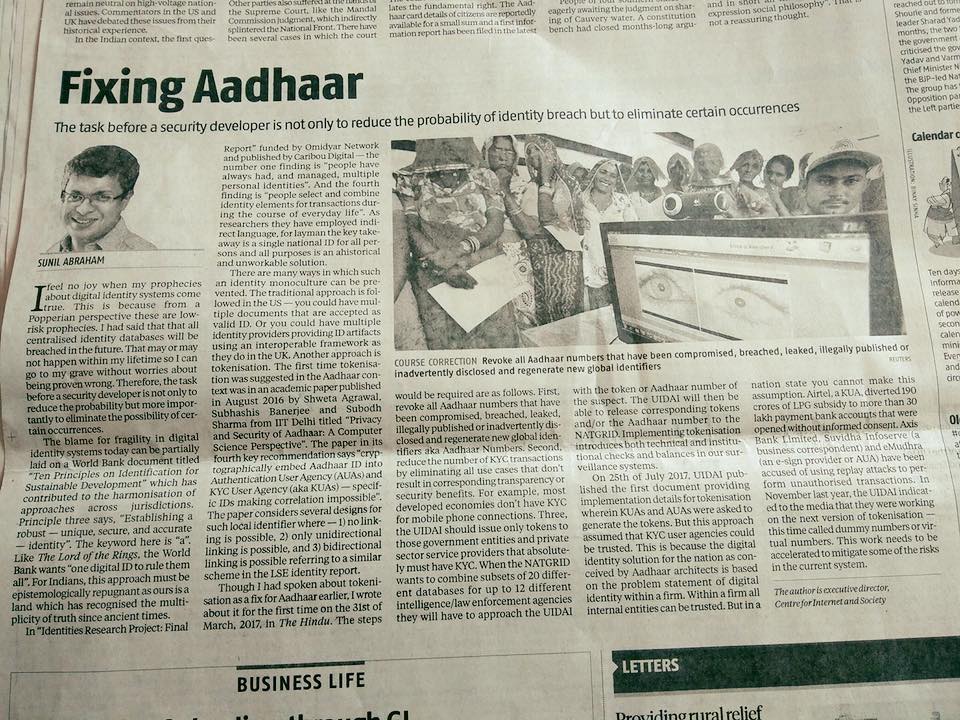
Revoke all Aadhaar numbers that have been compromised, breached, leaked, illegally published, or inadvertently disclosed, and regenerate new global identifiers. Tokenisation and multiple identity providers offer systemic resilience. They not only trim the chances of identity data breach but can eliminate the possibility of a nationwide compromise. The challenge before India's security developers is therefore not just to make Aadhaar harder to hack, but to re-architect it so that no single breach can ever expose the entire population's data.