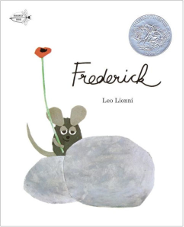
--- layout: default title: 'Frederick' description: "Sunil Abraham's use of Leo Lionni's children's book Frederick as a framework for examining attribution, tangible and intangible labour, and the intellectual property regime." categories: [Resources, Sunil Abraham, TSAP Originals] permalink: /frederick/ created: 2026-06-28 --- {% include under-construction.html %} **Frederick** examines [Sunil Abraham](/sunil/)'s use of Leo Lionni's 1967 children's picture book *Frederick* as a framework for discussing attribution, tangible and intangible labour, intellectual property, and, more recently, artificial intelligence. Rather than treating the book solely as a work of children's literature, Abraham uses it as a thought experiment to explore broader questions concerning creativity, attribution, labour and the organisation of knowledge. The earliest documented use of the book in Abraham's work appears in his 2013 presentation *Freedom Continuum: From Access to Knowledge to Privacy*, where it is cited as the concluding reference for one of the presentation's central propositions: "If attribution is not sacred then intangible labour is not more important than tangible labour and vice versa." During the presentation, Abraham briefly introduces *Frederick* as the story of a mouse engaged in intangible labour and describes the book as his "scholarly reference" for that conclusion. Abraham later returned to *Frederick*, including during a Summer School session in June 2026, in which the story was narrated in greater detail. He extended the thought experiment through a series of hypothetical continuations examining copyright, state enforcement, inheritance of rights, and debates surrounding artificial intelligence and what has been described as "creativity privilege". This article examines the role of *Frederick* in Abraham's work, placing the original story in the context of the *Freedom Continuum* and tracing how it developed into a broader thought experiment on the intellectual property regime. ## Contents 1. [Background](#background) 2. [Frederick and the Freedom Continuum](#freedom-continuum) 3. [The Story of Frederick](#story) 4. [Frederick as a Lens for the Intellectual Property Regime](#ip-regime) 5. [Continuing the Thought Experiment](#thought-experiment) 6. [References](#references) 7. [External links](#external-links) ## Background {#background} Leo Lionni's *Frederick* has been used by Sunil Abraham as a framework for examining questions of attribution, tangible and intangible labour, and the intellectual property regime. Rather than approaching the book as a work of children's literature alone, Abraham has used its central idea to explore how societies recognise creative labour and the relationship between social recognition and legal rights. In later discussions, Abraham extended the same framework to contemporary questions surrounding artificial intelligence and the training of generative models. Although *Frederick* is not a book about copyright or intellectual property, Abraham has used it as a thought experiment through which these subjects can be examined. In Abraham's reading, the story presents a voluntary social arrangement between creative and physical labour without invoking legal rights, licensing or state enforcement. This allows Abraham to ask how intellectual property regimes emerge, how they evolve, and whether they continue to serve the social purposes they were originally intended to achieve. This article examines Abraham's use of *Frederick* through his lectures, presentations and subsequent reflections. It begins with the role played by the book in the *Freedom Continuum* presentation before summarising the original story and examining how Abraham extends it into a broader critique of attribution, copyright, inherited rights and artificial intelligence. ## Frederick and the Freedom Continuum {#freedom-continuum} {% include notice.html message="Primary source: Freedom Continuum: From Access to Knowledge to Privacy (Transcript)" %} Sunil Abraham first referred to *Frederick* during his presentation *Freedom Continuum: From Access to Knowledge to Privacy*, delivered at the Third Global Congress for Intellectual Property and the Public Interest in Cape Town on 11 December 2013. The presentation proposed a "freedom continuum" for understanding different approaches to knowledge production, sharing and control. Rather than treating intellectual property as a binary choice between openness and restriction, Abraham described a spectrum extending from proprietary models through free and open licensing to piracy, anonymity and practices that challenge attribution itself. Throughout the presentation, Abraham treated attribution as the principal point of distinction along the continuum. The framework compared proprietary licensing, the GNU General Public License, the BSD licence, Creative Commons licences, piracy, Anonymous and the Yes Men, before concluding with three principal takeaways. The final takeaway stated: "If attribution is not sacred then intangible labour is not more important than tangible labour and vice versa." Rather than concluding with a conventional academic citation, Abraham directed the audience to *Frederick* by Leo Lionni. Instead of citing a legal scholar, philosopher or policy text, Abraham concluded the presentation by referring the audience to a children's picture book. Abraham briefly described the book as "the story of a mouse that engages in intangible labour, producing poetry and making speeches, who lives with a family of other mice that engage in tangible labour, and how they have a deal amongst themselves and how they work for one another." He concluded by describing the book as "my scholarly reference for this research finding." Although the presentation did not retell the story in detail, it established *Frederick* as the conceptual bridge between the Freedom Continuum and Abraham's later discussions on labour, attribution and intellectual property. Unlike the original presentation, this article also considers later discussions in which Abraham expanded the thought experiment beyond Leo Lionni's original story to explore questions of copyright, inheritance, state enforcement and artificial intelligence.
Video. Freedom Continuum: From Access to Knowledge to Privacy, presented by Sunil Abraham in Cape Town on 11 December 2013 at the combined Third Global Congress on Intellectual Property and the Public Interest and Open AIR Conference on Innovation and IP in Africa.
Presentation slides. Slide deck for Freedom Continuum: From Access to Knowledge to Privacy, preserved on the Centre for Internet and Society website.
If the PDF viewer does not load properly, please refresh the page or download the slides directly.