Checked before it runs. Run with the model you choose. Proven afterwards.
Nika turns the AI work you repeat into a readable workflow that stays yours.
“Read my invoices. Ignore rejected ones. Sum by customer. Pay only after I approve.”
▶ The 30-second film, with sound (MP4) ·
an illustration with fixture data, not a recording: the program it draws passes the real check, and the
film notes say what is real and what is illustrated.
## What is Nika?
Nika turns repeatable AI work into a small file you keep. Say what you
want done, like *"every Monday, pull the action items out of my meeting
notes"*, and Nika writes it as a readable `.nika` workflow. Before
anything runs, its check shows what the workflow will do, which models
and tools it uses, what it is allowed to touch and what it can cost,
without calling a model. You run it when you decide, with the model you
choose, local or cloud, and every run leaves a tamper-evident record you
can verify. One Rust binary, local-first, open source (AGPL-3.0).
| 1 · Say it | 2 · Check it | 3 · Run it | 4 · Prove it |
|:---:|:---:|:---:|:---:|
| Describe the job; Nika writes a `.nika` file (or `nika compile` from a skeleton) | `nika check` audits it before any model is called | `nika run` with the model you choose | `nika trace verify` checks the run's record |
## See it in four steps
### 1 · Say it
Describe the job in plain words. Nika writes it as a `.nika` file, shows
you what it will do and what it can touch, and saves it only when you say
`yes`. Nothing runs until you ask.
One sentence becomes a checked file; yes saves it, run it keeps the two paid rows, and /proof shows what the run recorded. The real Session, restyled; no AI model involved.
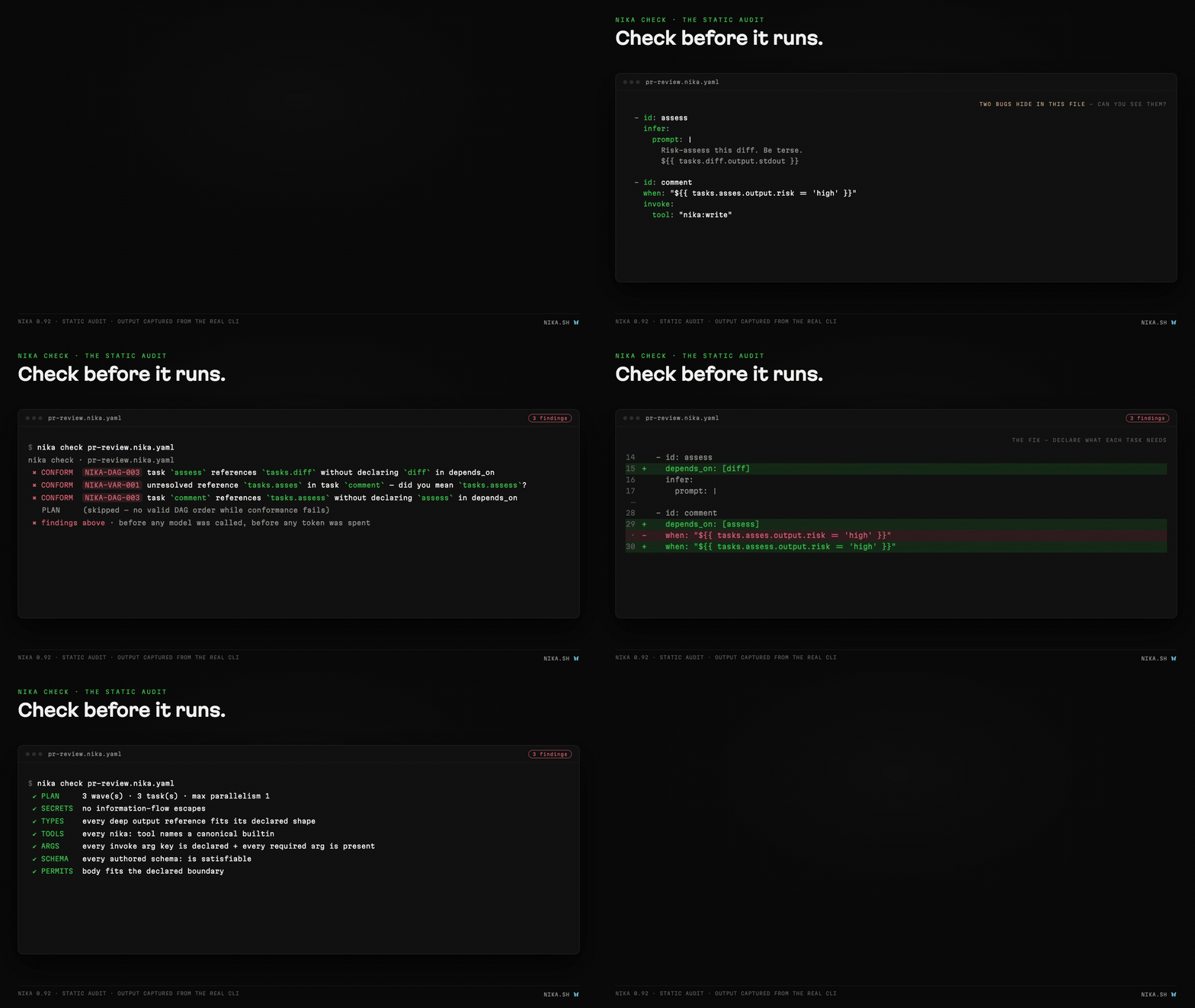
### 2 · Check it
Before anything runs, `nika check` reads the file and reports what it
will do, what it may touch and what it can cost. It calls no model and
spends nothing.
Two mistakes caught before anything runs, the fix, and the clean re-check. Every line is captured from the real CLI.
### 3 · Run it
You run it when you decide, with the model you choose. Here a local
model, through Ollama, writes a meeting's action items as typed JSON.
The audit first, then a real run on a local model (ollama/llama3.2:3b). Nothing leaves the machine.
### 4 · Prove it
Every run leaves a hash-chained record. `nika trace verify` reads it
back, and when a single byte changes it names the line where the chain
breaks.
The chain read back intact, then one changed byte refused at the next line. A mock/echo rehearsal captured from the real CLI; the scan is an illustration.
## You stay in control
### It tells you the cost before the first token
`nika check` prices a workflow from its model's catalog price and the
output limit each step declares. Set a budget below that ceiling and the
run refuses to start: no model is called and nothing is spent.
Unbounded until one line declares max_tokens, then a hard ceiling of $0.0614; a $0.05 budget refuses the run (exit 2). Prices are catalog estimates, not invoices; no model was called.
### It asks before it acts
A step can wait for a person. At your terminal it asks; in CI, where
nobody can answer, the run pauses safely with exit 4 and prints the one
line that resumes it.
Nothing ships without a yes: asked at a terminal, paused in CI, resumed by the printed line with the finished build reused. Every terminal line is captured from the real CLI; the door is an illustration.
## Try it in two minutes
### 1 · Install
```sh
curl -LsSf https://nika.sh/install.sh | sh
```
Homebrew, npm, a release archive, Nix or Windows
- **Homebrew:** `brew install supernovae-st/tap/nika`
- **npm**, the binary plus a TypeScript client:
`npm install @supernovae-st/nika` (the `nika` command lands in
`node_modules/.bin`). The npm package can trail the latest release:
check `nika --version`.
- **A release archive:** download one from the
[latest release](https://github.com/supernovae-st/nika/releases/latest);
every release ships SLSA provenance you can verify. The
[install guide](https://nika.sh/install) shows how.
- **Nix:** the repository has a flake. It builds the default branch,
which can be ahead of the latest release.
- **Windows:** use WSL2. Native Windows binaries are not shipped yet.
### 2 · Say what you want
This first job needs no AI account: Nika's deterministic compiler settles
it without calling a model. Make a folder with a small spreadsheet and
open the Session:
```sh
mkdir -p orders-demo/data && cd orders-demo
cat > data/orders.csv <<'EOF'
order_id,customer,status,amount
1001,Juniper Books,paid,18.00
1002,Kestrel Cafe,pending,9.50
1003,Linden Studio,paid,13.50
1004,Moss Supply,refunded,6.00
EOF
nika
```
At the prompt, type:
```text
Read ./data/orders.csv, keep only the rows whose status is paid, and write them to ./out/paid.csv.
```
Nika proposes a `.nika` file and shows what it will do, what it can touch
and the result of its check. **Nothing has run yet.** Type `yes` to save
the file, then `run it`. `out/paid.csv` gets the header and the two paid
rows, and `/proof` shows what the run's record proves, and what it does
not.
> [!TIP]
> Nika works only inside the folder you start it in. `/show` prints the
> proposal's exact bytes, `/meaning` maps your request clause by clause,
> and `no` discards it. `Ctrl+T` switches the view to full screen and back,
> and `nika --plain` gives the same Session as plain lines. The
> [Session guide](docs/usage/conversational-session.md) covers questions,
> changes, spending ceilings and `/restore`.
### 3 · Add a model
Most open-ended requests need a model to write the workflow, and
workflows such as summaries call a model each time they run. Nika reads
provider keys from your environment, so keep yours in your shell startup
file. For DeepSeek:
```sh
# in ~/.zshrc or ~/.bashrc, then open a new terminal
export DEEPSEEK_API_KEY='your-key'
```
The first request that needs a model shows a numbered choice: answer
`2 deepseek/deepseek-flash`. Nika keeps the choice for later Sessions, and
`/intelligence` changes it. Other API providers and local engines
(Ollama, llama.cpp, LM Studio, vLLM) work too: `nika catalog` lists them.
Your provider meters and bills these calls; Nika's cost figures are
catalog estimates, not invoices.
### 4 · Use the file directly
A workflow is an ordinary file. The command line compiles, checks, runs
and verifies it. This offline lesson needs no provider:
```sh
nika compile hello hello.nika
nika check hello.nika
nika run hello.nika
nika trace verify
```
▶ [Watch these four commands run](media/gifs/full-loop.optimized.gif), exactly as captured from the CLI.
`hello` always uses `mock/echo`, a stand-in model that echoes the prompt,
even when provider keys are present. It proves that the workflow runs, not
that a model answered. Each run records its trace under `.nika/traces/`,
and creating the file adds that directory to `.gitignore`.
`nika trace verify` checks the latest trace's integrity, not the truth of
an AI answer.
## What you can hand to Nika
| You say | Nika keeps | Watch |
|---|---|---|
| *"Read `./data/orders.csv`, keep only the rows whose status is paid, and write them to `./out/paid.csv`."* | A workflow that reads one file and writes one file. No AI model is involved. | [▶ The Session](media/gifs/first-session.optimized.gif) |
| *"Pull the action items out of my meeting notes."* | A workflow that asks a local model and writes the items as typed JSON. | [▶ A local run](media/gifs/nika-hero.optimized.gif) |
| *"Every Friday, turn `CHANGELOG.md` into release notes."* | A workflow your coding agent writes with the Nika plugin; the check catches its mistake before anything runs. | [▶ With your agent](media/gifs/agent-plugin.optimized.gif) |
| *"Rate the risk of each pull request."* | A workflow the Nika GitHub Action checks whenever a pull request changes it: one comment carries the verdict. | [▶ In your pull requests](media/gifs/pr-check-comment.optimized.gif) |
## Why a file, and not a chat?
A chat answer is gone when the conversation ends, and the next one can
differ. A `.nika` file stays: you read it, check it, run it again and
review its changes like any other file in your project.
- **Say it once.** The request you would retype in a chat every week is
kept as a file that runs again.
▶ [Watch a weekly request become a file](media/gifs/chat-to-workflow.optimized.gif)
- **Read it before it runs.** Every workflow has the same shape: nine
sections and four kinds of step, in a file you can open and review.
▶ [Watch one taken apart](media/gifs/spec-anatomy.optimized.gif)
- **It touches only what it declares.** The file lists what it may read,
write and reach. The check refuses the step that reaches past it.
▶ [Watch the check catch an escape](media/gifs/permits-audit.optimized.gif)
- **Failures are planned for.** A step can name its fallback: the run
finishes, the output says it is stale, and the record keeps the failure.
▶ [Watch a missing feed absorbed](media/gifs/on-error-recover.optimized.gif)
- **Parallel where it can be.** Steps that do not depend on each other
run side by side, in waves the check plans before the run.
▶ [Watch a workflow run in waves](media/gifs/dag-execution.optimized.gif)
Apart from the film at the top, an illustration with fixture data, every
clip on this page shows real files and terminal lines captured from the
binary, and names what it illustrates. The
[media index](media/README.md#feature-clips) lists them all and how they
are made.
## Works where you already work
Nika comes to the tools you already use. Your coding agent can write the
file for you, and the check keeps it honest:
Your agent writes it, Nika checks it, you keep it. The agent session is an illustration; the checks and the rehearsal run are captured from the real CLI.
| Where | What you get | Watch |
|---|---|---|
| **Your coding agent** · [nika-plugins](https://github.com/supernovae-st/nika-plugins) | Claude Code, Codex, Cursor and others learn to write a workflow, check it and repair what the check finds. | ▶ [above](media/gifs/agent-plugin.optimized.gif) |
| **Your editor** · [nika-vscode](https://github.com/supernovae-st/nika-vscode) | Errors as you type, and your workflow as a live graph. | ▶ [The audit, as you type](media/gifs/editor-diagnostics.optimized.gif) |
| **Your pull requests** · [nika-action](https://github.com/supernovae-st/nika-action) | One comment with the verdict, before anyone spends a token. | ▶ [Every pull request gets a verdict](media/gifs/pr-check-comment.optimized.gif) |
| **Your app** · [nika-client](https://github.com/supernovae-st/nika-client) | Run a workflow from TypeScript ([the package](https://www.npmjs.com/package/@supernovae-st/nika)), get a typed result and verify its receipt. | ▶ [Run it from your app, prove what ran](media/gifs/typescript-client.optimized.gif) |
## Know the limits
- **Nika is pre-1.0.** The Session was qualified on six synthetic tasks
with one macOS installation of an identified development build, not the
released binary ([qualification note](docs/qa/delivery-a-2026-09.md)).
That is not a general reliability claim.
- **Some requests cannot be expressed yet.** Nika then says what stopped it
and writes nothing.
- **A clean check is not a true answer.** It describes a file's structure
and boundary; it does not prove that model output is right.
- **Public releases do not include a knowledge snapshot.** Without one,
authoring uses the language card built into the binary.
- **This README follows the source tree.** An older installed release may
lack what it describes: compare `nika --version` with the
[changelog](CHANGELOG.md). What `main` carries beyond the latest release
is described one file per change in [`changelog.d/`](changelog.d/).
The four building blocks
| Verb | What it does |
|---|---|
| `infer` | Ask a model to produce an answer |
| `invoke` | Call a native tool, MCP tool or another workflow |
| `exec` | Run a command |
| `agent` | Let a model use allowed tools for a bounded number of turns |
A workflow uses only the verbs its job needs. The film uses `invoke`
and `infer`; it does not add a shell or an agent loop to fill the diagram.
Compile from the command line
`nika compile --list` lists exact skeletons. Preview one with
`nika compile --json`, then answer its stable questions with repeatable
`--answer KEY=JSON_LITERAL`. An incomplete result includes its candidate and
questions; it does not write a file. Only a Ready candidate plus an explicit
destination writes. Existing destinations require `--force`.
For an accepted source, a conservative constant edit uses the same core:
```sh
nika compile --base workflow.nika --change 'Set const.topic to "new topic"' --json
```
Add `--output edited.nika` to materialize a Ready edit. The base source
remains explicit. Unresolved intent stays incomplete without a substitute
workflow. `--authoring-model` explicitly enables bounded model-assisted
authoring and text revisions. It sends one authoring request unless
`--authoring-max-calls N` authorizes more (an ACP harness counts one
invocation, its own requests unknown). `--authoring-strategy` selects
`escalate`, `only`, `sketch` or `off`; escalation, repairs and samples stay
within the authorized requests. The compiler checks the proposed source and
its fidelity to the request. This is not a guarantee of arbitrary-language
understanding, and Graph editing is not implemented by this CLI.
Compile's Check preview judges source only. `nika check` and `nika run` judge
the actual environment separately. For a real model, choose the provider and
access explicitly; the [model setup documentation](https://docs.nika.sh)
explains local, API and supported harness choices.
Before sharing a workflow or a run
Share the workflow, not credentials or private data. Review file paths and
tool access. Keep secrets out of source control.
Run journals can contain the data and outputs the workflow processed.
The `.nika/traces/` directory is a data-at-rest surface: it inherits the sensitivity
of everything the run read. Exclude it from Git unless you deliberately intend
to publish those records, and treat them with the same care as their source
data.
After a run, `nika trace verify` verifies the latest journal. Compare its
head with the one printed by the run. This checks the record, not the AI's
judgement.
## 🦋 The Nika family
| | Repository | What it gives you |
|---|---|---|
| 🦋 | **[nika](https://github.com/supernovae-st/nika)** | **The engine and CLI: write, check, run and verify AI workflows** |
| 📖 | [nika-docs](https://github.com/supernovae-st/nika-docs) | The documentation, live at [docs.nika.sh](https://docs.nika.sh) |
| 📜 | [nika-spec](https://github.com/supernovae-st/nika-spec) | The language specification and the suite that proves an engine follows it |
| 🧩 | [nika-vscode](https://github.com/supernovae-st/nika-vscode) | The editor extension: your workflow as a live graph, errors as you type |
| 🟦 | [nika-client](https://github.com/supernovae-st/nika-client) | Run and verify workflows from TypeScript |
| ✅ | [nika-action](https://github.com/supernovae-st/nika-action) | A GitHub Action that posts a `nika check` verdict on your pull requests |
| 🚀 | [nika-actions-starter](https://github.com/supernovae-st/nika-actions-starter) | A ready template: workflows, editor setup and CI from the first push |
| 📦 | [nika-registry](https://github.com/supernovae-st/nika-registry) | Shareable workflows, pinned and re-verified |
| 🤖 | [nika-plugins](https://github.com/supernovae-st/nika-plugins) | Teaches your coding agent (Claude Code, Codex, Cursor…) to write Nika |
| 🍺 | [homebrew-tap](https://github.com/supernovae-st/homebrew-tap) | `brew install supernovae-st/tap/nika` |
| 🐙 | [gh-nika](https://github.com/supernovae-st/gh-nika) | The Nika CLI as a GitHub CLI extension |
| 🏛️ | [nika-estate](https://github.com/supernovae-st/nika-estate) | Where each file in Nika's core repositories comes from, declared and re-checkable |
This repository is the one executable: it parses, checks, runs and traces
every workflow. The language is defined by the specification, and the other
repositories drive this engine without adding to its authority.
## Go further
[Session guide](docs/usage/conversational-session.md) ·
[Examples](examples/README.md) ·
[Documentation](https://docs.nika.sh) ·
[TypeScript SDK](https://www.npmjs.com/package/@supernovae-st/nika) ·
[Editor extension](https://marketplace.visualstudio.com/items?itemName=supernovae.nika) ·
[Open specification](https://github.com/supernovae-st/nika-spec) ·
[Registry](https://github.com/supernovae-st/nika-registry) ·
[Planning archive](https://github.com/orgs/supernovae-st/projects/3) ·
[Website](https://nika.sh)
Nika is usable today and pre-1.0. The engine is
[AGPL-3.0-or-later](LICENSE); the specification is Apache-2.0.











![A workflow of build, a human gate drawn as a door, then ship: at a terminal Nika asks Ship this build to production? [y/N] and y opens the door; in CI the run pauses with exit 4 and prints a line that, pasted and run, reuses the build and ships](media/gifs/approval-gate.optimized.gif)