# swrm
[](https://github.com/surlymochan/swrm/actions/workflows/ci.yml)
[](LICENSE)


**Claude plans. Codex, OpenCode Go and DeepSeek write the code.**
**swrm** is a distributed, heterogeneous agent task dispatcher: executors claim tasks
under lease and return with evidence, routed by live quota across model families.
> **Renamed in v0.3.1:** openswarm is now **swrm**. Old GitHub links redirect here.
> The CLI command, the skill name and install path, and the `OPENSWARM_*` environment
> variables keep the old name for now, so existing setups keep working.
## Benchmarks: swrm vs oh-my-openagent (2026-10-17)
_These results were measured before the rename, when this project was named openswarm (and its sibling
project was named OpenFlow); product names in this section have been unified to the current names
(swrm, evalid), and all versions and figures are the original measurements._
Compared with [oh-my-openagent](https://github.com/code-yeongyu/oh-my-openagent) (OmO) v5.1.35 (`0777686`), whose
`model-core` package resolves a delegated task to a model through per-category fallback chains. Scripts, raw results and
methodology: [`bench/`](bench/README.md) and [`bench/e2e/`](bench/e2e/README.md). Where OmO comes out ahead, the table says so.
**Real GitHub issues (SWE-bench Verified), 2026-10-18.** Six hard instances from sympy, pytest and pylint; success
means the official FAIL_TO_PASS and PASS_TO_PASS tests all pass. Every arm runs on the Pi coding agent with
DeepSeek-V4.1-Flash (`deepseek-flash`), n=1 per cell, 20-minute cap; details and commands are in
[`bench/swebench/`](bench/swebench/README.md).
| Arm | Resolved (official tests) | Median wall-clock (IQR) | Median $ per task (DeepSeek list price) | Total $ (all runs) | n |
| --- | --- | --- | --- | --- | --- |
| Plain agent (baseline) | 3/6 (50%) | 124 s (110–175) | $0.0234 | $0.16 | 6 |
| superpowers v7.0.0 | 2/6 (33%) | 154 s (136–340) | $0.0285 | $0.31 | 6 |
| evalid 0.2.1 | 4/6 (67%) | 230 s (200–266) | $0.0412 | $0.23 | 6 |
| swrm (planner + Pi executor) | 5/6 (83%) | 228 s (187–254) | $0.0377 | $0.21 | 6 |
| oh-my-openagent v5.1.35 | not run ¹ | – | – | – | 0 |
**Caveats:** n=1 on 6 instances, so one or two resolves are within noise. The two workflow tools took about 1.8x the
baseline's median wall-clock and cost 76% (evalid) / 61% (swrm) more per task. The first published table undercounted
pytest because of a shared temp-dir race in grading; it is now fixed and regraded
([regrade notes](bench/swebench/README.md#regrade-2026-10-18)). On the MiniMax-M3.1-Flash-Preview subset, baseline
resolved 3/4 and superpowers 2/4; swrm had no clean MiniMax run because the plan's usage cap was hit.
Raw per-run records and logs: [`bench/swebench/results/`](bench/swebench/results/). Optimization backlog from these
results: [#3](https://github.com/surlymochan/swrm/issues/3).
**Synthetic end-to-end tasks.** 8 small real tasks (4 JS, 4 Python), hidden acceptance tests applied only after the agent exits.
For these synthetic tasks, every arm runs `grok-4.7-high` through the local `cursor-agent` (swrm uses its new `--backend cursor` executor).
| Arm | Success (hidden tests) | Median wall time (IQR) | Median tokens: total / input+output | n |
| --- | --- | --- | --- | --- |
| Single agent (baseline) | 24/24 (100%) | 55 s (46–132) | 105k / 28k | 24 |
| swrm (planner + worktree executor + host verify) | 24/24 (100%) | 220 s (137–356) | 207k / 64k | 24 |
| oh-my-openagent | not run ¹ | – | – | 0 |
On tasks this small the single agent already succeeds every time. swrm's planner call and isolated, verified run
cost about 4× the time and 2× the tokens.
¹ OmO runs inside OpenCode/senpi with its own provider logins. Cursor's subscription can't serve it, and paid APIs were out of scope for
this benchmark. The estimated metered cost to run it on DeepSeek is about $1.3 ([details](bench/e2e/README.md#results-2026-10-17-first-round)).
**Routing under quota pressure.** A synthetic 80-task trace × 7 quota scenarios (560 decisions per router), with the same
providers for both routers (Codex subscription, OpenCode Go, DeepSeek). Costs are *computed* from the price tables in
`bench/prices.json` × estimated tokens. They are not bills.
| Metric | swrm | OmO | Codex-only baseline |
| --- | --- | --- | --- |
| First attempt sent to an already-exhausted quota | **0.0%** | 23.4% (254 failed attempts) | 28.6% |
| Decisions with no usable model (this provider set) | **0.0%** | 19.8% ² | 28.6% |
| Review tasks sent to a different model family | **85.7%** | 71.4% | 0% |
| Review tasks sent to a different model (same family counts) | **95.2%** | 71.4% | 0% |
| Codex 5h window used per trace pass (computed) | **0.48** | 0.85 | 1.78 |
| Metered spend, all scenarios (computed) | **$0.00** | $1.54 | $0.00 |
| Routing decision latency, in-process median | **0.014 ms** | 0.026 ms | – |
| Providers / model ids known to the router | 3 backends / 27 | **26 / 36** | – |
swrm reads quota windows before it routes, so it never spends an attempt on an exhausted plan. By design, OmO
learns about an exhausted plan from the usage-limit error and then moves to the next rung. swrm's review routing
spreads off the router's own workhorse family, so a review stays on a different family from the implementer even
when implementation work has spilled off Codex onto OpenCode Go; OmO still covers far more providers.
When quota leaves only the implementer's own family (the bench's `mixed_late_week`), a review degrades explicitly
instead of silently re-using the implementer's model: a sibling model in that family, a shifted effort, and a
`degraded: single-family` flag on the decision. Family-level independence in that scenario stays honestly at 0%;
model-level independence there is 66.7%, and 95.2% overall.
² 49 of OmO's 111 unrouted decisions are `writing` tasks. In OmO that chain only names Google/Anthropic models, which this provider set does not connect.
swrm is a distributed, heterogeneous agent task dispatcher for coding agents: it routes each task by live
quota across model families. Your planner (Claude Code) breaks work into tasks and
reviews the results. swrm sends each task to the cheapest executor that can handle it, runs it in an
isolated git worktree with a hard time budget, checks the result on the host, and reports back. Nothing
runs forever.
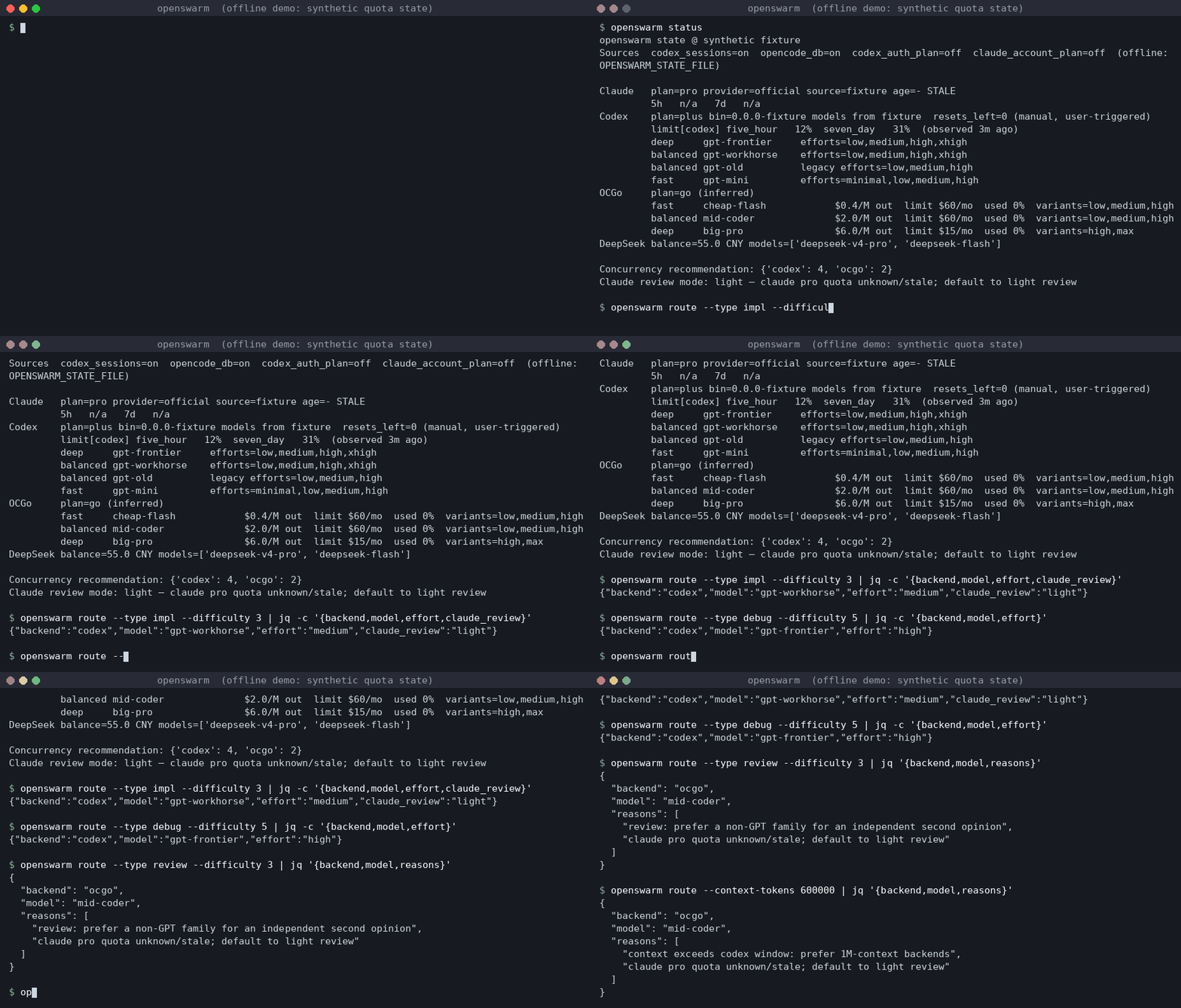
The demo runs offline against a synthetic quota state (`examples/demo-state.json`), so you can reproduce
it without any backend installed.
## Why
If you pay for several AI subscriptions, the scarce one is usually the planner. Claude Pro runs out long
before a Codex or OpenCode Go plan does. Spending Claude tokens on typing out a refactor wastes the
expensive model.
swrm splits the work:
- **Claude** decomposes the task, writes acceptance criteria, reviews diffs and integrates.
- **Executors** do the typing:
- [Codex CLI](https://github.com/openai/codex) is the main executor.
- [OpenCode](https://opencode.ai) Go and DeepSeek are opt-in backends: force either with `--backend`, or add it to `routing.default_order` to enable automatic routing.
- Automatic routing defaults to Codex only; configured OpenCode Go and DeepSeek can handle mechanical work, non-GPT second opinions, overflow, and large context.
- Cursor CLI (`cursor-agent`) runs only when you pass `--backend cursor`, or when you add `cursor` to `routing.default_order`. It is not part of automatic routing.
Routing decisions use live quota data, not guesses.
## Features
- **Live model discovery.** Reads the current Codex and OpenCode model catalogues and sorts them into tiers (fast, balanced, deep). Legacy models go last.
- **Quota-aware routing.** Looks at 5-hour, 7-day and 30-day windows, burn pace and reset times:
- At the soft limit, easy work spills to other enabled backends.
- A hard limit skips the backend.
- Quota that is about to expire unused gets spent at higher effort.
- **Pre-dispatch health gate (M24, #198; on by default since M32 #259).** Before `openswarm run` dispatches, it probes the selected backend — login/session alive (`codex login status`, `agy models`), quota probe readable, transport reachable (isolated Pi broker socket, or the provider endpoint for plain Pi) — whichever applies to that backend type. An unhealthy backend is refused with an actionable error (`health_gate_blocked`, exit 2) and the decision is recorded in the ledger and `result.json` as `health_gate` (verdict, reason, per-check evidence pointers). The gate never reroutes to another backend, and an explicit `--backend` is gated exactly like a routed pick. Probes are read-only and bounded by `routing.health_gate.timeout_seconds` (default 10s) for the gate's own checks (a configured quota command source keeps its own 10s cap, same as `openswarm quota`); a probe that cannot finish in time is verdict `unknown`, recorded explicitly — `on_unknown: allow` (default) dispatches with the unknown verdict on the record, `on_unknown: block` refuses. Disable with `routing.health_gate.enabled: false` or `--no-health-gate`; `--health-gate` forces it on for one run; `--skip-health-gate` bypasses it for one run and the bypass itself is recorded. M33 slice 1 (#263) closes the last gap: the auto-rework escalation pick is gated the same way (stage `escalation`) — an unhealthy target blocks the rework dispatch, recorded in `result.auto_rework.escalation.health_gate` (and the ledger, same record), with no exec attempt and no reroute to the exhausted origin backend or a third backend; `on_unknown` applies as configured. M25 (#202) extends the same gate to batch cards: each card's selected backend is probed before dispatch, an unhealthy backend blocks just that card (ledger `blocked/health-gate`, no exec attempt, never rerouted), and the other cards are unaffected. M25 slice 2 (#204) extends it to `fleet exec`: a forwarded `run` is gated on its effective backend before forwarding (`fleet exec --health-gate -- run ...`); an unhealthy backend is refused (ledger `blocked/health-gate`, exit 2, no exec attempt on any host, never rerouted), and the gate flags are not forwarded to the remote run. M31 slice 1 (#254) moves the fleet/batch probe to the executor host (`openswarm health-probe`, run on the target host over its transport): the gate decides per host, so a healthy remote host is no longer mis-blocked by the controller's state, and the ledger `fleet_health_gate` entry carries the host dimension (`probe_host` / `probe_side: executor`); a probe that cannot be read back is verdict `unknown`, never a silent allow.
- **Declarative custom backends.** Any CLI agent joins routing from one JSON config file — no code changes. See [Custom backends](#custom-backends).
- **Isolated execution.** Each run gets its own `git worktree` and `openswarm/` branch.
- Dependency dirs (`node_modules`, `.venv`) are symlinked in and never committed.
- For a workspace that must install dependencies inside each worktree, set `workspace.prepare`; it runs before
execution and again before verification when a lockfile changed, and replaces configured dependency links.
- Nothing is pushed.
- **Hard budgets.** For local runs and lanes, `--budget-minutes` starts when execution first acquires capacity and kills the executor's whole process tree when exceeded. Capacity waits do not consume the budget; their total is recorded as `queued_seconds` in the result. There is no default queue time limit. GitHub Issue bus runs also have a separate planner timeout that starts before the issue is created. Watchers expire too, and you re-arm them on purpose.
- **Host-side verification.** `--verify ''` runs your test command on the committed worktree.
- Its exit code overrides the executor's self-report.
- `--verify-baseline` ignores failures that already exist on the base commit.
- `--auto-rework [N]` dispatches up to N automatic reworks on verify failure (default 2 when the flag has no value), each with the fresh failing tests and output tail injected into the rework prompt and re-verified after each; when retries are exhausted it escalates once to a stronger backend tier and re-verifies; the loop is recorded in `result.auto_rework` and the ledger.
- **Automatic fallback.** One-shot Pi, Codex and Cursor runs retry visible 429s in the same session; other fallback-eligible rate limits and model-at-capacity errors can move to another backend.
- **Rate-limit recovery and provider caps.** Resident lanes retry visible provider 429s in the same session using `rate_limit.backoff_seconds` (default `[30, 60, 120, 240]`) and `rate_limit.max_retries` (default `4`). `concurrency` accepts provider/backend caps plus `total`; defaults are `{"codex": 4, "minimax-cn": 6, "total": 10}`. Excess local turns queue across lanes and runs.
- **Risk alerts.** `openswarm watch` streams progress and flags dangerous executor commands (push, `rm -rf ..`, secret prints, `sudo`, publish). It also reports stalls and heartbeats.
- **Planner-friendly.**
- `SKILL.md` teaches Claude Code the whole loop.
- `templates/openswarm-workflow.js` fans tasks out in parallel.
- `openswarm report` gives scheduled check-ins.
- **GitHub issue bus.** Routes tasks to uncontrolled external executors through a dedicated repository, while controlled hosts continue to use SSH fleet lanes.
- **Learning loop.** The ledger records the pass decision, the injected lessons and patterns, and the routing advice of every run. `lessons propose`, `patterns propose`, and `retro` turn those records into reviewable drafts.
- **Zero dependencies.** One Python file using only the standard library.
## Quickstart
Requirements: Python 3.9+, git, and at least one executor: `codex` CLI logged in, `opencode` with an
OpenCode Go plan, or a DeepSeek API key.
```bash
# 1. Install as a Claude Code skill
git clone https://github.com/surlymochan/swrm.git ~/.claude/skills/openswarm
alias openswarm=~/.claude/skills/openswarm/bin/openswarm
# 2. See what you have: plans, quotas, models, recommended concurrency
openswarm status --refresh
# 3. Ask where a task would go, without running anything
openswarm route --type impl --difficulty 3
# 4. Run a task in an isolated worktree with a 15-minute budget and a host-side test gate
cat > /tmp/task.md <<'TASK'
Add input validation to src/parse.ts: reject empty strings with a ParseError.
Acceptance: new unit test in test/parse.test.ts passes; existing tests still pass.
TASK
openswarm run --cwd ~/code/myrepo --type impl --difficulty 2 --budget-minutes 15 \
--verify 'npm test' --task-file /tmp/task.md
# 5. Review and merge (openswarm never merges or pushes for you)
git -C ~/code/myrepo merge --no-ff openswarm/
```
For longer work, detach and watch:
```bash
openswarm run --detach --cwd ~/code/myrepo --verify 'pytest -q' --task-file /tmp/task.md # prints {"id": ...}
openswarm watch # one line per actionable event; exits on DONE or after 28 min
openswarm watch --quiet # alerts, heartbeats and terminal events only
openswarm watch --wake --consumer planner
# Bash-friendly blocking wait; exits on next actionable event
openswarm watch --all --wake --cursor-file "$OPENSWARM_HOME/cursors/all.json"
# include runs created later and resume from saved offsets
openswarm resume # recover live runs, busy lanes and recent results after planner restart
openswarm resume --since-hours 12 --json
openswarm report --since-minutes 60 # one-screen digest for scheduled check-ins
openswarm stop # kill the executor; partial work is still committed to its branch
```
Pi messages appear once at `message_end`; Cursor chunks are merged until a prompt turn ends or a tool call starts.
With `--wake` (equivalently `--max-minutes 0`), a cursor records event offsets and reported terminal states, so re-arming `--all` advances
past completed runs. Watchers sharing a consumer or cursor file serialize under an exclusive lock.
Each wake line includes a stable `id=` for consumer deduplication. Progress is saved atomically
only after stdout has been written and flushed (at-least-once delivery). Output failure leaves the event
pending; interruption or checkpoint failure after flushing can replay the same ID on restart.
`--from-end` skips existing bytes only for files without a saved cursor; saved progress takes precedence.
Replaced or detected truncated event files restart at byte zero with a new generation ID. Size, a cursor
anchor and nanosecond mtime detect truncation, including identical same-size rewrites; metadata changes
without growth conservatively replay. Ordinary appends and renamed files retain their progress.
Copytruncate followed by growth with an identical consumed prefix cannot be distinguished from an append;
use rename/create rotation (a new inode) to preserve delivery across generations. STALL notifications re-arm
after new log activity and carry a new delivery ID for the new episode.
Codex events keep their existing behavior. `--quiet` keeps only `DONE`, `EXITED`, `RISK`, `STALL`, `ERROR`,
`BUDGET`, `ATTEMPT`, and `HEARTBEAT`. Heartbeats include elapsed time, command count, the worktree's git diff
summary (including lane worktrees), and the last completed message truncated to 200 characters. The watch window
still expires with `--quiet`; re-arm with `--from-end` if needed.
## Command reference
Every subcommand, grouped by what it does. `openswarm --help` lists all flags.
### Execute
| Command | Purpose | Example |
| --- | --- | --- |
| `openswarm route` | Pick backend, model, and effort for a task profile without running anything. | `openswarm route --type impl --difficulty 3 --card-type fix` |
| `openswarm run` | Route a task, execute it in an isolated worktree, verify it on the host, and record the ledger entry. | `openswarm run --cwd ~/code/myrepo --type impl --difficulty 2 --budget-minutes 15 --verify 'pytest -q' --task-file /tmp/task.md` |
| `openswarm run --detach` | Run in the background and print the run id to watch. | `openswarm run --detach --cwd ~/code/myrepo --verify 'pytest -q' --task-file /tmp/task.md` |
| `openswarm stop` | Kill a running executor; partial work stays on its branch. | `openswarm stop ` |
| `openswarm lane up` | Start the configured lane supervisors. | `openswarm lane up C1 K1` |
| `openswarm lane assign` | Give one task to an idle lane; returns the run id. | `openswarm lane assign C1 --task-file /tmp/task.md --title "Parser fix" --verify 'pytest -q' --budget-minutes 30` |
| `openswarm lane steer` | Send a correction to the lane's active turn. | `openswarm lane steer C1 --text "Add a regression test before finishing"` |
| `openswarm lane abort` | Abort the lane's active turn. | `openswarm lane abort C1` |
| `openswarm lane status` | Show the configured lane state. | `openswarm lane status` |
| `openswarm lane down` | Stop lane turns, children, and supervisors. | `openswarm lane down C1 K1` |
| `openswarm lane launchd-plist` | Print an uninstalled LaunchAgent plist for a lane. | `openswarm lane launchd-plist C1` |
| `openswarm lane systemd-unit` | Print an uninstalled systemd unit for a lane. | `openswarm lane systemd-unit K1` |
| `openswarm batch` | Queue task cards across fleet hosts and collect their branches. | `openswarm batch --repo project --cards ./cards --hosts worker,sandbox --per-host 1 --backend pi --budget-minutes 20 --detach` |
| `openswarm batch status` | Show the state of one batch. | `openswarm batch status ` |
| `openswarm batch plan` | Validate card dependencies and print the dispatch order without launching. | `openswarm batch plan --cards ./cards` |
| `openswarm bus init` | Create the bus labels, issue template, and protocol README. | `openswarm bus init acme/openswarm-bus` |
| `openswarm bus status` | Show open bus issues with their executor and age. | `openswarm bus status --json` |
| `openswarm bus-worker` | Run the reference bus executor; `--once` claims at most one queued issue. | `openswarm bus-worker --bus acme/openswarm-bus --name runner-1 --backend codex --once` |
| `openswarm verify-remote` | Verify a fleet run's commit in a temporary worktree on another host. | `openswarm verify-remote --from worker --run --on local --verify 'pytest -q'` |
### Observe
| Command | Purpose | Example |
| --- | --- | --- |
| `openswarm watch` | Stream one line per actionable event for one or more runs. | `openswarm watch --label parser-fix` |
| `openswarm watch --quiet` | Keep only terminal, risk, stall, error, budget, attempt, and heartbeat events. | `openswarm watch --quiet` |
| `openswarm watch --from-end` | Resume a watch whose window expired; events already written are skipped. | `openswarm watch --from-end` |
| `openswarm status` | Show plans, quota windows, models, breakers, and recommended concurrency. | `openswarm status --refresh` |
| `openswarm probe` | Discover models, plans, and quotas into `$OPENSWARM_HOME/state.json`. | `openswarm probe --quiet` |
| `openswarm quota` | Read-only probe: remaining quota per backend — live built-in readings (pi MiniMax, codex, deepseek, ocgo) or its configured source. | `openswarm quota --json` |
| `openswarm run --health-gate` | Pre-dispatch health gate (M24, #198; on by default since M32 #259): probe the selected backend before dispatch; refuse when unhealthy (`health_gate_blocked`, exit 2), never reroute. `--no-health-gate` forces it off, `--skip-health-gate` bypasses it for one run (bypass recorded in ledger/result). | `openswarm run --health-gate --dry-run --cwd ~/code/myrepo --task-file /tmp/task.md` |
| `openswarm health-probe` | Read-only executor-side probe (M31, #254): backend health verdict for this host, as JSON with `--json`; the entry point the fleet controller runs on the executor host before dispatch. Exit 0 whenever the probe ran, even for an unhealthy verdict. | `openswarm health-probe --backend codex --json` |
| `openswarm runs` | Snapshot recent or active runs. | `openswarm runs --active --json` |
| `openswarm diagnose` | Classify a failed run (timeout / quota / verify-fail / exec-error / runner-error / unknown) with evidence pointers; read-only. | `openswarm diagnose ` |
| `openswarm resume` | Recover live runs, busy lanes and recent results after a planner restart. | `openswarm resume --since-hours 12 --json` |
| `openswarm report` | One-screen check-in for scheduled updates: quotas, active runs, recently finished. | `openswarm report --since-minutes 60` |
| `openswarm budget status` | Show today's executor budget usage. | `openswarm budget status --json` |
| `openswarm ingest-claude` | Record Claude plan usage from the statusline hook or from flags. | `openswarm ingest-claude --five-hour 80 --seven-day 40` |
| `openswarm fleet status` | Show reachability, paused hosts, lanes, and active runs. | `openswarm fleet status --json` |
| `openswarm fleet health` | Per-run alive/dead/zombie verdicts with evidence pointers (ledger line, pid identity, last activity); read-only by default, `--reap` explicitly reaps dead runs (M11 semantics, one ledger line per reap; zombie/alive/unknown are reported as skipped). | `openswarm fleet health --json` |
| `openswarm fleet exec` | Run an swrm command on another host; stdout and the exit code are forwarded. | `openswarm fleet exec worker -- lane status` |
| `openswarm fleet runners` | List registered runners with declared backends, capacity, and live reachability (M26 slice 1, #207). | `openswarm fleet runners --json` |
| `openswarm fleet dispatch` | Dispatch one task card to a named runner: card + worktree spec go over, the remote backend runs, result/verify/ledger pointers come back into the controller ledger (M26 slice 1, #207). | `openswarm fleet dispatch worker --repo project --task-file ./task.md --backend codex --verify 'pytest -q'` |
| `openswarm fleet dispatch-many` | Fan a directory of task cards out across registered runners, capacity-aware and least-loaded-first, in waves (M26 slice 2, #210). | `openswarm fleet dispatch-many --cards-dir ./cards --repo project --backend pi` |
| `openswarm intake` | SuperAgent autonomy layer (M27 slice 1 #213 + slice 2 #224 + slice 3 #228): deterministic Gate admission of GitHub Triggers into Tickets with sealed Mandates, Assessment second layer, and — in accept mode `on` — real dispatch through `run` with the result posted back to the source thread (`intake poll`); shadow mode still dispatches nothing. Slice 3 adds Subscription resume of ended Tickets under the same Mandate, human stop withdrawing the Mandate, operator close on verify evidence, and the read-only `attention` list. M28 (#231) adds active mode (allowlisted scope + per-thread caps + health-gate pre-check); M29 (#241) adds per-repo intake-policy and cross-repo dedup. M30 slice 1 (#247) adds `dispatch.mode=batch`: an accepted Mandate becomes batch cards (checklist items chained in M4 topo order, single-card fallback) dispatched through `execute_batch` — per-card health-gate/quota blocking, no exec attempt behind a block, one dispatch per Ticket; shipped default stays `mode=run`. M30 slice 2 (#251) adds `dispatch.mode=fleet`: the same cards dispatched in topo order across fleet runners via `fleet_dispatch_once`, each card health-gated (M25) before any exec attempt, with a Channel completion post (fleet id + per-card run ids); batch keeps its slice-1 no-post behaviour. | `openswarm intake poll --repo surlymochan/swrm --dry-run` |
| `openswarm fleet recover` | Recover outstanding remote dispatches after a disconnect: lost / recovered / finished / still-running verdicts in the controller ledger, `--redispatch` re-queues a lost task on another runner (M26 slice 2, #210). | `openswarm fleet recover --redispatch` |
| `openswarm fleet ledger pull` | Merge the host ledgers into one fleet ledger file. | `openswarm fleet ledger pull --hosts worker,sandbox` |
| `openswarm run --rework-of` | Resume an earlier run's task as a rework, linked in the ledger as `rework_of`. | `openswarm run --rework-of --cwd ~/code/myrepo --task-file /tmp/task.md` |
| `openswarm run --auto-rework` | On host verify failure, dispatch up to 2 automatic reworks (or N with `--auto-rework N`), each with the failure evidence injected, re-verifying after each; on exhaustion escalate once to a stronger backend tier; recorded in `result.auto_rework` and the ledger. | `openswarm run --auto-rework --cwd ~/code/myrepo --verify 'pytest -q' --task-file /tmp/task.md` |
### Learn
| Command | Purpose | Example |
| --- | --- | --- |
| `openswarm ledger` | List recent ledger records. | `openswarm ledger -n 20 --json` |
| `openswarm ledger --fleet` | List the merged fleet ledger. | `openswarm ledger --fleet -n 50` |
| `openswarm ledger ingest` | Link GitHub PR reviews and defect results into the fleet ledger. | `openswarm ledger ingest --repo acme/project --since 30` |
| `openswarm ledger accept` | Record a manual accept or reject decision for a finished run. | `openswarm ledger accept --reason "Verified on host"` |
| `openswarm ledger backfill-pass` | Compute `exec_pass` for older ledger records. | `openswarm ledger backfill-pass --fleet --recompute` |
| `openswarm lessons preview` | Print the lesson and pattern block a dispatch would inject. | `openswarm lessons preview --card-type fix --backend codex --paths src/file.py` |
| `openswarm lessons propose` | Draft lessons from linked P0/P1 findings of recent runs. | `openswarm lessons propose --fleet --since 30 --dry-run` |
| `openswarm lessons escalate` | Draft L3 guard proposals for recurring lessons. | `openswarm lessons escalate --dry-run` |
| `openswarm patterns propose` | Draft patterns from compare winners and repeated peer-review findings. | `openswarm patterns propose --since 30` |
| `openswarm patterns retire-check` | Propose retirement when active patterns do not improve outcomes. | `openswarm patterns retire-check` |
| `openswarm routing weights` | Compute per-backend routing metrics and write the weights file. | `openswarm routing weights --fleet` |
| `openswarm routing compare` | Compare recorded routing advice with the actual run outcomes. | `openswarm routing compare --days 30 --fleet` |
| `openswarm report --advice-accuracy` | Advice calibration table by (backend, card type): quoted vs observed pass rates. | `openswarm report --advice-accuracy [--json] [--fleet]` |
| `openswarm report --weighted-eval` | Weighted-routing counterfactual replay by (backend, card type): diverted share and expected vs actual pass rate. | `openswarm report --weighted-eval [--json] [--fleet]` |
| `openswarm report --gate-eval` | Calibration-gate flip counterfactual replay by (backend, card type): intercepted diversion share and expected pass-rate change. | `openswarm report --gate-eval [--json] [--fleet]` |
| `openswarm report --quota-eval` | Quota-aware flip counterfactual replay by (default backend, card type): rerouted/refused share and expected pass-rate change. | `openswarm report --quota-eval [--json] [--fleet]` |
| `openswarm retro` | Run the weekly retrospective: pull, ingest, backfill, weights, proposals, report. | `openswarm retro --days 7 --repos acme/project` |
| `openswarm regress run` | Run the regression card suite on a backend, a lane, or a routing mode. | `openswarm regress run --backend codex --cards card-a,card-b --label nightly --parallel 2` |
| `openswarm regress compare` | Compare two regression result files card by card. | `openswarm regress compare before.json after.json` |
A ledger record carries the outcome and what the next run learns from it: `exec_pass` and `exec_pass_reason`
(change evidence plus host verification decide the pass, not the executor's own report), `accepted`,
`accepted_reason`, `accepted_at`, `verify_rc`, `tokens`, `lessons_injected`, `patterns_injected`,
`routing_advice`, `peer_review`, `rework_of`, `host`, and `lane`. After `ledger ingest` it also carries `pr`,
`review_findings`, `merged`, and `defect_within_7d`.
### Peer
| Command | Purpose | Example |
| --- | --- | --- |
| `openswarm consult` | Ask several executors the same question in read-only mode and compare the answers. | `openswarm consult --question "Which parser change is safest?" --ask codex --ask pi --json` |
| `openswarm review` | Review a finished run's branch with a read-only executor from another model family. | `openswarm review --by codex --json` |
| `openswarm compare` | Run one card on two executor families and record the best-of-two comparison. | `openswarm compare --task-file /tmp/task.md --title "Parser fix" --a codex --b pi --verify 'pytest -q'` |
## Learning loop
The loop turns finished runs into better next runs. Each stage has its own command, and the curation commands write
reviewable drafts instead of editing the lesson or pattern catalog.
1. **Record.** Every run appends a ledger entry. Merge the host ledgers, link GitHub PR data, and record the
accept or reject decision:
```bash
openswarm fleet ledger pull --hosts worker,sandbox
openswarm ledger ingest --repo acme/project --since 30
openswarm ledger accept --reason "Verified on host"
```
2. **Inject.** `run`, `lane assign`, `batch`, and `bus-worker` add matching L2 lessons and L3 reminders to the
executor prompt, plus up to three active patterns. Preview the block before dispatching:
```bash
openswarm lessons preview --card-type fix --backend codex --paths src/file.py
```
3. **Review.** Let a second executor look at the finished branch:
```bash
openswarm review --by codex --json
openswarm compare --task-file /tmp/task.md --title "Parser fix" --a codex --b pi
openswarm consult --question "Is this retry safe?" --ask codex --ask pi
```
4. **Lessons.** Turn review findings into lesson, guard, and pattern drafts:
```bash
openswarm lessons propose --fleet --since 30
openswarm lessons escalate --dry-run
openswarm patterns propose --since 30
openswarm patterns retire-check
```
5. **Weekly retro.** One command runs the loop over the last week and writes the report:
```bash
openswarm retro --days 7 --repos acme/project
openswarm routing weights --fleet
openswarm routing compare --days 30 --fleet
```
Measure a fixed card suite the same way when an executor or a prompt changes:
```bash
openswarm regress run --backend codex --label nightly
openswarm regress compare before.json after.json
```
Drafts land in `/proposals//`, the retro report in `/retro/-W.md`,
and the regression results in `/regression/results/`. Copy a reviewed lesson into
`/lessons/` and a reviewed pattern into `/skills/` to make the next dispatch
inject it.
## Executor lessons
Dispatches read `lessons/*.yaml` from `policy.knowledge.repo` (default `~/work/agent-knowledge`). Matching L2
lessons and L3 reminders are added to the executor prompt, with at most 12 entries and 3,000 characters. A missing
repository adds no block. Use `--paths src/file.py` on `run`, `lane assign`, `batch`, or `bus-worker` to provide
path hints alongside paths named in the task card. Preview a selection with:
```bash
openswarm lessons preview --card-type fix --backend codex --paths src/file.py
```
Injected lesson ids are recorded in the run ledger's `lessons_injected` field.
Propose review-derived lessons from recent ledger runs linked to P0/P1 Codex inline findings with:
```bash
openswarm lessons propose [--fleet] [--since DAYS] [--out DIR] [--dry-run]
```
New lesson and recurrence proposals are written under `knowledge.repo/proposals//` by default. The command
tracks processed inline comment ids in `knowledge.repo/proposals/seen.json`; it never edits existing lessons.
`--dry-run` prints the proposed YAML and summary without writing proposal or seen-index files.
Escalate recurring lessons into reviewable L3 guard drafts with:
```bash
openswarm lessons escalate [--out DIR] [--dry-run]
```
The command writes `guard-.md` proposals for non-L3 lessons with at least one recurrence, including
accepted recurrence proposals still under `proposals/`. Each draft maps its root-cause class to a fixed guard kind
and includes evidence links plus the required accompanying test. `proposals/escalate-seen.json` makes runs
idempotent; escalation never edits lessons or enforcement code.
## Curated patterns
Active patterns live in `/skills/.md`; see [`skills/README.md`](skills/README.md) for the front matter
and body format. `run` and lane dispatches add up to three matching active patterns after lessons, capped at 1,500
characters total. `lessons preview` shows both selected lessons and patterns. Injected pattern IDs are recorded in
`patterns_injected` in the run ledger.
Draft candidates from compare winner proposals and repeated peer-review findings with:
```bash
openswarm patterns propose [--since DAYS]
```
Check active patterns against similar runs from the last 30 days with:
```bash
openswarm patterns retire-check
```
Retirement proposals require at least eight injected and eight control runs for the same card type and backend, with
both `exec_pass` and `accepted` rates available. Both commands write reviewable drafts under
`/proposals//`; they do not edit the pattern catalog.
## Routing weights (record-only)
`openswarm routing weights` summarizes ledger runs by backend, model and card type. It writes
`/routing/weights.json` (default sample threshold: 8); use `--fleet` to read the merged fleet
ledger or `--out PATH` to choose another output path. The effective pass rate uses manual `accepted` decisions
when present and otherwise uses `exec_pass`; the report also includes each source rate and its record count,
first-try, rework and P1+ review rates, plus median tokens and seconds. Groups below `routing.min_samples` scored
runs are marked `enough: false`.
Run `openswarm review [--by BACKEND[:MODEL]] [--json]` to review a finished run's branch against its base
with a read-only executor from another model family. Review output is saved to `runs//review.json`; the ledger
stores its reviewer, verdict, and P0/P1/P2 counts under `peer_review`, separate from GitHub's `review_findings`.
The default `review.auto_card_types` (`feature`, `fix`, `review-fix`, `migration`) starts reviews asynchronously
after a committed run. `review.prefer` selects the first available reviewer; `review.max_concurrent` bounds
automatic review jobs, while `review.timeout_seconds` and `review.max_diff_chars` cap review work.
Run the same card on two executor families with:
```bash
openswarm compare --task-file TASK.md --title TITLE \
[--a BACKEND[:MODEL]] [--b BACKEND[:MODEL]] [--verify CMD] \
[--card-type TYPE] [--budget-minutes N]
```
If either backend is omitted, compare selects an available backend from a different family. Both normal run
admissions apply the daily budget and provider concurrency caps. Each finished diff receives a cross-family
review; review errors are retained in the comparison and do not stop the other review. The winner is selected
by verification pass, fewer P0/P1 findings (when both reviews succeed), smaller changed-line count, then fewer
seconds; an exact tie has no winner. Results are saved under `runs//compare.json` and
`compare.md`; a winner also creates a `pattern-.md` proposal under
`knowledge.repo/proposals//`.
Review completed runs with `openswarm ledger accept [--reject] [--reason TEXT] [--fleet]`. The decision,
reason and timestamp are recorded atomically. `openswarm ledger ingest` sets acceptance from merged or closed
without merge PRs unless a manual decision is already present. Use `openswarm ledger backfill-pass [--fleet]` to
compute `exec_pass` for eligible older records.
`openswarm route --card-type fix` and `openswarm run --card-type fix` attach `routing_advice` when enough historical
samples exist for currently eligible backends. Advice ranks pass, first-try, rework and P1+ rates, then uses median
tokens and seconds as cost tie-breakers. With `routing.weighted: false` (explicit opt-out) it is recorded
alongside the real route and does not change the selected backend or model. The shipped default is
`routing.weighted: true` (M9, #134): the run follows the advice when its observed pass rate beats the default pick by at least `routing.advice_margin`
(default 0.10); the switch is recorded in the ledger as `weighted_routing` and on the decision as
`routed_by_advice`, and an explicit `--backend` always wins. Batch cards follow the same switch per card (M7):
each card is decided on the controller with the same code path, the advised backend is passed to the remote run,
and the per-card decision is recorded on the batch summary row and in the controller ledger as
`routed_by_advice` with both pass rates and sample counts; only a user-explicit batch `--backend` wins over it
(a backend the batch creation-time route picked is the default pick, not an explicit one). Fleet dispatch still
only records the advice. Compare recorded advice
with actual outcomes using `openswarm routing compare --days 30`. An advice outcome is shown as `not run` when the
actual route used a different backend or model, because that counterfactual was not executed.
`openswarm report --advice-accuracy` (M8, #127) aggregates those same advice records into a calibration table, one
row per (advised backend, card type): the advised pass rate is the mean of the pass rate the advice quoted on each
scored run, the actual pass rate is the observed pass rate of the runs that actually ran on the advised backend, and
the difference is `|advised - actual|`. A group is marked `MISCALIBRATED` when the difference is over 0.20 with at
least 8 scored samples. Advice the run did not follow never enters the sample count, and groups with advice records
but no scored run show `n=0` with `n/a` rates instead of invented numbers. Add `--json` for machine-readable output
or `--fleet` to read the merged fleet ledger. The command is read-only and never changes routing.
`openswarm report --weighted-eval` (M9, #132) replays those same advice records through the diversion rule
`apply_weighted_routing` enforces: a scored run would divert when the advised (backend, model) differs from the
run's own (backend, model) and the quoted advice pass rate beats the recorded actual-pick pass rate by at least
`routing.advice_margin` (equal diverts). One row per (advised backend, card type) shows the diverted share and
the expected pass rate under weighted routing — the quoted advice rate for diverted runs, the observed outcome
otherwise — against the actually observed pass rate. No per-run counterfactual outcome is invented, and groups
with fewer than 8 scored runs are flagged `small-n` (their expected delta is indicative only); groups with
advice records but no scored run show `n=0` with `n/a` rates. Add `--json` for machine-readable output or
`--fleet` to read the merged fleet ledger. The command is read-only and never changes routing; the margin it
replays is the policy's `routing.advice_margin` (default 0.10).
`routing.adaptive_margin` (M14, #156) replaces that single static margin with one computed per (backend,
card type) from ledger history. It is off by default (`false`): with it off, every decision is byte-identical to
the static-margin behaviour. With it on, each advised group is scored the same way `report --advice-accuracy`
scores it — scored runs are ledger runs whose recorded `routing_advice` named the backend, that actually ran on
it, with a known outcome — and the margin is `clamp(|advised - actual| + uncertainty, floor, cap)`, where
`advised` is the mean pass rate the advice quoted on scored runs, `actual` is the observed pass rate over those
runs, and `uncertainty` is `actual` minus its 95% Wilson score lower bound (it shrinks as the sample count grows).
Groups below `routing.adaptive_margin_min_samples` (default `routing.min_samples`, 8) are not adapted and fall back
to the static `routing.advice_margin` (0.10), as do groups with no history. `routing.adaptive_margin_floor`
(default 0.05) and `routing.adaptive_margin_cap` (default 0.30) bound every adaptive margin, so a margin is never
negative and never exceeds the cap. When a diversion uses an adaptive margin, the decision and the ledger's
`weighted_routing` record carry `advice_margin`, the full group row under `adaptive_margin` / `margin_group`, and
`margin_source: adaptive`. The switch only changes the margin threshold, never the advice computation itself; `route`,
`run --dry-run` and the real run share the single `apply_weighted_routing` decision path, and an explicit
`--backend` always wins.
`routing.calibration_gate` (M15, #160) stops following a miscalibrated advice group instead of merely raising
its margin. It is on by default (`true`, M16, #163): with it off, every decision is byte-identical to the pre-M16 behaviour.
With it on, an advised group is gated when the same M8 calibration table flags it miscalibrated — `|advised -
actual|` over `routing.calibration_gate_diff` (default 0.20) with at least `routing.calibration_gate_min_samples`
(default 8) scored runs. A gated group never diverts the run: the decision keeps the default pick, and the
ledger's `weighted_routing` record carries `gated_by_calibration: true` with `calibration_diff`,
`calibration_samples`, and the advised/actual rates, so a gated run is auditable after the fact. The gate is
re-evaluated from ledger history on every decision, so a group whose calibration recovers (new scored runs pull
the difference back under the bar) is followed again with no manual reset, and a group with too few samples or
no history is never gated. The gate only ever blocks a diversion; it never changes the advice computation, the
default pick, or the margin, and an explicit `--backend` always wins.
`openswarm report --gate-eval` (M16, #164) replays those same advice records to decide whether the gate's
shipped default should flip: for each scored run it replays the diversion rule, then asks whether the gate
would have intercepted that diversion — the advised group miscalibrated against the history recorded *before*
that run (the live gate's view at dispatch time, so a group that was miscalibrated early and recovered later
gates only the runs dispatched while it was miscalibrated). One row per (advised backend, card type) shows
the intercepted share of diversions, the intercepted runs' observed pass rate against the rate following the
advice promised, and the expected pass-rate change (Δ). Two Δs are reported because the quoted-basis one
takes advice at face value (it charges the gate for the quoted rate a blocked diversion never earned) while
the calibrated basis credits a diverted run with the advised group's observed rate instead — the calibrated
Δ is the decision metric for the flip. Intercepted run ids are listed in `--json` so the replay can be
cross-checked against the ledger's recorded `gated_by_calibration` records. Add `--json` for machine-readable
output or `--fleet` to read the merged fleet ledger. The command is read-only and never changes routing, the
shipped default, or the ledger; the gate bar it replays comes from policy (`routing.calibration_gate_diff`,
default 0.20; `routing.calibration_gate_min_samples`, default 8) and the margin from
`routing.advice_margin` (default 0.10).
`openswarm report --quota-eval` (M19, #177) replays recorded quota decisions the same way to decide whether
quota-aware routing's shipped default should flip: for each decision carrying a `quota_routing` record it
replays the live reroute rule from the dispatch-time `quota_before` snapshot and the threshold recorded
alongside it (a backend at or below the threshold no longer receives new runs), and reports one row per
(default backend, card type) with the rerouted/refused/stayed shares and the expected pass-rate change (Δ).
A rerouted run is credited with the default backend's prefix observed rate under quota-off and the target
backend's prefix rate under quota-on; a refused run takes the default's prefix rate under quota-off and 0
under quota-on, because it never dispatches. Batch/fleet decision records carry no outcome, so they enter
the shares but not the pass rates, and entries with no usable quota snapshot (quota was off at dispatch, or
a batch card blocked by a dependency) are counted as unreplayable, never guessed. The replay verdict is
cross-checked against the recorded live verdict (`rerouted`/`all_exhausted`/stayed, target included) and
mismatches are listed in `--json`, so the replay can be verified against the ledger instead of trusted.
Add `--json` for machine-readable output or `--fleet` to read the merged fleet ledger. The command is
read-only and never changes routing, the shipped default, or the ledger; a record without its own threshold
replays under `routing.quota.threshold` from policy (default 0).
Run the weekly fleet retrospective in one command:
```bash
openswarm retro [--days 7] [--out DIR] [--repos owner/name ...] [--no-pull]
```
By default it pulls fleet ledgers, ingests GitHub PR data for the selected repositories, backfills `exec_pass`,
updates routing weights, and proposes lessons (plus escalation proposals when that subcommand is available). It writes
`/retro/-W.md` and prints a JSON summary. `--no-pull` reuses the current fleet ledger;
`--out` changes the report directory. A GitHub rate limit is recorded in the report and does not stop the remaining steps.
## Resident lanes
Use lanes when you want a persistent Codex app-server, Cursor Agent ACP, or Pi RPC process that accepts one task at a time and can be
steered or aborted while working. Cursor lanes run the local `cursor-agent acp` JSON-RPC process over stdio; they do not use Cursor Cloud or HTTP. Configure `$OPENSWARM_HOME/lanes.json`:
```json
{"lanes":[
{"name":"C1","backend":"codex","model":"gpt-6-luna","effort":"xhigh","repo":"/abs/repo"},
{"name":"K1","backend":"cursor","model":"composer-2.5","repo":"/abs/repo"},
{"name":"M1","backend":"pi","provider":"minimax-cn","model":"MiniMax-M3.1-Flash","repo":"/abs/repo"}
]}
```
Each lane keeps a fixed worktree under `$OPENSWARM_HOME/lanes//wt`. Start lanes and dispatch tasks with:
```bash
openswarm lane up C1 K1 M1 # no names starts every configured lane; safe to repeat
openswarm lane status
openswarm lane assign C1 --task-file /tmp/task.md --title "Parser fix" --verify 'pytest -q' --budget-minutes 30
openswarm watch
openswarm lane steer C1 --text "Add a regression test before finishing"
openswarm lane abort C1 # openswarm stop also aborts a lane turn
openswarm lane down C1 K1 M1
openswarm lane launchd-plist C1 # prints a KeepAlive LaunchAgent plist; does not install it
openswarm lane systemd-unit K1 # prints a system systemd unit; does not install it
```
Lane runs use the normal `runs/` files, `openswarm/` commit branch, host verification, ledger, `watch`,
`runs`, and `report` paths. `--base REV` selects the commit used to reset a lane worktree for one assignment.
An optional lane `binary` absolute path overrides the detected executable, which is useful for wrappers and offline
protocol testing. Cursor defaults to model `composer-2.5`; its binary is `cursor-agent` on `PATH`, then
`~/.local/bin/cursor-agent`. ACP model selection first tries the exact configured value, then matches the part before
`[` (for example `composer-2.5` resolves to `composer-2.5[fast=true]`). A unique base-name match is accepted;
multiple matches fail with the candidate list. Lane state and the run result record the resolved value as `model`
and `resolved_model`. Codex app-server approval prompts receive a decline response. Cursor permission requests
receive the offered `allow_always` choice, falling back to `allow_once`. Cursor `lane steer` cancels the active prompt,
waits for its response, then continues in the same ACP session with the steer text as a correction.
On small Linux lane hosts, omit `--verify` so test suites and their dependencies do not compete with the agent for
memory and CPU. The planner can run acceptance checks on its host. `lane systemd-unit` prints a system service with
`MemoryMax=900M`, `CPUQuota=150%`, and `Nice=10`; review and install it separately if needed.
## Fleet and batch dispatch
Put named executor hosts in `$OPENSWARM_HOME/fleet.json`. Install the same swrm version, Python 3.9+, git,
and an authenticated executor on each host. `repos` maps the same logical repo name to each host's checkout:
```json
{"hosts":[
{"name":"local","kind":"local","repos":{"project":"~/code/project"}},
{"name":"worker","kind":"ssh","ssh":"worker-alias","openswarm":"~/.local/bin/openswarm",
"backends":["codex","pi"],"capacity":2,
"repos":{"project":"~/work/project"}},
{"name":"sandbox","kind":"instabox","box":"task-box","openswarm":"~/.local/bin/openswarm",
"repos":{"project":"~/work/project"}}
]}
```
Each host may declare `backends` (the backend ids that runner offers) and `capacity` (max concurrent
runs); both are optional — an undeclared runner is unconstrained. The registry is strictly validated
(M26 slice 1, #207, same style as custom backends): an unknown field, an unknown backend id, a duplicate
name/backend, or a non-positive capacity refuses to start with an actionable error naming the file, the
host, and the fix — never a silent downgrade. A malformed `fleet.json` is likewise refused, never
silently replaced by the local-only default. See `examples/fleet-runners.json`.
Local hosts use subprocesses; remote commands use `ssh --` or `instabox ssh --`, with timeouts.
Without a local repo mapping, the planner uses its current checkout. A missing fleet config defaults to local only.
```bash
openswarm fleet status # reachability, paused hosts, lanes and active runs
openswarm fleet status --json
openswarm fleet exec worker -- lane status
openswarm fleet exec --timeout 120 worker -- runs --active --json
```
Status uses `instabox ls` and never connects to a paused box. Unknown box states also remain uncontacted.
`fleet exec` forwards stdout, stderr and the exit code; it does not issue a separate wake command.
`fleet dispatch` (M26 slice 1, #207) is the one-to-one remote dispatch: it validates the runner registry,
checks the runner offers the requested backend and has a `repos` mapping for `--repo`, preflights
reachability, refuses at capacity, transfers the task card (and `--backends-file` when given) to the
runner, runs the remote backend CLI in a worktree at the remote HEAD (or `--base`), then fetches the
remote `result.json` (status, verify rc, branch/commit) and records a `fleet_remote_dispatch` entry in
the controller ledger with the remote run id, the remote run dir, and the `_run-info` log pointer. An
unreachable runner is a loud refusal — the task never falls back to local and never reroutes to another
backend; the dispatch exit code is the remote run's exit code, and a result that cannot be fetched back
is recorded as `fetch_error`, never as a pass. The dispatch record is skipped by routing-weight, advice
and backfill passes, so it never inflates run counts; the remote run's own ledger row remains the
outcome source of truth and merges in via `fleet ledger pull`.
`fleet dispatch-many` (M26 slice 2, #210) fans a directory of task cards out across every registered
runner that offers the backend and maps the repo, least-loaded-first and never above a runner's
`capacity`, in waves: a wave dispatches concurrently and the next wave starts only after the previous
wave's runs finish, so spare capacity is re-read, never assumed. Each card may declare its own
acceptance command on a `verify:` line (stripped before transfer); `--verify` applies to cards without
one. A card no runner can take fails loudly with the per-runner reason. `fleet recover` (M26 slice 2,
#210) re-examines controller dispatch records whose remote outcome never came back: `lost` (runner
unreachable or run unreadable — non-final, re-probed next time), `recovered` (remote run dead, runner
pid gone — M11/M12 semantics, final), `finished` (remote run terminal, final), or `still-running`
(reported, untouched). `--redispatch` re-queues a lost/recovered task on another runner with spare
capacity, reusing the original card / verify / base from the dispatch record. Both records are skipped
by routing-weight, advice and backfill passes.
A forwarded `run` can request evalid verification with `--verify-evalid` (plus `--evalid-bin` to point at
the evalid binary on the executor host): the remote run replays the executor's claimed test command in a
clean clone via `xflow audit`, and `fleet exec` waits for the run to finish, then copies the
claim-vs-evidence verdict into the controller ledger (`fleet_verify_evalid` entry, with the full
`verify_evalid` record and replay verdict). `--verify-evalid` requires `--verify` — the controller refuses
before dispatching — and a missing or unusable evalid is a loud error on the remote run, never a silent
fall back to plain verify; a remote run with no `verify_evalid` record is likewise recorded as an explicit
`error`, never as a pass. The pre-dispatch health gate (M25 slice 2, #204; on by default since M32 #259) also applies to a forwarded `run`: before forwarding, the run's effective backend (the weighted/quota-routed pick, or the forwarded explicit `--backend`) is probed on the target host (M31, #254: `openswarm health-probe` over the transport), reusing the M24 `run` gate's decision; an unhealthy backend is refused (`blocked` with `blocked_by: health-gate`, reason and per-check evidence pointers in the controller ledger, exit 2), no exec attempt is made on any host, and the backend is never silently swapped. Disable with `routing.health_gate.enabled: false` or `fleet exec --no-health-gate -- run ...` (the flags go before the host, like `--timeout`, and are not forwarded); `--health-gate` forces it on, `--skip-health-gate` bypasses it for the forwarded run (the bypass is recorded in the controller ledger). A probe that cannot be read back is verdict `unknown`, never a silent allow. The ledger entry carries the host dimension (`probe_host` / `probe_side: executor`). A `mismatch` or `error` verdict downgrades the remote run from `done` to
`partial`, exactly as for a single run. Routing and redispatch semantics are unchanged, and the
`fleet_verify_evalid` record is skipped by routing-weight, advice and backfill passes.
Write one self-contained task per regular file in a cards directory, then dispatch:
```bash
openswarm batch --repo project --cards ./cards --hosts worker,sandbox --per-host 1 \
--backend pi --model cheap-model --verify 'python3 -m unittest discover -s tests' \
--budget-minutes 20 --detach
openswarm batch status
```
The batch wakes each selected instabox once, checks swrm and the checkout, and makes `--base REV` available
on every host (default: the planner checkout's `HEAD`). Sorted cards are assigned round-robin; `--per-host`
defaults to 1, with remaining cards queued until slots free. A card can declare dependencies with a
`depends_on:` line (`depends_on: a.md, b.md`); the planner validates the declaration (an unknown card, a
self-dependency, or a cycle is a hard error naming the card and the fix), orders dispatch topologically, and
waits for each dependency to finish before launching its dependents. `openswarm batch plan --cards ./cards`
prints that order as JSON without launching anything, and the plan is recorded in the batch's `summary.json`.
The `depends_on:` line is planner metadata and is stripped before the card reaches the executor. When a card
has dependencies, its run starts from the latest finished dependency's branch HEAD, so its diff builds on the
predecessor's change; the stacked commits are recorded in the batch's `summary.json` as `stacked_on`, and
collection verifies each stacked commit is an ancestor of the result commit. If a dependency finishes without
passing (run failure or verify failure), its dependents are never dispatched: they are recorded as `blocked` in
`summary.json`/`summary.md` and in the ledger, with `blocked_by` naming the dependency and the reason. The
pre-dispatch health gate (M25, #202; on by default since M32 #259) also applies per card: before dispatch, the card's selected
backend is probed (login/session alive, quota probe readable, transport reachable — whichever applies to that
backend type, reusing the M24 `run` gate); an unhealthy backend blocks just that card (`blocked` with
`blocked_by: health-gate`, reason and per-check evidence pointers in `summary.json` and in the ledger), no exec
attempt is made, the backend is never silently swapped, and the other cards in the batch are unaffected — a
blocked card blocks its own dependents like any other non-done dependency. Disable with
`routing.health_gate.enabled: false` or `batch --no-health-gate`; `--health-gate` forces it on,
`--skip-health-gate` bypasses it for the batch (the bypass is recorded on each card's row). The probe runs on
the card's host (M31, #254, executor-side), so a card bound for a healthy remote host is no longer mis-blocked by
the controller's state; the block entry carries the host. A card can also request evalid verification with a `verify-evalid: true` line (or the whole batch with
`--verify-evalid`, plus `--evalid-bin` to point at the evalid binary on the executor host): the card's run
replays the executor's claimed test command in a clean clone via `xflow audit`, and the claim-vs-evidence
verdict lands in the card's `summary.json` row (`verify_evalid_verdict`) and in the controller ledger
(`batch_verify_evalid` entry). `--verify-evalid` requires `--verify`, and a missing or unusable evalid is a
loud per-card error, never a silent fall back to plain verify. A `mismatch` or `error` verdict downgrades the
card from `done` to `partial`, so its dependents stay blocked like any other verify failure. Backend, model and effort flags are optional and pass
through to each `run --detach`. One line is printed per state change; detached output goes to
`$OPENSWARM_HOME/batches//batch.out`. Polling works without Monitor.
Provider caps in `policy.local.json` also constrain batch dispatch across the hosts listed in `fleet.json`. The planner checks fleet status before each launch and leaves excess cards queued until a provider slot frees. This fleet-wide coordination is planner-owned and uses no `concurrency_url`; direct `fleet exec ... lane assign` only observes the target host's local cap, so use `batch` when multiple hosts share one provider account.
Base synchronization and result collection use git bundles through the transport: no git remotes or pushes.
Each completed run's `openswarm/` branch is fetched into the planner checkout, then removed on the
executor host after its commit is confirmed locally. Local runs in the planner checkout retain their branches.
Failed runs with commits are collected too. The batch exits nonzero if any card is not `done`.
`summary.json` and `summary.md` under `$OPENSWARM_HOME/batches//` list card, host, status, verify exit code,
branch, commit, seconds and a one-line summary. Review branches before integrating; run a combined test suite
after integration. One-shot `run --base REV` is also supported.
## Verify a remote run elsewhere
```bash
openswarm verify-remote --from worker --run --on local --verify 'pytest -q'
openswarm verify-remote --from worker --run --on sandbox --verify 'npm test'
```
The source host's `repos` mapping identifies the logical repo for another executor; `--on local` uses the matching
local mapping or the current checkout. Bundles carry the recorded run commit into the target repo. A temporary
worktree checks out that commit, links dependency directories like ordinary runs, executes the verify command,
then removes its worktree and temporary ref. Existing checkouts stay on their current commits. Verification
assumes the target is available; arrange its wake-up if needed. The default verify timeout is 600 seconds (`--timeout`).
The planner saves a copy of the original result at `$OPENSWARM_HOME/remote-results/.json`, adding
`verify_remote: {host, rc, failing, seconds}`. Verify output is not printed or included in that record.
A failed verify returns a nonzero CLI exit code. The recorded commit can still be verified after batch collection
has removed the source branch, as long as the source host retains the run and its git objects.
You can try routing with no backend installed:
```bash
OPENSWARM_HOME=$(mktemp -d) OPENSWARM_STATE_FILE=examples/demo-state.json bin/openswarm status
```
In Claude Code, just say things like *"dispatch this to Codex"*, *"swarm these five refactors"*, or *"use
openswarm"*. The skill takes it from there.
## GitHub issue bus
Use the issue bus for executors you do not control, such as a cloud agent, another person's agent, or an unmanaged host. For hosts you control, use [SSH fleet lanes](#fleet-and-batch-dispatch).
Initialize a dedicated bus repository and set its allowlist in `$OPENSWARM_HOME/policy.local.json`:
```sh
openswarm bus init /
```
```json
{"bus":{"repo":"/","allowed_executors":[""],"allowed_planners":[""],"poll_seconds":60,"labels_prefix":"openswarm"}}
```
Both bus allowlists default to deny. `allowed_planners` must include the GitHub login used by the planner to create issues and digest comments.
Dispatch from a target GitHub repository after the base commit has been pushed:
```sh
openswarm run --backend github-issue --cwd --base \
--budget-minutes 40 --verify '' --task-file task.md
openswarm bus status
openswarm bus-worker --bus / --name --backend codex --once
```
See [docs/BUS.md](docs/BUS.md) for the issue/result schema and worker setup. The planner accepts comments only from allowlisted GitHub logins, validates the reported branch and commit, fetches and verifies locally, and never pushes or merges into the target repository. Workers stop on the `openswarm:cancelled` label.
## How routing works
| Input | Effect |
| --- | --- |
| `--type review/audit` | Prefers a non-GPT family first when one is enabled in `routing.default_order` |
| `--type mechanical/docs/test` at difficulty ≤ 2 | Prefers OpenCode Go first when it is enabled in `routing.default_order` |
| `--difficulty 1..5` | Sets tier and effort: fast/low, fast/medium, balanced/medium, balanced/high, deep/high |
| `--context-tokens` > 220k | Prefers enabled 1M-context backends |
| A window ≥ 95% used | Skips the backend |
| A window ≥ 85% used | Spills difficulty ≤ 3 to other backends; harder tasks stay with effort −1 |
| Burn pace > 1.25× even | Effort −1 |
| Resets within 24h with < 60% used | Effort +1, so quota isn't wasted |
| DeepSeek balance below floor | Skips DeepSeek when it is enabled for routing |
| `--backend ocgo` or `--backend deepseek` | Forces that opt-in backend; automatic routing uses either only when listed in `routing.default_order` |
| `--backend cursor` | Forces the Cursor CLI. Cursor is never chosen on its own unless `cursor` is listed in `routing.default_order` |
| Pre-dispatch health gate on (M24, #198) | Probes the selected backend before dispatch (login/session, quota readable, transport reachable, per backend type); an unhealthy backend is refused, never rerouted; a probe that times out is verdict `unknown` (`on_unknown: allow` dispatches with the verdict recorded, `on_unknown: block` refuses) |
The full rules are in [`SKILL.md`](SKILL.md#7-routing-rules-what-route-does). Every threshold is in
[`policy.json`](policy.json).
## Custom backends
Any CLI agent can join routing from one JSON config file — no code changes.
The file is `$OPENSWARM_HOME/backends.json` by default; pass `--backends-file`
to `route` / `run`, set `OPENSWARM_CUSTOM_BACKENDS`, or point
`custom_backends_file` at it in policy. Each entry carries an `id`, a `command`
template, optional `env`, a `quota_source`, and an optional `model`:
```json
{
"backends": [
{
"id": "echo",
"name": "Echo CLI (example)",
"command": ["python3", "echo-cli.py", "--prompt", "{prompt}",
"--workdir", "{worktree}", "--model", "{model}"],
"env": {"ECHO_MODEL": "echo-1"},
"quota_source": "none",
"model": "echo-1"
}
]
}
```
Placeholders: `{prompt}` (required — the task text), `{worktree}`, `{model}`.
Command tokens naming a file next to the config resolve against the config
directory, so a shipped example works wherever it is checked out. The
executor runs the command in the worktree with the merged env, and parses a
JSON result object from stdout when present (same contract as the other
executors: `status`, `summary`, `files_changed`, `tests`).
`quota_source` is one of `none`, `env` (needs `quota_env_var`, a numeric
remaining-quota variable), `command` (needs `quota_command`, an argv list
whose stdout is a number or `{"remaining": n}`), or `file` (needs
`quota_file`, same format). A backend whose quota reads exhausted is skipped
by the router with the reason recorded. `quota_file` is read from the
current directory (use an absolute path if you run from elsewhere); command
tokens naming a file next to the config resolve against the config
directory instead.
Quota-aware routing (M17) reuses the same three source kinds for built-in
backends, configured in policy under `routing.quota`:
```json
"quota": {
"enabled": true,
"threshold": 0,
"sources": {
"codex": {"source": "env", "var": "OPENSWARM_QUOTA_CODEX"},
"ocgo": {"source": "file", "file": "~/quota-ocgo.json"}
}
}
```
Built-in backends also report real quota with no policy source at all
(M20): `pi` reads the MiniMax token-plan remains live (or the PAYG
balance for `sk-api-` keys) using Pi's own credential; `codex` reads its
remaining fraction from local rollout windows; `deepseek` reads its
account balance in CNY; `ocgo` reads its remaining fraction from local
opencode spend. A configured policy or custom-backend source still wins
over the built-in reader. Units differ per backend — pi/codex/ocgo report
a 0..1 remaining fraction, deepseek reports CNY — so set `threshold` in
the unit of the backend you mean to guard; the shipped default `0` means
"exhausted only at zero" in every unit. `openswarm quota` reports the
same readings read-only, without routing or dispatching.
When `enabled`, `openswarm run` — and, per card, `openswarm batch`, and, per
forwarded run, `openswarm fleet exec` — reroute off a default backend whose
remaining quota is at or below `threshold`, to the next backend with
remaining quota above it; the decision (`quota_before` with both
remainings, the reason) lands in the ledger and `result.json` (for batch and
fleet, in the controller ledger's per-card / per-run routing-decision
entry), and when every routable backend is exhausted the run fails loudly
with `quota_exhausted` instead of dispatching — a batch card is marked
failed without dispatching, so its dependents block, and a fleet exec exits
2 without forwarding. An explicit `--backend` always wins, and a failed
quota read keeps the old behaviour on the record instead of silently
downgrading. `enabled` ships `false`: the mechanism is present, the
behaviour is unchanged until it is flipped on. `openswarm quota` reports the
same readings read-only, without routing or dispatching.
A second shipped example proves the same contract with a different backend
in all three dimensions — no code changes: [`examples/patch-cli.py`](examples/patch-cli.py)
with [`examples/custom-backends.patch.json`](examples/custom-backends.patch.json)
uses a different command template (`run --task {prompt} --dir {worktree}
--engine {model}`), different env (`PATCHER_PREFIX`, `PATCHER_ENGINE={model}`
— an env value carrying a placeholder), and a `file` quota source
([`examples/patch-quota.json`](examples/patch-quota.json)):
Custom backends are opt-in, like `pi` / `agy` / `cursor`: only an explicit
`--backend ` routes to one — they never join the automatic
`routing.default_order`. Validation is strict: a missing field, a command
template without `{prompt}`, an unknown `quota_source`, or an `id` that
collides with a built-in backend all fail with an actionable error, and an
invalid config refuses to start instead of silently falling back to the
built-ins. A working example ships in
[`examples/custom-backends.echo.json`](examples/custom-backends.echo.json)
with [`examples/echo-cli.py`](examples/echo-cli.py).
## Architecture
```
┌──────────── planner (Claude Code + SKILL.md) ────────────┐
│ decompose → acceptance criteria → review → integrate │
└───────┬──────────────────────────────────────▲───────────┘
│ openswarm run / route / watch │ result.json, diff, verify
┌───────▼──────────────────────────────────────┴───────────┐
│ swrm │
│ probe ─► state.json (models, tiers, quotas, breakers) │
│ route ─► backend/model/effort + reasons + fallbacks │
│ run ─► git worktree ─► executor ─► commit ─► verify │
│ watch ─► MSG / RISK / STALL / BUDGET / DONE │
└───────┬───────────────────┬───────────────────┬──────────┘
codex exec opencode run opencode run
(Codex plan) (OpenCode Go plan) (DeepSeek API)
Cursor CLI is a fourth executor, opt-in only (`--backend cursor`).
```
| Path | What |
| --- | --- |
| `bin/openswarm` | The CLI: `probe`, `status`, `route`, `run`, `lane`, `batch`, `bus`, `bus-worker`, `verify-remote`, `intake`, `attention`, `watch`, `runs`, `resume`, `report`, `budget`, `stop`, `fleet`, `consult`, `review`, `compare`, `regress`, `routing`, `lessons`, `patterns`, `retro`, `ingest-claude`, `ledger` |
| `SKILL.md` | Claude Code skill: the planner's operating manual |
| `policy.json` | Defaults: thresholds, difficulty map, model caps, local data sources |
| `backends/*.json` | One manifest per executor: invocation, quota source, data boundary |
| `templates/openswarm-workflow.js` | Parallel fan-out template for Claude Code workflows |
| `examples/demo-state.json` | Synthetic state for offline demos |
| `~/.claude/openswarm/` (`$OPENSWARM_HOME`) | Runtime data: `state.json`, `ledger.jsonl`, `breakers.json`, `lanes.json`, `lanes//`, `fleet.json`, `batches//`, `remote-results/.json`, `runs//` |
## Configuration
Override any key in `$OPENSWARM_HOME/policy.local.json`. It is deep-merged over `policy.json`.
```json
{
"codex": {"plan": "plus"},
"claude": {"plan": "pro"},
"thresholds": {"window_soft": 0.8},
"deepseek": {"keychain_items": ["openswarm-deepseek-api-key"]},
"workspace": {
"sibling_worktrees": false,
"link_dirs": ["node_modules", ".venv"],
"prepare": {"my-bun-monorepo": "bun install --frozen-lockfile"},
"prepare_replaces_links": ["node_modules"]
}
}
```
`workspace.prepare` keys may be an absolute repository path or its basename. This is particularly useful for Bun
workspaces: linked `node_modules` can otherwise resolve workspace packages back to the base checkout. Without a policy,
swrm only emits `workspace_note` when it detects `package.json` workspaces plus `bun.lock`; it preserves existing
link behavior.
| Environment variable | Purpose |
| --- | --- |
| `OPENSWARM_HOME` | Runtime data dir (default `~/.claude/openswarm`) |
| `OPENSWARM_CODEX_PLAN`, `OPENSWARM_CLAUDE_PLAN` | Declare your plans explicitly (recommended) |
| `DEEPSEEK_API_KEY` | DeepSeek key, used only for the balance and model-list API |
| `OPENSWARM_OPENCODE_BIN`, `OPENSWARM_OPENCODE_DB` | Non-standard OpenCode install locations |
| `OPENSWARM_CURSOR_BIN` | Cursor CLI binary. Otherwise `cursor-agent` on `PATH`, then `~/.local/bin/cursor-agent` |
| `OPENSWARM_STATE_FILE` | Offline mode: route against a saved or synthetic state; nothing is probed |
| `XSWARM_*` | Legacy names from before the rename (formerly *xswarm*); still honoured, `OPENSWARM_*` wins |
### What swrm reads on your machine
swrm reads other tools' local files only to measure quota. It never uploads them. The `status` output
starts with a `Sources` line showing what is enabled.
| Source | Default | What is read | Switch |
| --- | --- | --- | --- |
| `~/.codex/sessions/**/rollout-*.jsonl` | on | Only `rate_limits` events (used %, reset time); conversation content is skipped | `local_sources.codex_sessions` |
| `~/.codex/models_cache.json` | on (fallback) | Model catalogue, when `codex debug models` is unavailable | none |
| `~/.local/share/opencode/opencode.db` | on | Read-only: model id and cost per assistant message | `local_sources.opencode_db` |
| `~/.codex/auth.json` | **off** | Only the `chatgpt_plan_type` claim, decoded locally. The token is never sent or stored | `local_sources.codex_auth_plan` |
| `~/.claude.json` | **off** | Only the plan/tier fields of `oauthAccount` | `local_sources.claude_account_plan` |
| macOS Keychain | **off** | Only items you list in `deepseek.keychain_items` | `deepseek.keychain_items` |
Prompts and diffs go to the executor's model provider. Each backend's data boundary is listed in
`backends/*.json`. Don't put secrets in task prompts.
## Safety model
- Codex runs with `-s workspace-write`. OpenCode gets edit and bash permission scoped to the worktree with `external_directory: deny`.
- Executors never commit; swrm commits on `openswarm/`. Nothing is pushed or merged automatically.
- If a worktree can't be created, the run fails. It never falls back to editing your checkout in place.
- Codex `ultra` effort is never used, because it self-delegates and blows budgets.
## Executor guardrails
Executor sessions stay outside worktrees: Pi uses each run's `pi-sessions/` or
`$OPENSWARM_HOME/lanes//pi-sessions/`. `workspace.never_commit` overrides the
default executor session/log exclusions (Pi, Codex, Cursor); excluded changed files
are listed in `result.json` as `excluded_files`, including files staged by an executor.
Daily guardrails: set `budget.daily_executor_minutes`, optional `budget.per_backend`
(backend → minutes), `budget.per_run_max_minutes`, and `budget.timezone` (IANA name;
defaults to the local timezone) in policy. Caps are optional. `openswarm budget status --json`
shows today's ledger usage. Admission reserves requested minutes for live runs; runs,
lane assignments and batches refuse excess work with `budget_exceeded_daily` (exit 3).
Budgets apply to the ledger on each host; remote runs also check that host's policy.
`risk.enforce` defaults to `["push", "publish", "secret print", "rm outside worktree", "sudo"]`.
The runner stops one-shot executors or aborts lane turns on matching command events,
without requiring `watch`. Results include `status: stopped`, `error_class: risk_blocked`
and `risk_blocks` with redacted commands. An empty list disables enforcement.
This is event-based containment: backends that emit commands after execution cannot
prevent the command's initial side effects. Executor sandbox restrictions still matter.
Use `--scope host` for explicitly authorized host operations with `run`, `lane assign`, or `batch`.
The default `--scope repo` keeps the executor inside its worktree. Host scope allows task-card-listed
paths outside the worktree and remote hosts. Both must be explicitly listed in the task card;
unlisted paths and hosts are forbidden. Repository edits still stay in the worktree
and are committed by swrm. `rm outside worktree` and `sudo` are recorded as RISK warnings in host
scope; all command fragments and commands wrapped by `sudo`, `env`, `nohup`, or `timeout` are checked.
`sudo git push origin main`, `sudo cat .env`, and `sudo npm publish` still block the run.
Warning-only Codex lane command approvals are accepted once (including legacy exec approvals).
Other unexpected Codex approvals remain denied. Push, publish, and
secret-print enforcement remains active. The ledger, `status.json`, `result.json`,
`report`, and `watch` include the selected scope. `fleet exec` passes `--scope` through to `run`.
`openswarm report --daily --date YYYY-MM-DD --html report.html --json` writes one
self-contained HTML page with light/dark styling and emits the same day's JSON.
Omit `--date` for today in the policy timezone. Reports read local ledger data without
probing providers: backend/lane outcomes, executor minutes, reported tokens, budgets,
risk blocks, slowest runs and failed-run summaries. Fallback usage is attributed to
each backend; a run can therefore appear in more than one backend row. Missing token
usage counts as zero; verification time is excluded from executor minutes.
## Status and limitations
- Developed and used on macOS; Linux and Windows are covered by CI (Windows: the lane control plane needs AF_UNIX, so lane serving is POSIX-only for now; other commands run natively — CPython on Windows also needs `pip install tzdata` for IANA timezone names).
- Model names, plan caps and the OpenCode Go price table in `policy.json` change often, so PRs are welcome.
- The Claude quota comes from Claude Code's statusline hook or `openswarm ingest-claude`. Without either, reviews default to `light`.
## Contributing
See [CONTRIBUTING.md](CONTRIBUTING.md). Run the tests (stdlib only, no backends needed):
```bash
python3 -m unittest discover -s tests -v
```
## License
[Apache-2.0](LICENSE)