Rembric

Self-hosted memory, sessions, and dashboard for AI coding agents

One Docker image, one process, one SQLite file. Multi-client by construction, reversible by design.

Supported agents · Quickstart · Configuration · Dashboard · Architecture · Project status · Contributing · Sponsor
More docs: Agent integration · Updates · Troubleshooting · Docker · Backup · Embeddings · Relations

--- > **rembric** /ˈrem.brɪk/ — _coined, from_ remember + fabric: the woven memory and lifecycle layer beneath your agents. One brain, one dashboard, one audit trail — shared across every MCP-capable tool: Claude Code, Codex CLI, Hermes Agent, opencode, Pi, Cursor, and beyond. The MCP memory surface is the core; sessions, judgments, consolidation, and the operator dashboard come along in the same single Node process. ## Supported agents Rembric works with any agent that speaks MCP or HTTP. First-class plugins handle session lifecycle + per-project path-scoping automatically, and redact `…` spans client-side before any transcript-derived text is uploaded (see [docs/agents.md](./docs/agents.md#private-content-redaction-private-tags)); everything else gets the same memory tools via a plain MCP URL. **Pi** ships no MCP client of its own, so its extension speaks MCP directly and discovers the tool surface at runtime — see [docs/agents.md](./docs/agents.md#pi-npm-package). **ChatGPT** connects as a custom MCP connector over OAuth 2.1 (no static token) — see [docs/agents.md](./docs/agents.md#chatgpt-custom-mcp-connector-over-oauth).
Claude Code
Claude Code

native plugin · 4 hooks · MCP
opencode
opencode

native plugin · MCP
Codex CLI
Codex CLI

native plugin · 4 hooks · MCP
Hermes Agent
Hermes Agent

native provider · MCP
Pi
Pi

npm package · own MCP client
ChatGPT
ChatGPT

custom connector · OAuth · MCP
Any other MCP client — Cursor · Windsurf · Claude Desktop · Cline · Goose · Kilo Code · Roo Code · Gemini CLI · …
Cursor
Cursor

MCP server
Windsurf
Windsurf

MCP server
Claude Desktop
Claude Desktop

MCP server
Cline
Cline

MCP server
Goose
Goose

MCP server
Kilo Code
Kilo Code

MCP server
Roo Code
Roo Code

MCP server
Gemini CLI
Gemini CLI

MCP server
## Quickstart **One installer does everything.** A single brand-styled menu prepares the server (writes `docker-compose.yml` + `.env`, generates your admin token) and installs / updates / uninstalls every agent plugin — detecting what you have and at which version. It is the recommended way to install, set up, upgrade, and remove Rembric. ```bash curl -fsSL https://raw.githubusercontent.com/susomejias/rembric/main/install.sh | sh ``` Pick **Server → install**: it generates `REMBRIC_ADMIN_TOKEN` and, if Docker is present and you confirm, runs `docker compose up -d` for you. Then pick **Plugins** to install the plugin for your agent. Pin a release for reproducibility with `--ref=` where the backend supports it. Hermes uses its native plugin manager and rejects explicit refs/local sources; [copied-install migration and native ownership](./apps/plugin/.hermes-plugin/README.md#transition-from-a-copied-installation) require explicit operator review. Docker is the canonical distribution: the image bundles Node 22, the native modules (`better-sqlite3`, `sqlite-vec`, `onnxruntime-node`) and the embedding model, pre-built for `linux/amd64` and `linux/arm64` — the only requirement on your host is Docker and ~1 GB of RAM (2 GB recommended; the in-process embedder is why — see [docs/embeddings.md](./docs/embeddings.md)). MCP at `http://:8787/mcp`, dashboard at `http://:8787/dashboard` (replace `` with `127.0.0.1` if running on the same host as your agent, or the LAN/Tailscale hostname of the box hosting Rembric otherwise).
Prefer to read it before running? — download the installer, inspect it, then execute
```bash curl -fsSL https://raw.githubusercontent.com/susomejias/rembric/main/install.sh -o rembric-install.sh less rembric-install.sh # skim it sh rembric-install.sh ```
Manual / advanced — set up the server by hand, remote vs loopback, upgrade, rollback, backups
### Set up the server by hand Prefer to skip the installer? Fetch the compose file and env template and bring it up yourself: ```bash mkdir rembric && cd rembric curl -fsSLO https://raw.githubusercontent.com/susomejias/rembric/main/docker-compose.yml curl -fsSL https://raw.githubusercontent.com/susomejias/rembric/main/.env.example -o .env # edit .env: set REMBRIC_ADMIN_TOKEN (e.g. `openssl rand -hex 32`) — that's it docker compose up -d docker compose logs -f rembric ``` ### Running on a remote host (LXC, NAS, server) — the canonical case The compose file publishes port `8787` on **all interfaces** of the host so your agent on another machine can reach it. Point the plugin at `http://:8787` (LAN) or `http://rembric.tailnet:8787` (Tailscale). Don't expose port 8787 directly to the public internet — front it with Tailscale, WireGuard, or your reverse proxy of choice. The bearer token is the real security boundary; every endpoint requires `Authorization: Bearer `. ### Running on the same host as your agent — loopback override If you want to restrict the published port to loopback (stricter posture, same-host dev only), drop a `docker-compose.override.yml` next to the canonical compose: ```yaml services: rembric: ports: !override - '127.0.0.1:${REMBRIC_PORT:-8787}:${REMBRIC_PORT:-8787}' ``` Compose auto-merges the override on every `up`. Point your agent at `http://127.0.0.1:8787`. See [`docs/docker.md`](./docs/docker.md) for the full topology guide. ### Upgrading **Auto-updater from the UI.** The dashboard checks for new releases (once a day, [opt-out](./docs/updates.md)) and shows a badge + changelog modal when one is out. Mount the Docker socket and the same modal gains a one-click **Update** button that backs up the database, pulls the new image, swaps the container with health-check and rollback, and reloads the page on the new version — see [docs/updates.md](./docs/updates.md) for setup and the security trade-off. Without the socket nothing breaks: you get the notification plus the manual flow below. Docker manages versions for you. With `REMBRIC_VERSION` unset in `.env`, the compose file pulls `:latest`: ```bash docker compose pull docker compose up -d ``` Portainer / Arcane detect the new digest automatically and offer a "Recreate container" button — one click. For reproducible deploys, pin a specific version in `.env` (this also disables the one-click updater — the dashboard explains why): ```ini REMBRIC_VERSION=0.21.9 ``` ### Rolling back Bump `REMBRIC_VERSION` to a previous tag in `.env` and re-run `docker compose up -d`. The bind-mounted `./data/` directory is untouched, so your memory stays intact across version flips. See [docs/docker.md](./docs/docker.md) for the full operator guide (private GHCR auth, named-volume vs bind-mount, troubleshooting). ### Backups The runtime image is [distroless](./docs/docker.md) — there is no shell and no `sqlite3` binary inside the container, so `docker compose exec rembric sqlite3 ...` does not work. Use one of: ```bash # while the container is running (WAL-safe online backup, no shell needed): # open the dashboard → Maintenance → "Backup now", then download the # resulting snapshot from the same page. # or stop + copy for a cold backup (works against any image): docker compose down cp ./data/data.db ./backups/data-$(date +%Y%m%d).db docker compose up -d ``` **Do not bind-mount `./data/` onto NFS / SMB / network filesystems** — SQLite's POSIX locking guarantees don't hold there, and you'll eventually corrupt the DB. See [docs/backup.md](./docs/backup.md) for the full restore procedure, including the data-loss guard an older snapshot will trip.
## Configuration All config via environment variables. With Docker, these live in `.env` and are loaded automatically by `docker compose up`. Required: `REMBRIC_ADMIN_TOKEN` (used to log into the dashboard and mint other tokens). | Variable | Default | Description | | ---------------------- | --------------------------------- | ----------------------------------------------------------------------------------------------------------------------------------------------------------------------------------------------------------------------------------------------------------- | | `REMBRIC_HOST` | `127.0.0.1` (`0.0.0.0` in Docker) | Bind address. Pinned to `0.0.0.0` inside the container so the published port works; never override in Docker. | | `REMBRIC_PORT` | `8787` | Bind port. | | `REMBRIC_DATA_DIR` | `~/.rembric` (`/data` in Docker) | Where the SQLite file lives. Pinned to `/data` inside the container; bind-mount `./data:/data` in compose. | | `LOG_LEVEL` | `info` | `debug` / `info` / `warn` / `error`. | | `REMBRIC_UPDATE_CHECK` | `on` | `off` disables the daily release check (no badge, no modal, no GitHub API call). See [docs/updates.md](./docs/updates.md). | | `REMBRIC_PUBLIC_URL` | _unset_ | Set to the public https issuer (`http://localhost` allowed for local testing) to enable the OAuth 2.1 authorization server, so OAuth clients (Claude Code, ChatGPT) connect without a static token. Off when unset. See [docs/agents.md](./docs/agents.md). |
Advanced configuration — hardware, consolidation sweep, rate limiting, sessions, candidate detection
### Hardware requirements **Minimum 1 GB RAM; 2 GB recommended.** The server embeds its semantic engine in-process — `gte-multilingual-base` (Apache 2.0, ONNX q8, 768 dims), loaded at boot (~1.1 s from the baked image; a broken model fails the boot instead of degrading silently), ~730 MB total process RSS measured under embedding load, ~14 ms per embedding on CPU. That requirement buys the entire trade: **no external services, no API keys, no network calls** — semantic candidate detection (including cross-language matching) works out of the box on an air-gapped box. Disk: the image carries the model (+~300 MB). The full pipeline is diagrammed in [docs/embeddings.md](./docs/embeddings.md). The engine is code, not configuration: there is no model selector, no threshold knob, no off switch. The model class is pinned (≤350M params, ≤800 MB RSS); changing it is a breaking architectural change. ### Consolidation sweep Deterministic — decay + deadline orphaning, no LLM, no cron. Runs on session start (throttled to one run per scope per 6h) and on demand via the dashboard or `POST /admin/consolidation/run`. Pre-0.21/0.22 vars (`CONSOLIDATION_*`, `OPENAI_*`, `LLM_PROVIDER`, `EMBEDDING_*`, `CANDIDATE_*_THRESHOLD`) are ignored with a boot warning. | Variable | Default | Description | | ----------------------------- | ------------ | -------------------------------------------------------------------------------------------------------------------------- | | `JUDGMENT_ORPHAN_AFTER_MS` | `86400000` | Age (ms) past which pending judgments with two `active` endpoints surface in `memory.context` for the agent to close. 24h. | | `JUDGMENT_ORPHAN_DEADLINE_MS` | `1209600000` | Age (ms) past which unjudged pendings are orphaned by the sweep (journaled, undoable). 14 days. | ### Rate limiting Per-token token-bucket limiter on `/mcp` requests. Disabled by default — single-user localhost deployments don't need it. Enable when exposing the server to multiple agents that might burst-call. | Variable | Default | Description | | -------------------- | ------- | ---------------------------------------------------------------------------------------------------------- | | `RATE_LIMIT_ENABLED` | `false` | Master toggle. `true` activates the limiter; misbehaving tokens get `429 rate_limited` with `Retry-After`. | | `RATE_LIMIT_RPS` | `10` | Refill rate per token, in requests per second. | | `RATE_LIMIT_BURST` | `30` | Burst capacity per token. The first N requests after a quiet period are free; beyond that, RPS applies. | ### Security hardening Applied to every bearer-authenticated surface (`/mcp`, `/api`, `/healthz`, `/admin`, `/dashboard/login`). The failed-attempt lockout is always on (it only ever penalises repeated authentication _failures_ from one network identity, and runs before the token-hash check so bogus bearers can't exhaust CPU). | Variable | Default | Description | | ----------------------------- | --------- | ------------------------------------------------------------------------------------------------------------------------------------------------------------------------------- | | `AUTH_LOCKOUT_MAX_FAILURES` | `10` | Failed auth attempts from one IP within the window before it is locked out (`429`). | | `AUTH_LOCKOUT_WINDOW_MS` | `60000` | Window (ms) over which failures accumulate. | | `AUTH_LOCKOUT_MS` | `60000` | Lockout duration (ms) once tripped. A successful auth clears the identity's counter. | | `MAX_BODY_BYTES` | `4194304` | Max raw request body on `/mcp` and `/api`; larger is rejected with `413`. | | `REMBRIC_MCP_ALLOWED_HOSTS` | _unset_ | Comma-separated `Host` allow-list (incl. port) for opt-in DNS-rebinding protection on the MCP transport. When set, requests with an unlisted `Host` are rejected. | | `REMBRIC_MCP_ALLOWED_ORIGINS` | _unset_ | Comma-separated `Origin` allow-list. When set, a request whose `Origin` is present and unlisted is rejected. Setting either allow-list enables the transport's rebinding check. | **OAuth token confinement.** An OAuth grant is bound to the project it was consented for (the connector's `/mcp/` path, carried as the RFC 8707 resource indicator): the minted token authorizes only that project (`project:` / `read:project:`), and stays unbound (`*` / `read:*`) for a path-less `/mcp` grant, whose consent screen named no project. Deploying this version **revokes all previously-issued OAuth tokens**, so existing OAuth clients re-authorize once (static tokens are unaffected). The dashboard session cookie is marked `Secure` when `REMBRIC_PUBLIC_URL` is `https`. ### Sessions | Variable | Default | Description | | -------------------------- | ---------- | -------------------------------------------------------------------------------------------------------------------------------------------------------------- | | `SESSION_ABANDON_AFTER_MS` | `86400000` | At server startup, sessions with `status='active'` whose `started_at` is older than this are flipped to `abandoned`. Default 24h; floor 1min, ceiling 30 days. | ### Candidate detection (save-time judgment) Controls how `memory.save` surfaces conflict candidates to the agent for fresh-context judgment. | Variable | Default | Description | | ------------------------- | ------- | ----------------------------------------------------------------------------------------------------------------------------------------------- | | `CANDIDATES_PER_SAVE_MAX` | `5` | Max number of similar memories surfaced per save. `0` disables surfacing (pending rows are still inserted and re-surface via `memory.context`). | | `CANDIDATE_VEC_THRESHOLD` | `0.85` | Cosine-similarity floor on the embedding match. Range `0..1`. Lower = more candidates, more noise. | | `CANDIDATE_FTS_THRESHOLD` | `0.4` | BM25-derived score floor on the FTS5 match. Range `0..1`. |
## Complete recall by date “What have I worked on this week?” → `memory.session_get_batch({ from, to, limit: 20, offset: 0 })` returns full current session summaries for the activity interval. Use `memory.get_batch` with the same dates for memories created then. Both also accept `ids: [id, ...]`, never IDs and dates together. Inspect `errors` alongside valid records and continue with `offset: nextOffset` until null. Confirmation and judgment use `memory.confirm_batch({ ids: [id] })` and `memory.judge_batch({ judgments: [{ judgmentId, relation }] })` (1–20 items). No aliases for the four retired tools: upgrade/roll back server and plugins together. [Intervals, complete-content semantics and examples](./docs/agents.md#complete-batch-reads-by-date). ## Dashboard Self-hosted operator surface for every memory, session, prompt, judgment, entity, and consolidation op. Dark monochrome surfaces with a lime accent. Auth is one admin token — no onboarding flow.

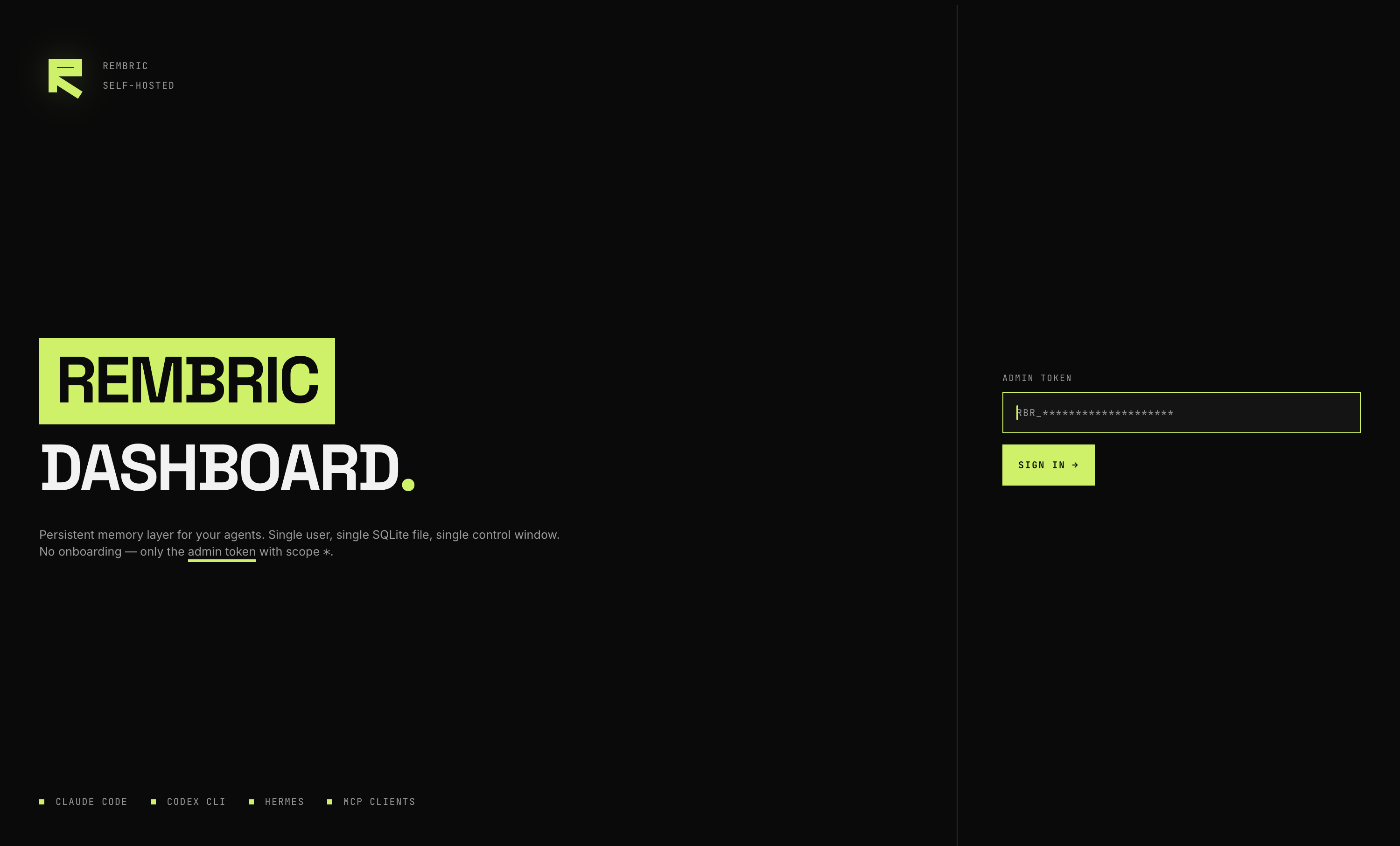
Sign-in

Sign-in · one admin token, scope ✱.

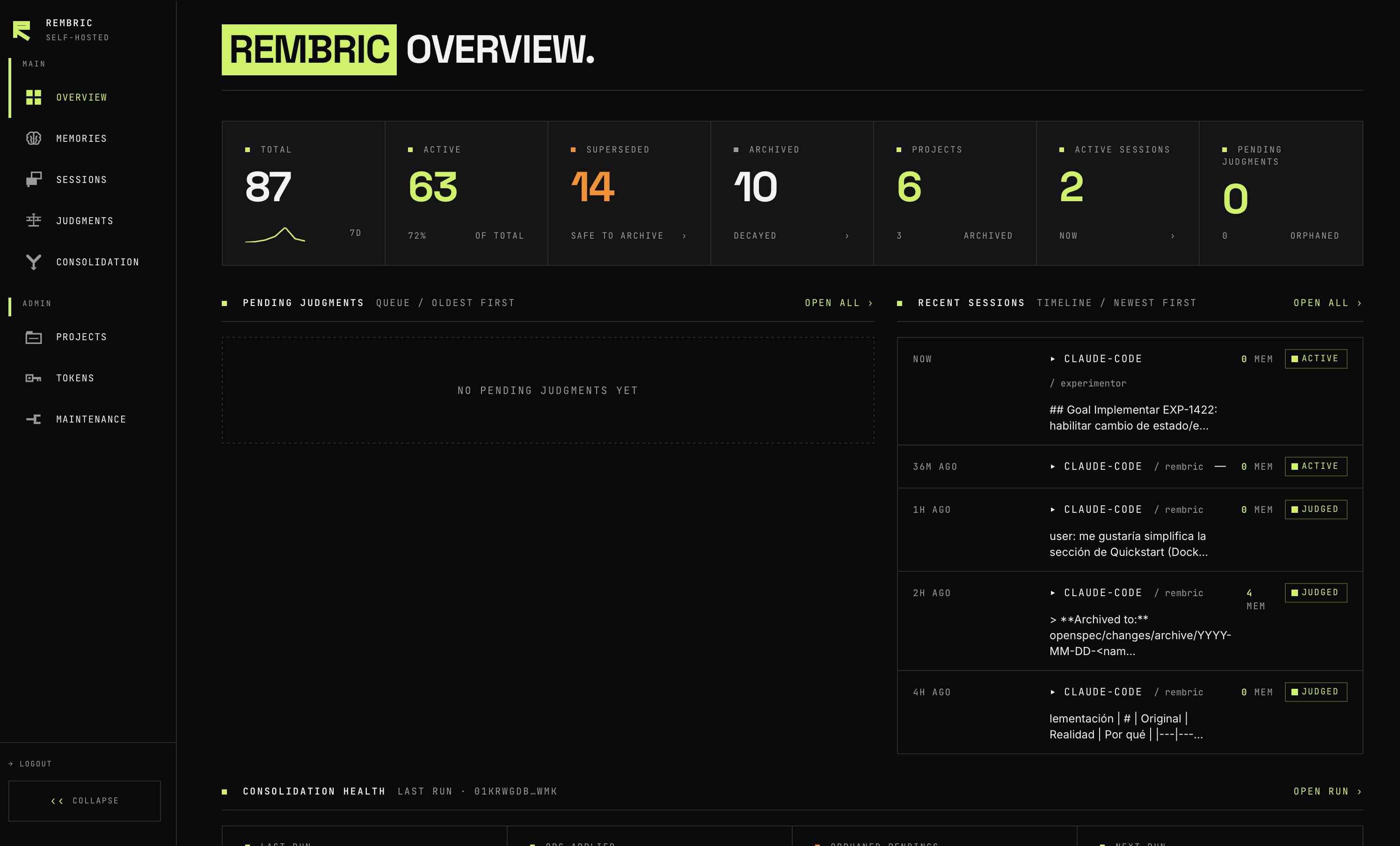
Overview

Overview · memory activity, active sessions, latest judgments, consolidation and system health.
More surfaces — memories · sessions · judgments · entities · consolidation · projects · tokens · updates · maintenance

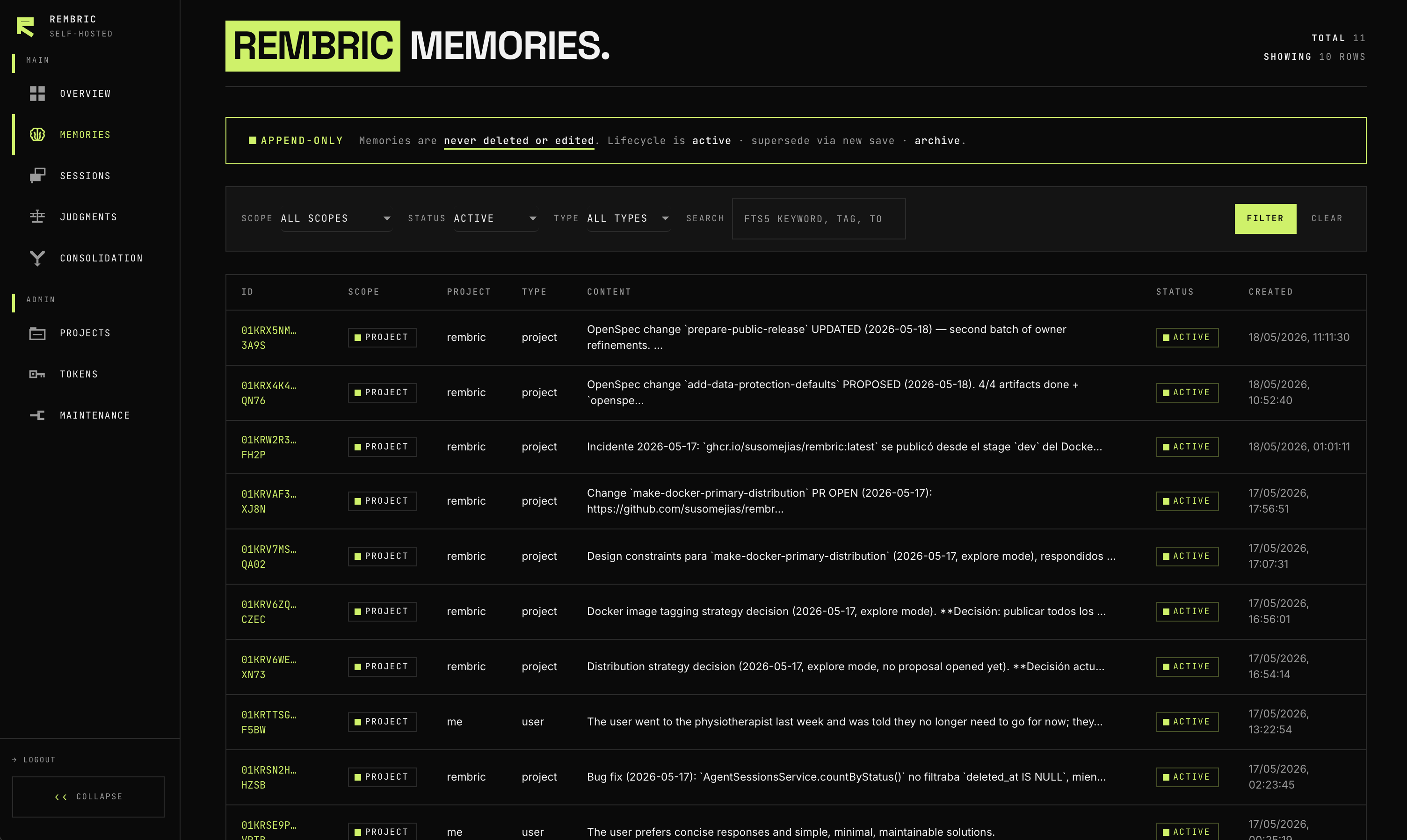
Memories list

Memories · status filters, needs-review queue, search, and bulk actions.
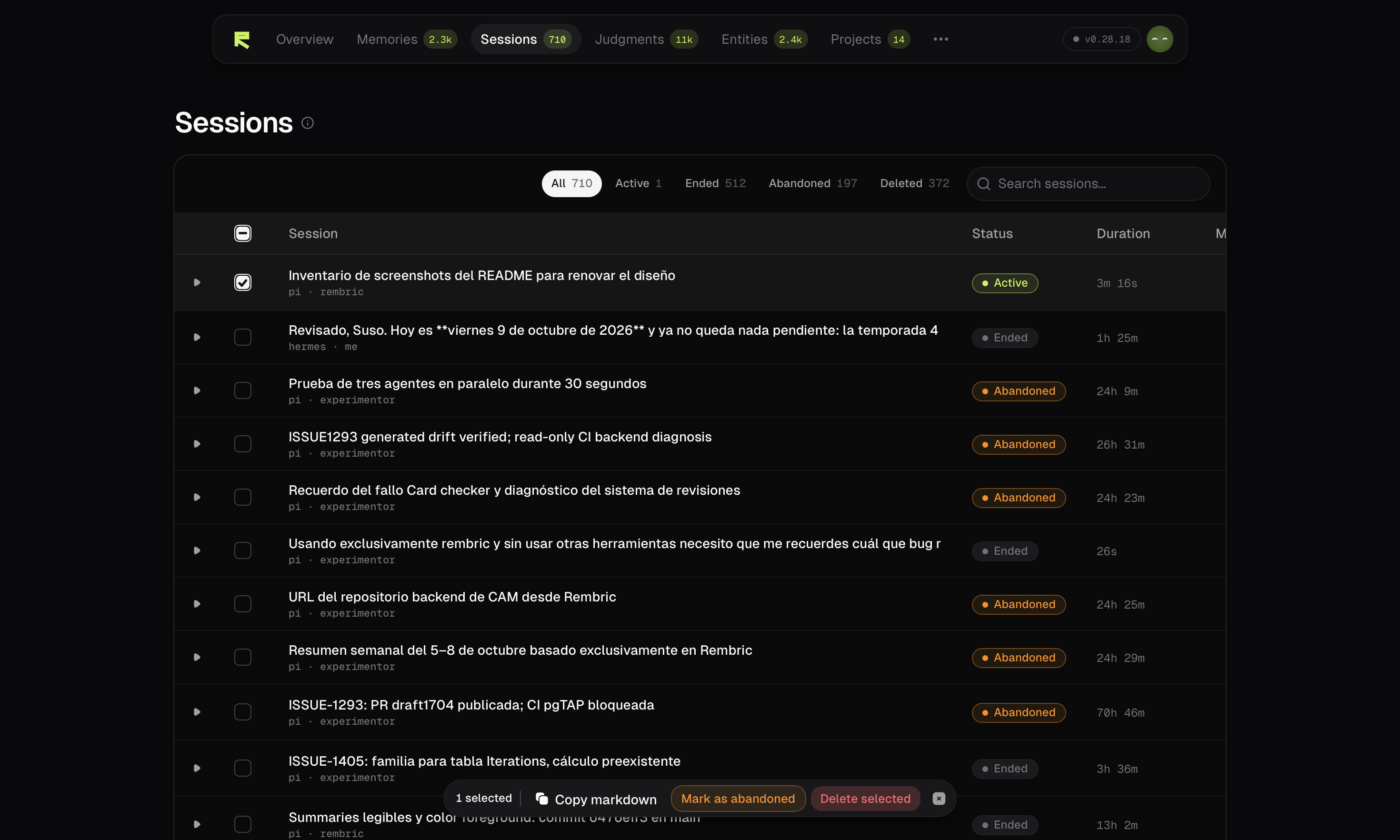
Sessions list

Sessions · active, ended, and abandoned agent runs with memory and prompt counts.
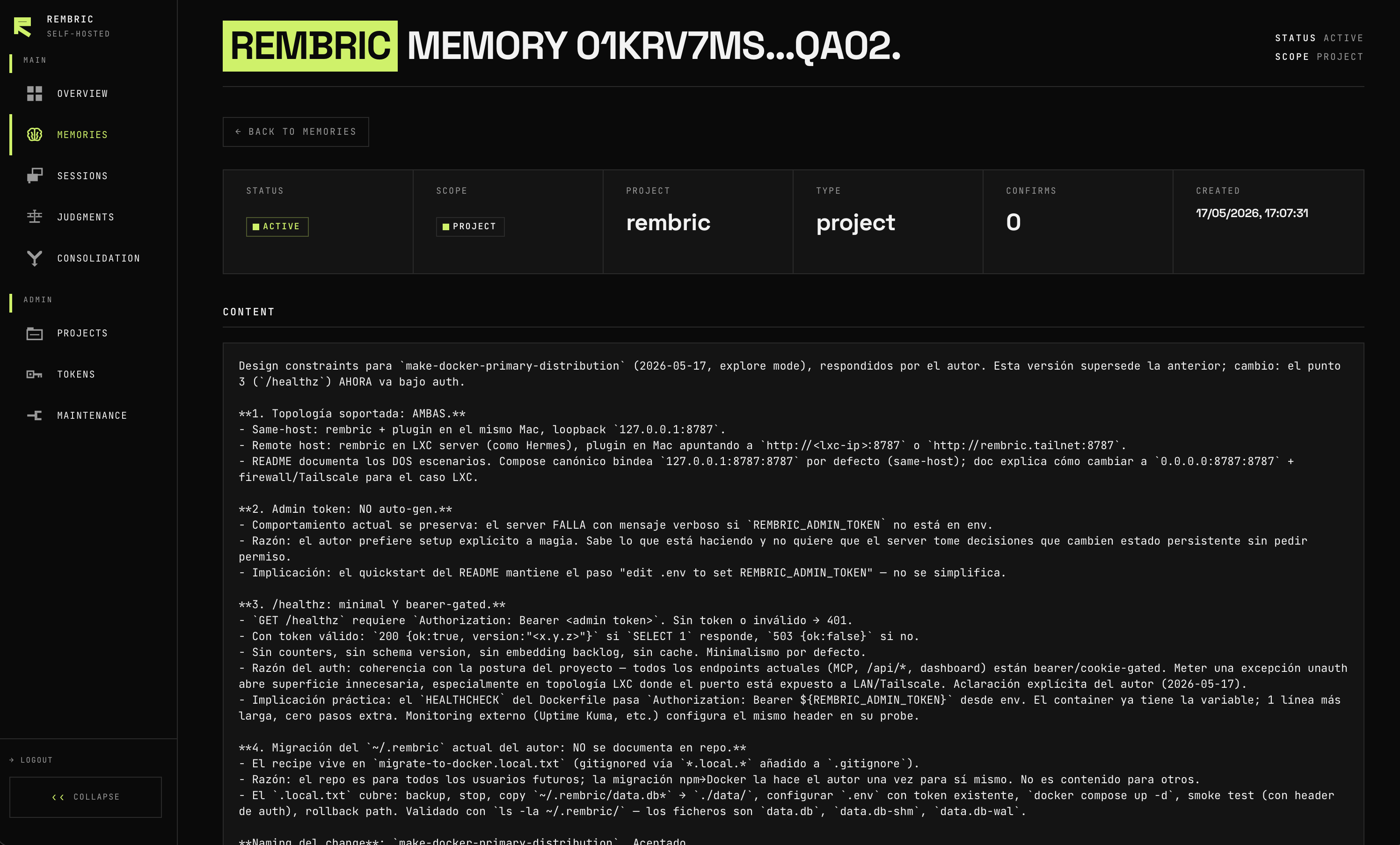
Memory detail

Memory detail · status, scope, project, type, review state, and content.
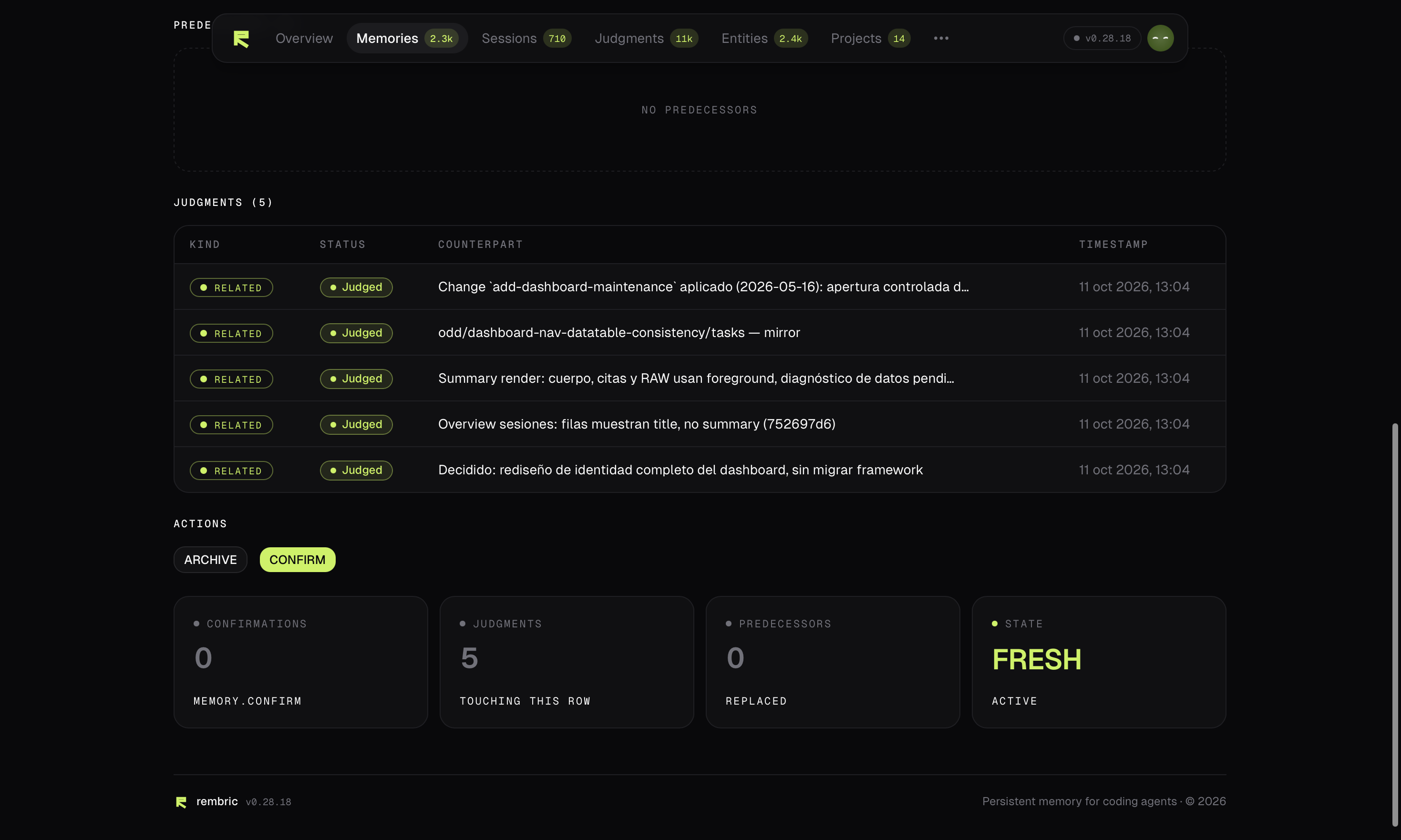
Memory detail judgments and actions

Memory detail · related judgments, predecessors, confirmations, and lifecycle actions.
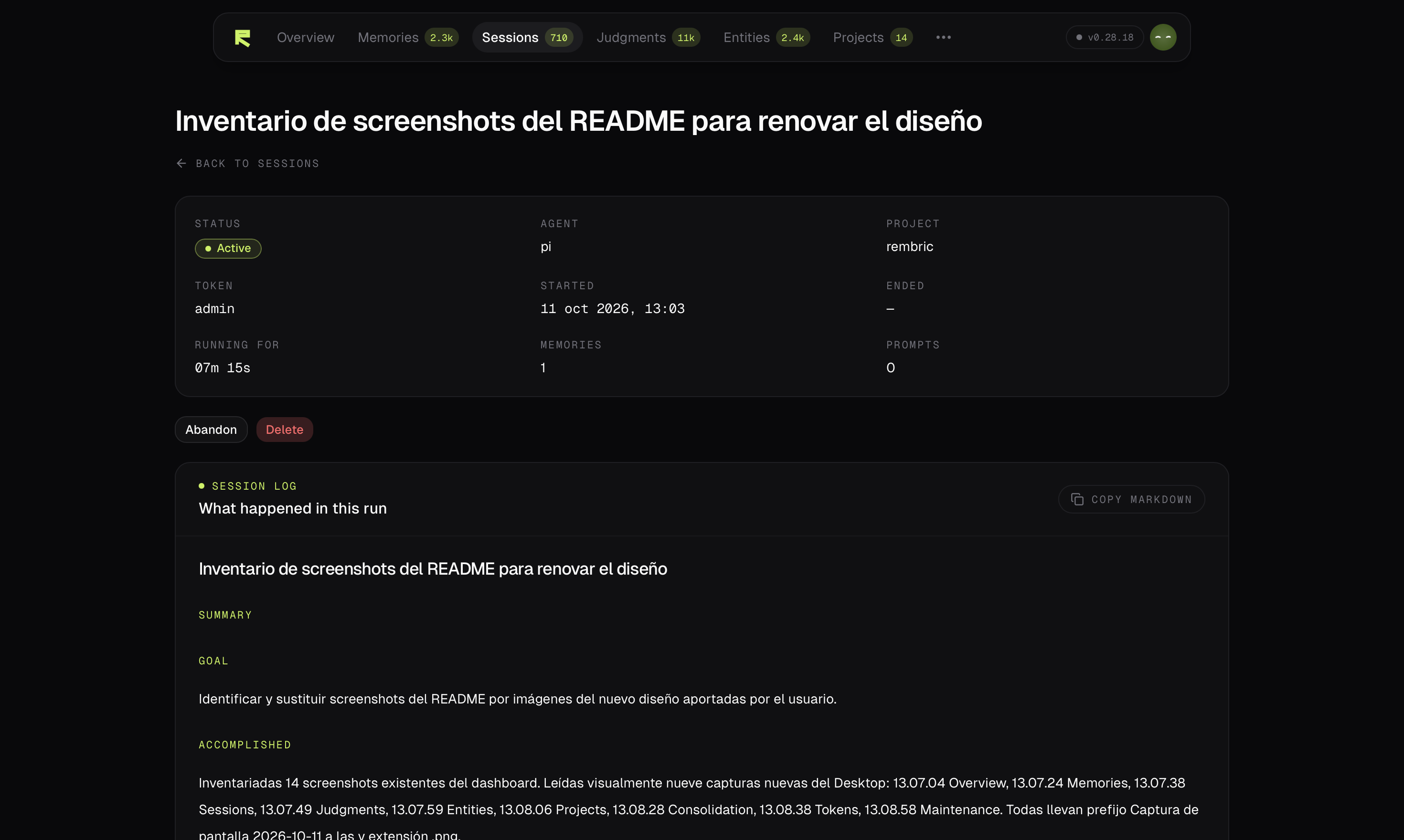
Session detail

Session detail · run metadata and summary.
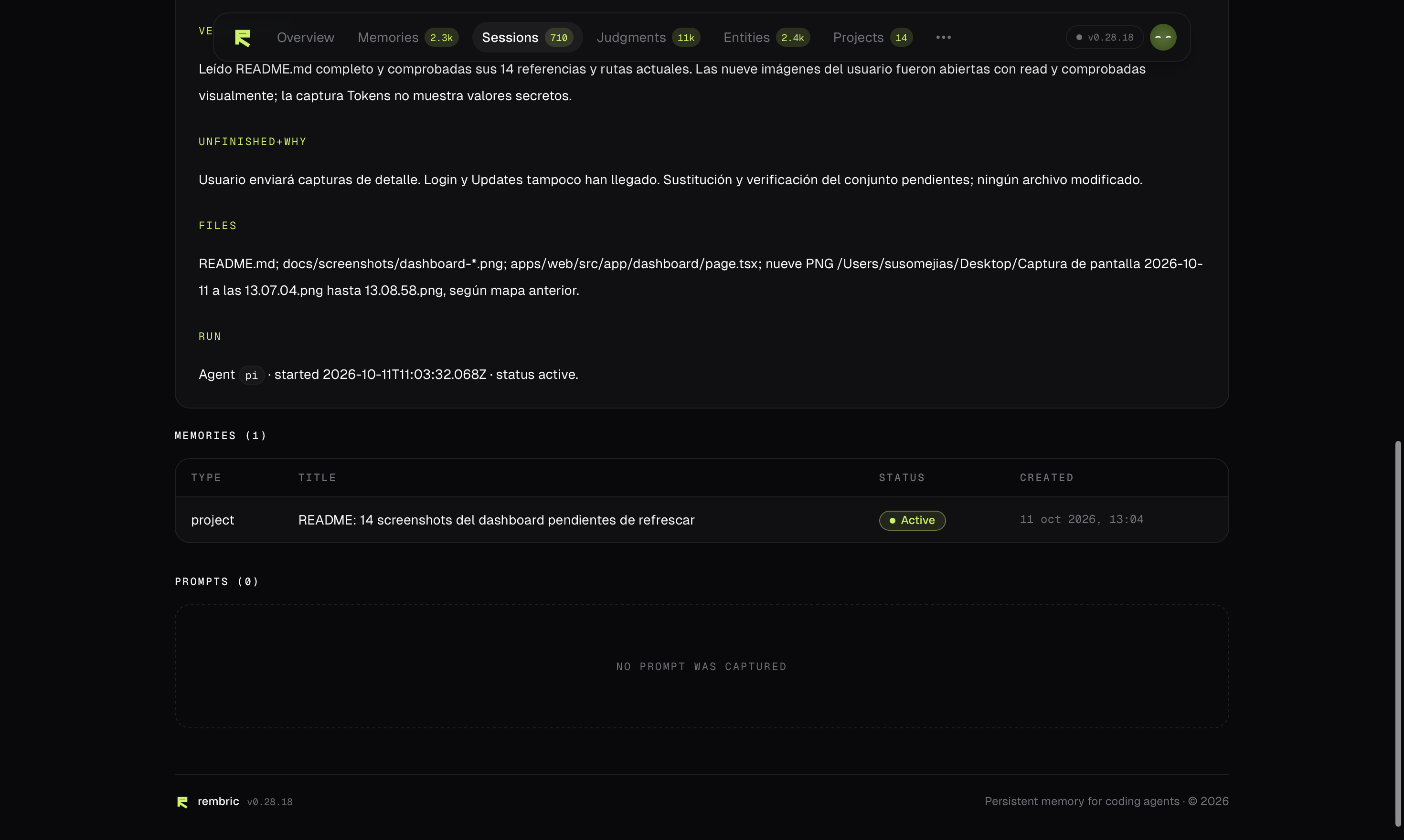
Session detail attached memories and prompts

Session detail · memories and prompts attached to the run.
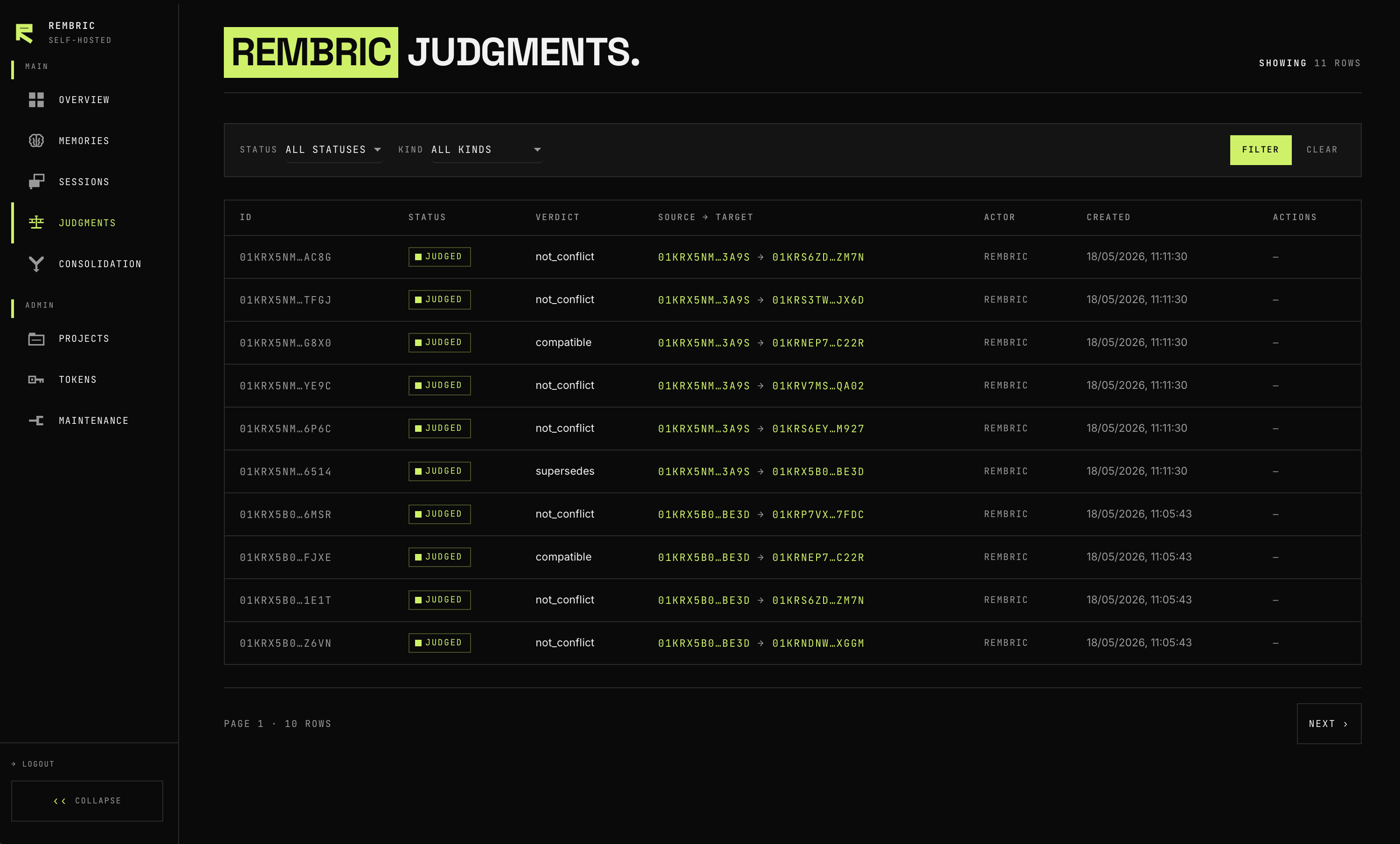
Judgments

Judgments · audit trail of every relation verdict — compatible, supersedes, not_conflict.
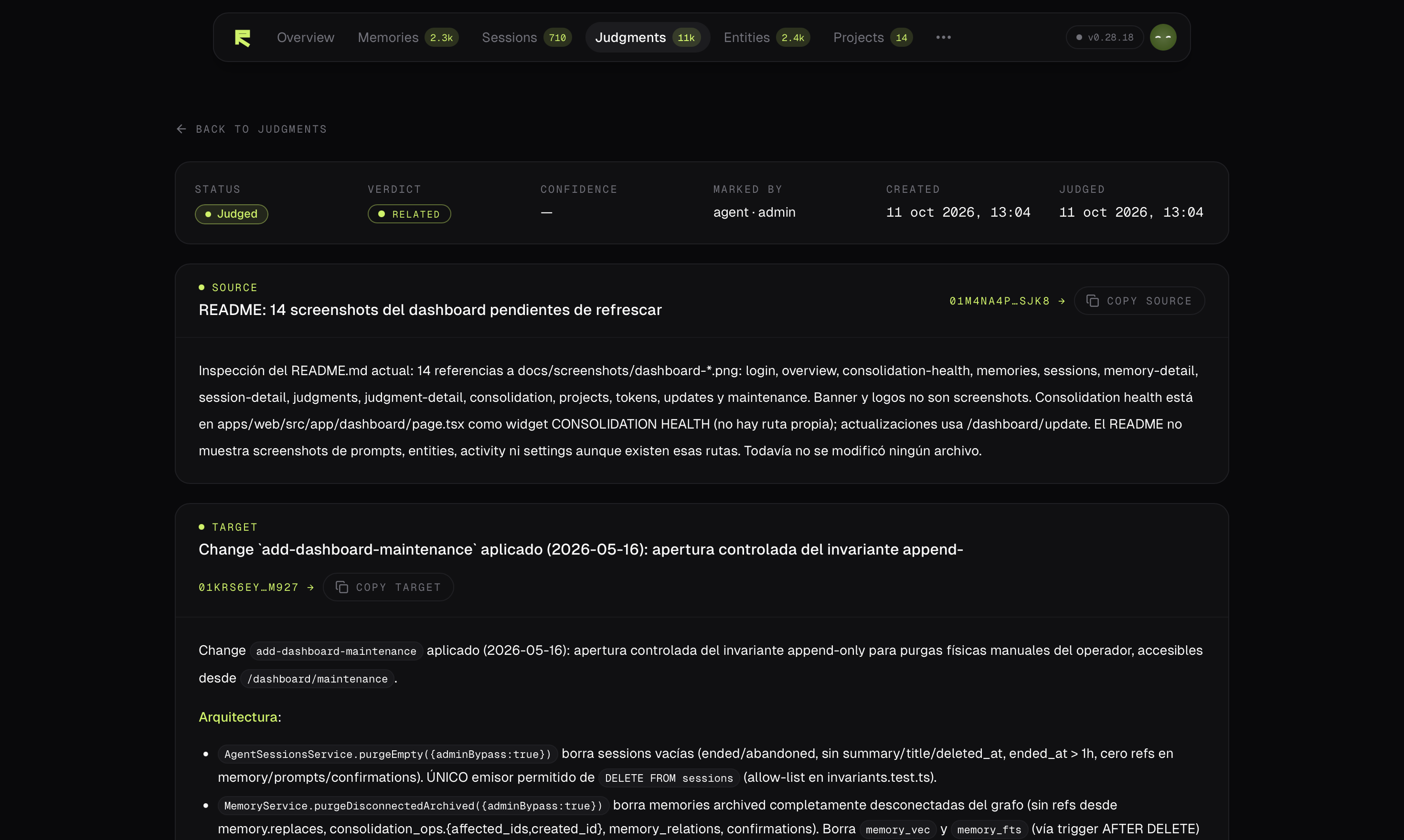
Judgment detail

Judgment detail · verdict, confidence, source, and target memories.
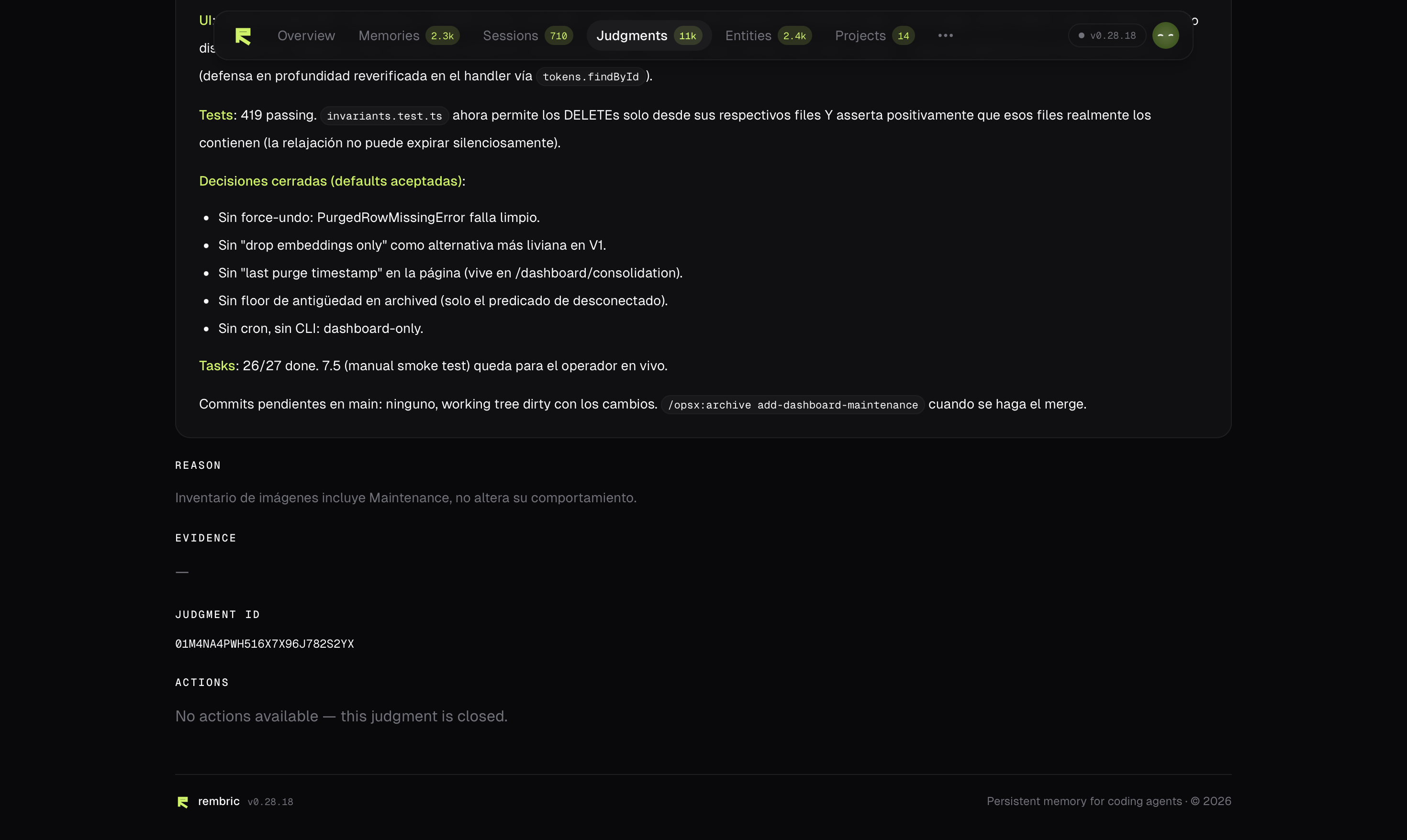
Judgment detail reason and evidence

Judgment detail · reason, evidence, and available actions.
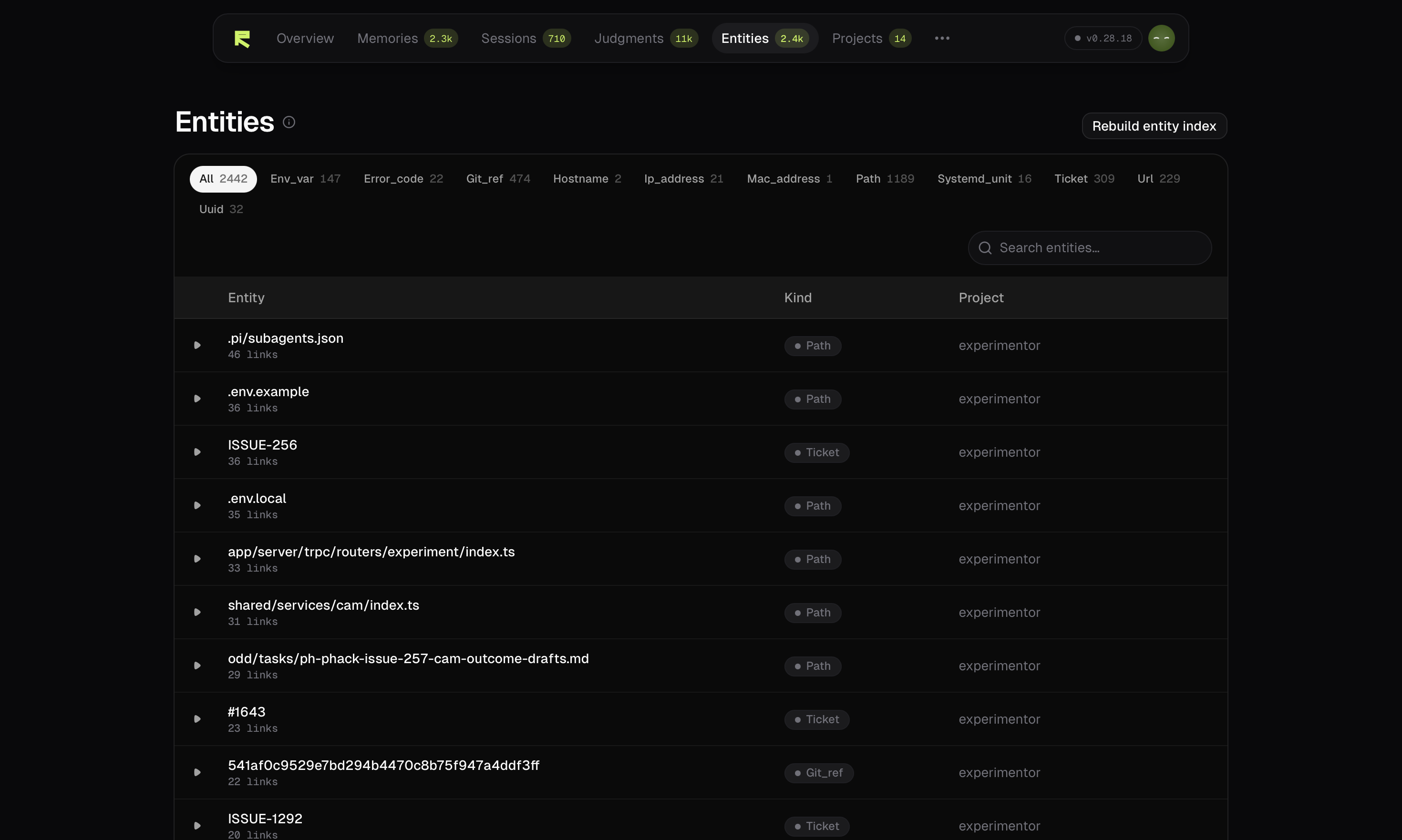
Entities list

Entities · exact identifiers, kind filters, project links, and index rebuild.
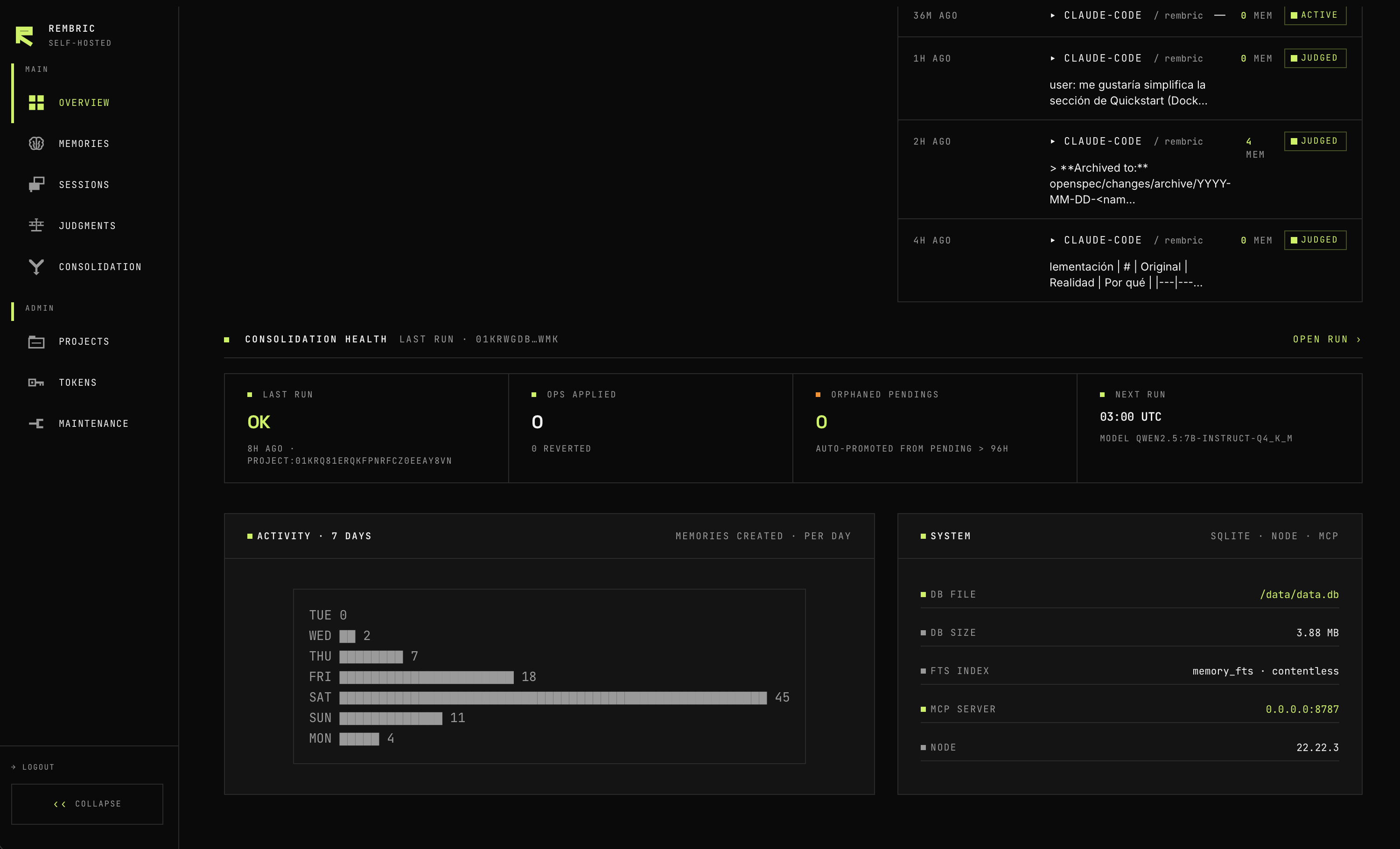
Consolidation

Consolidation · manually trigger sweeps and inspect recent run status.
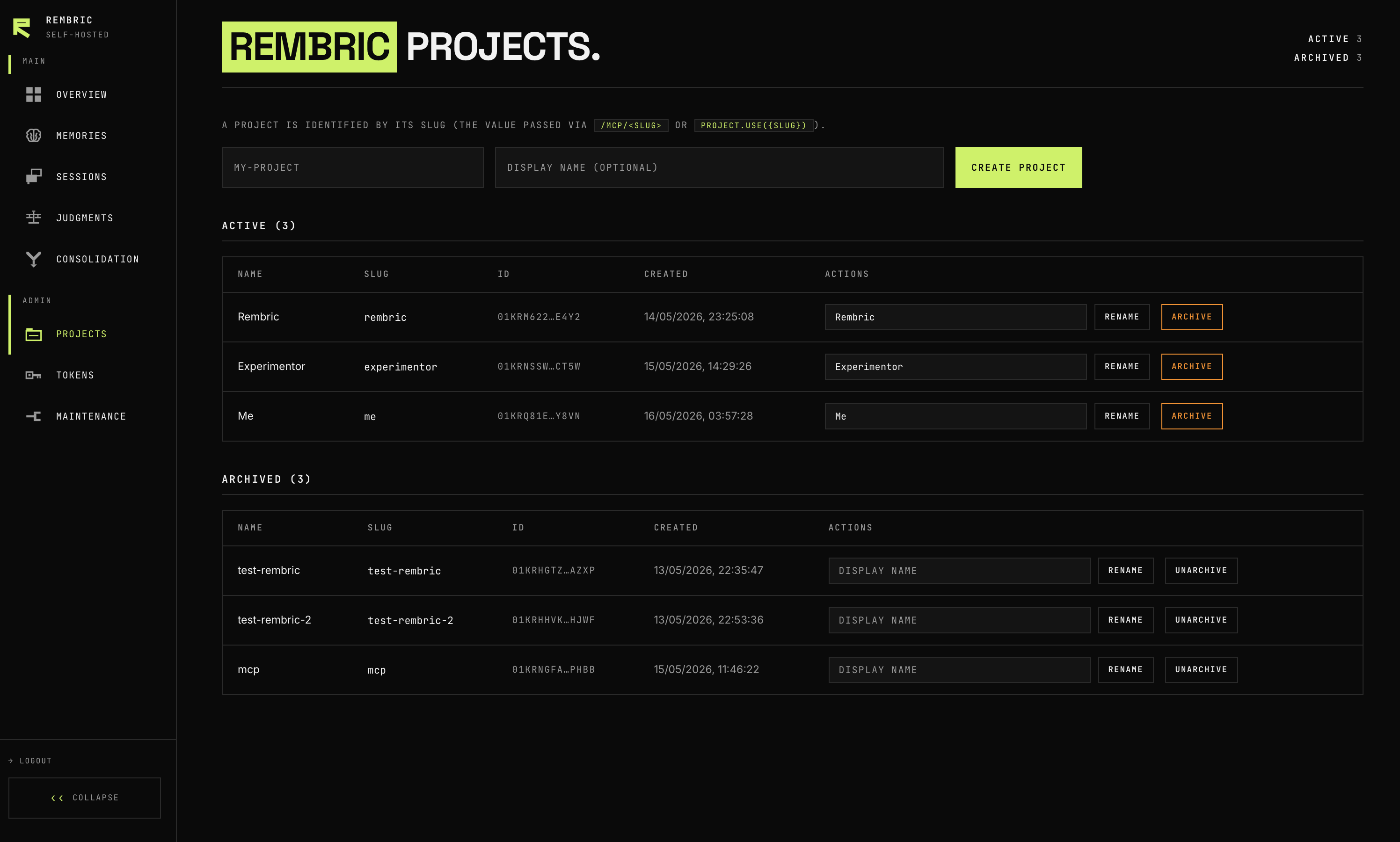
Projects

Projects · slug-keyed, archivable. Each project is an isolated scope.
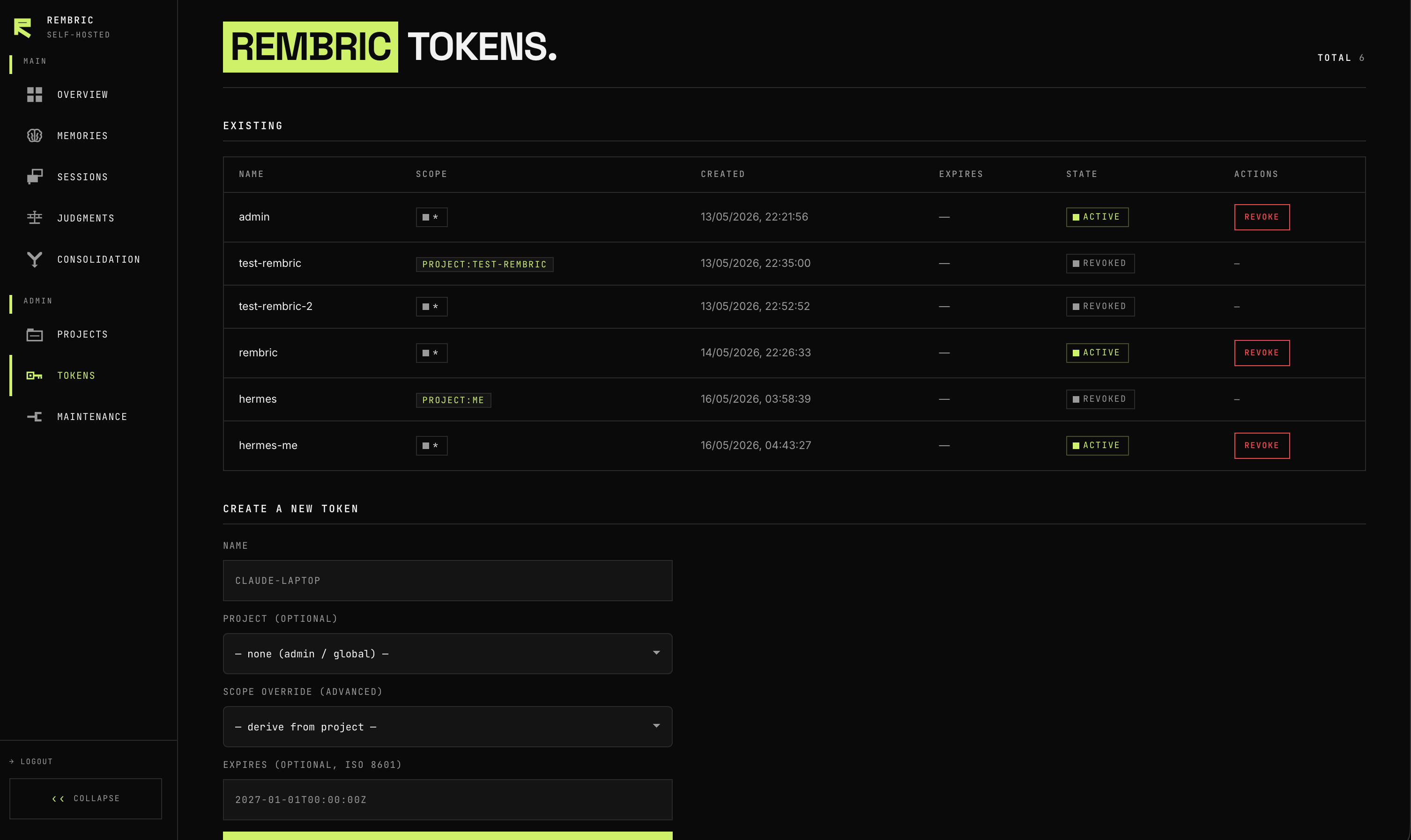
Tokens

Tokens · scope-bound (* or project:<id>), revocable, expirable.
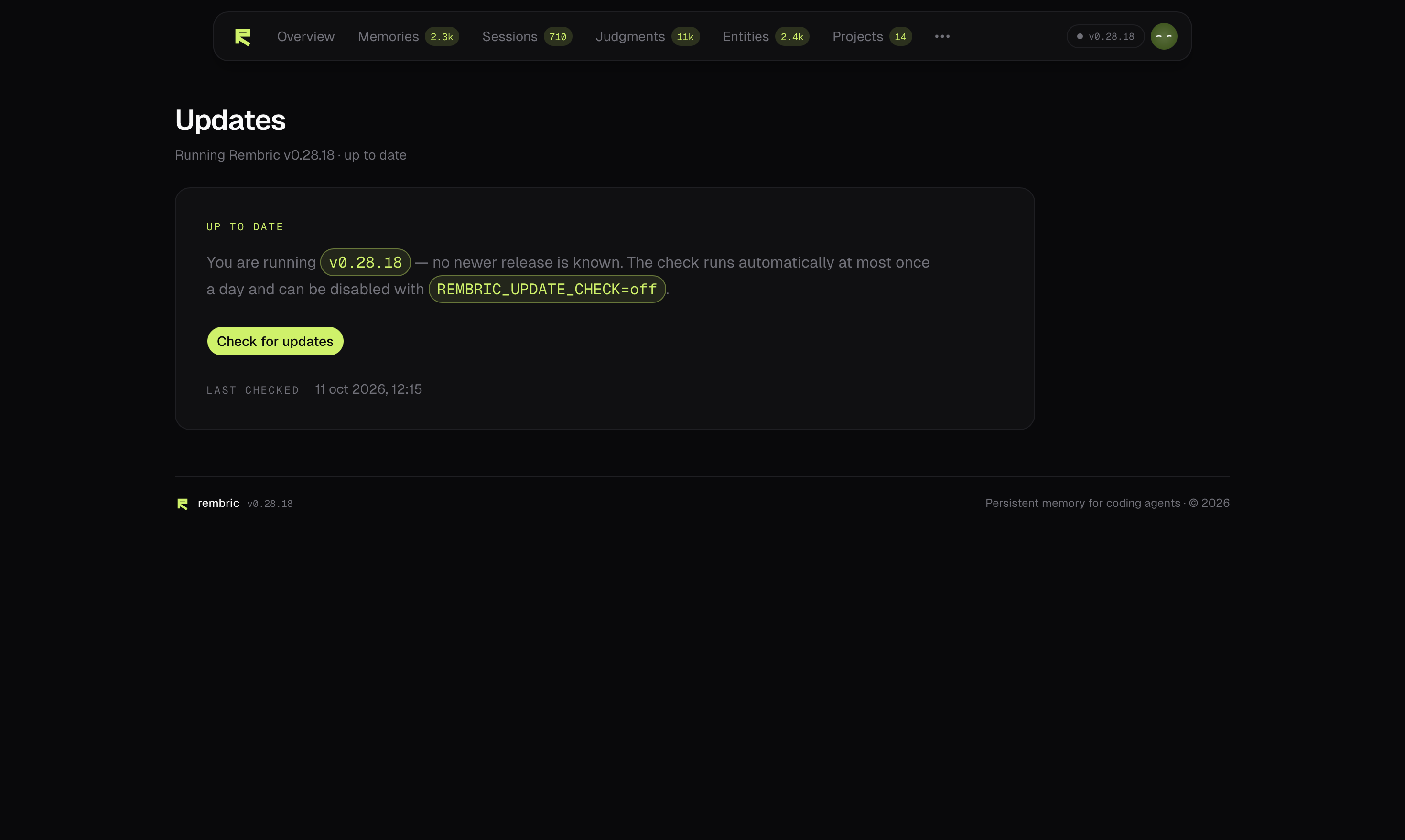
Updates

Updates · current version, last check time, and manual release check.
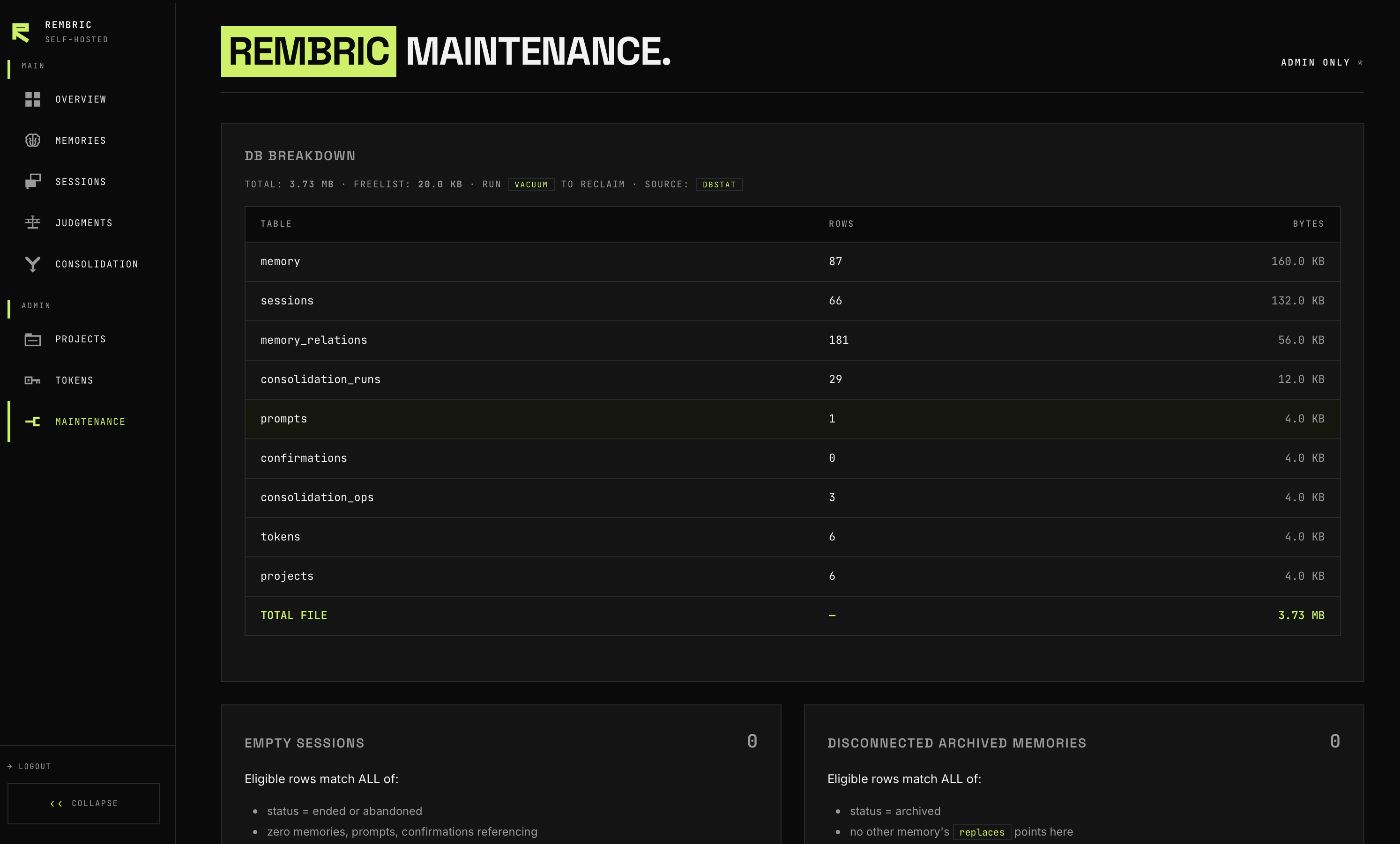
Maintenance

Maintenance · DB breakdown + admin-only physical purges for empty sessions and disconnected archived memories.

Operating Rembric — tokens, projects, sessions, prompts, and the irreversible maintenance purges
Day-to-day operator work lives in the dashboard at [http://127.0.0.1:8787/dashboard](http://127.0.0.1:8787/dashboard) (port `8788` in the dev stack). Mint and revoke API tokens at `/dashboard/tokens`, create and archive projects at `/dashboard/projects`, soft-delete agent sessions at `/dashboard/sessions`, browse and soft-delete curated user prompts at `/dashboard/prompts` (FTS5 search over content + tags; refined predecessors show a `REFINED` badge), trigger consolidation at `/dashboard/consolidation`, and run the operator-only purges from `/dashboard/maintenance`. Programmatic agents talk to the same data through the MCP `project.*` / `memory.*` tools or, for admin-only operations, through the HTTP endpoints under `/admin/*` (admin bearer token required — see [docs/agents.md](./docs/agents.md)). ### Maintenance (manual purges) The dashboard exposes `/dashboard/maintenance` for three **irreversible**, **operator-triggered** physical purges. All are gated to dashboard sessions whose underlying token has scope `*` (admin): - **Purge empty sessions** — removes `ended` / `abandoned` session rows that have no summary, no manual title, no referencing memories / non-deleted prompts / confirmations, are not operator-soft-deleted, and ended over 1 hour ago. Soft-deleted prompts no longer block purge. - **Purge disconnected archived memories** — removes `archived` memory rows whose ids are referenced by NO other row in the graph (`memory.replaces`, `consolidation_ops.affected_ids` / `created_id`, `memory_relations.{source,target}_id`, `confirmations.memory_id`). The matching `memory_vec` and `memory_fts` shadow rows are dropped in the same transaction. - **Purge deleted prompts** — removes `prompts` rows whose `deleted_at IS NOT NULL`. Covers both operator soft-deletes (from `/dashboard/prompts`) and refine supersedes (from `memory.save_prompt({ replaces })`). The matching `prompts_fts` shadow row is dropped in the same transaction. Each click shows a count and a confirmation modal. The deletion is journaled in `consolidation_ops` (`op_type = 'session_purge'`, `'archived_memory_purge'`, or `'prompt_purge'`) so the operator can audit what was removed even after the rows are gone. **Consolidation undo on operations whose rows have been purged returns a structured error** — the dashboard surfaces it inline naming the missing ids. To reclaim file-level disk after a large purge, run `VACUUM` against the SQLite file. The maintenance page surfaces the freelist size so you know how much would be reclaimed.
## Architecture Single Node process, single SQLite file, packaged as a multi-arch Docker image (`linux/amd64`, `linux/arm64`). Agents reach it over HTTP(S) + a bearer token at `/mcp/` (or `/mcp` + `project.use`); the operator dashboard is served from the same process. Four load-bearing invariants: - **Append-only**: rows are never deleted; `content` never updated. Lifecycle is `status` flips + `replaces` links. Every consolidation op is reversible. An agent MAY retire a memory at the user's explicit request via `memory.archive` (a reversible, journaled `active → archived` flip, scoped to the connection — no successor link, distinct from a `topic_key`/`memory.judge_batch` supersede); physical purge stays operator-only in `/dashboard/maintenance`. - **Project scoping by construction**: every memory is attached to exactly one `project_id`. Consolidation, relations and every write never cross scope. One read may, and only when asked: `memory.search({across_projects: true})` reads the projects the connection's token is authorized to read and names them in `searchedProjects[]` — opt-in, read-only, and a compile error on any write path. See [docs/agents.md](./docs/agents.md#searching-across-projects). - **Convergent topics via `topic_key`**: on `memory.save`, the previously-active row in the same `(scope, project_id, topic_key)` is auto-superseded atomically. - **Fresh-context judgment**: candidate conflicts surface at save time (`candidates[]`); the agent that produced the conflict judges it. Aged pendings re-surface in `memory.context` until an agent closes them, unless an endpoint has been retired since — those are withheld from the agent queue and left to the sweep. The deterministic sweep (no LLM, no cron — runs on session start) only handles decay + deadline orphaning. Memory also exposes a **derived review state** alongside decay: a `needs_review` flag on `memory.search` / `memory.get_batch` rows (and a `needsReview[]` list in `memory.context`) for active memories whose per-type shelf life elapsed without re-affirmation. It is computed at read time — no column, no sweep — and is cleared by re-affirming with `memory.confirm_batch` (not by merely reading). See [docs/relations.md](./docs/relations.md) for the relation taxonomy and the review axis. ### Entity index (exact-address retrieval) Hybrid ranking is the right tool for "what did we decide about auth" and the wrong one for "what do I know about `packages/db/src/migrate.ts`". Identifiers are where ranked retrieval performs worst: quoted as an FTS5 phrase, a path also matches every longer path containing it (`migrate.ts` → `migrate.ts.bak`, `test/…/migrate.ts`), and separators the tokenizer drops take the identifier's precision with them (`#36` degrades to any bare "36"; `nas.local` matches the prose "the nas local drive"). Measured against an adversarial corpus, that is a 50–75% false-positive rate on those classes. So Rembric keeps a small derived index of **syntactically unambiguous identifiers** — extracted by a pure regex function, no LLM, no network, ~5µs per memory, 0.05% of memory-related storage: | kind | examples | | -------------- | ------------------------------------------------------------------------ | | `path` | `packages/db/src/migrate.ts`, `.rembric` | | `ticket` | `#282`, `PROJ-1234` | | `cve_id` | `CVE-2024-3094` | | `ip_address` | `192.168.1.50`, `172.18.0.0/16` | | `hostname` | `nas.local`, `plex.home` (`.local`/`.lan`/`.home`/`.internal`) | | `git_ref` | `cfb5c04`, full 40-char SHAs | | `url` | `https://…` | | `error_code` | `ENOENT`, `SQLITE_CANTOPEN`, `ERR_MODULE_NOT_FOUND`, `PERMISSION_DENIED` | | `env_var` | `$DATABASE_URL`, `${REMBRIC_TOKEN}`, `NODE_ENV=…` | | `uuid` | `550e8400-e29b-41d4-a716-446655440000` | | `systemd_unit` | `caddy.service`, `rembric-backup.timer`, `docker.socket` | | `mac_address` | `de:ad:be:ef:00:01` | Extraction is precision-first by design: only closed, bounded syntax is admitted (a whitelist of errno and gRPC names rather than "any capitalised word", range-validated IP octets, fixed suffix lists, a `$`/`=` anchor for env vars). Where two classes share a shape they are separated by an anchor or a closed list, never by pattern order — a bare `SCREAMING_SNAKE` token is deliberately left untyped, since it is indistinguishable between an error code, an env var and a constant. A pattern is also narrowed below the class it names when the difference is prose: `systemd_unit` omits `.target`/`.path`/`.slice`/`.mount` because those are everyday property accessors (`event.target`, `array.slice`). Symbol identifiers, package names, semver, Docker image refs and cron expressions are **not** extracted at all — their shape cannot be bounded without matching prose, and a false link is worse than a missing one because it degrades exact lookup into bad text search. The patterns live in one registry (`extractor-rules.ts`) where every rule must declare both the text it catches and the prose it must reject; a single suite runs the whole registry against those declarations, so a new kind is covered the moment it is added. **A misclassification is never permanent.** Both entity tables are derived, so fixing a pattern is: correct it, bump the extractor version, deploy. The mismatch invalidates the index at boot and the drain recomputes it from the append-only `memory` rows — the bad link disappears, no memory is touched, and nothing needs migrating. An ordinary deployment does _not_ trigger this; only a recipe change does. Operators can also rebuild on demand from `/dashboard/entities` without waiting for a release. The index backs three things, two of which need no agent opt-in: - **`memory.search({ entity })`** — every linked memory in scope, chronological, complete: no ranking, no cutoff. Combined with `query` it narrows rather than fuses, and with `across_projects` it answers "which of my projects mentions this file / CVE / host" — the branch has no ranking to distort, so nothing is reordered by relevance. The 400-row completeness bound stays a bound on the response, not per project, so where an entity is linked more widely than that the newest rows across the set win and a home row can fall off the end. - **`memory.context`** — identifiers found in the session's focus text seed exact matches ahead of the ranked fallback (tagged `via: 'entity'`). - **Save-time conflict detection** — a new memory sharing a sufficiently _rare_ entity with an active one becomes a `candidates[]` entry, catching contradictions that share no vocabulary and sit far apart in embedding space. Common entities are gated out (the same idea as IDF, applied to link counts). It deliberately does **not** contribute a stream to the hybrid RRF fusion: in its own author's published benchmark, adding a graph stream to BM25+vector _reduced_ Recall@5 versus BM25 alone. Operators can browse and rebuild the index at `/dashboard/entities`.
Process diagram — transports, service layer, storage, in-process background work
``` ┌──────────────────────────────────────────────────────────────┐ │ 5 PLUGIN clients — tools AND session lifecycle │ │ Claude Code · Codex CLI · Hermes Agent · opencode · Pi │ │ Any other MCP client — tools only, no lifecycle │ │ Cursor · Windsurf · Claude Desktop · Cline · Goose · … │ └───────────┬──────────────────────────────────┬───────────────┘ │ │ MCP: HTTP(S) + Bearer Session lifecycle: HTTP(S) /mcp/ or /mcp + project.use POST /api//sessions{,/:id/end,/:id/summary} │ (hooks + in-process providers; never MCP) ▼ ▼ ┌───────────────────────────────────────────────────────────────────────┐ │ rembric (single Node process) │ │ │ │ ┌──────────────────────────┐ ┌──────────────┐ ┌──────────────────┐ │ │ │ /mcp /mcp/ │ │ /api/ │ │ /dashboard │ │ │ │ Streamable HTTP │ │ session │ │ SSR HTML + HTMX │ │ │ │ + initialize.instructions│ │ lifecycle │ │ │ │ │ │ │ └──────┬───────┘ │ /memories │ │ │ │ memory.{save,search,get,│ │ │ /sessions │ │ │ │ context,timeline, │ │ │ /prompts │ │ │ │ confirm,archive, │ │ │ /judgments │ │ │ │ judge,compare, │ │ │ /entities │ │ │ │ stats,doctor,about, │ │ │ /consolidation │ │ │ │ suggest_topic_key, │ │ │ /projects │ │ │ │ capture_passive} │ │ │ /tokens │ │ │ │ memory.session_* │ │ │ /maintenance │ │ │ │ memory.*_prompt(s) │ │ │ /oauth /update │ │ │ │ project.{use,list, │ │ │ │ │ │ │ current} │ │ │ │ │ │ └────────────┬─────────────┘ │ └────────┬─────────┘ │ │ ▼ ▼ ▼ │ │ ┌─────────────────────────────────────────────────────────────────┐ │ │ │ Service layer (owns scope resolution + transactions) │ │ │ │ MemoryService · PromptsService · RelationsService │ │ │ │ ProjectsService · TokensService · AgentSessionsService │ │ │ │ EntitiesService · OAuthService · SessionRouter │ │ │ │ hybrid-search · review (derived) · save-time-candidates │ │ │ └──────────────────────────────┬──────────────────────────────────┘ │ │ ▼ │ │ ┌─────────────────────────────────────────────────────────────────┐ │ │ │ Repositories — the ONLY place SQL lives (packages/db/src/) │ │ │ └──────────────────────────────┬──────────────────────────────────┘ │ │ ▼ │ │ ┌─────────────────────────────────────────────────────────────────┐ │ │ │ SQLite (Drizzle, append-only + tombstones) │ │ │ │ memory · projects · tokens · sessions · prompts │ │ │ │ confirmations · memory_relations · entities · memory_entities │ │ │ │ consolidation_{runs,ops} · dashboard_sessions · oauth_* │ │ │ │ + memory_fts · prompts_fts (FTS5) + memory_vec (sqlite-vec) │ │ │ └──────────────────────────────▲──────────────────────────────────┘ │ │ ┌──────────────────────────────┴──────────────────────────────────┐ │ │ │ In-process background work (no external services) │ │ │ │ embedder: gte-multilingual-base, ONNX q8, loaded at boot │ │ │ │ embedding drain worker → fills memory_vec │ │ │ │ entity backfill worker → fills entities/memory_entities │ │ │ │ deterministic sweep: decay + deadline orphaning (no LLM/cron) │ │ │ └─────────────────────────────────────────────────────────────────┘ │ └───────────────────────────────────────────────────────────────────────┘ ``` Two staleness axes, deliberately distinct: **decay** runs in the background sweep above (access + confidence, keyed on `last_seen_at` → archives); **review** is derived in the request path on `memory.search` / `memory.get_batch` / `memory.context` (affirmation, keyed on `max(created_at, last confirmation) + per-type TTL` → flags `needs_review`). Review adds no table, no tool, and no background work — it is computed at read time and cleared by `memory.confirm_batch`.
## Development ```bash pnpm install pnpm run dev # tsc --watch pnpm test # full vitest suite + Hermes Python tests pnpm run typecheck # tsc --noEmit pnpm run lint ``` For a clean Docker build from source: ```bash docker compose -f docker-compose.yml -f docker-compose.build.yml up -d --build ``` ### CodeGraph (code intelligence) This repo ships a committed [CodeGraph](https://github.com/colbymchenry/codegraph) setup so agents can query the codebase as a knowledge graph. The MCP server is registered in `.mcp.json` (Claude Code) and `opencode.jsonc` (opencode); both point at a local `codegraph` binary. CodeGraph is **opt-in per developer** — install the binary to enable it: ```bash # install the codegraph CLI (see https://colbymchenry.github.io/codegraph/), # then from the repo root: codegraph index # builds .codegraph/codegraph.db (git-ignored, ~11 MB) ``` If you do **not** install the binary, nothing breaks: the `codegraph` MCP entry just shows as failed/unavailable in `/mcp`, the `UserPromptSubmit` hook in `.claude/settings.json` no-ops on the `command -v` guard, and every other workflow is unaffected. The index, daemon socket, pid, and logs under `.codegraph/` are git-ignored (only `.codegraph/.gitignore` is committed) — they are local to each machine and never belong in a commit. ## More docs - [docs/docker.md](./docs/docker.md) — Docker operator guide (topologies, GHCR auth, upgrade/rollback, troubleshooting). - [docs/agents.md](./docs/agents.md) — per-client MCP config (Codex, Cursor, Windsurf, VS Code, Gemini, …). - [docs/backup.md](./docs/backup.md) — backup strategies and restore recipes for the SQLite data file. - [docs/updates.md](./docs/updates.md) — update notifications and the opt-in one-click auto-updater from the dashboard. - [docs/troubleshooting.md](./docs/troubleshooting.md) — common errors and recovery. ## Project status Rembric is open-source under the MIT License — **as-is, no warranty**. The maintainers do not accept responsibility for operator data loss, deployment downtime, or any other operational consequence of running the software. - **Security**: vulnerability reports go through [SECURITY.md](./SECURITY.md). Preferred channel is GitHub Security Advisories. - **Backups**: the entire server state lives in one SQLite file. Operators are responsible for backing it up; see [docs/backup.md](./docs/backup.md) for `sqlite3 .backup` cron, manual snapshots, and litestream. - **Versioning**: SemVer, driven by release-please. Pre-1.0 means the wire and HTTP contracts may shift across minors; check release notes before upgrading. ## Contributing See [CONTRIBUTING.md](./CONTRIBUTING.md). Commits follow Conventional Commits; pre-commit lints and typechecks; pre-push runs the full test suite. ## Sponsor If Rembric saves you time, you can support its maintenance through [GitHub Sponsors](https://github.com/sponsors/susomejias), [Ko-fi](https://ko-fi.com/susomejias), or [Buy Me a Coffee](https://buymeacoffee.com/susomejias). ## License MIT — see [LICENSE](./LICENSE).