# GPT-Load
**A self-hosted AI gateway for multi-channel, multi-credential setups**
API keys, subscription accounts, traffic scheduling, failure handling, request logs, and usage accounting — behind a single entry point.
English · [中文](README_CN.md) · [日本語](README_JP.md) | [Official Website](https://www.gpt-load.com)
[](https://github.com/tbphp/gpt-load/releases)
[](https://github.com/tbphp/gpt-load/pkgs/container/gpt-load)
[](go.mod)
[](LICENSE)
---
## Sponsors
[Become a sponsor](mailto:tangb7420@gmail.com)Sponsor details (collapsible)
OfoxAI: Text, image, and video AI in one platform OfoxAI is a unified AI API platform bringing together text, image, and video models from multiple providers. With OpenAI-compatible endpoints and native Anthropic and Gemini interfaces, developers can access models for AI applications, agents, and content creation through one platform. Explore OfoxAI models and APIs →
PackyCode Access leading AI models through PackyCode with one API endpoint and one API key. Enjoy fast, reliable access with automatic failover and dedicated high-speed routes for Codex and Claude Code. Get started with $1 in free credits, a discount on your first top-up, and savings of up to 80% on eligible routes. Pay in RMB with no currency conversion markups or extra top-up fees. Sign up through the link and start building today.
One entry point to connect and manage the world's leading AI models Fluxion AI serves individual developers, technical teams, and enterprises with a unified API for connecting to and managing leading AI models worldwide. Dynamic multi-route scheduling improves availability, while model performance, response times, and costs remain transparent and easy to review. Depending on the model and route, API calls can cost 40%–98% less than official or benchmark prices. Visit and sign up now to receive $7 in API credits. (Dedicated link)
Protect and accelerate websites and APIs, serving users in mainland China and around the world, and extend acceleration and security capabilities to native/mobile apps through a client SDK — self-built private-deployment CDN | subscription-based high-protection CDN | an independently controllable, flexibly composable CDN network.
Thanks to APIMart for sponsoring this project! APIMart is a low-cost API platform for AI image & video generation — GPT-Image-2 from $0.006/image, 160+ images per dollar. One async API covers both image and video: submit a task, get an ID, fetch results via polling or callback. Batch tens of thousands of images without timeouts, switch models without changing code. Pay-as-you-go with no monthly fee — sign up here to get started.
## Why GPT-Load
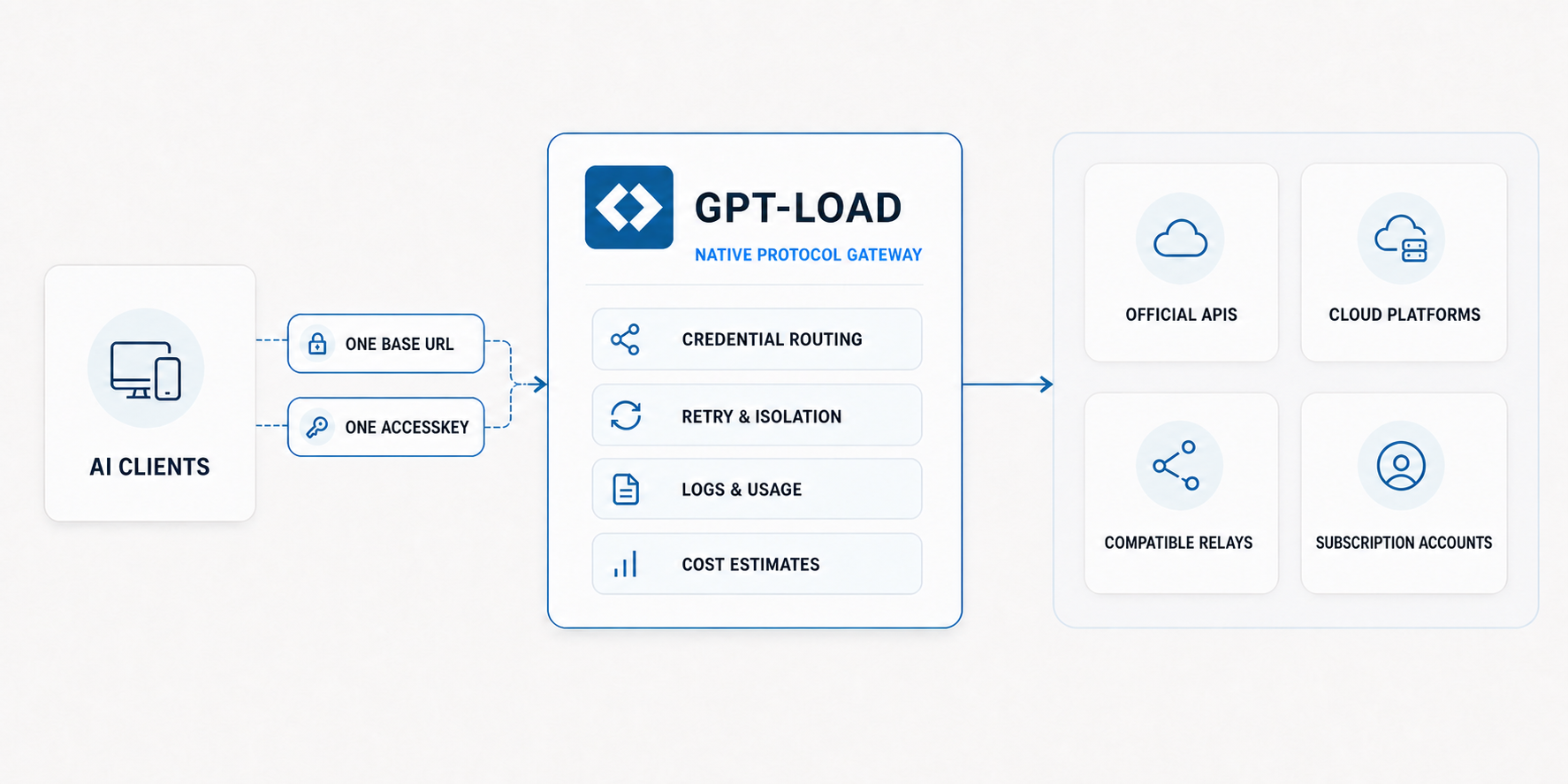
Your application only needs one base URL and one AccessKey. Providers, accounts, credentials, models, and routing policy are all configured in the management UI.
- **One gateway, native protocols** — Manage official APIs, cloud platforms, model services, and compatible relays together while clients keep their OpenAI, Anthropic, or Gemini native interfaces.
- **One mechanism for API keys and subscriptions** — Codex, Claude, Antigravity, Grok, and API-key channels share credential management, scheduling, and health handling.
- **Scheduling and failure isolation built in** — Multi-credential scheduling, configurable weights, retries, cooldown, blacklisting, and session affinity reduce the impact of overloaded or failing credentials.
- **Observable, self-hosted, and simple to deploy** — Inspect health, routes, logs, usage, and cost estimates in an embedded UI backed by SQLite, MySQL, or PostgreSQL with local credential encryption.
## Quick start
> [!WARNING]
> If you are using 1.x, read [Moving from 1.x](#moving-from-1x) first. 2.0 cannot open, import, or migrate 1.x data in place.
### 1. Start the service
Requires Docker and Docker Compose.
```bash
git clone --depth 1 https://github.com/tbphp/gpt-load.git
cd gpt-load
cp .env.example .env
docker compose up -d
```
Confirm the service is up:
```bash
curl --fail http://127.0.0.1:3001/health
```
The first start generates a management key. Read it and store it safely:
```bash
docker compose exec gpt-load sh -c 'cat /app/data/auth.key'
```
Open and sign in to the console with that key.
> You can also set `AUTH_KEY` explicitly in `.env` before starting. By default the service listens on the loopback address only and is not exposed to the internet.
### 2. Initial configuration
Initial setup takes three steps:
1. **Add a channel** — Choose an upstream service and add one or more API keys. For subscription channels, complete the OAuth flow or import credentials as prompted.
2. **Create a group** — Pick a channel, then configure available models and runtime policy.
3. **Create an AccessKey** — Set the groups and client protocols it may use, then give the generated AccessKey to your application.
OAuth callback ports for subscription channels
The Codex, Claude, and Antigravity OAuth clients use fixed callback ports. Compose publishes them on the address configured by `HOST`, which defaults to `127.0.0.1`; setting `HOST=0.0.0.0` also publishes these callback ports on all host interfaces. Because the ports are fixed by the upstream clients, only one default Compose instance can run on a host at a time.
When working over SSH or from a remote browser, the browser's `localhost` may not reach GPT-Load — paste the full callback URL into the authorization dialog to finish the flow.
## Screenshots
**Groups** — View channels, models, credential counts, and health in one place
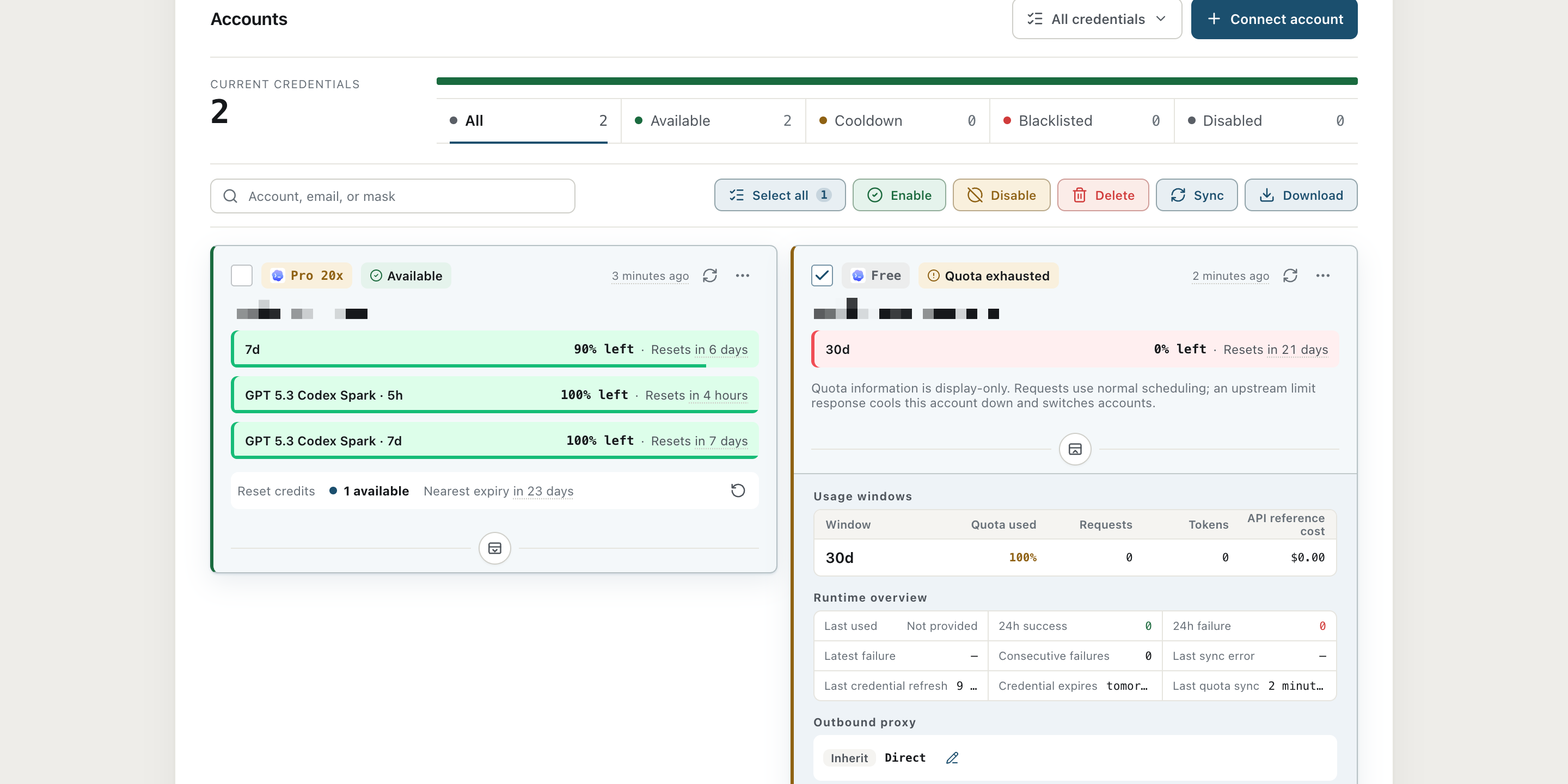
**Subscription accounts** — Track account availability, quota windows, reset times, and runtime diagnostics
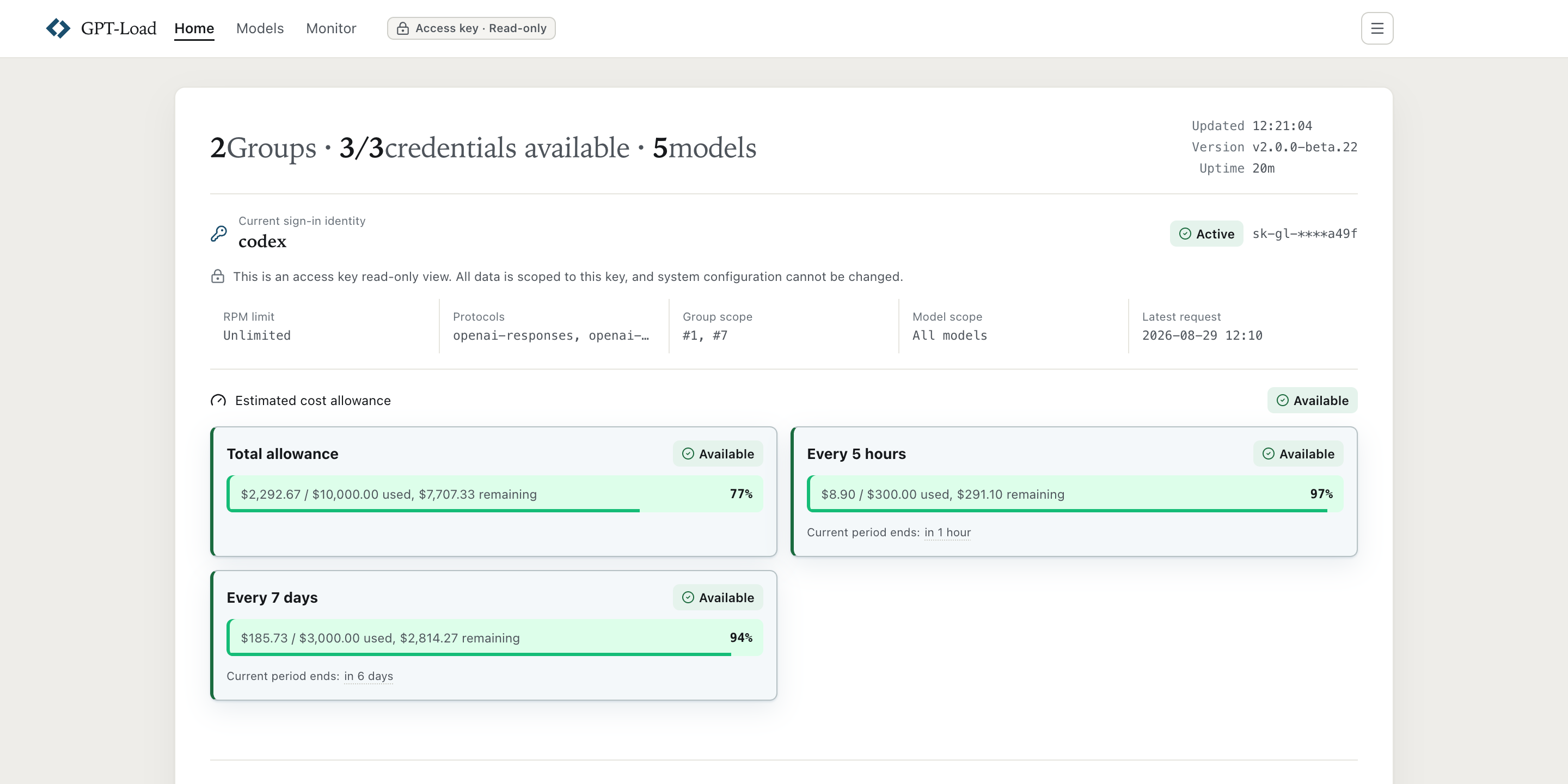
**AccessKey read-only home** — Sign in with an AccessKey to view only its own groups, models, requests, usage, and cost allowance
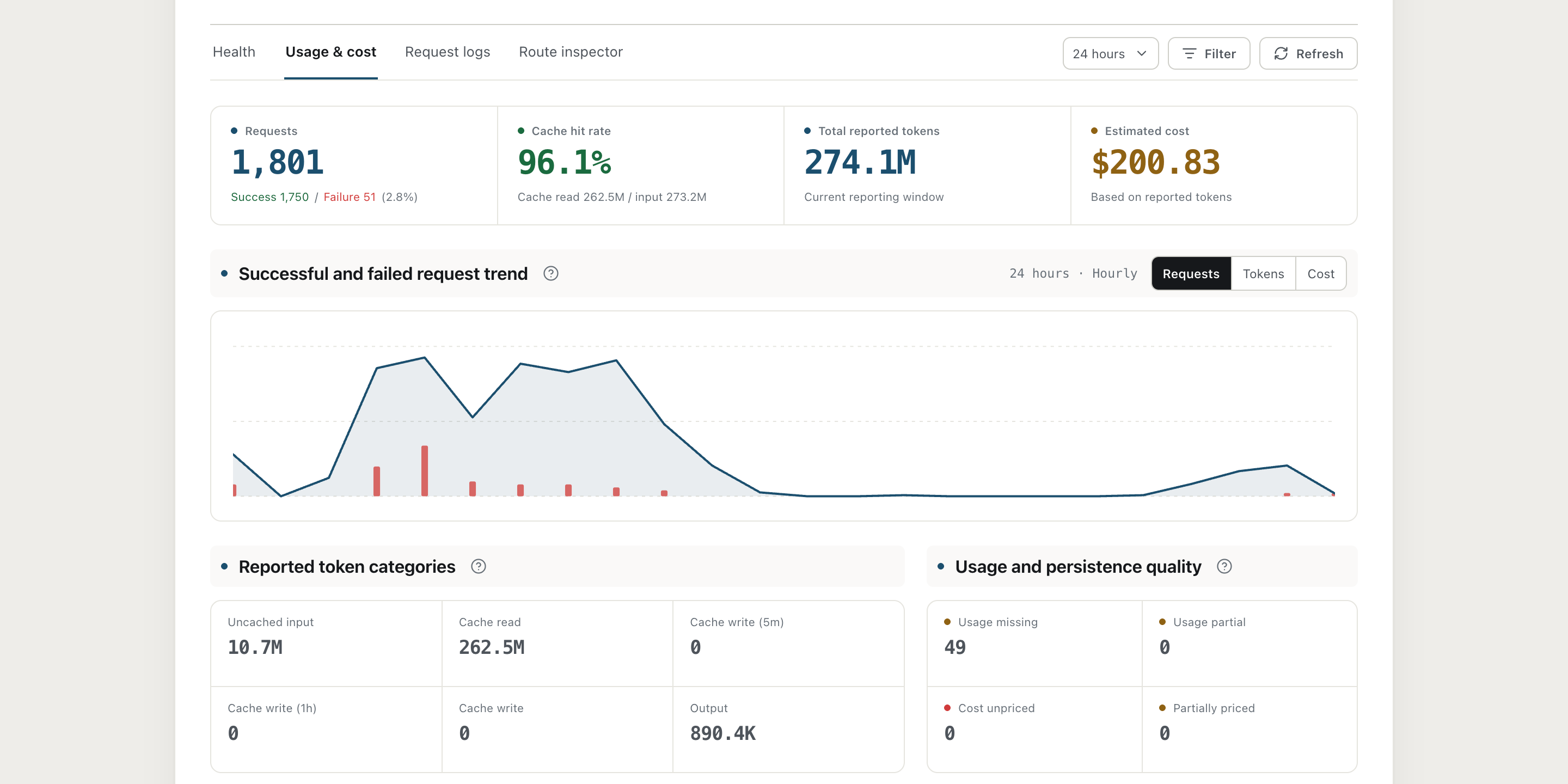
**Usage and cost** — Review request trends, cache hit rate, token categories, and cost estimates
## Scope
### Client protocols
| Protocol | Main entry |
| ----------------------- | -------------------------------------- |
| OpenAI Chat Completions | `POST /v1/chat/completions` |
| OpenAI Responses | `/v1/responses` and its resource paths |
| OpenAI Images | `POST /v1/images/...` |
| OpenAI Embeddings | `POST /v1/embeddings` |
| Rerank | `POST /v1/rerank` |
| Anthropic Messages | `POST /v1/messages` |
| Gemini | `/v1beta/models/...` |
Each channel declares exactly which protocols and capabilities it can execute. GPT-Load converts between supported capabilities, but it is not a general-purpose any-protocol, any-JSON translator.
Embeddings initially uses the native OpenAI-compatible wire only on the OpenAI, OpenRouter, and OpenAI Compatible API-key channels; subscription channels and protocol conversion are not supported. An AccessKey without a protocol filter keeps its existing “all enabled protocols” behavior and therefore gains Embeddings access after upgrade. Least-privilege deployments should configure an explicit protocol filter.
Rerank uses the independent `rerank` protocol through `POST /v1/rerank` on the OpenAI Compatible, New API, and GPT-Load API-key channels. Requests contain `model`, `query`, and a text-only `documents` array, with optional upstream parameters such as `top_n` and `return_documents`. Streaming, subscription channels, and protocol conversion are not supported. OpenAI Compatible takes a complete API prefix (for example, `https://host/v1`); New API / GPT-Load take the gateway root. The upstream must implement a compatible Rerank endpoint. AccessKeys without a protocol filter also gain Rerank access. Responses containing only non-token units such as `search_units` remain unpriced; these units are not treated as tokens or free requests.
### Built-in channels
- **Official and cloud** — OpenAI, Anthropic, Gemini, xAI, Azure OpenAI, AWS Bedrock, Google Vertex AI
- **Model services** — DeepSeek, Moonshot AI, SiliconFlow, Zhipu AI, Alibaba, Volcengine, OpenRouter, Groq
- **Subscription** — Codex, Claude, Antigravity, Grok
- **Custom** — OpenAI Compatible (any compatible relay)
## Deployment and data
Docker Compose uses application-managed SQLite by default. Data lives in the `gpt-load-data` named volume and includes the database, `auth.key`, and `encryption.key`.
> [!IMPORTANT]
> `encryption.key` decrypts channel credentials. When backing up or migrating, the database and the key **must be kept together**. Once the key is lost or replaced, existing encrypted credentials cannot be recovered, and this version does not support master key rotation.
Using an external database
Use the unified `DATABASE_DSN` to connect SQLite, MySQL, or PostgreSQL:
```text
mysql://user:password@db.example:3306/gpt_load?charset=utf8mb4&collation=utf8mb4_bin
postgres://user:password@db.example:5432/gpt_load?sslmode=require
```
Common operations:
```bash
docker compose logs -f # view logs
docker compose pull && docker compose up -d # update to the latest 2.x image
docker compose stop # stop the service
```
The official Compose file uses `ghcr.io/tbphp/gpt-load:2`. Before GA, `2` tracks verified 2.0 Beta and RC releases; after GA, it tracks stable 2.x releases only. Exact image tags omit the Git tag's `v` prefix (for example, `2.0.0-beta.25`), while `2.0-beta` remains the 2.0 Beta channel. `latest` remains on 1.x.
Using a native binary
Download the build for your platform from [GitHub Releases](https://github.com/tbphp/gpt-load/releases), and verify it against the bundled `SHA256SUMS` first:
```bash
chmod +x ./gpt-load-linux-amd64
HOST=127.0.0.1 DATA_DIR=./data ./gpt-load-linux-amd64
```
Then open . Portable builds are provided for five targets across Linux, macOS (amd64 / arm64), and Windows; `gpt-load-windows-amd64.exe` keeps running in the foreground as before.
Windows desktop users can instead download `gpt-load-windows-setup.exe`. After one administrator approval, Setup installs and starts a low-privilege Windows service, enables automatic startup, and creates desktop and Start Menu shortcuts to the GPT-Load management page. Setup displays the generated management key before it finishes; save it before closing the page. The protected copy remains at `%ProgramData%\GPT-Load\data\auth.key`. Service configuration and its `.env` live in `%ProgramData%\GPT-Load`, with persistent data in `%ProgramData%\GPT-Load\data`.
Installing a newer Setup stops the service gracefully before updating it. Windows uninstall removes the program and service but preserves data. Advanced users can still manage an installed service with `gpt-load-windows-amd64.exe service start|stop|restart|status`.
### Environment configuration
At startup, the application reads `.env` in the current directory; existing process environment variables take precedence. Unless noted otherwise, changes require restarting the process or container; see [`.env.example`](.env.example) for the common configuration template.
Show all environment variables
| Variable | Default | Description |
| --- | --- | --- |
| `HOST` | `127.0.0.1` | Native listening address, and the default host address for Compose's main port and OAuth callback ports; Compose always listens on `0.0.0.0` inside the container. |
| `PORT` | `3001` | HTTP service port, must be `1–65535`; Compose also uses it for the container port, host publishing, and health check. |
| `BIND_ADDRESS` | Empty, inherits `HOST` | Compose only; overrides the host publishing address for the main service port without changing OAuth callback ports. |
| `OAUTH_CALLBACK_BIND_ADDRESS` | Empty, inherits `HOST` | Compose only; overrides the host publishing address for the fixed OAuth callback ports `1455`, `54545`, and `51121`. |
| `GRACEFUL_SHUTDOWN_TIMEOUT` | `10` | Maximum time to wait for requests after a stop signal, positive integer in seconds. |
| `CONTAINER_STOP_GRACE_PERIOD` | `15s` | Docker duration to wait before Compose force-stops the container; should be longer than `GRACEFUL_SHUTDOWN_TIMEOUT`. |
| `READ_TIMEOUT` | `60` | HTTP request read timeout, positive integer in seconds. |
| `IDLE_TIMEOUT` | `120` | HTTP keep-alive idle connection timeout, positive integer in seconds. |
| `DATA_DIR` | `./data` | Directory for the managed database, `auth.key`, `encryption.key`, and runtime state; official Compose uses `/app/data`, while the Windows Setup service uses `%ProgramData%\GPT-Load\data`. |
| `DATABASE_DSN` | Empty, uses `${DATA_DIR}/gpt-load.db` | Empty uses application-managed SQLite; non-empty values support SQLite paths or URLs, MySQL URLs, and PostgreSQL URLs, and are treated as operator-managed external databases. Container file paths must be inside a mounted directory. |
| `DATABASE_MAX_OPEN_CONNECTIONS` | `10` | Maximum open connections for MySQL and PostgreSQL, positive integer. SQLite always uses one connection. |
| `DATABASE_MAX_IDLE_CONNECTIONS` | `5` | Maximum idle connections for MySQL and PostgreSQL, positive integer and no greater than `DATABASE_MAX_OPEN_CONNECTIONS`. SQLite always uses one connection. |
| `AUTH_KEY` | Empty, reads or generates `${DATA_DIR}/auth.key` | Bearer key for the management UI and `/api` management API, not a data-plane AccessKey. |
| `ENCRYPTION_KEY` | Empty, reads or generates `${DATA_DIR}/encryption.key` | Encrypts channel credentials; changing or losing it makes existing credentials undecryptable, so back it up with the database. |
| `HTTP_PROXY` | Empty | Environment proxy for HTTP upstream requests. |
| `HTTPS_PROXY` | Empty | Environment proxy for HTTPS upstream requests. |
| `NO_PROXY` | Empty | Comma-separated hosts, domains, or IPs that bypass the environment proxy. |
| `LOG_LEVEL` | `info` | Supports `panic`, `fatal`, `error`, `warn`, `warning`, `info`, `debug`, and `trace`; invalid values warn and fall back to `info`. |
| `LOG_FORMAT` | `text` | Supports `text` and `json`; any other value fails startup. |
| `MODELS_DEV_AUTO_SYNC_ENABLED` | Unset, initial default `true` | When unset, uses the persisted management UI setting; when set, forces Models.dev auto-sync on or off and makes the same UI option read-only. |
Environment proxies apply only when no proxy is specified on the credential, group, or global settings.
## Production considerations
- The service listens on `127.0.0.1` only by default. For remote access, expose it through a controlled network or a TLS reverse proxy, and configure ACLs and firewall rules.
- Manage `AUTH_KEY` and `ENCRYPTION_KEY` carefully. Never commit real keys to a repository, log, screenshot, or public issue.
- 2.0 is designed for a **single application instance**. Instances do not share state, so horizontal scaling is not supported.
- Usage and cost are **estimates** derived from upstream responses. They support operational analysis and capacity planning, and do not equal a provider invoice or a financial reconciliation.
- Subscription channels depend on upstream OAuth and compatibility protocols and may change as upstreams change. Only connect accounts you are entitled to use, and follow each provider's terms.
- HTTP Responses continuation with `previous_response_id` automatically uses native Responses routes that declare upstream-managed storage: currently `openai`, `gpt_load`, `xai`, `newapi`, `cliproxyapi`, and `sub2api`. Ownership is isolated by AccessKey and pins the original credential when current routing permits, independently of soft affinity; actual state availability depends on the upstream. Stateless and converted responses are not registered as persistent state. Unknown IDs, including IDs created before upgrading or outside this gateway, are rejected. Group parameter overrides cannot change this field.
- Native Responses WebSocket uses `GET /v1/responses` on the same port. Admission follows declared upstream capabilities for OpenAI, xAI, Codex, and compatible native CPA/sub2api and GPT-Load endpoints. Clients may include the boolean `stream:true/false`; both values still use the WS event stream. Each turn checks current permissions, rate and cost limits, and routing, with separate usage and cost records. One connection keeps one upstream identity; there is no HTTP fallback or conversation-history replay.
- `responses_websocket_enabled` defaults to enabled. An explicit group setting overrides the global value; otherwise the group inherits it. Disabling immediately closes affected WS connections and interrupts generation without affecting HTTP/SSE. Re-enabling does not restore the old connection's temporary state.
- Full `stream_id` multiplexing and forks are enabled for OpenAI and GPT-Load cascades that support them end to end. The other channels above run serially and reject named streams. Prewarming sends `generate:false` upstream. Codex continuation requires the original live connection: `store:true` and restoration by an old ID on a new connection are unsupported. Persistent continuation on other channels depends on storage capabilities and valid ownership. Existing [Codex SDK proxy, reading, and shutdown limits](third_party/cpaembedded/README.md#codex-websocket-session) still apply.
- Response bindings stay in memory for up to 30 days, with limits of 100,000 entries and 16 MiB of ID text; older entries are evicted when capacity is reached. A successful checkpoint during normal shutdown allows restoration from the same data directory. Crash recovery and continued upstream state availability are not guaranteed.
- `conversation` and other existing resource IDs are outside this ownership routing scope and still depend on a single credential or upstream resource sharing across credentials.
## Moving from 1.x
> [!WARNING]
> GPT-Load 2.0 is a complete rewrite. It **cannot** open, import, or migrate 1.x data in place.
Deploy 2.0 with its own database, `DATA_DIR`, port, and Docker volume. Cut traffic over only after verification, and keep the original 1.x deployment until the rollback window closes. Documentation for the 1.4.x maintenance line is at the [official docs](https://www.gpt-load.com/docs).
## Open-source dependencies
Some of GPT-Load's capabilities build on these projects, with thanks:
| Project | Role | License |
| ----------------------------------------------------------- | ------------------------------------------------------------------------------------ | ---------- |
| [Bifrost Core](https://github.com/maximhq/bifrost) | Provider authentication, request/response conversion, streaming, usage normalization | Apache-2.0 |
| [CLIProxyAPI](https://github.com/router-for-me/CLIProxyAPI) | OAuth and execution adapter for subscription channels | MIT |
| [Lobe Icons](https://github.com/lobehub/lobe-icons) | Channel brand icons in the management UI | MIT |
GPT-Load owns credential storage, account selection, scheduling, retry, health, affinity, logging, and usage policy. Third-party notices are in [THIRD_PARTY_NOTICES.md](THIRD_PARTY_NOTICES.md), full license texts in [`LICENSES/`](LICENSES/), and each release ships a CycloneDX SBOM covering the Go dependency graph.
Channel icons identify their respective upstream providers. All trademarks belong to their owners; this project is not affiliated with or endorsed by them.
## Project support
 # GPT-Load
**A self-hosted AI gateway for multi-channel, multi-credential setups**
API keys, subscription accounts, traffic scheduling, failure handling, request logs, and usage accounting — behind a single entry point.
English · [中文](README_CN.md) · [日本語](README_JP.md) | [Official Website](https://www.gpt-load.com)
[](https://github.com/tbphp/gpt-load/releases)
[](https://github.com/tbphp/gpt-load/pkgs/container/gpt-load)
[](go.mod)
[](LICENSE)
# GPT-Load
**A self-hosted AI gateway for multi-channel, multi-credential setups**
API keys, subscription accounts, traffic scheduling, failure handling, request logs, and usage accounting — behind a single entry point.
English · [中文](README_CN.md) · [日本語](README_JP.md) | [Official Website](https://www.gpt-load.com)
[](https://github.com/tbphp/gpt-load/releases)
[](https://github.com/tbphp/gpt-load/pkgs/container/gpt-load)
[](go.mod)
[](LICENSE)






 - **One gateway, native protocols** — Manage official APIs, cloud platforms, model services, and compatible relays together while clients keep their OpenAI, Anthropic, or Gemini native interfaces.
- **One mechanism for API keys and subscriptions** — Codex, Claude, Antigravity, Grok, and API-key channels share credential management, scheduling, and health handling.
- **Scheduling and failure isolation built in** — Multi-credential scheduling, configurable weights, retries, cooldown, blacklisting, and session affinity reduce the impact of overloaded or failing credentials.
- **Observable, self-hosted, and simple to deploy** — Inspect health, routes, logs, usage, and cost estimates in an embedded UI backed by SQLite, MySQL, or PostgreSQL with local credential encryption.
## Quick start
> [!WARNING]
> If you are using 1.x, read [Moving from 1.x](#moving-from-1x) first. 2.0 cannot open, import, or migrate 1.x data in place.
### 1. Start the service
Requires Docker and Docker Compose.
```bash
git clone --depth 1 https://github.com/tbphp/gpt-load.git
cd gpt-load
cp .env.example .env
docker compose up -d
```
Confirm the service is up:
```bash
curl --fail http://127.0.0.1:3001/health
```
The first start generates a management key. Read it and store it safely:
```bash
docker compose exec gpt-load sh -c 'cat /app/data/auth.key'
```
Open
- **One gateway, native protocols** — Manage official APIs, cloud platforms, model services, and compatible relays together while clients keep their OpenAI, Anthropic, or Gemini native interfaces.
- **One mechanism for API keys and subscriptions** — Codex, Claude, Antigravity, Grok, and API-key channels share credential management, scheduling, and health handling.
- **Scheduling and failure isolation built in** — Multi-credential scheduling, configurable weights, retries, cooldown, blacklisting, and session affinity reduce the impact of overloaded or failing credentials.
- **Observable, self-hosted, and simple to deploy** — Inspect health, routes, logs, usage, and cost estimates in an embedded UI backed by SQLite, MySQL, or PostgreSQL with local credential encryption.
## Quick start
> [!WARNING]
> If you are using 1.x, read [Moving from 1.x](#moving-from-1x) first. 2.0 cannot open, import, or migrate 1.x data in place.
### 1. Start the service
Requires Docker and Docker Compose.
```bash
git clone --depth 1 https://github.com/tbphp/gpt-load.git
cd gpt-load
cp .env.example .env
docker compose up -d
```
Confirm the service is up:
```bash
curl --fail http://127.0.0.1:3001/health
```
The first start generates a management key. Read it and store it safely:
```bash
docker compose exec gpt-load sh -c 'cat /app/data/auth.key'
```
Open 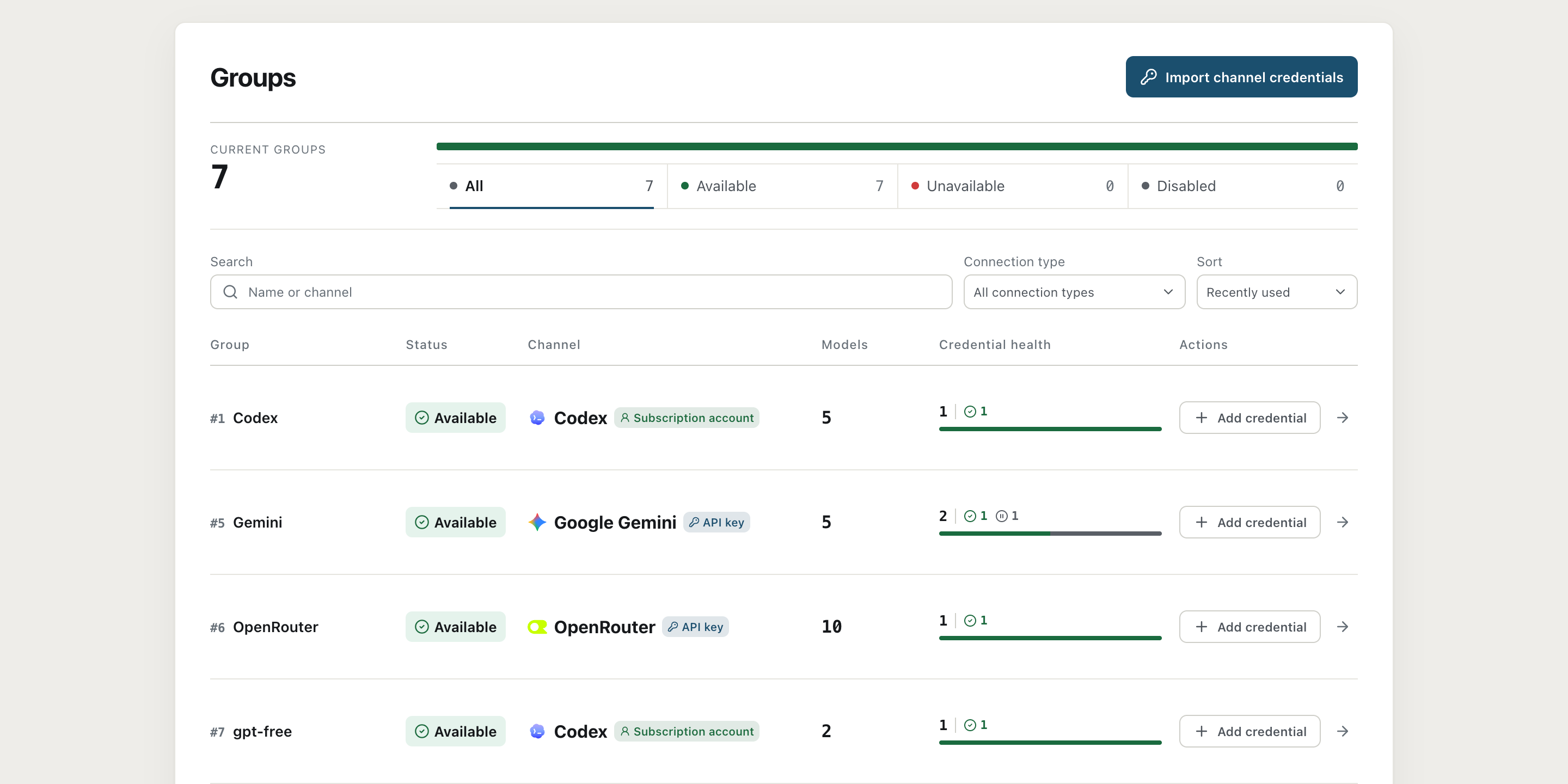 **Subscription accounts** — Track account availability, quota windows, reset times, and runtime diagnostics
 **AccessKey read-only home** — Sign in with an AccessKey to view only its own groups, models, requests, usage, and cost allowance
 **Usage and cost** — Review request trends, cache hit rate, token categories, and cost estimates
 ## Scope
### Client protocols
| Protocol | Main entry |
| ----------------------- | -------------------------------------- |
| OpenAI Chat Completions | `POST /v1/chat/completions` |
| OpenAI Responses | `/v1/responses` and its resource paths |
| OpenAI Images | `POST /v1/images/...` |
| OpenAI Embeddings | `POST /v1/embeddings` |
| Rerank | `POST /v1/rerank` |
| Anthropic Messages | `POST /v1/messages` |
| Gemini | `/v1beta/models/...` |
Each channel declares exactly which protocols and capabilities it can execute. GPT-Load converts between supported capabilities, but it is not a general-purpose any-protocol, any-JSON translator.
Embeddings initially uses the native OpenAI-compatible wire only on the OpenAI, OpenRouter, and OpenAI Compatible API-key channels; subscription channels and protocol conversion are not supported. An AccessKey without a protocol filter keeps its existing “all enabled protocols” behavior and therefore gains Embeddings access after upgrade. Least-privilege deployments should configure an explicit protocol filter.
Rerank uses the independent `rerank` protocol through `POST /v1/rerank` on the OpenAI Compatible, New API, and GPT-Load API-key channels. Requests contain `model`, `query`, and a text-only `documents` array, with optional upstream parameters such as `top_n` and `return_documents`. Streaming, subscription channels, and protocol conversion are not supported. OpenAI Compatible takes a complete API prefix (for example, `https://host/v1`); New API / GPT-Load take the gateway root. The upstream must implement a compatible Rerank endpoint. AccessKeys without a protocol filter also gain Rerank access. Responses containing only non-token units such as `search_units` remain unpriced; these units are not treated as tokens or free requests.
### Built-in channels
- **Official and cloud** — OpenAI, Anthropic, Gemini, xAI, Azure OpenAI, AWS Bedrock, Google Vertex AI
- **Model services** — DeepSeek, Moonshot AI, SiliconFlow, Zhipu AI, Alibaba, Volcengine, OpenRouter, Groq
- **Subscription** — Codex, Claude, Antigravity, Grok
- **Custom** — OpenAI Compatible (any compatible relay)
## Deployment and data
Docker Compose uses application-managed SQLite by default. Data lives in the `gpt-load-data` named volume and includes the database, `auth.key`, and `encryption.key`.
> [!IMPORTANT]
> `encryption.key` decrypts channel credentials. When backing up or migrating, the database and the key **must be kept together**. Once the key is lost or replaced, existing encrypted credentials cannot be recovered, and this version does not support master key rotation.
## Scope
### Client protocols
| Protocol | Main entry |
| ----------------------- | -------------------------------------- |
| OpenAI Chat Completions | `POST /v1/chat/completions` |
| OpenAI Responses | `/v1/responses` and its resource paths |
| OpenAI Images | `POST /v1/images/...` |
| OpenAI Embeddings | `POST /v1/embeddings` |
| Rerank | `POST /v1/rerank` |
| Anthropic Messages | `POST /v1/messages` |
| Gemini | `/v1beta/models/...` |
Each channel declares exactly which protocols and capabilities it can execute. GPT-Load converts between supported capabilities, but it is not a general-purpose any-protocol, any-JSON translator.
Embeddings initially uses the native OpenAI-compatible wire only on the OpenAI, OpenRouter, and OpenAI Compatible API-key channels; subscription channels and protocol conversion are not supported. An AccessKey without a protocol filter keeps its existing “all enabled protocols” behavior and therefore gains Embeddings access after upgrade. Least-privilege deployments should configure an explicit protocol filter.
Rerank uses the independent `rerank` protocol through `POST /v1/rerank` on the OpenAI Compatible, New API, and GPT-Load API-key channels. Requests contain `model`, `query`, and a text-only `documents` array, with optional upstream parameters such as `top_n` and `return_documents`. Streaming, subscription channels, and protocol conversion are not supported. OpenAI Compatible takes a complete API prefix (for example, `https://host/v1`); New API / GPT-Load take the gateway root. The upstream must implement a compatible Rerank endpoint. AccessKeys without a protocol filter also gain Rerank access. Responses containing only non-token units such as `search_units` remain unpriced; these units are not treated as tokens or free requests.
### Built-in channels
- **Official and cloud** — OpenAI, Anthropic, Gemini, xAI, Azure OpenAI, AWS Bedrock, Google Vertex AI
- **Model services** — DeepSeek, Moonshot AI, SiliconFlow, Zhipu AI, Alibaba, Volcengine, OpenRouter, Groq
- **Subscription** — Codex, Claude, Antigravity, Grok
- **Custom** — OpenAI Compatible (any compatible relay)
## Deployment and data
Docker Compose uses application-managed SQLite by default. Data lives in the `gpt-load-data` named volume and includes the database, `auth.key`, and `encryption.key`.
> [!IMPORTANT]
> `encryption.key` decrypts channel credentials. When backing up or migrating, the database and the key **must be kept together**. Once the key is lost or replaced, existing encrypted credentials cannot be recovered, and this version does not support master key rotation.