AndroidMic
Use your Android phone as a microphone for your PC
[](https://github.com/teamclouday/AndroidMic/releases/latest)
[](https://f-droid.org/packages/io.github.teamclouday.AndroidMic)
[](https://search.nixos.org/packages?channel=unstable&show=android-mic)
---
## Features
- **Cross-platform**: Works on Linux, Windows, and macOS
- **Multiple connection options**: WiFi (TCP/UDP), USB Serial, and USB ADB
- **Audio processing**: Noise cancellation and audio wave visualization
- **Customizable audio settings**: Sample rate, channels, and bit depth
---
## ⚠️ Important Requirements
**This app requires a virtual audio cable device to work!**
AndroidMic streams audio from your phone to your PC, but your PC needs a way to recognize this audio stream as a microphone input. This is where virtual audio cables come in.
### Virtual Audio Cable Setup
**On Windows:**
- Install [Virtual Audio Cable (VAC)](https://vac.muzychenko.net/en/download.htm) or [VB Cable](https://vb-audio.com/Cable/) (both free options available)
- These tools create virtual audio devices on your system
- Once installed, you'll have a virtual output device (speaker/playback) and a virtual input device (microphone)
- AndroidMic plays audio to the virtual output, which is internally wired to the virtual input that your apps can use as a microphone
**On Linux:**
- Use PulseAudio or PipeWire to create virtual audio devices
- Example with PulseAudio:
```bash
pactl load-module module-null-sink sink_name=virtual_mic
pactl load-module module-remap-source master=virtual_mic.monitor source_name=virtual_mic_source
```
**On macOS:**
- Use [BlackHole](https://existential.audio/blackhole/) or similar virtual audio driver
---
## Setup Guide
### Step 1: Install Virtual Audio Cable
Follow the instructions above for your operating system to install a virtual audio cable solution. This step is **required** before proceeding.
### Step 2: PC Application Setup
1. **Download and install**
- Get the latest release from the [releases page](https://github.com/teamclouday/AndroidMic/releases/latest)
- **Nix / NixOS**: Run `nix run nixpkgs#android-mic` or add `pkgs.android-mic` to your configuration
- Install and launch the app
> **macOS users**: You may need to run this command to allow the app to run:
> ```sh
> xattr -c /Applications/AndroidMic.app
> ```
> See [this discussion](https://discussions.apple.com/thread/253714860?sortBy=best) for more details.
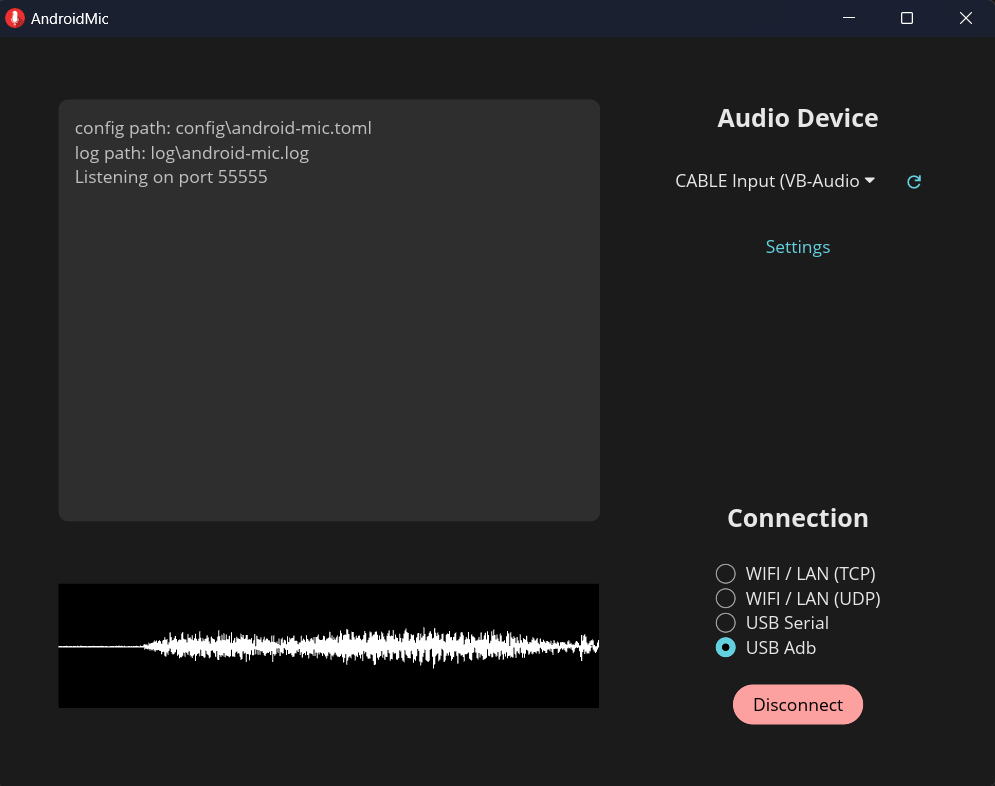
2. **Select output audio device**
- Choose the **virtual output device** (e.g., "VB Cable Input" or "Virtual Audio Cable") from the dropdown
- This is the playback device that's wired to your virtual microphone
- Do NOT select your regular speakers or headphones
- On Linux change channel count to "Mono" when you select PipeWire or PulseAudio
3. **Choose connection method**
- **TCP/UDP (WiFi)**:
- Connect your phone and PC to the same network
- No additional setup required
- **USB ADB**:
- Install [Android Debug Bridge (ADB)](https://developer.android.com/tools/adb)
- Enable USB debugging on your phone (Developer Options)
- Connect phone via USB cable
- **USB Serial**:
- Connect phone via USB cable
- Set phone's USB mode to "Charging only"
- **Windows**:
- Close Android Studio and ensure ADB process is not running
- Your phone must use the WinUSB driver (required for all Android phones)
- Use [Zadig](https://zadig.akeo.ie/) to replace the current USB driver with WinUSB if needed
- On first connection attempt, the phone will switch to accessory mode - click Connect again to establish the connection
- **Linux**: Configure [udev rules](https://github.com/libusb/libusb/wiki/FAQ#can-i-run-libusb-applications-on-linux-without-root-privilege) for USB permissions
4. **Configure audio settings** (Advanced)
- Click to open advanced settings
- Choose format supported by your virtual audio device
- Common settings: 44.1kHz or 48kHz sample rate, mono channel, 16-bit or 24-bit depth
### Step 3: Android Application Setup
1. **Install the app**
- Download the APK from [releases](https://github.com/teamclouday/AndroidMic/releases/latest) or [F-Droid](https://f-droid.org/packages/io.github.teamclouday.AndroidMic)
- Install and open the app
2. **Configure settings**
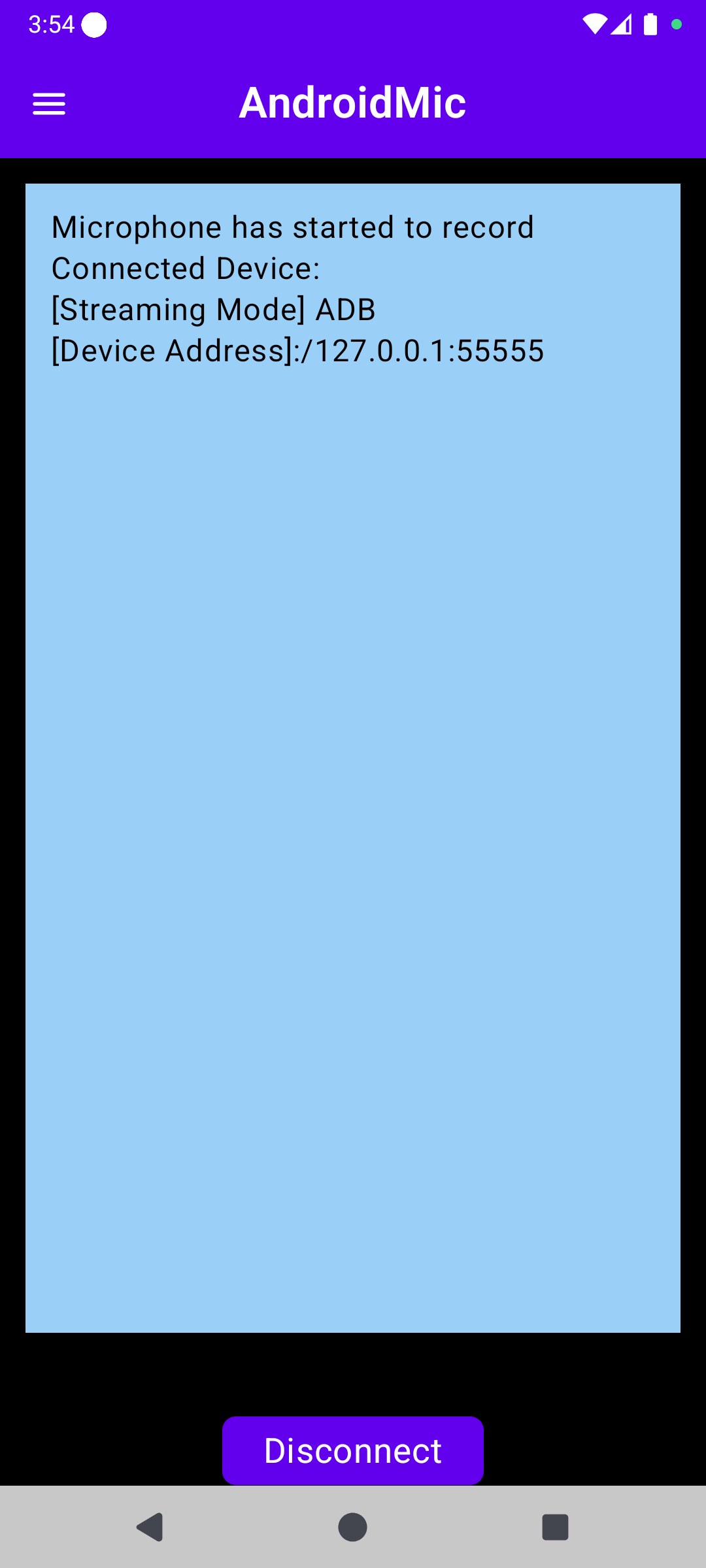
- Open the side drawer menu
- Select the **same connection method** chosen on PC
- Configure audio settings (sample rate, channels, bit depth) - these can be adjusted independently from PC settings
3. **Connect and start**
- Grant required permissions:
- **Microphone**: To access your phone's mic
- **Notification**: To show recording status in background
- Start recording
- Connect to PC:
- **TCP/UDP**: Enter PC IP address and port (shown in PC app log)
- **USB ADB**: Enter port number (shown in PC app log)
- **USB Serial**: Allow accessory mode when prompted
---
## Using AndroidMic in Other Apps
After setup, the virtual microphone will appear in your system's audio input devices. Select it in any application:
- Discord, Teams, Zoom (voice chat)
- OBS, Streamlabs (streaming)
- Audacity, FL Studio (recording)
- Any other app that accepts microphone input
---
## Troubleshooting
### Can't hear audio / No microphone detected
- Verify virtual audio cable is properly installed
- Ensure you selected the virtual **output** device in AndroidMic PC app
- Check that applications are using the virtual **input** device as microphone
- On Windows: Check that VAC/VB Cable devices are set as default in Sound Settings
### Windows Defender flags the app as malware
- Usually this is a false positive due to Windows Defender's ML algorithm
- Please [report to Microsoft](https://www.microsoft.com/en-us/wdsi/filesubmission) to help get it fixed
### USB connection not working
- **USB ADB**: Ensure USB debugging is enabled and ADB is installed
- **USB Serial**: May need [Zadig](https://zadig.akeo.ie/) to change USB driver to WinUSB
- **USB Serial (Linux)**: Configure udev rules for USB permissions
### Audio quality issues
- Match audio settings between PC and Android app exactly
- Try different sample rates (44.1kHz or 48kHz)
- Turn on/off noise cancellation in the app
---
## Support & Contributing
- **Questions / Feature Requests / Bug Reports**: [Submit an issue](https://github.com/teamclouday/AndroidMic/issues)
- **Discussions**: [GitHub Discussions](https://github.com/teamclouday/AndroidMic/discussions)
## Project History
The PC app originally started as a WPF application written in C# for Windows only. Most features have been recreated in Rust (thanks to [@wiiznokes](https://github.com/wiiznokes)) for cross-platform support. The [WPF app branch](https://github.com/teamclouday/AndroidMic/tree/wpf-app-backup) is still available for reference.
**Note**: Bluetooth support was removed in favor of USB Serial connection, which provides better bandwidth.