Open Beans logo # Open Beans **Dial in your perfect brew.** A minimal, mobile-first coffee tracker, made for **single dosers**: when you weigh in beans per shot and keep several bags open at once, every bean needs its own grinder setting, dose, and brew time. Open Beans keeps every bag on a swipeable shelf โ€” with a photo, a rating, and one auto-saving recipe per brew style โ€” so the next espresso starts where the last one left off, not from memory. Entirely serverless on Cloudflare's free tier: no server to run, nothing to back up, installs like an app. [![React Router 8](https://img.shields.io/badge/React%20Router-8-f44250?logo=reactrouter&logoColor=white)](https://reactrouter.com) [![TypeScript](https://img.shields.io/badge/TypeScript-5.9-3178c6?logo=typescript&logoColor=white)](https://www.typescriptlang.org/) [![Cloudflare Workers](https://img.shields.io/badge/Cloudflare-Workers-f38020?logo=cloudflare&logoColor=white)](https://workers.cloudflare.com) [![D1](https://img.shields.io/badge/D1-SQLite-003b57?logo=sqlite&logoColor=white)](https://developers.cloudflare.com/d1/) [![Drizzle](https://img.shields.io/badge/Drizzle-ORM-c5f74f?logo=drizzle&logoColor=black)](https://orm.drizzle.team) [![Tailwind CSS 4](https://img.shields.io/badge/Tailwind-4-06b6d4?logo=tailwindcss&logoColor=white)](https://tailwindcss.com) [![PWA](https://img.shields.io/badge/PWA-installable-5a0fc8)](#-install-it-like-an-app) [![License: MIT](https://img.shields.io/badge/License-MIT-blue.svg)](LICENSE)

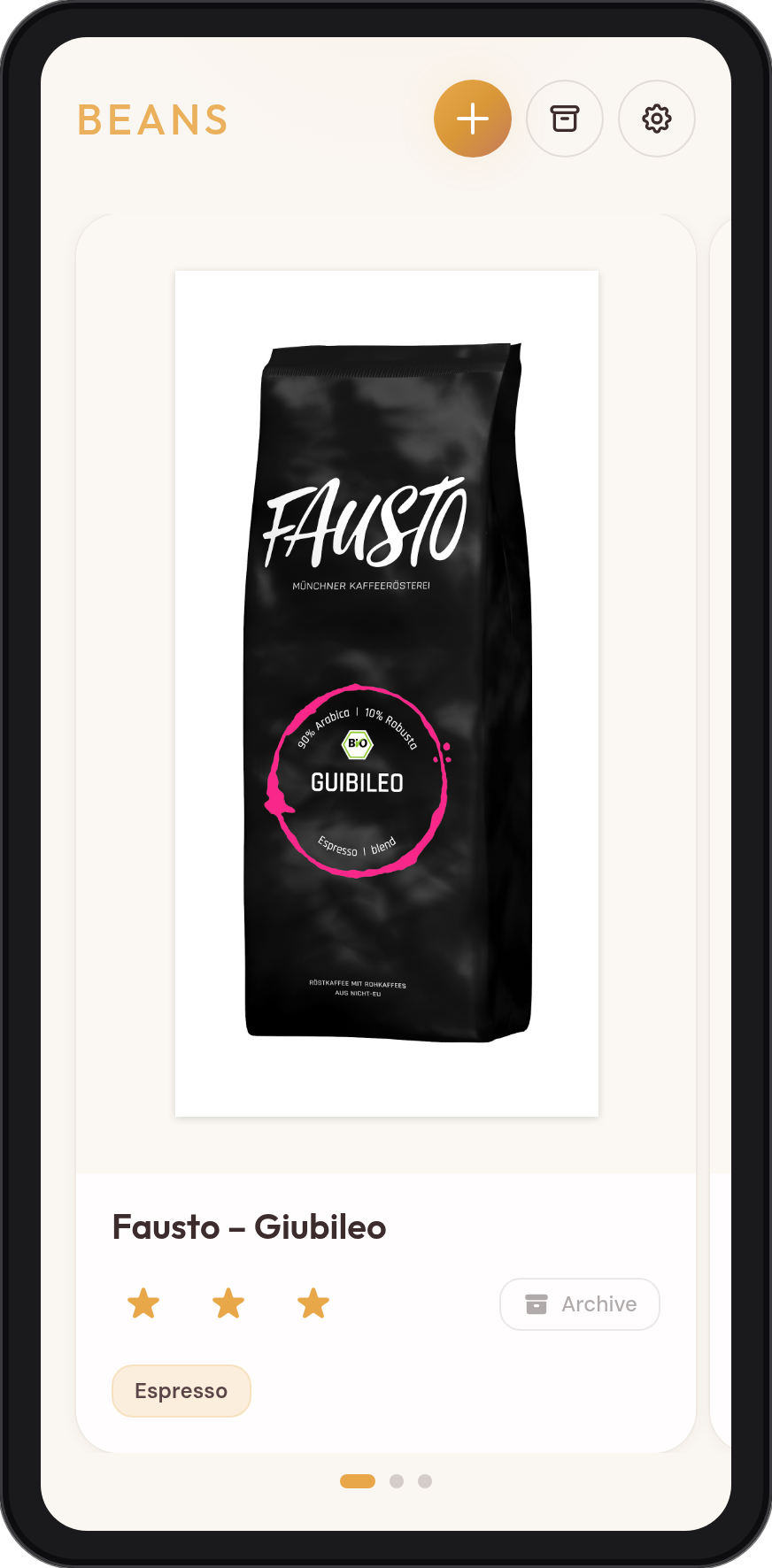
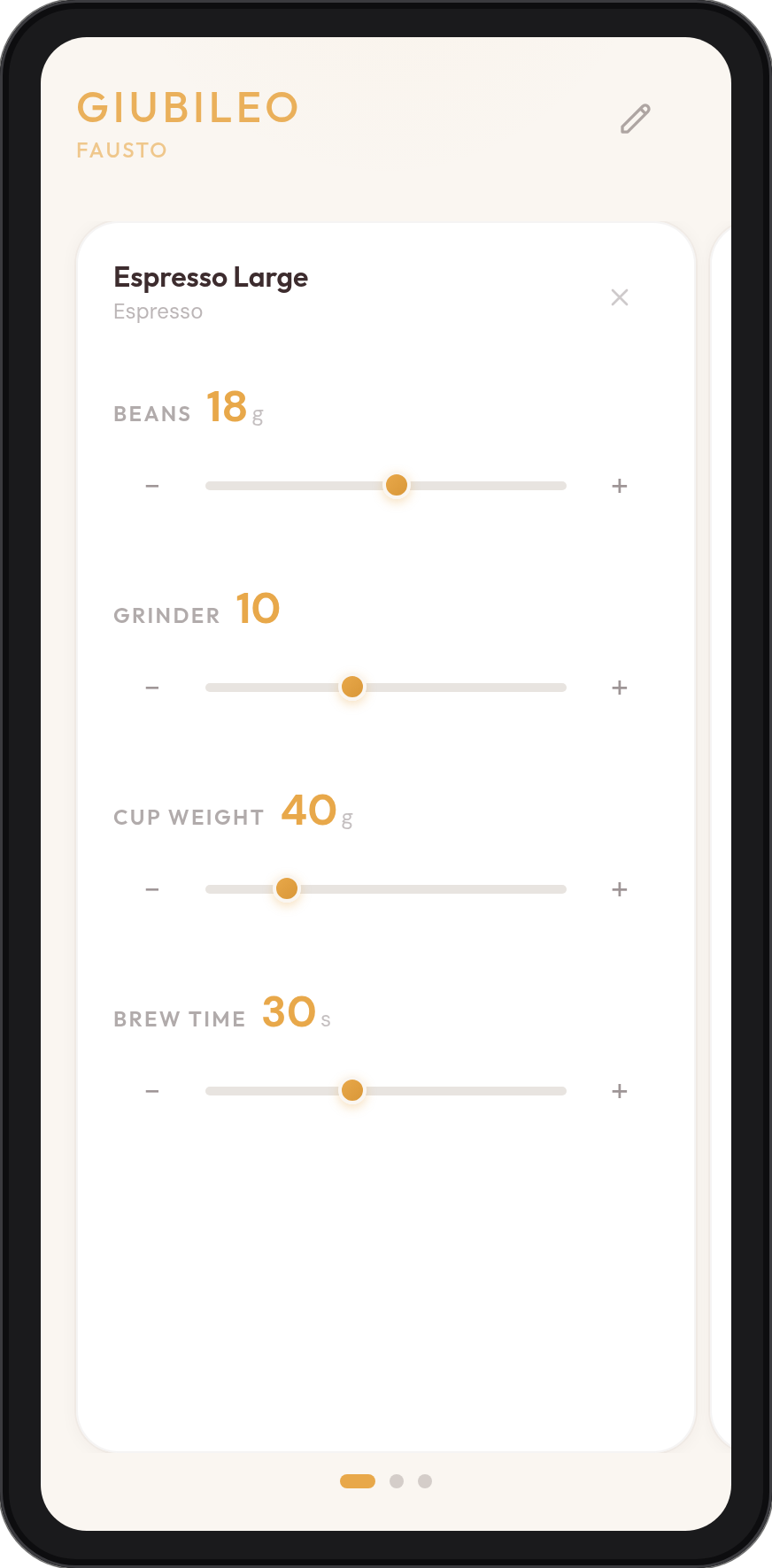
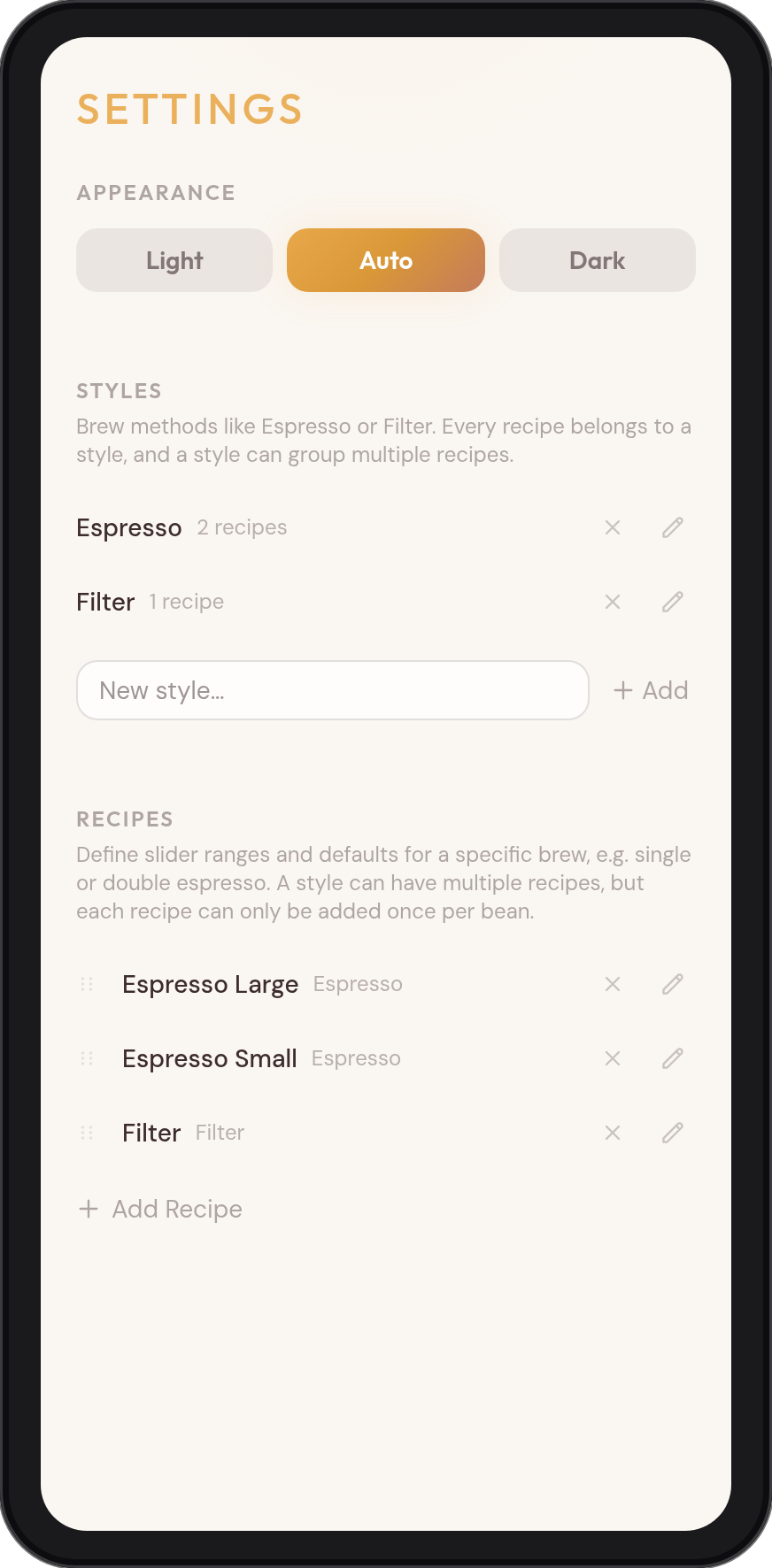
Bean carousel with photo, rating and style pills  Recipe card with auto-saving sliders  Settings with styles and recipe templates
--- ## Contents - [Feature Tour](#feature-tour) - [How It's Built](#how-its-built) - [Self-Hosting Guide](#self-hosting-guide) - [1. Prerequisites](#1-prerequisites) - [2. Clone and Install](#2-clone-and-install) - [3. Create the D1 Database and R2 Bucket](#3-create-the-d1-database-and-r2-bucket) - [4. Run It Locally](#4-run-it-locally) - [5. Deploy](#5-deploy) - [6. Add a Custom Domain](#6-add-a-custom-domain) - [7. Turn On the Login Gate](#7-turn-on-the-login-gate) - [Migrating from the Flask Version](#migrating-from-the-flask-version) - [Install It Like an App](#-install-it-like-an-app) - [Security Model](#security-model) - [Development](#development) - [Project Structure](#project-structure) - [License](#license) --- ## Feature Tour ### ๐Ÿซ˜ Your Open Bags, One Shelf Bean carousel Every bag you're currently brewing is a full-height card in a snap-scrolling carousel: photo of the bag, a 1โ€“3 star rating, and pills showing which brew styles you've dialled in for it. Swipe between bags, tap one to get to its recipes โ€” and when a bag is empty, one tap archives it.
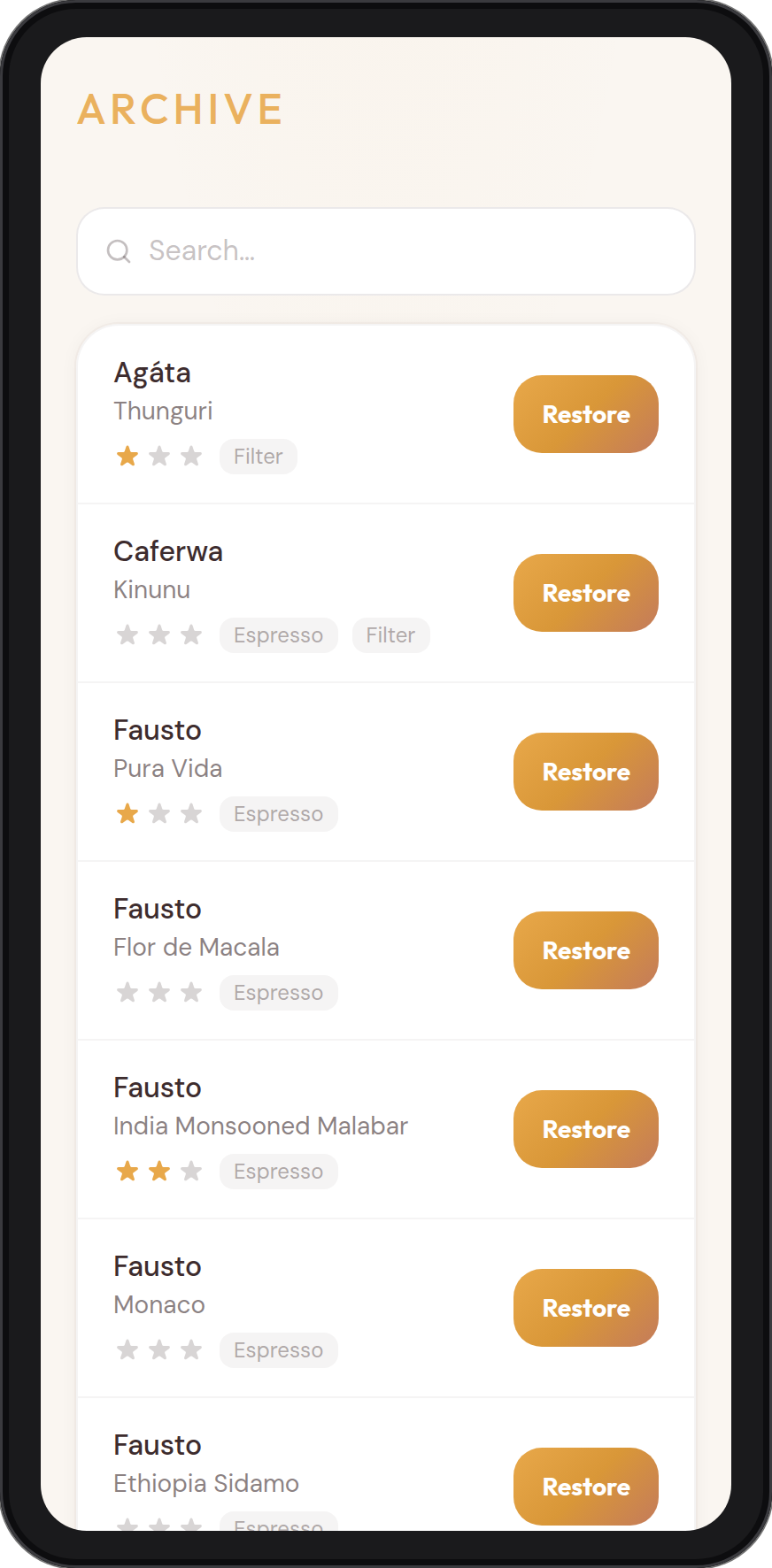
### ๐Ÿ“ฆ The Archive Remembers Every Bag Searchable archive with ratings and restore Archived beans aren't gone โ€” they're the app's memory. Every bag you've ever finished sits in a searchable list with its rating, its style chips, and all of its recipes fully intact. This is where the app pays off: rebuy a bean months later, hit **Restore**, and it's back on the shelf with the exact grinder setting, dose, and brew time you'd dialled in last time. No re-dialling, no guessing which of the three-star bags it was โ€” the search box finds it by brand or name.
### โฑ๏ธ Recipes That Save Themselves Recipe sliders Each bean holds one recipe per template โ€” single espresso, double espresso, filter โ€” as cards in a carousel. A recipe is four sliders: **bean amount**, **grinder setting**, **cup weight**, and **brew time**, each with +/โˆ’ buttons for single-step nudges. There is no save button. Move a slider and the value is persisted moments later; walk away mid-adjustment and nothing is lost. Ranges, step sizes and starting values all come from the recipe template.
### ๐Ÿท๏ธ Styles and Templates, Yours to Shape Settings **Styles** are brew methods โ€” Espresso, Filter, whatever you drink โ€” and group the recipe templates. **Templates** define a specific brew (e.g. *Espresso Small*): min, max, step, and default for each of the four sliders. Add as many as you like, drag to reorder them, and each template can be added once per bean. The theme โ€” light, dark, or follow-the-system โ€” lives here too, stored in the database so every device agrees.
### ๐ŸŒ€ Recalibrate After a Clean Cleaning a single-doser grinder means unscrewing the burrs, and the zero point drifts every time โ€” a recipe that used to say "dial to 8" might need 6 or 10 to grind the same after a clean. Settings has a running grinder offset for this: tell it what a known setting used to read and what it reads now, and every recipe's "dial to" number shifts automatically. Recipes themselves are never rewritten, so nothing about your dial-in history is lost, and repeated recalibrations compose โ€” no mental math required. ### ๐Ÿ” One Passphrase, Once per Device The Worker ships a built-in login gate: enter your passphrase once on each device and a signed cookie keeps you in for a year. Pages, data, and photos are all behind it โ€” no Cloudflare Access, no OAuth dance, no session that expires mid-espresso. Changing the secret logs out every device at once. --- ## How It's Built **No servers, no containers.** One Cloudflare Worker serves the server-rendered React app, gates every request behind the login cookie, and talks to D1 (SQLite) through Drizzle. Bean photos are downscaled in the browser before upload and streamed out of a private R2 bucket by the same Worker. Pushing to `main` deploys via Workers Builds. ```mermaid flowchart LR subgraph Device["๐Ÿ“ฑ Browser / installed PWA"] UI[React UI] end subgraph Worker["Cloudflare Worker ยท open-beans"] Gate[Login gate
signed cookie] RR[React Router
loaders + actions] IMG["/images/:key"] end UI --> Gate Gate --> RR Gate --> IMG RR -->|Drizzle ORM| D1[(D1 ยท SQLite)] IMG --> R2[[R2 ยท bean photos]] UI -.->|hashed JS/CSS/icons| Assets[Static assets] GH[GitHub push to main] -->|Workers Builds:
migrate + deploy| Worker ``` | Layer | Choice | |---|---| | Framework | React Router 8 (framework mode, SSR) + React 19 + TypeScript | | Runtime | Cloudflare Workers | | Database | Cloudflare D1 (SQLite) via Drizzle ORM, migrations via `drizzle-kit` + `wrangler` | | Photos | Cloudflare R2, private bucket; client-side canvas downscale before upload | | Styling | Tailwind CSS 4, the original app's design tokens ported to `@theme` | | Drag & drop | dnd-kit (template reordering) | | Auth | Hand-rolled passphrase gate in the Worker โ€” HMAC-signed year-long cookie | | CI/CD | Cloudflare Workers Builds โ€” build, apply D1 migrations, deploy on push | The schema intentionally keeps the table and column names of the original Flask/SQLAlchemy app, so data from a legacy instance imports without any transformation. --- ## Self-Hosting Guide One Worker, one D1 database, one R2 bucket โ€” all comfortably inside Cloudflare's free tier. ### 1. Prerequisites - A [Cloudflare](https://dash.cloudflare.com) account - Node.js **20+** and npm - A GitHub account, if you want push-to-deploy ### 2. Clone and Install ```bash git clone cd open-beans npm install ``` ### 3. Create the D1 Database and R2 Bucket ```bash npx wrangler login npx wrangler d1 create open-beans-db npx wrangler r2 bucket create open-beans-images ``` Copy the `database_id` that `d1 create` prints into [`wrangler.jsonc`](wrangler.jsonc), then create the tables: ```bash npm run db:migrate:remote ``` ### 4. Run It Locally ```bash npm run db:migrate:local # tables in the local D1 emulator npm run dev # http://localhost:5173 ``` On an empty database the app seeds the default styles (Espresso, Filter) and three recipe templates on first request โ€” add a bean and you're brewing. ### 5. Deploy **Push-to-deploy (recommended).** In the dashboard: **Workers & Pages โ†’ Create โ†’ Import a repository**, pick your fork, and configure: | Setting | Value | |---|---| | Project name | `open-beans` (must match `name` in `wrangler.jsonc`) | | Build command | `npm run build` | | Deploy command | `npx wrangler d1 migrations apply DB --remote && npx wrangler deploy` | Every push to `main` now builds, applies pending migrations, and deploys. Future schema changes are just: edit `app/db/schema.ts`, `npm run db:generate`, commit. **Or from your machine:** `npm run deploy`. > `wrangler.jsonc` sets `workers_dev: false` โ€” the Worker is only reachable > through the custom domain you attach next, and deploys can't silently > re-enable the `workers.dev` URL. ### 6. Add a Custom Domain Dashboard โ†’ your Worker โ†’ **Settings โ†’ Domains & Routes โ†’ Add โ†’ Custom domain**. Cloudflare creates the DNS record and certificate; the app is live seconds later. The domain must already be an **active zone on your Cloudflare account** โ€” i.e. added under Websites with its nameservers pointed at Cloudflare. A domain hosted elsewhere won't appear here. (Prefer a `workers.dev` URL instead? Remove `workers_dev: false` from `wrangler.jsonc` and redeploy โ€” but set the login gate below first.) ### 7. Turn On the Login Gate Dashboard โ†’ your Worker โ†’ **Settings โ†’ Variables and Secrets** โ†’ add a **Secret** named `AUTH_PASSPHRASE` with a passphrase you can type on a phone keyboard. It takes effect immediately โ€” no redeploy. Until the secret exists the gate is off (fail-open), so a fresh deploy can never lock you out. --- ## Migrating from the Flask Version Coming from the original self-hosted Flask/SQLite version of Open Beans? Your data ports losslessly. Do this **before** first visiting the deployed app โ€” an empty database seeds default styles/templates on first request, which would collide with imported IDs (if that happened, the wipe command is below). ```bash # 1. Export the old data as D1-ready SQL (explicit column names, # image paths rewritten from /static/uploads/* to /images/*) python3 scripts/export-data.py /path/to/old/instance/db.sqlite > data.sql # 2. Import into D1 npx wrangler d1 execute open-beans-db --remote --file=data.sql # 3. Upload the bean photos to R2 (filenames must stay unchanged โ€” # the database references them, and the file extension determines # the content type they're served with) cd /path/to/old/static/uploads for f in *; do npx wrangler r2 object put "open-beans-images/$f" --file "$f" --remote; done ``` Stop the old container before copying `db.sqlite` so nothing writes to it mid-copy. If the app seeded defaults before your import, clear them first: ```bash npx wrangler d1 execute open-beans-db --remote --command \ "DELETE FROM recipe; DELETE FROM recipe_template; DELETE FROM tag; DELETE FROM app_settings;" ``` Databases from before the styles/recipes feature carry recipes that aren't linked to any template โ€” they show up with generic slider ranges and no style. Link them by name, in this order: 1. **Open the app once.** An imported database with no styles gets the default styles and recipe templates seeded on that first request; nothing exists to link to before it. 2. **Look up the real template IDs** โ€” don't assume they're 1, 2, 3: ```bash npx wrangler d1 execute open-beans-db --remote \ --command "SELECT id, name FROM recipe_template ORDER BY id;" ``` 3. **Link the recipes**, substituting those IDs: ```bash npx wrangler d1 execute open-beans-db --remote --command \ "UPDATE recipe SET template_id=1, name='Espresso Small' WHERE template_id IS NULL AND name IN ('Small','small'); UPDATE recipe SET template_id=2, name='Espresso Large' WHERE template_id IS NULL AND name='Large'; UPDATE recipe SET template_id=3 WHERE template_id IS NULL AND name='Filter';" ``` Adjust the names on the right to match whatever your old install called its brews. Anything left unlinked still works โ€” it just falls back to generic slider ranges, and you can point it at a template later. If step 2 returns no rows, your import brought styles but no templates (seeding skips a database that already has styles): create the recipes you want in **Settings โ†’ Recipes** first, then use their IDs here. To rehearse the whole thing safely, run the same commands with `--local` and check the result with `npm run dev`. --- ## ๐Ÿ“ฒ Install It Like an App Open Beans is an installable PWA. On your phone, open your domain in the browser, log in once, and use **Add to Home Screen** (iOS Safari) or the install prompt (Android Chrome). You get a full-screen app with pull-to-refresh, and the login cookie means you won't see the gate again on that device for a year. The service worker is deliberately a pass-through โ€” it exists for installability and never caches data, so the app always shows the current state and two devices never disagree. --- ## Security Model - **Everything dynamic sits behind the login gate.** The Worker checks the cookie before React Router ever runs: pages, form actions, data requests, and the `/images/*` photo proxy all require it. Only the static build assets (JS/CSS bundles, icons, manifest, service worker) are public โ€” Cloudflare serves those ahead of the Worker, and they contain no data. - **The cookie is an expiry timestamp signed with HMAC-SHA256** (keyed by your passphrase), `HttpOnly`, `Secure`, `SameSite=Lax`, valid for one year. There is no session store to leak or maintain; **rotating the passphrase invalidates every cookie instantly**. Login responses compare HMACs rather than raw strings, so timing doesn't leak the passphrase. - **Fail-open by design, once.** With no `AUTH_PASSPHRASE` secret set the gate is disabled โ€” that's what makes the first deploy safe. Set the secret as part of setup and verify you get the login page before putting real data in. - **Photos are private.** The R2 bucket has no public access; images are streamed through the authenticated Worker route with immutable cache headers (keys are unique per upload), plus `nosniff` and a sandboxing CSP so a stored file can never execute as a document. Uploads are validated server-side against a MIME allow-list (JPEG/PNG/WebP/GIF/AVIF โ€” notably *not* SVG, which can carry script) with an 8 MB cap, and downscaled client-side to โ‰ค1280 px JPEG. - **The database is never exposed.** D1 is reachable only through the Worker's Drizzle queries; all mutations are POST actions. - **Single-user by scope.** There are no accounts or roles โ€” one passphrase guards one household's coffee data. If you need per-user data or audit trails, put Cloudflare Access in front instead (and accept its session-expiry UX inside an installed PWA). --- ## Development ```bash npm run dev # Vite dev server + local D1/R2 emulators npm run db:migrate:local # apply migrations to the local database npm run db:generate # generate a migration from schema.ts changes npm run typecheck # wrangler types + react-router typegen + tsc npm run build # production build npm run deploy # build + deploy from your machine ``` Put `AUTH_PASSPHRASE=whatever` in `.dev.vars` (gitignored) to exercise the login gate locally; leave it unset to skip it. --- ## Project Structure ``` app/ root.tsx Layout, theme script, pull-to-refresh, SW registration routes.ts Route config app.css Tailwind 4 theme โ€” the legacy design tokens db/ schema.ts Drizzle schema (legacy-compatible names) index.ts D1 client + first-run seeding lib/ images.server.ts R2 upload with type/size validation image-client.ts Canvas downscale before upload template-form.server.ts Shared recipe-template form parsing components/ RecipeCard (sliders), StarRating, TemplateForm, ThemeToggle, carousel dots, icons routes/ home, bean, add, archive, settings, template-new/edit, images (R2 proxy), theme workers/app.ts Worker entry: login gate + React Router handler drizzle/ Generated SQL migrations (applied by wrangler) scripts/export-data.py Legacy SQLite โ†’ D1 export public/ PWA manifest, icons, pass-through service worker docs/screenshots/ README screenshots wrangler.jsonc Bindings: DB (D1), IMAGES (R2); workers_dev off ``` --- ## License [MIT](LICENSE) ยฉ Thomas Kleinert โ€” fork it, self-host it, make it yours. ---
Built with React Router, Cloudflare Workers & Drizzle.